
A sprint finish today. Hopefully it stays dry as the finish has some tight turns and polished pavé.
Diluvio e Eulalio: it poured, rain was running down the roads in rivulets and in some places a torrent. The early breakaway took a while to form with the Visma-LAB team trying hard to filter the moves, including Victor Campenaerts going the move that did stick. Was he there to police things, to disrupt them or just see who was there under all the rain jackets? Because Alfondo Eulalio was there, the Bahrain rider started the day just over a minute down on GC. Lidl-Trek seemed to miss this or gambled others would chase but they didn’t.
Igor Arrieta attacked the 13 rider breakaway first with 52km to go and got a gap of 30 seconds when Eulalio rode across on the main climb of the day. The pair had every reason to co-operate, the “stage for you, jersey for me” scenario.
Once in the streets of Potenza the race took on a Wacky Races feel where the damp roads had their say. First Arrieta went sliding out on bend, then Eulalio moments later. This allowed Arrieta to get back so the pair could dispute the finish. Only for Arrieta to lock up on another corner and go off course. Eulalio now had a gap but his legs were tetanised by the cold. Arrieta began to close in and in a slow motion sprint came around for the win with Eulalio taking the maglia rosa as more than a consolation. All this on a day when earlier Mathys Rondel had smashed into the back window of a UAE team car and a moto in the race fell and took out several riders too.

Arrieta and Eulalio have been names to watch for the future, Eulalio a “neo-pro to watch” last year. Now we’ll use the present tense. Arrieta can feature for more stage wins. It’ll be interesting to see how long Eulalio spends in the lead, he’s got over six minutes on Jonas Vingegaard and company and is a good climber.
The stage was a flop for Lidl-Trek to lose the jersey so quickly. Visma-LAB were notably absent from the chase too. Now Vingegaard won’t lose much sleep about dropping Eulalio, and keeping the Portuguese rider in pink can even save Visma some work but still, six minutes is generous.

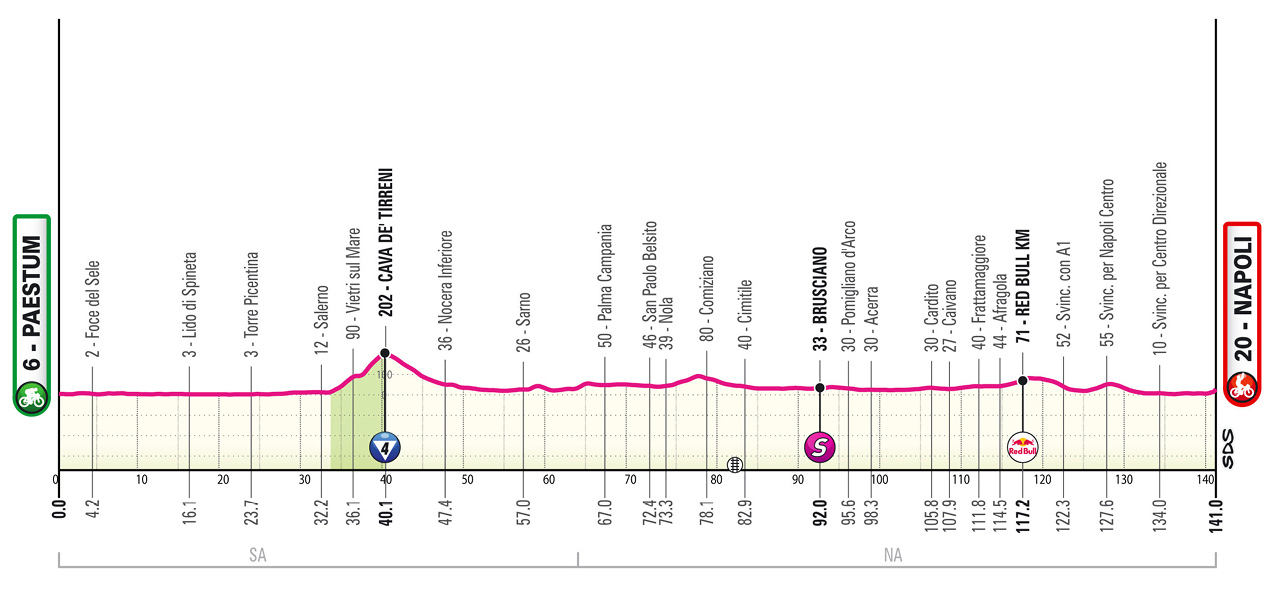
The Route: just 141km and a spin along the coast on big roads before the easy ascension through Cava de Tirreni. Today’s route sticks to the flattest roads possible rather taking any coastal cliff roads or tackling the slopes of Mount Vesuvius.
The Finish: if the Giro returns to Napoli and finishes by the sea, this is in a different place with a new route. It’s big streets through the city and then runs alongside the docks with 4km to go.
In the final kilometre there’s a tight left turn onto cobbles and the road begins to climb to a 180° corner (or two right-hand corners as there’s a small space in between) and then 400m of finishing straight to the line, all still climbing on cobbles. These are urban pavé but old, the kind where passing traffic noisily slaps the stones and they can be very tricky in the wet. Right at the finish the cobbles switch to large flagstones.
The Contenders: three sprinters lead the picks. Paul Magnier (Soudal-Quickstep) comes first because he’s won twice already and is agile for this uphill finish and the cobbles but with some risks too, he’s not the most delicate of bike handlers and besides two wins already is plenty.
Jonathan Milan (Lidl-Trek) has been close and today is a good chance. The uphill finish is within his range but we’ll see if the leadout changes, perhaps using big Max Walscheid up before little Simone Consonni takes over on the climb?
Tobias Lund (Decathlon-CMA CGM) is the third pick. Out of the picture in Sofia he had punctured on the run into town and lost energy in the late chase.
Dylan Groenewegen (Unibet Rose Rockets) gets a mention too, the slow turn and the uphill run to the line suits him less, but the penalty is moderate rather than severe.
It’s hard to get beyond these four. Others can win but all their chances seem reduced. Madhis Mihkels (EF) for example has done well but can he get ahead of the big names cited already in a straight sprint? Likewise for all but Ethan Vernon (NSN) is good at seated sprints and this could pay on the cobbled road.
 |
Magnier, Milan, Lund |
 |
Groenewegen |
 |
Vernon |
Weather: up to 21°C and sunshine but some heavy clouds rolling over the race at times which can unleash brief downpours.
TV: KM0 is at 2.05pm the finish is forecast for 5.15pm CEST. Tune in for the sprint finish.
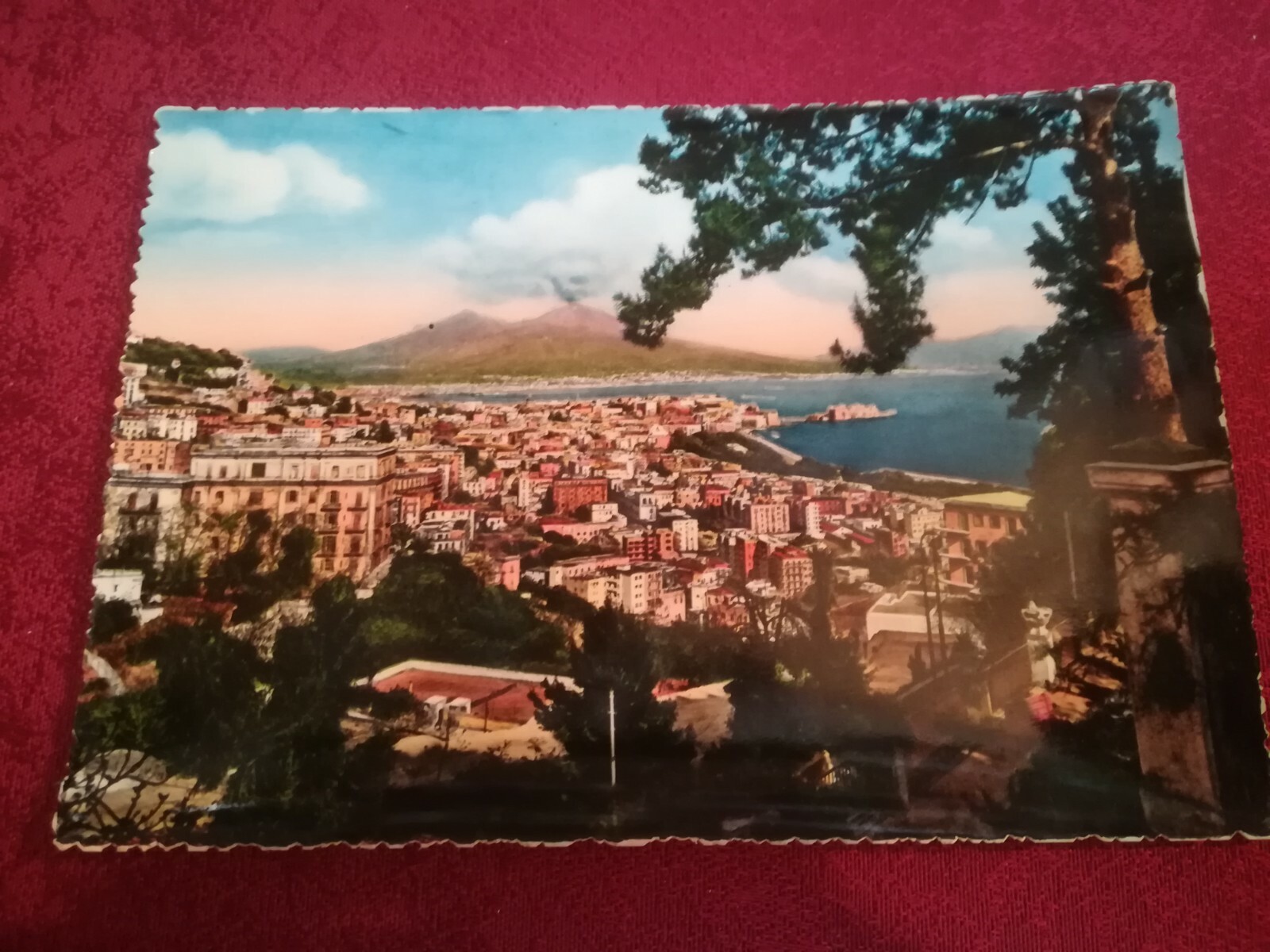
Postcard from Napoli
Carmine Castellano died in March at the age of 89 in his home town of Sorrento, a spin down the coast from Napoli. He was the Giro’s race director from 1993 to 2003.
There’s a blog post to do on race organising being a thankless task. If you do a great job and everything goes without a hitch, everyone congratulates the winner. If there’s one problem with the route, even a stray dog, then the organiser must be to blame. Nevertheless Castellano gave up being a lawyer working in the courts of Naples to run bike races.
After starting local races he was on the organising committee for the Giro stage from Potenza to Sorrento in 1974. The race had a central command in Milan and delegated on-the-ground organisation to local committees for each stage; the Tour de Romandie does this today. Castellano became the Giro’s man in the south. In the mid-80’s he moved to Milan to take on more work and by 1989 he ran the whole Giro, notionally alongside Vincenzo Torriani but as de facto organiser.
In 1993 Castellano took over formally as the race director. He was a pioneer in the literal sense, opening up new routes for the Giro. The Mortirolo and Zoncolan were both Castellano innovations, he was modest enough to attribute their discovery to locals but visionary to include them. The choice suited the race as they offered spectacle and notoriety without high altitude and so less risky for a visit in May. One high peak the Giro did visit to was the Colle delle Finestre in 2005, the first visit of a grand tour to a gravel road for a long time.
If the Giro had a golden age with Fausto Coppi and Gino Bartali, it enjoyed a boom under Castellano thanks to Marco Pantani and the flourishing Italian cycling scene. In 1997 the Giro resembled the Italian stage race championships with 131 Italians out of 180 starters. Only the bubble burst and Pantani’s ejection from the 1999 Giro after failing a blood test played a large part in this. Ejecting Pantani from the race must have been Castellano’s most difficult moment but he said “respect for the rules comes before everything else”. He was a lawyer after all.
It feels as though this race hasn’t even started, and yet we have been witness to fresh stories.
+1. Regrets to falls and trauma but I predict we have a race.
Vinny’s got a bit more work to do now than he would have liked given that he needs to conserve energy for the Tour.
Is Eulalio any good in time trials?
Is his own word, “no”.
Eulálio’s got a terrible record in TTs, of course greatly down to absolute lack of preparation or practice – to be seen if he can improve. Surely not in a couple of days.
Remember that he was racing on continental teams until 2024 included, mainly on an autarchic portuguese calendar. I doubt he ever raced a TT longer than 30 kms, let alone a serious one like the 40-some at this Giro. What’s certain, he never showed a natural propension or interest for the discipline.
By the way, he crashed hard his hand against the guardrail, hope nothing’s broken or with a strong inflammation.
Crazy reading about riders not having ridden TTs. In the UK alot of the grass roots are built on time trialing. It makes sense but it’s such an alien concept to me
Until a few years ago, Italy and Spain were also a bit the same as Portugal, many riders grew up until juniores included in very small local teams without the appropriate economic resources to work on ITTs – but they had a number of other advantages, of course. Gualdi is a current example of that sort of experience, now under huge pressure by the big Devo Teams.
In Italy the TT discipline was revived by Davide Cassani, whom many might remember as a TV pundit on RAI (I think he’s now back?), as he further promoted (between other initiatives) a series of ITT juvenile competitions known as “Bracciale del Cronoman” during his time as the Head Coach and Technical Manager of the National Federation.
Cassani also promoted track activity which is also good to develop TTers (and sprinters).
That sort of initiatives, one of which first results (or rather a forerunner) was Adriano Malori, then brought up the likes of Ganna and Affini but also other athletes who deploy those skills in regular road races rather in ITTs (or mainly so) like Sobrero or Milesi we named these days, or Cattaneo…
Unfortunately, I have a feeling that we’re living the last part of a wave which was left to its own decline some 4-5 years ago – the worst effects will be evident in years to come rather than right now. Going back to that periods when only a specific personal interest by the athlete lead potential talent to be more or less developed, as in Pinotti’s case. Many others were just talented “passisti” or even “passisti scalatori” whose talent was never refined through much more specific TT training, think Cataldo, Moscon, Moser, even Quinziato in a sense.
Spain is in a similar situation to Italy in its worst years, i.e., Castroviejo likes the discipline and is supported by his commercial team, so he gets some results, but the rest of the national scene were just riders with good wattage riding an ITT bike… same Luisle Sánchez a few years before.
As Spain often has had GT contenders, they must work on their TT skills, of course, think Contador, but it’s a process they must go through on their own or thanks to their commercial team, often well ahead in their careers. Ayuso and C. Rodríguez were partial exceptions in this sense – “partial” as in “they started sooner than usual”, but it was the same dynamics.
In the country of Indurain and Olano, but also Mauri, González de Galdeano, Casero, José Iván Gutiérrez…
This looks like an uncessesary bland stage to me. The area in and around Napoli has to offer a lot more than that. But we’ll see.
After yesterday I think the riders deserve a bowl of oatmeal.
As ever “stuff” happens at the Giro and if today’s stage is on the boring side then that is going to be good for everyone. Still rather bemused as to what some of the teams were up to yesterday though to be fair the conditions were horrendous at times and just keeping riding was enough without working out race tactics. If conditions are wet for the finish today I guess there is a fair chance the race will be neutralised (seem to remember this happened a couple of years back at a town on the Adriatic?). There has been some comments from the teams that yesterday could have long term effects on the race, getting cold & wet makes the riders more susceptible to colds & bugs plus riding on wet roads means it is more likely the riders might ingest bacteria.
It’s worth looking in on Geraint Thomas and Luke Rowe’s Youtube thing for some inside thoughts from the teams, though not sure its a good idea to have a Sport Director and DS from rival teams discussing their own and other riders quite so openly.
Rowe isn’t on Giro. Thomas isn’t in the cars. Guess it’s sort of Okey?
Would be funny come July.
Would be funny if Luke was sent to entice Seixas to NetCompany-Ineos.
“Would be funny if Luke was sent to entice Seixas to NetCompany-Ineos.”
Even funnier if he succeeded, seeing as Rowe is a DS with a different team entirely!*
* Decathlon CMA CGM
Sleeper cell?
Exactly. And convince your enemies to work for you (developing sources or instigating a defection) is actually what spies do 😅😅😅.
Rowe is on the same team as Seixas right? (ie. Decathlon)
Rowe becomes friends with Paul, convince him to join Ineos. Once job is done, he will return to Ineos as lead DS or whatever.
😅😅🤣🤣
Worth remembering once more that the last official conclusion (an indepth inquiry by the parliamentary investigation committee on organised crime) on that blood test was that it was manipulated by one of the UCI medical officials for motives which can only be conjectured and later on part of the Italian institutions, both within police and in courts, actively covered up that “irregularity” (to use an euphemism), that is, that the result of the test was altered.
Of course, no need to say that Pantani was actually blood doping as virtually everybody else or nearly so in commercial pro sports back then, from football to tennis to NBA etc. But the rules are the rules. Or not?
No need to say, either, that in Castellano’s position he had no other choice but ejecting the rider from the race.
Different choices could have surfaced in the following weeks by journalists or the cycling world, but obviously the sort of pressures which can lead a policeman to lie or a judge to modify data in a document are in action throughout the whole society. No doubt, either, than within cycling many were aware of was going to happen and just felt it was a good idea!
The last 10k into Potenza couldn’t have been better scripted by Hollywood. The Italian commentators thought the rain after a dry spell had made the more-trafficked roads in Potenza very slippery with rubber, oil and petrol residues — hence the issues on the final downhill section, where Arrieta repeatedly lost his back wheel before exiting the course momentarily. They also had some doubt about whether he took the wrong road by accident, or on purpose once he realised his line was wrong. Lucky there was just tape there, not a crowd barrier or a policeman with a flag…and that the tape didn’t get into his inring!
Eulalio’s bike mix-up comedy suggested he was more injured in his fall than Arrieta was. A highlights reel for the ages
Totally agreed on the above. I think that in Eulalio’s case one could even notice some sort of greasy foam.
However, on Spanish TV, Flecha, who knows a thing or two about frame design, also blamed the bikes, in that what would have otherwise been a small slip of the wheel now not only brings to a greater reaction of the bike but it’s also harder to correct (an example which ended well was what happened to Arrieta very soon *after* the wrong turn).
Lack of lucidity didn’t help the athletes, and these frames rarely forgive any loss of concentration.
It’s impossible to not get awfully curious and ask what exactly is it, according to Flecha, about the frame design of the bikes the pros ride these days, that make them behave like that?
I can’t imagine it’s the stiffness, I’d guess it must be some aspect of the geometry. Fork angle? Rake?
In Arrieta’s specific case, what Flecha detailed was a comparison between the Colnago V5Rs and Y1Rs, with the latter “shorter” and “way more compact” with less wheelbase, rake and trail (if I recall correctly). He defended that for example he believed that on the Women Vuelta Blasi had opportunely opted for one of the two different models according to stage and weather.
He generalised about many “top” bikes (for the pros) from the last 5 to 10 years – period depending on brands – having left aside handling to priorise aero, which makes sense at those speed but it’s got some obvious downsides, especially in some circumstances.
Not yesterday but on previous occasions I think I remember him commenting about recent bikes (not specific) keeping very well a line, especially a straight one but not necessarily so, but reacting poorly, i.e., too briskly, to lateral micro-corrections.
Plus some sort of “sometimes you see how people can fall on one side even with the bunch going pretty straight”.
Disclaimer: as you can imagine this kind of debate is normally on during less interesting parts of a stage (yesterday being an exception), so I’m typically listening on the background while doing something else, so sorry if I reported incorrectly.
There was some talk of UAE using TT tyres. Does anyone know if that was true? Presumably faster but less traction?
SBS commentary was talking about this. Apparently UAE usually do, but the commentators didn’t imagine they would have yesterday. However ..
Just a quick side note: does anyone know if SBS has begun tracking VPN usage, with the intention of blocking it in a BBC-style manner? I’ve used SBS via VPN from Germany and Austria, but there are rumors that they’re required to restrict access from outside the country.
I’m afraid they read inrng.
LOL. Valid point… 😉
Several teams do this as there can be real savings in watts and weight too but they wear out faster too. When fresh they’re supposed to offer normal grip but the problem is how they are after 200km after a day with hard braking, debris and so on.
One has to wonder sometimes on how the finishes are designed. At least it might not rain.
Who will rise to the occasion on Ascension Day? A tricky finale so I’ll pick Magnier to follow the Trek train, who’ve been misfiring recently, and get another win.
I’ve read locals commenting that it’s actually the only option to get to Piazza del Plebiscito, which was strongly asked for by the municipality. Even in that case, why not trying a more selective final circuit although with no pressure on maglia rosa? Or a hilly start to give leeway to a break *and* a moderately selective final circuit to prevent sprinters from being motivated to chase? Naples offers plenty of possibilities for those course designs and more.
I quite liked the Napoli stages in 22 & 23. This one seems a bit unimaginative, as written above.
Totally so, 2022 was memorable, to me one of the best GT stages in recent years, and without implying any excessive effort for GC men.
It’s a pretty great sprint group in this Giro, which is in part due to the opportunities for fairly straightforward sprints. Ten years ago I would have lamented flat boring stages; now I look forward to stages that allow sprint trains to set up for the big boys.
I’m also happy with some variety in “sprint” stages, including pan flat ones, and an easy stage between Potenza and Blockhaus is perfectly placed. The doubts concern the combo of a very technical finish and a stage which many will go for with no previous selection to have a 40-50 units sprint, or any energy sapping.
Mix of different necessities, of course, municipality included. I just hope that being the situation so clear, the athletes will behave accordingly. I’d have tried to have a bit more selection here and maybe an easier “pure sprinters” stage next Thursday or Friday, while making the other one of that pair a bit harder.
Fair enough. Many of these sprinters can get over a couple of hills too, so it would be ok to have some selection without destroying the opportunity to have a real sprint.
I’m not sure how wise it is to have a cobbled U-turn a few hundred metres from the finish of a sprint stage. It’s the same for everyone but feels a bit demolition derby.
Everyone was warning it would happen, and it came to pass.
I’m afraid they *don’t* read inrng.
Perhaps they do in Chiavari, where the finish was changed after the descent featured here as being too wild 😉
Yeah, it was tongue-in-cheek with reference to mine above at 1:45 pm 😉