
Years ago “revenue sharing” was all the rage with team managers making public calls for the major race organisers to pay them money. Only even if a race owner felt inclined, when you looked at the data the sums available were small.
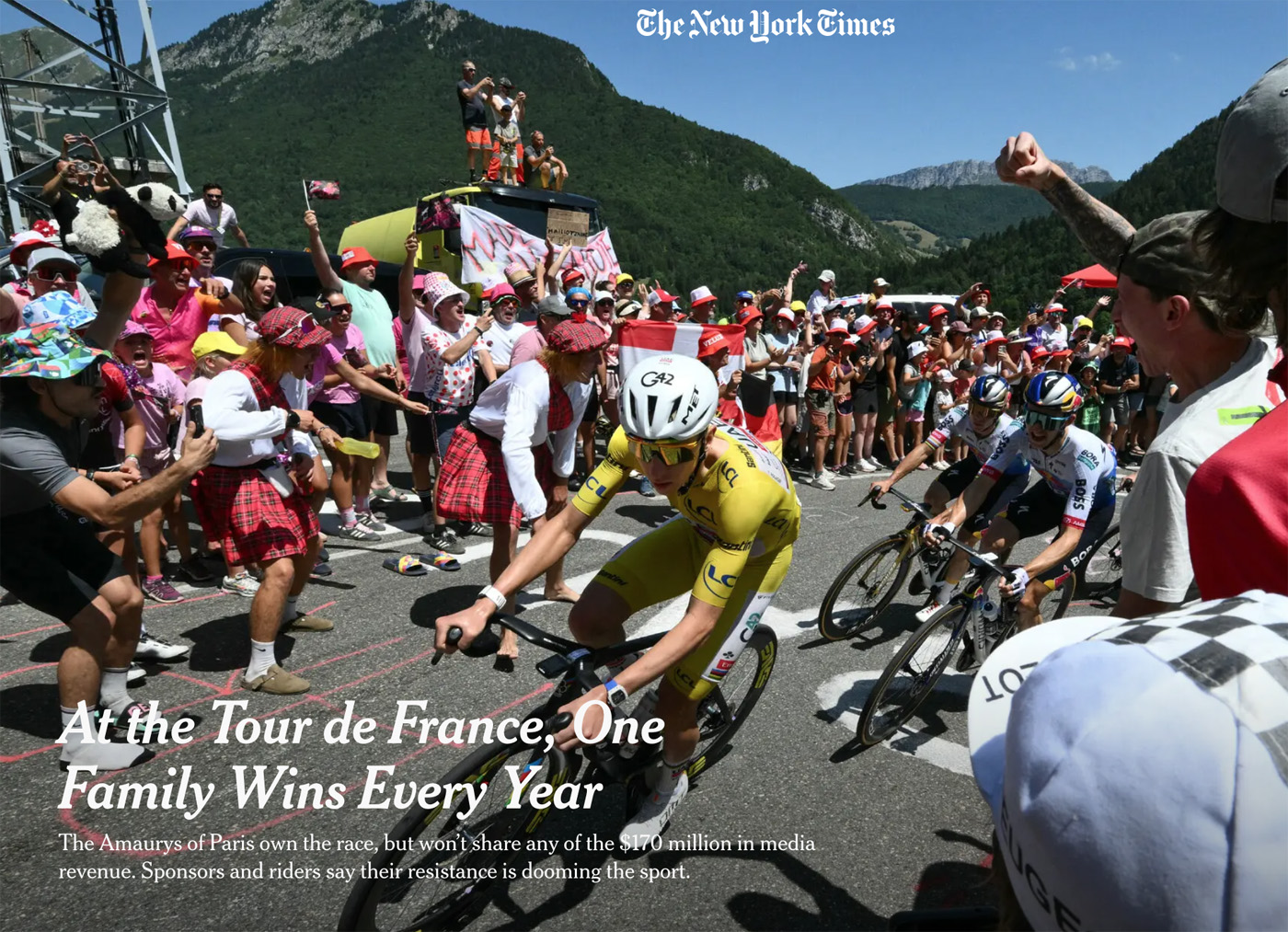
Today the calls remain but the sums have changed so time to look again with updated numbers. Especially as it’s been floated by no less than the New York Times, as the screengrab above shows.
The premise of the NYT article (paywall) is that the Amaury family that owns Amaury Sport Organisation (ASO) is “thoroughly resistant to change”, mentioning the FIFA World Cup which “is expected to pull in $13 billion, double the sum of 2022’s tournament. It started with more teams and matches; interrupting games with “hydration breaks” that increased the number of television commercials; and enacting “dynamic pricing,” which sent ticket prices soaring” and the suggestion the Tour de France and pro cycling should embrace similar practices
The article also says “The family doesn’t share any of the television rights revenue, reportedly worth more than $170 million a year. That starves the sport of capital that could expand the fan base and leaves cycling in a precarious spot.”

The $170 million comes with a hyperlink to sportspro.com which in turn links to bfmtv.com which uses a €150 million number (roughly $170 million). Only BFM itself says this is an informed estimate, and crucially this is total revenue, as in TV income and hosting fees, the publicity caravan, merchandising and more and cites a number of €150-200m. It’s not the TV rights, but we’re not here to fact check the NYT.
Still let’s take the $170 million. Let’s also assume ASO has no costs, ie no offices, no staff, no suppliers, no tax, and hotels give away rooms in July so that $170 million of revenue is still there, untouched. Now compound that wrong assumption by another where ASO pays out half of this money to teams, a pot of $85 million. Divided between 23 participating teams that’s $3.7 million per team. Nice but it doesn’t get teams out of the “precarious spot”.
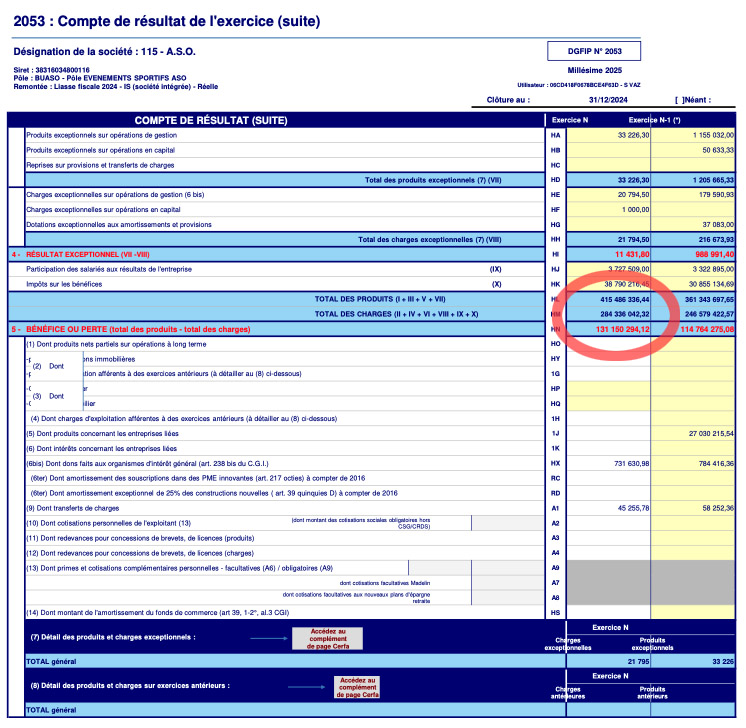
Rather than use fourth-hand estimates, ASO does publish annual accounts. 2024, the latest available, show total revenue of €415 million, costs of €284 million and a profit of €131 million, you can see this highlighted in the screengrab above from the accounts filed with the French government.
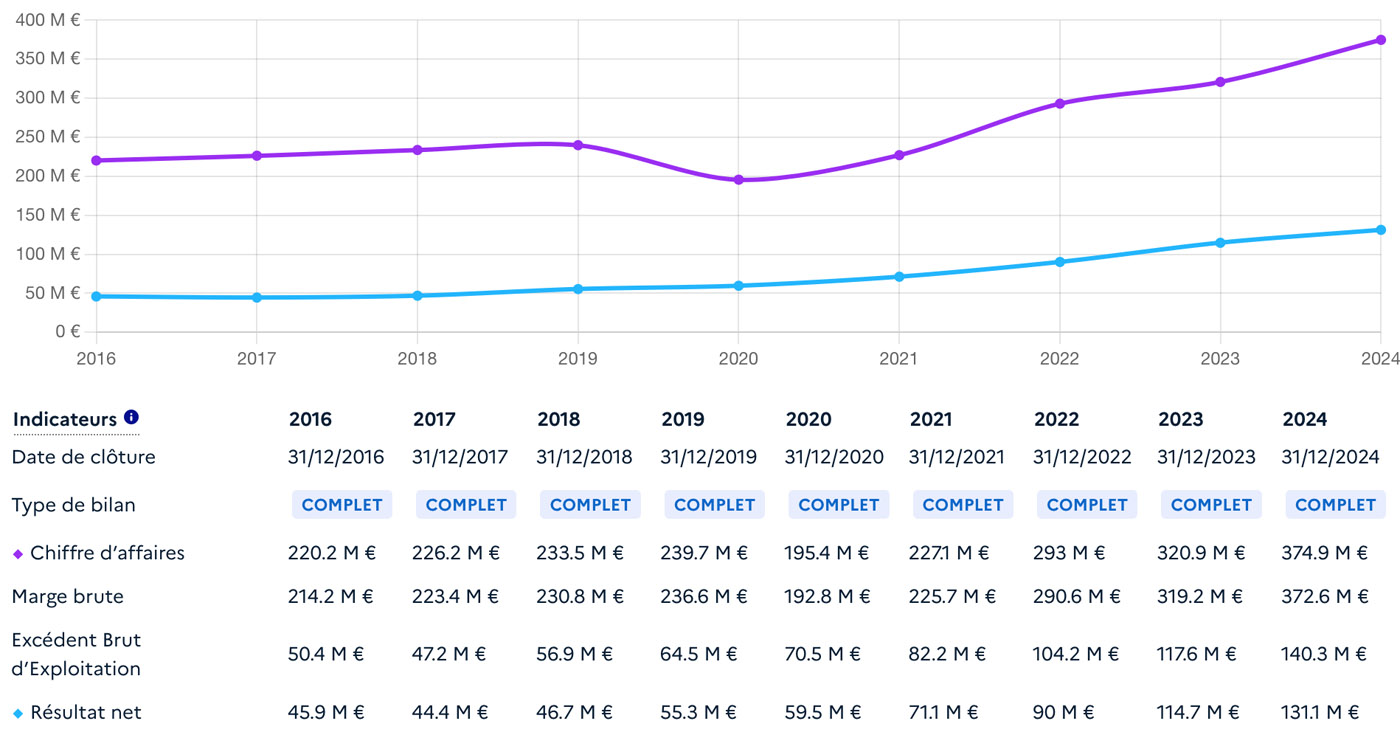
The government page also helpfully lists the numbers over the years and even plots them in a chart. You can see above how revenue and profits have been growing chez ASO. (For any sticklers, one image has gross revenue of €415m, the other uses net revenue of €375m).
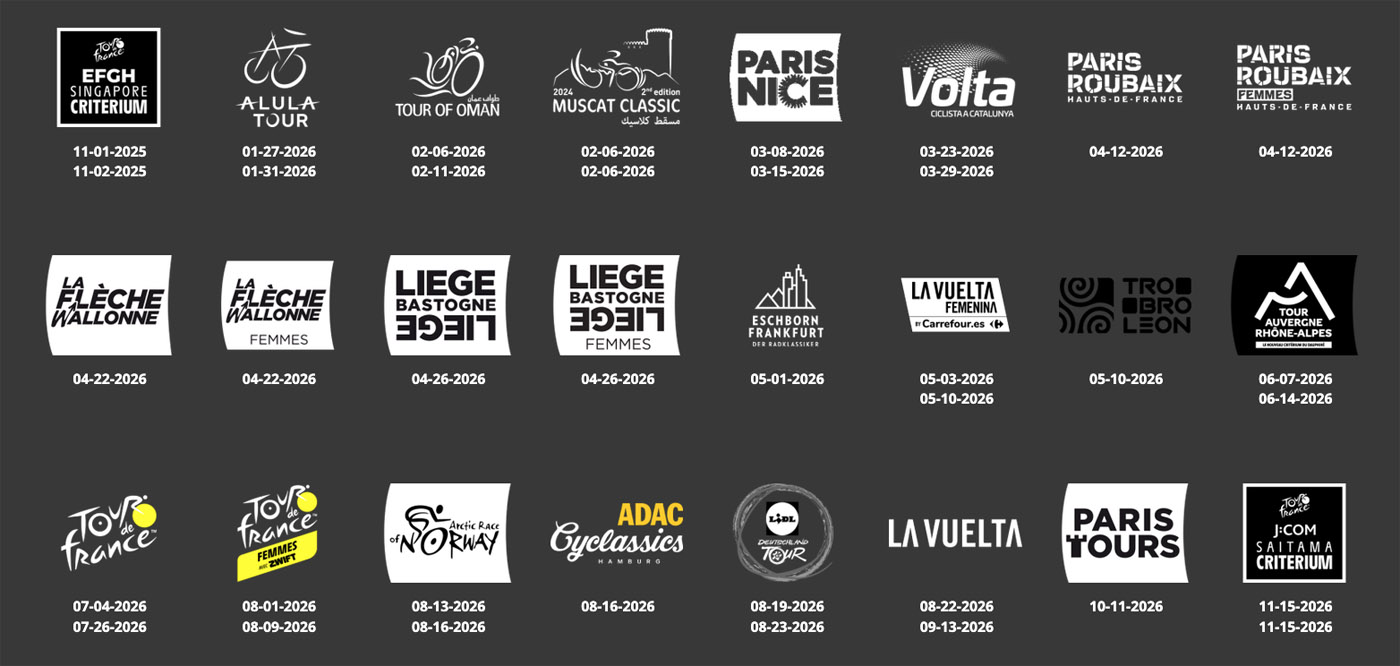
ASO is famous as the Tour de France organiser but promotes other cycling races, you can see the portfolio in the screengrab from the Tour de France website. It also does the Dakar motorsport rally, the Paris marathon, the Etape du Tour ride and more. It was also the organiser for some of the Paris Olympics, handling the cycling, triathlon and open water swimming events, apparently the first time a private company was brought into run part of the games.
Let’s make some more wrong assumptions. Assume the €130 million annual profits all come from the men’s Tour de France. Now imagine half of these profits are paid to 23 teams and it’s €2.8 million per team. Nice again, but even less game-changing and we’re still relying on wild assumptions.
We might as well go full reductio ad absurdum and assume all of ASO’s profits must be paid out to men’s cycling teams: they’d get €5.7 million each.
The average World Tour for 2026 is €33.1 million ($38.7m). So €5.7 million is 17% of the average team budget which could help, but it still doesn’t change the brittle model where teams rely on funding from title sponsors.
If Movistar, Cofidis or EF decided to halt sponsorship today and the structures could not find a replacement in time, €5.7 million would not keep a team afloat it, it doesn’t make the sponsorship model less precarious. Above all, remember to use this amount we’ve used wild assumptions.
If you’re bogged down in numbers by now, let’s step back as the concept sounds bold. Teams owned by nation states, billionaires and multinational corporates want money from company that turns over €415 million? It sounds like reverse redistribution.
The Tour organisers could equally turn around and ask teams for money instead, why not charge a start fee knowing that teams depend on participation, and the money could be re-invested in added safety? Or indeed point out that teams make money because of the Tour de France, if the race did not exist or their teams could not ride then team managers would have smaller budgets to reflect the reduced audience. Audacious? Yes but it’s more rational than assuming all of ASO’s profits come from the Tour, that all of this should be donated to the teams and it would make a meaningful difference.

Conclusion
Revenue sharing is one of those zombie arguments that won’t die. Whether an American newspaper or a social media post, there’s an enduring the sense that ASO should share profits, but often with little follow-up on the actual numbers or distribution because the moment you go from “ok” to “how much?” is when you can see it’s not as obvious as it sounds. Even if ASO decided to donate all its profits to men’s pro cycling teams it wouldn’t alter their brittle sponsorship model.
What’s probably behind the sentiment is the monopoly ASO has on the sport, the way the Tour de France is the dominant event and how this matters for sponsorship but also for control over the sport. It’s less the money, more the position.
I’m posting a link to this excellent takedown on the comments section of the article on nyt. If someone else hasn’t already done it.
And if anyone still wants to read the original after this solid demolition, here it is:
https://www.nytimes.com/2026/07/24/business/tour-de-france-amaury-aso.html?unlocked_article_code=1.11A.EyKH.cMhvGr872m6o&smid=nytcore-ios-share
I’d rather not.
I think ‘takedown’ is a little bit of a social media/permanently online phrase Emil.
@INRNG is informed and well researched but would be the first to admit other opinions are allowed and discussion is more fruitful than argument culture – things can change so none of this is set in stone, even if cycling’s chaotic overall structure seems to have glacial rates evolution rather than nimble development.
A nice post. I think the Tour used to charge the teams a participation fee, at least in the 1970s. I don’t know when they stopped.
PS. Would the teams be happy to share costs as well as revenue. Should they pay for the road closures for each race?
I think I read about a fee in the 1980s still. It wasn’t big, a four figure sum back then perhaps? Makes you think if they did charge a fee today how big it could be, racing the Tour is essential for many teams these days.
£37000 in 1987. ANC boss Tony Capper famously struggled to pay it.
https://www.cyclingweekly.com/news/latest-news/anc-halfords-who-was-tony-capper-87739
You also need to think about the behaviour of those teams if they got the hypothetical $5.7m each. They’re not going to pocket it for a rainy day because the incentive is to spend it to increase the chances of winning. And that probably means going after better riders in the main. All of which leads to salaries for top riders going up with little benefit to team security or the wages of the average rider in the peloton.
Yes, in one of the previous versions of this blog post that was a point made then, money poured in the top goes straight back out as it’s rational for teams to bid for talent. The budget cap (not salary cap) is something that is being explored by teams and the UCI alike at the moment.
Why won’t the idea die? Your explanation is simple and it’s easy to grasp why revenue sharing is an illusion. Team managers aren’t stupid, so why cling to this? Are they just looking for a stick to beat ASO with or an excuse for their own failings?
It’s an odd one, team managers were vocal about revenue sharing but went off the idea when they saw the sums, at least one from reading about it here. So odd to see it aired especially as the NYT article feels like it’s written up from the perspective of a team manager keen to reform the sport
In 1987 the TdFbentry fee was £25000 according to Jeff Connor in the book Wide Eyed & Legless.
In 1984 the average team budget was about £500,000, I think (I could well be mistaken, maybe someone else knows more). This suggests the fee was rather substantial compared to the team’s budget.
Did the entry fee come to an end when the (for-runner of the) world tour started and it became compulsory to enter all WT races if a WT-team?
Good info, thanks both.
One can make an argument for revenue sharing even if the amounts would not be a huge percentage of team budgets. But I’m not sure why a capitalist would want to give away (“donate,” I think you wrote) capital. My main issue with revenue sharing is that it is a form of dependency. Why can’t teams figure out a way to be more capitalistic, to own more stuff so they can actually generate their own revenue rather than beg for sponsorship money or revenue sharing?
I think the teams have been trying this, eg courting Saudi money for the One Cycling project. But it’s a delicate position, the NYT piece salutes FIFA’s efforts to add more ad breaks to football matches, charge more for tickets etc but there’s not much ability to do this in pro cycling, a lot of the domain is in a mixed private-public sphere, eg ASO own the race but require public roads, ASO sell the rights but it in France and several other countries in Europe, ie a lot of their prime market, it can only go to free-to-air broadcasters rather than the highest bidder etc. But you could do with with a race in Saudi etc.
Thank you, Inner Ring. Just curious but how did ASO manage to own TV broadcast rights? Just looking at the three major US sports, NFL, NBA, and MLB, a bunch of different media companies own TV rights.
Actually, the organiser of the competition (NFL, NBA, MLB) own the TV rights and sell these broadcasting rights to a media company. [Few sports take the commercial risk to broadcast themselves]. ASO organise the Tour de France and sell the broadcasting rights. They were given the rights to organise the race post-1945 by the then government after the previous organisers were removed over their role in the Vichy regime (ASO were split from Equipe later).
As Inner-Ring said, ASO have a delicate balance to strike with the owners of the road on which they race. The French government (and local government) both own the roads and provide a lot of support to the race. They expect something back. In particular, they want the race on free-to-air television (as far as possible) and they want to maximise viewers rather than revenue. They regard the race is an advert for France (hence the shots of all the towns and buildings they pass). Maximising viewers also maximizes the value of team sponsorship.
The French government also keep a sharp eye on what money ASO make from the Tour. ASO are also expected to be “good citizens” and support the french race scene more generally (as well as other historic races). These discussion is why ASO spend most of their time discussing the race with government rather than the teams.
@John. Now I get it! Thank you so much for explaining this. So would you say that most of the financial issues for teams is that they don’t own private stadiums? Thank you.
Yes, the fact teams don’t own the stadiums, and can’t charge the spectators, is part of the problem.
But we should also understand that the teams are more stable now than they have ever been, and have the largest budgets they have ever had. Professional cyclists now have multi-year contracts and high wages. Forty years ago, they mostly had much shorter contracts and were not much more than what a factory worker earned. The teams are in a much healthier state than some people pretend.
Albert:
Another difference is that with the NFL, MLB, English Premier League etc. the competition is (normally) owned and run by the teams participating in the competition. Whatever money the competition makes is shared between the teams. In cycling, the teams do not own and run the races. Instead they entirely rely on sponsors willing to pay to appear on the shirt.
ASO own and run most of the races in France, particularly the Tour (which is greatly resented by many teams and fans). The Tour generates most of the income in cycling; the teams revenue depends on the Tour since this is where fans see the name of the sponsors on their shirt (few people watch other races). Inner-Ring is hinting that the argument about revenue sharing is really an argument by the teams that they should have greater control over the race.
NB – ASO no longer organizing the Paris Marathon after several decades of running a successful event. I’m not aware of the backstory for the change but the new consortium is slow on the uptake as the date / route / registration has yet to be announced for 2027.
No word either on revenue sharing for runners 😉
Thanks, noted and was looking backwards at the accounts. Apparently it’s the biggest marathon in the world when measured by finishers.
Yes, the allure of running along Paris’ famous boulevards and monuments in the spring is ‘incontournable’ for any marathon runner, despite it not being among the “7 majors”. It is indeed the largest by participation for now – London is moving to a 2 day event, so will surpass – tale of 2 cities, redux!
It’s clearly too easy then. The ideal marathon course would be one with only 1 finisher, no?
That’s basically how the ‘backyard ultra’ (or frontyard ultra for events in cities) works. Every runner starts a lap of a 6.71km cross-country course every hour (24 hours = 100 miles), until they either retire or get timed out by not completing a lap within an hour.
Retired international cricket player Johan Botha attracted a lot of attention in Australia when he set a national record of 59 laps / 395km in Adelaide … the week after winning a coaching position on the basis of building the players’ toughness and discipline.
In fairness to NYT, it has only seriously covered cycing for two or so years. Some of its reporting (mainly in its sister publication The Athletic) has been excellent. The particular piece at issue here isn’t necessarily representative. It struck me as being overly influenced by Jonathan Vaughters, who is quoted in the piece. Still, the Amaury family, their relationship to the Tour, and the financial problems of pro cycling are legitimate newsworthy topics for NYT’s general interest readers – most of whom are not cognoscenti lucky enough to have the benefit of Mr. Inrng’s insights!
I agree that the NYTimes piece relied on Vaughters too much. But the NYTimes has covered the Tour de France for decades, including many years by Sam Abt — who’s writing on the topic is some of the best I’ve ever read.
Sam Abt was amazing – my intro to the sport before the days of cable streaming and VPNs or any regular coverage in the US market. But it’s a legit point about the NYT – they don’t actually have a sports department. All of those writers were terminated and then rehired as “independent contractors” for The Athletic. IMO much of their recent cycling coverage has been quite good, but this piece about ASO was written under the NYT byline and not by the cycling journalist from The Athletic. Thus it seems to lack some of the background knowledge and insight kindly provided by our host.
Vaughters is another reason not to read it (other than it’s clearly a load of tosh).
It may be irrational but I really don’t like the guy.
I don’t like the guy either. He’s a hypocrite and shouldn’t be in the sport.
Obvs we agree on many things @KevinR but this is one point of difference, I have never got the dislike of Vaughters similar to anger Adam Hansen generates – not that I agree with everything either say but I do still think we need a wide pool of voices in the sport even if we disagree, and as far as I can see Vaughters has run a relatively successful team with roots in a country that most of us would like to see fall further in love with the sport, so if he’s one of few figureheads there that’s fine by me.
Is it opinions like this that annoy most about him, or is the a sense he’s a know-it-all, or maybe simply the doping history? This isn’t me trying to be annoying, it’s just the dislike of Vaughters comes up regularly and I’ve never fully understood what annoys people the most? Maybe it’s the sideburns?
As for shouldn’t be in the sport, I do disagree on this @Bubble Wrap, you may dislike and be angry for his role in doping, but surely the team Vaughters created and brought to the TDF from 2008 onwards was a breath of fresh air then (despite whatever hypocrisies and bumps in the road they’ve had) and continues to be a fun addition to peloton?
I love many of their past and present riders, plus the recent Palace giro collaboration jersey’s they made and the alien jerseys from this year, also following their off road journey has been interesting too, so I can’t really see them as anything other than a likeable group who it’s nice to see win every so often? He isn’t his team, but he’s a large part of it and the calendar would be poorer were they not around.
I guess I’m also just in awe of anyone who starts a team from scratch and fights for twenty years to keep it afloat, I’d forgive a lot because I respect that kind of hardcore endeavour highly.
Vaughters said of that team that if anyone ever doped on it then he personally would leave the sport. Someone did. He didn’t leave.
I can’t stand him or his team and want it out of the sport. I will cheer when he’s gone.
PS the fact he was a cheat, both on Armstrong’s team and not, is just the icing on the cake. Why does he get the free pass cos his team does funky jerseys?
I mean, if we were all held to the silliest thing we said I’m sure we’d all be in trouble? He’s probably got a mortgage and a family so it’s a bit much to expect him to walk away from a company he’s spent two decades building for someone else’s mistake?
But to me, fashion is more important than life, so the funky jerseys are enough!
oldDAVE, you’re awesome. For me your comments are one of the highlights of this wonderful blog.
I think one reason Vaughters rubs people the wrong way is that he has Aspergers syndrome. His blunt, unfiltered communication style can be grating, especially given that as an American he’s less wedded to the long, European traditions of the sport. Like you I admire what he’s accomplished, even if I often think he’s barking up the wrong tree.
I don’t care much about his past doping unless it’s defended by people who then became very selective in other cases. But that’s about them, not him.
I greatly appreciate his team and the way he manages it, jerseys included – I want him and his approach in the sport as long as possible.
Generally, I tend to like him as so many intelligent athletes who stayed in the sport, say the Basso-Contador couple or Vinokourov. Sometimes you feel they’re being a bit too smart, or trying to, but I can live with that.
It’s just that I find Vaughter’s opinions on the sport as a whole are terrible when matched with sheee facts, and not because they’re blunt, just because they look so biased and ill-informed that you suspect he’s deliberately manipulating.
I have to say, I don’t mind Vaughters. He says some interesting things and some absolute nonsense. I probably do the same. And, on the whole, his teams race in an entertaining way.
@KevinK thank you and ah okay, you made me realise I haven’t actually seen that many videos of him talking and maybe have read more of his words than directly heard them!
I’ll go and listen and see if they rub me up the wrong way!
Was nice to see Carapaz in finale of Sebastian today even if I missed it live, my liking of Carapaz has increased about ten fold this year.
@oldDAVE I don’t care for his views, his character, pretty much everything. And that’s not strictly tied to his doping past.
@KevinK Thanks for that point. I haven’t minded Vaughters from what I’ve heard from him, including when he’s done guest commentary for Eurosport, & have been rather puzzled as to why so many seem to dislike him so perhaps that’s because I’m autistic myself so his communication style works for me.
Every. Single. Fan. Of. Soccer/Football absolutely hates what Fifa did to the commercial side of this year’s WC. Universal loathing of the “commercial” breaks, the obscene ticket prices that priced out 99% of normal fans… to the point where Fifa’s blathering after oligarch dollars is increasingly embattled.
First, NYT should know better. Second, if ASO pulls a Fifa, then I can only imagine many a fan will flee / be priced out.
Yes, and it hasn’t ended well for them! The fallout from the ‘innovations’ (I believe the interval show in the final actually broke international rules by being too long) still rumbles on. And UEFA have threatened to withdraw completely…..
I’m not sure that’s an equivalent?
It’s also pretty difficult to compare sports because I wouldn’t say everything is rosy over here in cycle-dom even if we all scoff at the recent FIFA story: football fans for example do not have to deal with in sport/training deaths of athletes anywhere near the amount that we do in cycling, and you suspect (seeing how well they dealt with on field heart attacks in recent times) they might do more about it than we’ve seen from our governing bodies/owners.
Comparing FIFA and cycling is laughable. One of the things I enjoy about cycling is how amateurish it often feels compared to the sports that are fully corporatized. It’s one reason I’m on the fence about whether to try to “fix” cycling, even though there are things about it that I don’t like, like petrodollars completely distorting the sport.
OT, but allow me to say that it wasn’t until 2018 that the UCI mandated the requirement of a functioning email address for their commissaires. 2018!
I assume “OT” means off-topic, but I don’t think it’s off-topic at all. It’s emblematic of the way people in cycling think. That same mentality is very much reflected in the comments on this post.
+uhj
not exactly sure what The Other Craig means here – whether they shouldn’t now have emails or what?
I kind of find we all just deal in binaries too often – it’s either everything’s rubbish let’s start again or it’s all great let’s leave it.
I agree comparing ASO with the current FIFA situation is apples and pears so what’s really the point? In fact I don’t really see any kind of relevant comparison, plus we’ll all forget about Gianni with in a few weeks and it’ll be good riddance!
At the same time, cycling’s not perfect and we can’t really call football fully corporatised when cycling’s not exactly immune from sponsorship and the recent petrodollars that have flowed in are pretty distasteful.
I see all of this a pretty normal debate in any walk of life? In that things change constantly whether you like it or not and while it’s important not to lose focus on the stengths/problems of area of interest (cycling here) that doesn’t mean you can’t learn from or avoid the success/pitfalls of others.
There’s no real debate about how to ‘fix’ cycling, as it’s great already, but it’s always evolving so it’s fine to talk about how it might be better and it’s also fine if people want to talk something or nothing from the FIFA comparison.
OldDave – I was referring to the “it’s all great, let’s leave it” position that I see all the time in these comments. Maybe I’m being overly sensitive, but it often feels very Eurocentric, while at the same time ignoring how the current model relies on taking money from whatever source is offering. I actually love 80% of the current model, but I see a lot of negativity surrounding almost any suggestion of change, which seems to me to be tacitly endorsing the status quo, and in my mind the status quo is that it is nearly impossible for all but a few teams to be competitive in big races. This year’s Tour showed that starkly. And when so many pour derision on the director of one of the few smaller teams still staying competitive…grumble, grumble, grumble…sorry if I sounded too snarky, but this topic often brings out a lot of veiled animosity that gets my hackles up.
Other Craid writes: “it is nearly impossible for all but a few teams to be competitive”
My view is that there are a small number of riders (not teams) which are dominating the races. It doesn’t matter how they are distributed between the teams, these same riders will still be dominating the races. The only way to stop this is to have artificial handicaps which takes-away from the sporting contest.
As other users have said above, it is the norm for GC in the Tour to not be much of a contest. We have actually been lucky that 2020-2022-2023-2024 were contests. (I included 2024 since the majority of people thought Vingegaard would win going into the third week in 2024).
Hi John, not trying to argue, just to clarify: I’m referring more to the number of teams in the mix for stage wins/jerseys. Totally agree about the gc. Pogi would win on Picnic.
Other Craig:
Maybe we have different views about this (which is fine). But smaller budget teams can make their money go much further by ignoring the GC. For example, Alpecin won three stages, EF Education won two stages and the Mountains Jersey, Quickstep won three stages. This is possible on a 20-25 million budget; the three teams I mentioned are not among the rich teams. And teams like Ineos spend their money badly and achieve nothing much despite a much bigger budget.
I also believe (a key point) is that the money largely follows the “big name” riders. The entire reason that UAE have a big budget is because they discovered Pogacar: without him they were a mid-budget team. If Pogacar had been at Picnic then that team would have a huge budget now. We can see this happening with Decathlon: now they have Seixas the money taps have opened. This believe about how teams end up with lots of money dramatically challenges the narrative about what remedy is needed.
Thanks @The Other Craig – no your tone wasn’t too snarky, I genuinely could not quite tell which way you were going!
Now I get it and yes I’m with you.
I very much agree that any kind of change often gets quickly shot down here so +1.
Am just about to read your debate below with @John – enjoy John’s contributions here so looking forward to which way this one goes!
Thank you for an updated installment of this analysis. The original echoes in my head every time the ASO revenue sharing notion gets put forth. Maybe some team managers and pundits haven’t crunched the numbers — if so this article is all they need. But surely many/most are aware there’s no sport-altering size pie to slice up, even if ASO gave what they have away. So it’s puzzled me why the idea persists, and the last line finally makes sense of it:
“It’s less the money, more the position.”
Bravo for this piece.
For those without a subscription to the NYT, you’ll be happy to know that all of the most liked comments are basically saying “good for the Amaury family, they should keep it that way.” I’m not sure I agree with that sentiment 100%, but there is certainly a strong desire to keep the American sport/big-money football model out of cycling.
There’s another level to this as well.
The French government has a legitimate argument that it is the ultimate owner of the Tour de France, following the processes of the 1940s when L’Auto was closed and its property seized. The licence to run the Tour de France was put out to a bidding process, won by L’Équipe which in turn sought funding to run it from Émilion Amaury.
If the racing teams demand a share of the net revenue from the ASO’s cycling events portfolio (which may not even be half of the company’s net revenue – the Dakar Rally side of things is absolutely massive in monetary terms) then the French government might conclude they have the right to
1) tell them to get in line behind the government
2) demand teams buy in rather than getting a stake for free, with the buy in to be split between ASO and the government.
3) set terms under which any team might be ineligible to participate, forfeit its share, have payments suspended or require re-buying in. JV MBA might find that his team is ineligible due to its doping record, or have to resign from his involvement due to his own doping history.
A better way might be for cycling to introduce a voluntary spending/salary cap* and for race organisers such as ASO to restrict prizemoney access to teams complying with the voluntary cap. There could even be separate GC titles for capped/uncapped teams.
* WorldTour cycling being an international sport largely contested in the EU would make a compulsory cap extremely difficult to impose. F1 has managed to do it, but only by relocating management of it to the USA.
Some points about prize-money.
1. The value of prize money is very small. For example, the winner of the biggest one-day race in the world gets 20,000 euros (he actually doesn’t get it). The riders and teams could not rely on prize-money to fund themselves.
2. The money does not go to the teams (this is actually a UCI rule). It is shared among the domestiques and soigneurs. These people are (historically) very poorly paid.
3. The prize money is used to pay for doping control.
Prize money does go to the teams… but they pay it out as you say. It’s levied for anti-doping, the rider retirement fund etc.
There are always “look prize money in golf or tennis compared to cycling” articles every year but this is comparing apples and pears as they say in French, or clickbait in English. I don’t think anybody in golf or tennis earns a salary. In cycling having salaries seems very preferential for a sport where the risks of accidental injury are high – you can still pay bills if you’re in rehab – and where a millionaire team leader needs to recruit the help of team mates.
If anyone is interested, the Tour de Pologne (a world tour race) has 145,000 euros in prize money to award. That averages under 7,000 per team.
The Classica San Sebastian awarded 42,000 euros in prize money last year (it is also a world tour race). That is less than 2,000 per team.
As Inner-Ring explains, teams are not being funded through prize-money. This is different from sports like tennis and golf.
That ASOs’ business ventures include things like the Paris-Dakar rally, the Lacoste Ladied Open de France, and a bunch of not-inconsequential mass participation running and triathlon events, does suggest there may be a lot more to their bottom line than cycling – never mind Le Tour!
@John, I listen to a couple of podcasts and the hosts make me feel like the sport is going to close later in the afternoon. You have given me a much better perspective on the health of the sport. (“The teams are in a much healthier state than some people pretend.”) Thank you.
Thanks for your kind words.
Its telling a certain Mr L. Armstrong bigged up this article on his podcast. Talking out of his behind.
Lance said possibly the stupidest thing I’ve ever heard any commentator on cycling say during this Tour when he stated that the next step after late night doping tests is to keep all cyclists in a rehab facility or jail during races for 24hr surveillance.
I spat out my cornflakes in laughter – especially as it was said with the usual iron clad conviction he says everything!
He’s a proper drama queen, but something I love about sport is how it’s historically been dominated by men and the type of men who are quick to call women hysterical or drama queens, when this entire sporting forum is full of hysterical men willing to give the most absurd overreactions to the most minor talking point. They rarely get called out on it, but Lance’s fall from grace means we’re able to take him with a pinch of salt and I definitely enjoy laughing at him every so often, and even he’s gotten better over the years at mocking his own silliness. I guess a generational kick from the pedestal will do that to someone!
I have to admit though, listening to him sell beds or similar on his podcast is one of my favourite things! I’ve never heard anyone as good at selling something, every time he finishes an advert I feel like I must have whatever he’s hawking… I think he’s the most impressive liar I’ve ever seen during my lifetime and despite the harm it brought to so many and our sport as a whole, I can’t help but marvel as he talks about ‘game changing sleep dynamics’ or something other bullshit product.
Don’t give him 10 seconds of your attention. There are so many other dopers with a podcast.
🙂
But his is still better than Horners knucklehead rants
Listen, don’t mention the war. I mentioned it once, but I think I got away with it all right.
One thing I’ve wondered about in this context is how profitable ASO’s other races are.
It wouldn’t be good, even for the teams, if a consequence of receiving a slice of the Tour income was that the Dauphiné, for example, folded a couple of years later as it was no longer being subsidised by TdF income.
Something that Jonathan Vaughters MBA (Master Bulls**t Artist) has never covered in relation to this topic is the issue of what happens when races have negative net revenue and depend on a subsidy from the host government’s tourism board to cover the loss.
Will the teams join the government in covering the loss?
I’ve replied to him about this on the couple of times that I’ve spotted him on a news story comment platform, but never received an answer.
It’s very easy to just handwave this away by saying those other races should adapt or die. But what happens when there are no longer enough races left on the calendar for JV MBA’s team to keep earning exposure for their sponsors and money from other revenue sources?
I was wondering that myself. Of the 24 races organized by ASO, how many are profitable, how many break even, and how many lose money? I’m guessing P-R is profitable, but Tro Bro, Paris-Tours, Vuelta Femenina, etc?
Based merely on viewing figures, probably none of the rest. And fees by municipalities are also lower than in GTs. It depends mainly on the interest of local sponsors, plus public support different from basic fees. Several smaller races in Italy break even thanks to a careful balance of factors, but essentially those from a specific organiser (GS Emilia and Amici), other experiments failed again and again. Which shows what sort of miracle was it to run the Giro Donne for decades when support was nil. Same in France or Spain, some small organisers prove that it can be done and succeed year after year, demonstrating that at least at that scale the sport sells and is sustainable. Yet, the quantity of failures also shows that it’s not an easy task and you need a lot of good will and notable management skills to achieve that balance.
Hey @TDK, nice to see you around these ways again
🙂 Thanks!
There is no question that ensuring the viability of all but those teams with guaranteed winners is an annual exercise in squeaky bum time for team managers, but there’s also no question that teams these days are stabler, longer lasting, and better funded. BITD even successful teams might last just a few years (Skil-Sem, DAF …) And I have to wonder how much of that is because of the support that ASO and similar organizations provide to women’s races and less prominent races. Tro Bro Leon, eg, was an obscure .1 not so long ago but is now a .Pro. Women’s racing has expanded quite a lot in recent years. These things enlarge the fan base, makes the races more popular, and makes the sport more appealing to sponsors while staying true to the sport. Surely that’s a healthier approach than Cycle One or monetizing hydration breaks.
The finances are not clear. And the ASO, as an organisation have a permanent staff which are used to run the Tour de France and the other races when they have spare time. They probably could not really apportion the costs to individual races. But essentially, only Paris-Roubaix and the Tour cover the payable costs of the ASO with a small surplus (and the Vuelta in Spain).
But, a key point, ALL races are heavily subsidized by government. They provide the road, and the police to close it and keep traffic out. And many other soft subsidies. No race can actually cover its costs if it had to pay the full costs of all these things provided by national and local government, not even the Tour.
That is why the Tour of California ceased to exist. Not enough people cared enough to be inconvenienced, and it was too expensive to pay for without local government buy-in.
ASO pays about €7 million for the police at the Tour but this is a soft rate, other races don’t get the same deal or resources. For example a local “Tour of [Region]” race pays more per hour for each officer on the ground, while at the Tour there is a also a lot more going on, from a full time control centre at the interior ministry every July to coordinate things, to sniffer dogs on the ground.
It would be extremely difficult but also fascinating to do an analysis of what the Tour would cost without public investment. I would think that it would be far too expensive to make it look anything like it does now.
If revenue sharing where to be put in place, the obvious consequence is to want to raise more revenue. The easiest path to that, is to close off spectator areas and charge for tickets. I suspect the Amaury family finds that distasteful.
It would be unpopular with the host towns, the public, the caravan participants too. It goes against what the Tour is for a lot of people, a free event that comes to them.
Put that aside and do the numbers. If the Tour gets 10-15 million spectators and impossibly you could charge everyone €10 with no barriers/police or ticketing costs you’d have €150 million and then while this belongs to the organisers you somehow pay it all away among 23 teams… again it doesn’t save them. Or use more realistic assumptions and end with a much smaller number.
The general point, a more general point, is that every time there is a change in a core element of a structure, the whole structure mutates. If a maximize profit (or alternately, maximize share to each team) motive is put in place, anything can change. EG number of teams, size of teams, number of spectators, advertising hoardings, conformations of races, barriers with high ticket prices, etc etc.
In short, the Tour would no longer be the tour that we now know. And the changes, as innumerable other situations have illustrated, will be in the direction of dilution and degradation.
In my atavistic view, the golden age of sport involved noblesse oblige and kindness as much a performance maximization. The term eye-candy comes to mind. Addictive but ultimately unsatisfying. A core appeal of cycling, to me, are the unwritten rules of the peloton. The human accomodations which do not align one for one with monetary accomodations.
Not reading much currently but I liked the above, thanks for sharing
> In short, the Tour would no longer be the tour that we now know. And the changes, as innumerable other situations have illustrated, will be in the direction of dilution and degradation.
Numerous issues in Formula 1 this year show what happen when the needle shifts too far in the direction of extracting value rather than creating it.
The real problem is that the government cares about voters (e.g. the people in the towns) rather than the teams and their revenue. Afterall, the teams are going to turn up anyway. Charging will not happen.
Agree it would be unpopular. However, perhaps they will need to do something for the big mountain stages. Alpe d’Huez was not ideal this year. Perhaps a small fee euro 10 per person to go up the mountain. That fee would then cover the costs of putting barricades the whole length of the climb.
Not necessarily on topic here, but if ASO are to raise more funds, the bulk of these would then be taken up with providing more value / entertainment to fans and teams. vs just giving cash to teams.
I don’t think many people would be willing to pay to see a glimpse of the riders one time. It can only work on a circuit and I found ASO already does sell a lot of VIP arrangements for the Champs-Élysées: https://indd.adobe.com/view/30a7d9ba-c592-4c1a-8278-49d536a61552
They do set up VIP viewing marquees and grandstands with hospitality, transfers etc on every road stage, but there’s only so much of the space they can fill with those.
Whilst pondering this, it occurred to me that there IS a case for revenue sharing, but not wirh the teams. The TdF warps the whole sport around itself, and relies on participants and spectators for its future. Perhaps we should try to campaign for an annual donation to race organisers. If we took (we stole or they donated) 10 – 15 million euros each year, that could make a huge difference to club and minor pro race organisers across Europe.5-10k for a minor elite level race would make a huge difference, and guarantee survival of races in lean years, and we rarely seem to see “paused” races resurrected.
ASO’s long term health would be enhanced by the greater development pathways for racers, better minor team survival, and increased spectator growth as road racing remains/become a part of the general population’s annual experience.
Probably not realistic, but more logical and fruitful than throwing a little cash at each team?
This is what the big race organisers already do. ASO run a lot of cycling events and use the revenue from the Tour de France to help fund their other cycling races. You will find RCS also do this in Italy.
I’m pretty sure no one thinks revenue sharing is going to fix every financial problem in the sport, and I agree the conversation is often as much about control as it is money.
Most serious conversations involve bundling broadcast rights across the season. Outside of the traditional cycling countries It’s an absolute nightmare, and very expensive, to subscribe to all of the streaming services for access to even the biggest races. In the US, you have to sub to HBO Max, Peacock, and FloBikes. I don’t think we can over emphasize how bad this is for the sport, both in the short and long term. RCS and Flanders Classics have indicated their willingness to participate in bundling. Even This is unlikely to solve financial problems of the sport but might be a step in the right direction.
Additional talk is usually on ‘expanding the sport’ with things like selling concessions on location and revenue sharing the profits from this. Flanders Classics have shown how well this can work.
While running the numbers is eye-opening, you and many of the commentators seem far too polyannish about the financial health of the sport. Yes the top teams are mostly doing better than ever, but the lower half struggle year in, year out. Every year we lose another (often French) team. Arkae last year, Total Energies this year. On the World Tour level, Picnic was granted only a one year license due to financial insecurity. (Your hypothetical 3-5 million would make all the difference to those teams—Picnic’s entire budget is reportedly in the 12 million range and I’m sure it’s less for the Pro teams.)
Furthermore even big teams are not immune: Visma are reportedly in financial difficulty and looking for new sponsors. We saw at the tour how this impacts the sporting side when they fielded a team with half of the riders having just come off the giro. Many of them (including Jonas btw) the TdF was their 4th GT in a row, in just over a year.
Anyway, the problem is far more complex than ‘just add revenue sharing and stir’ but I think the conversation needs to be a but nuanced.
Jason, this is very well reasoned. I would just add that the sport’s biggest star is on a team that is sponsored by a nation state that has a questionable record on human rights and is based purely upon petroleum extraction. That team is literally able to spend an order of magnitude more than teams at the bottom of the table. This hardly seems like a “healthy” situation to me. Simply taking money from ASO may not be the answer, but to argue “nothing to see here folks, Vaughters and Plugge are just money grubbers” is whistling past the graveyard.
Sadly enough, that’s how most sports now work in Europe. Watch the shirts in all those ball games.
Equally sadly, the biggest global alternative is a whole State (or federation thereof) that has a questionable record on human rights and whose current wealth is based mainly upon massive fossile abuse for well over a century, hence doping its whole economic structure through predatory gains at expense of the rest of the planet.
The above isn’t meant to say it’s fine, just that as they say in Spain “you ain’t set a dog’s leg straight”.
As I’ve said and shown several times (this NYT article a further example) Vaughters is mudding the waters not contributing to the debate. It feels like some are pissing in the graveyard pretending that thus they’ll grow better flowers there.
“Querer enderezar la pata del perro” or “trying to straighten the dog’s leg” is the Spanish expression for an impossible task or trying to correct something that is inherently and hopelessly crooked or stubborn.
It describes a waste of time trying to fix a bad habit, a stubborn person’s behavior, or a natural defect that can never be changed.
Similar English idioms include “a leopard can’t change its spots” or “you can’t make a silk purse out of a sow’s ear”.
Most idioms lose something in translation but this one actually works better given the sheer silliness of a straight dogleg. The oxymoron does not occur in Spanish.
The fragmentation of TV rights is a huge issue, but also the approach through which you decide to sell them. RCS and FLCS are available for the bundle but their attitude has also been a big part of the problem (RCS is more to blame as FLCS hadn’t mass viewership outside their own countries – yet, I can’t see their decision of raising prices, hence losing mass spectators in Italy and Spain, as a good idea). To me, the worst aspect isn’t even the reduction of viewership, which is bad enough, but even more so the loss of the perception of cycling sport as a whole. I always failed to fully understand what some people see of so chaotic in the cycling calendar as such, but having each national public watching only their own races surely doesn’t make it easier for anybody to perceive any “season narrative”. I guess we’re just going one century back?
Perhaps the money should only go to the teams which are struggling, under a set of conditions thought to avoid it becoming a desirable condition in itself.
However, it’s also worth noting that in most European sports, at least in the countries I know, it’s perfectly normal that the ecosystem is very dynamic with many teams potentially struggling from an economic POV and being relegated or disappearing as a consequence. Sure, “disappearing” is different from cycling because the stadium and jersey colour are still there, but the organisation, staff, approach, often the management society, well, everything is hugely different. Sometimes even the fanbase changes! And I’m speaking of football, even. What matters if the sport as a whole can go on. There are some valid points to be worried about in current cycling, but some of them might just self-adjust. Downscaling is also a valid option.
P.s. I’m far from sure that Visma’s sporting woes depended on lack of resources.
“Perhaps the money should only go to the teams which are struggling, under a set of conditions thought to avoid it becoming a desirable condition in itself.”
A parallel occurs in US sports, where the worst-performing teams get the top picks in the drafts for new players. Maybe this (in addition to their salary caps, and monetisable assets – eg stadiums, ticket sales) is another reason for less precarity for teams in those sports (though that’s obviously too simplistic… the lack of any promotion/relegation in US sports is certainly another huge factor).
Could a draft system ever work for cycling?
There are several problems with the draft system. But the key point is that riders are not chattels.
European sports (including cycling) have promotion and relegation. How would a draft system deal with this? Would Pro-Teams and Conti teams be part of the draft system?
It would breach (European) employment law. Why should the rider be forced to ride for Vaughters (say) and in his races when the rider has another offer that he prefers. Why should the rider be made to ride in Spain if he comes from Belgium and wants to ride cobbled classics (or to ride exclusively in Asia)? Could the rider be forced to live in a foreign country where he doesn’t speak the language?
What if the rider rode for a team at youth level; should he be forced to move to Vaughters team as part of the draft? Why would teams invest in development teams if there was a draft and they could steal the riders developed by other teams?
I agree entirely (and appreciate your well-informed comments elsewhere for this post). My final question was rhetorical: a draft system wouldn’t work for cycling or most other sports. In the USA it works precisely because of the rigid, closed structures that exist, and I suppose partly because the leagues exist entirely within the USA (plus a few teams in Canada), so there’s not the issue of forcing athletes to live and work in an entirely different country/culture/language
ASO bundle the rights to all the races they run. As do RCS and Flanders Classics. However, there is no chance that these race organisers will pool their races and sell common rights. And it would likely be against competition law if they did. (Note: the English Premier League have been forced to split TV rights into small packages going to different broadcasters due to competition reasons).
They bundle what they sell but, however hard, they should perhaps try to have a “make-it-public clause” (like publishing contracts) preventing the buyer to keep off-broadcast some races in the bundle which they prefer not to show (happening all the time in Italy and in Spain despite good audience results of cycling compared to the alternatives).
Well, FIFA’s attitude is horrible enough for football. To even have it in the same conversation as cycling, that does absolutely not need more money around or a more planetary appeal, is simply ludicrous.
Now people in football are starting to act in order to make their sport less Infantino-sick. To be seen if they’ll succeed. Considering the last football Worlds as a good model of anything means being pretty much blind, although the best won.
Besides other considerations, it was generally a mediocre contest from a sporting view, and that won’t bring you very far anyway. You can have a lot of people paying a huge lot for what the sport has built and been through over a century, but in a decade nobody will pay for what you’ve made that sport now.
The lack of financial rigour shown in such a long feature by a “business reporter” in the NY Times is pretty shocking. As ever the research and analysis from INRNG is so far ahead of others it isn’t even close.
Find public filed accounts, divide by 23. It’s not world champ stuff here but felt like worth pointing this out.
Poor that the NYT can’t be bothered to go to the same lengths though.
One thing that struck me in the article and comments were the constant moans about accommodation, as though there are endless hotel rooms to allocate at every medium sized French town, and Amaury were just scrimping on costs.
How many towns / rural regions could host the riders and staff from 23 teams (30 people per team?) alongside all the race officials and accredited journalists without resorting to some less than salubrious hotels?
As you say, the choices get reduced. The minimum hotel criteria for the Tour is 15 rooms for 24 people and a private dining room for them. The regular deal breaker seems to be having 200m² of reserved parking for the team bus, cars and trucks etc. This rules out a lot of hotels in town centres as they don’t have this off-street parking or if they do it’s underground and you can’t fit the vehicles and mechanics can’t wash bikes there. But the result of this is some choices are basic and budget options. The Tour used to publish hotel locations in the roadbook but post Covid this is private now so hard to compare.
While the Tour route may leak out between now and the presentation in October, some hotels get reserved 18 months in advance or as soon as the race outline takes shape so if anyone wants to guess where the route goes, look up the chain hotels with out of town locations to see if they’re booked already for July 2026.
Do you know how many rooms the Tour books in total, once it has also booked rooms for the race organisers, caravan etc? It must be thousands.
About 1,800 per night booked by the race. About another 3,000 are booked by others working on the race but not part of the organisation, eg media.
Escape Collective had some funny stories along these lines during the Tour. When you get to the bottom 25% of properties, I would imagine it’s not pretty.
The article mentions €214m of ASO costs in 2024.
Any payments to teams made from this cost line?
They do award prize money for their races. But there are huge costs involved in running the races which are not met by the teams.
Small, every team gets a small participation allowance in the Tour but we’re probably short of €1.5 between the 23 teams for the Tour and other races are smaller. Plus prize money as John says.
Patrick Leveffre complains that the Tour de Suisse pays each team €8,000 as a participation fee. (The Swiss teams might get less; the fee is meant to cover transportation to the race). Board-and-lodging for the riders are also funded by the race organisers (although riders don’t eat the hotel food anymore).
Total aside – was looking at a photo of Poulidor, Anquetil and Bahamontes on a Tour podium today.
Set me thinking what’s the greatest Tour podium?
49 has Coppi and Bartali but I don’t really know Jacques Marinelli.
71 is Merckx, Zoetemelk, Van Impe
72 is merckx, gimondi, poulidor
75 is thévenet, merckx, Van Impe
84 is fignon, hinault, lemond
85 is hinault, lemond, roche
89 is lemond, fignon, delgado
09 is contador, schleck, wiggins
12 is wiggins, froome, nibali
22 is vingegaard, pogacar, thomas
despite not having three tour winners these two will probably age well
24 pogačar, vingegaard, evenepoel
26 pogacar, evenepoel, del toro
I think 84, 71, 75, 22 sit above most the above.
Although if Remco ever nabs a Tour then 24 will shoot up to the top bracket also.
A really nice and interesting comment. Thankyou.
I thought you were refering to 1922, and thought 1924 was more plausible, since it had three tour winners on the podium (Bottecchia, Frantz and Buysse). The year 1928 also had three Tour winners on the podium (Frantz, Leducq and De Waele). Of course, the racing was very different before the war, and not everyone will want to consider these early races (an entirely reasonable view).
1964 had Anquetil, Poulidor and Bahamontes. Both the points and mountains jersey were also won by Tour winners.
If I am forced the decide, then I think 1984 had the strongest podium. I would rate Lemond the weakest of the three (I know, many will find this controversial). And if he is the weakest rider in the podium then it is a very special podium indeed.
Loving the many directions this thread is going. As an Aussie my favourite podium by far is Cadel flanked by the Schleck sandwich
Sick burn on the NYT and AIGCP dictation-taking, financially illiterate stance of the reporter. In fairness, he previously worked on the business desk of the Washington Post. “Business news” there consists of U.S. Federal Reserve interest rate announcements and feature stories about the announcers.
Revenue in cycling is for the moment a pipe dream.
All the discussions always revolve around the tdf because its just about the only race that makes a real profit. Which highlights the real issue with revenue sharing. There is precious little to share.
There is some sharing in the form of prize money which does not go to the teams directly but is a form of wage support. I do think ASO could afford to increase the prize money. I thin its reasonable that a certain percentage of profit goes to prize money shared. But its not really going to amount to much.
The answer is that of course for the teams and sport as a whole is that the tdf does pay the bills indirectly. The only reason for the big sponsorships is the tdf in most cases. Even the teams sponsored by a rich nation or person would not get the money if not for the tdf. Those deals would not be worth it without the Europe and world wide coverage that one race gets.
Will be very interesting to see the level of interest in the Vuelta now. Gabriele, keep an eye on those viewing figures!
I find the start in Monaco really off putting?
I know this might sound bad but I can’t help but think what’s the point?
There’s loads of cycling round there, we’re hardly exploring new audiences etc.
I loved the TT start at the Tour in Barcelona this year in terms of the stage itself but still thought beginning in Spain was a bit weird seeing as they have many of their own races?
I get ASO own both races and it’s about more than just what the fans think but to me it’s a shame to dilute the importance of races like Vuelta or other Spanish events by seeing the Tour drop in and steal their thunder.
And really, back to the Vuelta… I just don’t get why it’s starting in Monaco beyond the obvious.
It doesn’t seem to be a move made with the long term health of the sport or race in mind and I’m increasingly starting to think Grand Departs in neighbouring countries are something that disguises the weakness of the overall sport outside of the biggest races, and the negatives outweigh than positives of bringing new fans etc. They feel like shortsighted money grabs where the new fans and races that spring up after soon dissipate. Personally I think (as y’all know!) a calendar/sport revamp that encouraged a longer term vision of supporting races in more varied places where cycling fandom already exists but isn’t properly catered for will help build a more sustainable fan base/viewership – but what do I know!
I’m also starting to feel like the Vuelta is hitting the buffers in recent years?
Their date switch breathed new life into the race and it felt like it might continue to build on a heyday in the mid2010s but in recent years it’s begun to feel a bit tired and the afterthought some feared it might become by moving to after the Tour? It’s a race I always liked (as I’m a fan of short sharp climbs to bring out the best climbers at the end of stages!) but it’s a number of years since I looked forward to a Vuelta, which may be partly down to this generation of riders, I just don’t think it can be down to that alone? Recent seasons have just felt like a long drag to Worlds rather than anything close to the excitement of the Classics season or the Tour.
This may be swings and roundabouts, and soon we’ll be back to great Vueltas, but it’s just how I’ve felt as a fan, and given that next to none of my cycling friends even watch the Vuelta anymore my hunch is that there’s others!
A counterpoint is that sometimes a Grand Tour has tried to start in a country that is under-exposed to cycling, but this hasn’t had any long-term impact in terms of establishing the sport in a new place. I’m thinking mostly of the Albanian start to the Giro, which even at the time seemed to go unnoticed in Albania. The start in Bulgaria this year seemed more effective, though.
I guess it’s a perennial question: how much does the sport need to expand to new horizons, vs capitalising on existing interest in its heartlands? A parallel may be the NFL having games in London (etc): sure, there is interest at the time, and there will always be some NFL fans in the UK. But American Football is not going to suddenly become a national sport there just because the NFL occasionally dips its toes into that market.
I thought the Barcelona grand depart worked really well, showcasing a beautiful city with a strong fanbase.
As for the Vuelta, I liked the recent edition where O’Connor got a big gap on GC and had to be clawed back.
I also really liked the Barcelona grand depart; the location felt much more organic and less forced than many of the other locations where races have started. The culture of Catalunya spills over the border and Occitanie doesn’t feel like a big change from the first two stages, so it felt very natural to me. Conversely, starting the Vuelta in Torino seemed very forced. It’s not like Italy needs to be introduced to cycling (!), and a couple of stages of the Vuelta seems like an odd addition to the cycling scene there. The grand depart in the UK will likely be fantastic next year as it was in the past, so it’s really a mixed bag. I don’t want to see it completely banned, but maybe stricter rules about how often and the length of transfers would be good. My guess regarding this year’s Vuelta is that there will be a flurry of interest at the beginning and then a big drop off, but I hope I’m wrong about that.
The Tirana Giro start completely changed the way I see Albania.
It’s not about cycling, at all. Just seeing the heli shots of the centre of Tirana was all it took.