
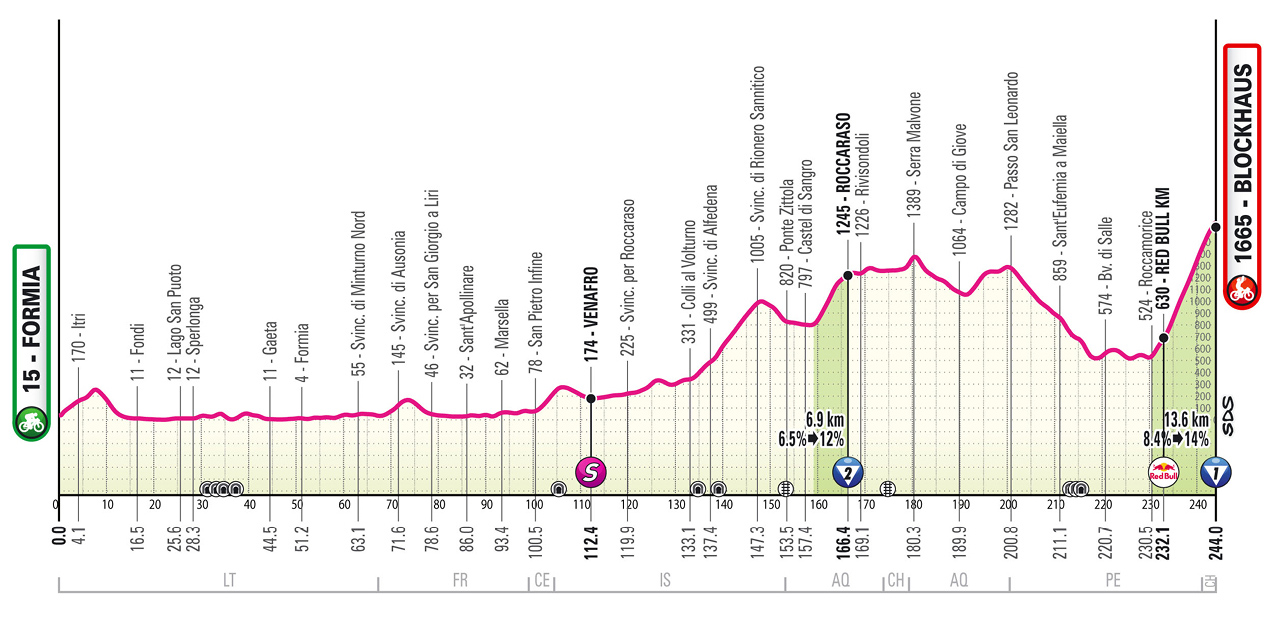
The first summit finish awaits. As long as you are patient because today’s stage is a marathon by modern grand tour standards at 246km so it will take some time before the riders tackle the slopes of the Blockhaus.

Polemica napoletana: the Giro went to Naples for the fifth consecutive year with a flat finish by the sea. When the route was announced it was easy to assume the finish would be the same as usual. Only it wasn’t, and everyone who discovered this change – be it over winter, this spring or yesterday morning – could see the cobbled U-turn and thought: “that’s risky” and “it better not rain”.
It started to rain as the race approached, Italian TV commentators reported umbrellas going up at the finish while the peloton was 2.5km away. Going into by then infamous last corner Elmar Reinders fell first, his back wheel washing out and taking his sprinter Dylan Groenewegen with him – have the Rockets uploaded a video with screeching tire sound effects and a sad trombone? – prompting others to brake and more fell. Davide Ballerini and Jasper Stuyven took a tighter line and stayed upright and Ballerini was able to sprint for the win with Stuyven later complaining he couldn’t change gears. As the two got round it’s proof the bend was rideable, but equally the propensity for a crash was high. The good news is that nobody was badly injured.
Despite almost coming to a halt, Paul Magnier calmly clipped a foot back in and rampaged past the traffic to take third place. Perhaps he would have won? More certainly he took plenty of points and now has 134, more than double that of Jonathan Milan.

The Route: A long day at 246km – the longest grand tour stage since 2021 – so there’s plenty to tire the riders before they reach the final climb of the day with 4,600m of vertical gain, most of it before Roccamorice and the final climb. Part of the distance comes from doing a 50km loop at the start out of Formia.

The Finish: 18km at over 8% so comparable to Mont Ventoux in terms of stats; and anecdotally often windy too. The road goes on to over 2,000m to the Blockhaus peak proper but the finish today at 1,665m is plenty for the first week.
Blockhaus? the Giro calls it Blockhaus but locally all the signs say Block Haus. Either way as Guillaume Martin said, “you think to yourself it’s on the Austrian border, then I realised it’s in the south of Italy“. Only there is a piece of Austria here. A lot of Italian military officers trained with the Austro-Hungarian empire and imported various techniques, including fortifications such as a Blockhaus, German for a log cabin and a garrison built to control the mountain and keep an eye on smugglers. If you want more on what it’s like to ride up, see the Roads to Ride post.

The Contenders: Jonas Vingegaard (Visma-LAB) is the obvious pick, today serves as confirmation for his status as the runaway pick and we’ll know plenty this evening.
If Giulio Pellizarri (Red Bull-Bora-Hansgrohe) can out-climb him then we’ve got a race on.
Others? Yes, from the breakaway because if a solid group can go clear then have a chance of being able to stay away but this will require no GC contenders or outsiders, and then then take molto minutes during the stage so that they start the last climb with a cushion of at least five minutes. A stage winner last year Chris Harper (Pinarello-Q36.5) fits the bill, as does another winner in Einer Rubio (Movistar). Darren Rafferty (EF) and Alessandro Pinarello (NSN) could be worth watching.
 |
Vingegaard |
 |
– |
 |
Pellizzari, Harper, Rubio, Pinarello |
Weather: a cold day in the Apennines, weak sunshine and often cloud, 12°C and some rain showers too.
TV: KM0 is at 10.55 and the finish is forecast for 5.15pm CEST. Castel di Sangro is where the climb to Roccaraso begins around 2.20pm and the final climb of the Blockhaus starts around 4.30pm.
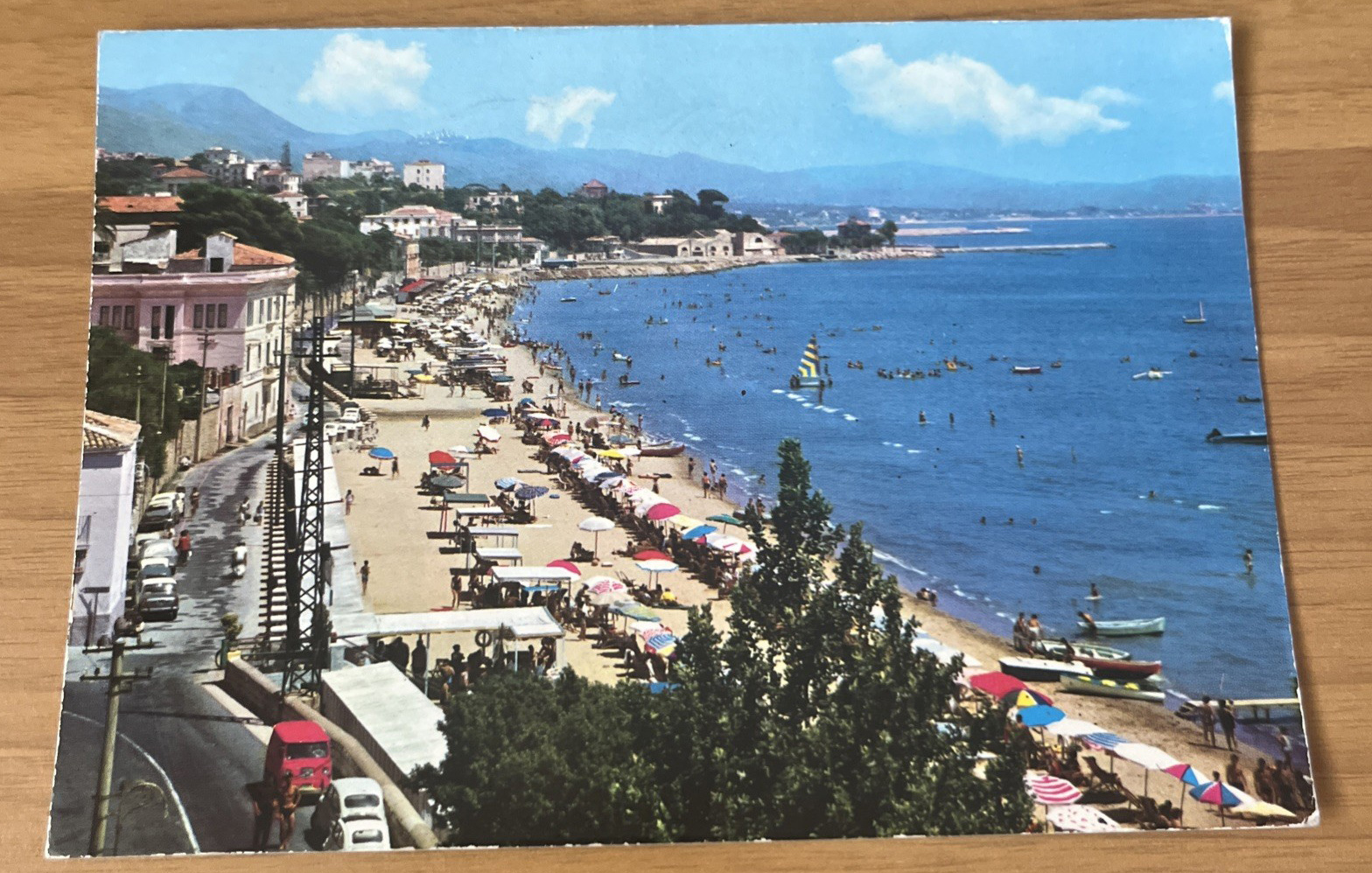
Postcard from Formia
Today’s postcard comes from the start town. Many riders might want to linger around town, if only to grab more for breakfast. The stage is 246km and could be the longest race of the year. It’s certainly the longest grand tour stage since the 2021 Tour de France did 248km from Vierzon to Le Creusot.
The Monuments are regularly normally longer when it comes to distance – Lombardia can be under 250km – but they’re one day races of course. Today could be the longest day of racing when measured by time. The start is at 10.55 and the finish is due for 17.15 which is six hours and twenty minutes, this year’s Milan-Sanremo was done in 6:35. If today takes less time, it’ll be only just. With the cold and rain, plus teams unlikely to take the fight to Visma it could be longer.
It’s a challenge for riders. Everyone in the peloton is used to high calorie consumption, often the talk is of 120 grams of carbs per hour, a round number which varies from rider to rider and different terrain and phases of the race. Being able to fuel more means being able to ride harder for longer. But how much to take on today? Just as the race can finish ahead of schedule or behind it, riders may need a wide variety of calories today depending on how hard the racing is. Better to just eat more in case? Sure but do this a few times and a rider can put on a kilo before race reaches the Alps; or their intestinal system struggles to cope with the load well before.
It’s a lot of broadcast hours. What do the commentators talk about? The hardest job is probably the moto camera crew. Holding a camera is hard work on foot, now try it on a motorbike which is moving. The worst role is Moto 2. If Moto 1 goes to cover the breakaway, Moto 2 is often filming in front of the peloton. This is done backwards, the motorbike is riding forwards but the camera has to be turned the other way. Camera operators have different techniques, some want to sit facing forward on the bike while rotating as much as they can to see what is happening behind, others find it easier to turn while standing. Remember all this the next time you’re on the sofa for six hours with snacks close to hand.
Imagine proposing such a route to your fellow club riders: “Let’s ride 200 km to the foot of a viciously steep mountain tomorrow, but first we’ll do a 50 km activation loop around town to get the blood flowing!” Madness.
The first mountaintop finish of a Grand Tour is always a treat, though I’m not expecting anything other than an assertion of dominance from Vingegaard today. Frankly, this race is starting to resemble the trajectory of last year’s Vuelta – i.e., V-LAB lend the jersey to a Bahrain-Victorious rider in week 1, Jonas reclaims it in week 2, then he slowly holds/expands his GC lead until the very end. Except this time there may not be an Almeida-like rider to run him close and maintain the tension. Hoping against hope that the pattern doesn’t repeat itself.
Madness for some, though a 240km stage is no more than what was considered typical fifty years ago. Some value tradition and a different sort of challenge.
Saying that the absence of convincing rivals for Vingegaard – can one really imagine Harper matching Vingegaard on the Blockhaus? – might lead this IR reader onto the roadside to watch the our local 2.1 race (La Flèche du Sud) which should be less predictable.
If Harper and others get a 10 minute head start then they could win. I don’t see the likes of Red Bull, Bahrain and Ineos driving the pace all day to intimidate Visma so the breakaway has a chance today. As for the Flèche du Sud, who can stop Brennan even if today looks hillier, his team mate Schiffer?
For La Flèche today, maybe Rowe but almost certainly Visma. I was at the opening stage and it seemed unfair with Visma’s luxury bus and mechanic’s truck, while the others made do with camper vans. Did Visma know when adding the race to their programme that they would be alone among the Contis?
And some ten years ago in 2015 the Giro still had three stages over 220 km, including a very hilly one at 264 and a mountain marathon with over 5.000 m of altitude gain in 236 km.
Some further ten years back polemica hit the route presentation of the 2004 “baby Giro” (it was the pro version but called so in reference to “Giro baby” for U23) because the last two decisive mountain stages were some 120 kms long.
Yet, imagine that the course had *six* stages well over 200 kms…!
There’s a UCI limit on total kms but organisers now have no difficulties sitting below it, whereas I recall occasions when the Giro included more ITTs in order to be able to include more lengthy stages.
If anyone in my club proposed even a 200km ride I would tell them I’ll see them another time. But this aint a club ride so the point is moot.
My kind of club… especially if we’re riding back too. But just not with today’s weather.
What’s decisive is the appropriate stops to have second breakfast, aperitivo and introductory lunch.
😀
Feeding is paramount for performance!
Although nutritionists might have a doubt or two about or menúes.
I’m an audaxer, so 200km rides are normal. Sadly it’s almost impossible to persuade the racers in my club to tackle anything longer than 100km.
It is a crazy distance to contemplate. Though, bear in mind that a club ride km ≠ pro ride km. The pros go far quicker, for a lower level of perceived effort – they’re just so incredibly fit. A lot of the guys in the peloton will just be in Z2, even Z1 at times, for the bulk of the kms before Blockhaus.
Still a lot of cumulative fatigue though.
I thought that Magnier’s sprint from a standing start was the highlight.
A pity we didn’t get to see this power in the spring classic but the team are building around him for this.
Can also see Christian Prudhomme opening an email to colleagues saying “I know we don’t like bunch sprints but get me some finishing straights that are 2-4% uphill for 2027”.
It was very impressive. Moreover, watching the replays and that’s with having a couple of attempts to click back into his pedal
It’s staggering that Magnier finished 3rd after skilfully avoiding the crash, dandy-horsing through it, then reclipping, given how many other riders came past him on the inside.
Is there any video of him restarting from the corner and going all the way to the line? Would be great to see
Think it was briefly on TV yesterday with the overhead shot. It felt like he passed 20 riders but it was more like ten, still impressive.
Magnier was unbelievable in that sprint. One moment he is at rest picking his way through fallen riders well inside the final kilometre, the next he is up in third place! The overhead would be interesting. Real presence of mind to get going again and start sprinting; many riders I’m sure would assume the chance was gone and just roll in slowly.
+1 (to you and others above)
The athletical aspect was shocking (he sprang from a standstill!) but the mind one was even more amazing.
I was thinking the same about the mindset thing. Impressive and really what sets people apart from their peers at any sporting level – from the under 10s footballer who leaps to block a ball when others would turn and duck, to the elite rider who goes again without a second thought. Always impressive to see.
Hopefully the wacky races element is finished, certainly should be no more numpties trying to be social media “stars” by jumping at the riders. The Visma tatic of sitting at the back for sprint stages certainly seems to be working out, keep away from the chaos up front. As much as I am not a great fan of the short stages favoured in recent years, especially at the Tour, I really dont see the point of the opening loop, has Formia town council paid extra to have the race pass through again? A 200km stage would have been plenty with the climb at the end.
Assuming he is healthy and avoids any issues then difficult to see any other result than a Jonas Vingegaard win, I dont see Visma letting a break build up a big enough lead for someone to hang on. Maybe the cool damp weather might influence things though a quick look at the weather forecast suggest it may stay dry at the finish, the rain staying further west.
There needs to be some sort of memorandum to avoid cobbles or paving slabs or anything similar in the finale of a bike race. Especially if that bike race is in a city centre so said cobbles/slabs get nicely smoothed out and a good coating of diesel. Throw in a Mediterranean climate to add a little layer of dust and you have the perfect recipe for the farce of yesterday. Just finish on a straight tarmac road, its not complicated. If there isn’t one nearby, have a rethink.
Seems a bit of a mystery this year – are they looking for dramatic settings, or more drama in the race?
Plenty of races finish not exactly in the town but on a slightly larger road just outside with handy access to a retail or industrial park for all the parking and podium requirements. Once all the finish line paraphernalia is up it hardly seems to affect the spectacle of the race (not everywhere has to be the Mur de Huy).
Inrng commented on this subject in a recent postcard a couple of days ago I think.
City centre finishes are good, but the rest of the route leading there must be consistent with the setting.
In Italy, most main towns, including those which aren’t anymore as big, have a very extended historical centre which would force you to move quite much out.
And for the roadside public in the current context it’s paramount to finish well within the city.
Plus, no, I don’t think it looks more or less the same.
However, sure, the solution you suggest is great to achieve some specific objective, like a bunch sprint, although it’s not a logical necessity, either. Stage 1 or 3, for example, had no real course-related issue at all.
Yes, I was thinking really about finishes with a likely large bunch sprint. Those days when the (TV) audience is perhaps focussed on the moves within the pack ahead of anything else. Those days where, speaking for myself, you get closer and closer and closer to the screen to pick out who is surfing on which wheel.
Yeah, I’m on the same wave, I like those last 10-15 kms where “nothing happens” but I’m glued to the screen (to identify riders, trains and strategies ^___^).
The routes are supposedly revised by some sort of UCI committee?
However, as inrng says above, it was far from impossible to notice the couple of very relevant changes applied to this stage during the last 6 months.
The finale, and that the stage was made dangerously easier.
Many common fans had commented such issues publicly.
So I wonder why those jumping up for safety’s sake when it brought clickbait and cheap demagogy, i.e., when the crash had already happened on st. 1, OTOH didn’t act beforehand about *this* Naples stage. Dunno, just tackle the subject when the news first came out.
For sure, it’s always *safer* (for journos, influencers and the likes) to talk over and over… the aftermath.
Anyway, in Tirreno-Adriatico there are often cobble finishes which entail no crash, it’s mainly about being able to pick your trajectory, lower speeds and a less thick head group.
Actually, no UCI committee has to approve anything. In some races the UCI will nominate a technical delegate, mostly for WC, cross mtb and para.
For the course, art. 1.2.061 states: “Without prejudice to the relevant legal and administrative provisions and the general duty of care, the organiser shall ensure that the race course or the competition grounds
include no places or situations that could constitute a particular safety risk to anyone
(riders, attendants, officials, spectators, etc.).”
And to be sure the UCI is not to blame follows art. 1.2.063: “In no case can the UCI be held responsible for defects in the course or installations or
for any accidents that may occur.”
Thanks!
I had a vague memory of somebody having to previously check the course from when we had that Itzulia (I think) accident when riders crashed on bollards (!!!) in the final straight of one of the first stages.
Can’t even say when that was, maybe AI can help 😉 but I won’t use it!
I’ll typically discover it was 2003 or the likes and rules changed or whatever (maybe it was a wrong info from the very beginning).
World Tour races now have to appoint someone as their “event safety manager” and they prepare a report that goes to the UCI, commissaires and others ahead of the race. There can be dialogue as a result but it’s on the organisers as UHJ says, both because they produce the report and act on it, ie they’re marking their own homework.
People might like the UCI to intervene here but it would mean having extra staff check the course and having the authority to tell RCS, ASO and mayors of big cities, regional governors etc what to do and the governing body does not have the resources to do this, nor the clout.
Happy to help. 😄
Are you thinking of the vuelta a burgos where they had a speed bump on a downhill in the last 3k just as the sprint trains were winding it up? Something like 2019 I think.
Not the final straight, but I can remember how “un bolardo situado en las calles de Lugo provocó la caída de Steven Kruijswijk”. That was in 2016, stage 5 of the Vuelta.
It was Itzulia 2015 in Bilbao…!
Bollards in the very road the riders had to sprint on, just orange cones placed as hats on top of them.
“Unos bolardos, incomprensiblemente mal señalizados, en la Gran Vía de Bilbao, causaron el lunes, en el esprint de la primera etapa de la Vuelta al País Vasco, una gravísima caída masiva que acabó con cuatro ciclistas en el hospital.”
https://www.ciclo21.com/vuelta-pais-vasco-los-bolardos-de-la-indignacion/
The cobbles didn’t seem to be a major problem. The relatively tight turns were.
Some novel tactics here, Visma down the back and Bahrain, Red Bull etc keeping the break within reach. A bit perplexing.
Already riding for 2nd…
RBBH have explicitly said–though maybe it’s gamesmanship–that they are here for the podium…as in not the top step. Realistic, perhaps, but deflating nonetheless. It’s why Remco is their Tour hope–no chance of the top step!
You’d think they were a Canadian team. We learn here not to dream too big.
… excepting Ryder H, of course
O Ca-na-da…
I don’t have the statistical memory of Mr. Inrng or others here, but in my memory in the giro usually the Blockhaus mostly fizzled out. It seemed to be always less dramatically raced than it was hyped.
Today after so many km and in so bad weather? Dunno.
It’s been relatively passive and we’re getting close now. Looks like it will be pretty explosive. There will be gaps, we’ll see how big…
It’s been decisive in the past, Dumoulin almost matching Quintana and Pinot in 2017, Hindley winning here in 2022 on his way to the overall win and usually with riders scattered over the mountain by the finish. Other Apennine summit finishes (Gran Sasso, Campo Imperatore) have disappointed with groups huddling in a headwind.
The wind is crazy today.
@UHJ, someday, a motivated attorney might challenge this. And if successful, road safety would increase. This is basically what personal injury and product liability attorneys do, besides make money. They make things safer.
“And to be sure the UCI is not to blame follows art. 1.2.063: “In no case can the UCI be held responsible for defects in the course or installations or
for any accidents that may occur.””
Yeah, that’s what my lawyer friends tell me. “In no case can XXX be held responsible” is BS no matter who writes it in their own rules, it’s mostly there to encourage people to think for themselves. Judges will decide who can or can not be held responsible.
In this case though, it does make sense to me. Race organizers can be expected to know what they are doing. They do not need a UCI commissaire to point out a certain situation is not optimal regarding safety. So if they leave such a situation as is, they do this knowing it is a risk and should be the ones held responsible. It do’nt expect a judge would rule that race organizers are not able to make a safe parcours without the UCI babysitting them, and therefore the UCI is responsible if they don’t send people to every race course to double check it.
In case readers can’t/won’t watch the paywalled TNT/HBMax Giro stages live, Freeview Channel 39 Dmax is showing highlights from 7 -8pm UK time.
Rewatching stage 7 I’m laughing at how the commentators are conveniently ignoring the massive handicaps that Gall has and selling the “disappointment” of Vingegaard not taking more time. The way I see it, it was a great day for Arensman, who will probably put minutes into Gall in the TT. Not to mention Gall’s descending problems, which he won’t be able to hide. Good day for Bora too, who will want to attack Gall’s weaknesses at every opportunity.