

A post-Tour look at the team standings to see who is up and who is down.
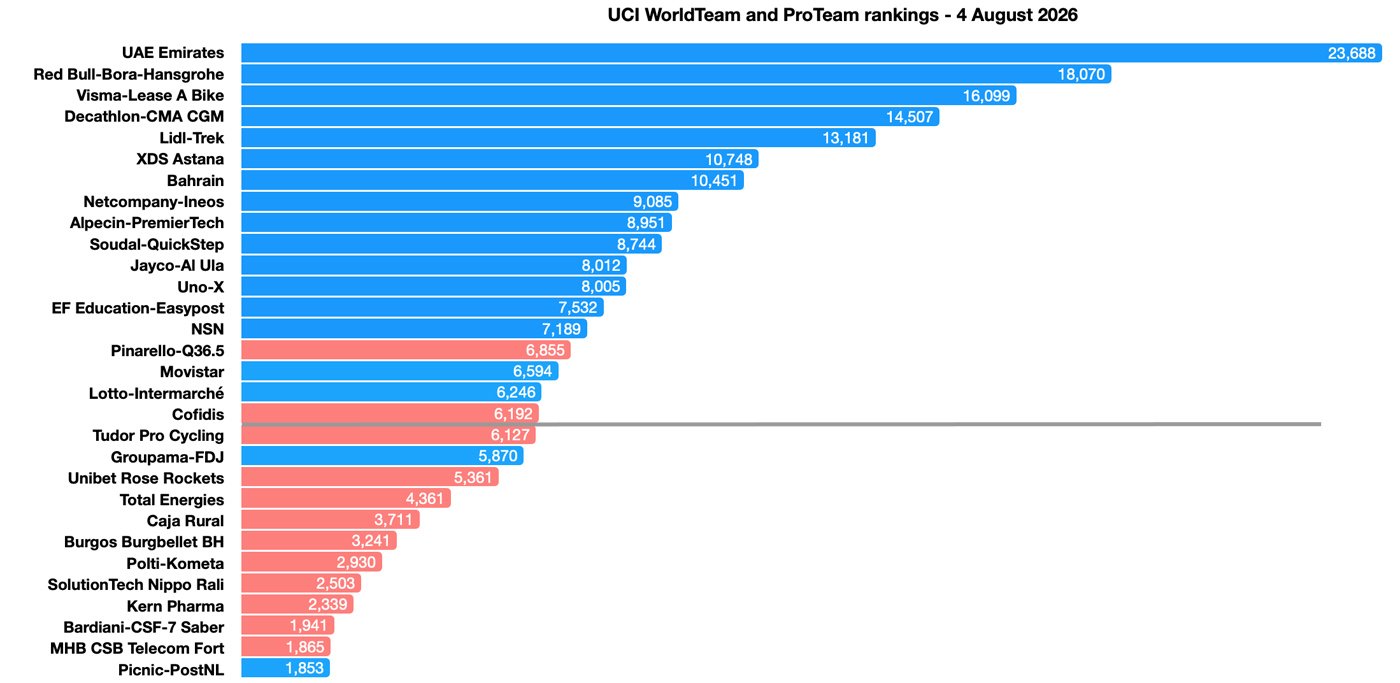
Two changes at the top. First the UAE team is still in the lead but they’ve pulled out a big lead after “only” having less than two thousand points on RedBull going into the Tour, now they’re over five thousand clear and with Pogačar racing the Vuelta likely to pull further ahead. The other movement is Lidl-Trek overtaking XDS-Astana, the German team enjoyed a successful team while the Kazakh squad found it hard to get a look in.
The grey line on the chart represents the border between 18th and 19th place. Notionally this is the relegation point at the end of the 2026-2027-2028 cycle. It’s far away, and also conditional on there being 18 teams in the World Tour. Pinarello-Q36.5 already look like a competitive World Tour team and signing the likes of Mauro Schmid only bolsters this. Movistar and Lotto-Intermarché might be where they’re expected to be but it’s not a comfortable place.

Thanks to a good Tour EF went into the Tour below the grey line, now they’re well above it with Richard Carapaz scoring over 1,300 points. Cofidis are just above the line but Tudor are close, the Swiss team had a discreet Tour de France but have signed Arnaud De Lie who ought to score big for them next year, the team need this. Marc Hirschi for example only has 308 points this season.

A poor Tour for Groupama-FDJ, around 300 points of which two thirds came from Clément Russo’s stealthy top-10s. They will be worried about relegation, especially as they’re still highly reliant on Romain Grégoire. He’s extended his contract with the team which helps but injury or illness could be ruinous for the team. Valentin Madouas is leaving and you can understand why, he’s only got 120 points this season when he’s been second in the Olympics and the Ronde alike and notionally one of the leaders; the same for David Gaudu with 98 points this season with talk of a breakdown in relations and the team wanting to unload him but he’s got a valid and lucrative contract so in no hurry to leave. Having seen Stefan Küng leave and now Madouas there ought to be some budget for some scorers. House sprinter Paul Penhoët is leaving too.

Picnic-PostNL are in a catastrophic position. Only one win this season is poor but it’s the absence from podiums, placings and other results that is proving so damaging. They’re really missing Max Poole, their stage racing talent, but only three riders in Pavel Bittner, Frits Biesterbos and Bjorn Koerdt have a points score in triple digits, with Bittner the top scorer on 580 points. They’re 4,339 short of Cofidis, to avoid relegation they’re going to need to score at a rate like Soudal-Quickstep just to get back on terms. Fabio Jakobsen could be leaving the team in the coming days
One year rankings
Everything else being equal* the best three ProTeams this season get automatic invites to the biggest races for next year, so Pinarello-Q36.5, Cofidis and Tudor clear for this award but there’s still time for the Unibet Rockets to close the gap but they can bank on a wildcard invite.
To be eligible for a grand tour a ProTeam has to be inside the Top-30 at the end of the season so plenty of familiar names including Bardiani which has climbed up. But the rule means the likes of Euskaltel-Euskadi and Modern Adventure Cycling are out of the picture now so new Euskaltel signing Mikel Landa may not have the romantic farewell at the Vuelta.
As written before the top-30 rule is based of the rankings at the end of the year which will include teams like Kern Pharma and TotalEnergies and only the first has said it’s stopping and the second is probably going to stop too but no announcement yet so if they won’t exist next year it doesn’t make sense to include them.
* an open question with an uncertain future for several teams, see July’s Race for Survival post
Generically, these rankings seem to feel more like how a team’s marquee riders are getting on vs actual team performance. Maybe it just shows your support riders and staff have to be stars themselves.
Picnic has had a brutal year. I wonder if Visma felt obligated to throw Jakobsen a bone after 2020.
Picnic – a team I have always liked – seem to know it’s over and are just going through the motions. The squads they put out in worthwhile races (Poland, Burgos…) wouldn’t frighten anyone. Poole hasn’t raced since February but is listed (PCN) for the Vuelta. If true that sounds unfair for the rider and a real sign of desperation.
It will be interesting to see if another team culture can make something of Jakobsen.
Groupama-FDJ do not seem to be in a happy place. They must be wishing that they did not let Lenny Martinez go.
It seems it will be a real dog fight for those around the 18th spot.
It wasn’t quite as simple as sitting down and having three boxes marked Martinez, Gaudu and Madouas and working which ones to keep and which one to bin… but this has turned out poorly, letting Martinez go and extending Gaudu and Madouas on big contracts. Madouas is off to Cofidis and if he doesn’t win much as a strong rider he still ought to score points but maybe a team like Soudal could have been better for him.
Yeah, we don’t know the ins and outs of the thinking of FDJ management, but good management should be able to work out what’s coming down the pipeline (or to put it in cycling terms, read the roadbook before the race).
Now FDJ have the added headache of promising French guys and gals looking at Decathlon instead as first choice for a career.
I feel pretty sorry for all these struggling teams.
They’re damned if they do and damned if they don’t.
Picnic had a solid policy of promoting youth with a high turnover of riders that seemed to be going swell till recent times.
A few years ago you might think FDJ and Cofidis should try to go more of that direction rather than getting tied to riders who will only ever be hit and miss at best.
But then you see Schmidt getting a 2M contract at Pinarello, and how are teams like Picnic and FDJ not only meant to exist in this kind of environment but also plan for the long term?
Not only do sponsors come and go, national interest waxes and wanes, but the entire playbook of how to run a successful/sustainable team changes so often it makes any model that isn’t ‘big sponsor+big rider’ redundant within a few years.
Picnic should be the Brighton of our sport and celebrated for doing so, instead their moment has seemingly past and we’re moving into the era of youtube/strava teams with the Rockets, Swatt Club etc.
Change is good and exciting, but I do feel like cycling is far too brutal on these lower ranked teams, where if they win it’s often at races that no one sees, nor has even heard of sometimes because of a shoddy calendar, and if they look to promote youth they’re now pushed out giant teams hoovering up the next Pog and then they’re left to find sponsorship with little promise to anything to offer except maybe a breakaway at the Tour if they get there?
It’s a thankless task and even if revenue sharing, draft systems and all the other ideas that may not work in cycling, I still think the over sport should do whatever it can to start helping.
Plus beyond all the above the French tax system adds another layer of difficulty to the French teams which seems a tad unfair, even if I have no issue nor understanding of their taxes overall, it just seems to create an uneven playing field in this particular circumstance.
That’s hundreds of nuances all wrapped up in each one of these points that no comment post could properly rake over, so I’m highly aware I’ve missed a number of details plus many more issues, I’m just stating that it upsets me and is a large part of the reason why I think change will come sooner or later to the sport the current set up is bad for the riders, the fans and the teams beyond a few hallowed weeks and weekends of the year. That’s my belief, I know many will disagree and I’m happy to be proved, argued wrong from the comfort of this la-z-boy.
How do you feel about new teams coming into the sport, such as Q36.5 and Tudor? These new teams are well funded and well run, and want to go to the world tour, and their presence raises riders wages. This, of course, means some existing teams need to drop out of the world tour to make space for them. I am curious about whether you view this as positive or negative.
It’s difficult because similar to you when you’re a fan for a long time you see so many good teams come and go – and usually I’m a big fan of change – but with teams I’m always thinking about that day when they fall into pain, like INEOS now who are talked about as a bunch of loser after a poor tour despite being one of the lucky ones?
Seeing the owner of Arkea celebrating wildly at the tour one year then out of business the next is just so upsetting, especially as a fan when you’re just getting to know these people?
And even if they don’t disappear they go through so many guises that you start to lose track – Leopark Trek arrived with such a strong identity and have only really regained this in my mind recently with Mads and Lidl.
But with teams arriving… I can’t help but feel like it’s just not a level playing field, both teams you mentioned are Swiss registered so immediately start with an advantage over FDJ, Decathalon and others in France, and even this small detail doesn’t seem fair to me – plus that’s not even taking into account the influx of petrodollars that’s further tilted the playing field.
Money always wins in all sports, so this isn’t new but cycling seems to suffer all the negatives of big money like other sports alongside an additional bucketload of negatives from being a niche sport – there’s almost nothing in place aside from the fact ‘the races have been going a long time’ to really help and grow fan engagement with the teams and riders that might help them build a legacy that will help the sport in the longterm…
Even narratives suffer – beyond teams constantly changing names and sponsors, so you lose track that Banesto is the same team as Movistar now, if you focus on ‘new’ teams; some arrive with budgets but come from nowhere so you have no relationship with them or connection unless a famous ex rider is attached? Who are Q.36.5? All I know is they’re a billionaire’s plaything? It’s not like they’ve come up through divisions and built an identity as football teams like Brentford, Brighton and others have – they’re just thrust upon you? The social media teams (Rockets/Swatt) are helping with this but it’s done wholly off their own back (similar to social media helping with fan engagement not the sport itself), there’s nothing in the sport to assist with building this stories and allowing fans a way to connect better with their favourite teams.
My main issue overall is that cycling doesn’t do the easy stuff – we’re locked in debates about revenue sharing and drafts when the basics that most other sports learnt long ago are ignored or screwed up so badly they push fans away rather than bring them closer: these UCI points are a perfect example, I’m all in favour of leagues and year round competition but these UCI points seem so alien to the average fan that you’re left thinking what’s the point? It’s seemingly for the teams and riders only and maybe 1% of fans who read INRNG’s posts!!
Rant over. I find it infuriating but I still love cycling! It’s not a deal breaker and obviously I just have to put up with it and enjoy what I’m given, which thankfully I do!!
oldDave, you know I agree with your rant! I will say this, however: both Picnic and FDJ made really stupid mistakes that weren’t only due to their financial situation. It sounds like 20/20 hindsight, but did anyone think it was a great idea to invest in the likes of Degenkolb and Jakobsen, even at the time? I know that by the time UAE comes calling it’s too late, but Picnic had Vermaerke for years and probably could have locked him up so they could at least get a transfer fee as with Onley. While it saddens me to see them struggle so badly, there is an element of survival of the fittest that has to come into play.
What are Brentford and Brighton? The latter a town in the UK? No idea.
Assuming it’s football or rugby, I asked several friends in six different European countries (including four big ones), all of them quite passionate about football and ball sports, although perhaps not absolute freaks and nobody knew a thing about them. Zero.
Did those teams ever get to some quarter finals of anything in Europe?
I think that in the above there’s some projection of very personal, niche experience from a market which is relevant but second-line for cycling.
As for Q36.5, I don’t know who owns but I use often their materials while cycling myself and I think Nibali is or has been an embassador for the brand and team, so as a fan of the latter they’ve got quite an identity for me. Plus, I’ve been following Pidcock since his juvenile years, hence the match strengthened quite much the team’s presence in my mindset. Thanks to Pidcock, they’re on CN very often, too.
Brentford and Brighton are well known to international fans of the Premier League, which means they are far from niche. They are great examples of how minnows can thrive in well-run sports.
Yeah, but “international fans of Premier League” are a category which isn’t as solid in most big European countries (unlike, perhaps, in the rest of the World… but I have some doubts about that, too, in that they might make big figures summing up little niches in many separated countries).
However, the global popularity (note: as different from “fandom”) of middle to smaller clubs of the Premier League is a magnitude below the big 5. People interested on a global scale in anything Premier League barring the big 5 is a tenth part of the interest in the latter. This is already a huge hint about the reduced interest about “the League” as such, as a whole competition with minor teams and so.
Apart from the big 5, there’s some vague, moderate interest in Everton, Tottenham, Aston Villa and pretty much full stop.
In viewing terms, barring the UK the main market is… the USA, with peaks of 500K viewers. Which is less than any sprinters stage in the Giro’s first week.
OldDave:
I think I understand how you feel about it. Personally, I feel differently about the teams, and I think this means I have a different perspective on the sport. (Note: it is OK that we have different feelings, it doesn’t make anyone right or wrong).
For me, teams is just a vehicle which allows the riders to race. What matters to me are the riders and it doesn’t really matter to me which teams they ride for. Gabriele hints at this when he says he is a fan of Pidcock and not of Q36.5. Teams come and go, but what gives me the memories are the riders who raced and not the teams they raced for. For me, it was Armstrong v. Ulrich (and not US-Postal v. Telecom). Similarly, I am watching Pogacar against Vingegaard (and not UAE v. Visma or Jumbo). I actually am a bit baffled when fans support teams in cycling rather than riders (this is just how I feel, they of course feel differently).
Given my perspective, it does not really matter much to me if a team goes out of the sport, and another team enters. So long as the riders are paid, and there are enough teams to fill the races, then who the teams are really doesn’t particularly matter to me. If a team gets a new sponsor and changes its name, it doesn’t really affect me. If a new team arrives which pays the riders better, then I think this is a good thing for the sport. If an older team is unable to raise enough money then it is fine for the riders to move somewhere which pays them better.
Of course, many people feel emotionally invested in particular teams, and if you have that view-point, you will of course care about those teams, and their survival. Some people mentioned football, and in that sport the teams have a meaning beyond the players who are on the pitch (the “thing” most people care about is the team rather than the players). This is one of the things that makes football different from cycling.
John: perhaps I’m being naive, but I feel like there is a huge difference between the UAE team and the Visma team (anyone who reads my comments knows I’m team Visma). Same with, say, Alpecin and EF. I know that the sponsors change, but I like it when there is a specific ethos associated with a team rather than the team just being a group of talented mercenaries.
Other Craig:
It is perfectly fine to feel something about the teams, if that is how you feel. And to have a different view. People can enjoy different things about the racing.
For me, the way the teams race (what, for me, is important about ethos) is a reflection of the riders in the team, how they co-operate, and the tactics which are best for those riders. For example, Alpecin are a “sprints and classics” team. While EF-Education concentrate on stage-hunting in grand tours. Both are very sensible approaches to their mid-tier budgets. If these teams had different (types of) riders they would have a different ethos. While Van der Poel and Healy would be much the same riders if they rode for another team.
@Gabriele, yes see @The Other Craig’s comment – I think you’ve got a touch too fixated on who knows those teams mentioned rather than the point illustrated by being able to follow a team’s journey longterm and identify an ethos with them that draws you to liking them. You could just as easily talk about Atalanta’s journey from relegation in 2010 to Europe in the 2020s, or Union Berlin story recently or many other sports that manage to give narratives beyond just the players. Cycling has much to offer beyond the riders, but I think the overall sport could do more to support and push this further rather than leaving Rocket/Swatt Club to do the job for them.
@John, yes I do concede some follow the athletes rather than teams, which makes sense as cycling makes it extremely difficult to follow the teams! I guess what I am arguing for is the option to have both? In football fans might follow Messi, but they can follow Benfica if they want, both kinds of fans are catered for, same with most team sports – cycling makes this kind of thing very difficult from my perspective, as it does many other things other sports take from granted which means it’s perfect for fans like you, me, Gabriele and The Other Craig (old to middle aged men with too much time on our hands!) but for people who might want something different, the sport itself does very little to offer an alternate pathway, even if social media and other tech innovations recently have done some of the work for them.
Re Picnic/FDJ @The Other Craig – I actually don’t know the full story of either tbh, although I had thought Degenkolb was just an old timer to show the young kids the ropes rather than investment?
I guess my response though would be that (and I’m sure you’d likely agree) the system makes minor mistakes into giant miscalculations, when mistakes are normal and happen to us all, but in a sport with so little margin for error, it means we lose good people from defunct teams unfairly which doesn’t help the sport overall as it stops those of us who want to from identifying with more of the sports characters as they’re gone before most have had a chance to even get to know their name.
I think the point with Brentford and Brighton is that, despite not being well-known (Brentford might be the 9th biggest team in London) and not having the resources of their rivals, they’ve been able to carve out places for themselves in the Premier League while other, larger clubs bounce up and down between the PL and lower leagues – and often fall into financial difficulties on relegation.
But the background is so different
I thought the rule was changed and now the top three Pro-Teams get automatic invites to the World Tour races. Is this wrong?
Doh, quite right. It is three, will amend the text to show Pinarello, Cofidis and Tudor are ok.
Which climb is that first image with the hairpin turns? Thank you!
Stelvio?
Col de Noyer from South side. Used in TdF stage 19 this year.
Correct, it’s one of those passes that always feels like it should be climbed from this side. The photos of the race are scenic but go up and the views of the valley below are superb.
@ Jean Bon, Thank you!
It looks like no points for Jayco next year without Schmid.
He’s got 2,300 points for them. Without him Jayco would be alongside the Rockets. It doesn’t work that way as the team could set up other riders for results… but still, it does show the risks ahead for the team. Pinarello are apparently paying him €2m, not long ago that was the going rate for a solid grand tour contender.
BOC on his way out too. The list of riders to set up is shrinking and aging. It’s going to be really interesting to see how much Ryan wants to pony up to stay (barely) relevant.
Hope to be proved wrong but I feel like next year could likely be their last year. Happy to be corrected by more informed readers
Noises are that Gerry Ryan may be willing to fund through 2028 but only as part of a transition period. Their efforts are centred on that backing coming from the Middle East but understand that’s proving really challenging.
How correlatet with budget size is this list?
@Halvor. I have no idea about the other teams but confident that uae have the largest budget.
But still a rounding error compared to what they are spending on the genocide in Sudan.
@DaveRides Absolutely- this is small change to their African expenses. Quite sad to see kids on the side of the road wearing uae tops
I bet several sprinters on the lower level are getting some really nice offers now from teams that really need points. I am specifically thinking of Flanders-Baloise’s Tom Crabbe (the team is going to stop anyway) and especially continental break out talent Team UKYO’s Tommaso Dati. There also were already rumors Movistar wanted to buy Dylan Groenewegen out of his contract with Unibet and I wouldn’t be surprised if the same team has had several offers for Lukáš Kubiš too.
Tom Crabbe is off to Pinarello-Q36.5. Dati is almost certainly off to XDS-Astana.
For those concerned about the future of the sport, Flanders-Baloise have announced they will fold at the end of the season.
Personally, I think there is a real problem at the Pro-Tour level. There were 27 Pro-Tour teams in 2018. There are only 16 in 2026. And it looks like the number will be several less next year since Flanders-Baloise are likely not the only Pro-Tour team to fold this year.
But isn’t that more the direct result of the UCI’s decision to raise the level of the second highest category than an indication of the dire situation most ProTeams find themselves in financially?
In 2019, the last year of the Professional Continental teams, there were 25 teams that had to employ at least 14 riders, 2 team managers and 3 other staff (paramedical assistants, mechanics, etc.) on a full time basis to be eligible.
In 2020, the first year of the ProTeams, the number of teams dropped to 19 teams that had to employ at least 20 riders, 3 team managers and 5 other staff.
(Possibly there were also other criteria that were tightened and that necessitated an increase of the budget in order to be eligible, let alone to stay competitive.)
Yes, I agree with your point about the change in the rules (the increase in the size of the Pro-Teams). I think you explained it very well. The Pro-Teams are now mini-world teams who try to race a fairly international circuit.
Two other points. The UCI also introduced automatic invites to 2-3 Pro-Teams (and made being top-30 a requirement for being invited to a Grand Tour). And most WT teams now have development teams for less experienced riders.
In the past many teams raced in one of the four national circuits that could support full-time racing (Belgium, France, Italy, Spain). These teams could get local sponsors on board to support the team; these sponsors had little interest in races outside their home country. But these teams needed to be in the WT races on their national circuit (especially the Giro for Italian teams, the Vuelta for Spanish teams etc.). The change in the rules means these teams can struggle to get invited to their local WT races (often replaced by foreign WT teams who have no interest in the race). As a result, these teams are struggling to get sponsors on board.
Many Pro-Teams have taken a role in developing young riders not yet ready for the World-Tour. Or older riders who want to step down (Landa is a current example). This provided interest to the sponsors. But the rise of development teams and the reduction in “invited teams” to WT races means these teams struggle to attract these riders to race for them now.
I think the sharp reduction at the level of Pro-Teams is a concern. Thursday explained very well how this is a result of the changes in the sport. Perhaps this is what the UCI and the big teams want; the loss of Pro-teams riding their local circuit. My personal view is that the sport depends on the whole pyramid, and that the loss of these Pro-Teams racing their national circuit (in Belgium, France, Spain, Italy) will hollow out the base of the pyramid, and ultimately will damage the sport. It also means the non-WT races in these countries will no longer have a large pool of teams which they know will appear at their race; they depend on these teams to make these smaller races viable.