
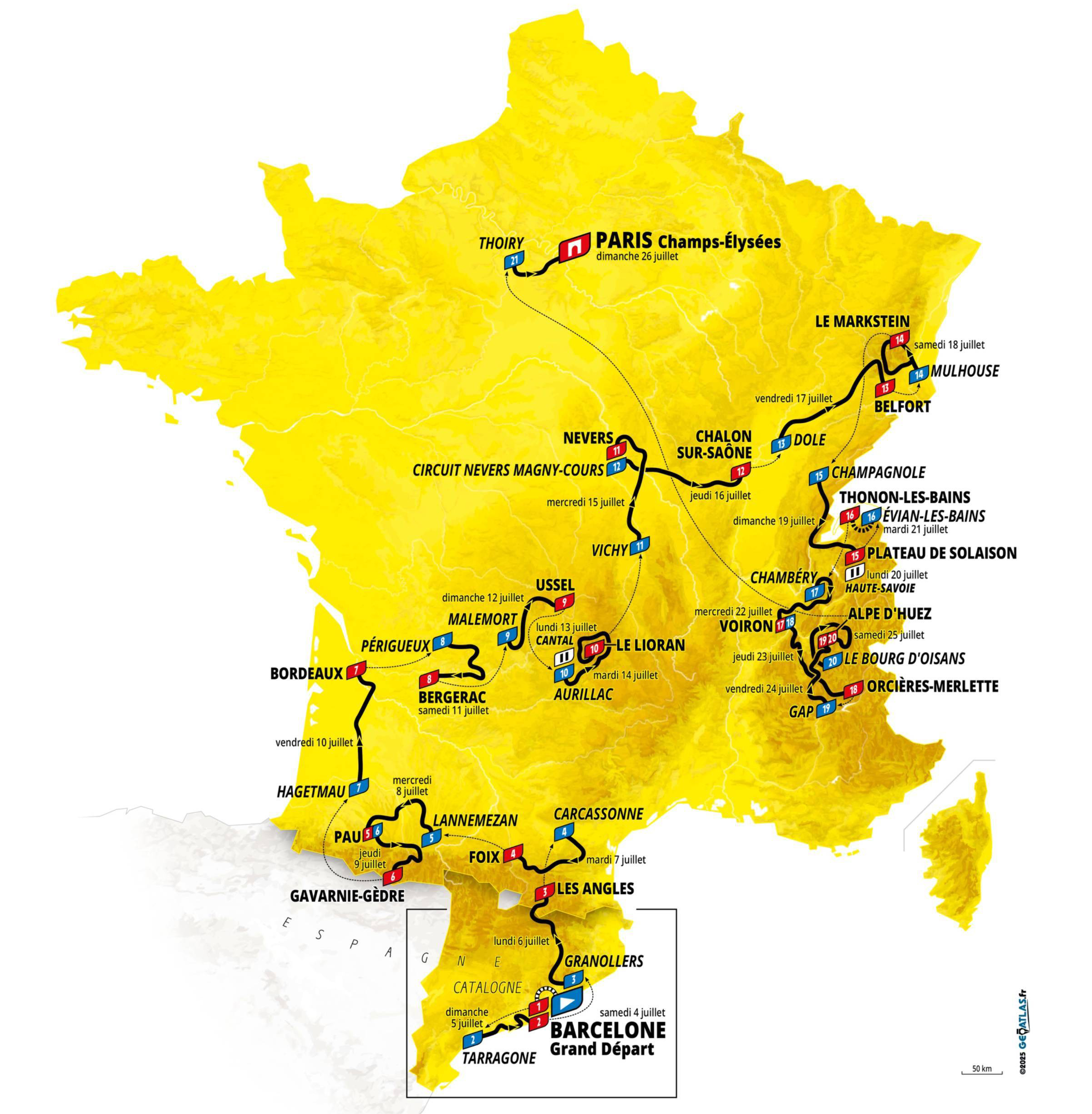
Here is the Tour de France stage-by-stage guide with all the profiles on one page along with a summary of each stage.
From here through July you’ll find all the stage profiles at inrng.com/tour which can be found via the menu at the top of the page, which also has a all the relevant sports rules and regulation for the race including the new scales for the points and mountain competitions, both of which have changed this year and are explained quickly below here too if you want to scroll.

Route Summary
54,450m of vertical gain in total, the third most mountainous route in the last 20 years (average is 50,400m) but a lot of this climbing is away from the set-piece mountain stages and reserved for battles stages in the mid-mountains. There are seven summit finishes but some are mild like Les Angles and Gavarnie. One solo time trial with 26km makes it the third lightest for TT distance in the last 20 years (average 50km). The sprinters get five clear chances, the same as last year but those with range have a shot at more wins.
The start in Barcelona obliges an early visit to the Pyrenees and so these are more hors-d’œuvre than main course. Indeed the route seems designed to leave the reveal of the winner for as late as possible with mid-mountain stages that look promising for frantic breakaway days, although even better if the big names want to try too.
There’s no realistic course that could trouble Pogačar – a blend of 21 sprints and time trials could thwart him but it’s not a realistic prospect – and so even if we think we know the winner already, plenty of stages along the way offer amusement before the Alpe d’Huez finale.
Stage 1 – Saturday 4 July
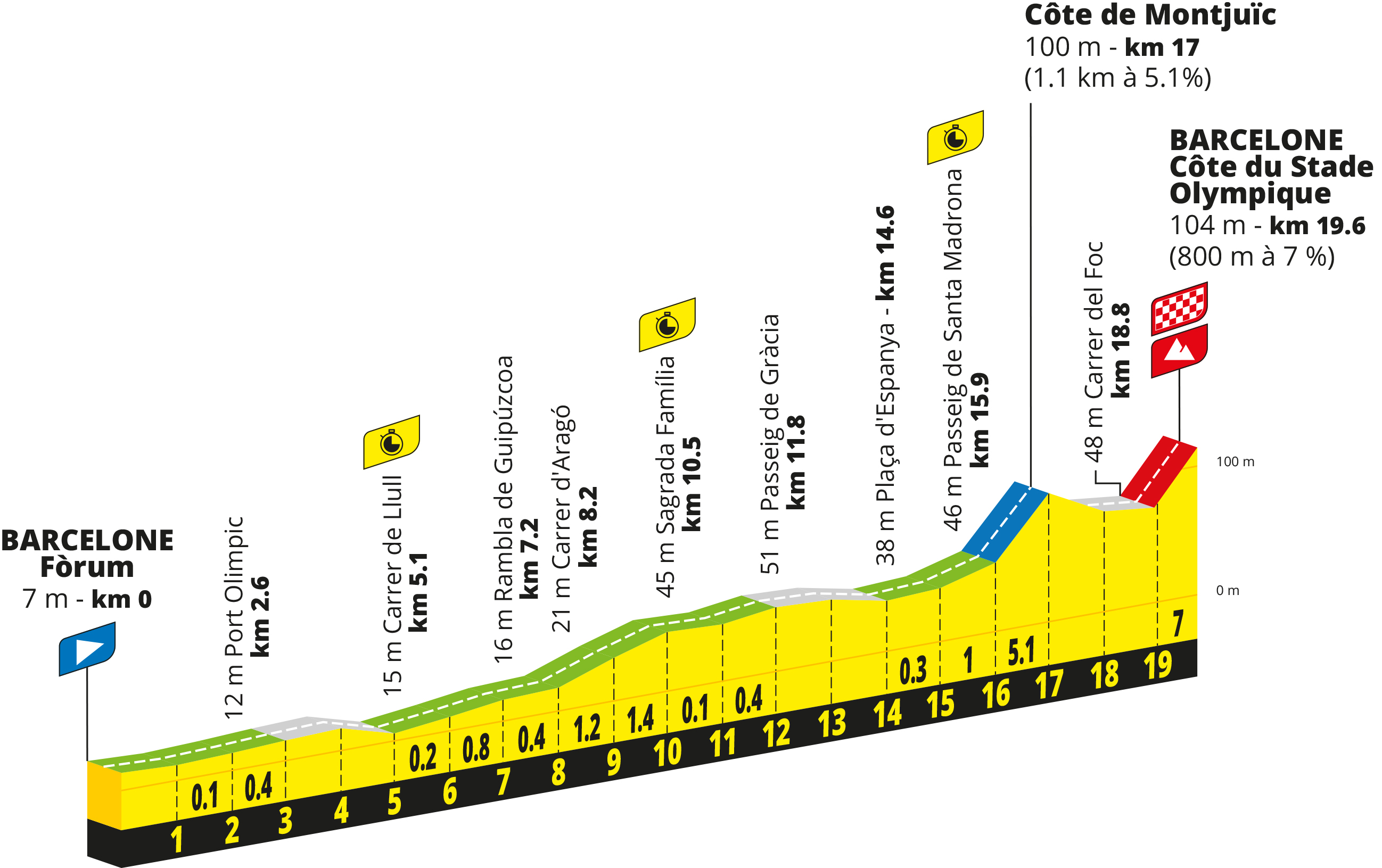
A team time trial in Barcelona. Held in the evening, the time of each team is taken on their first rider across the line and all riders get credited with the time it takes them to complete the course. It’s on big boulevards at first where strong riders can propel their teams before two climbs in Montjuïc where team leaders will make their bids for the first yellow jersey.
Stage 2 – Sunday 5 July
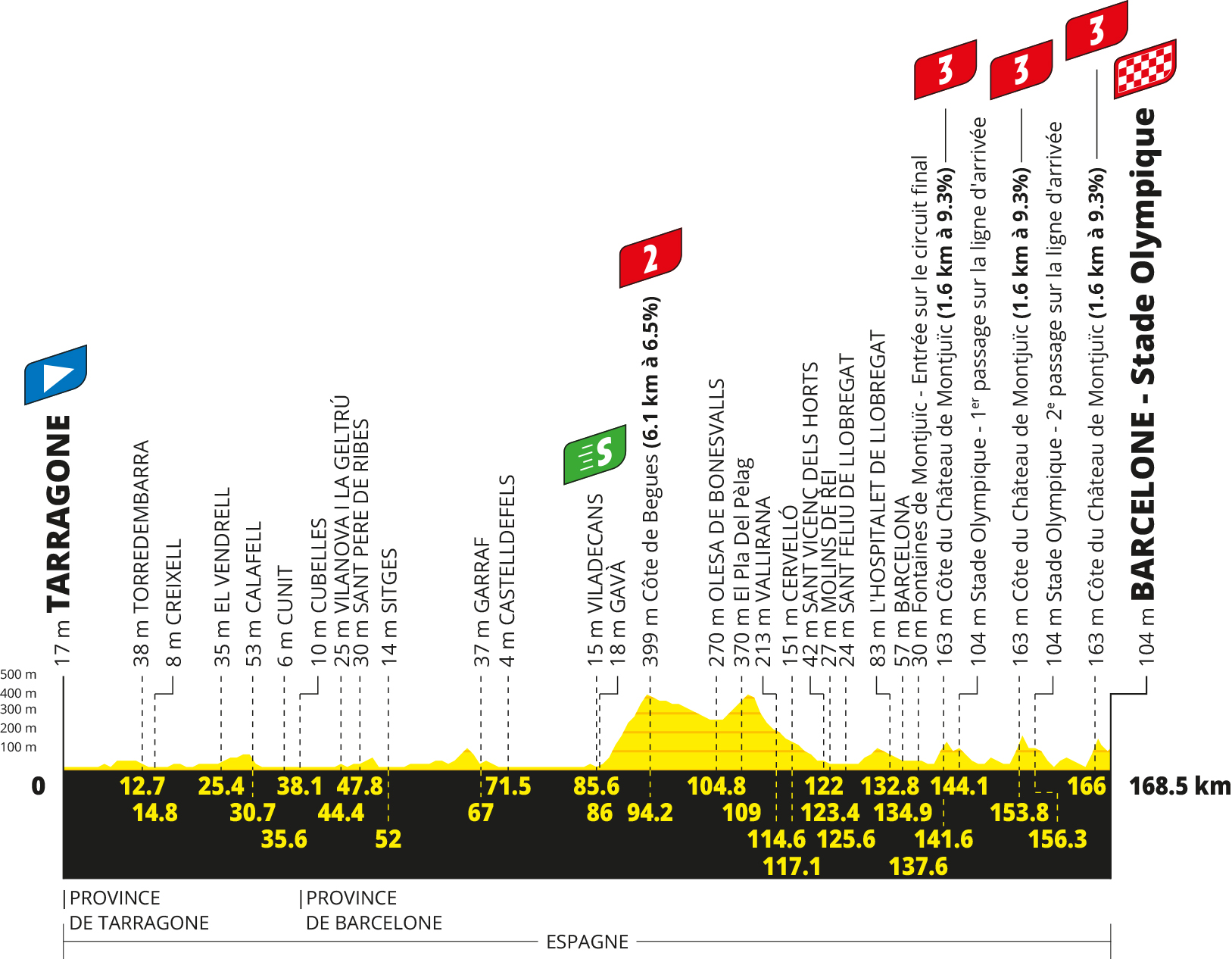
A spin up the Mediterranean coast then turning inland to add some climbing in the hills before a finishing circuit in Barcelona with the finish again in Montjuïc. The finish line is in the same place as the first stage but the preceding climb is different, it’s steeper and was used when the Vuelta a España finished here in 2023. If it helps imagine the Volta a Catalunya finish, just harder.
Stage 3 – Monday 6 July
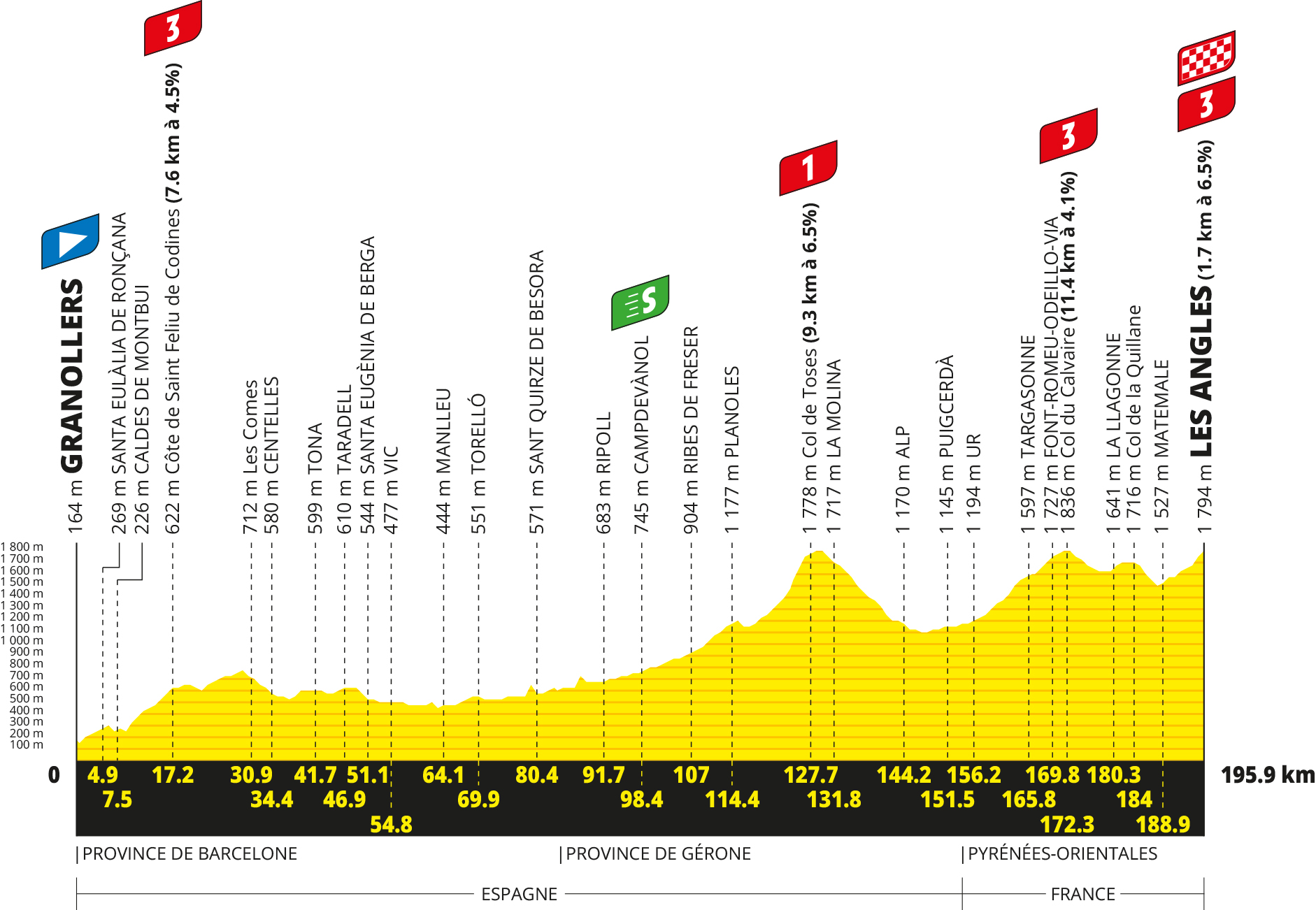
A mountain stage? It goes into the Pyrenees, there are 3,850m of vertical gain and the finish is just short of 1,800m above sea level so yes. The finish isn’t savage but has some hairpins and should give us a glimpse of form.
Stage 4 – Tuesday 7 July
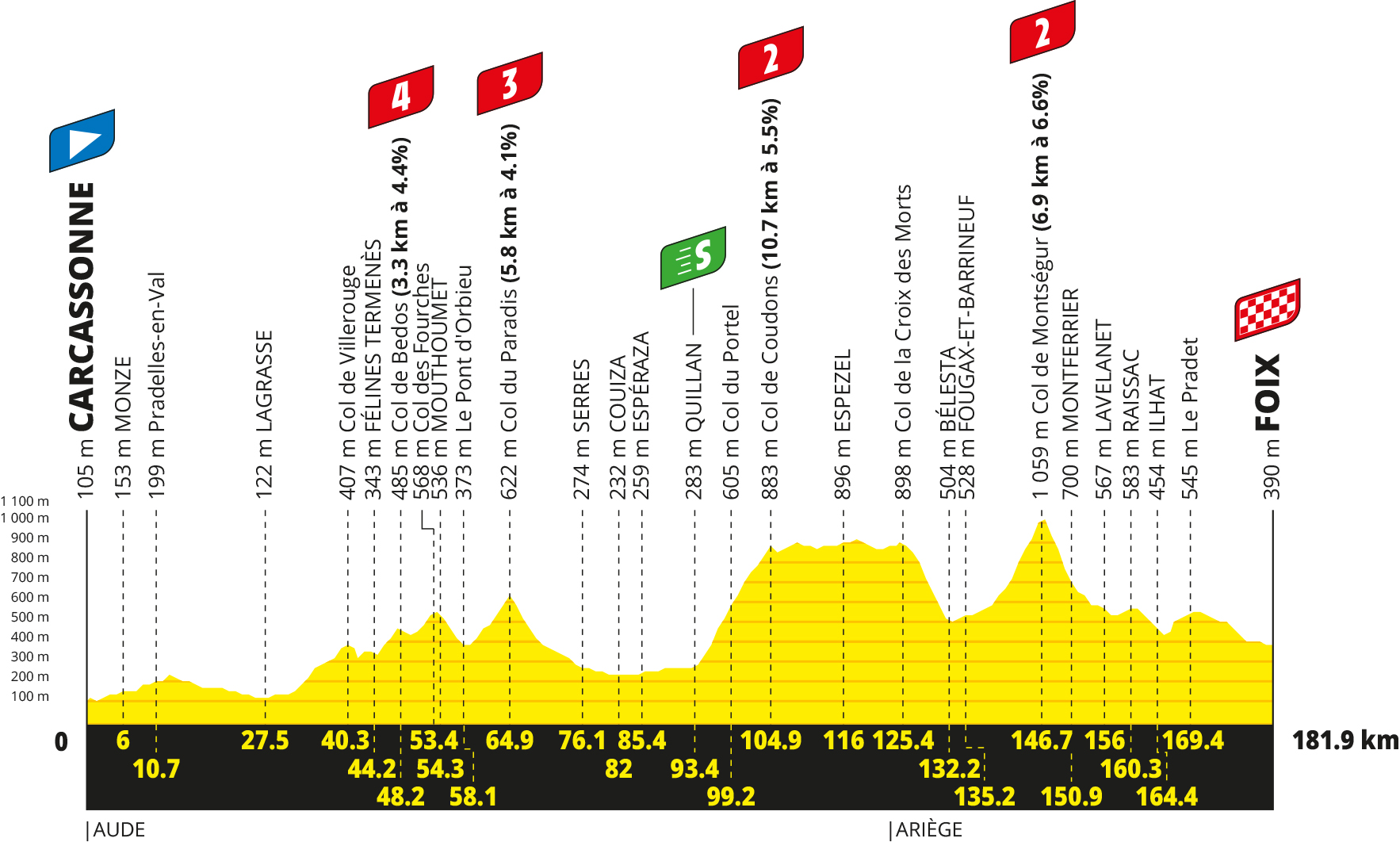
2,700m of vertical gain and this looks like an ideal mid-mountain stage for the breakaway, especially if the yellow jersey after Barcelona and Les Angles wants to give it away to better reclaim it later. It’s all on scenic roads of the Aude and Ariège.
Stage 5 – Wednesday 8 July
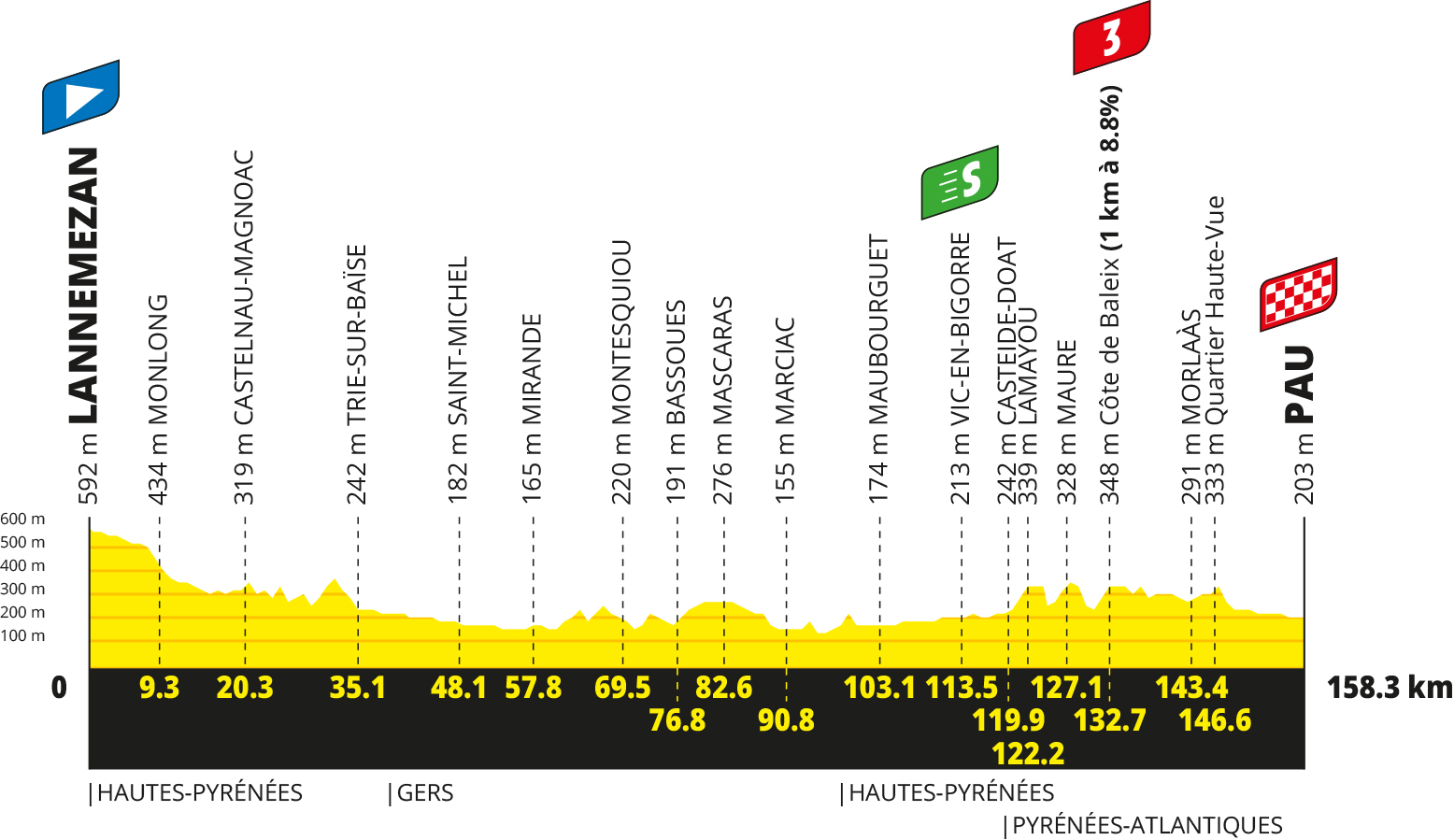
The stage goes to Pau for the 77th time. It’s not totally flat but this is a day for the sprinters.
Stage 6 – Thursday 9 July
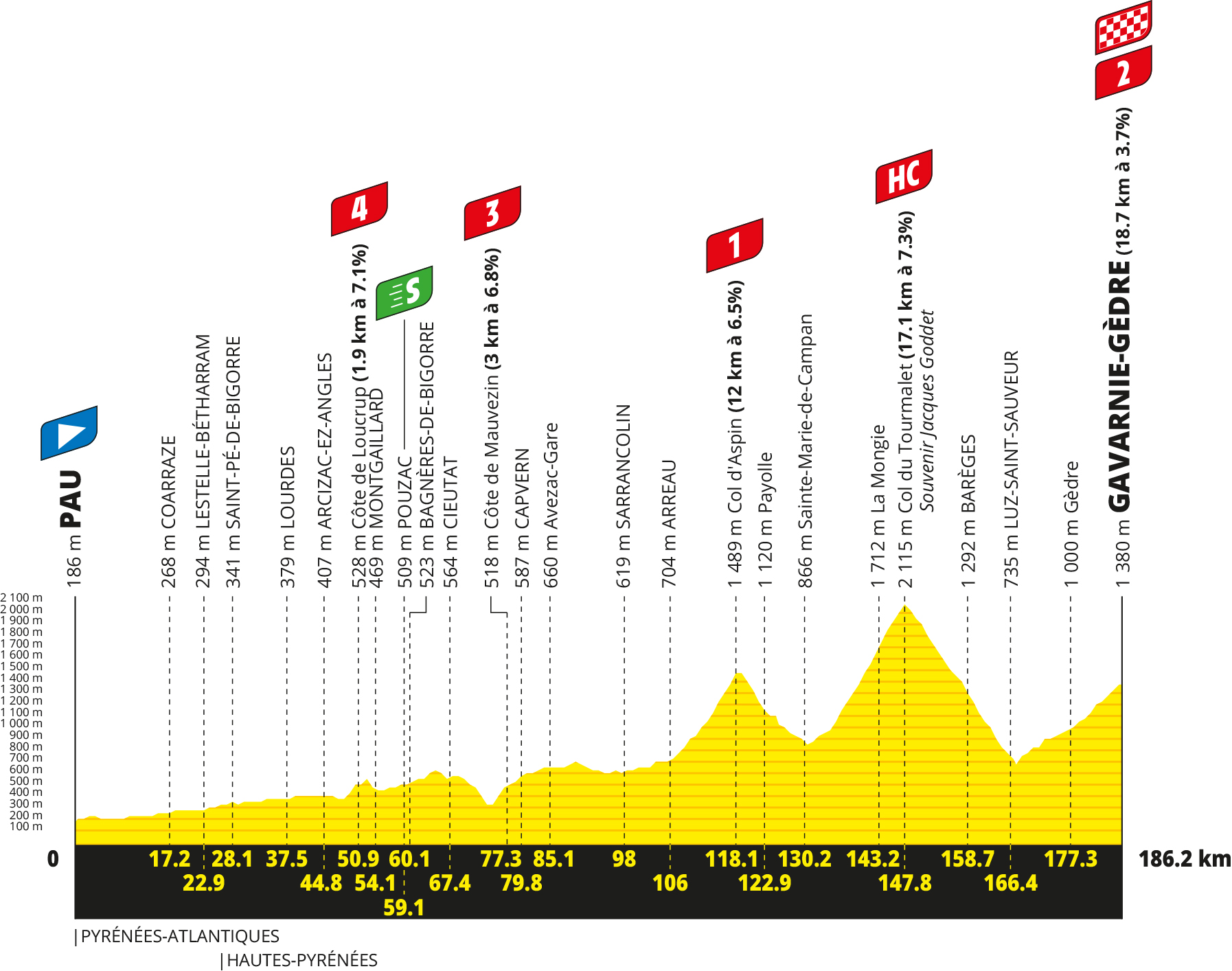
The Tourmalet awaits after the classic route out of Pau via Lourdes to the Col d’Aspin. So far, so déjà vu but the finish is novel with the climb to the village of Gavarnie. It’s a spectacular location inside a national park which explains why the race hasn’t been here before and if it works it opens up more routes that’s exciting as same road goes on to the Col de Tentes at over 2,200m but next time as that would be too much for the first Thursday.
Stage 7 – Friday 10 July
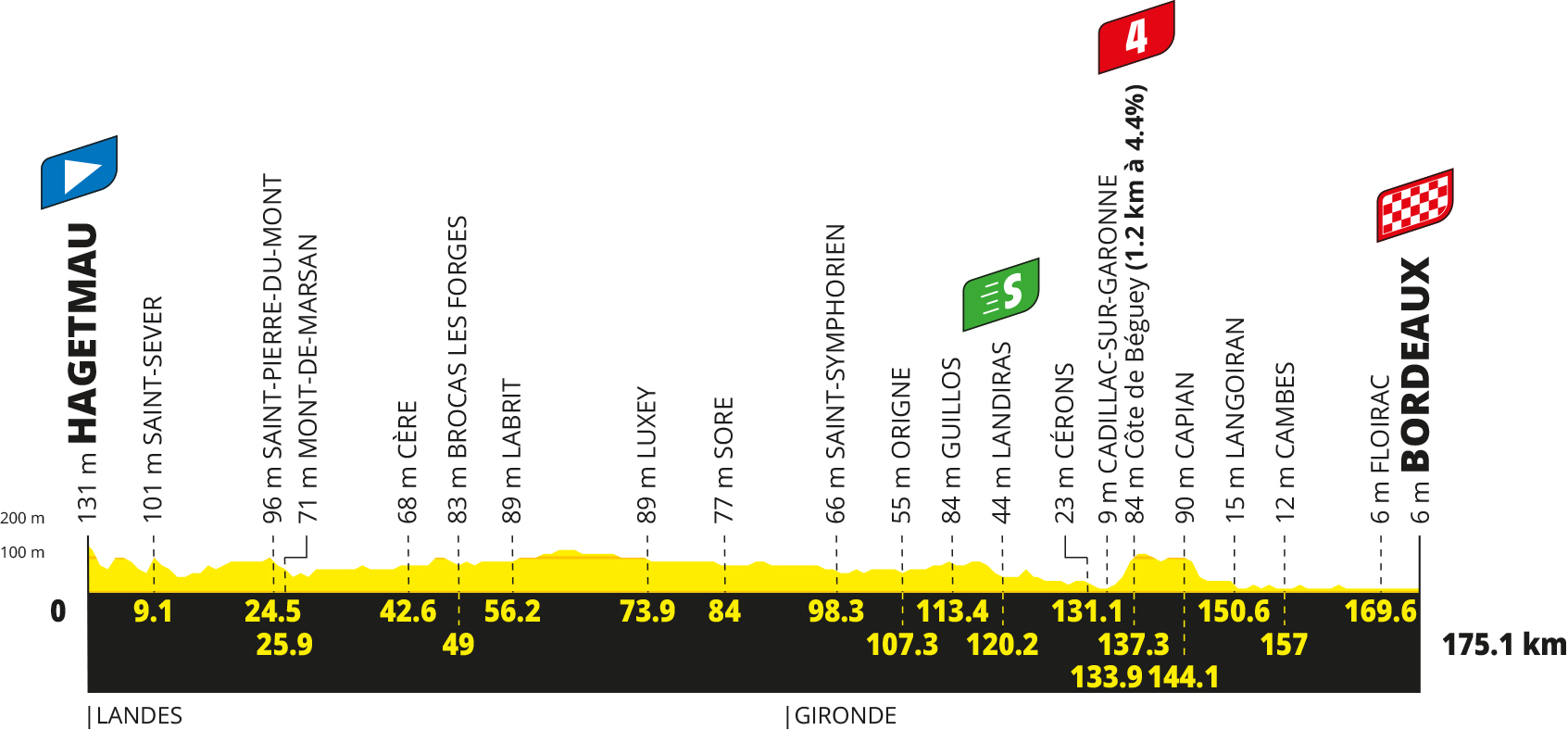
A sprint finish in Bordeaux. We’ll see if anyone attacks at all given the move is certain to be reeled in.
Stage 8 – Saturday 11 July
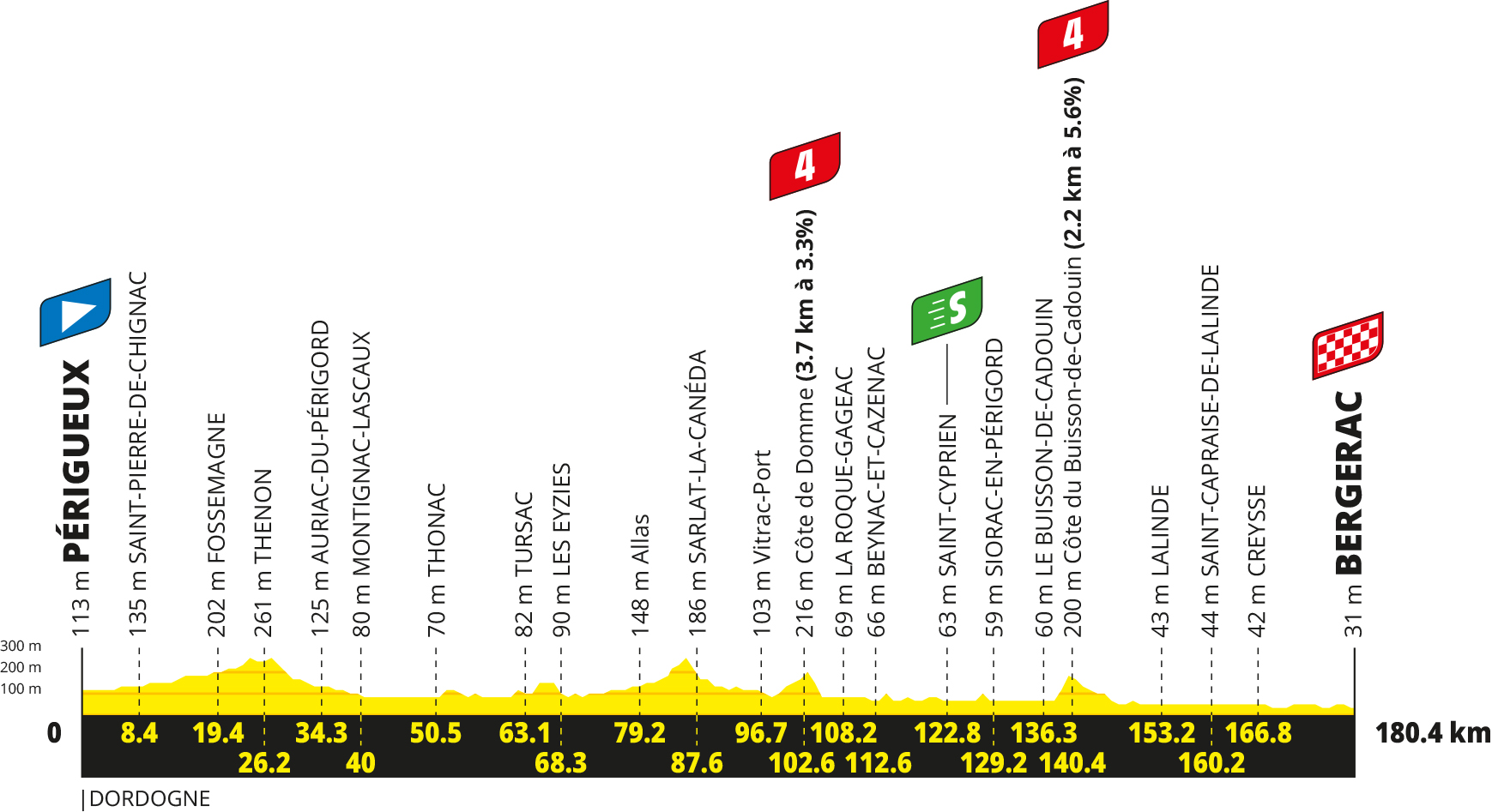
A sprint stage, this time arguably more scenic as it follows the Dordogne valley to Bergerac.
Stage 9 – Sunday 12 July
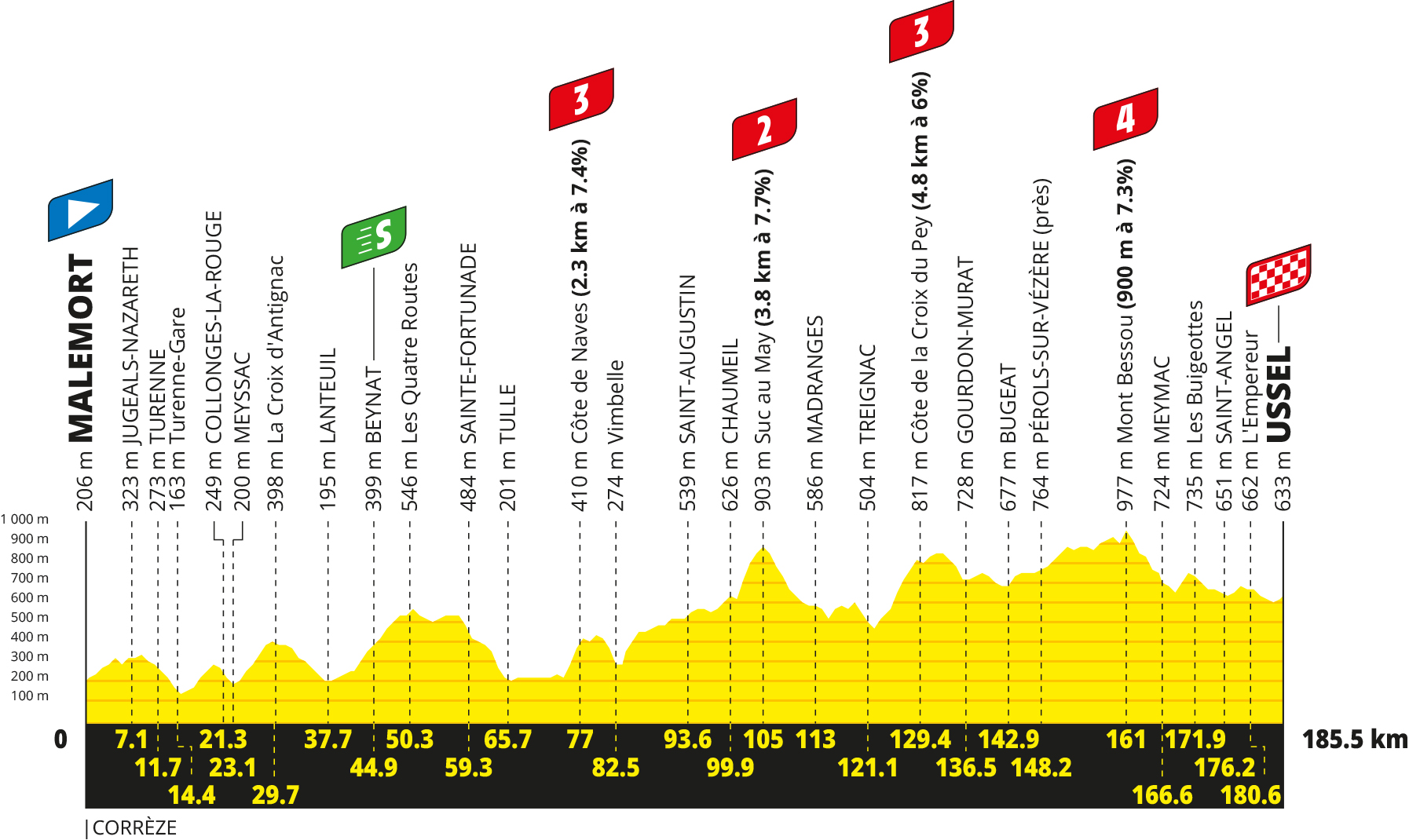
A day for the breakaway on hilly terrain with sapping rural roads that offer little rest. It’s likely more teams have spent more time analysing this stage than the Alpe d’Huez days as so many will want to go for the win on a day with plenty of uncategorised climbs. Expect a raucous first hour and more.
Stage 10 – Tuesday 14 July
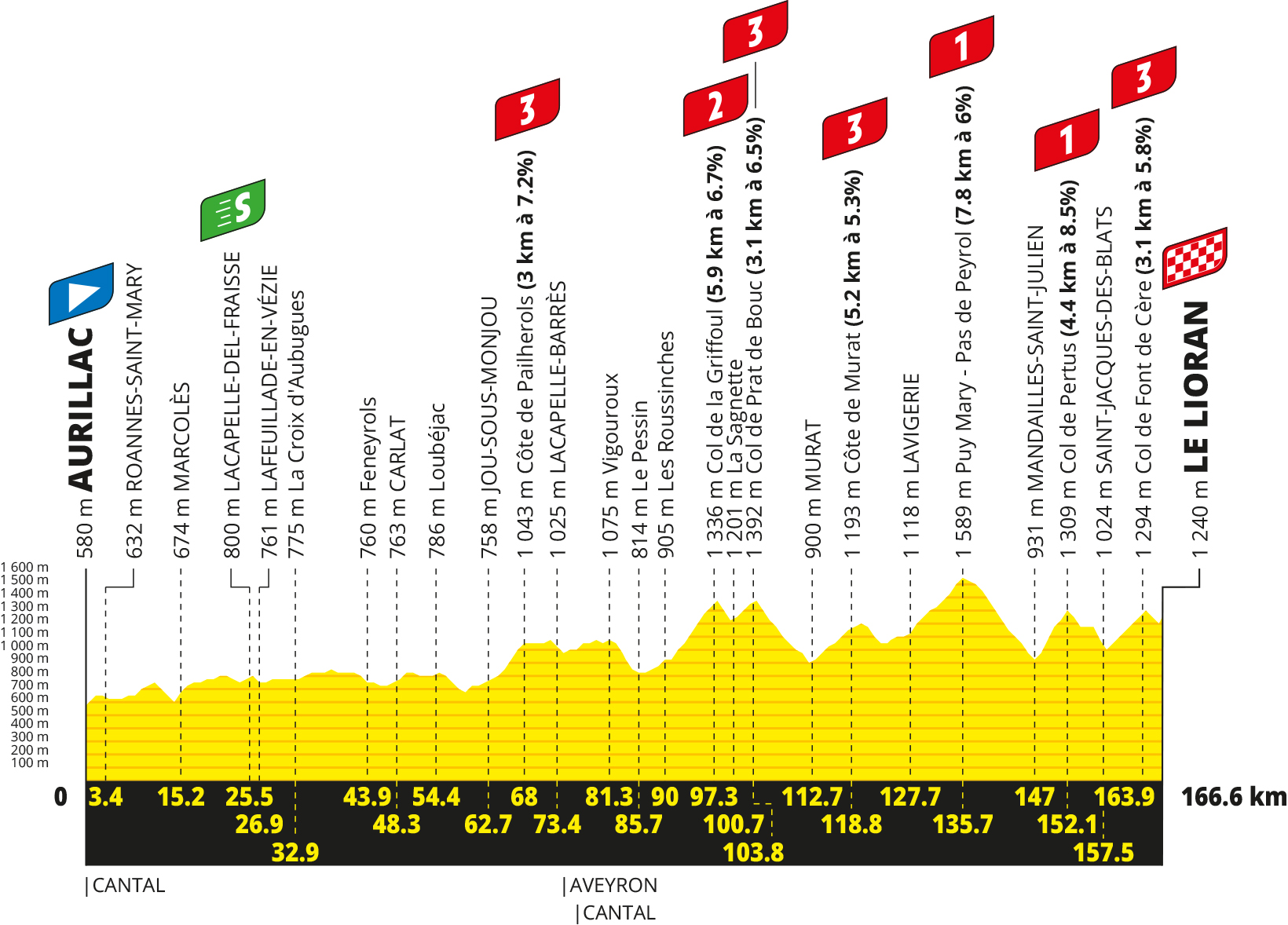
Bastille day and it’s back to Le Lioran for the third time this decade after 2020 and 2024. Visitors to the ski station could be forgiven for thinking there’s only one road there as the same roads are used again: the steep Pas de Peyrol and the Col de Pertus leading to the Font de Cère. It’s no bad thing, a photofinish was needed to separate Tadej Pogačar and Jonas Vingegaard last time.
Stage 11 – Wednesday 15 July
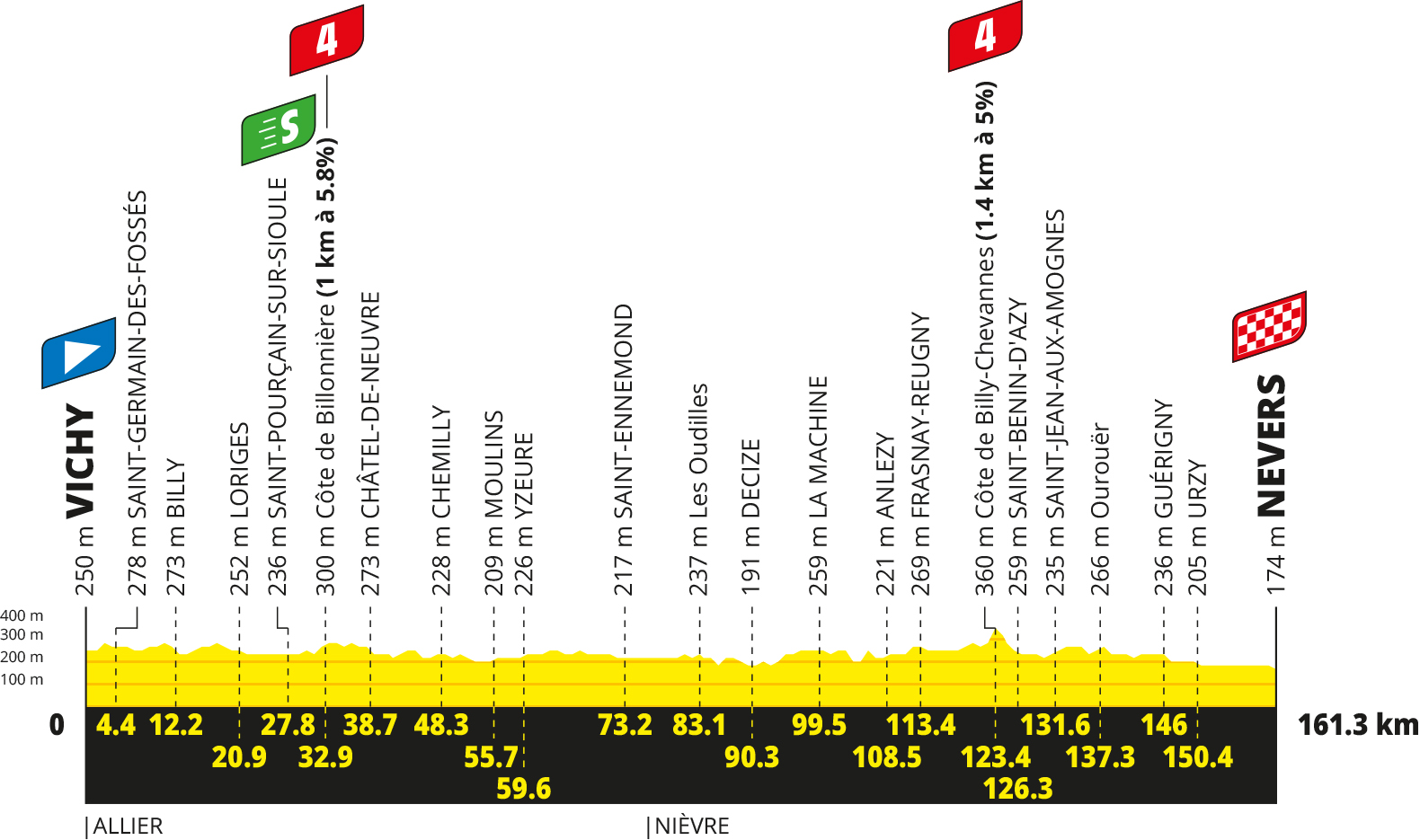
A flat stage to Nevers. When Paris-Nice came here in 2024 the team time trial found a steep hill to spice up the finish but this time it’s a day pledged to the sprinters.
Stage 12 – Thursday 16 July
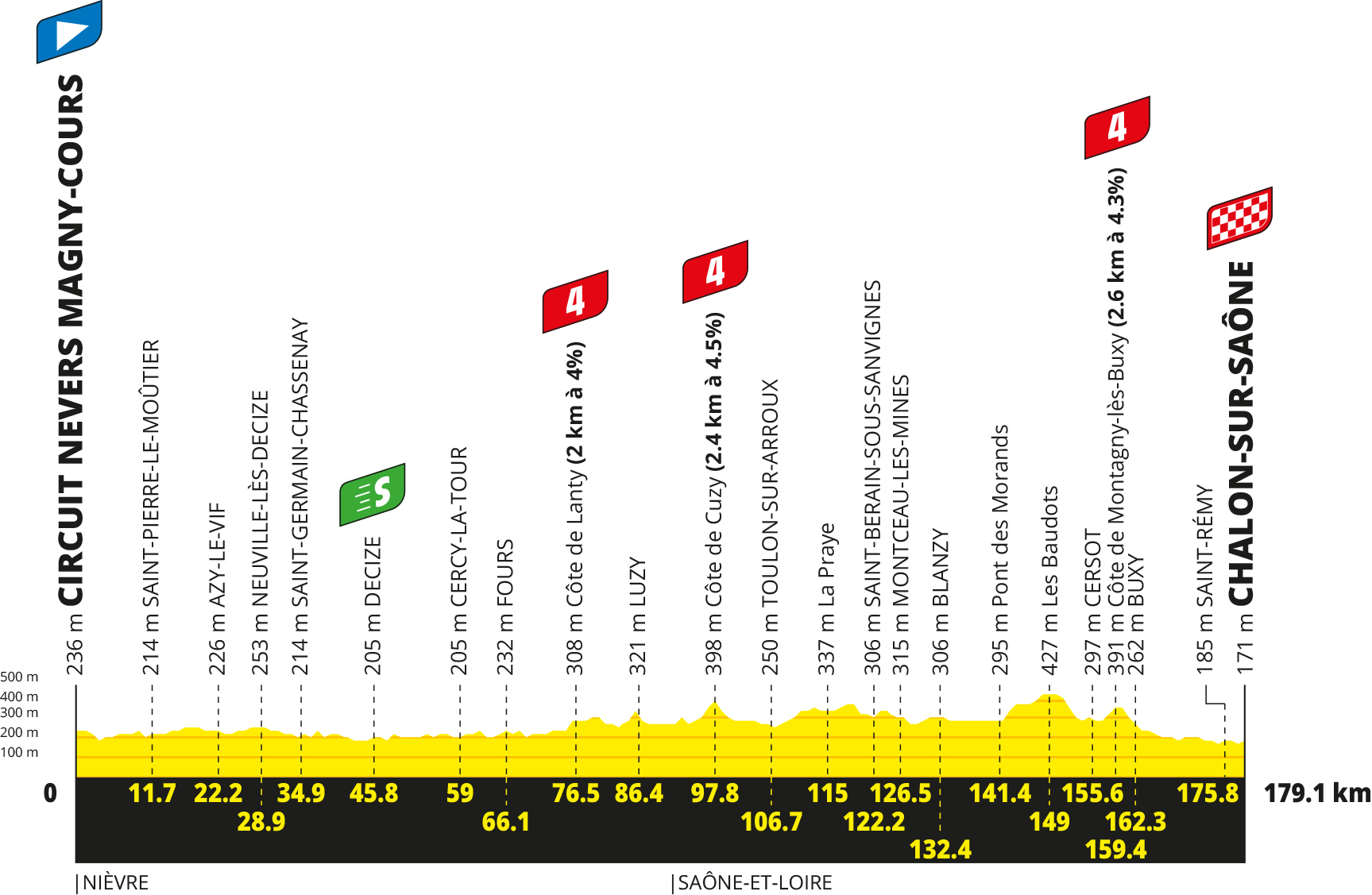
Hillier than the previous stage, the sprinters will be desperate to take this as afterwards their opportunities vanish.
Stage 13 – Friday 17 July
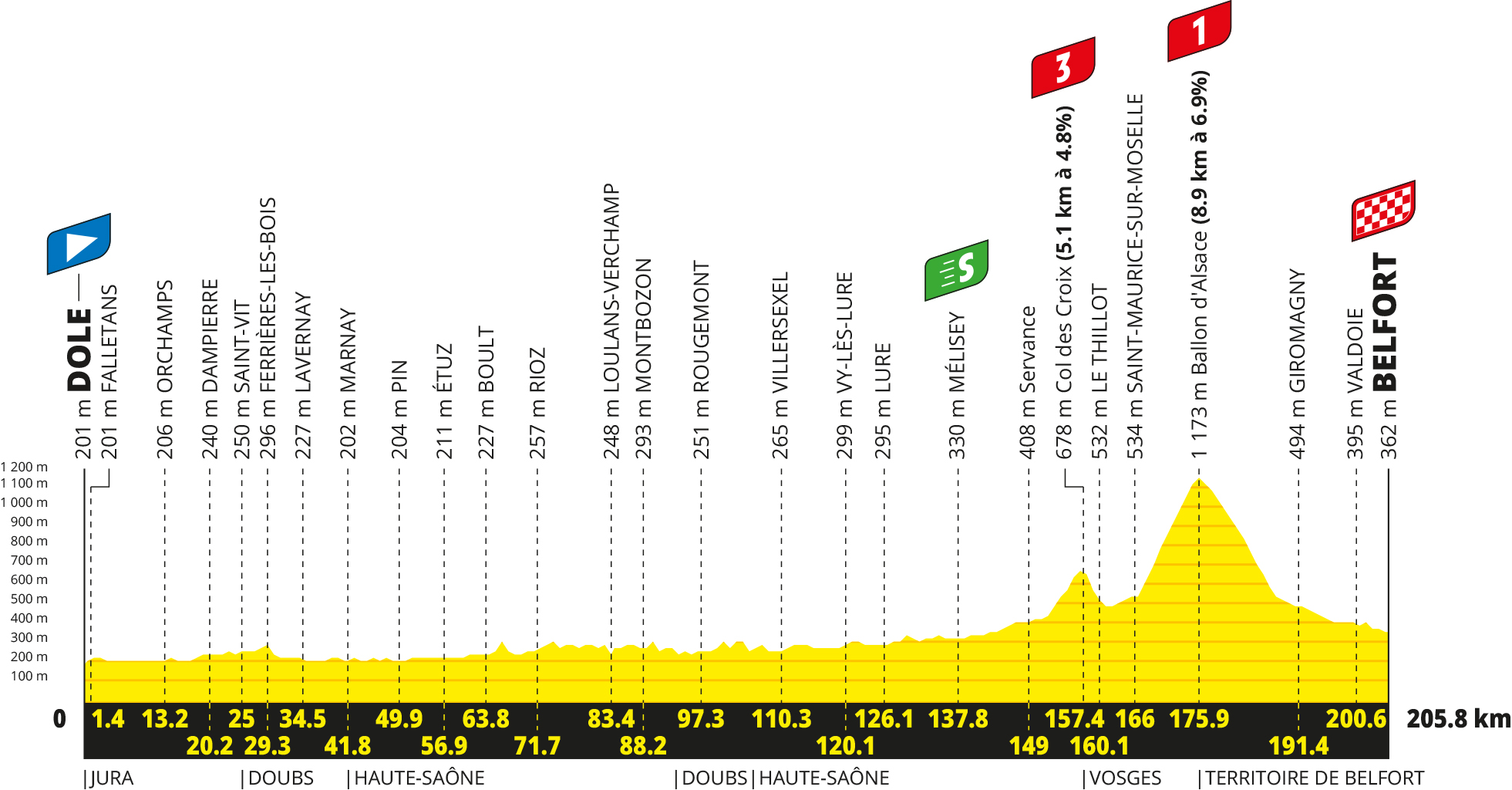
The first two editions of the Tour de France did cross some small mountain passes and hills but in 1905 the Ballon d’Alsace was the first big mountain tackled by the race. Today it takes 150km to reach it which is a problem for the eventual stage winner as they’ll have to cope with pushing a big gear for hours before finding their climbing legs to make their winning move. Will the GC riders attack? Don’t bet on it given the next stage.
Stage 14 – Saturday 18 July
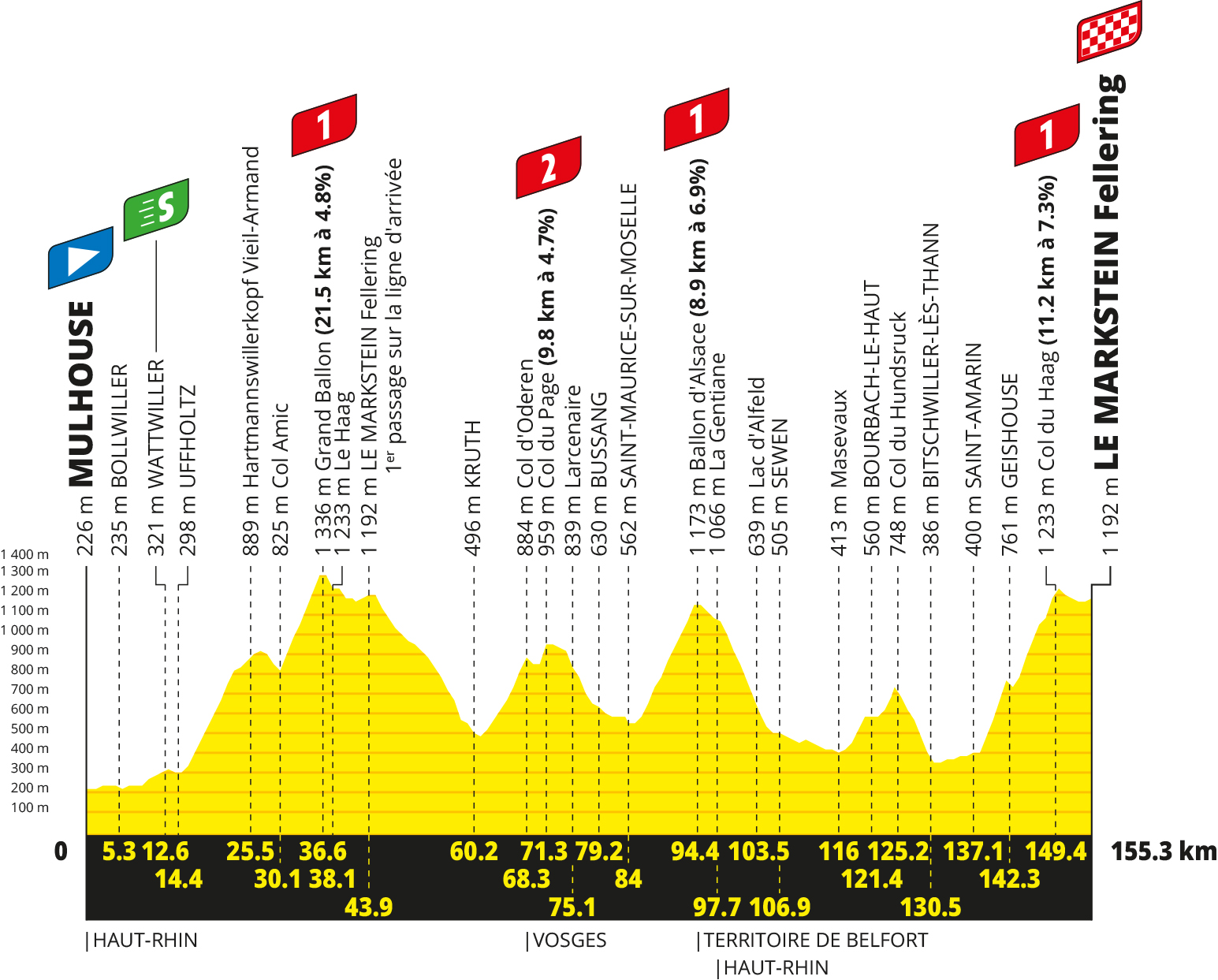
Only 155km and 3,800m of vertical gain but this is a crucial stage. The race has crossed the Col du Haag many times but in passing along the ridge of the Grand Ballon. Now it takes a new route up, a forest track that’s been paved to use as a cycle path and it’s steep and cycle-path wide in places, think an Alsatian version of the Col de Loze.
Stage 15 – Sunday 19 July
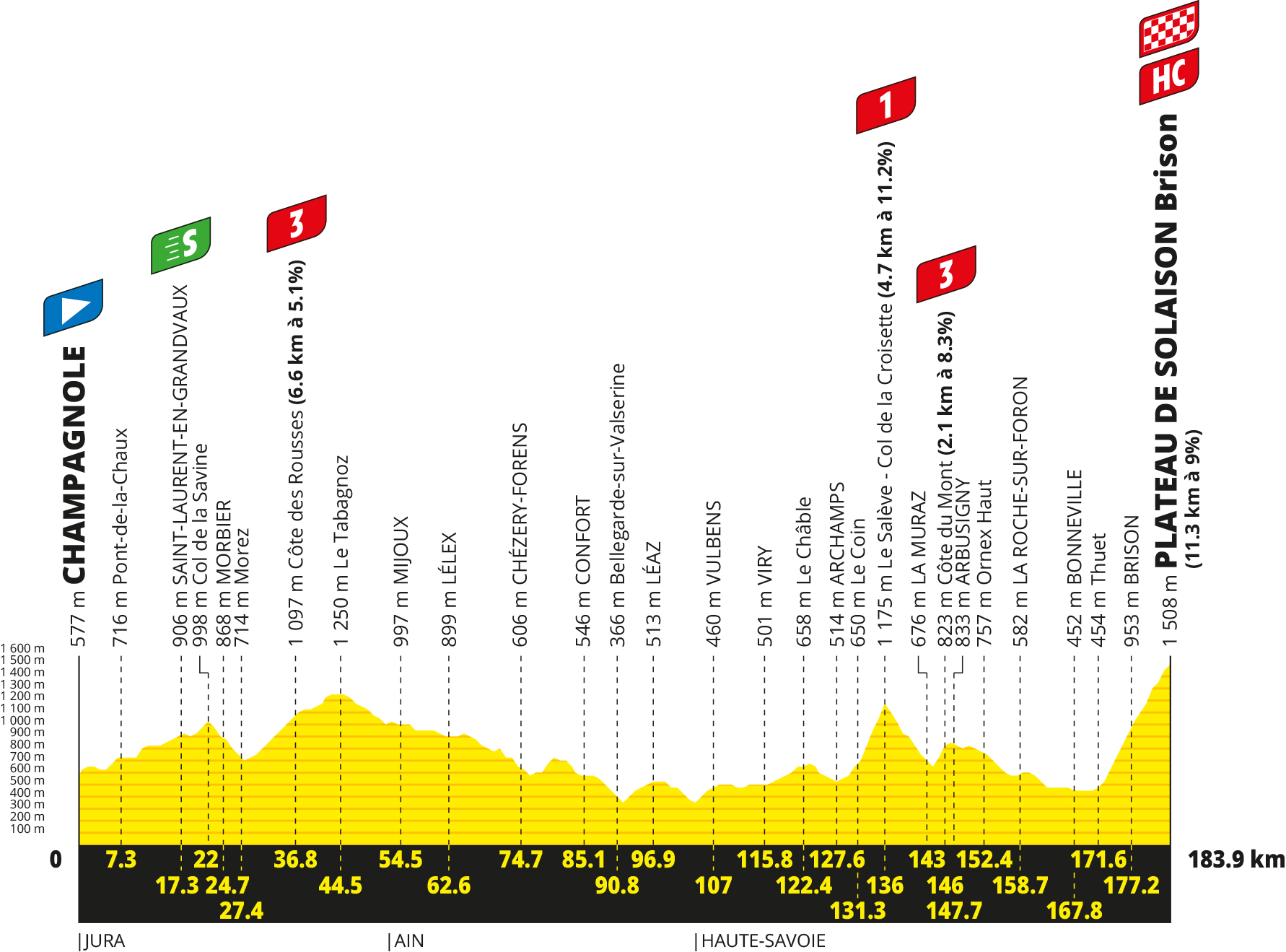
With luck we could have two races for the price of one as the breakaway goes clear to contest the stage win and the GC contenders battle it out. The stage opens in the Jura mountains and some gentle but persistent climbs. The “new” climb is Mont Salève, climbed via the direct route on the north-west flank and while the profile says it’s 4.7km at 11%, it climbs to the start making it 9km at 9% and the upper half has sustained sections at 15% so plenty will be dropped here. There’s still about a third of the stage left before the final climb to the Plateau de Solaison, 11km at 9% where Isaac del Toro just wrapped up the Aura Tour.
Stage 16 – Tuesday 21 July
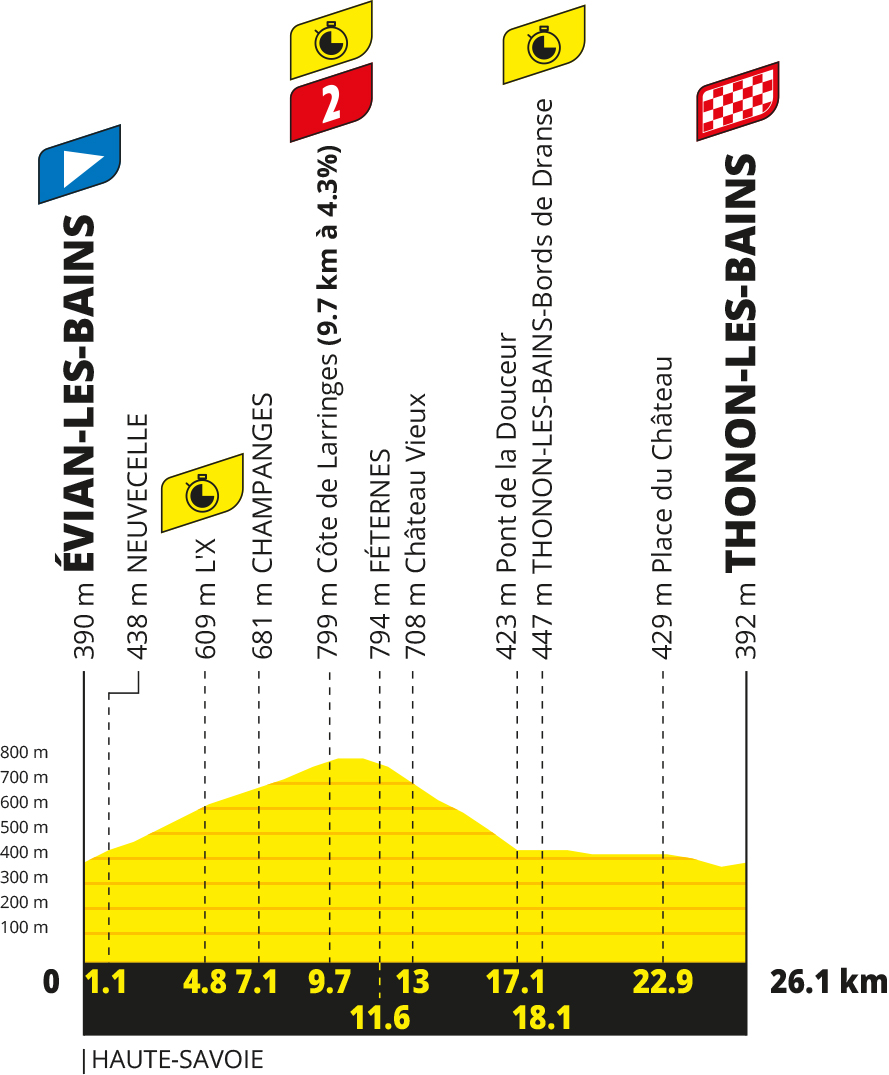
A time trial on the shores of Lake Geneva. The hilly climb out of Evian is gradual, it climbs at 3% most of the time on a regular road before a trickier descent. What looks flat for the final 8km is twisty in Thonon.
Stage 17 – Wednesday 22 July
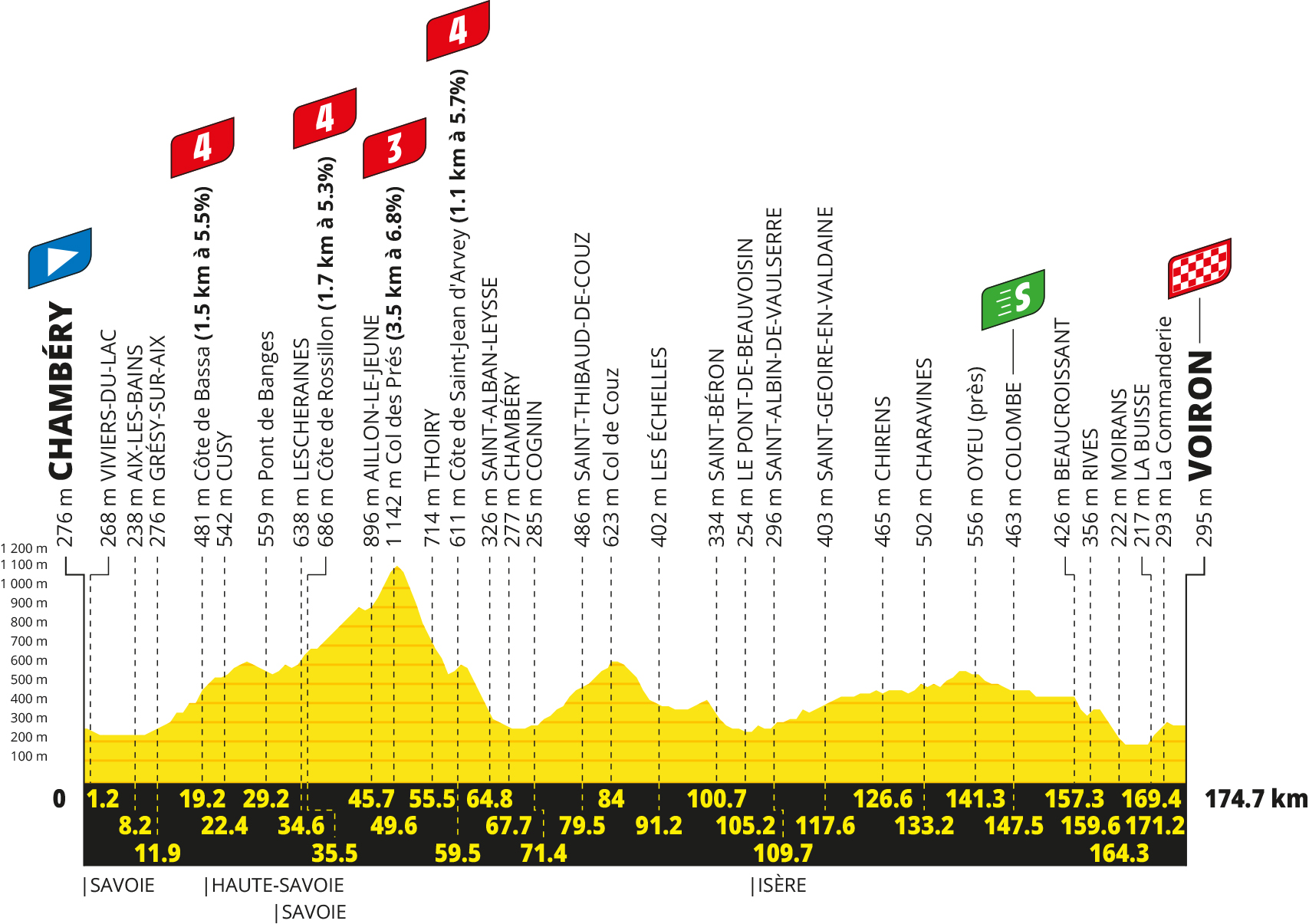
Plenty of jagged peaks and cliffs on the horizon but the route avoids the mountain roads. It still crosses the Massif des Bauges and climbs to the Col du Frêne before dropping back to skirt the start town of Chambéry and then take the Col de Couz before the route reaches the plains for Voiron which hosted the Vuelta’s French arrival last year. Sold as a sprint stage when presented last autumn, many will be tired now and this is a great day for a breakaway battle.
Stage 18 – Thursday 23 July
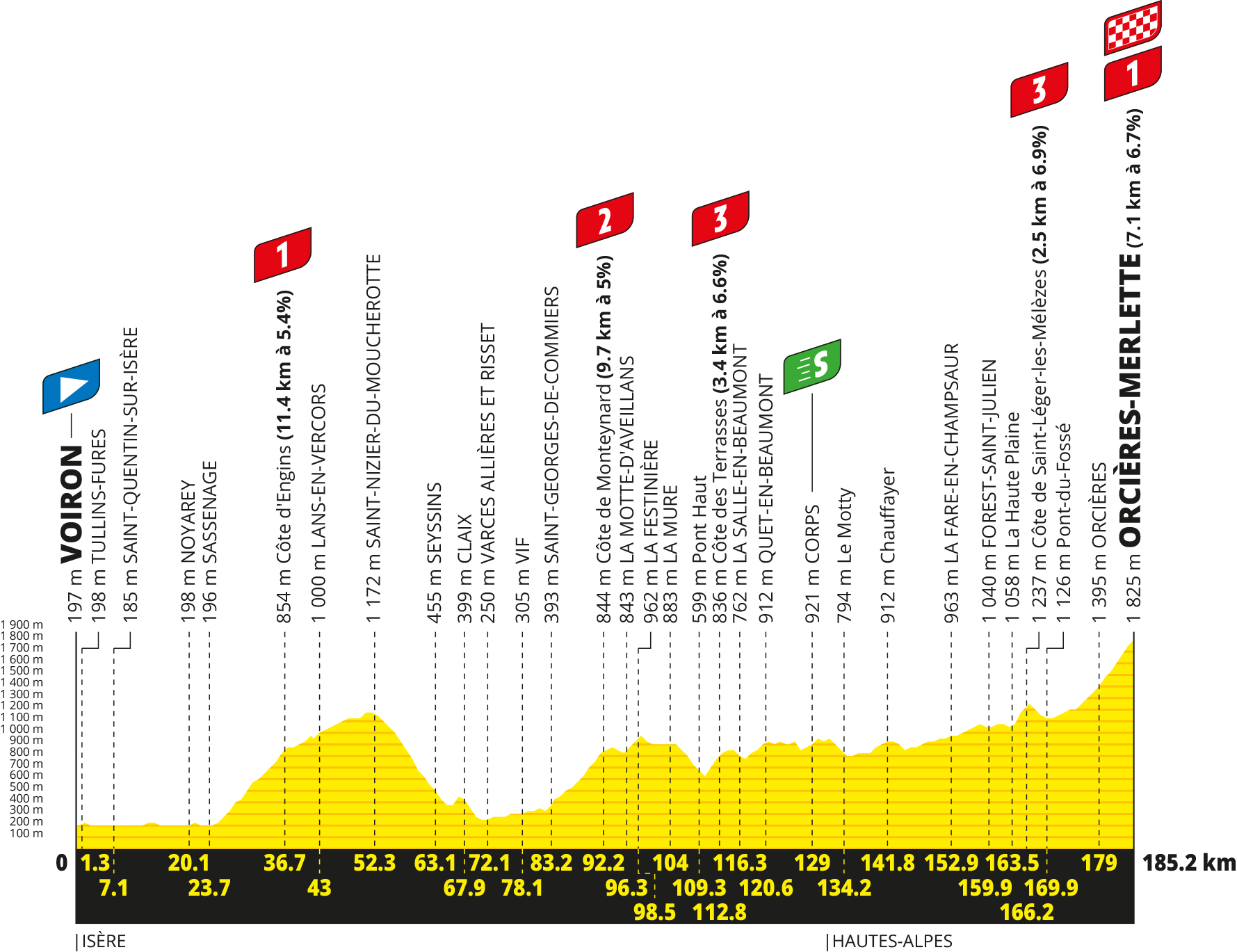
A ski station summit finish that avoids the high passes, the Col de la Festinière comes after Monteynard and no surprises before the finish in Orcière-Merlette, 7km at 6.5%. It featured in the 2020 Tour’s first week and the low gradient saw teams ride up in train formation and anyone who struck out was mown down. Coming in the third week means it should be different and a breakaway should be clear for the stage win.
Stage 19 – Friday 24 July
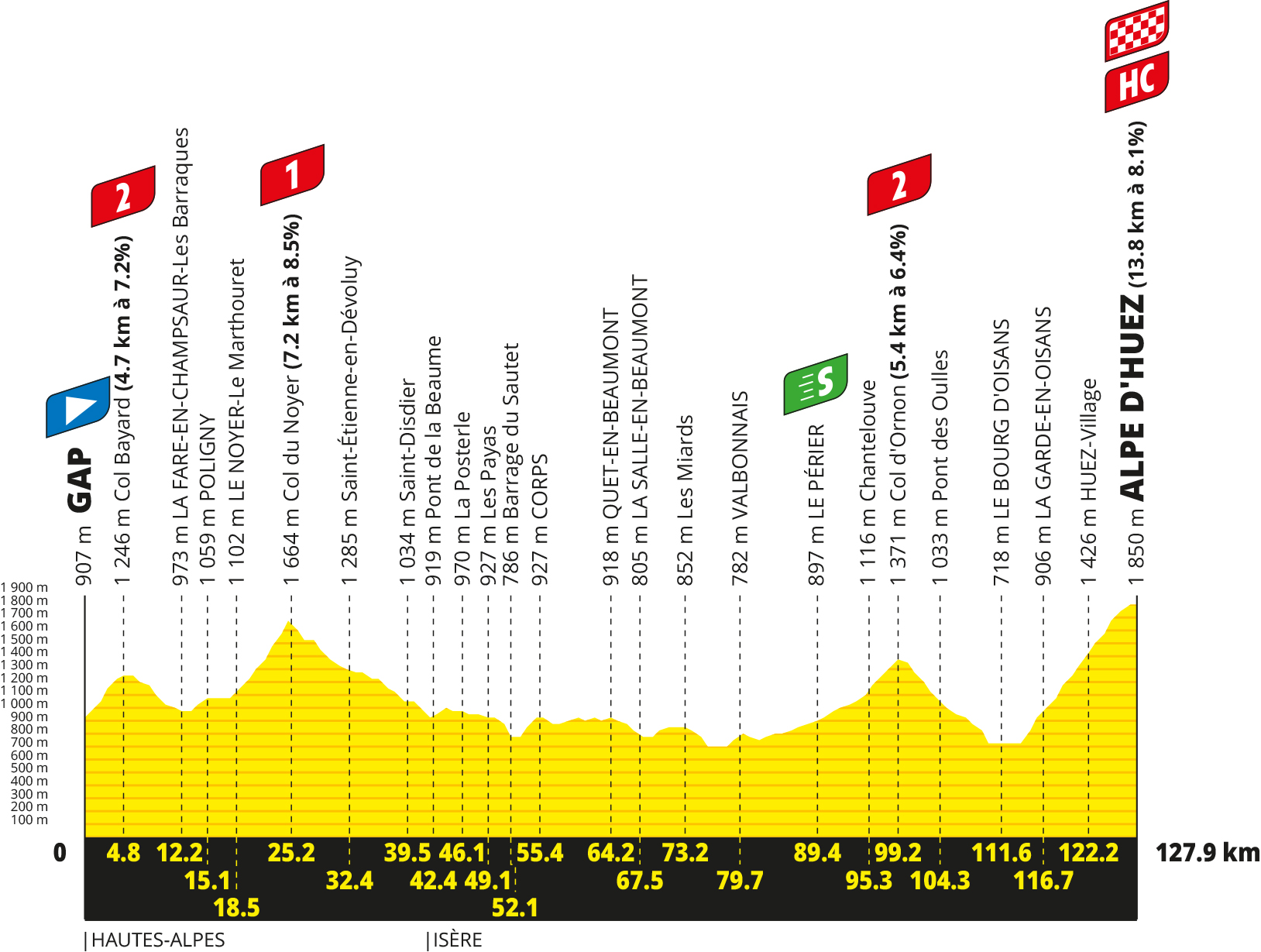
Just 130km. The Bayard and then Noyer climbs will sting early on as a move tries to go clear for the day. The Col d’Ornon is a gentle climb before a spectacular descent to Le Bourg d’Oisans. Then come the 21 hairpins – 23 if you actually count them – to the finish line in Alpe d’Huez, back after a four year hiatus. It’s famous for being famous but with 13km at over 8% it’s a decisive climb.
Stage 20 – Saturday 26 July
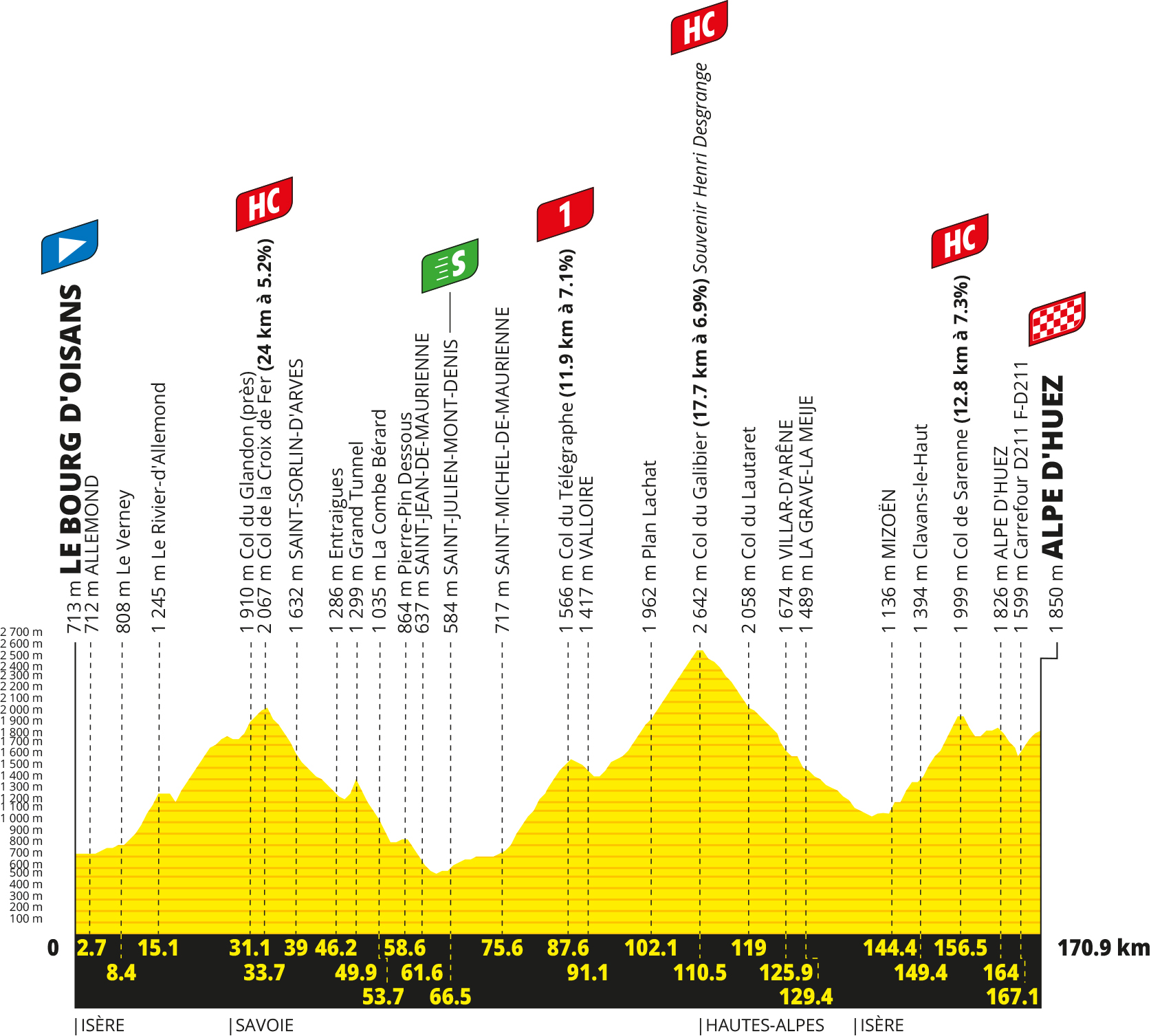
After the peloton’s had a rough night’s sleep at 1900m in Alpe d’Huez here comes the Queen Stage with 5,600m of vertical gain. The Croix de Fer is a big start and then comes the mighty Galibier, the high point of the Tour. The plot twist is rather than the descent all the way to Le Bourg d’Oisans at the foot of Alpe d’Huez, a right turn instead to tackle the Col de Sarenne which leads onto Alpe d’Huez via a backroad. The Sarenne has been used before but as a descent and the climb is tougher than the stats suggest.
Stage 21 – Sunday 26 July
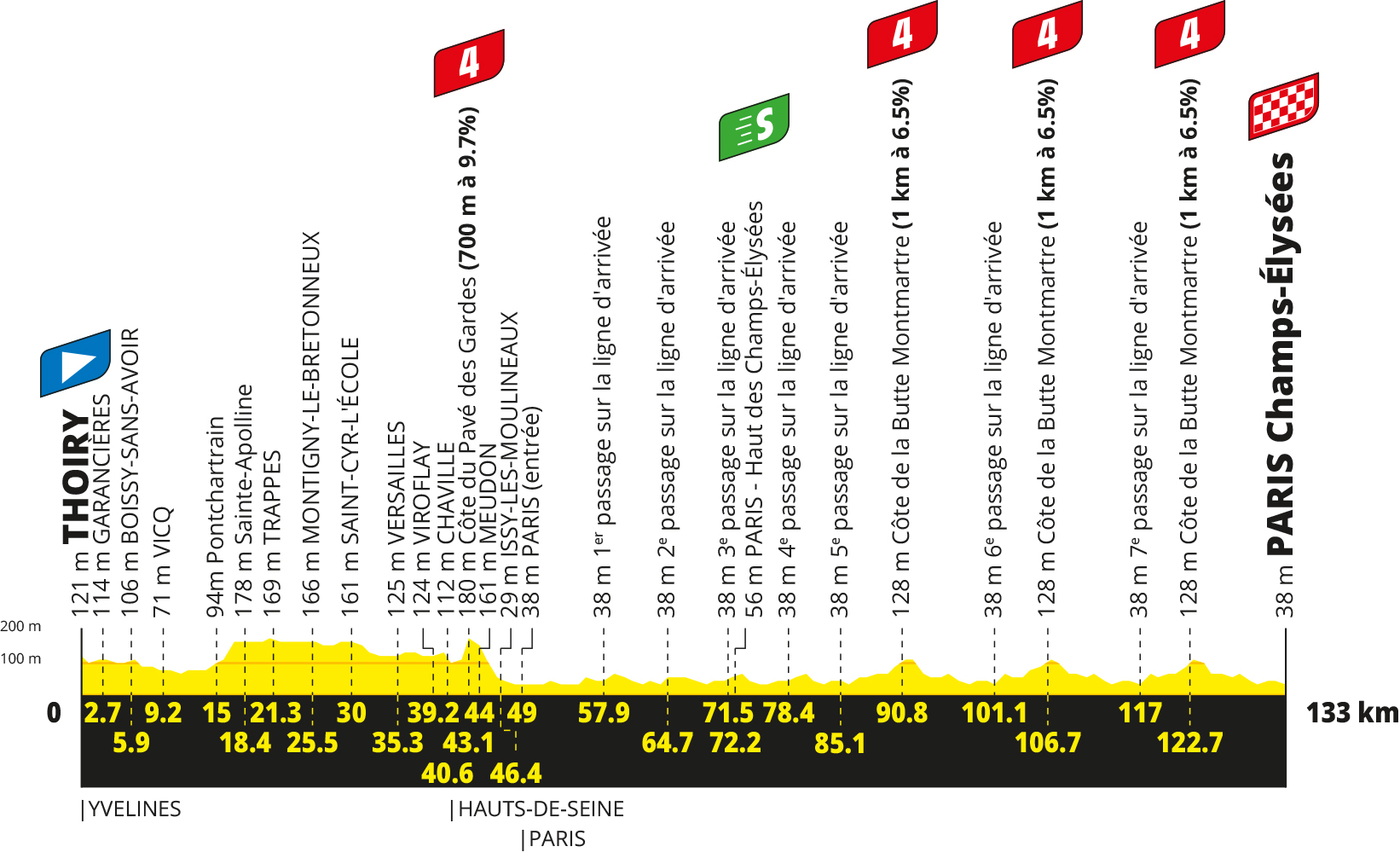
It’s back to Paris with the Rue Le Pic and Montmartre making an encore after the thrills they supplied the last time. The Paris match will be slightly different this time with a longer passage along the Champs-Elysées in between to lengthen the laps and give some riders more chance to chase in between the ascents of Montmartre.

The Unmissable Stages
Do you really want to miss anything? Every stage is live from start to finish and with most of the best riders present and in peak form there’s an intensity and pressure only felt at the Tour.
The easy advice is to say watch almost everything but on the sprint stages tune in for the finish; but if you did that last year you’d have missed Jonas Rickaert and Mathieu van der Poel’s thrilling move.
- Stage 1 should look the part amid the landmarks of Barcelona and the team time trial is now a televisual event thanks to the rule timing riders individually
- Stage 2 should offer lively sport in the finish
- Stage 6 for the Tourmalet and Gavarnie finish
- Stage 9 for the breakaway battle, the first hour could be more thrilling than the last
- Stage 14 for the Vosges mountains and the Haag summit finish
- Stage 15 for the Plateau de Solaison finish
- Stage 19 for the Alpe d’Huez summit finish
- Stage 20 and the Alpe d’Huez encore, hopefully there’s some suspense left
- Stage 21 for the Paris match in Montmartre

Points and Mountains competition changes
If you’ve made it this far, some news too. For 2026 points competition sees more points awarded on flat stages, 70 for the winner instead of 50 and this should tilt the green jersey contest even more towards the sprinters. Similarly there are more points at the intermediate sprint too with 25 to the winner when it has been 20 before.
The mountains competition no longer awards double points for the highest climb. Obviously this should make the polka dot jersey less dependent on one moment, ie the Galibier on Stage 20 where it’ll be 20 points for an HC climb as usual, rather than the 40 points we saw awarded on the Col de la Loze last year.
The new scales for 2026 are listed in full at inrng.com/tour
Thanks as always for this! I don’t have time to follow the sport as closely as I did, so having this concise context for each stage is invaluable. I for one am looking forward to the battle this year, and if I had to make a bet it’s that the Tour will be quite a bit more exciting than watching paint dry as some have suggested.
“Watching paint dry” might be a bit too harsh, as the first week seems interesting.
The ideal scenario for the race would be if UAE and Visma stumbled in the TTT and Pog experienced one of his pre-2024 off-days on the Tourmalet.
Now *that* would make for a Tour. 🙂
Kevin,
Guilty as charged, though I’m not so sure anymore. Aside from the first stage, Pogačar hasn’t been as dominant in TdS as I expected (writing before the end of the last stage).
Yes, there are all sorts of reservations, but Pogačar rarely misses a chance to win convincingly if he can. It may be that we’re heading into a closer Tour than we would have guessed…
The latter has always been my feeling this season, notwithstanding what we saw or might see in this TdS (now Pogi left everyone else behind but is still chasing Lenny).
attacking for the stage win 71 km out and crossing the line 2min 15sec ahead –
not a dominant show
tough crowd
+ His partner’s broken jaw probably curtailed his mood during the event
He was speaking of renouncing to the last key altitude concentration in Isola 2000 (or reduding it) to stay with her at home…
The difference between one’s domination and the mere submission of most of the rest might be subtle in cycling as well as lige in general, yet it was quite visible on st. 1 of TdS – which doesn’t take too much away from the show provided by the racing on that stage, especially some 10-15 kms before and after the “attack”. Which wasn’t even properly “an attack” in the strictest sense, although of course it worked as such (plus some further elements of interest provided by Carapaz, Bagioli or Pogi himself when he later pushed hard on the wall).
Same for the ITT or the last stage, i.e., great, impressive, amazing was it anybody else, but not as astonishing being Pogi, even more so considering how close were both MvdP (not a TT specialist) and Lenny (great climber but all the day out in the break).
The Locarno stage didn’t improve sensations on a very appropriate terrain, but I agree with James that emotional and tactical confusion probably weighed him back even more than the efforts done the day before.
All in all, a very solid and consistent performance which confirmed excellent work has been done in the while when compared to Romandie, yet not the sort of shocking piece we saw in last year’s Dauphiné.
Add to that UAE team generally suffering from a mediocre season with just a few individual exceptions, whereas Visma looks back to convincing preparation work across most of their athletes, and Vingo having had one of his best Springs ever, 2023 level, without looking to stressed by the Giro.
Not that I’d be hugely surprised if Pogi had the TDF sealed come st. 14 – or 10, or even 6! But that’s more ’cause of his potential and creativity.
All the same, I wouldn’t be surprised if he had to fight for it across the three week, and it wouldn’t surprise me, either, if he was to lose it around the Alpe, or in any of the (few) stages where team strength is paramount.
+1 Joe… tough crowd!!!
I don’t see this Pog negativity tbh – and he didn’t just finish ahead of Lenny, he chased down 2mins, having already put the rest of the race to the sword on stage1 plus won the TT. I cannot see the evidence that he’s below par in any sense, and given what we’ve seen the last few years I think it’s more likely he was treating this as a training block rather than anything else. Riding to numbers rather than showing his full hand.
MVDPs TT ride may have been an outlier but we also know how strong he is, and there’s a good chance if he went for more TT’s we’d see more results like this so again I’m in the camp that Pog’s level is still extremely high, especially given his poor-ish TT at last years Dauphine.
I just think that given the weight of all the results and form of the last few years it makes a lot more logical sense to see Suisse as Pog heading towards his peak rather than being sub-par as some seem to be inferring, if I’m proved wrong so be it but it seems like wishful thinking from those hoping for a close TDF.
Pog has hit almost every goal he’s set for close to three years, the thought he’s coming into this TDF any less than 99% to me is fanciful – plus… he could be 90% and still win… so I have him as the overwhelming favourite.
“Add to that UAE team generally suffering from a mediocre season”
Normally I’m enjoying your fact based comments, but what the hell is the “mediocre” part of the leading team with 44 wins and 36 other podiums?
Do we now consider ever season in which they might not reach the otherworldly 97 wins of last year “mediocre”?
That’s hilarious. The second placed team had just ten more wins than UAE now, and this after 12 months…
Just compare with previous years: how “concentrated” are wins vs. spread across the team? Especially relevant wins. This year I feel I’ve only seen Pogi and Del Toro winning big, the rest only got very small change. But I admit that perhaps I’m wrong as I didn’t compare seasons at the same moment, i.e., maybe it was the same in previous years right before the TDF. I believe that Adam Yates, Almeida, Ayuso, besides Pogi and Del Toro, had been performing better across the previous two seasons. Maybe even McNulty.
The opening few days seems absolutely prime for Pog – especially after what we saw on stage 1 of the TdS. These mid-mountain stages are where I think he holds a real advantage over JV and I could easily see him having a couple of minutes advantage by the end of stage 4 or 6.
Unless it becomes a self-imposed ego trap as in 2022 😉
@Kit It does seem like the parcours doesn’t suit Vinny so much but does favour Pog (not that many types of terrain stop him). So maybe that played into the decision to go the Giro, as well as achieving the ‘triple crown’ before Pog.
It also seems a bit odd that the aim seems to be to have the race decided on the two Alpe d’Huez stages before Paris, yet as Kit says the early stages seem to favour Pog building a decent lead (unless UAE have a nightmare ITT and he’s playing catch-up!)
We’ll see the team selection but he/UAE should be behind for the opening TTT. Or to put it another way, if Ayuso takes yellow in Barcelona, Pogačar might be quite happy to leave him in it given the course, the work involved.
We’ll see but I can’t imagine he will lose much, if any, time on the TTT (sorry, mistakenly wrote ITT originally). But agree it may be wise to let someone else have yellow for a while.
Based on Pog’s recent Swiss solo, I doubt even if half the UAE team crashed in the TTT, it would set him back much. The issue with the new format (though I get the reasoning behind it) is that it removes some of the team element.
I’ve just scrolled down and looked at each stage without really reading much and on first impression it seems incredibly hilly without any really flat bits!
5, 7, 8, 11, 12, probably the new new 21 too, pretty standard I’d say, for the Proud’homme era of course, not the ol’ Leblanc days.
A certain lack of mountains, but perhaps that’s not bad from time to time, at least if the big names fight hilliers stages, too (as they often do) and it doesn’t turn all into breakaway material.
I agree with Gabriele. My impression is that after the first few days, there is a week with what looks like 5 flat sprint stages. And then, as you say, a lot of hilly stages, especially after stage 12. There look to be only four big multi-mountain stages (6, 14, 19, 20) where the last climb on stage 6 might be a bit too shallow for too much action. But there is a good chance that some of the hilly stages could produce GC-action.
Thank you. As ever such a good summary and identification of highlights. Like Kevin above I’ve got a feeling there is a good chance of a proper contested race; I thought Vingo was magnificent at the Giro and this could be close. All kinds of possible dynamics if Pogacar doesn’t break free early. With the sub-plot of Seixas we could be in for a treat.
I recognise this comment may not age well…
“After the peloton’s had a rough night’s sleep at 1900m in Alpe d’Huez”. So true. Any good facts on the altiport up there?
It is less of a challenge in FSX than Courcheval.
Just the race goes past it when it climbs the Col de Sarenne.
Scrolling down I was thinking the stage 12 was a crime, not using the Morvan roads to go from Nevers to Chalon, given how the last stages there were lively… Then I saw the rest : not one opportunity left for sprinters after stage 12. I can understand, maybe. But I wonder if it’s a good idea to put all the mountains in the last stages : in Pogacar dominates as last years, it will be very boring. Why can’t we have some proper mountains in the Pyrenées, and then have some less in the last week…
I like stages 13 and 17 : seeing the profile you don’t know what will happen there, it will depend a lot of some small actions by some teams which can have a lot of different consequences.
Thanks once again for the info and post.
After watching Pogacar’s demolition of the peloton at Tour de Suisse, it’ll be hard to not have him as favourite.
The opening TTT might put someone unexpected in the yellow jersey, which will be, no doubt, appreciated by the GC contenders.
A big unknown is Remco after all his weeks at altitude and focusing on training.
As usual a brilliant walk-through!
ASO has clearly backloaded the route, which is arguably a smart move to try and avoid a repeat of ’24 and ’25. Still, it’s close to impossible to design a course that truly bridges the massive gaps between the potential top-10 contenders, and Pog’s horrorshow at the first TdS stage felt pretty depressing from that viewpoint.
There’s still plenty to look forward to. I’ve lowered my expectations regarding Seixas, and hopefully France has too, but it’s going to be interesting how he’ll manage a 3-week trial. And I love this TTT format so at least for the first week we should find plenty to enjoy,
Cynically, the upside of Seixas’ Dauphiné—well, Aura—is that expectations have likely dipped quite a bit. I really hope he, Remco, Lipo, and Gall hit their career-best and—again, cynically—that Pog’s Swiss solo would indicate a slightly mistimed peak. What a race it could be!
Drop Gall. I forgot he is scheduled to to the Vuelta. 🙁
@Michael, I like Remco, but I think, as far as the Tour goes, he’s shot his bolt – or will this year. A few years back, it wasn’t unreasonable for him to assume he might outlast Pog and Vingo, and that his moment would come. But the youngsters just keep coming. If not this year, can he realistically beat Seixas, Del Toro, and others next year? His 10-week prep for the Tour feels a bit like a last-ditch hail mary attempt.
I may have to eat my words 5 weeks from now, but I doubt it…
I think he and his team have decided he needs to try something different to avoid the same outcome – sensible/logical but perhaps only last ditch in the sense that if there isn’t an improvement, he has nowhere else to turn really other than hoping for a massively time trial heavy Tour or Giro.
Totally agree that he’s got to win one of those very soon because the new kids on the block are going to overtake him soon, if they don’t this summer.
It’s not implausible that Remco might not even get onto the TdF’s GC podium.
My guess: Pogacar 1st, Vingegaard 2nd, Del Toro or Seixas 3rd.
Remco probably top-5, but that would considered big disappointment, no?
I would be surprised if Remco ends up as his teams No.1 option in normal circumstances, as Lipowitz has been stronger than him quite consistently.
There are a lot of plausible candidates for third in the Tour. I really don’t view Remco as the strong favourite among these candidates. Remco really has not shown the requisite climbing ability for some time, and the memories of his 2024 Tour are starting to fade: it is legitimate to wonder whether he will ever get back to that level.
I wouldn’t rule out Seixas or Del Torro in The Year Of The Super El Nino.
Someone’s hacked my TdF preview 😉
How many chances are there for riders like MVDP and Pedersen? Not that many I would think initially.
Not many. Stage 2 is possible but at the edge of their limits vs Pogačar, and they’ll have to use their teams to try and drop sprinters, eg on Stage 4 could work. Stage 17 possibly but they’ll be drained by the climbing too.
Paris might be their best bet, depending what state they’re in at the end of 3 weeks
It’s going to be a very odd Tour without the ITV coverage. Obviously we’ll have to reserve judgement on the C5 highlights until we see them, but I’ll going to miss spending the summer with Gary Imlach, Ned & Dave etc.
Sounds like there will be live coverage next year for the start in Britain. Which commentators will do it?
It’s C5. So probably a woman, a POC, a bloke in a dress and someone who was on Love Island three years ago and has ‘always been a passionate cyclist’.
‘Cos wider audience…..
Presenter is Rebecca Charlton. Obviously just got the gig on account of being female, it’s not like she know anything about cycling.
Oh…..https://www.cyclinguk.org/article/rebecca-charlton
The rest of your post is pure trolling.
Who knows? Presumably Ned & Dave are doing whatever they’re doing, so they’re not free. But C5 could poach any number of people with experience. Just not Kirby. Please God, anything but Kirby.
Have you offered your services? 😉
I imagine that the weather may play a serious role in this TdF. Scarily hot in Europe this week–Berlin, where I lived for several years, is forecast for 40 later in the week. To me that is unfathomable. I see that Barcelona is currently forecast for 30 or so on July 4.
Boiling hot in San Sebastian at the moment. Went through Pau earlier and it was around 42 degrees. We were discussing what would happen if it was that hot when the race was happening. Is there any precedent?
Large parts of France are reaching 40°C at the moment, it’s due to cool at the end of the week. These are the official temperatures as measured in the shade, off the ground etc. When you’re out on the tarmac things can be hotter.
Am reconning some Tour stages this week and it’s a dry heat so personally it’s fine when moving on the bike as long as there’s enough to drink.
The Vuelta’s had these kind of temperatures, the Tour too in 2022 and 2015. It can be a lot more work for teams to hand up drinks and ice, and teams with more budget can bring more staff to the Tour for this.
French roads seem to melt in the summer but one thing I’ve noticed is some are being sprayed with lime/whitewash and this works well to prevent this.
There’s the UCI’s Extreme Heat Protocol to apply for racing.
ASO rate climbs for length, gradient… and shade, eg Stage 14 features the newly made route up to the Col du Haag and apparently it’s shaded. Hope to see if this is for real soon.
It’s not a dry heat in San Sebastián, so without air conditioning it’s absolutely miserable. I can understand why there are warnings posted everywhere. We’re accustomed to the California heat so we can cope, but it would be crazy to have a tour stage here right now, not just for the riders but for the entire organizational structure. As Peter mentioned below, things are trending this way, so it will be interesting to see how the Tour and Vuelta cope with the climate going forward.
If anyone is interested: A recent study examines the impact of climate change on major sporting events, using the Tour de France as a case study. The study employs the “Wet-Bulb Globe Temperature” (WBGT)—a metric originally developed by the US military—which factors in humidity, wind, and solar radiation alongside absolute temperature to assess heat stress on the human body. According to the study, the UCI has classified a WBGT above 28 degrees Celsius as a high-risk condition since 2023.
The study unsurprisingly reveals a trend towards higher WBGT values and increasingly frequent high-risk episodes exceeding 28 degrees Celsius – particularly in cities in southern France, but also in Paris. To date, however, Tour stages have largely avoided these conditions by visiting locations on days with lower WBGT readings. Given the climate-driven trend towards higher WBGT values in July, it is likely only a matter of time before individual Tour stages encounter WBGT levels exceeding 28 degrees Celsius.
https://www.nature.com/articles/s41598-025-30129-8
I think barring mechanicals or anything else Pog will go after the first week.
Tactically it just makes a lot of sense to remind Jonas quickly of recent TDF defeats and given Seixas’ Dauphine crash and inexperience, to quickly establish the rankings and stop the new kid on the block building a head of steam. Despite Del Toro being Pog’s teammate, taking time early will also stop any intra-team confusion if Del Toro suddenly surprises us with a new level of performance.
Sadly I cannot see Remco seriously challenging nor others, as none have been close to the best riders level, let alone Pog’s, in recent years – so from where I stand this is Pog’s to lose and Jonas/Seixas need to hope for some luck to be in the conversation.
Although given this is Seixas’ first tour even a top10 would be a great result so we shouldn’t expect too much – but both he and Jonas are the only two riders who’ve even been vaguely/briefly close to Pog in recent history so are the only two realistic challengers outside of Pog’s own super-domestique, Del Toro, who I expect to be firmly loyal.
I think there’s a chance Pog takes yellow from stage 1 to finish.
Regarding Del Toro, I can imagine the team and Pog making some accommodations to give him a solid chance at a podium. I think you’re correct that Pogacar won’t want to get into the situation that Visma got into a couple of years back with Sepp Kuss at the Vuelta, but I could also see Del Toro not being required to destroy himself for Pog. I don’t think Pogacar will need that, not with the strong team he has, and giving Del Toro a shot at a podiumcould ensure loyalty.
There’s a chance of yellow on st. 1 and he’s surely thinking about it, but UAE should really step up, not a good year for many of their athletes (although Del Toro looked good in general… and yet, always negative in TTs).
Besides, it’s one of the aspects they stayed very “Lamprish” – did they ever had a decent TTT? I can’t remember them being close to win barring a couple of occasions with no Pogi and Almeida leading, at the Vuelta last Autumn and a Paris-Nice without Pogi, must have been two years ago. But those are exceptions, despite their strong line-up most of the times they struggle not only to podium in this discipline, but even to get a mere top 5…
However, the finale and the “Pa-Ni rule” grant Pogi at least a personal shot to yellow taking advantage of the terrain and his solo skills.
What do you all think about Pogacar skipping his remaining altitude training?
Is he that confident that he is far enough ahead of his rivals anyways or is he willing to risk a closer TDF due to other priorities? And how much of a difference does this really make? (I am obviously not an expert in preparing for grand tours)
My guess is it’ll be a trivial difference. His primary TdF altitude training was done before Tour de Suisse and this “top up”altitude training would be of short enough duration that it likely couldn’t make a substantial difference in his prep. I can even imagine that not being at altitude right now will aid his recover from the TdS and leave him a bit fresher for the Tour.
If they usually programme it, I suppose it must make some difference, given the material and psychological costs implied.
But, of course, there are alternatives to reduce the loss, like altitude tents for the “sleep high” part, driving to the site for the “train high” one etc.
Curiously, the main advantage of being high this year would be comfort against extreme heat both for rest and training but staying low might mean adaptative heat training this time!
ps I believe Suisse was also an altitude camp as many stayed at altitude during the race itself so I wouldn’t read too much into a skipped camp tbh.
I really think in the hype we’re starting to miss the scale of Pog’s achievements in the last two years – he has not been close to being beaten in any race he’s wanted to win aside from flat roads which do not favour him. Plus he’s not just won by seconds, he’s won by minutes repeatedly, leaving every other climber in his dust when going uphill. It would be a giant upset if we don’t see him not only win, but win by a distance.
If this is close I’ll be as happy as anyone as it’ll be epic but to me the only real possibility of that is with crashes or illness.
Good selection of the time window, as two solar years rather than “two seasons” do opportunely leave out the Sanremo 2024 and the opening stage at the Giro that same year
^____^
Yet, he also lost the Sanremo 2025 (might be included in “flat roads”, admittedly) and the Amstel that same year.
He also tried something which didn’t work in GP Québec and didn’t even podium at the Worlds ITT.
But, yeah, mind-blowing consistency.
Adaptions from altitude camps (e.g. increased red blood cell count) disappear after some time. A period of 2 to 4 weeks is sometimes cited as the time required for these adaptations to peak before gradually disappearing. Therefore, it seems possible, that the time point of Pogacars peak performance may change. I can’t see him getting in trouble because of this, but it may alter his race tactics.
On stage 3 the climb up to Toses and the subsequent sections look like they take on the N260 which will provide some lovely viewing and a lot of twists and turns for a big bunch. Drove it a couple of weeks ago for the first time on a road trip, definitely a road to ride. Saw a lot of pros, including a couple of the visma lads on the section between Seu and Puigcerda.
They’re not riding the N260 unfortunately. They take the 4016 which is the valley road and altogether less scenic.
For me, the best thing about the Tour de France is the tour of France. The scenery and local information shared by the commentators never disappoint. The Tour always makes me want to plan another trip somewhere in France.
The racing is usually pretty exciting too. Most stage predictions are wrong, so it’s competitive, and that always makes sport interesting.
In a perfect Tour, the GC racing would also be competitive. But that doesn’t always happen. I’m not even sure it usually happens. So I’m trying to have a good attitude going in, even though I expect no real GC competition for Tadej. He is obviously stronger than last year. He will probably win every stage he wants to win. And he will likely win by whatever margin he is comfortable with. I haven’t quite yet figured out a way to enjoy that, but I’m still working on it!
Thank you for preparing this Mr. Ring! Excellent and informative as always.
After MvdP’s TT ride at Suiss, I expect he will try to take the first yellow jersey, and he could hold it through stage 4 or 6. Although Remco is so good at TT he is likely the favorite to take stage 1.
Even though Jonas looks very good this year, Tadje looks better. Lipowitz takes the 3rd podium place again, and Sexias and del Toro battle for white.
Good luck to Van der Poel taking yellow, his team will have their work cut out to take on bigger squads, it’s a team time trial.