
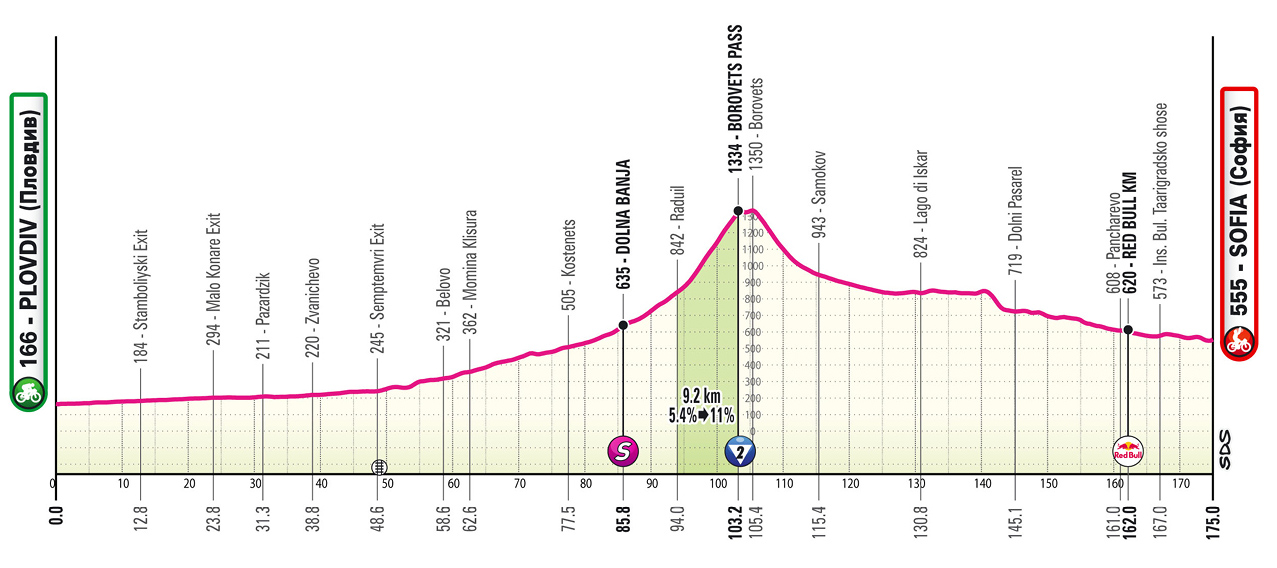
A sprint stage to the capital to conclude the Giro’s Balkan start.
Stage 2 review: Polti-Malta riders Mirco Maestri and Diego Pablo Sevilla went clear with Sevilla out for more mountains points. He’s on 24 points now (and there are 18 available for the second category climb today, presumably his finish line). Several sprinters were dropped on the mid-stage mountain pass with Arnaud De Lie suffering the most but he was able to get back to the convoy and then to the bunch.
With 23km to go a UAE rider towards the front of the bunch seemed to grab the brakes and lock up his front wheel, sliding out and taking many down with him. The bend was lined by a crash barrier and riders slammed into this at speed. Marc Soler, Jay Vine, Adne Holter and Santiago Buitrago left the race, plenty more were left with abrasions and musculoskeletal trauma.
The race was was briefly neutralised to take stock and see if there was medical cover left. Things resumed within a few kilometres.

On the Lyaskovets climb Davide Piganzoli set the pace with his captain Jonas Vingegaard in second wheel. It looked prudent, to keep the Dane out of trouble but once Piganzoli could pull no more and the group had been reduced to less than 50 riders Vingegaard accelerated. Prudence? Was it to keep out of trouble ahead of descent? No, this time he stamped on the pedals in a real attack and only Giuilo Pellizzari and Lennart Van Eetvelt could follow.

Van Eetvelt was after the stage win without an interest in gaining time but it showed too much and this slowed the trio. Jan Christen floated across but this just sabotaged the group further and they were swept up by the group in the final kilometre. In the sprint Thomas Silva had the timing and speed to take a surprise win for XDS-Astana with Christian Scaroni being the more obvious contender. Silva has been a punchy rider who seemed to specialise in Asian races when at Caja Rural, and now at Astana after winning the Tour of Hainan last month. Now he has his first World Tour win and the maglia rosa for today and probably beyond.

We got a glimpse at the GC race with Pellizzari able to follow Vingegaard. Plus the hypothesis of Vingegaard being out to take advantage of every opportunity is bolstered but with one example, we’ll look out for more.
Derek Gee-West was part of the big crash and would lose a minute, a setback. Adam Yates finished over 13 minutes down. Santiago Buitrago didn’t finish the stage. Andrea Vendrame won’t start today.
Overall for all the novelty and surprise of Silva’s win, the day had a sour note for the crash and the damage it caused.
The Route: 175km and with a second category climb offering 18 points for the first rider over, a finish line of sorts for the competition leader Diego Pablo Sevilla with 24 points already.
The Finish: an 8km long finishing straight.
The Contenders: a sprint finish and we’ll see if Jonathan Milan (Lidl-Trek) can get this. He looked underpowered in the opening stage but this could just have been the crashing and chaos around him but it’s a concern. Tobias Lund (Decathlon-CMA CGM) could be more reliable today. Paul Magnier (Soudal-Quickstep) has the speed, power and lead-out to make him a factor too.
Dylan Groenewegen (Unibet Rose Rockets) gets a finish to suit as if there are other flat stages, ones like Napoli are full of corners and even some climbing.
 |
Lund, Milan |
 |
Magnier |
 |
Groenewegen, Vernon, Van Uden |
Weather: sunshine and clouds, 23°C.
TV: KM0 is at 13.05 and the finish is forecast for 4.15pm CEST.
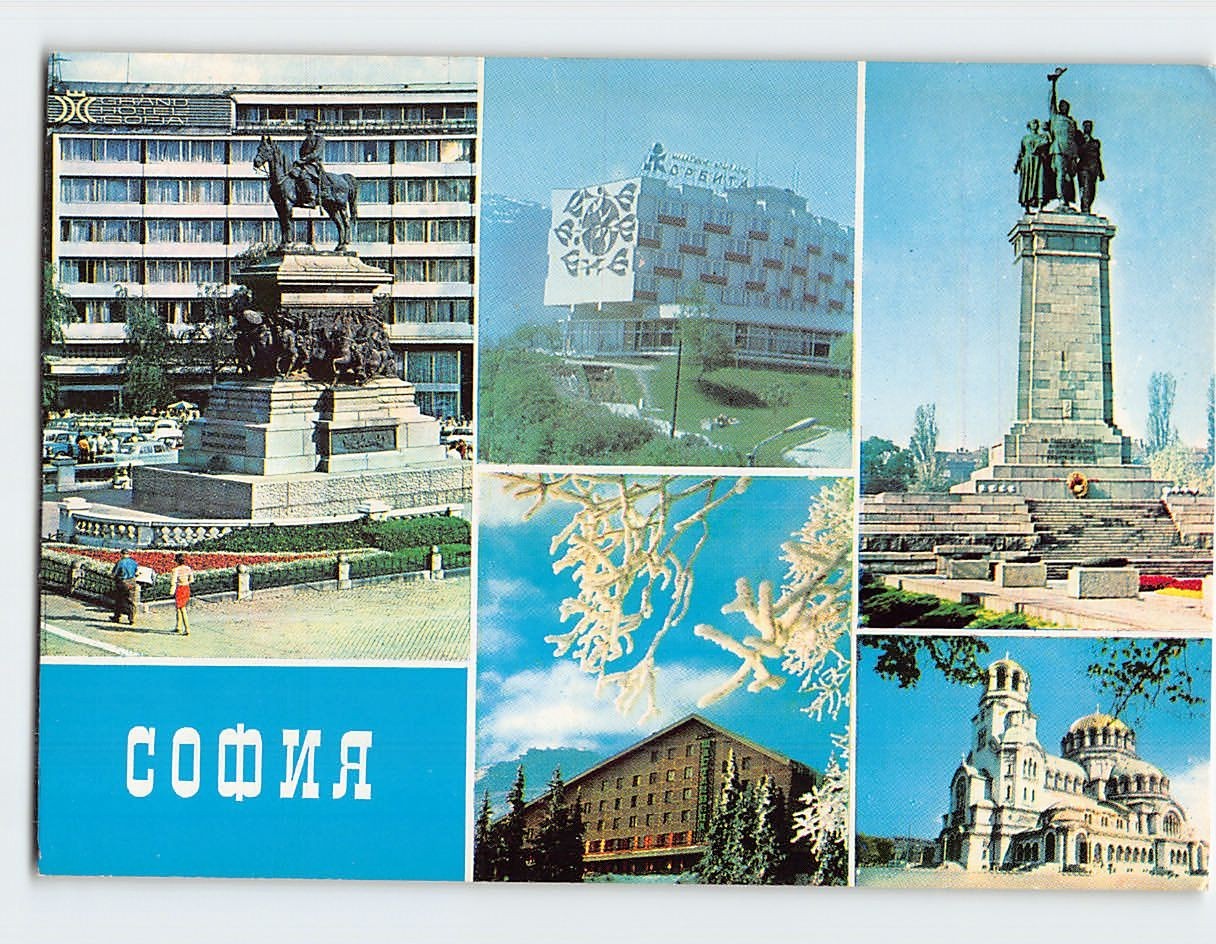
Postcard from Sofia
The race goes to the capital city today and it’ll be interesting to see the turnout in the city. The government has changed this weekend so there are bigger stories. It has not been easy to find local press coverage about the Giro, there was a piece explaining the history of the race with references to Fausto Coppi and similar but often articles have been along the lines of “the following roads will be closed, expect delays” or “the Giro is a big bicycle race, the national authorities are using it to promote tourism”, the tone was of inconvenience and something being done rather than an invitation to a party. But all this was viewed from afar via an internet connection, clearly a lot more happened on the ground as the crowds have impressed so far, people have come out to see.
The Giro will make its way to Italy now. Each team gets up to 20 seats on five charter flights for riders and team staff which will be chased by three cargo planes. There’s also a ferry from Greece to Italy to take team vehicles, that involves a 600km drive away from Sofia. All the logistics mean the race pauses on Monday, but the “rest day” is a euphemism for “travel day”.
Not everyone is making the journey. Some teams sent staff for the Bulgarian start who go home this evening, with a separate crew waiting to start work on work in Italy. Host broadcaster RAI has kept staff including several of its presenters in Italy where they’ve been broadcasting their post-stage “Processo” show from Consenza too.
This year’s Giro is 24 days long. The UCI rules (2.6.007) say a grand tour should be up to 23 days but allow for an extra day once every four years “to organise the start in a non-adjacent territory to the country of the event and/or requiring a long transfer” only Bulgaria comes a year after Albania so this rule is flexible.
It opens the door to further travels. This time last year Abu Dhabi was being talked of as a possibility for 2027. It’s hot and not just the 40°C temperatures likely in early May but the geo-political situation too. Maybe there’s a greater need to appear open for business than ever and the Gulf state will pay even more of a premium than it pays for the organisation of the UAE Tour? It could fork out for the biggest hosting fee in pro cycling. Just don’t expect the same crowds.
After Saturday’s big crash and the long injury list, I expect there’s more enthusiasm to get on the plane to Italy and a day off, then for the stage today (Sunday).
Will the Trek train roll in first? A big wide straight road will hopefully not lead to more crashes.
A shame for the race that so many DNF, and Visma’s public statements of playing it safe, means that Silva might keep the leaders’ jersey for a few more days.
A day, sadly, of mixed emotions – absolutely delighted for Silva and his family, gutted for the half-dozen or so quality riders who’ll now be watching the Giro from their hospital beds.
It never ceases to amaze me how five-star GC favourites seemingly have a nose for danger and always manage to steer clear of it. I can’t remember the last time such a rider had to abandon a Grand Tour because of a racing incident – Chris Froome at the 2014 TdF, perhaps?
There is a large element of luck (though positioning helps, either right at the front or right at the back with the risk of getting stuck behind a pile up). Jonas Vinegegaard was next to Marc Soler when he slid out starting the pile up, from the looks of it his team mate Wilco Keldermann could be a DNS this morning. Geraint Thomas said it could have easily been Ineos (or whatever they are now called) but they ended up on the right so on the inside line away from the pile up, that was just happenstance. Occasionally there are riders with exceptional bike handling that seem to be able to jump over obstacles, Peter Sagan for example. Others, Geraint Thomas, for example seem to attract bidons and Police motorbikes.
van der Poel is stage hunter, not 5* GC contender, but he seems extraordinarily skillful at general positioning, and avoiding obstacles and crashes.
Perhaps not coincidental that racers with strong MTB (eg, Sagan) and cyclocross/MTB (MvdP) background are able to avoid the worst crashes.
Although, Wout seems a counter-example in recent years.
Contador that year too. Carapaz and Mas on the opening stage of the 2023 Tour de France comes to mind as more recent but depends on the definition of 5*.
I was thinking about that as well. The only five star favorite I can think of from that time was when Roglic crashed himself out of the 2022 Vuelta. I was expecting him to give Remco a lot of trouble for the rest of that race.
That 2014 Tour and the 2019 Tour are so strange in hindsight – maybe there are other debatable Grand Tours in the last decade, but of the Sky TDF era those two still play on my mind? You always have to congratulate the winner and believe in their superiority (that even without injuries/unforeseen circumstances they’d have won – plus I like both Bernal and Nibali a lot and am still happy they both have a TDF victory) – but it’s hard also not to have a tiny part of your mind that would’ve liked to see those races without the landslide that changed the race in 2019 and the crashes that took out Froome and Contador.
Seeing Geraint in ‘23 behind P/V (despite him winning in ‘18!) alongside Bernal’s struggles, even before his crash, have made wonder more over the years whether we missed the true fireworks on the final climb of that stage that determined winner. Bernal was a deserving and brilliant winner, plus good for the sport, but I blindly accepted his win that day and have thought about it more since.
Nibali in 2014 is even more complicated as both Froome and Contador crashed, plus any debate isn’t really fair on his magnificent performance, but it’s hard to reign in your imagination once it starts asking.
I do think it’s good though to see that neither Geraint nor Froome have ever stoked the debate and undermined the eventual winner.
Contador I loved as a rider but I particularly dislike how he consistently undermines Froome’s victories by saying he was beaten by Team Sky not Froome. He’s a competitive guy and I get it but it’s smacks of a particularly poor loser all these years later when we all saw him dropped fair and square on multiple stages when Froome was at his peak.
I think that Contador was meaning something more when saying he was beat by Team Sky. But I agree that in pro sport you’d better accept the nature of pro sport, politics and its consequences included. As you say, especially hard for a competitive guy who on top of that knows to be a better cyclist than a given rival, but Fignon, Pantani, Ullrich, Sastre and many many more had to endure such a situation and kept a less sour tone (although some of them paid for it with a different sort of internal struggle).
Err, Thomas, Giro?
Thomas and his Moto crash? Also Giro. Maybe 2021ish?
Roglič tour 21, 22, vuelta 22
Great review, love the postcards…keep up the good work!
Interested to know a little more about Jasper Stuyven’s very outspoken criticism of the way the race was started again so quickly. I would think someone of his experience is usually worth paying attention to and he had some harsh words for the race referee…will there be any consequences for his outspokeness?
None in the moment, as in the commissaires bulletin mentions they halted the race to allow medical care on scene and to make sure they had spare paramedics to follow the race if it resumed. This was ok and so it started again.
In the event of a neutralisation due to a mass crash incident, isn’t the race director supposed to wait until riders caught up in the crash have rejoined the groups they were in before it? That didn’t happen yesterday
No, it can just be to neutralise as in slow or stop the race changing phases but it’s not necessarily a chance to regroup and wait.
Thanks
A really nasty crash, the slow motion replay wasn’t an easy watch. I was quite surprised when they started off again so quickly, but I guess they were pretty close to the finish and it was then or never.
Didn’t put it in the text above but it was like watching riders standing still only to have someone wielding a baseball bat or big iron bar on them. We’ll see for more news today if more are out and who is sore.
Yates looked more like an extra from Platoon than peleton.
Adam Yates is a DNS, first time in 16 GTs
If he’d stayed in the race he would have had a big effect as he could go in the breakaways on mountain stages and then aim to win and take the mountains prize.
We’ve seen Visma dropping back to avoid trouble; here teams riding in formation is not without risk because if one falls, several do.
Sadly I think the Bulgarian start will mostly be remembered for the crashes, which is a pity because I think the organizers did a decent job and the crowd has been very enthusiastic. Much better than Albania.
A bit harsh. I think the Bulgarian crowds did the Giro proud. Much better than Albania is a huge understatement.
Yes, at first I hadn’t been especially fond of this Grande Partenza on paper, but the Sofia crowds were shockingly good, and people’s participation looked appreciable everywhere. Plus, most roads were presented in good to excellent conditions, with the horrific crashes essentially down to modern bikes (the Luddite’s corner here 😛 ).
KevinR – I think you misunderstood what I was trying to convey. I actually thought it was quite successful, but due to the magnitude of the crashes in terms of dnf’s and dns’s, there will be a shadow over an otherwise very positive experience. I even watched the team presentation and it was better than most.
So the French start 21 will always be rememberd for the the crashes or does this judge a country by it’s crashes only apply to somewhat “foreign” countries?
I think the spirit of the preceding comments was more to praise the Bulgarian start to the race, while acknowledging the crashes have colored these race days a little bittersweet. Rather than judging a country by its crashes, it’s a better fit to judge a race by its events and circumstances, with the good moments and the unfortunate ones too. I think that probably applies in whatever countries you choose.
Thanks Jim!
The Bulgarian detour has decimated UAE. How many of their 3 current DNFs would normally been expected to also support Pogacar at TdF ?
PCS currently has Yates and Soler in the Tour startlist
I am finding the long transfers of this giro to be extremely silly
Foreign “Grande Partenza” and “finishing in the capital” often albeit not always tend to imply big transfers as a concept, be it in whatever GT. I’d say – but I might be wrong – that the Giro has even been using this couple of resources (summing up the two of them) more sparingly than ASO usually does at TDF or Vuelta. I’ll agree that they could be used even more sparingly, but in order to be fair this should be regulated across the three GTs.
As for the rest of this Giro, this comment results even quite surprising, because Vegni always tried to reduce transfers due to his poorly corresponded love towards the cyclists, and in this case the huge majority of transfers are actually very short in time and pretty comfortable for the teams
Except maybe st. 13 to 14 and 14 to 15.
Yet, a wise look at the map will easily suggest that stages 13 (finale)-14-15-16 and the start of st. 17 plus the Rest Day can be properly managed with one or two hotels between the zones of Novara and Biella (including the likes of Santhià, Arona etc.) which would keep all those transfers within a relatively close range, lots of highways, the option of not moving from the hotel or at most 2 hotels in 5 days, and this way the longest transfer times woul anyway be kept under 2hrs. at most (or well below).
I like to have finish and next start in a single town, BUT today it’s essentially the same in terms of transfers as the teams won’t stay in city centres, AND the issue of costs and maximising fees tends to imply that “two different municipalities paying are better than one”.
As a sidenote, RCS apparently cashed in only with the Bulgarian Grande Partenza as much money as ASO got from its Spanish (Basque) *and* Italian Grand Départs – the two of them together.
As always, ASO looks for a balance between prestige of the race and monetising (for instance, they accepted to get less money in order to have Florence, which wasn’t interested or even part of the original project, as the start city), whereas RCS, well…
I was just gutted to learn that local boy Ådne Holter had to leave the race. He’ll be ok though his parents are assuring us.
Great crowds in Sofia, but allowing those protruding fence feet on a GT sprint stage finish is terrible organisation.