
The Giro resumes in Italy with short stage with a big climb.

Magnier-fico: if you could replay a summit finish over and over with the riders who arrive at the foot of the a mountain often the result would be the same. In a sprint it’s very different. With Stage 3 take the riders who were together with 3km to go on the road into Sofia and replay it and the outcome could vary. But the sense is that Paul Magnier would win a lot and Jonathan Milan would too. The problem for Dylan Groenewegen is that he could too only future stages now get harder for him until the Milan criterium on Stage 15.

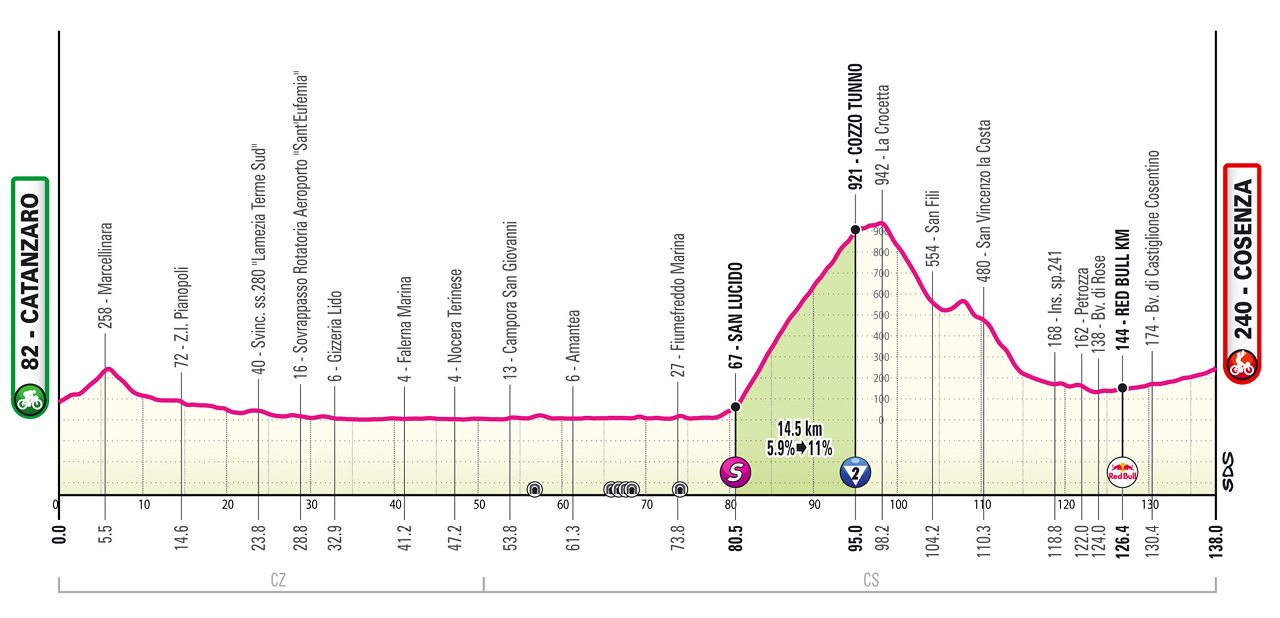
The Route: 144km and an early unmarked climb after the start but it’s a five minute effort and was tackled a decade ago when the Giro also rolled out of Catenzaro. Then it’s along the coast.
Today is all about the climb midway. The race manual says it’s “easy” and 17km at 5% sounds steady but zoom in because there’s 14km at 6% and the first 8km are close to 7% which is Alpine enough to drop plenty, all on a twisting side road too.
Once past the mountains banner there’s a false flat to the real pass and then a long descent and 40km to the finish with the final 20km on the flat.
The Finish: ah, Cosenza! Its cathedral perched on the hill, the charming cobbled streets, even labelled the Athens of Italy [record scratch sound].
A run past the railway yards, a set of roundabouts where a wrong turn leads to a McDonalds Drive and then a few zigzags in town. It’ll pay to have a good lead out through the streets but they’re wide and the final 450m rise at 3%.

The Contenders: Maglia rosa Thomas Silva (XDS-Astana) is now a name to contend with, he’s got a good finish and every reason to sprint for the win today with team mates Scaroni and Ulissi on hand to help. He’s shown he can win from a group when others have been dropped on a climb. Florian Stork (Tudor) was close on Saturday and could be too and his team will work twice as hard to set him up.
Paul Magnier (Soudal-Quickstep) is the default pick today. Not that he is a certain pick, it’s more that in a range of outcomes he might be one who ends up winning.
The Passo Crocetta ought to be used by teams with a fast finisher as an elimination race, they can set a pace to distance bulky sprinters. So Soudal-Quickstep can ride fast enough to leave Dylan Groenewegen floundering, then Movistar can set a pace too fast for Paul Magnier to the advantage of Orluis Aular and so on. Easier said than done as they have to be left behind early and then the teams that achieve this have to be able to sustain it on the 20km to the finish to keep any chasers away. So in reality Magnier might be dropped but he could come back; or maybe teams don’t like this tactic and Magnier hangs on. Again he’s far from a certain pick, but quick and more agile so he might be able to go for the win when Milan and Gronewegen have been dropped. Kaden Groves (Alpecin-PremierTech) has won this way before but he’s uncertain with injuries on Stage 2. Tobias Lund (Decathlon-CMA CGM) can do well but we’ll see with the climbing.
Francesco Busatto (Alpcein-PremierTech) is another rider who is quick for a stage like today from a small group. Orluis Aular (Movistar) and Corbin Strong (NSN) are fast too, we saw NSN working for Strong on Stage 2
With plenty of riders having lost time already the early breakaway also has a good chance, more than we might have imagined pre-Bulgaria. It’ll have to work hard to build a lead before the climb, this might require sending two riders per team with one to pull and the other to win the stage. António Morgado (UAE) could give his team something to cheer but pick from plenty who face a stage that is neither sprint nor summit finish.
 |
– |
 |
Magnier, Silva |
 |
Stork, Bussato, Aular, Strong, Lund, Turner, Morgado |
Weather: sunny, 25°C and an onshore breeze for the passage along the coast. Forecasts say up to 20km/h so not enough to split the peloton normally but teams can try.
TV: the finish is forecast for 5.15pm CEST. Tune in from 3.40pm for the Passo Crocetta.
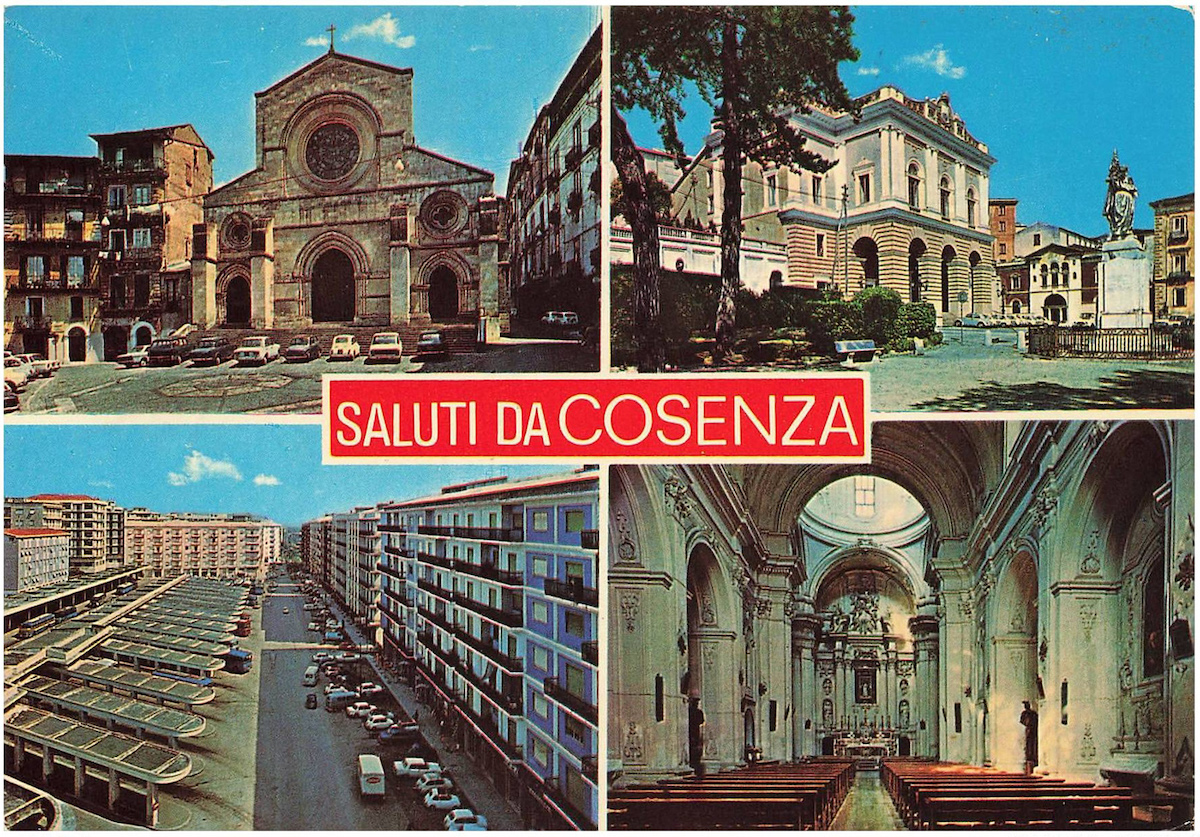
Postcard from Cosenza
Today’s stage is 100% in Calabria and the finish is in Cosenza, the region’s fifth biggest city. It’s the sort of place that should host the Giro regularly but hasn’t finished here since 1989. Swiss rider Rolf Järmann went solo near the finish to win the stage. Järmann would go on to win a Tour stage and the Amstel Gold race twice in the 1990s.
As he told Blick magazine his career overlapped with the EPO doping era. Pressured by his team – Ariostea – to take EPO, he bought it to appease management but threw it away as he hoped to prove he could win without, only for the team doctor to angrily spot his blood values had not changed.
In time he’d use EPO to win. After the Festina affair he decided to stop, only to find when he was planned to attack on a short climb near the finish of a stage of the Tour de Suisse in 1999, just the kind of move that suited him, 60 riders came past him uphill. He had changed ways but the peloton had not.
Järmann had a hobby outside of cycling: computing. It’s a claim that’s difficult to verify but he may have been the first professional athlete to start a blog. He would post brief diary entries and remarks. One day he estimated how much spaghetti he ate in a year, and calculated that laid lengthwise it would cover 5km. That sort of thing.
The hobby became business as he went into internet hosting and web design. During this time he also got into campervans and the two interests combined into a blog about van life which occupies him now, it’s called womoblog, as in Wohnmobil or camping car in German. Maybe he’ll be beside the road somewhere this month?
I can’t comprehend how you started with Cosenza and ended up on a van life blog. Chapeau!
Jaërmann’s done some good interviews over the years. One of those names you see on winners’ lists but turns out there’s a lot more going on and while he’s not someone dining off his past stories at all, it’s been good to read.
Great story about Järmann, an interesting example for a point I’ve often make through the years, that is how the concept of «cheater» (individual, focussed on a supposed moral nature or «character» which marks a person throughout their whole life unless they «repent» etc.) is a poor POV to understand how things really work in pro sports, but as that concept is so deeply rooted in some cultures it’s an anthropological artifact actually quite hard to get over.
Agree fully on the black and white way that many view those who’ve previously doped. I’ve been guilty of this in the past, including for Michele Scarponi; it wasn’t until his tragic death that I learned more about the lovely person behind the ‘doper’ mask.
Good people can make poor choices if the system forces these upon them.
Briko Raiders and EPO, the epitome of 90s pro cycling.
Again, a wonderful postcard…great preview too, complimenti.
In a way if the stage was raced the correct way any of the sprinters could win.
But this sort of relies on no strong break because any pace slow enough to hold onto the sprinters with sprinting power remaining is slow enough that a strong working break will take a big lead and with not that much flat to take it back it seems a gamble to chase all day.
Even if i had a team with a sprinter i would aim to put a strong all-round rider in the break. Either a Plapp who could get a gap on the climb and solo or somebody who can go up the climb good enough to finish in a group with a fast finish.
If this stage starts again with 2 or 3 riders from low ranking teams going in the break for TV time i don’t know what half the teams are here for because this is a genuine half a chance at least.
I wholly agree with your last paragraph. A strong break today has a great chance of contesting for the win, so let’s hope enough teams are prepared to gamble.
If the sprinter teams try to put a man in the break, then two things will happen. There’ll be more teams trying to get in to the break and it will end up with a strong group … and… those teams that miss the break will have to take the climber faster. Ergo, they’ll be taking away the chances of their sprinter competing. Not to mention, with the possibility of the sprinter teams still missing out on the break!
So they’ll want to actually close down stronger riders early on and let it be known they want a small weak group. It’s their best chance even though they’ll still need things to go their way later in the stage if their sprinters are going to have a chance to comeback after the climb.
My money is on a weak small break again and if we are to get some jeopardy, it’ll be whether the sprint teams can bring it back together in the last 40k.
After all that, I don’t like their chances. 😉
It’s a difficult stage to call, it promises action but there’s every chance things cancel out. There’s been talk of crosswinds on the coast from riders/teams but no wind model predicts anything strong enough. Even in the “weather” section above the 20km/h is the upper end, some say 10km/h. But sometimes this can be self-fulfilling, the peloton is nervous, it does get to 20km/h and so it happens.
I’m chuckling over the nervous peloton leading to increased wind speeds 😄
Yep. Multiple possibilities and it’s easy to focus on the bigger teams (especially GC) and what they want to get out of a particular stage but for some reason, the teams outside of the invitees, consistently seem to wait until week 2/3 to be really aggressive.
I imagine a lot of those teams have their eyes on tomorrow as a stage for the break and will play it ‘safe’ today.
Was rather disappointed with Bulgaria, maybe it was just the weather but unlike Albania nothing I saw made me think that it was somewhere I might like to visit despite much tourist office hype from Rob Hatch!
The race is in a bit of a holding pattern with the focus further up the Apennines at Blockhaus. The weather forecast suggests more nice sunny weather but maybe with a thundery shower or two over the coming days hopefully not timed for a tricky descent, no more crashes!
Happy to see a GT with a decent number of first week sprint finishes.
I think Bulgaria did well from a crowd perspective – lots of people lining the roads in a way that wasn’t seen in Albania.
While the country was hardly shown in its best light (the weather didn’t help), it wasn’t bad either and I suspect there will be some people thinking of giving it a try for a holiday as a result of the Giro’s visit (whether that’s enough to justify the huge outlay is a different matter).
Normally what cycling works best for isn’t really convincing that a product or place is good (which is still a big part of it, of course) but rather the more subtle recognisition of placing even a mere name in the mental background of possibilities. The effect on selling works as in “hmmm dunno where but I’ve heard of this brand” generally sells better than “never heard of it”. This explanation is more obvious in the case of products or services (especially the latter, even more so when based on trust, typically banks/credit or big retail), but it works on a very basic cognitive level for geography, too. Like, what are the first three info your brain associates in a microsec when scrolling over a name well before you are aware yoy’re even “thinking”? Sort of “negative stereotype + negative stereotype + blank” or rather “undefined memories of watching *a sport I like* + negative stereotype (that never goes fully away) + mix of interesting images”… Even more basic. The mere subconscious acknowledging of “oh, hey, Bulgaria” will grant a fraction of a fraction time of precious micro-lingering on a banner, a shopwindow, a roadside ad from which a thought process leading to buy/consider buying might start versus any general name we don’t associate with much.
Very interesting description of how recognition is so important to marketing. Especially, as you say, if one already has a built-in negative opinion regarding something they know almost nothing about. I am a person *of a certain age* who reflexively (that is, without knowing it) has negative thoughts about the former Soviet bloc. So if I’m at all representative of my cohort, a place like Bulgaria would need to first show that “hey, this isn’t 1982, this place is actually really nice.” I thought they accomplished that pretty well.
So well said, Gabriele. I recently visited the Orkney Islands only because I used to know a very nice man at the YMCA who was from Orkney, spoke Gaelic, studied Italian and French in Italy, absolutely loved Dante, moved to California and taught French in high school. So for decades I have a curiosity about and positive associations with Orkney. And after visiting, still do!
Nice postcard !
Magnier seems to be one of those sprinters that don’t win only once in a stage race. If he wins, he wins plenty, though some sprinters rather have some wins here and there (Meeus for example, or Viviani or Ewan most of the time). I wonder how these things work. Most of the time, the multiple winner is well above the rest, so there is no difficulties (Cipollini, Petacchi, Cavendish). Here it doesn’t seem to be the case, as you said : it’s a lot of small things that make him win both times, but it always turns out in his favour. That’s why sprint can be so fascinating.
Being the 5th town of a sparsely populated region doesn’t mean much. Calabria has less population than the Canary Islands (-10%) with twice the territory. Cosenza is losing population, today I think it’s closer to 60K than 70K, although its province gathers 40% of the region’s whole population, which explains why when the race passes by it normally stops elsewhere. Other municipalities around are smaller but wealthier.
That said, I really like this course design and hope the teams will make something interesting of it, no matter how it ends up.
Unofficial peloton talk (probably false) is reporting other teams are paying real money (although not much) to some of the smallest Pro Teams in order to play the script. Personally, I don’t believe it, but it’s probably a metaphore of some feelings.
I immediately thought that a 1990s pro rider’s yearly intake of spaghetti laid end to end would stretch way further than 5k. So I tried to do the maths*.
Assuming the length of a spaghetti strand is 25cms, 5 km is approximately 20,000 individual strands.
If you assume (as the AI Overlords tell me) that a standard portion of 100g is 60 strands, that is *only* 333 “normal human” bowls of spaghetti in a year.
Perhaps he liked other pasta shapes.
*Disclaimer: I am very bad at maths.
The size of the Rabo rider in the background!
He looks like the sort of chap you’d find at the tail end of a 200km audax!
Aside from the drugs, the change in rider shape has been extraordinary over the last 20 years.
Rabo bloke must have eaten 10km of spaghetti.
Good one. It’s Maarten den Baaker, the photo does make him look bigger than other images seem to.