
The Queen Stage? Yes, but at 151km today’s stage is minor royalty. It’ll still be entertaining and scenic too.

Tri-Paul: an impromptu sprint stage. With few obvious sprint stages to start with and some of those leaving the sprinters thwarted and even sore, several teams conspired to keep a lid on the day’s modest breakaway and then deter further attacks with Lidl-Trek, NSN and UAE all active here and the field split under the pressure and regrouped. The climbs along the day saw other moves contained; plus a crash for Afonso Eulalio but no injury give he attacked on the Ca’ del Poggio climb but couldn’t get a gap but this helped condense the bunch down to about 60 riders.
If yesterday’s preview did not consider a bunch sprint outcome – mea culpa – the finish did not seemed designed for it either. But this allowed Jasper Stuyven to lead out Paul Magnier and force Jonathan Milan again to find another route around riders. Magnier was clear and takes back the points jersey with a 37 point advantage. There are 12-8-5-3-1 at the intermediate sprint today and tomorrow and 15-12-9-7-6-5-4-3-2-1 so Narvaez needs to score big and then hope Magnier fumbles the sprint in Rome; in practical terms this is unlikely but Magnier’s biggest challenge is the next two stages and the time limit. He said he did not think of the sprint yesterday because he’s so tired.

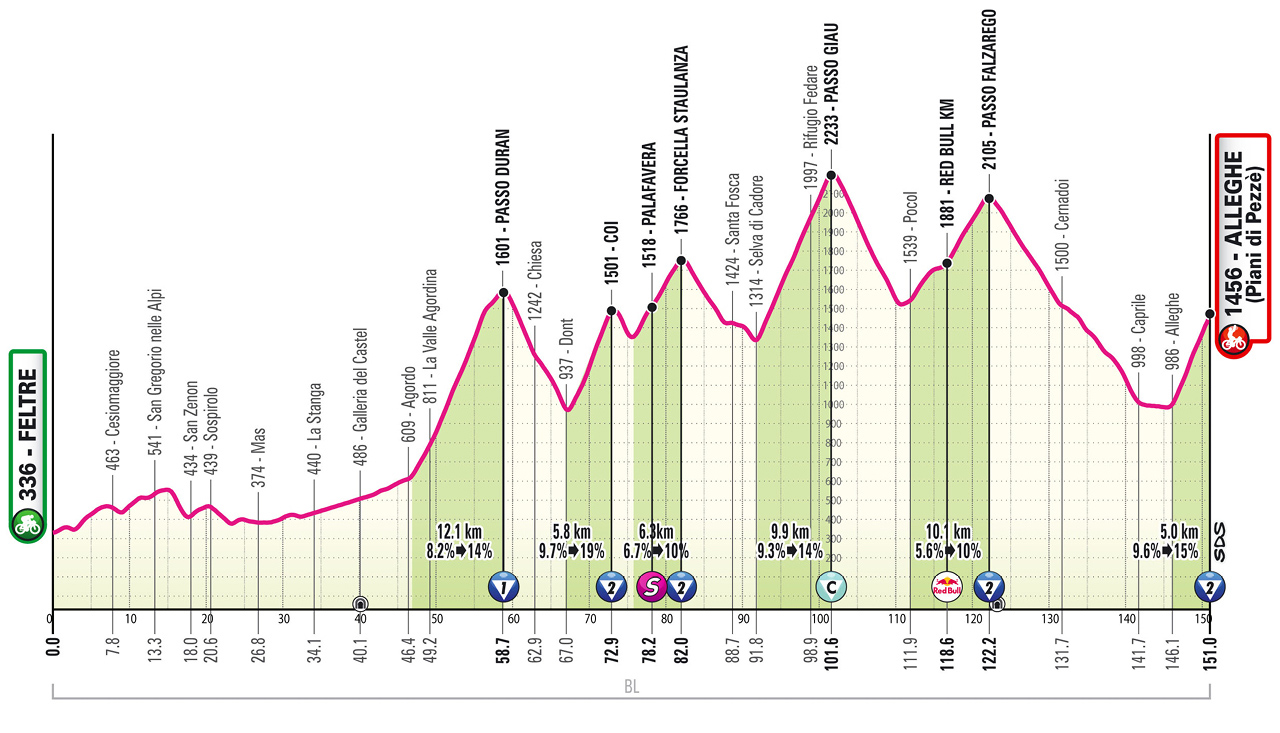
The Route: 151km and 4,800m of vertical gain. There’s a hilly 45km to the first pass on a small backroad, terrain for the breakaway to form but their challenge is to stay away for the day.
The Passo Duran marks the start of the climbing and it’s hard at the start, plenty of 10-12% for the first two thirds before easing. The final 100km have almost no flat roads except for a brief moment before the final climb. The descents matter today too, they’re frequently steep and with tight, irregular corners.
The Passo Giau is long and steep, 10km at almost 10% and with its 29 hairpins hard for anyone struggling to follow the pace as they can get shaken off on these bends.

The Finish: not a famous pass or anything like that, this is a small road to a ski lift in winter and the start of hiking trails in summer, all below the cragged peaks of Monte Civetta. It’s consistently steep.
The Contenders: Jonas Vingegaard (Visma-LAB) is the easy pick, he’s out-climbing everyone so why turn down another stage win? But this all hangs on whether his team will work all day because there’s little point in Red Bull-Bora-Hansgrohe or Netcompany-Ineos mowing down the breakaway today as they’d just gift the win to Vingegaard; but little rather than zero given Red Bull might want to soften up Arensman on the climbs. Several teams might also see if they can test Felix Gall on the descents.
Breakaway picks are Giulio Ciccone (Lidl-Trek) but he might be caught between sprinting for mountains points and the stage. He’s 81 points behind Vingegaard for the blue mountains jersey and if there’s 50 for Cima Coppi, he’ll need the 40 pointer Duran early on too as the other’s offer 18 points. He can do it today, the trick will be to score tomorrow too.
Einer Rubio (Movistar) is climbing well. Will Aleksandr Vlasov (Red Bull) go clear again? He’s been making moves but not looked incisive yet, instead team mate Giulio Pellizzari might try and grab a consolatory stage win now that he’s 20th overall and almost 37 minutes down so a new name to watch for the breakaway but does he try today or save it for tomorrow which might suit the breakaway more?
 |
Vingegaard |
 |
– |
 |
Ciccone, Rubio, Pellizzari |
Weather: sunny but cooler, 23°C at the start and then mid-way in between the climbs.
TV: KM0 is at 12.20pm, the Passo Giau begins around 3.20pm and the finish is forecast for 5.15pm CEST.
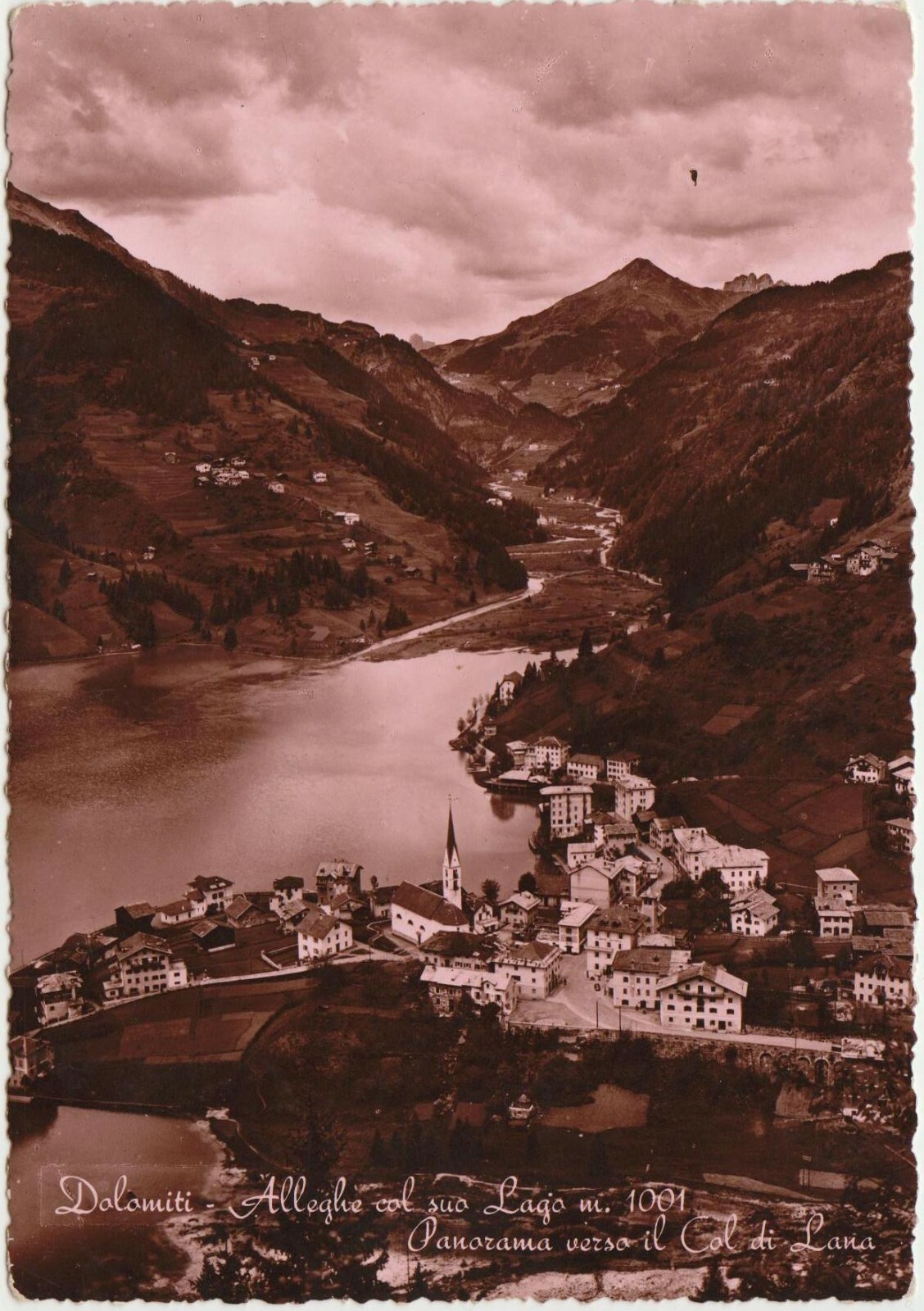
Postcard from Alleghe
Today’s finish is deserving of its own postcard, a wish-you-were-here paean to the Dolomites and the Giro because this is a picture-postcard scenery, a finish above Alleghe with its blue lake, and with Monte Civetta towering above.
If yesterday’s postcard touched on the origins of the Dolomites, it’s not all about events from millions of years ago. The lake near the finish today only appeared in the late 18th century following a giant rockfall. If this happened, what could happen next?
There’s probably more chance lakes are formed today by human actions like the construction of hydroelectric dams. The nearby Vajont disaster in 1963 – commemorated by the 2013 Giro – saw a huge block of rock slide into the newly filled lake following the construction of a giant dam, causing a massive wave that flooded the area below killing around 2,000 people. It happened because the faults and geology were poorly understand at the time, and also ignored in part too.
Natural phenomenons occur too. A year ago yesterday in Switzerland a glacier fell apart, causing a huge landslide with three million cubic metres of rock, ice, water and mud coming down the mountain to bury much of the village of Blatten. Fortunately this had been predicted and the locals evacuated a week before but that counts as a narrow escape. Alas one shepherd died but things could have been a lot worse.
These events are likely to become more frequent. Dramatic events like the Swiss one grab the headlines but it’s the smaller rockfalls that are proliferating. The Alps are warming up about twice as fast as the surrounding area. Rock and ice that is habitually frozen at high altitude all year is now subject to more frequent cycles of melting and freezing and so the mountains are at risk of falling apart faster. The Dolomites are especially prone with their softer limestone rock according to Professor Nicolas Casagli, a specialist in geo-engineering from Florence University who studies the mountains and is a media-go to in Italy for these events.
Roads here are regularly being closed because of landslides and the repairs are expensive. This is forcing local authorities to review the costs and benefits: is it worth clearing a road if it will be buried again soon? Should tens of millions be spent securing the roads with coverings and other fortifications to keep them open as important traffic arteries? If so, then who pays locals, the region or the country?
The Alps took millions of years to form and they’ll be there for millions more. The forces that made them are still pushing the peaks upwards rather than making them collapse. Any change in the rate of erosion is tiny in relative terms. But it is a noticeable pre-occupation of residents, the local newspapers as well as geologists, hydrologists and public safety officials alike. If the Giro organisers are worried about snowfall affecting the race in the Alps every year, in the near future rockfall could become a similar concern too.
Here’s hoping Gall has a stellar day. FTW perhaps? Please!
Not losing time as the first goal. It’s not raining today which helps.
Prediction: Vingegaard ate too much fish yesterday at dinner. Today he abandons the stage to jump into a (newly formed) lake, and declare that he will from now on live with his family in an artists commune on Monte Veritas.
The peloton is so confused by this, Paul Magnier will be the only one who continues to ride, so he seizes the stage win and the maglia rosa.
Certainly can’t argue with a prediction like this!!!
Seixas and Magnier are making France great again!
well, lets hope it’s not just a make belief slogan this time, for the French specially at the TdF. I believe Seixas could be at Pogacar’s level, if not this year, then within the next one or two seasons.
I’ll reserve judgement on the hype and the promise of some results and other performance – a three-week GT is a very different beast.
We’ll soon get a good idea the Dauphiné. Even if Seixas comes in under done with eyes on July, there’s a lot to observe in how he handles expectations and more.
There might be a ‘sweet spot’ in entertainment in about 3 years time when an ascending Seixas meets a declining Pogacar. After that we’ll probably have to wait another 5-10 years for competition. The Pareto distribution isn’t great for producing entertaining battles.
Egan Bernal was going to win seven straight Tours too.
To add the the accident litany, there was the Marmolada glacier collapse a few years back, a number of people were killed. The Marmolada is not far from today’s route, above Passo Fedaia.
Am I correct in that it was on a foggy Passo Giau that Egan Bernal confirmed his 2021 Giro?
Yesterday, or at least the finale, was surprisingly good an ending with a proper sprint.
Today seems a bit on the tame side, these sort of stages are often a second “big” mountain day, rumour has it that the original plan was for the Swiss stage to feature the Gotthard, Furka & Nufenen but the Cantonal authorities outside of Ticino were not keen.
Unless a strong break gets a big lead difficult to see past a Jonas Vingegaard win I dont see how he can gift a win to one of his team mates.
I think there’s a chance Vinny might try to do just that. Let a rider go on the final climb or earlier (maybe with others not threatening on GC) and sit back to see what happens. If it doesn’t come off, he can hoover up another stage for himself.
Yes for Bernal in 2021 on the Giau and the Swiss stage which was meant to be bigger but got shrunk. But this Giro is a “medio fondo” version, the average stage distance is 165km, down from 179km in 2025 and 193km in 2023, a big fall.
I think the “gift” for Piganzoli could be to get him in white, more achievable and practical than a stage win.
There is no clear evidence that Piganzoli can outclimb Gall, Arensmen or Hindley; this means there is no real path to Vingegaard gifting him the stage win. The best outcome for Piganzoli is probably dropping Eulalio by enough time to win the white jersey.
100%. Yesterday was quite entertaining.
That leadout from Stuyven was epic. Timing and everything was exactly perfect.
The Dolomites are also famous in cycling terms because it’s one of the not-so-common areas in Italy where you can climb consistently around 2,000 m altitude or above on several asphalted passes in a row without much flat terrain in-between. It’s not the only one, of course, but more or less all the existing ones tends to become legendary in cycling terms (Stelvio-Gavia; South-Western Alps, think Fauniera-Sampeyre-Agnello and more).
As inrng says, today isn’t a true Alpine tappone. This edition really lacks one, those days on the saddle closer to 6 hrs. than to 5 hrs. (even better if they reach or surpass 6 hrs. of course) tackling series of long, tough climbs. The Giro has been resisting as much as it could the trend of shortening the stages (careful here, not simply having one or two very short and lively stages, which can be deemed traditional, even, and useful to meet the max total kms allowed by UCI inserting longer stages; no, just all the stages being generally shorter, especially the decisive one).
As long as I recall this is the first time with no such tappone by design, typically at least one 6 hrs mountainous stage or two ~5h40′ such stages had to be in the original course (2013 and 2021 didn’t comply due to stage cancellations or shortening, reasonably enough in 2013, less so in 2021). What’s worrying is that the other Giro which finally didn’t comply without any cancellation was… 2025. In that case, you could at least assume that Brentonico and Sestriere might have been ridden just a bit slowlier and be “kinda of”.
The elimination of such stages is a huge loss for the sport.
I think Pellizzari could change his name to Lazarus if he’s anywhere near the front today!
Gall, Hindley and Aresman to fight it out for the podium spots unless something dramatic happens (this is Italy after all, home of opera).
All the above said, this stage is extremely interesting all the same, because that “blockchain” of mountains
(block of chained passes ^___^)
looks nearly unprecedented, or at least I struggle to find proper terms of comparisons as far as “climbing concentration” is concerned.
~3,500 m of altitude gain in 75 km from Agordo to the top of Falzarego or ~2,900 m in 55 km to the top of the Giau are quite much shocking figures and difficult to reach elsewhere be it only for logistic reasons (long descents, valley roads betweenclimbs etc.).
I’d be curious to know if anybody here remembers something similar.
Most I’ve tried (Gavia-Stelvio, Stelvio-Umbrail, Sampeyre with Fauniera or Agnello, Vars-Bonette) sits at some 3,000x 70 km at the very most.
I really like that QuickStep have bounced back from the Remco loss almost immediately with Magnier.
I assume he can’t ride the Tour as well, but if he does they suddenly become a far more interesting proposition as do the sprints if Magnier can take the battle to Philipsen.
There’s a world where this years Tour De France could be surprisingly brilliant with Pog/Vin/Seix going head to head while the sprinters, uphill sprint specialists and break away specialists are also extremely competitive – unfortunately there’s also a world where Pog rolls everyone and we see a repeat of Philipsen’s recent July crescendos. I’m holding out hope though…
Seeing Seixas match Pog at LBL was stunning, and despite this likely being a year too early Paul, in the scenario that Pog lost early time, there are a lot of riders who could snipe from afar or benefit from breakaway surprises this year, even Remco.
I really like Pog, but last year it was hard to see a scenario outside of illness or a bad crash removing him, where he wouldn’t triumph at the TDF – even with a mechanical you sensed he could over turn any deficit. This year (despite Pog being possibly even better than last), there’s a different sense that aggressive riding from Jumbo, Red Bull, Trek and Decathlon (alongside a big slice of luck) may well throw up a surprise or two and all four of those teams are stacked with talent and it’s easy to see one or all finding a way to make hay with whatever luck they get.
Even though UAE will arrive with their own absurd eight man behemoth of a team.
Merlier is riding the Tour for Quickstep, he’s arguably the fastest sprinter in the world so that makes sense. But he’s also fully aware that Magnier is his replacement and not in a nervous way about someone taking his place, just that he knows his age and what will happen in the future.
Loving the Dolomite postcards, I’d like to see you and Daniel Friebe writing a book together!
Is it Tim Rex keeping the high-quality break on a very tight rein pulling constantly on the front of a now 25 or some men group, the full Duran and Coi? Nearly dropping poor Eulalio…! Just 22, another case of much stronger younger brother ^___^
From Giau to Alleghe the big teams are going to destroy the break, I’m afraid… the T-Rex bit hard and his jaws ain’t let the break go, so now both Visma and Decathlon (and Red Bull… or will Hindley try something interesting early for a change?) have the numbers for a strong chasing pace on the long 45-kms easy segment – including Falzarego – before the last climb.
Kind of surprised that Visma are working so much. They don’t need to. Maybe looking to dislodge Eulalio?
Equally surprised. Things as they are, some curious interest for the final blue jersey and a further stage for Jonas?
I’m sure that if they didn’t work, Decathlon would.
That seems like a reasonable explanation.
What I am not grasping is that teams on the podium don’t seem concerned about Derek Gee getting on the podium. Is his threat just not taken seriously? The final cliimb is not very long to take that time back…
Somebody was commenting on the divide between teams… of course.
Selected group on the Giau, 16 athletes:
– 4 Visma (+1 in the break)
– 4 Decathlon
– 3 Ineos (+1 in the break)
– 2 Red Bull (+1 in the break)
Then – Eulalio, Bouwman and Leknessund.
Halfway through, Vlasov goes on the front – Bouwman and Leknessund (and one Visma) dropped.
Einer Rubio should win the combativity prize for the stage.
Hah! Very nice.