
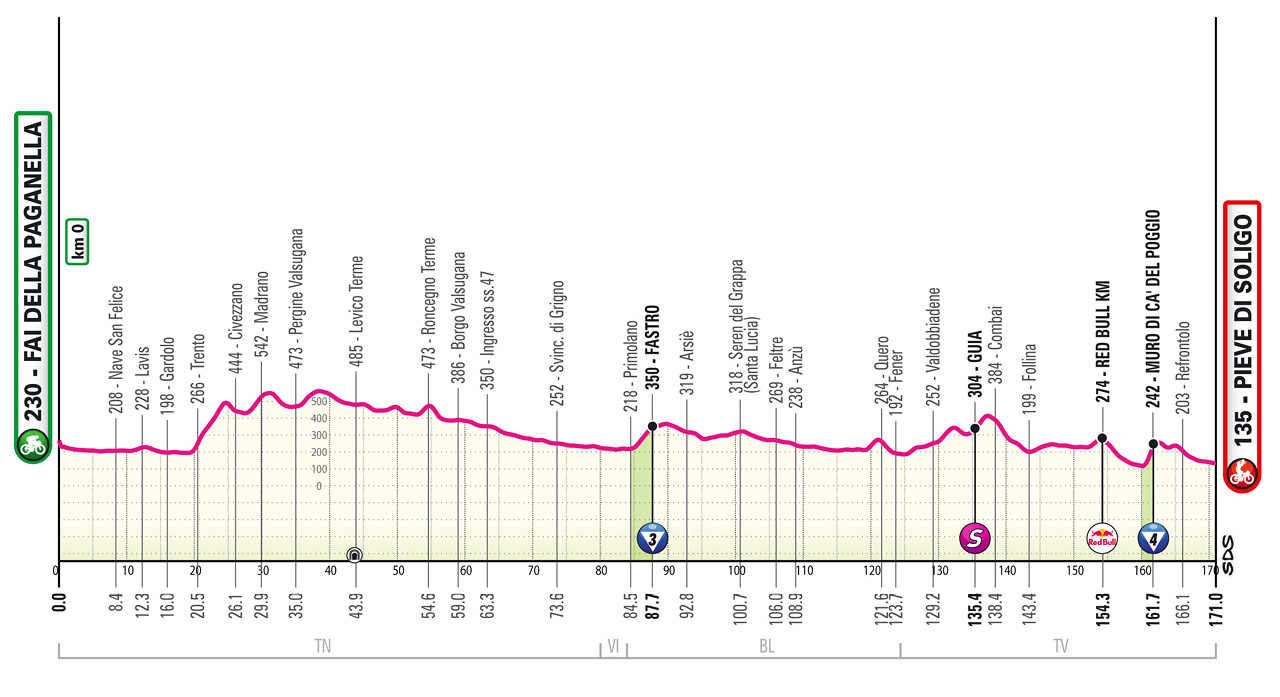
A last chance for the breakaway. Today’s stage is hillier than it looks.

The Art of the Breakaway: the best actors can have great scripts, the best comedians great lines but what makes them stand out is timing. Michael Valgren made his winning attack with 1,200m with such exquisite timing that he could try the stage, or if not then talk to Tudor about a contract.
It was a lively day with a breakaway up the road and a counter move chasing hard for a long time, all while the bunch didn’t want to give them any room either. Hot sunshine turned to a downpour when Rémi Cavagna floated away solo and took two minutes but he seemed to crack and was hauled in.

In the hilly finish riders kept attacking, more would jump across. Einer Rubio and Michael Valgren were away but with only a few seconds on Damiano Caruso, Igor Arrieta, Andreas Leknessund and Aleksandr Vlasov. Arrieta bridged across and then the rest came back. Valgren had a thespian touch when shaking his head towards Rubio so say he was, unwilling or unable to take a pull on the climb to the finish in Andalo. With the climb done they were spread across the road, each looking for someone else to lead.
Just as the road flattened out with 1,200m Valgren hit them with a perfect attack. Starting at the back of the group, and just as others were looking at each other and tired, it felt like Valgren couldn’t have found a better microsecond to make his move.

Damiano Caruso moved up to ninth overall, continuing his tradition of soaring on GC in the third week. And Jhonathan Narvaez now leads the points competition with 12 points on Paul Magnier. The final stage in Rome offers 50-35-25-18-14-12-10-8-7-6-5-4-3-2-1 points.
The Route: a stage out of the mountains and there are some passes to climb but they’re not even marked. Today’s stage is hilly with plenty of unmarked climbs, starting with the road to Cicezzano, 6km at 5%.
Once out of the Alpine valleys and into the Valdobbiadene and its prosecco-producing vineyards there are several hills. The one after the sprint point is hard going at times with some 7%.
The Ca’ del Poggio is a wall-like climb, one kilometre at 12% and with a 20% section halfway. It’s a famous local climb and has been in the Giro and other races before.
The Finish: a flat run into town. There’s a sharp right bend with 300m to go and then it’s downhill to the line; unadvisable for a sprint finish but the field should be thinned out by now.
The Contenders: a stage open to plenty as long as they can cope with the sharp climbs and better still, profit from them. Alberto Bettiol (XDS-Astana) has already proved this but as mentioned before he’s far from a prolific winner. Jhonatan Narvaez (UAE) feels like a copy-paste pick but suited to the course while team mate Antonio Morgado feels like the UAE rider we’ve barely seen but this stage ought to be good for him.
Toon Aerts (Lotto-Intermarché) has shown he can handle brief climbs and win, we’ll see if he can do this into the third week of a grand tour.
Michael Valgren (EF) could try again but he showed how heavier riders can still score so Jasper Stuyven (Soudal-Quickstep) is worth watching.
 |
– |
 |
Narvaez, Bettiol, Stuyven |
 |
Aerts, Morgado, Ulissi, Zambanini, Sheffield |
Weather: 30°C and sunshine but with clouds building during the day.
TV: KM0 is at 12.20pm and the finish is forecast for 5.15pm CEST.
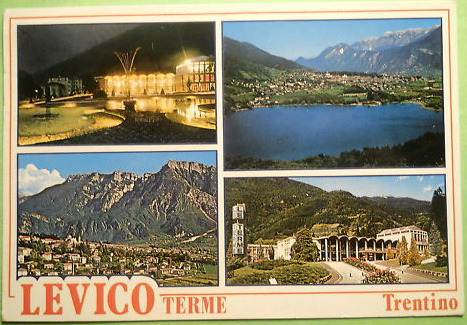
Postcard from Levico Terme
Today’s stage is in the Dolomites. No high mountain passes today but the Sugana valley used by much of the route today tends to mark the southern border of this mountain range topped by the Marmolada at 3,343m.
The Alps form an arc spanning several countries and there are many subdivisions, often labelled because of geology. The Dolomites, dolomiti in Italian, are made of, wait for it, dolomite rock. It is named after Gratet de Dolomieu, a French mineralogist who discovered the rock was different to regular limestone on account of its high magnesium content. A cousin of sedimentary limestone, it’s different to, say, the volcanic basalt and granite that form other parts of the Alps.
You’ll find dolomite all over the world, from Kansas to Tochigi. And not all the Italian Dolomites are made out of dolomite. Plus the exact map of the Dolomites is hard to pin down, the Italian Alpine club’s Alpenvereinseinteilung der Ostalpen says it is Zones 51, 52 and 53 in the map below, highlighted here in Giro-pink for you:
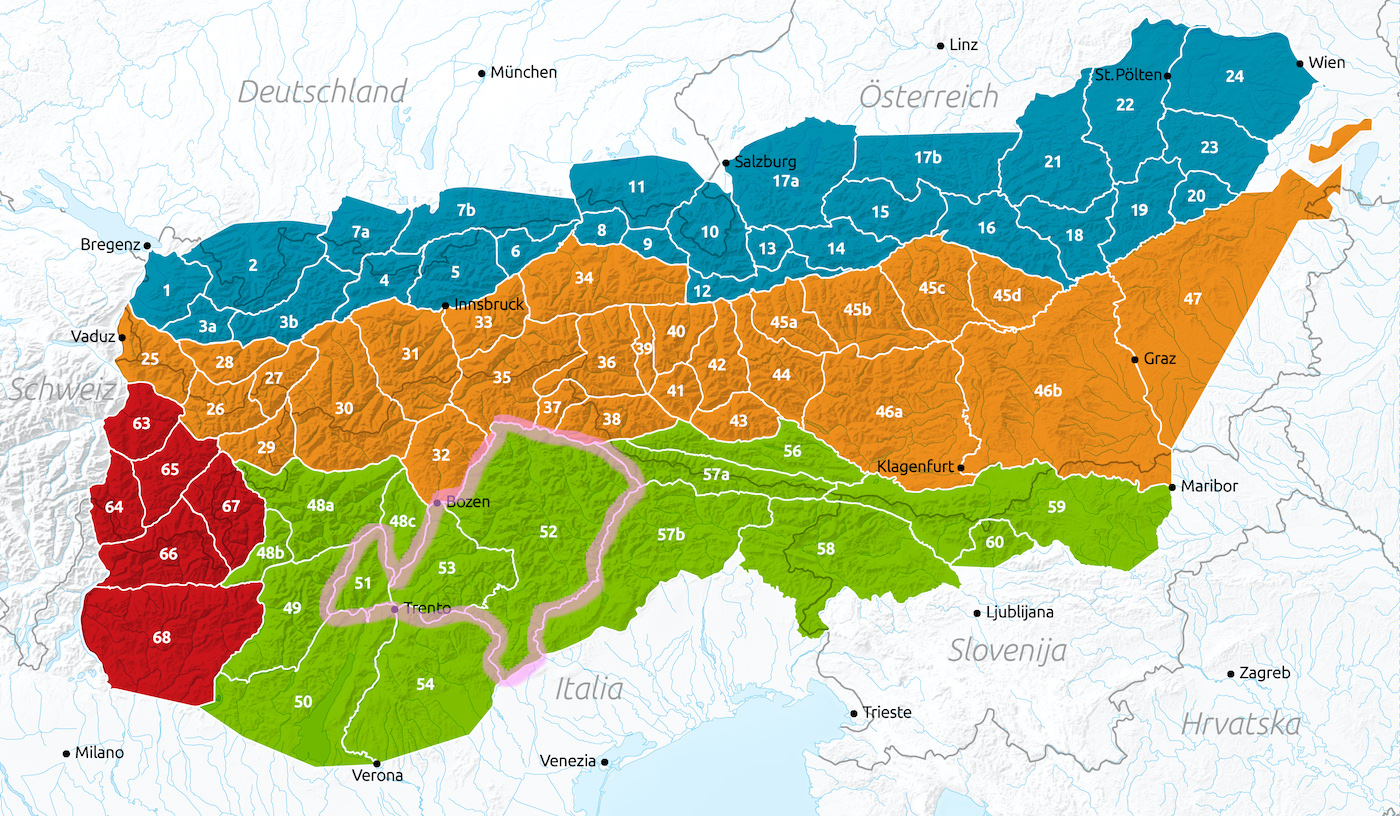
Pro cycling is heavily reliant on geology. All the mountain passes, climbs and even the flatlands we celebrate are the result of millions of years of terra-formation. But rarely mentioned, except in the Giro when the Dolomites appear on the horizon. Nobody speaks of the Carnic Alps or the Julian Alps, two nearby ranges; ditto in the Tour de France, the two day visit to Alpe d’Huez will happen without a mention of the Grandes Rousses range. If you want to be a pedant the Dolomites have subdivisions too: today’s stage is in the Brenta Dolomites, the western side.
Instead what if the Dolomites were also a social construction? The magnesium content can give the rocks a more pinkish hue which is appealing at sunrise and sunsets, it has attracted poets and painters before, today Instagrammers. There are popular ski resorts here that bid for the Giro. Also they’re close to some of Italy’s cycling heartlands with nearby industry and population centres. Some of the passes are old routes from Italy to Austria, and not the 1930s onwards ski resorts custom-built for car and bus access – think Sestriere – and so the passes twist and turn up the mountain more than usual which gives the roads more appeal and a greater sporting challenge. All these factors combine to make them a popular and rewarding outdoor destination.
Can I ask: what does the remark about Valgren and a contract with Tudor mean? Sorry if I’m being obtuse.
Love this postcard.
“timing”
Cannot find the face-palm emoji at the moment. Doh. (I had no idea what Tudor is…I never read the sponsors summaries that INRNG provides…)
Tudor is making watches.
I was thinking the Tudor reference was Ring’s jest that because Valgren was such a great actor, he should perform in Shakespeare’s plays who lived during the Tudor period.
Ganna said after the TT that he was going to go for another stage.
He’s said to be tired too but if he wants to try this might be last chance… although Sunday gives him an option too.
How much is Ganna paid? Random question sorry…
He’s just a funny rider in my eyes, as his profile seems to far exceed his win rate? I think back to Tony Martin and *if* Ganna is earning significantly more whether it might bug someone like Martin who dominated TT’s for years but got lost a little post Cancellara, plus I guess in the post-Ulrich German cycling malaise and maybe ended up not reaping the financial rewards that Ganna has?
I don’t know his salary, but I agree that Ganna probably gets billed as a prospect more often than his recent palmeres would warrant.
A big part of his profile is obviously his track success, where he’s a 6 time IP world champ (itself a record), and the hour record holder. His first couple of big years on the road were also very successful – 2 TT world champs, 6 Giro stages plus stints in pink among other wins. At that time it felt like he would dominate in TTs for years to come whilst his power would see him charge to classics & breakaway wins…
But it feels like his stock has fallen in recent years, where he’s been overshadowed by the likes of Remco in TTs, and hasn’t managed to deliver on expectations in one-day races – he’s had a few podiums, but it’s taken him until this spring to finally win a classic, where he’s perhaps suffered from the way classics are races these days – in Cancellara’s era he may have been able to show himself more.
Anecdotally, it also feels like he showed some promise on hills earlier in his career (in his Giro road / non-TT win for example), but seems less competitive these days. Being 87kg is certainly a hindrance!
As Davesta says, Ganna is primarily a track rider, which also explains Ineos’ interest in him.
However, although he started racing seriously Classics only too late (Classics normally require direct experience, loads of it, and 2023 was the real beginning for him, so this is his 4th season at most) – still, he’s a double Sanremo runner-up and also’s got an E3 podium, besides a 6th in Roubaix. Something unthinkable in T. Martin’s case, and also especially valuable for Ineos as currently they’d barely have anyone else to race for in Classics (not that they had plenty more in recent years, probably just Pidcock).
I think he’ll hardly get much more in the field because he should have started before, and the level of competition is extreme (well, just as in TTs, a field especially stacked with several top-level athletes in recent years). Which also explains why the athlete is so appreciated if one looks a little beyond PCS points: PCS points reward quantity over quality and don’t consider at all who the competitors are, which on the contrary is pretty much paramount in cycling.
Besides, a strong difference between his career and Martin’s is that Ganna is living a period when his specialty is nearly disappearing both in terms of races/stages available and in length of those, so that, for example, it makes very little sense for Filippo, compared to Martin, to even try and develop more as a “minor stage races” GC contender, given that, unlike the German, he couldn’t take advantage of his main virtue on current courses.
That team pursuit final where he did a double pull and rode down the other team (Australia?) was truly heroic!
Dolomite is used as the major contributor in a pottery glaze; it gives a very dense, pure white and slightly rough finish which was very popular in the mid twentieth century . I think I still have a small bag of it in the garage! I knew that it was sourced in Italy, I just presumed that the source named the product – but I didn’t know the mountain and so its constituent was named after the geologist. Thank you for the information.
There’s dolomite the mineral and dolomite the rock (which contains a lot of dolomite mineral), you probably have pure mineral for the glaze, CaMg(CO3)2).
Come for the preview, stay for the postcard. Enjoying these 👍
+1
Every day’s a school day 🙂
+1
Nico Denz may be worth a chainring too. Don’t recall him trying for the break in the previous stages and usually picks his days.
Good pick, he might be needed tomorrow but there’s only so much he can do on the course so can try something today.
It’s very open today as so many riders and teams know this is their last chance, without counting there are probably 15 teams without a stage win.
I used to have a Triumph Dolomite. Lovely car, I still miss it.
I bet all that rock made it rather slow to accelerate!
My first ever car. Bright blue and ripped the bottom of the oil sump off going over a raised manhole in the road. Flooded our drive with oil…
Can go with the Bianchi Tonale, named after the Passo Tonale, another “dolomite” vehicle and also available in “celeste”.
Very good pick!!, especially speaking of Giro d’Italia… which it won in 1956, when it also broke some speed records – thanks to a special aero cover (following up on the other day’s conversation on the aero subject).
Does anybody else feel like we’re getting the same breakaway cast every day? I mean gosh. It doesn’t seem like there are very many riders actually interested in winning a stage at this point in the race.
Are Alpecin or Picnic even at the Giro?
That’s quite common in Grand Tours, where those who have hit their peak and are strongest, are able to recover better, and so able to show themselves day after day…after 2+ weeks a lot of riders will be hanging on and looking forward to just making it to Rome.
Picnic were in the break yesterday and their rider was very active before Caruso et al got ahead. I agree on Alpecin, though: can’t recall them doing anything.
Would love for Toon Aerts to win today: he has a very good sprint and has been impressive on the climbs. Plus, I always appreciate it when the win goes to a team who’ve so far gone empty handed (as for Valgren yesterday)
There is an Alpecin rider in the break today, so maybe the team decided they’d better do something! It looks highly unlikely the break is going to get anywhere near contesting the stage though.
As Davesta says we often see the same riders over and over. Alpecin-PremierTech lost Kaden Groves and are not that into the Giro (good luck buying Alpecin shampoo in Italy, it’s not easily available) and lost some core riders last year when Fenix backed out and there was no replacement until PremierTech came in after the IPT/Vuelta fall-out.
We were on Ca del Poggio in 2024, on the double Monte Grappa stage. Beautiful countryside. Brutal, brutal climb. Barely managed it with a 34-27.
Can’t see any sprinters surviving this so close to the finish.
I thought they’d be softened up by the early climbs and out before… but this didn’t happen.
Unexpected result. Great leadout by Stuyven, very impressive.
About the Dolomites:
The notoriety of Dolomites should mostly be a social construct. Maybe a consequence of a long-term regionally united marketing?
I guess a French equivalent could be the Vercors (WW2) or perhaps Chartreuse (the drink and the monastery), although I am not French.
A nitpick:
I doubt that Italians generally divide the Alps according to the Alpenvereinseinteilung der Ostalpen. Perhaps only the Alpine Club from Südtirol? According to Wiki French and Italians use Partizione delle Alpi, while there is also newer SOIUSA.
The Dolomites themselves are treated inconsistently between the classifications. Classification is not easy: should one use geological, geomorphological, or cultural division?
An example, the northern tip of Vercors is technically part of Jura, but of course no one would put it appart of Vercors.