
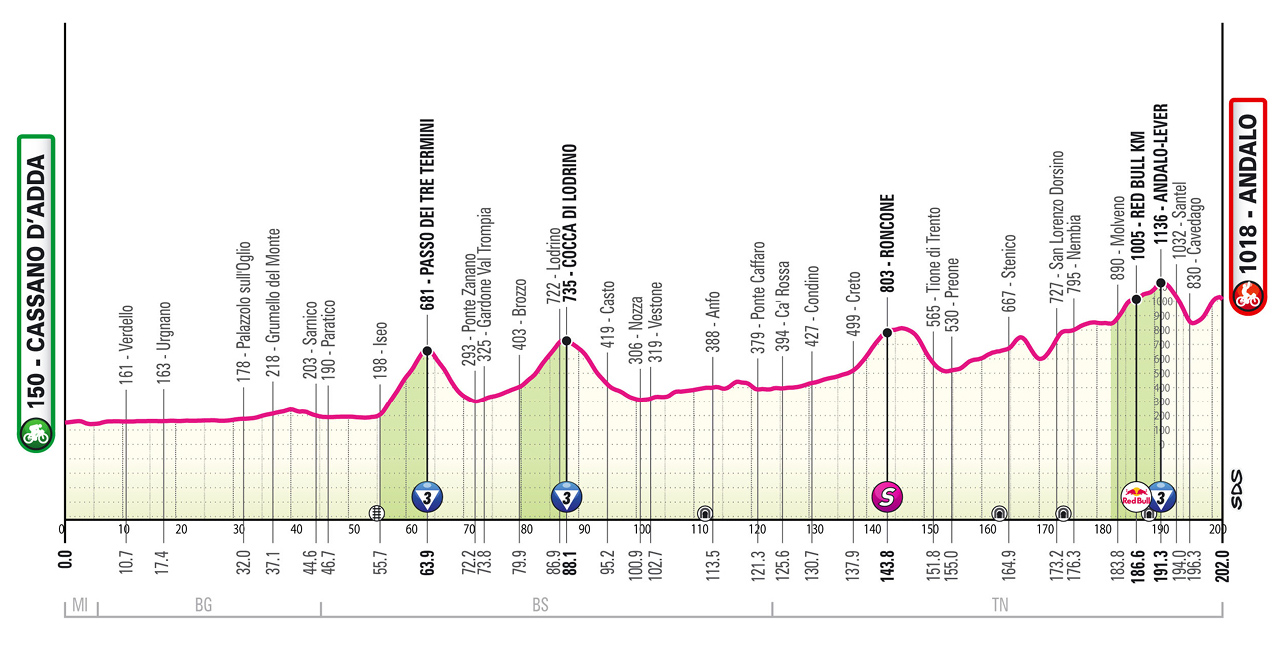
At the start of the Giro this would have been “the breakaway day” for everyone with dreams of a life-changing stage win. It could still be but with several sprinters’ teams struggling for success and Paul Magnier needing points they now have an interest to try and lock this down.

Encore: another stage win for Jonas Vingegaard, his fourth and this time in the maglia rosa so a photo to keep. He attacked in the last 7km of the climb, very much his style to surge clear to get a gap, then keep going to gradually take more time. Felix Gall tried to respond but surrendered to reason after 14 pedal strokes and finished in second but only just, with Jai Hindley, Thymen Arensman and Derek Gee-West near by.
Red Bull had worked hard but it gained Hindley three seconds on Arensman but Giulio Pellizzari cracked, losing 18 minutes and sliding to 19th overall, a disastro said the Giro website. It means Afonso Eulalio is in the white jersey but Davide Piganzoli is 2m17s behind and probably fancies his chances.
For all the stasis overall, there’s a lot going in the secondary classifications. Giulio Ciccone was out points hunting and got 54 points for winning the first four climbs… but Vingegaard got 50 for the final one. The arithmetic looks very difficult for the Italian. Jhonathan Narvaez seems to know his maths better and closed in on Paul Magnier’s points lead, now just two points in it.
The Route: 202km and the hardest climbing comes early with the Passo dei Tre Termini, 8km at 6%. The Cocca di Lodrino is what Italians call pedalabile, literally “pedalable” as you won’t be walking up and it’s a big ring climb of 8km at 4%. The intermediate sprint looks like a climb on the profile but it’s a drag up the main valley road. The unmarked climb to San Lorenzo Dorsino is 2km at 7%.

The Finish: into the town of Andalo and then back out for a loop that includes some climbing. It’s all on wide roads but the gradient gets difficult for plenty, it suits punchy riders. From the 4km to go point to the 1km point it climbs at 6%,
The Contenders: a breakaway or sprint? Probably a breakaway, as if the sprinters crave an extra shot at the win, several will find today’s stage is too mountainous for them which leaves few teams willing to try. Paul Magnier has a tiny chance, Dylan Groenewegen none. Movistar can try playing their Orluis Aular card again but it might well benefit someone else again.
Breakaway picks are Jhonatan Narvaez (UAE) but with fatigue unknown after all the accumulated efforts and he might just want to grab points at the intermediate sprint as he only needs three to fleece the ciclamino off Paul Magnier’s shoulders. Team mate Igor Arrieta is suited too.
Andreas Leknessund (Uno-X), Ludovico Crescioli (Polti-Malta) and Michael Valgren (EF) are outside picks.
Alberto Bettiol (XDS-Astana) is suited but he’s such a rare winner that once feels like a lot, we’ll see if soon to be 37 year old Diego Ulissi can play a role.
Edoardo Zambanini (Bahrain) sprints well from a reduced group and is a local along the route today.
 |
– |
 |
Narvaez, Ciccone, Silva, Valgren |
 |
Crescioli, Aular, Leknessund, Aerts, Ulissi, Bettiol, Zambanini |
Weather: sunny, 30°C
TV: KM0 is at 12.20pm and the finish is forecast for 5.15pm CEST.
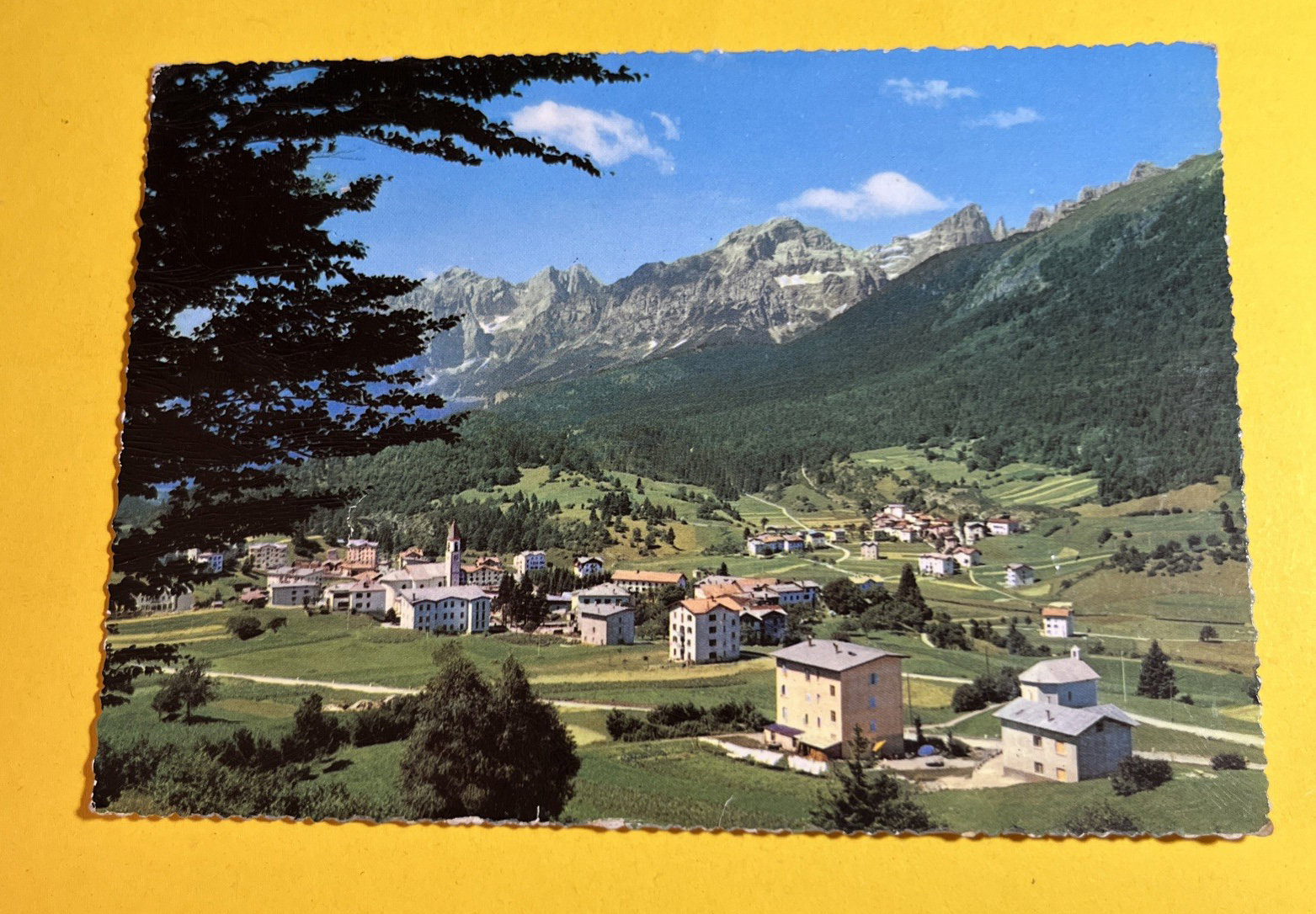
Postcard from Andalo
The Giro last came here in 2016. That day Alejandro Valverde won Stage 16, pipping Steven Kruijswijk for the win but the Dutchman was arguably the bigger winner as he took the time bonus for second and had distanced all the other riders in the field. The second-placed rider on GC was Esteban Chaves at three minutes, Valverde was next and then came Vincenzo Nibali and Ilnur Zakarin, both almost five minutes down. Stages 17 and 18 were flatter days with wins for Roger Kluge and Matteo Trentin.

Stage 19 reversed all of that. After cresting the giant Colle dell’Agnello Kruijswijk went wide on a corner, he seemed to lock-up, as if fixated by the approaching wall of snow and collided with the bank of ice, causing him to somersault over the bars and land hard on the road. Nobody waited – why should they? – and Kruijswijk was now isolated with no team mates and over 50km to ride. Nibali rode way for the win and Kruijswijk finished almost five minutes down. Chaves took the overall lead and the following day Nibali overhauled Chaves to win the race.
Should Vingegaard be worried given his team lost the Giro after things had looked so comfortable? Never say never as accidents happen but back then Nibali remarked Kruijswijk had three weaknesses: descending, the propensity for a bad day in a grand tour and a weak team. Kruijswijk alas was confronted with all of these on the Agnello. Vingegaard is a different customer.
Just a couple of thoughts about yesterday.
Sepp Kuss did a very short turn on the front for Vinny so I wonder if he’s still building to the Tour (and would seem well short currently) or he is off form.
Vinny had 1 min 30 seconds lead at one point but that was pegged back quite considerably and even taking into account the sprint for 2nd/3rd it would seem he lost some time in the last 1 to 2km. So maybe he remains short of top form too with the Tour in mind, given that he probably hoped Kuss’ turn would have meant attacking from 5km instead of around 7km.
Feels like Kuss hasn’t had top form since his Vuelta win although circumstances have dictated that occasionally he’s not been used or UAE have burnt him off before his usual stint as they made the race rather than Visma.
Kuss reminds me of Wout Poels now, excellent rider who’s long been aware he’s not racing with the gods and has forged a brilliant career in the only lane open to him – ie deluxe domestique grabbing wins where he can. He might even be the most decorated full time domestique I can think of with his Vuelta win? (Not counting those who race classics as leaders then double as domestiques in summer).
It’s funny there’s real glass ceiling in cycling that us viewers usually only know by the time the riders/teams have already made their career decisions – as in we might think a rider can progress to being a GC leader or a Classics leader etc but really the majority likely know very early that such goals are beyond their level and make decisions accordingly.
Riders like Politt, who some might have wanted to see go the VanMarcke route, and pursue the Classics, maybe knew despite his runners up spot at Roubaix that this was never really an option so took a different path? Same with Kuss etc – it must be horrible to be on the border line of this decision like Mikel Landa, Adam Yates, even someone of the calibre of Narvarez (who’s apparently heading back to Ineos and his contract decisions must be hard as he’s such a valuable domestique but also has an enviable ability to win regularly unlike 99% of riders).
Trying to balance the desire for wins if you are capable, alongside money and the prospect of excellent team support on the days you’re allowed to race for yourself with potential domestique duties must be a very difficult life decision for some riders.
Politt, I think, is happy with his choice. He doesn’t really have the sprint to win big one-day races, and he struggles with positioning. Narvaez also struggles with positioning, but his excellent punch and sprint means he can win from reduced groups. I can understand if Narvaez wants to be a team leader in hilly classics, and on hilly GC stages, since he can get wins for himself rather than Pogacar.
I like you point about Yates and Landa being on the border for the decision.
I would add Jorgenson to this discussion. He’s clearly a great rider and has some big wins already, but it seems like there is another level that he might never hit. He’s an extremely valuable rider either way, but in the next couple of years we’ll see whether he has a next level or he’s just not that guy.
An aside – oldDave, you must be British, adding the extra “r” in Nar-vay-ez. Heard so many people (including former teammates on a certain podcast) call him Navarez 😉
I think Jorgensen’s ship has already sailed on being that next level GT rider I’m afraid, brilliant though he can be.
100%, I’m probably wrong but has Kuss won anything other than that Vuelta of note?
I suspect he’ll be changing teams at the end of the season. Or possibly out of work.
Way too much salary for a guy to pull for 300m. He’s looked off for the last season and a half.
I’d add Kwiatkowski in the mix of most decorated full time domestique. Albeit arguably his biggest wins came before he dedicated himself to domestique work.
Today would be good day for Jasper Stuyven to finally snatch another win.
He’s a big guy. He could, but it won’t be easy plus he’s probably on hand to help Magnier.
Gobbling up the points on offer is also a means of helping Magnier 😉 If I were Brama I’d go all in for Stuyven today. He’s been their best guy in the spring classics, he’s been instrumental in Magnier’s succes so far and he’s shown he’s got the form in this Giro on two occasions already. Try to get him in the break with a teammate and tell the others to sit back and be ready in case the break gets caught.
I miss Nibali. Not the most talented rider of his generation but a proper racer, but he never really got his dues for what he achieved. Pog rightly gets lauded for having a go at one day races and grand tours. It Anibal was out there last decade, winning Milan San Romeo, the tdf and Giro, even in editions he wasn’t the strongest rider.
His tdf cobble ride and having a crack at the tour of flanders (his attack arguably leading to the winning move, even though he was quickly reeled in) also showed a top racing side to him.
2016 a great Giro. And that Andalo stage a perfect example of what I hinted at below, you don’t need a big mountain marathon to enjoy full mayhem mode after the rest day, mid-mountain may do.
Worth noting that the K crash down the Agnello didn’t come unforced, over the top he was on his very limit (in his own words) as Nibali had pushed harder on the highest slopes of the Agnello… without getting as much wasted. In fact, Nibali prepared for what was coming, whereas Kriijswijk was even in sore need of eating and drinking (again, in his words), besides not having appropriate protection and windshield from cold.
Totally the sort of cycling I miss, when the environment, the logistics, the equipment is a relevant part of the challenge. Now any lack of comfort equals supposed lack of safety, so that it’s all closer to “track & field on wheels”. Only heat is apparently accepted, maybe because big teams have protcols to deal with it. Or perhaps because the intention is making cycling more and more similar to rollers, so welcome extra sweating!
I’ve been thinking about Nibali a lot over the past few days. I haven’t heard much talk about descending during this race, but if Nibali was here it would be a critical element of the race. Gall still has a big test coming up, so we’ll see if anyone is willing and able to do what Lo Squalo would have done.
He was a skilled racer. One observation was that his personality never came across well to English-speaking audiences but in Italy he was often warmer in interviews and amusing with a lot of self-deprecation etc.
I didn’t realise this about Nibali. In English, unfortunately, he sometimes comes across as a d***h**d. But English obviously isn’t his first language, and likely he doesn’t quite get the nuances that native speakers understand.
I didn’t know he could even speak English 😀
He generally refused to speak English although his command of it was easily good enough to do so.
I thought it was a bit of a statement ride yesterday both by Jonas Vingegaard and his team (who have been pretty flawless so far a bit like peak Team Sky). Maybe he did ease off in the last km, though it was very warm and not convinced the timing shown on the screen is always accurate, especially on multiple hairpin ascents. Polemica now moves on as to whether he wants to win more stages (he suggested better for other team members to do so, easier said than done though Davide Piganzoli for White seems possible) and how does that compare to riders not at the Giro. Maybe best enjoy what’s been achieved and leave July discussions for another day.
Another somewhat anonymous stage today, perfectly OK transition stage but another one tomorrow, feels like we have been transitioning most of the past couple of weeks
Visma is way better than Team Sky. The latter banked essentially on political pressure (among other aspects, the UCI, of course, *and* riders’ market through tight association with powerful sports agents) to allow their most common, ahem, strategy: “ride slow through previous mountains then rocket launch for the final 15′ rush”. Visma control the race through traditional means, i.e., working hard on the front of the bunch, closing on dangerous attempts of breaks etc. In fact, sometimes they just need to face some shortcoming in terms of energies.
Yesterday we had a good example of a basic difference between the two models: Visma riders spread across the road in a “horizontal” line to signify they were fine with break and would stop chasing things as they were… a clear message, but several riders jumped all the same. In Sky…well… things worked a bit differently… nobody would be allow to jump, it was no “message” or “suggestion”, rather an “order” or “menace”, and in later years we could see how some of their riders who became used to that system then had it so naturalised that even became violent or complained (!) because people tried to go when they blocked the road (which is against the rules of course).
I think your personal feelings on Sky cloud your judgement, as the similarities between how Visma ride today and how Sky rode then are clear. Sky worked hard on the front of the bunch all day, and controlled the race, just as Visma do. Froome was able to out climb all his rivals on the final ascent of the day, after being set up by his team, just as Vingegaard does. Froome could take time in time trials against his GC rivals, just as Vingegaard normally does.
I’ve also seen Visma block the course, most teams will deploy that tactic when racing on narrow roads, it’s part of racing so to single out Sky, and insinuate that they resorted to violence often, seems unnecessary.
You can just check the climbing speeds normally held by Sky on previous climbs with Visma’s, also normalising to “cycling evolution”, i.e., to general final speeds.
And if you want an example from back then, you can compare the Astana pace on climbs in 2014 with Sky’s.
If you fancy, you can also check how often break made it on hard mountain stages and with what sort of time difference over the selected group.
And how do you “control a race” if not holding a high-enough pace? This is the question.
We also had an explicit example of what happened in case somebody wanted to raise the pace beforehand with the infamous Aru episode.
The narrative “oh wow, what a war machine, nobody can attack with such a pace” which held true *only for the final uphill train*, but was just plain false across the entire stages, was sold to a public who simply had no parametre to understand what going fast or slow would mean.
And, even more important, might not like to ask themselves the above question, if not working, how is it that they “control the race”?
The relation between Sky and some Italian figures at the UCI (Zorzoli and the TUEs provided) or on riders’ market (the pressure over Movistar through Acquadro) surfaced fully, there’s no mystery anymore.
If you pretend to say (just as Lance’s fans do) “oh everybody else does the same”, you should provide equivalent data. The same? The very same? Waiting for names and figures.
Otherwise, let me assume that it’s your judgement to be slightly clouded by years and years of marketing bordering propaganda.
I’ve seen Visma blocking the course and other riders jumping all the same with no consequence deployed except with sporting means (like, I’ll hold a grudge and chase you next time, arrogant but acceptable). I’ve also seen Sky blocking the course and nobody jumping. There’s a slight difference, but on this I’ll let you wonder why.
I come back to these pages every year or so to see if people are still moaning about Team Sky. And like clockwork they are. Get over it guys
Yeah that would be great, first you can tell people that it’s all conspiracy theory or conjecture at best, then when facts surface, “let’s get over it, why still talking of those old news…”
Or year 2016: “look cycling is like this, you know? Just ugly. Maybe not at the Giro or in the Classics, but this is how it works at the TDF”. Five years later we discover TDF doesn’t need to be that awful… so best thing we can do is if we forget all we said and just move on.
Cycling is history, sorry for you, but I’ve read they have some brand new Enhanced Games in Vegas where nobody is moaning, from now on no need to come back here every year and sadden yourself, just go and celebrate sports science with those guys.
Can I just check what you’re saying here Gabriele, as I’m not sure I fully understand?
Are you arguing that Sky rode slow during the day then fast up climbs… but that their climbing speeds on these final hills were comparable with Astana’s from 2008 (or I guess what we commonly call the ‘acknowledged doping era’ of 95-2010 now)?
And your arguing their speed on these climbs which was equivalent to proven dopers proves they were doping? (alongside all the other evidence you’ve listed).
I’m not looking for detailed reply, just if I’ve understood correctly because I’ve not heard this exact argument before. I was under the impression climbing speeds noticeably decreased following the bio-passport of 2010 and that’s why we were all so amazed when Pogacar climbed faster than Contador’s 2008 Verbier time and that other mid90s climbing feats now appear to be within reach?
Apologies to all those who have no interest in raking over Team Sky again, I’m actually with you but Gabriele peaked my interest here with something I’ve not heard previously.
@oldDAVE, no, that’s not at all what I was saying.
“[typical strategy was to] ride slow through previous mountains then rocket launch for the final 15′ rush”
“[the idea Sky controlled the race through high pace] which held true *only for the final uphill train*, but was just plain false across the entire stages”
Sky typically kept a mediocre pace on most climbs of a mountain stages *barring the finale one* (if anything) to sometimes prepare a short attack with an uphill train.
They did NOT control the race through sustained high-level effort as INSTEAD, with more or less success, we may see Visma do these days.
Or as Astana often tried to do in 2014.
But the race stayed controlled all the same, ain’t it?
Why people didn’t attack if the pace was not that intense, be it only for lesser objectives, as they did and do all the time in other races?
I did *not* argue *anyhting specific* about the actual speed on the last climb, nor did I relate anything of the above to Sky’s doping practices which were just a consequence of the same cause, i.e., dominant political power.
Ah, the “acknowledged doping era” should include all the periods when *proven systematic doping* was able to go massively through the supposed antidoping system without detection, whatever such system was, and whatever the reasons, so a restrictive and provisional definition for the last 50 years could be “1976-2018”.
We know mainly thanks to other justice institutions external to the sport that at Sky they were doping systematically with no consequences, and we know thanks to police and Operation Aderlass that people were blood doping in late ’10s without being detected by any bio-passport.
The above could be extended to 2022 if we want to include Superman López’ case, also doping without the sport system being able to detect him, but it’s unclear if he was just lucky or his doctor very good, rather than it all being part of a systematic lack of proper control.
Personally, I must say that my opinion corresponds to the latter, but this is mere opinion, indeed, the rest I cited are large-scale facts
Just to be clear – I was asking honestly as I did not understand your point, this wasn’t me trying to annoy and my mistaking your argument was genuine.
So you’re saying Sky did not ride fast and no one attacked and that was for political reasons. Okay, I get it, whereas in 2014 with Astana and Nibali they did ride fast and no one attacked because they could not.
Do you have any stats to back it up? I’m interested – as a quick armchair fan I just googled the average pace of the 2013 and 2014 TDFs and they were around the same, with all races seemingly between 39kph-41kph till more recently when they jumped to 42kph – but this is just google and may well be wrong.
As for doping, I’m very happy not to be having that conversation again, I just used the Armstrong era as a hold-all in the previous comment but am well aware of historic and contemporary cases making that a poor term.
@oldDAVE
I’ve already written it out above. Check climbing times (wattages or VAM) on ascents previous to the last one and how many breaks do arrive to the finish line – and with what advantage – in monutain stages. The general average speed of the race doesn’t tell much on this subject as it depends on many factors (type of course, speed on stages which aren’t relevant to this discussion, weather etc.).
I have not all the data at hand and no intention to check it all now, so I’m going by memory but 2016 was shocking, especially two stages which I had expectations on like the Spanish and the Swiss one. But it’s a modus operandi, so you’ll find as many as you please. It’s a debate I already had infinite team, hence as Anon says above, it’s sort of boring mining the obvious again and again.
Sorry Gabriele:
The doping era was c.1990 to 2007. The bio-passport came in in 2008. It took 2-3 years for the doping to be fully shaken out, at least for the GC teams.
There is evidence for Sky abusing the TUE system, and they may have had a small group of riders within the team further bending the rules at the margin: but there no evidence of team-wide doping or of this being winked at the authorities.
Sky also had a huge budget (they hired the best domestiques). More importantly, they were the first team to really take a scientific approach to training, equipment, and later nutrition: this is something people really under-estimate about Sky. Their gains from this approach allowed them to win the Tour with some otherwise fairly mediocre riders.
Jumbo had caught up with them by about 2019, and then Pogi happened.
@John
No, John – *I* am sorry…
ROTFL.
(I suppose the Freeman investigations didn’t leave any trace in your AI.)
(Or the biopassport not catching blood dopers and why Ashenden did resign).
But let’s leave it like that. The stage hasn’t been great until late yet «ogni limite ha una pazienza» and I wouldn’t defy our host’s.
I’m under no illusions at all that there was a lot of cheating during the 2010s. We saw it with Astana 2014 (when the media couldn’t fall over itself fast enough to emphasize that Nibali had nothing to do with it), we saw it when Nibali hitched a lift in the Vuelta like it was so common that it was nothing, we saw it in the 2017 Giro when the winner benefited from a doper. But people have forgotten because these things captured the media’s attention for about one day.
Enough of the trial by blog comments, it rarely goes anywhere useful and just raises temperatures.
Have to agree. Plenty of similarities between Visma and Sky, although definitely not carbon copies.
Totally agreed with your last paragraph.
The Swiss case shows how locals were enthusiast with what they got, and Cairo surely as well (Swiss Franc is always a good currency), but what was hindered was the general design of the race.
I won’t insist on chronology or possible solutions because I already did in the past, but I’ll take advantage of this manifest case to recall the other “Swiss situation” in 2023 in order to underline once more that a GT relies strongly on a properly organised general structure, it’s not a stage-by-stage thing, so even a little “isolated” change alters the balance and narrative of the whole.
I really believe that the Giro should go back to his “heavy penultimate weekend” format. I know they’ve come to love the “very tough mountain stage after the rest day, on last Tuesday”, but it becomes too fundamental a piece and when it doesn’t deliver for whatever reason, it’s a serious issue. A hard, tricky, hilly / mid-mountain stage on Tuesday would do, then a transition and a triple set of varying difficulty. For example. Now they ended up watering it all down way too much.
Agree that the TV on screen gaps can be inaccurate but I suspect Vinny was expecting to do an effort that was a couple of kms shorter but Kuss didn’t play his part with the expected turn.
I’d love to know if this was the case actually…
I’m pretty used to so many attacks over the years coming at 7/6km from the top so thought that it was pretty on the money even if Kuss and Campernaerts didn’t do much yesterday in the end. I’d really like to know exactly how these attacks are worked out today, I assume it’s mathematical and Xwatts for Xtime dependant on the climb, but what would count as a domestique underperforming in a teams eyes? And how do they work out the exact outputs if you’re UAE or Visma or Sky back in the day? Would be nice to get a more indepth understanding.
I’m also happy to see more of Piganzoli either way, I just like his name! Shame that Scrofa is Pig in Italian so he’s unlikely to embrace and swine based nicknames. We’re getting a treat recently with young riders names – Del Torro, Uijtdebroeks (translating as out of pants), Seixas (I love commentators trying to embrace it’s Portuguese origins with ‘say-shas’ only to be corrected by the man himself that it’s ‘sex-ass’) etc.
It really makes me laugh that Juan Ayuso went for the bull as his icon on his personal website only to have Del Torro come through and take not only his place on the team, but also his place as a rising star and then finally his self-anointed moniker of the bull!
I’d suggest that any team would rate pulling for a few hundred metres with no impact on the race as underperforming. Victor did more than Kuss.
You’re probably right.
Kuss and Vini def trying to win this at 80% effort. Would be undignified to put in full effort with Pog not around. Obv Piganzoli has reasons for going full gas – home tour, new guy needs to prove himself. Kuss def saving his best for 3rd week in France as usual.
Stuyven i think is allowed to pull rank in QS. If he wants to go for a stage he can go for it. F them kids etc etc. I’ll def have a couple of quid on him. I hope Giulio didn’t burn all his matches already, need him to win. Reckon Ulissi will have a say as well, he looks mega strong. Astana got that good prep in again. Leknessund as well looks super strong, bad idea for him to ride for Kulset the other day, he is the hot hand. Although lets be honest, parcours is set for another Jonny Narvs masterclass.
Fingers-crossed for Ulissi, or will 2026 be his first season ever as a professional rider with no victories, after 16 years in a row scoring at least one each (2010-2025)?
(2013-2023 always at least .Pro level or above)
(From 2011 to 2020 he got at least one WT victory a year in 9 out of 11 seasons)
(A contradictory and peculiar profile as few others. International, but wins big only at the Giro. Old style, wins “ancient looking” races, thrives in stages, i.e., when fatigu gets cumulated, yet struggles terribly with single-day long distance. He won races in 13 different countries, including Spain and France, but never a TDF or Vuelta stage – a single participation in both, and in both cases just getting runner-up spots. He never won any Monument or major Classic, although an argument could be made for Emilia, Mi-To and Montreal. Expert in “declining” Classics like Appennino, Lugano, Camaiore or Prato. Out of his 49 victories, he could prevail in a race significantly over 200 km only three times – 3 Giro stages in 2011-15-16).
I’d suggest that any team would rate pulling for a few hundred metres with no impact on the race as underperforming. Victor did more than Kuss.