
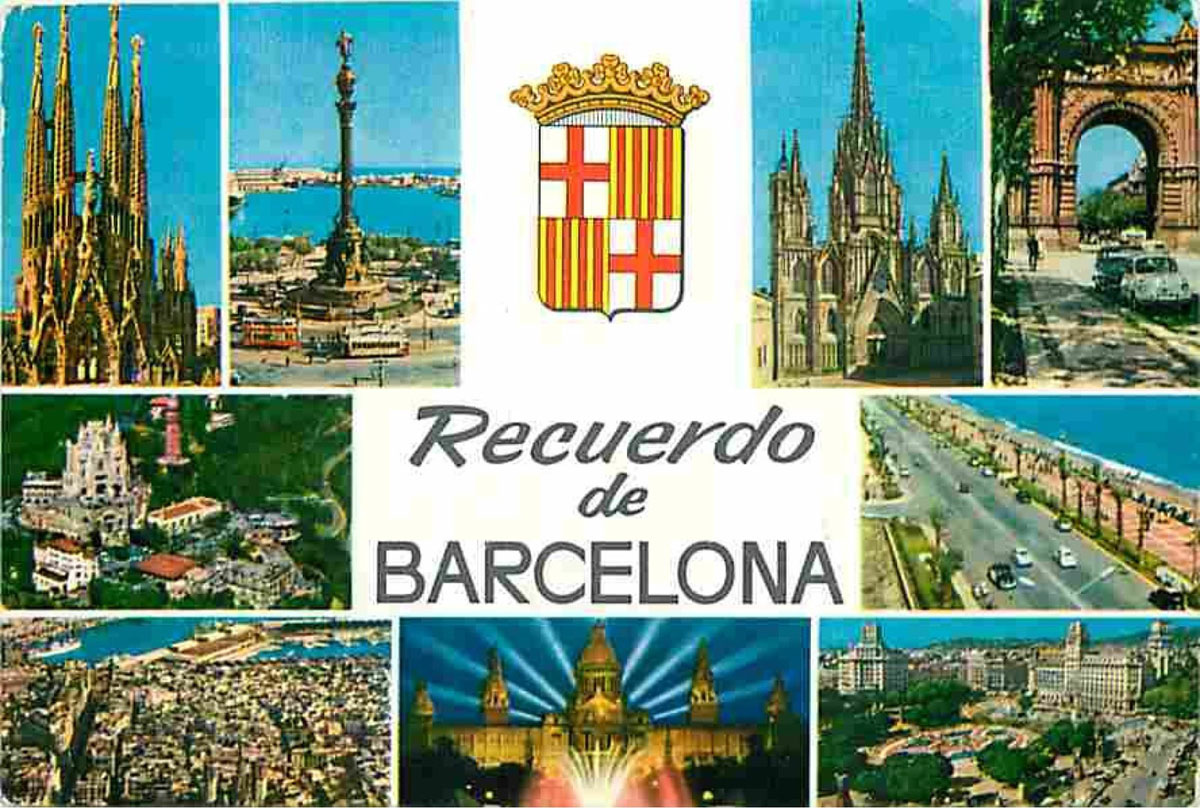
What makes the ideal grand départ? Barcelona certainly adds grandeur to the Tour, and the Tour is of sufficient scale to bring something to the city as well.
A grand départ is an expensive ticket. Barcelona is said to have fronted up €8 million; Bulgaria paid a similar sum for the Giro d’Italia in May. It’s a premium on the going rate for hosting fees: €100k for a stage start and €140k for a stage finish of the Tour de France.
Based on this, the gran partida is three starts (3 x €100k) and two finishes (2 x €140k) so the bill ought to be €580k and you’d think that could be rounded down €500k as a package.
Exclusivity and duration comes at a premium. The Tour de France can pass like a shooting star. A grand départ is more notable, a more durable fixture than a morning or afternoon. This year’s Tour will visit places like Hagetmau, Ussel and Champagnole, on the map for a moment but can’t hope to generate the barrage of “content” that a long weekend in Barcelona offers.
The start is more than three days of sport. The Tour opened on Wednesday, lodging riders, organisers and more from then until Monday morning. This travelling circus amounts to roughly 1,800 occupants a night alone on the Tour’s ticket. Add to that attendant media, teams booking for extra staff beyond their 28 bed allocation, plenty of fans and more and it starts to put something back into the local coffers.
What other event of this scale can come to town and beam images around the world? It’s hardly an unknown quantity. According to the city hall it got 26 million visitors last year, of which 18 million were foreigners; it can be hard to compare measurement methodologies and local boasts but this a lot; not Paris but maybe more than London or Tokyo.
Some barceloní complain about overtourism. Social media increasingly herds tourists to visit the same places. Can the Tour redirect people to Montjuic instead? Unlikely. If millions came last year to take selfies at the Sagrada Familia, Nou Camp and La Rambla, who will come next year? Locals may be crowded out of their local bar, bus… or even housing but the tourism industry needs flow: airlines, hoteliers, retailers and restaurants count on sustained high tourist visits.
One thing specific to this start is the promotion of sport as much as tourism. The lead figure behind the bid has been David Escudé, a Catalan politician who held the sports brief and himself a keen athlete. Yes the city wants to show the landmarks but it wants to promote sport. Escudé is now leading the bid to bring the Olympic Games back to Barcelona after 1992 and the Tour this weekend is a stage along that route. Similarly the city hall is trying to build more of a cycling culture and the Tour is being used as part of this.
Tour organisers ASO are notable for their ability to cross-sell something thanks to a large portfolio of races. ASO help run the Volta a Catalunya every March which finishes with laps around Montjuic. The Vuelta a España, now 100% owned by ASO, had its start in 2023 in Barcelona, opening with an evening time trial and the next day used a hillier version of the Montjuic circuit than the Volta which mirrors tomorrow’s stage. With hindsight it was a dress rehearsal for 2026.

It’s not an incongruous start. Catalunya is an autonomous community in Spain but also a a wider identity, parts of France share a link. The eastern Pyrenees see the yellow and red Senyera flag fluttering in the tramontane wind on both sides of the border. The map is from 1608 and the top left of “Cataloniae” gets close to the foot of the Tourmalet and includes Monday’s stage finish in Les Angles… or Els Angles as it was once known.
Nobody has turned a pedal yet but Barcelona ought to work. It gives glamour to the Tour and works on a practical level as it’s within reach of France, a foreign start but only just. Internally Tour staff have a house phrase that “a good Tour is one that starts well”. Let’s hope so because as onlookers that’s worth the fee and then some.
Tourism is actually become a problem of sort for Catalunya in the last couple of decades, essentially since the 2008 crisis. An important part of the regional economy? Of course (~12% of GDP), although less than, say, manufacturing industry (~16%).
But all in all, unlike other productive sectors (pharma, or part of the primary sector), it currently generates a big deficit through its negative impacts (which the government takes care of), on top of the constant need of public subventions of every kind, for example because most workers of the sector can’t live anymore on their wages due to high cost of the life in the whole region, so lots of them actually survive on… public aid in different forms (legions of “working poors”).
Tourism is big, so you can’t just switch it off, and the private owners who (or “which”, as in funds, not persons) are extracting profit from the model also have strong political influence through association, lobbying or lawfare. And at the end of the day, besides getting direct and indrect subventions, they’re taking advantage of the ahem “soft spot” of European governments towards, well, protecting the well-being of their citizens, hence paying the difference between wage and survival income.
It’s a classic economy case-study for dependency models, in Italian or Spanish it sounds even better because it’s the same word for “addiction”: the sort of condition when something doesn’t make you feel well anymore, it even makes you feel bad, but you aren’t just able to stop.
Interestingly enough, Catalunya’s got a similar issue with the meat industry!
Logistics or construction also have their little virtues (cit. N. Ginzburg) and many flaws, but they’re currently just a little smaller than tourism (around 10% of regional PIB each) while not having the same negative impact on the whole of local economy. At least they aren’t disappearing money. Instead, tourism or the meat industry as a whole are nowadays destroying wealth, but private subjects gets the profit while public money covers the deficit.
A divulgative source accesible to not-experts:
https://www.eleconomista.es/economia/noticias/13922514/05/26/la-dependencia-del-turismo-y-las-carnicas-tira-a-la-baja-el-pib-per-capita-de-cataluna.html
They should get the archer out of retirement to kick things off with a flame lighting demonstration.
Barcelona is my favourite city and I’m looking forward to seeing it again on TV later, as I always did when the Volta a Catalunya was on Eurosport in the UK. Montjuic is a lovely area too, away from the hustle and bustle of the city centre.
Perhaps there’s a disconnect between politicians’ ambitions and the views of the ordinary people who suffer the effects of excessive tourism.
I don’t know whether tourists being redirected to other locations was part of the motivation or a convenient justification. In any case, people will always complain about something or other. As for the wider requirement of tourism: it’s either that or the return of heavy industry (which will lead to complaints about increased emissions… )
One of the hidden costs of mass tourism is the increase in crime: pickpockets, drug dealers, prostitution, general hustling and scamming. And then ‘organised crime’ moves in and the demand for ‘protection’ money which involves intimidation and sometimes arson , violence and even murder.
These all affect non tourists’ wish ( let alone ability) to live in a high tourist area, which further changes the character of the place ; a classic downwards spiral.
I thought that ASO did not really publish a price for stage starts/finishes, and the pricing is rather opaque (deliberately). At heart, the price really depends on who wants to bid for the stage. Long gone are the days when large cities wanted the Tour to spend a day at their city since the road closures are pretty disruptive for people going about their daily lives. As a result, much of the race goes through the “empty diagonal”. And a lot of the places in France which host a race start or finish are pretty small places in very rural regions where it is difficult to believe they pay anything much. But nowadays, there are lots of mountains (and ski resorts) who want the Tour because it generates cycling tourism; I can believe they are willing to pay a bit more (but not every stage can be a mountain stage). And as InnerRing said, there is a great deal of interest in hosting the grand depart (which ASO have turned into a multi-day event), and hence it costs a lot of money.
The fees aren’t on the Tour website but there’s a tariff so everyone knows what the rate is rather than haggling too much. It’s gone up, not long ago it was €70k for a stage start and €120k for a finish.
INRNG=Best cycling site in history
Having just left Barcelona, I was struck by a couple of things: although it’s easy to see examples of the anti-tourist sentiment, it’s also a very welcoming city, especially outside of the insane throngs around places like the Sagrada Familia. Also, many if not most of the people I met were not Spanish (or Catalunyan), especially up the coast where we were staying. Argentinians, Colombians, Peruvians…clearly have a different approach to economic stimulus of whatever flavor. It’s an issue all over Europe; how to protect the culture of a place while avoiding economic stagnation?
What would be the effect on tourism if you significantly increase the tax on a hotel room night?
Also, how did over-tourism happen? What were all these people before they started flooding cities like Barcelona and Venice? Seems like there must be places that have lost tourisism.
Tourism, in general, keeps increasing, so places don’t necessarily need to lose too much tourism for places like Barcelona, or Paris, or Yosemite, or Patagonia to be overwhelmed…
Social media plays a part. Over-tourism can be hyperlocal, not just Venice but one palace, not Rome but the Trevi fountain. Some of this has always been true, the Mona Lisa in Paris attracting crowds who ignore 95% of the rest of the Louvre.
In cycling Alpe d’Huez is a good example, it’s really not the best place to visit yet everyone goes there because everyone else does. Today this effect feels more concentrated, Tiktok pushing one bar or cafe while the next door one is empty.
I read a good piece about this effect on Kyoto a while back where business owners were worried about this. You’d think they’d love to go viral and have people queuing for their produce but no. The experience instead was it crowds out locals and while there’s a mini-boom, the algo or trend changes and the business is left high and dry with regulars having given up.
Over population.
I’ve lived in Barcelona for 45 years and tourism (and the Olympics) have been so, so bad for 95% us who live here, leaving the city way less interestingly unique and totally pricing us out of the affordable housing market.
Thanks for this. It doesn’t seem a great investment for 8 million euros. More like a public subsidy to a tourism industry that doesn’t need it. I’m not convinced big events promote sport participation, investment in facilities and opportunities would give a bigger return.
Whilst social media has undoubtedly exacerbated the effect of hyperlocal over tourism, it has always been a thing.
For those of us old enough to remember hard copy guidebooks there was often a ‘Lonely Planet effect’ whereby an attraction or even a bar or restaurant mentioned in print would be disproportionately busy.
It’s in human nature to seek recommendations, I guess.
For those who don’t live here, it’s hard to understand how quantitative scaling up has had qualitative effects changing deeply the nature itself of many places. Of course such peaks have always existed in time or space, but now it’s just spreading and thus changing radically the social mix of population, hence the very logic of public investments and so on. A spectacular library or sport centre for a neighbourhood at risk of marginalization now just visited as an architectural feature (if anything) because an impressive percentage of the housing has gone AirBnB and often only used to sleep and get the tube to the Ramblas – besides, people actually living there are now upper class with spending power so don’t really need public support. And this happened in less than a decade, in some areas, so it’s very hard to manage the impact. It’s the basic reason because of which AirBnB and co. should have been blocked from scratch: they take advantage of gray areas in normative to throw to the bin urban programmes and any attempt to manage cities in a perspective of shared wealth.