

The Critérium du Dauphiné is now the Tour Auvergne-Rhône-Alpes. The change was announced last year but will need time to feel right.
The new name is like a mouthful to say and a handful to type but the real problem is not the name change, more that it should have happened long ago.
History
Georges Cazeneuve was one of the founders of Le Dauphiné Libéré newspaper which was launched in 1945, its name evoked the Dauphiné area in the Alps and the newly-liberated France. The first edition appeared on 7 September 1945, the front page mentions Hiroshima.

The newspaper had local competition and Cazeneuve hit on the idea of a bike race to promote his paper. In 1947 the Critérium du Dauphiné Libéré was launched. Critérium gets used today to mean an urban bike race lapping a short circuit but the original meaning was a selective race. The stunt worked, the paper and race thrived.
Dauphiné?
The Dauphiné was an old kingdom and principality that has long since vanished. Its capital was the city of Grenoble. It lives on as a vague name and local identity. There’s the newspaper with its HQ in Grenoble and a few old street names, plus it’s also used for some regional branding, for example the local crops of walnuts can be branded Noix du Dauphiné. It roughly overlaps the Isère department.
Over the years the race went further the Dauphiné region and beyond where the Dauphiné Libéré paper is sold. But Grenoble has hosted the race more than anywhere else with 45 stage starts and 60 stage finishes, double that of any other location. Later run by Thierry Cazeneuve, nephew of Georgesf and also a journalist, he would organise the race in June and by July revert back to covering cycling at the Tour de France from the press room.
Takeover
In 2010 Tour de France organisers ASO took over the race from the newspaper and renamed it the Critérium du Dauphiné. Chopping “libéré” made sense as the newspaper has nothing to do with the race, it was probably a condition of the deal.
Regional change
In 2016 as part of a regional government reorganisation the Rhône-Alpes region merged with the Auvergne region to form a mega region, the Auvergne-Rhône-Alpes. The enlarged region is vast, comparable in size to Ireland, the UAE or Sri Lanka; more than 1.5 times the size of Switzerland; bigger than two Belgiums.
The enlarged region took to sponsoring the race. It makes sense as the route can help knit together these two areas and with this sponsorship the race has ranged wide. The map below shows the whole region with the yellow outline for the Isère and Drome departments being a proxy for the ancient Dauphiné area.
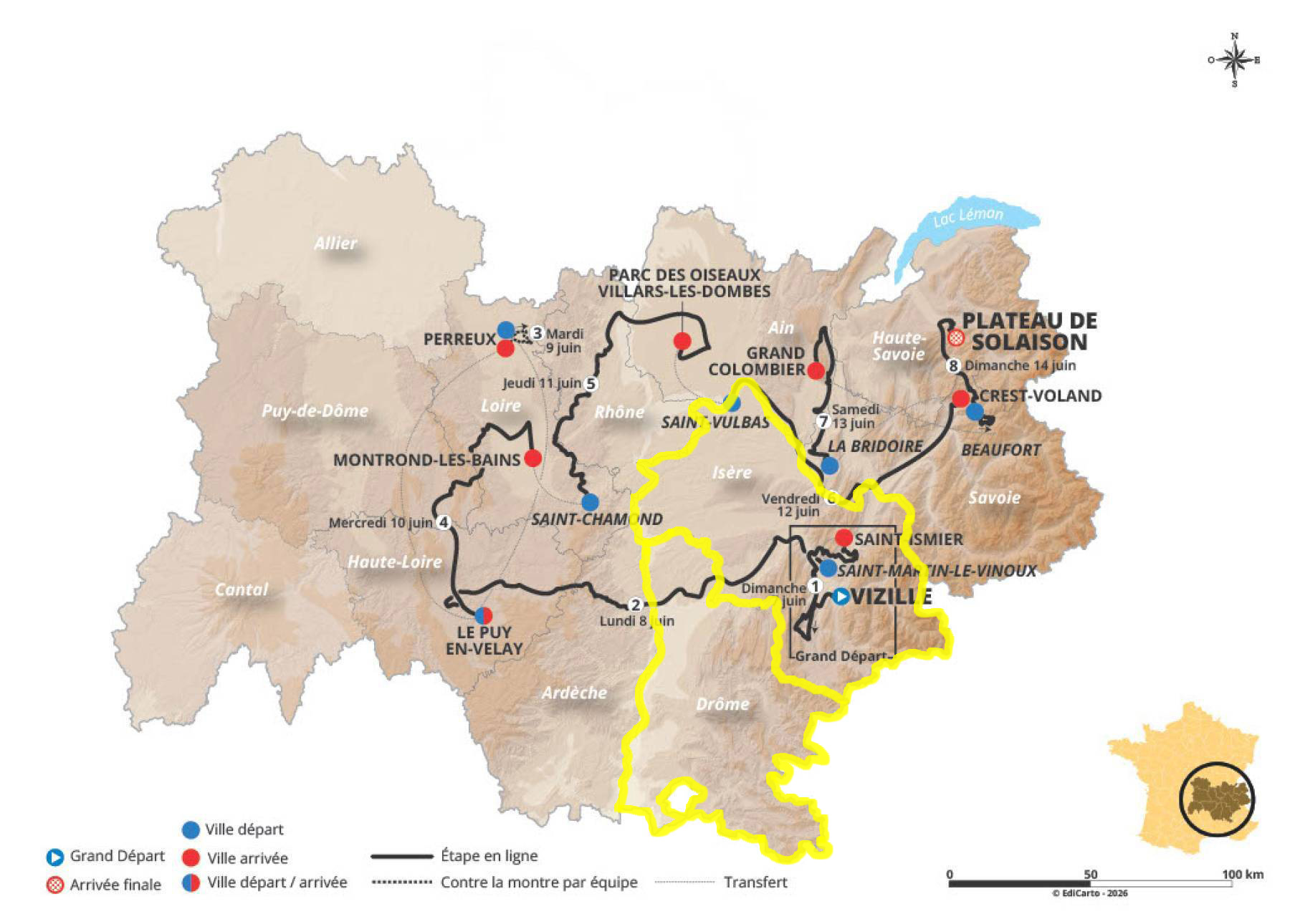
Indeed lately the race has spent so much time in the Auvergne it’s barely visited the Dauphiné. In recent years there have been editions where it’s probably spent thirty minutes in the Isère department. All those visits to Grenoble over the years? Only twice in the past 10 years. Today the race’s wide remit means a loss of identity, it ranges so wide that there a changes in architecture, geology, vegetation, it almost feels rootless and certainly hasn’t looked like the Dauphiné.

The result is the Dauphiné-race long stopped racing in the Dauphiné-area. This is a pity as it’s a great place for cycling. You could hold a week long stage race in this area and have everything from sprint stages to high mountain passes, tiny backroad climbs and ski resorts like, all in a scenic spot, with a defined identity and enough variety with plenty of mountain passes; plus fewer transfers.
If there was a campaign to relocate the race back to this region, this blog would be posting about it, raving about the roads in the Vercors and Champsaur, and linking to the petition. But that’s not happening. So if the race is not in the Dauphiné that’s a good reason to bin “the Dauphiné” label.
Also the Dauphiné is an old region that few know. Maybe you know it thanks to the cycling race? But it’s not easy to find out what it means today. If the whole point of the race at the start was to promote a newspaper, having a name today that only evokes a Ye Olde Kingdom is defunct.

Conclusion
The race doesn’t take place in the Dauphiné any more but it’ll be hard to stop reflexively calling it the Dauphiné. In an ideal world the race would still be the Dauphiné, and it would race exclusively in the Dauphiné region. Since it doesn’t, better to reflect where it does visit. The surprise is that after a decade of roaming the Auvergne-Rhône-Alpes under the region’s patronage is that it’s taken so long to change the name.
The Tour Auvergne-Rhône-Alpes is a mouthful to say and a handful to type, and if that’s just for one week of the year for cycling fans, imagine it for locals? Instead many have solved it by calling their region “Au-RA”. If you wanted a better name than the Dauphiné, how about the Aura Tour?
… or the “Tour de Warm-Up” perhaps.
I may be the only one peering at the first front page of Le Dauphiné Libéré to see not what it said about Hiroshima or French politics but what it said about the potential marriage plans of the then Princess Elizabeth!
Something for everyone…I was fascinated by the piece about the changing American ouest!
The second paragraph says that a palace spokesperson has denied any rumours of links to Philip of Greece! Just shows you never could trust what you read!
Thanks for confirming what it said. I made out Prince Philip’s name but between the small print & my limited French I wasn’t quite sure what was said about him. Yes, that statement indeed didn’t age well!
As always, enlightening and entertaining.
The big question is though, who do we put our hard-earned francs on to win?
Race preview coming soon.
Brilliant, informative article as usual. For someone who has been to France but doesn’t have a feel for the size, it’s interesting to see the size comparison between France and some of its neighbors. Clarifies the reasoning for the name change, but doesn’t make me like the new one any better!
“Indeed lately the race has spent so much time in the Auvergne” – no comment on the politics behind this? And why the département of Haute-Loire features so heavily?
Even stages to Chambon-sur-Lignon. But didn’t want to go into too much detail as local government – as important as it is for the funding and support of pro cycling – is not the stuff of dreams.
But yes, the region has been run by Laurent Wauquiez who has been a backer of the race, the initiative to sponsor it and perhaps not coincidentally seen the race visit places where he’s been the mayor too.
Well done for writing this piece Mr Ring. Guessing I’m not the only one who’s got a bit tired of cycling broadcasters, podcasters and journalists berating the name change.
It is funny how commentators who like to proclaim themselves to be progressive and forward looking get very unhappy about changes to things they are used to in cycling. 100% agree with you that the old name made little sense any more, and that if a new, refreshed identity is closer to reality then that’s a good thing.
Just hope that the region backs it for a while so that the new name sticks. (And at some point cycling pundits then get annoyed if anyone suggests changing it…)
These races become institutions and so a name change feels odd but this time it’s a honest move, on a calendar with the “Tour of the Alps”, the Tour de Langkawi (one stage in Langkawi, the rest on the mainland) and a Gent-Wevelgem that was Wevelgem-Wevelgem.
Or see races like the Renewi or Eneco Tour which tells people the corporate sponsor but it could be anywhere, at least it is the Aura Tour rather than the “BasicFit Tour” or “McCain Chips Tour” to cite two of ASO partners.
I have a question along these lines: Have there been any negative effects from constantly renaming some of the races? It seems like they would lose a certain amount of gravitas over time. Are there clear examples of this happening with specific races?
It’s hard to measure. But who knows what the Ronde Van Brugge is, or where the Renewi Tour takes place?
I think we’re relatively lucky as race naming rights haven’t gone too far, eg the Baloise Belgium Tour is signalling it’s the Tour of Belgium, the Danilith Nokere Koerse is in Nokere, the Lloyds Tour of Britain is obvious. The Baloise Tour, the Danilith Koerse, the Lloyds Tour could be much more confusing.
What about Omloop Het Nieuwsblad? Shouldn’t that be a crit on the streets around the newspaper’s head office?
Do you follow any other sports? Changing names is something the successful sports don’t do. But of course cycling does……..
I think these people are right to moan about this name change.
Plenty of other sports change the names, tennis is front page news now and they have the HSBC Championships, the Generali Open etc, these are not the original names of the tournaments. Various league cups in football change names with their sponsors, the same for rugby tournaments etc.
Umm, I think that the Dauphine, in medieval times, also included the Hautes-Alpes and some of what is now Piedmont as well as Isere and Drome. But the borders don’t exactly match since the Revolution largely obliterated the original regional boundaries.
The region is most famous since the eldest son of the King of France was “the Dauphin”, named after the region, at least from 1349 when (most of) the area fell to the French crown.
Right you are. There is a Montdauphin next to Guillestre, and Casteldelfino on the italian side of col Agnel. Definitiely a suitable area for a bike race.
To add – some older people in the western Piedmont valleys like Valgrana or Val Maira still speak a French patois and understand French, remnants of the old dauphiné.
Yes, there’s a bit of the Hautes-Alpes in there too but think of the Drôme and Isère extended. Plus whatever the boundary was, it changed at times, and it’s not like the precision we have today.
I don’t think it ‘fell’ to the French ; my French tutor ( in France) told me that the last independent Ruler left the territory to the French Crown on condition that it should bear the name of the Crown Prince : le Dauphin.
The name lives on though in the ‘Queen of Potato dishes’ pommels dauphinois (originally made from the soft cows milk cheeses of the region). I’m hoping for a gastronomic tour from M. Ring this time!
Pommes not pommels, why is autocorrect so monolingual?
The inventor of autocorrect died recently; his funfair is a weed next monkey…
A powerful resonance of the old race name remains rooted in the name for the local mountains – the Dauphine Alps.
In cycling terms the boundary is roughly NE from Grenoble, swooping E to take in the Belledonne heights above the Croix de Fer, slicing though the Galibier down to Briancon, S to Gap, then back W to Serre and then Grenoble.
It includes the Ecrins massive at the centre, with the Barre des Ecrins at its heart as the highest summit entirely in France (rather than on a border).
It was also the first ‘big’ Alpine peak I climbed as a teenager. With other beautiful and harder peaks and climbs around it was my loved mountaineering playground for 20 years … until some 30 years ago when the road bike became a smarter way to keep fit for a pressured London professional.
So as Ms INRNG 😉 reflects, the old Dauphine was a compact treat surrounded by some of Alps’ finest mountains, more than worth a long weekend’s visit to watch.
The Aura Tour has a nice ring to it, but to folks like me, it’ll always be ‘The Dauphine’.
Oh dear, cycling just can’t get this right.The most successful sports keep their identity, and everybody knows what an event/ team is.
Changing a race’s name is idiotic, but so typical of cycling, and the ASO…….And don’t start me on team names…….but we know why.
I think “the Dauphine” will continue to be shorthand for the name of the race.
While I will happily watch and support the Aura tour, with its big names warming up for the TdF and its habit of visiting a lot of ‘moyenne montagne’ in the Massif Central to the west, I reckon there’s space for Grenoble to set up a smaller, lower-level race to take advantage of those wonderful roads and climbs. It’s a pity to not see them used any more. Perhaps get a local newspaper to do some sponsorship, finish in the city centre, use a historical name to convey some faux prestige …
There’s the Alpes Isère Tour as a 2.2, and the 1.1 GP Chambéry and Alpes Grésivaudan Classic women’s races. It’s a good place for racing and a World Tour race could fit in nicely. Every Dauphiné should visit the Vercors.
The little Dauphine is dead.
And who knew Horace Greeley had a trans-Atlantic following?