

The winning moment? No, rather than a breakthrough decisive moment, this Giro d’Italia gave us repeat results across multiple mountain stages. Jonas Vingegaard would attack mid-climb, Felix Gall would briefly give chase before deciding otherwise while the rest paced themselves as best they could. Each mountain stage felt like a Bayesian exercise in confirmation every each test brought the same result from Blockhaus to Piancavallo.

The race started in Bulgaria. These grand tour starts can be expensive, the value questionnable. But we got to see the country and watch Paul Magnier take his first win in a finish marred by a crash that blocked the whole road.
The next day another crash and more traumatic. It took out Jay Vine, Marc Soler, Santiago Buitrago and Adne Holter; the next day Adam Yates and Andrea Vendrame did not start. If UAE started without João Almeida, now their second GC rider was gone.

After a brief neutralisation things restarted. Vingegaard lead up the sharp climb out of Lyaskovets, at first it just looked like he wanted to be out of danger but he accelerated. Only Giulio Pellizzari and Lennert Van Eetvelt could follow him but they were all swept up in the finish. With hindsight this was tantalising moment, Vingegaard hustling for time but he’d soon prove more measured.

Thomas Silva won the stage, the first of several surprise winners; one theme. Another was that a handful of riders won most of the stages. Paul Magnier won again in Sofia. He, Vingegaard and Jhonatan Narvaez would win half the stages.

With the race back in Italy Movistar set the pace on the Crocetta pass to Consenza and popped all of the sprinters except their house fastman Orluis Aular. Only for UAE to have numbers in the finish too and Narvaez won the stage, the first of three wins for him.

The next day saw Igor Arrieta win ahead of Afonso Eulalio in a slapstick ending. Wet roads on day of biblical rain saw Arrieta and Eulalio take turns to crash and remount, as if there were banana skins on a Mario Kart route. Just as it looked like one was clear for the win, they crashed and the other surged past and so on. Live bookmakers must have made small fortune. Arrieta eventually won but Eulalio took the maglia rosa which he’d keep until Stage 14.

Eulalio’s time in pink suited Vingegaard as Bahrain committed to riding on the front of the peloton but with hindsight – which is what a blog review is for – giving the Portuguese rider such a lead meant he’d win the white jersey in Rome at the expense of Davide Piganzoli. It’s not like Visma could have adjusted a dial to give Eulalio less of a lead and his riding exceeded expectations but there are trade-offs when renting out the lead too.
Davide Ballerini won in Naples with a finish that everyone who saw the course thought “that U-turn on the cobbles before the finish looks risky for a bunch” and sure enough there was a crash even if most stayed upright.

Stage 7 was the longest in the race, a marathon 244km day to the Blockhaus climb on a Giro of otherwise short stages. Jonas Vingegaard attacked from far out. Giulio Pellizzari audaciously gave chase but his oxygen debt came with a hefty interest rate and he could not meet the repayments. Felix Gall came past like a pedalling preying mantis to finish second.
Blockhaus was informative. Foresight said Vingegaard was going to win and he confirmed this; hindsight showed him winning with Gall behind and everyone else further back. Indeed Vingegaard won every summit finish, Felix Gall was second on every summit finish and Jai Hindley was third on every summit finish, except Stage 9 to the Corno alle Scale. This was the final podium being repeated again and again. It was like going to see the same band multiple times in different venues and realise they played the same tunes each time.

Stage 10 was a time trial and if the Giro route seemed to be designed to lure Remco Evenepoel, this day was for Filippo Ganna. He won with almost two minutes on team mate Thymen Arensman which helped lift Arensman up to third place overall with Eulalio still in pink. Assuming Eulalio would fade, the question was if Arensman could sustain second place? Answers in the moment were hard to find with the media complaining he was refusing interviews. This might have protected him from fatigue and even stress but left the impression of a spectral figure with no voice. Vingegaard didn’t have a great ride but finished the day just where he needed to be.

Stage 11 to Chiavari saw Narvaez take another win at the expense of Enric Mas. The Movistar leader was publicly berated by his team for his lack of form but this time his tactics were questionable, although the sense that Narvaez could win in every scenario possible in the final 20km.

Stage 12 to Novi saw a masterpiece by Alec Segaert, an attack with 3km to go in three parts: a jump so sharp he quickly got a gap, a sustained effort to the line that nobody could match, and tactical awareness to time the move and exploit the course and other teams. We’re bound to see this again , and when he isn’t he’s a valuable workhorse too.

Alberto Bettiol is one of those riders who doesn’t win often but when he does it’s quality. Overhauling Michael Valgren, Josh Kench and above all a valiant Andreas Leknessund, he won in Verbania, home town of Filippo Ganna. It would have been romantic for Ganna to take a home win but it turned out to be doubly-so as Bettiol’s partner is from Verbania.

The Giro reached the Alps and Jonas Vingegaard won at Pila, his team riding down the breakaway. Gall second, Hindley third and Arensman losing time. Again you didn’t need to be Lieutenant Colombo to spot the pattern.

The stage to Milan was meant to be a sprint finish but Frederik Dversnes won the stage for Uno-X from the breakaway, crushing two Bardiani riders and one Polti-Malta. He got to enjoy the win but soon got criticism for the role motorbikes played in the finish in helping the break to stay away. Loyal readers might recall the story of a rider donating cases of wine of motorbike drivers in the Tour de France but here Dversnes was not to blame. There were times when the lead vehicles were close, equally it looked like the sprinters teams did not have the numbers to chase and each hoped another would work.

The Swiss stage to Carì was bis repetita for a summit finish, right down to Felix Gall briefly trying to follow Vingegaard, only for the Austrian to realise he could not handle the pace and sit back down.

Michael Valgren won Stage 17 to Andalo with an exquisitely-timed attack but the real triumph was to be there in the finish alongside riders who normally should have out-climbed him. For all his pedigree and experience this was his first grand tour stage win.

Stage 18 was both a surprise and a confirmation. The points competition had seen a duel at distance between Narvaez and Magnier but it got settled on this day when several teams toiled to set up a sprint finish on a day late in the third week normally for the breakaway. We got a reduced bunch of sixty riders from which Magnier was delivered by Jasper Stuyven to take a third win, and with it a clear lead in the competition. As it happened Narvaez would collide with a team bus after riding back from the finish and quit the race next day, an unwarranted exit but Magnier had got clear in the competition already.

The winner of the Stage 19? The results sheet said Sepp Kuss and he was first across the line but the scenery could share the podium with him. Stage 20 saw the final summit finish and a win for Vingegaard again with the same pattern of Gall next, then Hindley, with Arensman losing more time but no change on GC among the top-10. The final day in Rome saw Jonathan Milan win, a result he and his team needed more than most.

The Verdict
The pre-race favourite won in the pre-race predicted manner. His task made easier by rivals falling away through illness or accident, Jonas Vingegaard was never troubled.
Jonas Vingegaard’s Giro did not begin in Nessebar, nor on the Blockhaus. It started atop Hautacam last summer. He was trounced by his arch rival, losing two minutes in the first summit finish and left to needing to revise his plans. The Tour showed us he was better than everyone except Pogačar, the Giro here proved that again.
This was not a Giro of suspense and rovesciamento, reversal of fortune, it was the antithesis of last year’s Finestre extravaganza. If people still watched DVDs, the highlights video would not do much business apart from Denmark and maybe Austria.
Instead it felt like an exercise in the scientific method: we thought Vuelta and Tour winner Jonas Vingegaard was capable of winning the Giro. Sure enough he proved it, replicating success in several stages, each summit finish was an assertion of proof.
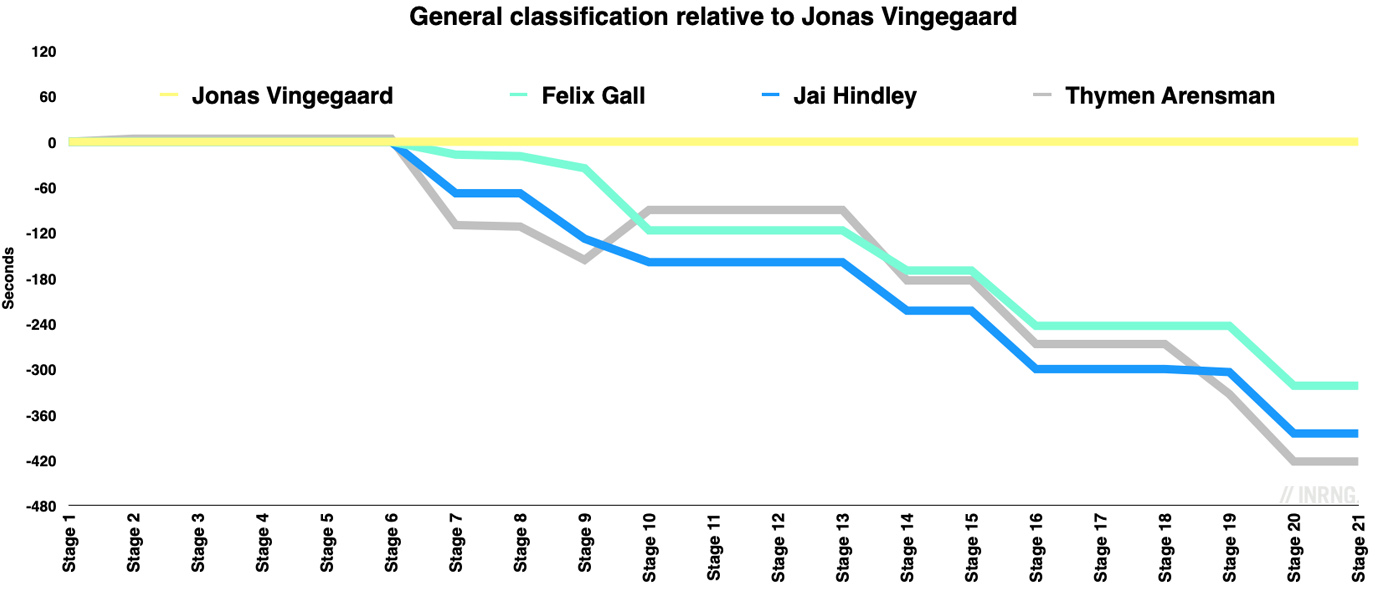
The chart above shows the GC standings during the race relative to Vingegaard. Arensman’s grey line is just above Vingegaard thanks to a time bonus taken on Stage 2. They all fall away on Blockhaus. Stage 10 is the time trial and if Arensman overhauls Gall on the day, Gall is consistently the second best climber while Hindley is almost as regular. Vingegaard finishes four minutes clear.
Vingegaard now has the “triple crown” of winning all three grand tours, a feat Tadej Pogačar has not managed, something his team are keen to point out as they still search for a replacement sponsor. Whatever people think of the man, he’s got a palmarès among the best. But now Vingegaard has ticked the box marked “Giro” it’s quite possible he never returns.

Felix Gall was never going to win but his second place is above expectations. L’Equipe’s Thomas Perotto deftly branded him the “eternal second” as he was always the runner-up in the mountains. He and Decathlon would have signed for this result in Bulgaria, and they’d have signed for it every morning during the race too. The worry was he’d slip up, literally. Perhaps aided by good weather he never made a mistake – unlike in Catalunya back March – and so never lost time because of a mishap. A more upright TT position helped, as did several altitude camps before the race including a last one at Etna, and even having his girlfriend drop by the hotels along the way apparently made a difference too for Gall’s performance and his first grand tour podium.
Jai Hindley finishes third thanks to dependable reliability. Regularly finishing third is no mean feat but he showed no sign of being able to finish second. Team mate Pellizzari was lively and probably over-inflated by the media coverage, he paid on the Blockhaus and then struggled with illness but still 22 and if he glances at Hindley on the podium he ought to see himself there next year.
For all the predictability on GC, the daily stage battles were good, boosted by cheerful weather. Take Movistar’s collective action on the stage to Cosenza, this may not prove a highlight of the season but it was something that provided spice to the stage and for hours on end too: if they didn’t gain, we did. Afonso Eulalio was a revelation even if he’s been quietly tipped for his abilities and we’ll see more from him. The points and mountains competitions were competitive late into the third week.
The Giro is in a bind. If it was a film, the casting director would not be up for any awards. The race struggles to get star names, and if it does then the big name steals the thunder. It’s not an easy trap to escape. The Tour de France is now five weeks away. No doubt we’ll see plenty of Danish flags being waved by holidaymakers but Vingegaard’s biggest fans in July could be the Giro organisers. If he can feel unburdened for the rest of the season with nothing to lose it could be good for the Giro and the Tour alike.
Thankyou Inrng for three weeks of insight and elegant prose to start the day.
Vingegaard – Gall – Hindley filled the stage podium in that order four times: the first time the same podium has been repeated so often in the Giro.
I do wonder if the ever-increasing scientific focus on training, nutrition etc is taking the suspense out of racing. Riders have their individual level, but are able to consistently hit it. So if the natural level is A then B then C, they just keep finishing in that order, particularly on summit finishes. Are the days of mountain stage shocks with a rider inexplicably riding poorly and another excelling beyond expectation behind us?
I think the riders at their respective levels was more mental than physical, they (and we) knew were they were at and so aimed for that. Jai Hindley knew he was third and that first place was out of reach, all with the idea that if he stayed there then you never know in case Vingegaard fell ill, Gall fell down etc. Despite this we did see Gall try several times to follow Vingegaard rather than let him go and then see if he could bridge across, it was not the most rational of moves but you could see him hoping to latch on and get towed away.
The days of cracking big are largely gone because you can fuel all the time but can still happen with over-heating, bad sleep or sometimes the legs just say no etc.
Agreed with both above. In an age of neo-feudalism, well beyond sports, it sounds a lot like ancien regime’s «know your place in the world and stick with it as happy as you manage to be». Also a logical consequence of scarcity, not intrinsical but due to resource concentration: why should anybody try anything daring if occasions are so few? Few races have most visibility and one above them all; in each race visible objectives are becoming less and less as secundary ones lose media traction; few subjects (athletes or teams… three of the alternative winners this year were from Astana!) take most prizes, often thanks to a big gap in performance.
As in our very societies, hoping for «magical» self-regulation by the «natural interaction» of competing agents is just a myth spread by interested parties.
Near-monopoly (ASO) or oligopoly (teams) don’t look like effective solutions save for those who sit on the top (and who might soon discover that the base they sit on is crumbling, so no «top» anymore either, but such awareness won’t ever happen soon enough)
Nobody expects the Spanish cycling-marxism ! 🙂
Come for the cycling banter, stay for the sociopolitical/macroeconomic analysis!
Best polemica of the season @Gabrielle – 👏🏻
@Mr Ring. Maybe Gall was initially encouraged on the stage where Vinny went away but he gradually reduced the deficit to not a lot of seconds? Then increasingly realised that it wasn’t wise.
I’d love to see some of the legs of the support that enables these precision, scientific efforts be knocked out. Make the riders more self-supported and self-reliant, rather than have a literal team of sports-science boffins and cycling tacticians sitting in front of screens in a van (as Visma apparently now have) monitor everything and help direct pacing, nutrition, strategy, etc. to the rider – while they get gels and drinks metered out to them from a car.
Limit support to a limited number of static, technical support zones – as gravel does. Get rid of per-team radio. Make the riders responsible for their own tactics and fuelling again.
The team radio has an important role in safety (can shout things over the radio) and in letting riders know the race situation. I think it is absurd to have a situation (as happened in the past) where riders had no idea that someone is up the road or how far in front they are. Yes, we can all laugh when we see it on television, but this is the opposite of good raace tactics.
For radios, if safety is the key point, a single channel race radio from the commissars that all the riders and cars are listening to the same information and which the riders can call for assistance on from the team car on but the tactical element is more in the riders hands than the apparent “remote control” racing many see occuring.
No radio could be counterproductive by making the racing even more defensive/conservative.
Also, it’s not gravel racing. That’s the point.
I’m kinda bummed about the crash in the first few days for UAE. I’m wondering what pressure they could have put on the GC.
Great recap. Thanks!
More so if Almeida could have started fitter. They still had a good Giro but Christen was a small disappointment, a massive talent but unchanelled this time and he won’t get as much freedom in a grand tour for a while.
Maybe that was really the moment when the Giro was won – Almeida pulling out. Although of course he wasn’t able to beat a below-par Vinny at last year’s Vuelta.
It would have been a much more enjoyable GC race, I believe, if Almeida had been able to compete here at the level that he was at last year’s Tour de Suisse. I’d like to think that he would have then been able to be more of a match to Vingegaard’s current form. But who knows? Entering into fan fiction territory at this point. He and the team would have needed to have had better luck on stage 2. Losing all his mountain domestiques to crashes in the first week.
I can’t see Almeida making a difference in this Giro. He’s way more prone to disappointment than actually winning.
And Christen – always attacking and always blowing up and getting shelled out the back. Confusing.
Almeida won three different WorldTour stage races last year. The same number as Pogacar, no-one else achieved that.
And never really in contention in a Grand Tour.
“And never really in contention in a Grand Tour.”
Second in a GT is not in contention. Seen from the sofa
Christen seemed to fade rather quickly after the first week. Maybe, like Cosnefroy, he’s not made for GT ? But he has to learn to wait… “Patience, for me, is greater than miracles”, said Gregory the Great.
Is it that what we tell a 21 year old now when he’s not the next big thing in his first GT? Next year he will be too old for sure. Career over.
Think I enjoyed reading this every day more than I did some of the racing. Thank you!
Visma got it all so tactically right that it was all kind of predictable and rather dull. Congrats to them but it didn’t make for a Giro to savour.
Indeed. Inrng has written about how newspaper reporting magnified the romance of cycling in ways television cannot reproduce. This blog has the same effect on me.
Maybe you should make the name mandatory, which would stop us forgetting to include our names… 😉 ?
Like to keep it simple and open here, to the point of not having notice to approve, deny or select cookies and tracking data.
Heartfelt applauding here. I wouldn’t be writing here otherwise, for good or ill. So now you know… 😛
Excellent choice of photos. I too wished that UAE would have provided a closer battle for GC had Yates and Vine been present. Possibly a slippery choice of tires for UAE derailed their Giro campaign. Thank you for all your thoughtful summaries and forecasts each day. I read them each day.
So opportune you pointed out the image selection! One of inrng’s strong points, much finesse there, and we tend to take it for granted because the writing is also so good.
A lot of riders fell ill during the Giro – or at least were not in top health for a few days – including Vingegaard who rode a time trial that was considered below his ability. In the end this proved not decisive but for a few days there my impression was that staying healthy (and masking weaknesses) was the biggest concern on team buses.
I’m not sure anyone who didn’t finish, or who didn’t start (other than Pogacar obvs) would have made any difference to Vingegaard winning in relative comfort. A full strength UAE B-Team would have made him work harder in the mountains perhaps, but he had plenty in the bank. Vingegaard is as superior over the lay cyclists as Pogacar is over him.
I’m not sure if it’s interesting or not that the only time there was any sort of surprise in the GC results was in the long flat time trial. Maybe that’s something for organisers to consider.
A Giro with few real highlights although one that stands out for me was the tactical perfection, timing and execution of Valgren’s late attack to victory. So often we see a late attack telegraphed and anticipated so clearly it’s almost neutralised before the attacker has passed the leading rider. Not this time, and refreshing to see an attack without the usual looking back before separation is established. Of course it’s so easy to sit in judgement watching from afar but full credit to Valgren, amplified of course by what he has come back from.
Special mention too to Alex Segaert for his late move, harking back to the exploits of Jelle Nijdam in the late 1980s, although probably from even further out.
As a student of the 1989 Tour, Nijdam’s moves were great as you’d expect bunch sprint and then he’d sneak up on them. Was discussing this the other day and people mentioned the likes of Ekimov, Seigneur came to mind since but hard to think of many contemporary examples; Cancellara did it a couple of times but not much more.
Roger Kluge during the 2016 giro was another brilliant move swarting the sprinters although he chased down Pozzato and just kept going.
Had a short list posted here some days ago…
I liked Alberto Bettiol’s attack best. The timing and the speed as he was flying past the Uno-x rider was awesome. By our wonderful host description I knew that the hardest part of the climb is about to begin before he launched so I was super excited to watch him deliver.
Worst and most uninspiring Giro ever.
That’s crazy.
With a dominant GC rider like V, the stories to watch are in the details. There were TONS of classy rides.
Valgren
Bettiol
Segaert
Eulalio
Narvaes x3
Hindley (seemingly back from the dead)
Kuss (out of nowhere)
This was not a movie, but a TV series. Old style one, from the 80s, without great focus on continuity, pretty repetitive as a general scheme, but at the same time interesting day by day thanks to little creative variations. A-team, Supercar, that sort of things. Afternoon shows, indeed (in Italy at least).
Probably the worst viewing figures ever on TV in terms of eyeballs – not any sudden drop, just slightly worse, mainly due to impressively steady figures through the three weeks. No third weak soaring up anymore, but constant decent numbers.
Yet, what was impressively good was the SHARE. As good as ever or even better, in terms of repeated good days.
Very often 1 out of every 5 households with a TV on was watching the Giro, and 1 out of 4 was reached more than once.
It looks like that, at least this year, and unlike, say, 2018 (which was the negative reference back then) the issues with audience are the woes of TV as a medium.
On TV and among TV shows the Giro is even strengthening its position, which grants it a solid defensive position (the 2M barrier was overcome three times), but at the same time such a situation underlines the need to adapt to ongoing processes.
In this sense, it’s worth noting that the Giro was also systematically among the TV programmes with a greater percentage of «online spectators», mainly on mobile phones or computers, same for the growth of people who don’t watch live although they watch the online recorded version later. That’s good news and what could be expected, but it’s still relatively small figures, so it’s not the obvious solution.
Also worth noting that, unlike the TDF which could break through very young new audiences, the Giro stays strong mainly among 55+.
In Italy, the main change as for cycling on TV is the absolute and relative growth of Classics, but they’re still way smaller than the Giro and now many won’t be broadcast free anymore.
What proportion watch “as live” after the event? It must be hard to assign a number to the people watching this way. This is how I do it, and it must be common, particularly among people of working age.
They consider only the streaming viewers in the first 24h.
It’s a very low percentage (which is extremely surprising to me!), but anyway the Giro is normally among the TV shows on which this aspect proves to be more relevant, in Italy of course. Absolute #1 or #2 against any other TV show in whichever day or hour.
However, for example on Friday when Kuss won some 1.5M watched live and some 55K watched a streaming during the following 24 hrs.
I was as shocked when I discovered that Eurosport figures were very low… like 10% of Rai at most!
Normal TV watched the old way is still much bigger than any video alternative, but whereas the platform have been able to eat into it a decent bite albeit not huge, OTOH TV companies have failed nearly completely to break into the streaming market, for now at least.
Even those which are free like Rai…!
I wonder if a lot of viewing simply isn’t captured in the numbers, particularly those streaming “as live” after the event (not necessarily using RAI). Are the Eurosport figures for Italy only, or are they Europe-wide. I would be surprised if Europe-wide numbers are as low as 150,000, but would be interested in the figures.
ES data for Italy only.
Similar figures for each European big market, although with variations (sometimes more in Germany when it’s free, usually much less in Spain etc.). But note that they work hard to avoid having their figures disclosed.
Internet streamings in general hit very low figures, which always left me very perplexed. It’s as if the public was very segmented. Different age groups… different interests… different media.
For example, I always imagined a lot of roadside public wanting to follow the race on their smartphone. But, apparently, it doesn’t happen much.
I agree it might be an issue of measurement, anyway.
Network coverage often does not allow watching on the roadside in a crowd.
Very true, a mountain road might have one cell tower nearby but it can be saturated by fan use. At the Tour they have started bringing mobile cell towers to some places but more like the finish rather than halfway on a climb.
You could argue that “The moment the Giro was won” was at km 0 of the first stage. Visma were magisterial, difficult to remember a better team performance in a GT in the past 20 years. The team were always where they needed to be, to the extent of hanging around the back in the first few stages, minor illness issue dealt with and winning the Queen (Princess!) stage with JV’s loyal lieutenant plus the GC by 5 minutes.
I agree it was not the best Giro ever, partly down to course design but also the lack of competition. Having both the Milan stage and the Rome stage made no sense, too many short stages and the lack of the high mountains (though would not want to miss out on the images from the Dolomites) detracts from the race.
As to the inevitable question as to what this means for July, I think Jonas Vingegaard’s decision to race has been vindicated both physically and mentally. Maybe sports science’s decrees that athlete’s bodies need to be precisely sculpted are best implemented by hours of training rides in controlled conditions. The psychological boost of of winning with such ease and joining a very elite club of the sport’s legends must be worth a watt or three on the climb up the Galibier or the memory of winning will help ring the last ounce of effort on the drag up to the line at Alpe d’Huez. We need to wait for another two months to find out which approach is the better one.
As ever thanks for all the effort in writing the best bike racing site around, the sport would not be the same without this place
Thank you INRNG, for the daily coverage. This Giro was full of epic performances by some likeable riders:
Sepp Kuss winning like he did;
Bettiol’s attack over the top of the mountain;
Michael Valgren hanging with the climbers and pulling out an emphatic win;
Alec Segaert’s attack was something that hardly ever results in a win.
I agree with the tv analogy. Entertaining on an episode to episode basis, but overall hardly the Sopranos.
It seems that both Pogacar and Vingegaard have shown racing two GTs is feasible, without jeopardizing the second race. I imagine this means many more of the top riders will be willing to ride the Giro in the future.
Vingegaard also seems to want to ride two grand tours each year (he doesn’t ride classics), which suggests he might well come back to the Giro in the future. Next year, I suspect he might want to do something like Romandie–Suisse–Tour–Vuelta, but he might be happy to come back to the Giro once he has done the Swiss races.
Have to agree with other commenters that UAE might have made this Giro somewhat bumpier for JV, but even at full strength I don’t think we would have seen a serious fight for the win. This Giro was a reminder that at his best, JV twice trounced the field in the biggest race of the year. Pog has obviously taken a huge leap forward since then, but guys like Almeida and Remco are not close. It will be really interesting to see how close Seixas is to truly competing with the best of the best, and if either Jonas or Seixas trouble Pog at all.
At the end of the last climb, my Mum (who likes the Grand Tours quite possibly as much for the scenery as the racing) said “he doesn’t even look like he had to try”. That echoes Pog at last year’s Tour.
Full power Vinny may still not be enough to challenge Pog now but he’ll still blast everyone else away and so it irritates me a little bit when I see journalists (not here) writing that he might be challenged by Seixas at this year’s Tour (but without any reasoning for it) – someone who may one day fairly soon be up there but currently hasn’t even completed a GT. Indeed, he may get a pretty high finish at this year’s Tour but realistically he won’t be near Vinny or Pog.
I don’t think the Seixas hype is too unfair – whilst he’s not ridden a grand tour yet, he has done something that only Pogacar & Vingegaard (and a couple of others in the classics) have done, which is to ride the entire peloton off his wheel on the way to a commanding win. Or in the case of Liege, being the only person to stick with Pogacar in a full-blown attack up La Redoute.
He may not manage it for the whole three weeks, but I think it’s fair to assume that he might be able to challenge Pogacar & Vingegaard for a while, in a way that the likes of Remco & Almeida cannot.
Just to put a dose of realism on the Seixas thing. He followed Pogacar up one 2.5km climb, and then got dropped on the next one. We’re making a hell of a jump to equate that to competing with one of the greatest cyclists ever across 3 weeks, at age 19. We can say he might be able to compete for stage wins in the first week, but not much else at this stage.
@RichardS. Exactly my point – you’ve hit the nail on the head. One shortish steep climb does not even remotely equate to one big day in the high mountains, let alone a series of them in a three-week race that you’ve never done before. Seixas may be a GT star some time soon though.
I would suggest Seixas is someone who can be high in GC, before fading slightly in week 3 (but not too far). For me, this is the most likely scenario. I think there is a small chance of a complete “jour sans” and dropping out of the top-10. And a small chance of comfortably getting on the podium; but without properly threatening either Pogacar or Vingegaard on a big mountain day in week 2/3. If he does have a disastrous day, then he might be in a position to get a stage win later in the race if he recovers.
But I guess we will see.
We’ll know more soon with the Dauphiné rushing up this weekend.
Dauphiné? I don’t see that on the calendar.
He’s likely to do a Remco (ie. 3rd place on the podium but not close enough to trouble Pogi or Jonas). The likelihood of him finishing ahead of Remco is very good.
“Another was that a handful of riders won most of the stages. Paul Magnier won again in Sofia. He, Vingegaard and Jhonatan Narvaez would win half the stages.”
This was what I found quite depressing about this Giro. I was fully expecting Vingegaard to win the GC with ease but for him to also take 5 mountain stages and the sole other one to be taken by his team mate Kuss felt as though there was nothing left for any of the other climbers in the race. Then all bar one of the sprint stages for Magnier. Narvaez getting 3 punchy stages wasn’t quite as bad as there were several other punchy stages won by others. But overall I felt sorry for so many teams who left completely empty handed. If my calculations are correct then only 9 out of the 23 teams left with any wins:
Visma 6 stages, overall & team
Quickstep 3 stages & points
Lidl 1 stage & KOM
Bahrain 1 stage & young rider
UAE 4 stages
Astana 3 stages
Ineos, EF & Uno-X 1 stage each
I suppose of the other 14 teams Decathlon & Red Bull might be happy enough with their podium places to put up with no wins but that still leaves a dozen teams who must be leaving feeling not that happy.
Teams also fight for sheer visibility. And points. Several of them which didn’t enter your list actually had a lively Giro and some form of reward. They were actually among the best things of this Giro, as much as all the above (or more, in a sense).
From such a POV, Polti, Tudor, Unibet and Movistar might have got to different extents something to get back home, let’ s say, feeling someway between greatly and partially satisfied (in that order) against previous expectations.
Polti had a huge Giro, as a proxy (and not just that) imagine that they even managed to sit in the top half of the table for team prizemoney.
Tudor was always close to have 2 men in the final GC top-10 (like only Visma, Bahrain, Ineos), and although Rondel was eventually 11th, they’re still part of the very selected club which could be seen consistently playing a GC part, actively, even, and at a point aggressively, too. Which was pretty exceptional. The double GC placing was worth as much as Gee’s 5th place, and more or less like a podium in a Monument.
Unibet and Movistar were less of a success story, but they’ve been talked a lot about, and, as I said, that’s also part of the business. Besides, Movistar also collected a decent quantity of points, I think, which isn’t bad if you check their budget and where they sat in the UCI point classification at the end of the last 3-years cycle.
—
Instead, a team which was striving for more but was left empty-handed was Q36.5 De la Cruz and Harper were quite active but the level was probably too high. I wouldn’t say they rode a bad Giro, anyway, they helped to sustain the many moves which gave meaning and intensity to the stages, no matter how they ended. That’s an aspect which also made this Giro very good to watxh beyond the superficial results. Results were dull but what happened before was vibrant. Not much of a consolation? Yep, but much better than the alternative – dull racing for dull results!
Then we had some teams who came with a good line-up but just couldn’t perform. Jayco is an example. Sadly O’Connor just didn’t have it. He tried to hold on then he sank with his guns blazing. Vendrame was out too soon. A mistake on their part was probably Ackermann and men for him instead of more stage hunters.
NSN was among the more serious deceptions for me. I expected quite much from Pinarello and both Vernon and Strong who had very adequate stages for their skills. They all had shown form to different degrees but were really never a factor despite the team working for them.
Finally, the teams you frankly couldn’t expect anything from even before the start, or before we got in Italian soil.
FDJ and Picnic brought as they sometimes did in the past a very weak team. Then at least FDJ tried often but just didn’t have the means. A startlist decision they both might regret sorely in three years time. But that sounds sooo far, doesn’t it? Bardiani will also think back about this Giro and much sooner, a 1 year time. But they probably just couldn’t gather the human resources.
Lotto belongs to the category of Giro-snubbers in terms of previous attitude, but on the contrary this time they came with a decent team. Alas, bad luck had them torn into pieces. Alpecin came with a single horse they bet all in, Groves, and when he was soon out, it was all over.
gabriele, I was writing a similar response (mine was a lot less wordy 😉 ), but I accidentally killed it before posting. I would agree with almost everything you said, but I had forgotten about Groves and the quick death of Alpecin’s Giro. Still, even though some of the teams COULD have done better (NSN for example), I recall seeing the startlists and thinking that it was obvious that a lot of teams were not taking the Giro very seriously. I was listening to G’s podcast and he and Luke Rowe were saying basically the same thing, also mentioning that it’s nothing new at the Giro. I suppose there’s nothing the organizers can do about it, but it’s a shame when such a prominent event has so many “participants” that are there just to fill the numbers. It makes me really appreciate Tudor, Movistar, the Rockets, and the smaller Italian teams that actually showed up trying to make something happen.
This year really few teams didn’t bring a decent startlist. The relegation thing starts to be understood and bites hard, although someone struggles to adapt and maybe will pay the price.
This time I’d say that only EF (which then rode well), Groupama, Alpecin and Picnic didn’t bring a solid team, relative to their roster of course. “Funny” that 3 out of 4 look bound to struggle with relegation!
Perhaps one could add Q36.5 although their actual effort made for their less-than-peak selection. Bardiani couldn’t do any better.
The rest brought good teams and deployed them consistently on the ground, most failures being about bad luck or athletical breakdown, rather than not trying. Lidl, Lotto, Movistar, Jayco and NSN being prime examples, as I also wrote above.
18/22 bringing very good teams and going hard for different objectives at every level is an excellent profile, to me. In *real-life terms* (as in: different from PCS startlist quality, where you may see Lombardia or Ti-Ad on top irrespective of teams actually having anything they strive for on those day), it’s essentially better than any other race barring the TDF – just as one would expect.
The Giro has had more of a shifting profile through the decades and several factors impacted on it in ever-changing ways.
The WT at first nad a negative effect, then it became quite positive, and the points system is also being favourable. They aren’t necessarily good per se, but they’re having good effects on the Giro in the current context.
Things as they are now, GT aren’t in a good moment, barring the TDF when you have a fight between Pogi and Vinge. And even that might look not that much if the rest is mediocre, just check last year. So even having lively racing is a good result.
Shorter stage races who had a great moment for some years are now often terrible, because of Pogi, or Vingo… or Almeida or Jorgenson 😛
Sending apparent C teams brings back the old topic of why the need for 18 World Tour teams (and their automatic invitations). 12 teams would be sufficient on top level. So the remaining 10 spots can be filled by organizer’s discretion – out of the top 30 teams if UCI insists.
I think there are a lot of Pro-Conti teams who would build their season around a place in the Giro or Vuelta, if they could. And there are sponsors who are willing to support such teams. These teams are prepared to send their top riders to these races but they are lower budget teams and don’t want to do the full WT calendar (just their local national circuit). But entry from the “top 30 teams” makes it difficult for these teams since they can’t be sure of their place in the top-30.
Many WT teams just don’t have the roster to go to all three Grand Tours (Picnic, Lotto, Groupama, NSN etc.), and inevitably send weak squads to the Giro an/or the Vuelta. Of the Pro-Conti teams, only Tudor are really able to send a good team to several Grand Tours. And there are a lot of points available at non-Giro races (so understandable that Cofidis skip it).
PS: This year, every Pro-team eligible for a Grand Tour have been invited to at least one. Only Tudor and Q36.5 are doing all three (and I can’t see how Q36.5 have the squad to do this).
This is currently not a problem, even less so in this Giro where the interest’s been raised precisely by many teams being active each at its own level. I’d even say that such aspect working so well is the main positive facet which compensated the lack of proper GC podium competition (due to concentration of team power and talented athlete on the peak).
In fact, as I underlined, four weak line-ups is pretty much good for any race different from the TDF and 18 solid and/or motivated ones are more than enough to provide spectacle (and even leave some of them a bit empty-handed due to, well, sheer competition, and then crashes, bad luck etc.).
If anything, as John says (or implies or whatever), the current situation can be seen as *an opportunity* to help a sector of the sport currently struggling, i.e., Pro Teams.
If that’s the objective, it might make sense to open a door for some of such projects to *develop* (but, hey, most of them should get better than they actually are, which they might do counting on new sponsors, which might come up as they’re shown a better chance of granted visibility in their national GT etc.)
However, I’m afraid that, as Bardiani’s case makes quite clear, but that’s also true for Caja Rural or Burgos, we’re now short on available raw materiale. Talented (not supertalented) cyclists. You don’t just notice it in Pro Teams but also, as I pointed out elsewhere, at Movistar, Jayco, Picnic, EF, all teams who were good in picking potential and bring it to the point where a further step could be done (there… or elsewhere).
The sport is now able to identify, pick and push to a maximum some super-talents; even some athletes who would have been deemed mediocre in other historical contexts can be lifted by the superteams to quantitatively excellent performances. But that hides a more general problem of average athletical and technical base-level across the whole peloton, which is the unavoidable consequences of less depth of the juvenile base (how deep is the pond you fish into) and a narrow window of age for the select-discard phase.
More Pro Teams, and more solid ones, can be an answer for the second factor, but the first one is a huge issue. If less young people practise a sport, that sport’s general level will drop.
In the mix of varied factors which bring an athlete to be selected for pro sport, pure potential (save for the very top level) is having in many key countries a *relatively* minor weight against family support, maturing at the most opportune moment, a given social context.
Broadening of the base (new countries, electronic training) can’t equate losing depth in statistical terms precisely because it’s only depth which reduces the numerical impact of random factors external to talent across a greater number of athletes and across different levels of basic talent. Interestingly enough, broadening indeed helps in finding new supertalents, but not in strengthening the average level.
You’ll get better result for the average level if you have say 10% of juvenile population practising a sport in one single country than 1% each across more countries (random figures just to make it a bit clearer).
I think that’s not pure chance that we notice it way more in stage racing, as Italy and Spain are the two countries where the juvenile practise shrinked the most and they provided a lot of that stage racing “middle-high class”.
I don’t have info re: France and Germany but I’d be curious to know more.
Gabriele:
My point is the following: (i) the Giro and Vuelta normally only have two free wild cards they can choose from among their domestic Pro-teams; (ii) Pro-teams need to be in the top-30, a tough requirement. This has changed the way the market operates.
Both these restrictions mean that, under the current rules, a rider like Caruso (or someone similar) is unwilling to race for a team like Bardiani (or another middling Pro-Tour team). If he did he faces the risk that Bardiani will not be invited in the Giro (there are more than two Italian Pro-teams looking to be invited but normally only two places). If you take the Italian and Spanish Pro-teams, we know that at least some of them will finish outside the top-30.
The peloton is full of riders like Caruso: Italian, not good enough for the Tour, but able to top-10 the Giro. These riders provide plenty of interest to the Italian market. Having a rider like him on Bardiani would allow the team to get local sponsors on board. This is what happened before when the Giro and Vuelta were full of local teams (with local riders) who took an active part in the race.
The current rules are pushing these types of teams out of the peloton: these are Pro-teams with second tier riders who want to race their national circuit, who have local second tier sponsors. They are replaced by teams like Lotto whose main interest is the Belgian market (hence their lack of interest in the Giro). As a result it is damaging many of the races who don’t have teams who would be interested in participating. I believe it is hollowing out the sport.
The final prize money ranking really supports John’s point. Polti was in the top half and Bardiani were far from the bottom. The only team that surprises me near the bottom is the Rockets, who put all their eggs in one basket and Groenewegen just didn’t have it for whatever reason. The rest of them could have been predicted by the team they brought, although Alpecin and Jayco would have been expected to do better. I still think they both brought pretty weak teams, but maybe that’s just the stratified nature of cycling at the moment.
@TheOtherCraig
I don’t really get what the debate is, but I think Bardiani didn’t have a good Giro or proved to be a valuable technical asset for the race. This year. Click on “breakdown” and see why. Or check also the classification by UCI points gained.
But this isn’t relevant, I’m totally on the side of helping Pro Teams giving them more options and hence hopefully access to richer sponsors.
Only, the reason isn’t surely (as for present days) the lack of competitive alternative to make the race lively, as this Giro showed quite much. Even Unibet will be happy with the decent haul of points (for their level) which they got all the same, even more so NSN or Tudor and even Q36.5… all rightly so.
By the way, if the WT was down to 12, last cycle would have equally delivered FDJ and Alpecin among them. And Picnic will probably be out soon all the same, if they don’t change mentality. Those are really the three which didn’t even try.
That said, I am just afraid that there’s more to this problem. Caruso wouldn’t ever get in any Pro team the wage and options he’s been getting until he now finally decided to retire. And there’s no abundance of available talent to pick from. Imagine that Solution Tech brought Pozzovivo out of retirement, and he’s scoring good for them. I am not sure he would add value to the Giro as he once did.
I agree with what somebody said here that Pro teams should pick in the markets which had a boom in athletes’ base growth then faced with a bottleneck when the bubble burst, for example UK. But cultural and geographical barriers don’t help.
However, of course, let’s start giving more room to Pro teams and let’s see what happens, I’d give it a try.
“Caruso couldn’t get the salary on a Pro-Conti team”.
This is the key point. If the PCT team knew they were invited to their home grand tour then they could get a local sponsor on board to pay the money for someone like Caruso. And Caruso would be happy to race for the team if they matched his WT salary and he knew he got to race the Giro and the other big Italian races.
This is how it worked up until recently. But the three auto-wildcards and top-30 requirements means that mid-level PCT teams are no longer sure of entry to their home Grand Tour. We have gone from 27 PCT teams in 2018 to only 16 teams in 2026. And some of those teams won’t be here next year.
AND the Giro has been forced to change the race design to attract non-Italian GC riders since it can no longer depend on Italian teams with second tier riders treating it as the highlight of their year. This is exactly what many people have complained about: the watering down of the Giro route.
@John I am essentially sure Caruso wouldn’t have moved away from Bahrain anyway, just as he didn’t move to San Marino. I can’t imagine the sort of offer he should have received to have him motivated to leave his current team (…and future one, may I add, despite his retirement as an athlete). But I guess we’re not understanding each other here given that I’m speaking of the real Damiano Caruso whereas I suppose you were referring to an abstraction of sort, i.e., any other rider like him.
The question is that presently in Italy (or Spain) that kind of rider is so rare that the few available easily found already an accomodation they’ll hardly move away from.
Think – on a lower level than Caruso – Formolo, Ulissi, Bettiol… maybe when they start to look spent they can be lured away, Formolo and Ulissi might be next on list, and had been there an Italian Pro Team for Trentin he’d have gone there, perhaps. Not sure these would be winning bets, anyway.
Maybe Ciccone, I can see him being pushed away from Lidl if Guercilena isn’t there anymore.
But, yes, as I wrote above I agree with the general point – only, remember that it’s *exactly* where we come from and it had become unsatisfactory.
Your chronology is indeed wrong. The Giro wasn’t inviting all the Italian teams he could when RCS had 4 discretional wildcards until the very end of the ’10s. That was because of, well, making money, but also because the level of Italian Pro Teams had become too low. Normally there were under the board agreements as with the Flaminia case. Sponsors knew in advance what they’d get, but that wasn’t the key aspect anyway.
Things started to change in the ’20s, when wildcards went down to 3 and RCS decided to systematically support whatever Italian team was around, including “things” as the terrible 2023 Team Corratec. It’s not apparent at all that anyone has benefitted during these seasons of such an opportunity to build a more solid project or find new sponsors.
Feel assured that if a decently big sponsor jumps in, staying in the first 30 places wouldn’t be an issue. Look at whom the fight is between.
As for the courses and the $$$ invites to foreign champions, it’s got little relation to the whole wildcard and Pro Team situation… if any at all.
If you *really* think that RCS wouldn’t have invited Vingo, Remco, Pogi & C. had been Caruso at, say, Bardiani-Esselunga Pro Team, elevated to a Tudor of sort, well, I think there’s little I can tell to explain why that’s all wrong!
Yes, a hypothetical person like Caruso. There are a lot of middling Italian GC riders who aren’t going to podium the Tour but could have a good career contesting the Giro (Piganzoli and Tiberi, for instance).
And 20 years ago there was much less interest in getting the top GC riders to the Giro or Vuelta. Those races looked much more like a contest between good local riders with a few others involved. In 2024 and 2026 the course has been softened to allow Pogacar/Vingegaard to do the Giro-Tour double.
Almost two thirds of Bardiani’s prize money was earned by breakaway activist Manuele Tarozzi.
In ranking by UCI points gained Bardiani was last but one, “outdone” only by Picnic – PostNL.
PS I can still remember there was one Bardiani rider in the breakaway group of four riders that sprinted for victory (and Dversnes won) in Milan.
@John
You’re messing up chronology again.
I brought you examples from “the very end of the ’10s” which was 7-8 years ago, so why you speak “20 years ago?”.
In-between the Giro has had an era of consistent growth implying top contenders at the start who put at stake their TDF result to have a shot at the Giro; and a few times a fight for the podium, or sometimes even the whole top-10, at the same level of the TDF (or better).
Which is just context to understand how the Giro went through radical cycles of opposite trends, not any progressive unidirectional process, making the reference to 20 years ago totally useless in order to understand what had happened with wildcards during the 10s.
Besides, such context shows why any association with the Vuelta makes littles sense, as the two GTs have two stories which aren’t parallel at all.
If the Giro lived indeed some nationalist years from the end of the 90s to 2008-2009, on the contrary it had had a very high level through the 90s. It looks like it follows a decade-long pattern of notable rise and sudden decline (just pure chance I guess) whereas the Vuelta has been more or less slowly improving since the end of the 70s (save for the Lance years).
Softening the course (relative to the average level of the moment) to have some champion at the start had happened before, notably in 2017 or 2009, so it’s a variable with hardly any relation at all with the wildcard situation, which was hugely different in any of those periods from each other.
But this is, however interesting, just idle conversation on context and reasons, whereas we essentially agree on the opportunity of investing energies to support the Pro level of the sport.
Unfortunately I’m no longer able to actually watch cycling, due to the massive TNT Sports subscription price rise in the UK, so I could only judge by results (Pro Cycling Stats & headlines on Cycling News etc.) as I literally couldn’t see who was visible during each stage. I’m glad if some of the teams who looked to have got very little in terms of hard results out of the Giro did actually manage to get something less tangible.
Sorry for that.
The media situation should be concern number one (or two, besides *real* safety) within the sport rather than twisting the calendar, new funny races, stealing each other revenues, damaging existing races and organisers for the sake of self-promotion and so on…
But that’s just my personal opinion.
I have to admit that I succumbed to it because Sky now have a pay monthly option. Once the season ends, I will cancel until the start of March, maybe even a bit later. I’m not happy about it but I can’t do without the races!
I might have succumbed for a month apiece for each of the 3 GTs if the TV coverage was the same as it used to be and gave each stage uninterrupted from start to finish but I’m damned if I’m forking out £30.99 a month for several ad breaks per hour.
Its interesting that even though Lidl made it onto your list with a stage and the KOM jersey, and they were regularly on screen either through marshalling a flat stage for Milan or through Ciccone’s jack-in-the-box antics, they were often portrayed as having a bad Giro and were in a way perhaps unexpectedly gazumped by Quick-Step.
It was about expectations. As a minimum, they came for multiple stage wins with Milan and the jersey of course (first time he doesn’t win it in a GT, I believe). Ciccone had to win a stage at the very least. Gee-West came for a solid shot at the podium. Probably too much? Indeed.
Getting something only on the very last three stages doesn’t help towards “the sensation” of having had a good Giro, feels rather like having “salvaged” it, even if the final result ain’t look so bad on paper.
The sponsor expected quantity, so now you have Guercilena out after well over a decade and Niermann it. Guess Visma is cleaning up ex dopers! (Just joking)
Just to add my voice to the chorus of thanks to our host for another great grand tour of predictions and postcards. Ceaselessly brilliant.
Not quite what I expected, with plenty of interesting subplots, but overall a pretty predictable Giro. Not as dull as the 2024 edition, yet still close. I like Vingo, but I truly hope he and Seixas reach a level where they can genuinely challenge Pogacar in July. Cycling deserves a real showdown.
Poor Gerry Ryan would be looking at Jayco and wondering where his money’s going. I wonder if Sepp Kuss will go to the Tour? I know he won a stage but as a helper he was a little anonymous
Kuss and Campenaerts should be going to the Tour.
It looks like Ryan’s funding could be stopping soon. A lot of teams are after a replacement or new sponsor. Visma and EF for example.
You’ve pointed out that Schmid is having a blinder thankfully for Jayco but I also wonder how much the debacle at the Nationals has affected team morale. I can barely remember them riding together once in the whole race
It feels strange to us, much more than it does in football, because of the impact of the name title and colours in cycling, and also because in football you often don’t perceive deeper changes in sponsorship or structure. Whereas the paradox is that in cycling we sometimes “feel” things are changing even when they’re essentially stable.
But although a football team keeps its name and colours (sort of) and (sometimes) the stadium, the different sponsorship eras have a huge impact on a team’s identity in terms of what objectives they can fight for etc., same for property.
Como football club anyone? ^___^
Football teams face different changes in their structure at various level, but in Spain typically you have a radical shake-up every decade or so, Florentino at Madrid now for a quarter of a century – with interruptions – being quite exceptional (and currently challenged hard).
I understand that Visma has sponsorship problems mainly because Plugge does not want to let the sponsor own the team (which requires him to sell).
Quite unfair to Jayco. They brought a good selection with solid names in Vendrame and O’Connor. I guess on paper they could also hope something from Ackermann. It just didn’t work at all, but not for lack of trying I think, a mix of bad luck and bad days.
Frankly, it makes perfect sense to keep Plapp and Schmid fresh for the TDF.
An issue they have is that they don’t seem to fully appreciate what the impact of a first GT can be on a rider. So obviously Double didn’t perform last year despite coming in the race with supposed good form, just like Hatherly or Donaldson this time around. But OTOH a couple of debutants makes perfect sense, along with more expert athletes and potential great support as Juul-Jensen or Bouwman (well, the latter only thrived on Super-JV-22 so a bit of a risky hire, as Ackermann for other reasons).
Double himself looks currently on terrible form after a promising start of season, so I don’t know if having him would really improve things.
I am afraid that Jayco is just like Movistar, a team which hasn’t the resources to follow up with the latest news in “sport science” and whose model counted a lot on being a great place to develop the first part of the career of a young-ish rider. A huge lot of GT top competitors who weren’t brought up by the superteams has come from there in the last decade. These are people who actually know a lot about cycling and can also create a decent environment (with its little dark sides, of course, but nothing comparable to the big ships). Very few other WT teams, if any, outside the obvious very top ones, can compare to them under that respect. But their model is being unsettled by increasing budgets and the penetration of superteams in the teenager market.
Thanks for the reply, take your point, I was being too hard. I just remember the old Greenedge or whatever they were called seemed a tighter unit, really rode for each other. I’m not seeing it this year and as I suggested I wonder if it goes back to the Aussie nationals. But hoping for better in the TDF. I wonder how far off Matthews is?
It goes back further than that, back to the Manuela Fundacion scandal in 2020. For those not in the know, this was an incident in 2020 when the team manager Shayne Bannan tried to sell the team to a bunch of Spanish scammers from Spain, but was fired on the spot when the owner Gerry Ryan came to what he was told would be a sponsorship announcement and presented with paperwork for selling the team.
The scammers involved did eventually get into cycling, running a Continental team in 2022 until they gave up in the second half of the year and left the riders and staff to claim from their bank guarantee.
Brent Copeland and the other managers who have been hired since the Manuela Fundacion scandal have done a mostly competent job, but they have failed to revitalise the team’s previously strong identity and culture. Like Movistar, it’s now a generic mid level team indistinguishable from the others around them.
I know it’s off topic, but I just had to mention the shocking (to me at least) news that Grischa Niermann is leaving Visma. I guess he’ll be calling someone else a f@&$ing motorbike now.
Yes, me too. One of the few times I have been genuinely shocked by a transfer.
Will he have to be on “gardening leave” for a while?
Yep, hinted at it above. And Guercilena kicked out to make room for Grischa. But the piece of news which most shocked me (can’t be true, seriously) is that the property at Lidl wants Andy Schleck at the head of things. Wow. One gets why (as John said) Plugge might prefer not to sell out to any of these big companies wanting to sponsor only if they own.
You must understand that Andy has gained valuable experience in athlete development, event organisation, and team leadership by opening his own bike shop, managing a junior women’s team and serving as President of the Tour of Luxembourg.
A bit more seriously: I’m tickled by the titles given to these guys (whose merits and professionalism I don’t doubt), such as “Head of Performance” or “Chief Sporting Officer”.
For a moment I had read just “President” and “of Luxembourg” ^____^
Jokes apart, if he’s really well into those activities and not just putting his name, face and money in, I’m quite happy for him as he had looked a bit lost in other moments of his earlier life.
Still, to switch Guercilena with him, can’t say but “wow” (again). Daring. Or classic corporate crazy (like people above it all taking decisions about something which they don’t quite understand).
this has been a fun and interesting comments section to read.
and as always INRNGs coverage is excellent so thank you.
I’ve banged on long and hard enough about my cycling opinions in these comments so won’t bore anyone this time. I especially enjoyed all John’s comments above, thank you for taking to time to write so concisely and clearly.
I’m usually relentlessly positive and always looking for the most optimistic view but I do find incoming sponsorship woes for teams and the general downbeat reaction to this Giro (which I’m sad to say I include myself in) a tiny bit unnerving.
My most upbeat take is that I’m not convinced the current calendar/system can support three riveting Grand Tours in a year, so if this was below par then hopefully that might mean we’re in for a barnstorming Tour!
And to a lot of the questions/arguments above I often feel like turning them around on yourself is a good exercise, however patronising this sounds – I’m intrigued by the paid-UK TV debate which comes up regularly and would like to know why people won’t pay?
I’m not saying that in an accusatory sense, but more from an armchair research perspective because I think the only answer can be ‘it’s not worth it’ – which is fair, and I’m just wondering what would be worth it at the same price point (in a sporting sense rather than the obvious GCN+ answer).
Hear, hear both on the congratulations to our host on the ongoing excellence of their blog, and also the comments section – I like to think that it is INRNG’s polished and reasoned writing that demands thoughtful and respectful comments in return. Long may this continue.
The resistance to the new pricing model for watching pro-cycling in the UK is two main issues (as far as I can see), both of which are linked:
1. The price increase. The monthly subscription to watch cycling went from £6 per month to ~£40. Quite a steep rise, especially at a time when household budgets are already being squeezed elsewhere
2. The ‘sports bundle’ – the justification for the steep price rise is that it’s part of the TNT sports bundle which gives access to Premier League football / rugby / tennis. Cycling subscribers railed against the fact that no-one was asking for this, and it doesn’t take much of a cynical view to surmise that the powers-that-be realised they had wrung the football supporters dry, and therefore they found a way to bring in new subscribers and therefore more money to pay for the hugely inflated rights to show football
PS. with the talk of t-shirts, surely we’re not too far from a INRNG-CORNER at the Tour one year (not the Alpe, far too gauche for our host and the readership! 😆)
Yes, 1. and 2. are both reasons for me. The proportionally massive price rise is the main reason but, since the only other sport I follow closely is F1 & Sky has the rights for that, the addition of other sports to TNT adds no value for me as I don’t want to watch them. Also (as I’ve already said above) that the product is now inferior because there are ad breaks whereas up to last year you could watch an entire 5-6 hour grand tour stage uninterrupted. If only cycling had some sort of audio only or highlights options like F1 has, which I’ve followed for years via BBC radio & C4 highlights without ever paying a penny to Sky.
Three riveting GTs a year, systematically or, say, frequently so? You’re calling for scripted sport. That’s why I like films. You can know in advance that if you pick well they’ll be extremely good. I would pay 40 € each month for movies or book, but never ever for any sport.
Jokes apart, what I mean is that any big real sport event has got more or less memorable editions, and asking for three of them to be great on the very same year is essentially a matter of probabilities. I think that if any of them avoids to sum up three dull editions in a row, things are just rolling fine.
However, good ol’ variables check for your theory: the calendar/system was the same in 2019 when we had three very good GTs on the same season, and a point could be made for 2020, too, although of course that TDF was so peculiar that’s hard to classify.
No doubt we had three riveting GTs in 2015, and in 2014 it can be argued that all of them were at least quite good, the Giro and Vuelta hitting the “exceptional” level.
2010, 2011 and 2013 are also interesting case studies. Much depend on what each person finds “riveting”, but they tick at least some of the boxes when they happen to slightly fail under some regard.
I’d say that from this sample what looks more relevant is, in order of importance: abundance of high level GT riders; a propensity to test themselves in different GTs with a winning focus, not just their “home” GT or the TDF; not necessarily priorising the TDF, and not just once in a career (Aru, Nibali and even Dumoulin at the Vuelta, Quintana, Contador, Roglic, Landa, Carapaz at the Giro etc.); a more radical diversity between the course-style of the 3 GTs.
We can also check the previous decade, where the Vuelta (2001, 2003-2006) and the Giro (2000, 2002, 2004-2007, 2009) both had some very good editions, and the TDF was also good in 2003, 2007 (?), 2009, but the Vuelta and the Giro only slowly started to get back to an international dimension, so the best athletes in each country priorised their own GT and rarely tested seriously themselves outside, while at the TDF frequent domination by athletes and teams often killed much interest.
Yet, notwithstanding these conditions, or precisely thanks to these specific conditions, one can notice that “having three good GTs in a season” didn’t happen for merely statistical reasons, not because the calendar prevented it.
Errata corrige above, only the Vuelta was exceptional in 2014, re: the Giro I had 2016 in mind (when the Giro was exceptional, the Vuelta too… but the TDF was pretty awful).
on a general point – can we assume that the whole peloton use the Maurten fuelling tech (I assume other brands are available now) and this is partly responsible for the general lift in levels? (see so many comments ‘I’m doing better numbers than ever, but so is the whole peloton etc etc’…)