
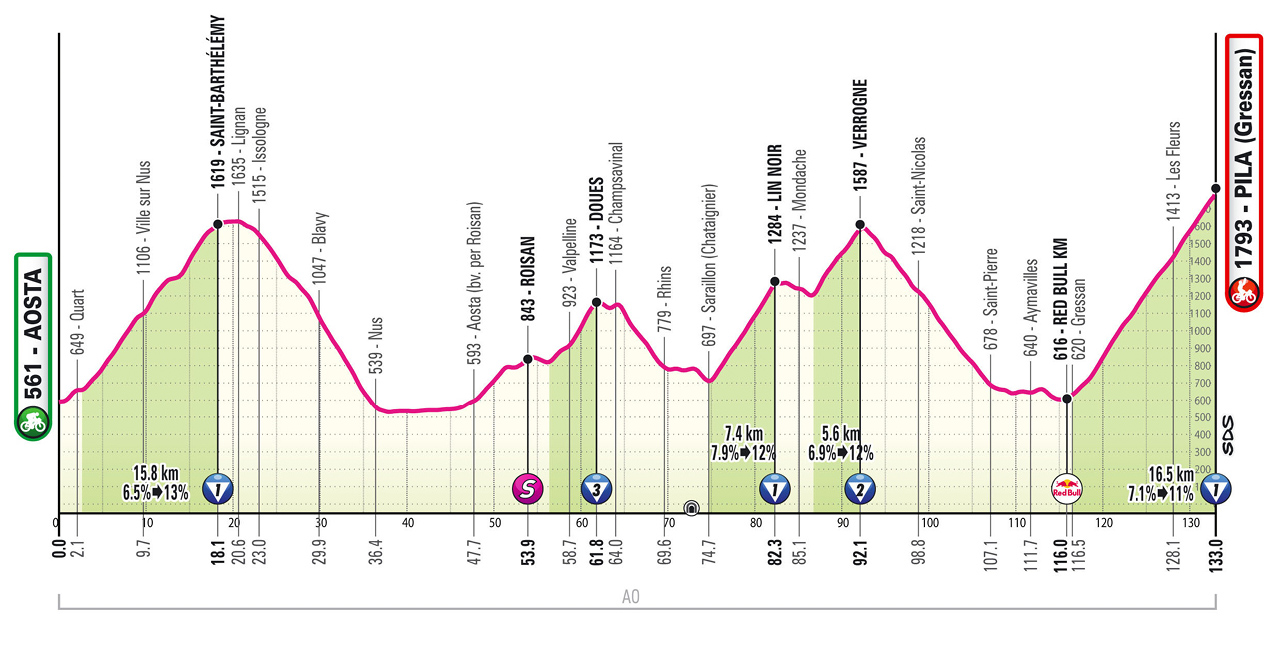
The Giro heads into the Alps with a short but very vertical stage.
Stage 14 Review: an early breakaway was joined by a counter-move to put 13 riders in the lead and they had a ticket for the day. There were no big moves on the flat, it was all about the final climbs. Groupama-FDJ had three in the break. They pulled for Josh Kench, shattering the group and when the New Zealdander attacked and only three could follow: Alberto Bettiol, Andreas Leknessund and Michael Valgren. Not bad company for the neo-pro to hang with.

Leknessund then went solo but was paying for it, his cadence dropping like a toy with empty batteries. Bettiol was behind, spinning a low gear and taking the sharpest line through every bend, he was locked onto the Norwegian champ.

He caught Leknessund and jumped passed him with a sharp attack. Solo, there was no catching him. If plenty wanted local rider Filippo Ganna to shine, Bettiol is an adopted local too as his girlfriend Lisa is from the finish town of Verbania and he knew every metre of the final climb.

The Route: just 133km but 4,250m of vertical gain. This is an Aosta city and Aosta valley tribute stage, which owes itself to the fiasco of 2023 when the Giro was supposed to start here on Stage 13 and ride to Switzerland but riders were scared about a descent mid-way. So the compromise solution was to skip the start… but do the dodgy descent. This left local politicians fuming and some swearing the Giro would never be back. It returned last year and is back again so the hatchet has been buried, presumably with the Giro offering a cut-price deal.

The climbing starts in the neutral zone and then tackles the 16km climb to Saint-Barthélémy, and if it averages 6.5% that’s because there’s a flat section a quarter of the way up and a descent halfway, the rest is often 8-9% and all on the south-facing slopes where vines grow amid rocky walls so it’ll be hot from the start too.
This is a difficult start as riders go all out to establish the breakaway while the GC contenders have to keep near the front in order not to lose ground and so there’s a lot of energy spent by all in the first 30 minutes.
There’s a wider road back down to the valley. There’s more climbing and all on the south-facing slopes amid vineyards.

The Finish: a 16.5km climb all the way to the line. Cut out the first 2km that lead away from the valley floor and it’s 14.5km at 7.5% and a tough climb that winds up through plenty of hairpins and where the slope never quite settles down.
The Contenders: Jonas Vingegaard (Visma-LAB) is the easy pick. He’s out-climbed everyone and now finds a stage even more suited. We’ll get a health check, he told Italian TV yesterday evening he was fine… but he coughed before a word came out. The final climb is consistently difficult all the way up, there are almost no points where someone who he’s not worried about can sneak away and build up a lead. It’s also a chance to put the squeeze on others including Thymen Arensman.
Felix Gall has been climbing very well but enough to ride away? We’ve not seen it. But we’ll see if he can regain time on Arensman and the others.
The breakaway has a good chance as Visma won’t, or can’t control the stage from start to finish. The uphill start is also ideal for the eventual stage winners as strong climbers can go clear rather than opportunists.
Enric Mas and Einer Rubio (Movistar) have been riding well and have terrain to suit. Giulio Ciccone (Lidl-Trek) has used up a lot of energy in his stage-hunting quest so far.
Aleksandr Vlasov is an outside pick, he’s been able to go in breakaways so far but maybe he is on team duty today.
Jefferson Cepeda (EF) and Rémy Rochas (Groupama-FDJ) are two of the lightest riders in the race but the form and their results make them harder picks. Harold Martín López (XDS-Astana) is another small climber but possibly more likely to win here.
 |
Vingegaard |
 |
Mas, Rubio, Ciccone, Gall |
 |
H Lopez, Poels, Christen |
Weather: sunny and 31°C in the valley. Much of the stage is on the south-facing slopes and they are often rocky or have stone walls to radiate heat back. The final climb is cooler with more shade.
TV: KM0 is at 13.05pm and the finish is forecast for 5.15pm CEST. Tune in early to watch the fight for the breakaway and then to see the rest of the stage evolve.
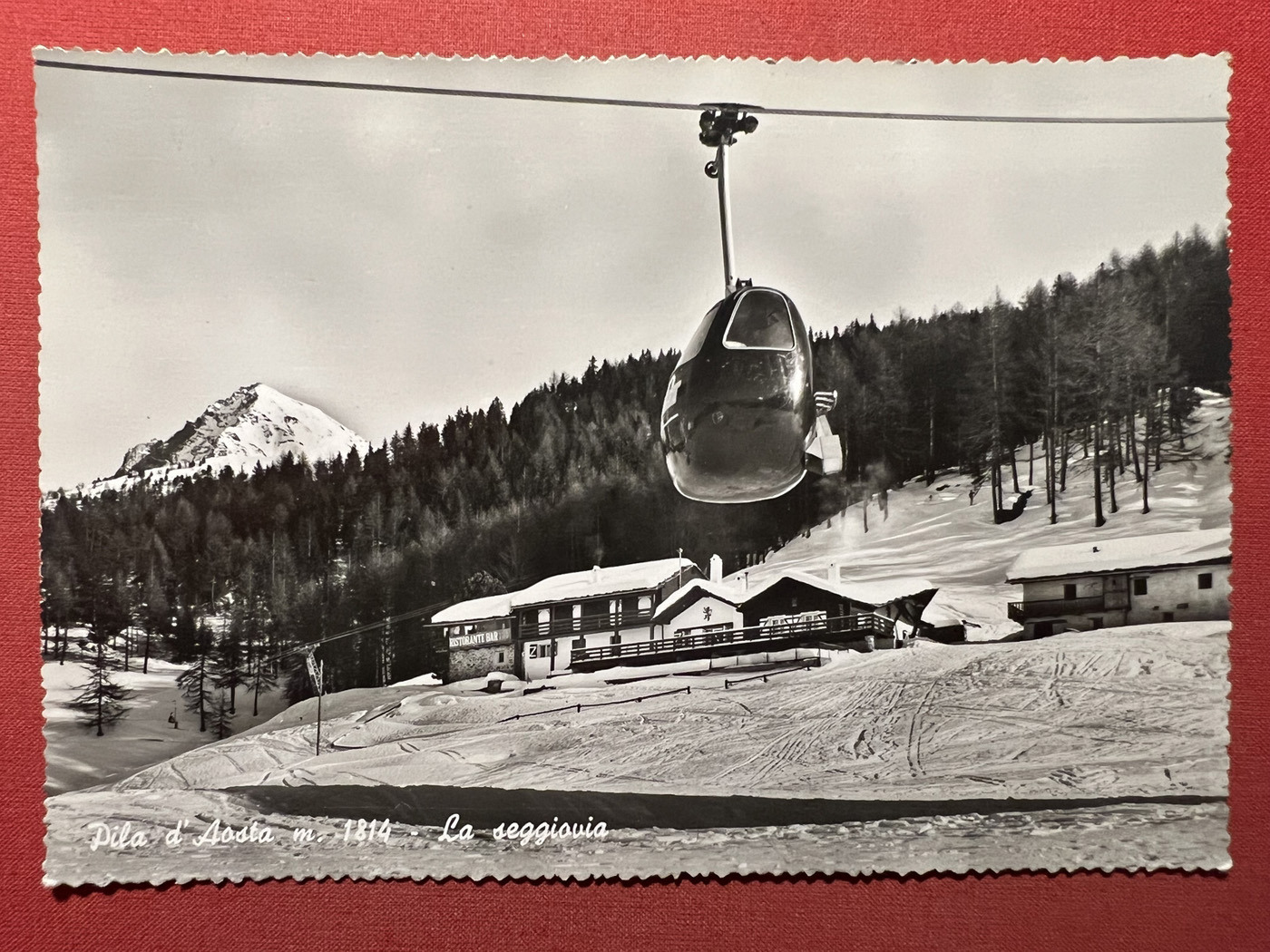
Postcard from Aosta
Today’s finish is in Pila, a ski resort directly connected to the city of Aosta by cable car. The local rider of the day is, or rather was, Maurice Garin, winner of the inaugural Tour de France in 1903.
The Aosta region is bilingual with French but today Italian dominates. But this explains why Garin was named after his father Maurice and not Maurizio when born in Arvier, just up the valley from Aosta. The town of Arvier doesn’t make much play of this, the municipal website mentions Garin but one page says he was born in 1871, another 1872. Plus he left the region early to find work in France as a child. After retiring as a cyclist he remained in France and ran a garage in Lens for almost 50 years. He is buried in nearby Sallaumines. He’s not celebrated there either, although a cycle path is named after him.

Back in the Aosta valley and Garin is a local name, there are several villages called Garin, there’s even a Garin mountain pass too. The city of Aosta has a Via Garin main road but this is not a tribute to the Tour de France winner.
However there is the Via Maurice Garin, a back alley on the edge of town. It’s not hardly prestigious but it does almost tell a story. Garin began a chimney sweep, became a cyclist and ended up running a garage. The Via Maurice Garin today mirrors this with the Termo Team heating and plumbing business at one end, the road, and at the other end the Gallo tire garage. Hardly veneration, but maybe fitting.
Funny that cycling took so long to discover aerodynamics, when it was on display in many other machines, such as your postcard’s old cable cars, as well as racing cars, planes, etc.
In all of cycling, one could argue that all meaningful aero advances were within the past 10 years. Whether this will make any placement differences with tomorrow’s descents (apart from rider skills), who knows?
Your 10 year limit is a little overstating things. Disc wheels and aero bars in time trials were fairly meaningful aero advances.
Quite, Chris Boardman and his lotus bike were fully aero focused more than 30 years ago and I doubt they were the first.
There was Moser and his hour record bikes in the 1980s. I think Cyrille Guimard was the first to send his riders into a wind tunnel in the 1970s, because of the Renault sponsorship. It didn’t lead to this but enjoy…
But the “aero is everything” is relatively new, it wasn’t long ago riders were giving away energy with loose flapping jerseys etc. A lot of these tiny gains don’t do anything at 30-40km/h but reach 45-50km/h and they start to pay.
And you get the trickle down effect of people turning up to 25kmh club rides on aero frames and in aero helmets and socks up to their armpits.
Indeed. British time trialists in the seventies actively promoted turbulence through the widespread drilling of holes in handlebars, seat pins, chainrings… all to save an irrelevant gram. Eddy Merckx did the same at one time.
Recent accidents to cable cars in high winds highlight the importance of smoothing airflow over surfaces, though I suspect the postcard illustrates a choice made to give a modern look rather than aerodynamic efficiency.
Aero is the new weightweenies ^___^
Counter-intuitively, ovoid shapes can be aerodynamically poor and unstable. It’s a devilishly complicated subject.
Thank you, Pete for raising this question. Aerodynamics were indeed applied to racing bicycles, notably by Francis Faure. Faure beat Oscar Eggs one hour record in 1934 on a recumbent. Which was promptly banned by the UCI, reportedly at the behest of makers of “traditional” bicycles. Later came Graeme Obree, whose incremental evolutions in bike geometry were also banned. Is the UCI aiding or hurting new developments in human powered vehicles/ bicycles?
All to my point, that aero was not fully understood in the context of cycling until late.
Sure the Lotus was close to an understanding of flow dynamics, but mechanically flawed from a stress standpoint.
Not trying to threadjack, just interesting that both the men & women are much faster in the past few years, esp. on descents (terminal velocities), due in no small matter to the new frames.
I guess I was bored by the inevitable outcome today.
Yep, that early climb will catch some people out, so will we see guys on the rollers before the start? Also, we should find out who is still feeling ill.
Good chance of a breakaway win if there’s some decent climbers in there, otherwise Visma will obviously try to control the day.
Could be a “two races in one” day today. Visma wont bother to chase the break their one focus will be on JV getting as much time on his immediate rivals, I suppose Bahrain might do so but not sure worth the effort, doubt Red Bull will with the talk of illness in the camp, I guess Netcompany will stick with their traditional tactics in any case cant see Thymen Arensman riding away but second must be a realistic possibility so will ride with that in mind. Perhaps if someone who could get top 10 gets in the break then another team might try to protect their position. Otherwise if the break goes it might stay away, maybe folk looking for mountain points.
Note JV said he prefers riding in hot weather to cold as he often trains in Spain.
The last two days have felt like textbook Giro stages. Such short mountain stages feel weird for the Giro though.
Textbook Giro would have implied some GC skirmish or surprise. But as commented before, this was tamed a bit to prevent that.
Sram expressed their satisfaction for the verdict which in their own words certified that the industry is an active part in writing the rule of the sport, not only those institutional bottom-up based structures like the UCI or federations.
Now we’ve been seeing for years (15 at least) how teams (some of them, of course) are defining the playground as they’ve got more power than some organisers, just as municipalities and the such have more of a say compared with a decade ago.
Seem to recall from a few years back there was a statue to garin on the roundabout between arvier and leverogne
I’ve ridden through and never seen it… but because the roundabout also has a statue for winemaking and so if you pass in one direction you see one and not the other as you’re looking for the exit rather than back at it. But see it now on Google, thanks.
Heating, plumbing and tyres -> fitting. Well played.
To join two subjects of the day, shortening a lot the stages and reducing cumulative altitude gain, together with other factors of course, helped quite much in raising speeds and hence making aero more relevant.
Besides, it’s improvement in weight and more generally in carbon technology (at a cost effective level) which made aero more interesting than in previous decades. 25 years ago many carbon frames just couldn’t keep together effectively being minimally comfortable, being rigid, not breaking up etc., let alone aero. Just 10 years ago the Venge was far from being a decent bike on most terrains, we were very far from current “aero” bikes which athletes also love to ride uphill or on rough surfaces. So it was’t for lack of trying, more the specific costraints of a sport where the available power to manage mass is what a human being not an engine can deliver (ahem… or not?).
Everything depends on Vingegaard and his condition today which is in all likelihood good. But for him he did have a poor TT.
I can Invision a moment within the last few km where any one of the people in the top 10 (2:30 behind or more) attack and Vingegaard sorts of lets them take same a small amount of time looking for others to cover for their own positions.
Of course, if he is in the old TDF form he can attack at the bottom of the climb and the others just let him ride away because there’s not much point in challenging.
Well, we’re about to see how everyone’s feeling, nowhere to hide. Love these stages!
Terrible stage, and with the potential it had. Hope that the likes of Gee, Storer / Rondel , Bernal / Arensman, Hindley / Pellizzari , O’Connor, Harper all feel really great or really terrible, like they’re sure that with a standard final climb they’ll destroy GC rivals OR they know they just have to defend (not from Vingo, obviously, against the rest I mean). Especially so as many of the above names have given their best in the past with long range mountain marathon moves.
Of course written before the last climb and obvious big kudos to Visma and Vingegaard, with a special mention for Piganzoli. Perfect performance and growing hopes for a tight challenge in July.
The rest, results in hand, are mostly justified. O’Connor and Harper the two who in hindsight might have tried a move from a different playbook, but it’s as well quite probable they just felt awful legs. Now I guess they’ll play out differently the next occasion, a shame it’s essentially a single one.
Gee perhaps the case study of not that bad legs but not as good, either, to deem a great idea just waiting the last climb to gift out time to all rivals. Yet, in his case, I suppose that going over to the break would have looked like boycotting Ciccone’s game.
Not exactly loving Hindley’s attitude towards Pellizzari, but I suspect that’s UAE approach of sort. Copying the worst from the best… 😛
Piganzoli was a beast today.
Piganzoli was a beast. So was the entire Visma team. Rex turned himself inside out. Those riders gabriele mentioned didn’t just have a bad day, Visma put a lot of them to the sword before JV ever hit the front. I’ll admit that I generally don’t love it when one team dominates like that, but it really tested the contenders and it became even more clear who the serious podium contenders are. The fight for the podium looks to be very interesting, even if JV never stumbles. The ciclamino is still in play, as is the white jersey. Drama still to come.
Yes and no. Poels, Hirt and Rubio, solid riders but not exactly superhuman forces to deal with (ot not anymore at 38… not that Hirt is any youngster at 35) got to the line half a minute before Gee, one minute before O’Connor (and Rondel), two minutes before Harper… all that, after having spent the whole stage on the front and the three of them pulling or attacking hard on multiple occasions. Not that they were resting much in previous stages, either, with Hirt keeping a GC defence of sort, Rubio trying several breaks or Poels going deep also on BH, walls stage, Corno alle Scale, Liguria…
So while Visma were spctacular in keeping a strong break in perfect striking distance for Jonas, granting he’d get the stage and the jersey without need to exert himself beyond an opportune level, yet it’s not very obvious that such a pace was the direct reason because of which the above named (the second list) found themselves in the wrong place without even trying anything different.
Heat management? If you look at who was in the final group, it was the strongest. I think the difficulty of the day definitely came into play. Normally I would agree that teams should at least try some kind of tactical wrinkle, but in the interviews I heard it sounded like everyone expected Visma to strangle the race. Considering how strong they were, I’m not sure anyone could have done anything about it.
@The Other Craig, as I said, no need to even conjecture much, we have examples above of some “lesser” athletes taking benefit from the stage going the different way, without much of any tactical creativity, even, save for Movistar’s all-in bet, if anything.
However, sure, one never knows in advance. I hope that the picture now being clearer, things will be very different on Friday, for the show’s sake. A pity Tuesday won’t be anything like the original proposal, but at least it will make everything even clearer to everybody, allowing for a broader and cruder GC battle (not for Rosa of course) on the last couple of mountain stages.