
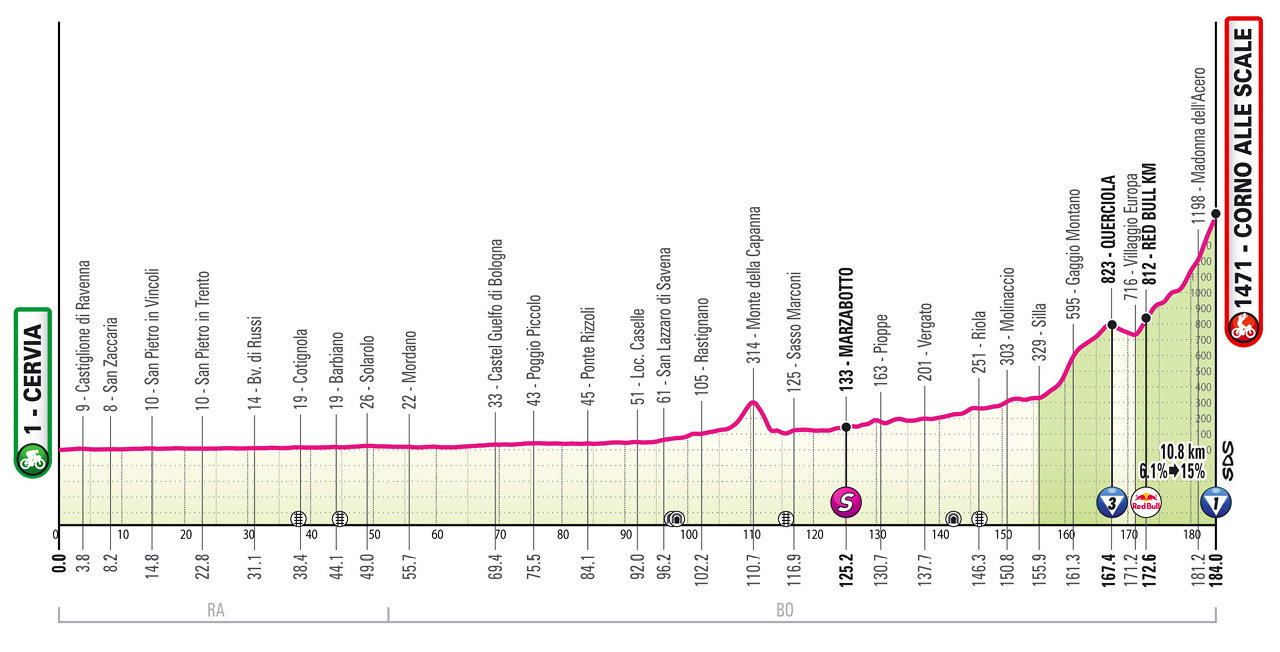
A summit finish? Yes but of sorts as it’s only steep in the final three kilometres.
Non fermo fino a Fermo: a non-stop stage that looked the part from start to finish, all at 45km/h. After a flurry of attacks, Filippo Ganna and Alberto Bettiol got away together but they were too strong, it was impossible for others too bridge across and eventually the pair folded. More moves came and went until with 76km to go, on wet roads, UAE’s Mikkel Bjerg went clear and seconds later his team mate Jhonatan Narvaez went across to his colleague, and Andreas Leknessund of Uno-X just made it across.
The trio combined well, with a classic stand-off behind. Moves from the likes of Garofoli and Romo to get across were doomed as the lead three were too far clear. In sporting terms this sucked the suspense out of the day, it would have been exciting to see more riders joining them and the the script changing. But Bjerg was working hard to avoid just this.
It was hard to see how Leknessund could win from here, grind down the others? With 10km to go as they climbed to Capodarco Narvaez attacked and this shed Bjerg. Leknessund got back on terms, but only just and another move by Narvaez shook of the Leknessund. Narvaez was only a few metres ahead at times but measured in time on the 20% slopes he had a sufficient margin to keep the Norwegian champ away and take a second stage win.

The Route: 184km with 2,400m of vertical gain. It’s across the pianura bolognese, the flat home roads of the Bardiani team. The climb after 110km lifts the route over from one valley to the next but is on a regular road. Once back in the next valley it’s inland to Sila.
Out of Sila and the road starts climbing and into Gaggio Montano, home of several coffee machine factories including Gaggia and also another company founded by two men called Sergio and Arthur and they created SA and company or SAeCo, which later sponsored a cycling team, more of which below. It’s gentle for the most part on a wide road but with one steep ramp coming into the town. From there there’s 20km and the first 10km are gentle and with some descents.

The Finish: the 28km climb is really all about the final three kilometres and even these don’t have many surprises, the road drags up through woodland with a 10% slope to the line to make the final selection.

The Contenders: Jonas Vingegaard (Visma-LAB) is the obvious pick, he can bid his time until the final 3km before using the 10% slope to jump away. But will his team ride lock down the race? Unlikely, so the breakaway has a good chance.
Picks for the breakaway are wide open because if this is a summit finish, a non-climber can still attack within 10km and use their power to take a gap which they can defend at the end. Not that 80kg riders like Max Walscheid, Jonas Rutsch or Tord Gudmestad stand a chase, but it’s open to plenty.
Giulio Ciccone (Lidl-Trek) is suited to the stage and his team needs a result, he had pink but lost it for a day and if the team has pretensions to be among the best the need to score soon.
 |
Ciccone, Christen |
 |
Vingegaard, Rubio, Van Eetvelt |
 |
Vergalito, Sobrero, Pinarello, Poels, Rafferty, Lopez² |
Weather: a mix of sunshine and clouds, 21°C during the stage but the more into the mountains the cloudier it gets, and a chilly 6°C at the finish.
TV: KM0 is at 12.50pm and the finish is forecast for 5.15pm CEST. Tune in at 4.00pm for the final climb but don’t expect fireworks on this long, gradual climb.
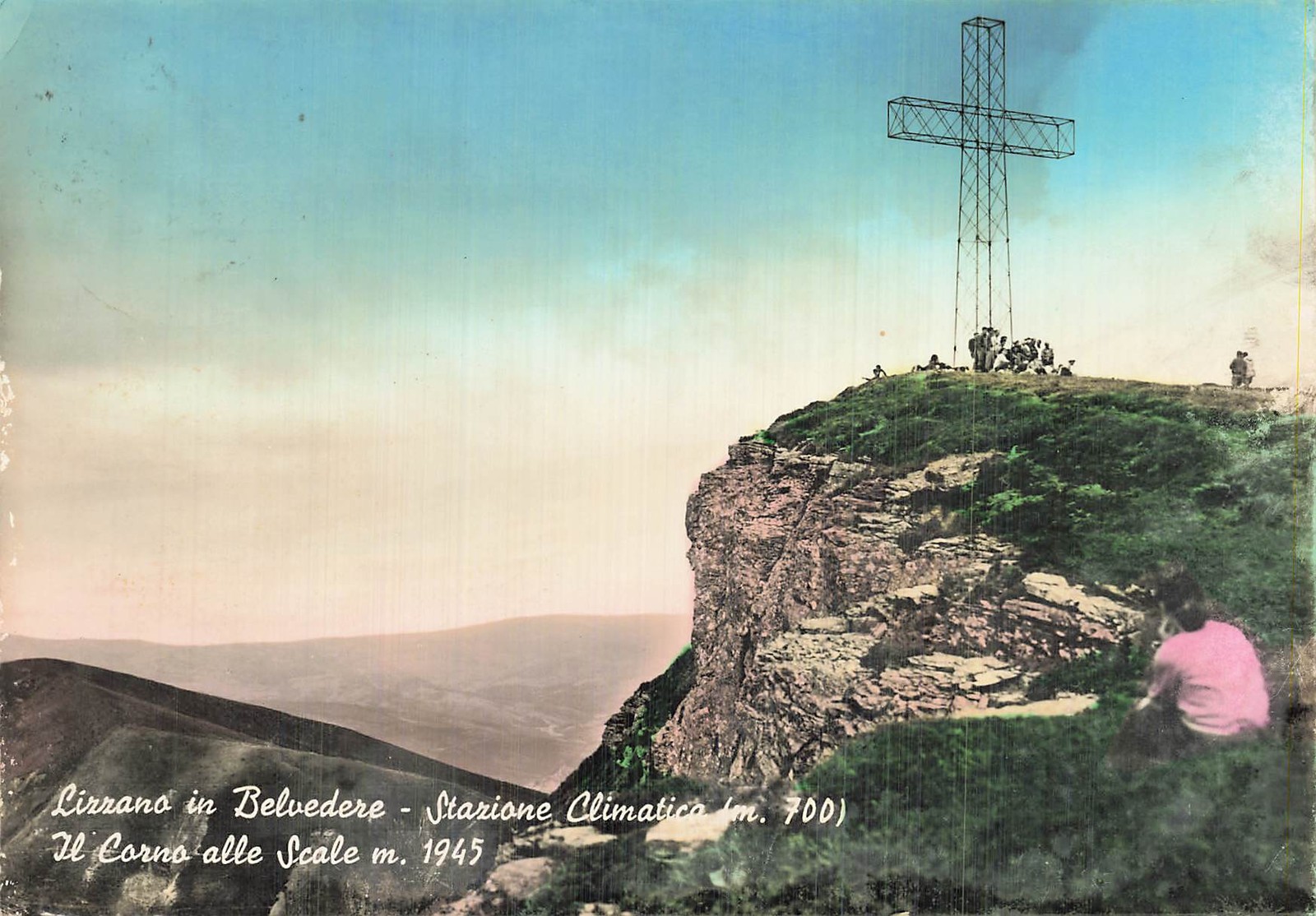
Postcard from the Corno alle Scale
The Giro last finished here in 2004 and what an edition that was. This was the Giro post-Pantani after he’d died in February that year. Il Pirata remains a constant presence at the race, just yesterday one branch of his still existant fan club was at the stage finish.
The 2004 Giro became a duel between Gilberto Simoni and Damiano Cunego, team mates at Saeco. Simoni was 32 years old and had won the Giro in 2001 and 2003 and was known for his straight talking. He would comment on rivals in a way that nobody does today and his quotes often formed headlines by themselves. Cunego was a second year pro with cherubic cheeks and tufts of blond hair. You can begin to spot opposing caricatures.
“Let’s not forget that I am the captain of Saeco” said Simoni on the eve of the Giro after Cunego won the Giro del Trentino (the Tour of the Alps today) ahead of him, and on Simoni’s home roads. Simoni was even talking about winning the Giro as a springpad to a Tour de France victory that year and had spent the winter taunting Lance Armstrong, trying to provoke the American to do the Giro as well. We don’t need too much hindsight to spot the hubris here.
Cunego won Stage 2, taking a 40-rider sprint. The next day the race finished at the Corno alle Scale and Simoni won solo ahead of Cunego, with Simoni taking the race lead too. But come Stage 7 and Cunego won and with the time bonus took the maglia rosa. The two battled each other, sometimes via the pedals, sometimes via the press. Simoni would remark he could still win the Giro even if he did not attack Cunego, as his younger team mate would melt under pressure. But Cunego would finish the race with four stage wins and with two minutes on Serhiy Gonchar, with Simoni third by a few seconds.
These duels and beefs don’t exist in cycling any more. Tadej Pogačar and Jonas Vingegaard aren’t friends but neither gives quotes designed to wind up their rival. If you can find a verbal gap between Jai Hindley and Giulio Pellizzari it might be over their preferred pasta shapes. The hypothesis here is that there are two reasons. First, newspapers no longer mediate these rivalries, instead social media does and for all the potential for online antagonism, riders follow each other and can message each other, rather than polemiche and spiced-up quotes pitched in opposition, which see one rider read a quote and then react but also if a rider did say something outrageous it became a headline, now it can be challenged and even demolished in minutes which tempers the riders. So now things can be smoothed over, or iced, almost in real time. Second, a lot of this smoothing is achieved by teams who go a long way to policing the communication of their athletes, they don’t want any negative output including criticism of rivals. What gets said inside the team bus is drilled into riders to stay there… unless it happens outside between Gianmarco Garofoli and Filippo Zana.
When Simoni won here at the Corno alle Scale he declared “Someday soon I’ll teach him [Cunego] all about how to win a grand tour“. It was a line that was more defensive rather than an invitation to share tips and lives on because of its sizzling invective. All eyes on Hindley and Pellizzari but the quotes won’t be so spicy.
A few guys thinking of the rest day on Monday.
30 guys otherwise going up the road probably and the rest following at a distance that encourages a breakaway win.
Bahrain have the pink jersey and Visma won’t mind them keeping it for a couple more days.
Excellent stage recap and postcard, as ever. I don’t want to imagine a world without this cycling blog in it. W IL GIRO E W INRNG.
I for one am grateful to see the days of bitter invective between rivals long gone. Not certain if this is a minority viewpoint, but I MUCH prefer the civility and sportsmanship of the current era to what came before. MvDP rushing over to congratulate WvA after Wout’s Paris-Roubaix win, for example, is precisely what I want to see. I realise that pro athletes are fiercely competitive and cut from a different cloth than us ordinary types, but give me courtesy over hostility any day. The world needs more of the former and less of the latter.
+1
There’s a delicate balance, some rivalry can be good, for example if a rider is beaten one day they can say “I’ll get my revenge tomorrow” rather than “My power numbers are good, we’ll take it day by day” but the talk also has to reflect the sporting rivalry. When things cross into insults it gets worse.
Also these rivalries do exist, sometimes for petty reasons. A rider drops a bidon in front one day and then does it the next, or they swing out of the line unpredictably and suddenly they’re the enemy for the rest of a grand tour or even longer. But in the past this would have seen a barbed comment at the finish, now things are normally internalised.
What happened with Garofoli and Zana?
In recent years, I remember Nibali inviting Rogla to visit his trophy room (rolling eyes). A fan of Vincenzo here, but that sentence left me ashamed for him, even more so in hindisght as it was him who threw away that Giro (otherwise greatly deserved by Carapaz anyway).
Instead a fun episode was L’Aquila with all the big names in the peloton shouting angry at Vinokourov who didn’t pull despite wearing the maglia rosa and Vino commenting: “questo è Giro d’Italia no Giro di Kazakhstan” (insert at will Ivan Drago accent) as in “do or say as you please, I couldn’t care less”.
See the reply to Cascarinho below, a clash between the two at the finish yesterday and it needed someone to intervene in between them.
Would love to see Jai Hindley have a crack today, I’m sure he’s hungry enough, despite the amount of Rigatoni he eats 😁
Diego Sevilla to try to get the Maglia Azzurra back today? Will Jonas want to TT in his own skinsuit?
Yes, Vingegaard has said aloud he wants to ride the TT in his own suit. But it’s not easy for Sevilla to score, he is only one point behind Vingegaard so needs to be at least third over the 3rd category climb in Querciola and then for Vingegaard not to score.
Bahrain and others could even work to block Vingegaard and Sevilla. But the skinsuit is not some budget offering a size too big, it’s Castelli’s best and can be fitted, with work to adjust the seams length etc. In other words Bahrain need not fry the whole team for this.
The thing Vingegaard can do today is not worry about the skinsuit and use the final 2km to take 30 seconds.
I suspect we will see Visma at the back again today with a rider or two to police the break. The break could take a very long time to form (if at all)the roads are flat and lots will see a chance. Visma’s ideal strategy would be a relatively strong break of non GC folk to get away and then a gentle ride across the plains. I guess Bahrain will ride again. 125km seems a long way for the sprinters to ride in the break to pick up a point or two. Of course this being the Giro always a chance that Jai Hindley makes the break and takes 5 minutes on the rest of the GC……
No.
Thanks for reliving the rise to power, albeit brief, of the Little Prince. That Giro was the first that I paid close attention to, having heard that this Grand Tour was the hipsters choice at the time. Cunego captured my imagination and the polemica made me fall hard for the Giro.
Indeed so much of an impression did this leave on me that a year or so later I made a pilgramage to the route of Stage 16 to scale the Forcella Staulanza, Passo Valparola and Passo Furcia on an out and back route from Treviso. It was the first time that I had rideen a Dolomite and I was a little slower than my riding buddy (also my boss!) so our unlit descent in virtual darkness down into La Villa was somewhat nervous. A great time and perhaps the reason I have returned to take part in the Marartona a few times to see it all in the daylight.
Thanks for sharing!
I remember Simoni trash talking Armstrong via the cover of Cycle Sport magazine as far back as early 2002 with the headline “I CAN DROP LANCE”. (narrator; he didn’t)
I also see that the previous visit to this climb was a harder stage and sixteen riders still came in within a minute of Simoni, which kind of suggests we may not get huge gaps today.
It also showed how far he was from the TDF reality, which he had ridden just a couple of times at the beginning of his career and with no ambition whatsoever.
At the TDF lightweight riders were literally destroyed in the “useless flat stages” during the first half of the race before the first climb was even hit. In fact, they typically struggled, even the best of them, even in the first uphill stage or two, until cumulative fatigue made the competition a little more balanced into the third week. Before the course and racing approach changed completely, a pure climber could hope to win a TDF every ten years or so ^___^
Besides, poor Simoni had no idea of the level of mafia dominating the TDF peloton. He had had at home the closest parallel in… Cipollini… still several steps down on the “violent cop” scale.
That said, Simoni had really the potential of the best international climbers of his age, as he clearly showed in his Vuelta victories against some of the very best on mythical climbs like Angliru or Abantos (but partially so also in that Peyresourde stage at the 2003 TDF). Or, paradoxically, at the Giro 2006 despite finishing over 10 minutes behind Basso. Turboboost Basso. He was just “out of his times” in many senses, in terms of age because his career was late and had many stops (he was 30… in 2001), but also because he belonged to a less “scientific” cycling.
Mikkel Bjerg selflessly riding for a team-mate, without Pog to glower at him if he doesn’t, despite said team-mate supposedly leaving at the end of the year, is an example certain other UAE riders *cough*Christen*cough*, and indeed other teams might profitably learn from.
The infighting I was expecting amongst UAE has not happened due to the intervening circumstances, and as every surviving rider except Bjerg seems now to be riding for themselves and stage wins, but could UAE work together to help him get a stage win? He hasn’t got much on his palmares, and he deserves it for his loyalty and hard work.
Cunego took the jersey with a tactical long range attack supported by a teammate, which had Simoni fuming further as the move was (supposedly) intended to function just as “strategy” for Simoni’s sake.
Which brings me to Bjerg, named above. Curiously, such a situation as yesterday is probably one of the best occasions he can get to win a stage, however tired he gets to the finale. Without pushing anymore (as he was caught), still he was a mere minute back, which means that if Leknessund had wanted to gamble a little more, maybe Mikkel could get to the line with a proxy attack. If you aren’t the fastest or the strongest on a hilly finale, a tactical lock-up when you’re in the company of a real fav may happen to be your best option (hey, not a great chance, sure – anyway, a great cyclist isn’t made only by victories, ask Igor Arrieta’s daddy).
Back to Simoni and Cunego, the last mountain stage of that Giro had Simoni attacking his maglia rosa teammate with a long range move in the company of his old rival Garzelli.
It was a short stage and the excitation it generated, although it ended up with no much GC effect, was among the factors which prompted the “new wave” of short, adrenalinic hard Alpine mountain stages, no longer than 150 km and often as short as 120, which had sparsely existed even in the past, even relatively distant, but which from then on became a regular feature at the Giro as a means to see more attacks before the last climb.
It was like one such stage for each edition, but sometimes many more were implemented, as in the 2016 edition, whem they all worked spectacularly.
What’s now TDF-standard needed more or less a decade to cross the Alps. Even the Vuelta, which had something similar from time to time in the “fixed” 145 km long stage to the Calar Alto observatory, later offered the new concept as such only in 2007 with the Abantos stage, as an experiment which wasn’t repeated for years and years to come.
The Giro – currently the more “conservative” and “fondo-focussed” GT – some 15/20 years ago offered most innovations (also think strade bianche or technical ITTs), even in terms of shorter, explosive racing.
While even now I struggle to remember any “innovation” introduced by the TDF, perhaps logically so.
But, sadly enough, when exceptions or novelties are turned into norms and ceremonial… they lose their original function and just leave us with a “poorer” sport in terms of depth and variety.
The 40km-stage ! 🙂
More seriously, the new kind of TTT can be fun. Innovations in the TdF are almost always tried in Paris-Nice or the Dauphiné first.
Having just descended Blockhaus… what about the 80-kms long Chieti-Blockhaus in 2009? A failed experiment, but what Vuelta later popularised and generalised as “efecto Camperona”, short, flat stages with just a hard or hardish final monoclimb/wall.
A bit like what Giro copied for today -___-
Worse ideas spread faster indeed.
However, today was intended to be a 4K altitude gain stage across the Appennines but ahem “some fav” asked to have it ironed down last Autumn during the negotiations. Or so they say in the backrooms of RCS…
The route looks like it was designed for Evenepoel, only for him to say no thanks.
I suspect he’d have taken part, even said something along those lines last year I think, but the team said “no way”.
Normally the Giro “buys” a rider via his team, but sometimes it can happen much more “under the table”, talking directly with the rider’s personal entourage. Only, the team may have later something to say…
However, I guess that Visma were happy with sort of an “easy” Giro, just like Pogi, in order to make the double. Hard stages are good for a favourite if he *needs* to build up a difference stage after stage, for the likes of Pogi or Vingo is just an extra in case they want to collect stage victories, but some occasions where they can decide to rest are also great to “manage their in-race training”.
For the breakaway, why not Tjotta ? He impressed me yesterday in the last salita, being from far the strongest. In Arkea he was one of the team’s hope. Seems like a Uno-X or Astana kind of day. Or Zana or Cepeda. I’ll stop here 🙂
What was the Zana-Garofoli thing ? Was it in Sardegna ?
I remember the Cunego-Simoni beef : like mendip5000, it was the first Giro I could follow. I remember connecting every evening in the computer’s room of my high school and visiting velo101 to have the résumé of the stage of the day… I thought Cunego would have an extraordinary career.
Simoni was a funny rider, especially in the 2006 Giro when Basso was taking 2 minutes over everybody every mountain stage…
Garofoli and Zana were remonstrating with at each other at the finish yesterday, “I’ll have you” shouted Zana to his team mate before someone got between them. Hopefully they’re not room mates.
What was the Garofoli and Zana argument all about? I think I missed that one.
Sorry, ignore that, see it’s been answered now.
Ay, Vingo, why so poor?
???!
Glad I’m not the only one who thought that was a pretty sorry show for a champion. Suck wheel till 900m and then attack poor old Gall, who wanted him to come through a number of times. Maybe that’s “smart” tactics, but it’s also a d**k move where I come from.
L’Equipe’s is “Vingegaard en gagne-petit” which sort of translates as he’s a “small timer”. It wasn’t his best win and arguably some kind of alliance with Gall later might help him, ie if they’d worked together to reach the finish they’d both gain time, and Vingegaard would look like a Lord for gifting the win to Gall.
But remember as things stand Visma still don’t have a sponsor for next year.
Many sponsors come into cycling through a personal interest by somebody in the high spheres, whether we or the general public end up knowing that or not.
In that case, being “Meangegaard” doesn’t feel good or sell well, notwithstanding the extra winning photo on the line on a forgettable Giro stage, which might appeal for an extra patch on Bardiani’s jersey, not Visma’s next tens-of-millions provider.
That’s true. But also that some company in California or the Middle-East and their board just wants wins, trophies and gold too.
gall is his single strongest rival in the race , i think itd be a grave insult to not deem him a worthy opponent you need to take time on but rather someone you can ally with ( against whom ? )
as i recall it everyone understood why pogi didnt gift couillole to vingegaard despite sitting on his wheel until he sprinted past him , and practically no one belittled pogacar as a small rider for winning then
Exactly. JV knew that Gall needed that time more than he did, and he did nothing to jeopardize his chance of a stage win or increase the (albeit unlikely) chance that Gall drops him. JV couldn’t care less what anyone thinks of his tactics, his bike-kissing, ring-kissing, etc. Which is why I like him.
@The Other Craig
Yeah, one must really suppose (and hope quite much, even) he doesn’t care, because he made it really hard for anyone to think anything good about that “tactics” (even more so if the reasons are those you expressed).
Yet, just check below many of us on these pages producing beautiful efforts to actually think something good about it…!
Well, one must also hope that his main intention wasn’t really “avoiding to insult” Gall because the latter apparently didn’t appreciate such sportmanship and even insisted a lot to be insulted. Hard to understand how he failed to see the clear equivalence between him himself and that outstanding rival who had beat Pogi two years in a row at the TDF…
Of course Gall knew what was going on, and he was smart to keep going. I’m sure he heard that Pellizzari was bleeding time (among others) and he knew it was a good opportunity to take as much time as he could. He really would have looked foolish if he petulantly refused to pull JV, just like JV would have looked stupid if he refused to pull Pogi to another TDF stage win just because it hurt his feelings. Life can feel pretty unfair at times.
So harsh on Vingo, it’s a race not a charity. As everyone quotes because it’s a perfect analogy, “lick your opponents plate clean first” and Gall seemed to be spooning his food onto Vingegards plate.
The Rich Man crawling under the table to lick Lazarus’ crumbles? Looks good.
I enjoyed your analogy, made me chuckle. even if I think it’s exactly what cycling is about.
A bit of what-aboutism: How did for instance the greatly esteemed Slovenian four-time winner ride on stage 14, 16 or 18 of last year´s TdF? Sucked wheel when the foremost competitor attacked in headwind and then counter-attacked.
The only differences are that Pogacar didn´t drop Vingegaard and that Pogacar didn´t take the stage victory on those occasions.
See the reply to Cadence 66 below.
Well, if you or Vingegaard or anyone on Earth really believe that Pogi:Vingo=Vingo:Gall under every respect (strength, palmarés, rivalry), what you say makes some sense, but let me have some doubts.
Stress on mutual perception, irrespective of Gall having gained superpowers along the way (or not).
Plus, as I also said, it’s not like Pogi’s behaviour didn’t raise eyebrows. And giving out the stage makes it very different, of course. It makes clear that you’re acting for some sort of unknown reason different from pure greed.
Whataboutism by definition means searching feverishly for *something* and settling for something that one perfectly well knows isn’t quite equivalent or even genuinely comparable.
In other words: I, too, would have preferred it if Vingegaard had not ridden the way he did.
It’s just that I believe – but I know that I don’t know :-)- an overwhelming majority of Vingo fans felt as I did watching the last 2.7 km of yesterday’s stage – but I’m not sure that most Pogi fans would’ve felt the same way, had it been Pogacar riding in Vingegaard’s place and taking the stage win in identical manner.
It’s called racing. Especially when you want wins to attract a sponsor.
It was 100% consistent with how he rides … but it is the sport of drafting afterall.
I don’t really know why Gall attacked when he did.
Having little to talk about, there’s an ongoing debate among Italian fans.
Many say, more or less along your lines, “wheelsuckers will suck wheels”, then they further divide into “a wheelsucker always sucks” and “when a wheelsuckers win, the rest is just -so what? -“.
Frankly, I fail to see Vingegaard as a real wheelsucker, despite him having recently gained the World Wheelsucking Title in that Catalunya stage trailing Remco.
I remember several unexpected attacks from him (Ventoux 2021, first win at Vuelta 2025), others which were expected but equally generous as they brought him to the limit, no matter how they ended (Tirreno 2022, PDB 2024), others again which were relatively safe for him but still very aggressive (TDF 22, Marie Blanque 23), and of course many more.
Sometimes he looked more of a wheelsucker, but more than reasonably so, just think the Catalunya storm stage, or some challenge against Pogi.
Pogi himself a handful of times sat passively on Vingo’s wheel only to attack him closer to the line. But it’s pretty clear, at least to me, that when it happened in 2024 it was part of a long term psychological warfare within the highest-level rivalry in GTs in many many years. And in 2025 even Pogi’s attitude raised more than one eyebrow, indeed, and had France’s many psychoanalists dealing with the Childlike Emperor’s mysterious illness.
To me, much in cycling is properly assessing your own strength and then how you ride is also where you place yourself compared to other rivals.
If Vingo *really* feels that Gall is to him what, say, he’s to Pogačar, well, fine enough. But it’s to be seen if that’s “properly assessing his own strength”.
What feels insulting to others and yourself in wheelsucking is when you actually don’t need it: in that case it comes close to taunting your rival.
I’d go as far as implying that irrespective of Gall being a true menace for Vingo’s Giro bid, the latter’s record requires a different attitude.
And sitting on the wheel for some 5′ on a 10% gradient isn’t even “saving you energies for the TDF”, come on.
In this case it was more like “yep, man, I know you’ll pull all the same with all you have, know why?, because you’re fighting for scraps with the other miserable guys, but I don’t need to take time on them helping you, and I don’t even need to take much time on you attacking you, say, 3 kms to the line, so I’ll leave you raging on the front until I just steal the stage accelerating on the flatter final part”.
The sarchastic part which make it even worse was the interviewing mocking Pogi, “I’m happy to win for my teammates who worked hard”, only the teammates who worked hard were Gall’s, whereas Visma’s only pair who worked a little were so fresh they could get 3rd and 8th.
It was as bad as any movie villain, it sort of reminded me of Froome bullying poor Aru (that was worse, of course). And in this case it indeed complied with the old definition of wheelsucker: “Winning like a true loser”.
Totally agree with this assessment of the situation. Well said.
How about the following hypothesis? Maybe Vingegaard is not at all confident that he stands head and shoulders above Gall at this Giro. We all would have expected this, but what evidence do we have, apart from the palmares? Maybe Vingegaard is close to his limits, and he fears that if he takes the risk of working too hard too far from the finish, then Gall might discover that he is vunerable. He of course can’t say this, as it would encourage Gall and be a terrible signal ahead of the TdF, so he is trying to hide it. Maybe Gall is stronger than ever (some evidence supporting this), maybe Vingegaard doesn’t have his usual GT readiness since he is working towards the TdF (could be plausible), maybe he is just not in great shape — maybe it’s a bit of all of these things. The one time he tried to dominate on a climb, i.e., Blockhaus, he didn’t really manage to do that. So, is he simply trying to win (well, he *has* to win the Giro) while hiding his vulnerability?
We’ll soon know how far the Decathlon «new materials» have gone to improve Gall’s ITT performance – an athlete who struggles to make the top 50 (!) when the altitude gain is under 200m. and whose H2H against Vingegaard in the discipline are unforgiving. But, yes, I myself have insisted on «as far as we know», «things as they look now» etc. Let’s admit your conjecture is true and Visma or Vingo feel Gall’s menace. In that case…don’t wheelsuck anyway! If the conjecture was true, it would be better for V. if it ain’t surface at all -‘ instead, here we are.
If you’re strong, don’t tease to no use a weaker athlete.
If you’re weak, better behave normally, i.e., the standard way, a token turn or two and nobody will comment on your last km attack. It’s physically impossible that taking a turn at 18 km/h within a 6-7 minute effort would change radically the final result we saw on the road.
I at first thought Vingegaard was being a bit of a yutz, but figured: “I didn’t want to attack. Gall did. I have to follow him. Let him pull. We’re gaining plenty of time without my help and I’ll dismiss him on Tuesday. And I’ll get 10 or 12 seconds plus bonuses at the end.”
In the past Vingegaard has been quite confident about his prospects later in grand tours: “The TDF will not be won by a few seconds. It will be minutes”, as he said one year. He said that, I think, in Spain this year too?
That said, I agree that a little cooperation here might have gone a long way toward his reputation in the peloton, etc.
I just wish he’d shave his little whiskers and quit kissing his bike.
Vinny may well have come into the Giro undercooked like Froome did when he won – his aim was to be firing in the third week as I recall. Worked out well for him.
I cannot find anything to disagree with here (but then again I don’t think I have to).
But just to speculate for the sake of speculating or for the sake of getting some small amusement out of a not particularly pleasant aspect of racing:
It could be that Vingegaard simply feels that he shouldn’t meddle with the fight for 2nd place? By doing his share of pulling he would’ve helped Gall widen the time gap to the other podium contestants…
This is exceptional. I like the idea that Vingegaard is simply here to observe like a scientist. He knows not to step over the line of observing otherwise the results will be contaminated by his presence.
I love this theory, too. It’s the best by far, notwithstanding let me add a couple more.
1) Having a rival athlete racing in race and hope… is generally not a great idea, but having a rival *team* with such an attitude may work great to… spare your own teammates. Vingegaard doesn’t currently have to worry much about his personal efforts, but perhaps his team might consider that going on having others working instead of them is a good investment.
2) Reharsing for July. Hold Pogi wheel then jump away. Against Pogi it would look great, indeed. And some reharsal is surely needed (check that arms raising in celebration…).
Gall kept riding since he wanted to win time on the other GC riders who weren’t Vingegaard. In the Tour, Pogi won’t ride with Vingegaard on his wheel: Pogi is actually a smart tactical rider, something which many under-estimate.
Sort of like the way people making nature documentaries can’t interfere when a cute cub falls in the water, or something like that? Yeah love this theory.
Toon Aerts not the most popular guy…what was the deal with that?
I mean I know why he was unpopular but what on earth was he trying to achieve?
Yes, that’s the question. Maybe just testing legs or sheer lack of road experience (it’s his first GT ever I think). The others were also a little unnecesarily aggressive, given that he wasn’t going anywhere anyway, but maybe they could just explain him.
Oh wait, I think I know, yesterday’s there was a secret wheelsucking contest in the peloton, which would explain both Jonas’ and Toon’s case. Victory for whomever drives crazier his fellows on the front
^___^
Maybe Toon won…anyway not the way to make mates in your first GT. But yeah a lot of the arm waving was a bit over the top although quite entertaining
Could there be an equivalent to most aggressive award? Some kind of coloured race number for best wheel sucker to wear the next day?
A bit of the top, yes — especially coming from Movistar riders!
They used to show the stats on what % people (teams?) were pulling. What happened to that?
@Tom I reckon nobody can complain about Movistar lack of pulling since they have Milesi with them
^___^
(To be fair, Valverde and maybe even Mas are indeed iconic defensive riders, but historically their guys in the breaks typically had their share of work, even too generous sometimes, in recent seasons think García Cortina, Romeo, Formolo, Oliveira, Erviti, G. Izaguirre, Verona, Soler, Cataldo, Amador, Carapaz, Quintana himself… Einer Rubio often keeps his powders dry but there’s typically a teammate along to do double work)
@Andrew I’m not sure a wheelsucker award would help fireworks on the road, barring the subsequent brawling I mean 😉
…but maybe it would make cycling less predictable, as Pogi would no doubt feel the urge to win that, too, then in a sprint is when his chances drop.
However, Toon Aerts went he himself a bit over the top as he tried to get a free ride like three times in a row, to reach the front then in a couple of splits. In this sort of situations giving at least a token turn from time to time not only is basic education, but it actually helps the rest, hence the move succeeding or lasting, hence you yourself being part of something meaningful. The cost benefit balance makes it a no brainer, which is why the others got mad, but also the very same reason to be more tolerant – he clearly hadn’t any idea, rather than being on the verge of outsmarting everybody!
I read somewhere that he was to be up the road as help for one of his teammates later in the stage. In order to be of said help, he would have to be as rested as possible and so was told by the team not to work.