
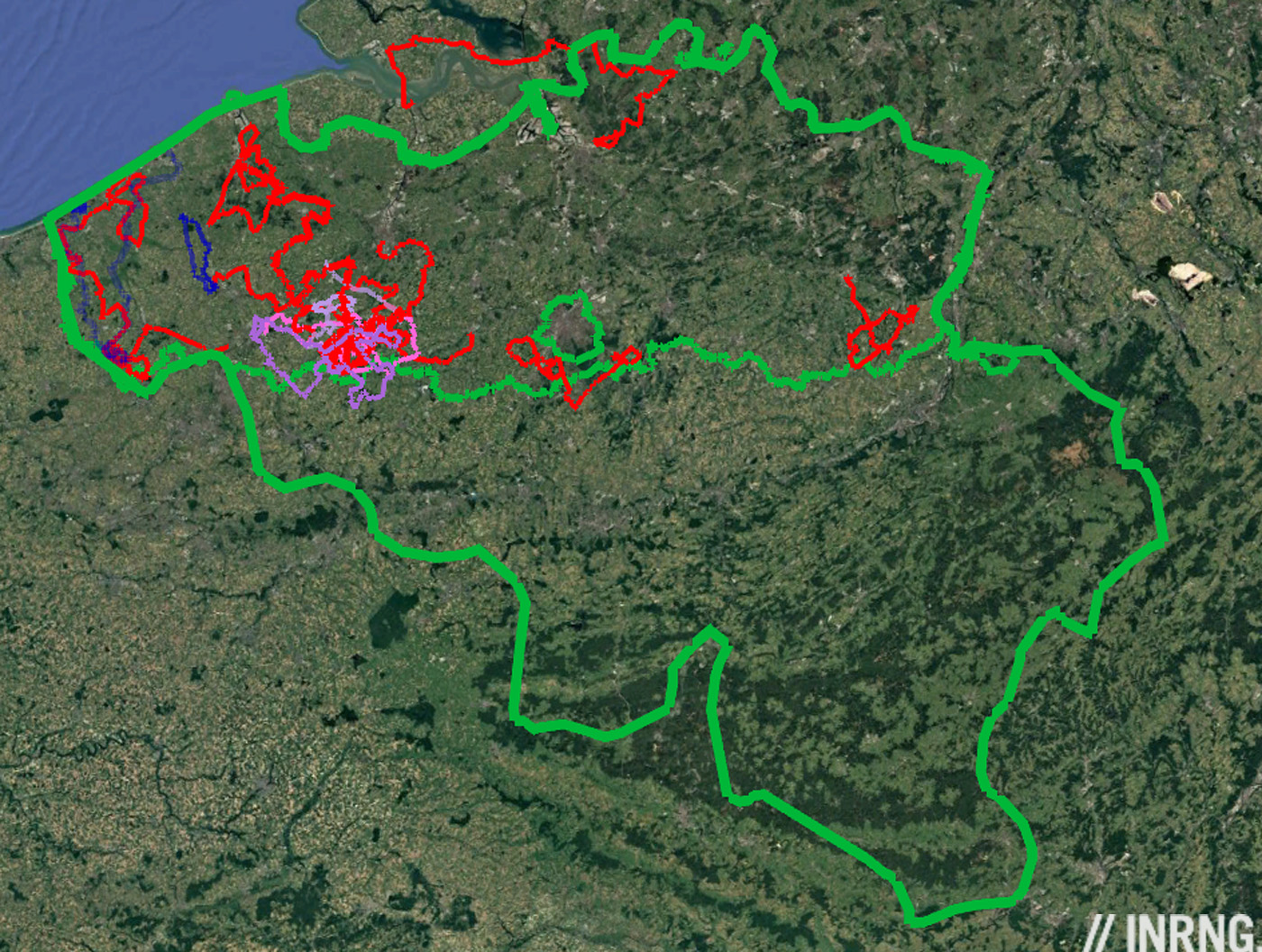
Dwaars door Vlaanderen is today, its name is literally “Across Flanders” only it covers a tiny portion of Flanders. Similarly this Sunday’s Ronde van Vlaanderen doesn’t tour much of Flanders, instead it loops around a very small part of the region. As do many of the other spring classics.
The map above shows Belgium within the thick green national border and the Flanders-Wallonia border running east-west, as well as the circle of Brussels.
The red lines are the routes of all the events organised by Flanders Classics (Omloop Nieuwsblad, Ronde van Brugge, In Flanders Fields/Wevelgem, Dwars door Vlaanderen, Ronde van Vlaanderen, Scheldeprijs, Ronde van Limburg, Brabantse Pijl with the last four using last year’s routes as the source data as this year’s races have yet to happen).
The other races are the independently run Kuurne-Brussels-Kuurne in dark purple, the Nokere Koerse is light purple while pink is the E3 Saxo Classic route, light blue for the Koksijde Classic and dark blue for the GP Monsére.
You might prefer to see each race in a different colour. But the point here is not to differentiate each course more to show how many overlap. It’s less a map and more a bowl of spaghetti. Trying different colours actually doesn’t work well because so many overlap.
As you can see a lot of Flanders isn’t visited by the major bike races, plenty of Flemish residents don’t exactly have a spring classic on their doorstep. The Scheldeprijs might be around Antwerp to the north but has plenty of the course in the Netherlands.
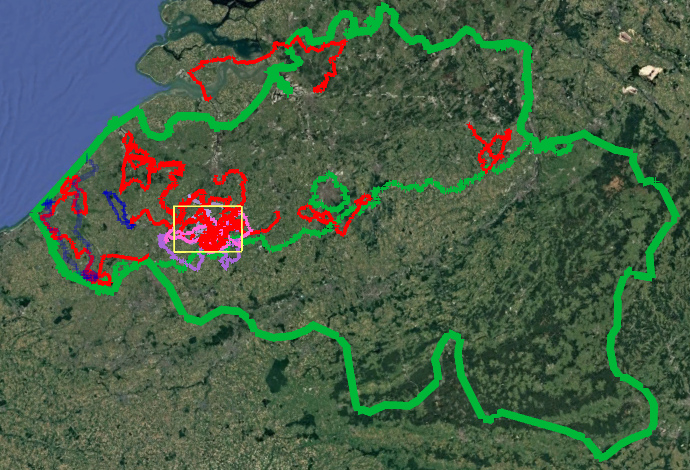
Look at the map again and this time there’s an added yellow rectangle. This measures 30km by 20km. Inside it sit most of the Omloop, Kuurne, Nokere, E3, Dwaars and Ronde routes. It’s here that sit many of the famous climbs, think of the Paterberg, Oude Kwaremont, Taaienberg and Molenberg.

The screenshot from Dwars door Vlaanderen today includes a white line, that’s the Nokere Koerse finish painted on the road from a few weeks ago. It’s why the guy with the “LUC” sign can appear so many times along the course of a race.
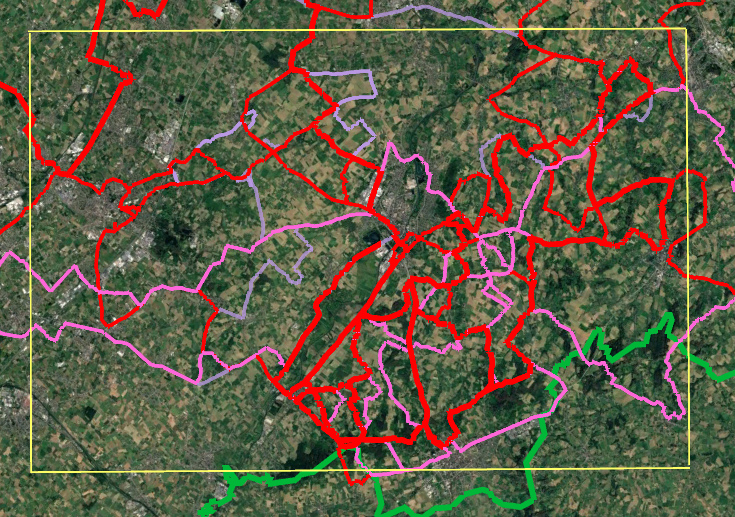
The image above zooms in on the same 30km by 20km zone. A lot of races within this area overlap. There can be cobbled sectors taken one direction that are reversed in another race but often there’s only one right way. Nobody wants to race down the Paterberg.
By themselves most of these climbs are modest, the Taaienberg can often be crucial but it is about 600m long and lasts just over a minute in these races. It’s the accumulation and distance that’s needed.
Geography means some races have few features to break up the peloton unless the wind is blowing. A sprint finish can be thrilling but the ride to get their can feel processional for TV viewers. Since the last decade many race organisers, including plenty outside of Flanders, have sought to add more obstacles and jeopardy in order to make the TV experience more lively.
So in Flanders organisers head for the hills and concoct a course designed to tackle as many climbs and cobbles as possible and most of these are in a relatively small area, sometimes branded the heuvelzone, the “hill zone”. The twisting and turning to achieve this compounds matters as races zig and zag through corners and junctions.
It used to be thought that learning the lie of the land was an advantage in racing, knowing where a road widened and allowed you to overtake before a key climb or cobbled sector could save energy. Now a lot of this lore has been mapped.
There’s now familiarity for riders and spectators alike. The current Omloop Nieuwsblad finale has the same route as the old Ronde. Meanwhile the current Ronde has the same Oude Kwaremont-Paterberg-finish in Oudenaarde since 2014 now and feels very much like a known quantity
Conclusion
Many of the Flemish classics take place in a small area and the same roads get criss-crossed? It’s no secret and obvious to many. But this post just puts all the Flemish classics onto the same map to visualise this.
Coming from the western US, most places in northwestern Europe seem shockingly close together when you’re actually there. But this map is especially striking because you realize how important a truly tiny part of Europe is to cycling past and present. And the races barely touch the major cities! I truly envy those of you who can make a day trip to any one of these races; it’s quite a privilege.
Americans think 100 years is a long time. Europeans think 100 miles is a long distance.
That is funny and true….
Most Americans think that four years is too long!
That is (not so) funny and true!
Not only Americans, to be frank.
Well, this season until now, surely not to be taken as the norm (the risk of copycat races is always present within the new homologating FlCl approach), has offered a huge variety of race dynamics and finales, most of them highly emotional and rewarding, E3 , G-W, Nokere (plus Denain) and Waregen especially so, but also Kuurne or Het Volk were very good. Perhaps only Le Samyn was quite “normal”.
By the way, I’ve read that FLCL had issued an exclusive to ES which had been sub-licensing to RAI and others until this year. Was it so, really not a great move by FLCL, that is, it’s not them who weighed the opportunity (or not) to raise prices and reduce public but a broadcaster vs. its competitors. Can anyone confirm if that was the case?
And we can now add DDV to the list of thrilling races this Classics season.
Heartbroken and delighted in equal measure for Wout and Pippo!
No news on the broadcast deals, normally these things come with official press releases etc but this year still waiting for news on the RCS deal etc.
A trip to ride these roads is a must for any fan of the Classics. Stay near Oudenaarde (make sure to check out the museum) and try riding the signed routes – you will take in many of the famous Flanders roads and get a much greater appreciation of just how tough are these races. Best place to ride in the world ATMO.
It’s good and Oudenaarde is probably heuvelzone central. But one thing readers who have not visited may not realise is it is compulsory to ride on the cycle path. These are often good – and building them is welcome etc – but you might think you’re going to do the race route only you’ve got to stick to the path on the side.
There is a way to avoid having to cycle on compulsory cycle paths I gather: Ride in a group of 15+ cyclists (max size 150). Groups of cyclists have different rules, inc being exempt from compulsory fietspaden. 😉
Everyone here surely can persuade 15 other cycling friends to go on a holiday to België with them, I am sure. 😉
It would have to be a “no-drop” ride.
I did a pilgrimage from the U.S. to ride in the area. The first time I hit a sector of cobbles I burst out laughing at how insane they were to ride (back when 23mm tires were the norm). My friend/guide said they get smoother the faster you go. True but still insane. Years on I still think my arms are numb. I can say I never put my foot down going up the Koppenberg – my small cycling achievement! TV doesn’t do the steepness of the berg justice. It rears straight up. Great trip. Makes watching the races a bit more relatable.
That’s grade
The “Tour Down Under” doesn’t leave Adelaide and environs so the race names really don’t tell you anything. The Volta a Catalunya works though.
The Ronde did used to range wider. Take the 2010 edition, it began in Brugge but then went west out to the coast, then came all the way across to Ninove via Geraardsbergen.
Maze van Vlanderen might work … or Dolhof.
A Rose by any other Name, would smell as Sweet.
So Remco would, were he not Remco called,
Stop along the way for a warm cone of friet?
😂
^TOP^
So you’re saying Remco will announce he’s riding the Giro too?
He’s still pissed at Jonas for kicking his ass at Paris-Nice.
Literally so ^___^
Remco didn’t ride Paris nice
Another in-aptly named “tour”–so wrong that it took place in Spain!
In its early years, the Tour of Flanders was a genuine tour of all the major Flemish towns (but not Brabant), passing through the mostly flat countryside of Flanders; the main roads were mostly made of cobbles. Even in 1969, the year Merckx first won, there were only four climbs (two cobbled). From the 1970s, the larger towns increasingly did not want the race to disrupt their roads. And the race introduced more-and-more hills (it now has 16-18). Necessarily, this meant the race increasingly became concentrated on the Flemish Ardennes since most of Flanders is flat. The other races have mostly followed suit: those that don’t invariably end in a sprint.
When I did the Tour of Flanders Sportive a couple a couple of years ago I didn’t really have any perception of where I was, I didn’t really get a sense that I was pretty much just riding round in circles. I quite enjoyed the cobbled climbs, modern tyres have maybe taken the edge off some of the challenge. I did not fully anticipate how much I would dislike the flat and slightly downhill ones though. They are a completely different ball game. Riding along them when soaking wet in a very loose sportive group I was in full admiration of anyone who could fly down them at 40-50kph in a tight peloton.
Also amazing how rugged modern carbon wheel rims are. In the “olden days”, the box section rims with 32-36 spokes often had the spokes “wired” together and soldered.
Teams would have old or special wheels that were more heavy duty for Flanders and Roubaix. They’d stay gathering dust until next year (or as an aside get brought to the Tour of Poland as the roads were so bad, but they have improved much since). You can probably find cyclingnews.com articles about teams running double bar tape and “wide 25mm” tires instead of 19mm.
Carbon might seem more fragile and it was at first, but wider rims makes the rim more like an arch and it can deflect a bit too and gets cushioned by wider tires. It’s made the course a lot easier, as does having more gearing.
All better than wooden rims. The oldest living winner of the Ronde is 1956 winner Jean Forestier who rode on metal rims normally (steel presumably) but heard that wood was softer for the cobbles and less prone to failure so he got some specially for the race. But it rained on the day and the wood had not been treated or cured and so the wheels started to change shape. He still won, jumping his rivals with 500m to go.
Wooden wheels look very adequate for a Forestier!