

A mid-summer look at the team standings now the Tour de France looms large.
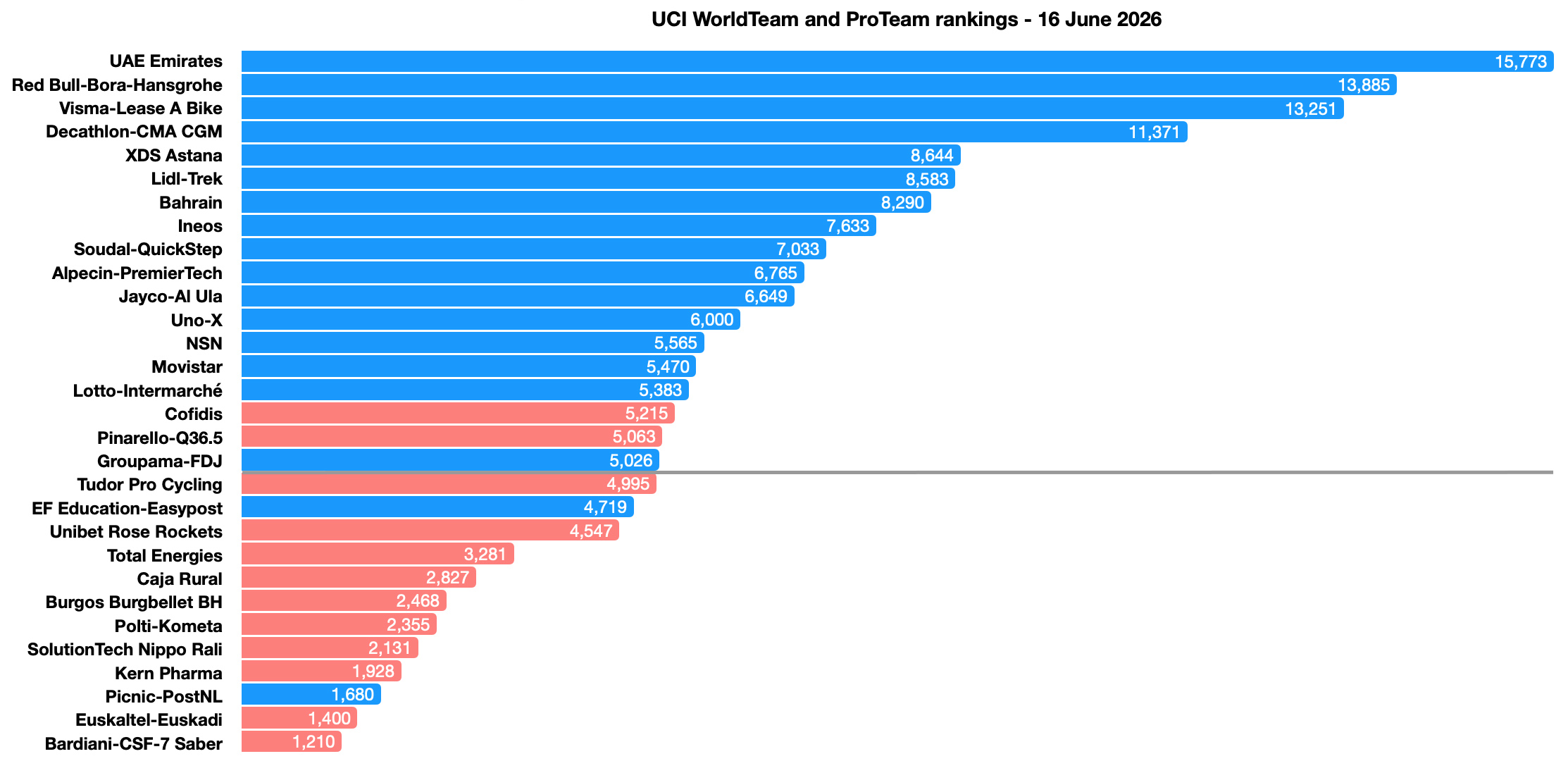
UAE lead the rankings but the surprise is they’re not that far ahead. It’s easily explained by Tadej Pogačar not racing as much this season as before and their Giro being reduced to stage hunting but the result is they’re less than two thousand points clear when this time last year they were ahead by over six thousand.
A year ago too Lidl-Trek were in second place but now sit in sixth place, the result of their modest start to the season which has seen a management shake-up take place. Lidl now owns the team and so is able to directly hold managers accountable. But just as in football it’s easy – but expensive – to rotate management but this rarely guarantees change as a successful manager on a team is often the product of a system rather than a lone genius.

Visma-LAB sit third and a reminder that there’s still no replacement sponsor for the Norwegian IT firm. Ahead of the Giro Jonas Vingegaard said he was relaxed as if there’s no title sponsorship deal then the team will still be underwritten by Dutch billionaire Robert van der Wallen something the team was quick to tackle as the “we don’t really need a sponsor” message was not helpful and presupposes the generosity of Van der Wallen. As rich as he might be and with Visma keen to remain a smaller sponsor, there are millions to backfill quickly so it’s a concern there’s no news. Fingers crossed for a Tour rest day press conference with some good news.
Relegation candidates last time, Jayco are clear this time so something to cheer but their best scorer Mauro Schmid is off to Q36.5 next year and there’s no visibility for the team in terms of ongoing sponsorship. Having points is necessary to avoid relegation but not sufficient if the funding has dried up.
The grey line on the chart represents the border between 18th and 19th place. Notionally this is the relegation point at the end of the 2026-2027-2028 cycle. It’s far away, and also conditional on there being 18 teams in the World Tour. Still we can see a cluster of teams around this point. With Q36.5 and Tudor expanding and hiring more riders – points machine Arnaud De Lie is set to join Tudor – and Cofidis just doing alright it’s putting pressure on other teams. Romain Grégoire has extended his deal with Groupama-FDJ, something the team really needed as he’s been their best points scorer but as they unload other riders we’ll see who they sign.

20th placed EF have twin problems of few points and a sponsor search with no news. Officially the idea is to find a new sponsor to pour more money on top to expand the team budget but it’s also signalling EF is stepping off the team budget inflation train and in the absence of a new title sponsor budgets will be tight. All this goes together as the results so far may not be enticing new backers given as things stand they face relegation, although the Dauphiné helped for publicity and so will a good Tour de Suisse and Tour de France for points if Richard Carapaz thrives and the quality of the roster should help them score once injured riders find form. For now Alex Baudin is their top scorer on 933 points. A regular reminder that for this team and all others new sponsorship contracts needs to filed for the UCI’s soft deadline of October and so a deal ought to be signed already.

Poor Picnic-PostNL sit in 28th place. The lack of results is obvious, just one win this season but it’s so much worse than that with few placings thanks to a series of injuries, all on a squad with few stars beyond Fabio Jakobsen who alas seems to be heading for retirement. Beyond the results, doing daily previews here means downloading the official results sheets every evening and this technical document lists the results, standings in all the points competitions, any commissaire decisions for fines and yellow cards and more, including the order of team vehicles for the following day which is ordered by the position of the first rider from each team on the overall classification. Often the Dutch team is last – pictured – and it must weigh on staff as they sit so far from the action each day. There’s no end in sight with their best scorer Pavel Bittner nursing an ankle injury and uncertain for the Tour; their most talented rider Max Poole is still struck by post-viral fatigue and hoping to ride the Vuelta.

There’s the three year promotion and relegation cycle far away on the horizon but also the one year rankings. Bardiani-CSF now sit in 30th place and so are eligible, just, for an invite to the Giro next year because of the rule that says only teams in the top-30 can ride a grand tour. Note Modern Adventure Cycling have impressed by winning the Tour de Wallonie against World Tour opposition but the US team only has 906 points and 32nd place so far.
Kern Pharma are due to stop at the end of the season; plus there’s no news on a replacement sponsor for TotalEnergies but note if these teams vanish it does not advantage the remaining squads for next year. The rule is written such that the top-30 is based on the end of year rankings rather than the start of next season among ongoing teams; it ought to be revised.
Conclusion
Count the points today but watch the sponsors. Picnic-PostNL are into the relegation battle already thanks to a dire score but while they and several other teams aim to score, their survival is conditional on financial backing. Will Picnic renew, would another company be interested in taking over?
It’s early in the three year cycle to assess the other teams for the relegation contest due in 2028 but any crystal ball is clouded further by question of which teams are still around by then. The upcoming Tour de France will play its outsized role here, both in terms of results and VIP moments with potential backers.
Picnic look in a dire position but then so did Astana with only one year left in the previous cycle. This raises a few points, e.g.
– Can/should low-scoring teams use Astana’s example when negotiating with potential sponsors? i.e. “Things look bad but are salvageable”? Or is Astana the exception that proves the rule?
– Astana are now riding remarkably high. Has the relegation dogfight now honed the team into a point-scoring machine, even though relegation worries are now behind them? Or is this a Matthew effect, i.e. success making the team more attractive for potential riders, and/or establishing a new mindset in the team?
Does Astana’s miraculous escape make it more or less likely that a team in Picnic’s situation can survive? I guess it shows that it’s possible, but also normalises the points-harvesting strategy so that it’s no longer such low-hanging fruit.
Agreed with much of the reflections above; namely, I think your last point is excellent.
One parallel is Astana focusing a lot on their house sprinter Cavendish and once he’d retired then there was just time for a big refocus, helped by a new sponsor. The team bet big on hiring Jakobsen but it’s been one of the worst signings in recent years, up there with Froome going to IPT.
Jakobsen’s contract is up at the end of the year so they can refocus and it’ll surely free up a seven figure sum but can this go on another rider, or is it used to repaying losses? And can they keep sponsorship going. Remember the UCI only gave them a one year licence too.
Good questions. Astana were very shrewd in their signings last year and matching those riders to a race program that yielded the best opportunities for points. They’ve usually ridden a reasonably global calendar compared to a lot of WorldTour teams. Around two-thirds of their wins last year were in non-European races. Same this year. Even if those didn’t always bring in big points, it’s a rich source that Picnic aren’t chasing to any great extent. Maybe due to costs, logistics and lack of sponsor interest? Notable that during the Tour de France when the alternative calendar is slim, Astana are off to the Tour of Magnificent Qinghai along with a bunch of PRT teams chasing points and securing a Top 30 slot.
Grupetto, you make an excellent and very important point. Astana is relatively strong financially, plus they have connections to Asia. You could say that they present a completely different model from the traditional Europe-based teams, and based on where the sport seems to be heading it looks like a winning formula. Once upon a time a team could do well with a solid North American block; if you watched the Tour of California and for a while the Tour of Utah, you could see which teams cared about that. Now, it’s Guangxi and other lower-level races that can be a decent alternative calendar. Alas for poor Picnic, that simply isn’t an option, and the minor European calendar is a much more difficult place to pick up points.
I agree with your comment. But doing the Asian races as well as the European races costs a lot more money.
I wasn’t very clear, I was trying to say exactly that. Astana is in a much better position financially to do the Asian calendar, and part of that is due to their Asian connections. A relative minnow like Picnic simply can’t compete on the same scale.
Picnic Post NL are a lot further behind 18th place than Astana were. They will need to improve next year, by a lot, for there to be any chance of “doing an Astana”.
The management of Picnic seems to be very different from the Astana one too, always counting on slow construction, youngs hopes and protocoles. They have some nice riders in the conti (Vanhuffel, Zomermaand), but 1. will they stay in such a team ? 2. will they be as good when they grow up ? They often have some good hopes but then they fade or go elsewhere.
It really is, and always have been, a strange team. I would really like to have an insider view sometimes, things seem to happen differently than in other teams.
Movistar (the company, aka Telefónica) is trying to buy themselves a way out from the cycling team. Besides a long and weak list of commercial reasons, the actual motive is of political nature. Live by the sword, die by the sword?
It’s a pity to see the team struggling (but any agreement will imply a short term lifeline, whether they pay a way out or sell the whole contract to a different sponsor, the latter option being really telling about commercial perspectives being far from tragic), as they constantly prove they’re a good environment to calmly develop some young middle-level athletes, just like Jayco, FDJ… and PicNic.
The WT/PRT teams looking for a new sponsor (with various degrees of desperation since some sponsors are happy to continue but with a lower budget).
Visma LAB
Netcompany Ineos (?)
Jayco Alula
Picnic PostNL
Movistar
EF Education
TotalEnergies
Equipo Kern Pharma
Flanders-Baloise
Is that the complete list? Or have I missed something.
Bahrain too but for a co-sponsor with talk this could be unveiled soon.
NSN because they have no title sponsor
Wouldn’t it be easier to make a list of who doesn’t have sponsorship concerns? 😆
I suppose some sort of deal might be done with NSN, who are basically a Spanish team, and Movistar in the future if the rumours of sponsor problems are confirmed.
Is it? IPT merge with Movistar?
I mean, do we really think NSN is primarily Spanish funded.
Thanks for this. Adding these two teams makes it 8/18 WT teams who have funding problems.
And at least one of the Pro-Conti teams are folding.
What’s the status on betting sponsor bans in EU countries? I remember talk of how Lotto-Intermarché, Groupama-FDJ and Unibet Rose Rockets could be affected by this.
Complicated as national laws prevail. I can remember reading Belgian legislation and there’s a coming ban on sports sponsorship by gambling companies, but – don’t have the text right now – there is an exemption for Lotto and cycling in the law. We’ve already seen Unibet register as a French team to escape the Dutch ban.