

The Tour de France routes for 2027 are out and here is a stage-by-stage look at the men’s course. It runs between Friday 2 July and Sunday 25 July 2027.

Beginning on a Friday in order to fit the British grand départ into a long weekend Stage 1 is a road race from Edinburgh to Carlisle. It’s the most northerly start of the Tour ever, anecdotal perhaps but means talk of heatwaves and forest fires will be unlikely. There’s one marked climb to award the mountains jersey at Melrose which suggests a tame stage but wait for the weather forecast as there’s plenty of exposed moorland and the first days of the Tour are always high stress.

Stage 2 features more moorland and if the stats on the climbs look tame, zoom in. The Trough of Bowland might be 2km at 5% but it has plenty of 10-14% slopes towards the top to blunt the legs of some heavyset sprinters and the climbs mid-stage should be spectator hotspots, a chance for locals to see riders go past slower and for TV viewers to sample the crowd size compared to the festivities of Yorkshire in 2014, forever the standard against which grand départs are measured. It’s a long stage and the weather could make things harder still giving this the feel of a classic more than regular sprint stage.

Stage 3 is another hard day at 223km again and will have plenty of team managers fretting because a mistake or mishap here could sink a GC contender’s season. But it’s nothing savage, there’s 3,000 metres of vertical gain on the way to Cardiff, too much for most sprinters but the climbs are largely on wide roads, it’s the repetition that will shrink things down and hopefully open up space for attacks.

Stage 4 and after a transfer by ferry to Cherbourg, a circuit race around Normandy peppered with sharp climbs that are often exposed and along the coast concluding with the uphill finish in 2016 where Peter Sagan, Alejandro Valverde and Julian Alaphilippe contested the win. In today’s terms we could see Tadej Pogačar and Mathieu van der Poel duking it out.

Stage 5 and a start in Pontorson, population around 4,000 a first for them to host the Tour because another nearby candidate said non to ASO over the costs but the strain on French finances is a story for another day. Live TV will show the Mont-Saint-Michel but this day is probably all about the second day of consecutive uphill finishes, this time in Plumelec, twice up the Cadoudal climb used in a variety of races before like the GP Morbihan, the 2016 Euro champs and both the men’s and women’s Tours too.

Stage 6 is a flat sprint stage to Angers which as we’ve seen from Paris-Nice finishes is a calm place despite the name and if you don’t like wordplay then skip this day given it starts in Vannes too. The brief sporting aspect is that final metres drag up to the line, reaching 5%.

Stage 7 is the first time trial in the Loire valley to Chambord, which for trivia is the largest of the châteaux in the Loire and if you read it here first, chance are you’ll hear it 36 more times in July . It’s 38km long which makes it the longest TT in a Tour since 2022’s 40km race to Rocamadour. Crucially it’s flat, talk on the day will also be about who has the biggest chainring as it’s accessible to the pure time trial specialists and GC contenders alike. Assuming no mishaps on the preceding stages and Remco Evenepoel can dream of the maillot jaune many times between now and July.

Stage 8 and the longest stage of the Tour, just. There’s déjà vu with a similar day to Le Creusot as Stage 7 in 2021 won by Matej Mohorič. It’s similar but not identical, but like then it features the Croix de la Libération and then the tricky Signal d’Uchon which you might remember from Paris-Nice back in March too with biblical weather and bib longs. This should again be one the “breakaway world championships” stages with waves of riders trying to land an elusive win.

Stage 9 goes into the Jura mountains where the three mid-mountain passes along the way are tiring but have no surprises and suit teams trying to set tempo rather than providing ambush terrain. Then it’s the Grand Colombier, tackled from Culoz via the lacets which means it’s hard from the start with a brief respite and then unusually steep again almost all the way to the top. Race director Christian Prudhomme says he wants the race to unfold slowly but this is big climb, a 40 minute effort, that should shape the overall classification at the risk of setting it, and all by the end of the first week. A rest day in the Alps awaits.

With the route leaking long before, Stage 10 from Annecy to Sallanches sounded predictable but who would have guessed this course? The Salève is back after last summer but it’s a gentler route along the mountain rather than up a cliff face. Instead the déjà vu comes from the Brison climb which is the lower half of the Plateau de Solaison which also featured on the same day. Next, Domancy is a predictable as a nod to the upcoming World Championships here. But the climb to Le Bettex is via a small back-road and similarly many standing will be standing on the pedals to get to up to the Plateau d’Assy before another time up the steep Domancy climb and a fast run to Sallanches. It could be a hard one to control but equally big teams will be content to see a breakaway go clear so their leaders can save something for the following day.

Stage 11 is a big day in the Alps only 150km but 4,750m of vertical gain and this year’s visit to the Alps only briefly spends time above 1,500m above sea level. It’s all via climbs that are steeper than normal for the Alps, achieved via back-road climbs like the Col du Pré and if the finish is in the ski resort of Les Saisies, it’s via the Bisanne route which the hardest way up with only a short transition across to the finish line so we’ll count it as a summit finish. Expect lively crowds as it’s on 14 July, aka Bastille day. And that’s it for the Alps.

Stage 12 is a transition stage out of the Alps and to the Rhone valley. It’s hilly and should be a sprint finish in Valence but could still be worth a go for the breakaway.

Stage 13 is even flatter and so even more likely to finish in a sprint in Montpellier but the obligatory mention of the ability of the Mistral wind’s ability to make mischief.

Stage 14 leaves Montpellier for Mende via plenty of rough roads and 4,300m of vertical gain. A mountain stage? Almost. The final “Laurent Jalabert” climb to the aerodrome is always selective so while Michael Matthews got a masterpiece win from the breakaway on this finish in 2022 we had GC action behind. This time the approach from the south instead of the north is significantly harder. If you wanted to ride a stage for the sake of it, this is a good choice for the scenery, like the cirque de Navacelles, empty roads and it borrows roads described in Tim Krabbé’s The Rider.

Stage 15 might be flat enough for a sprint but with a week left in the race many teams will be desperate for a stage win and will try to get in the breakaway. You can see some of the climbs on the profile but there are more than suggested in the final hour.

Stage 16 is a second individual time trial that starts in Toulouse and heads south following one bank of Garonne river back before returning back on the other side of the river into the city via the wall-like Pech David climb used in 2025 before big boulevards to the same finish.

If the weather is good then the Pyrenees will be visible on the horizon for hours as Stage 17 heads west from Muret to Pau for a likely sprint finish. There are some small climbs to exploit but they’re less launchpads and more hurdles for bulkier sprinters.

Stage 18 is the “Queen Stage” of the Tour with 5,400m of vertical gain and via the aristocratic ascents of the Soulor and then the Tourmalet where the race climbs beyond 2,000 metres for the first time before the upstart additions of the Hourquette d’Ancizan, first climbed in 2011 by the Tour, and then the “new” climb of the Col du Portet, which as a reminder is the Pla d’Adet climb before turning onto a ski lift access path that was tarmacked in time for the 2018 Tour and is now the highest official paved pass in the French Pyrenees. Nairo Quintana won here in 2018 (and Chris Froome was yanked off his bike by a gendarme) while Tadej Pogačar won in 2022 after nearly 50 minutes of climbing time, making this the key test of the race.

Stage 19 is the hipster Pyrenean stage, starting in Hasparren which was once famous for making shoes, it’s via the Burdincurutcheta which as well as being a tongue-twister is a lung-buster with plenty of 10-12% slopes. The Soudet is a backroad route to the La Pierre-Saint-Martin ski station before the Marie Blanque which is climbed, of course, via its steeper side before the descent to Laruns where Tadej Pogačar won his first Tour de France stage.

Stage 20 is a flat stage to take the riders to Libourne for a probable sprint finish and handily it has its own TGV station to take the race to Paris.

Stage 21 and where Champs-Elysées and Rue Lepic now go together like steak-frîtes or jambon-beurre and hopefully we get another Paris match thriller.
The Tour in Numbers
Flatter in feel with only three summit finishes this time when 2026 had four in the Alps alone. There are seven likely sprint finishes when last time there were five, and more time trials too. The 2027 Tour de France route feels like a calmer edition where the imported mantra of citius, altius, fortius is reset. But what do the numbers say?
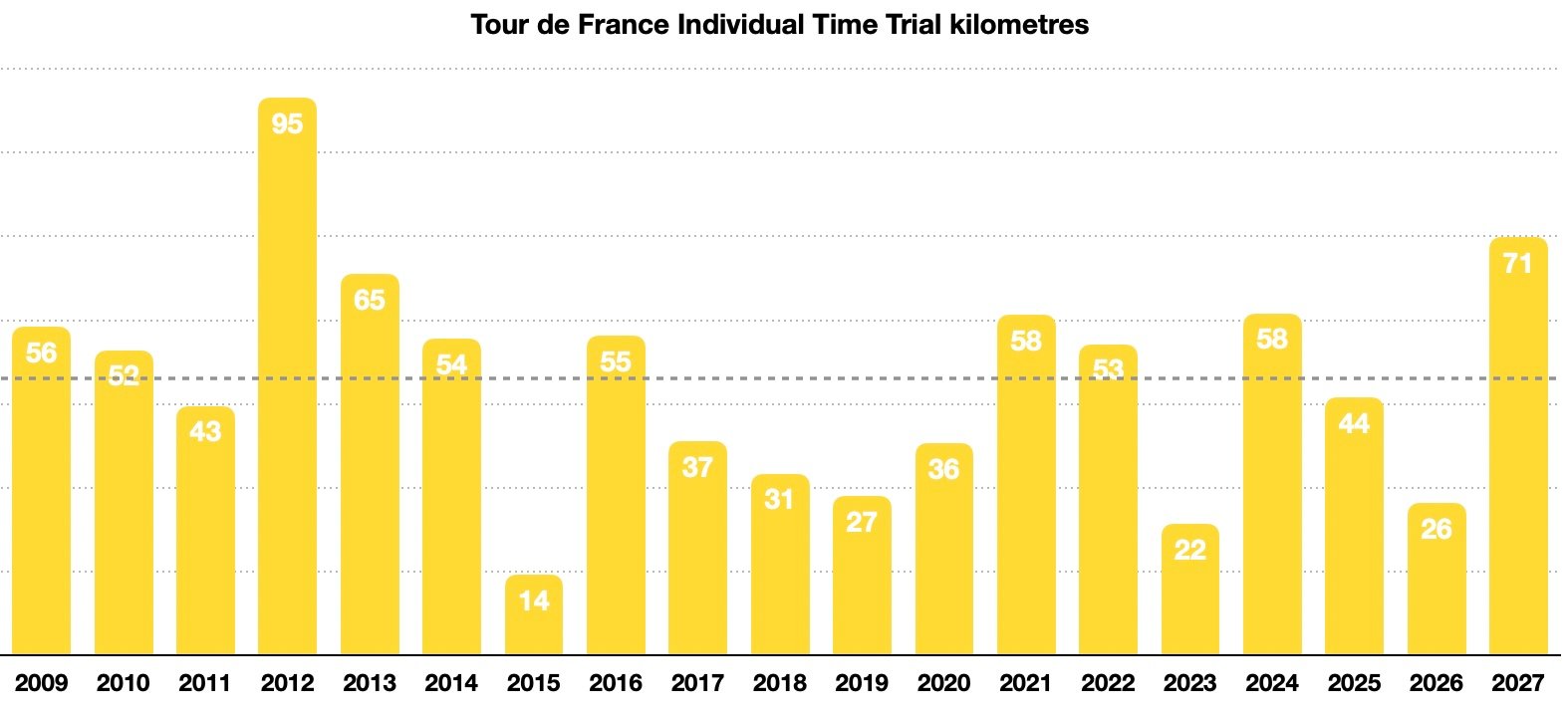
The most solo kilometres since 2012 and as the chart shows, above average but not exceptional. Where the difference comes is the manner, 2027’s vintage is – with the brief exception of Pech David – all flat, these are TT stages that will appeal as much to Filippo Ganna and Josh Tarling as to Tadej Pogačar and Paul Seixas while Remco Evenepoel will be licking his lips at the possibility of stage wins and time gains, if he can take a second per kilometre on Pogačar in last summer’s Evian-Thonon TT and two seconds, then he ought to be able to take more on flat courses and profit from the 71km.
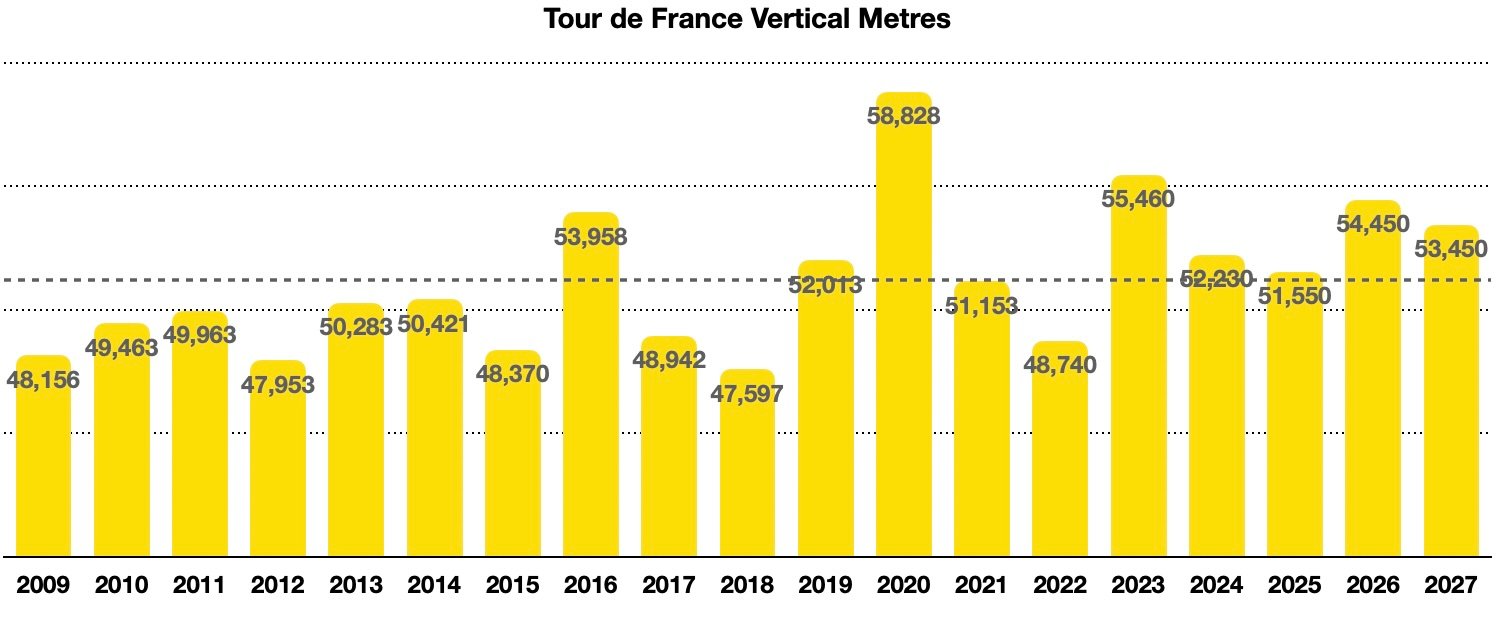
This chart says it’s not actually a flatter Tour at all, 53,450 metres of vertical gain is well above average for the Christian Prudhomme era. But again it’s the details within the stages that count, plenty of climbing in 2027 but far fewer set-piece mountain stages with summit finishes.

The Verdict
A vanilla route even if the Tour is rarely plain given the quality of riders and intensity of racing. The 2027 edition doesn’t have any wow factors, no cobbles nor gravel and little novelty either, no “new” mountains. Visiting the Basque Pyrenees is enticing because it’s rare rather than new, likewise tackling Mont Aigoual. Instead it’s defined by fewer summit finishes and more time trial kilometres. Will this make the race closer? To wonder which rider it suits the feels like a dead end given Tadej Pogačar’s record of five wins but if the Tour presentation gives us embers to keep burning during the dark winter nights, one of the brightest flames must be for Remco Evenepoel who now has three weeks in July with a route that flickers with a yellow flame.
This post looks into the men’s route, a follow-up doing the same for the women’s route will appear soon.
Great review. I wish there were more famous climbs. People will say the route was designed to disadvantage Tadej but I doubt that will matter.
It’s hard to realistically create route to trouble Pogačar, especially as he and his team can react to the route, for example going harder for the earlier stages and the 10 second time bonus which have already been confirmed by the way. Still it’s now possible to see a path to yellow for Evenepoel in Chambord, then to see what he can do with Toulouse.
With the post being long and about the Tour, I didn’t mention it above but the Giro route sounds similar: more time trials, fewer mountains which sounded like an appeal to Evenepoel. He might fancy both but this edition of the Tour has to appeal.
@Inner Ring, it’s a good thing that the Tour and Giro are trying to make the races more competitive, would you agree?
It sounds like a good thing but hard to know, is easing off the climbs and adding more TTs going to change the result? Or just keep things closer? Possibly the latter.
I think the excitement comes if Evenepoel can avoid trouble until the first TT and then get a head start. Then he might well lose ground in the Alps only to take it back before the Pyrenees which sets things up for a close finish. A lot to ask for but not an outrageous scenario either.
And there are not many big mountain top finishes for Remco to lose time on. This might make the hilly stages more of a scrap.
Tdf Hommes first… Would agree that this route seems made to minimise differences. Of course the status quo could still apply, riders make the racing etc etc. But on paper this seems to lean slightly into Remco and Seixas’ strengths, sort of neutral for Pog, and poses an interesting question for Jonas (who has put together a handy time or two in the past). We can hope to see a tight race for the podium.
UK roads are different to French roads and I do think that these stages, which seem relatively benign on paper, may race a bit differently. Weird crown and camber changes, messy verges, grippy surfaces and general pressure in the peloton may see some early chaos.
Now a note on the TdF Femmes route – that London TTT stage is going to be sensational to look at. A real block buster and should be just the shop window the race needs in the UK. The other stages are well conceived, too.
In response to JV.
The women’s race isn’t available to watch in the UK unless you pay £34 a month. The men’s only had highlights on free-to-air TV. Not much of a shop window when you can only see it when standing in front of a shop window as the race comes past.
One wonders if it’ll make Pogacar will spend a bit more time on his TT bike this winter…
Pogacar’s number one aim next season is probably (definitely) Paris-Roubaix, so he might well come in a bit meatier and more powerful on the flat. He probably has minutes per kilometre to give away on climbs in his current condition!
Fewer mountain… maybe relative to the Giro high standards? *Six* real uphill finishes on serious climbs (not just short walls) are expected including Zoncolan and a couple of new pretty long climbs with sustained double digit gradients. Then they speak of a Mortirolo-Gavia-Mortirolo stage which wouldn’t be an uphill finish so would add up to the previously named.
All to be confirmed, of course.
He would be nuts to attempt both. This route likely represents his one and only chance of wearing yellow in Paris. And even that is a slim chance because Pog will no doubt up his already elite ITT game for it.
Totally so, especially as according to my sources (which could well be wrong, as I read here different insights) the Giro despite a couple of good ITTs should be a mountainous matter.
He tends to back himself and so the Tour has be alluring, he made a breakthrough of sorts last summer and so if he can find a bit more… we’ll see.
Equally he was dropped on the Tourmalet, then on the road to Le Lioran and then held on the Alps by which time Pogačar was looking around for Del Toro and he finished six minutes down so the TT vs mountain finish exchange rate is still a tricky one, he can gain a minute in the TT but equally lose this in a summit finish or more.
The Giro should be mountainous but is meant to be more open for longer. We’ll see and the good thing is the route is out very soon when in recent years its been December/January even if teams have been briefed on the outline before to help them plan ahead.
Delays in recent years were mainly due to the well-known political reasons, be it at home or in the country of the foreign start.
Normally they aren’t as careless with the Giro as with, say, Lombardia – or other races RCS treats even worse as minor affairs.
That said, the Giro will surely be “more open” in that it’s got a heavy-loaded third week, but the second is also serious and the first has got a minimum of 2 mountain-top finishes where the TDF is having just one. The latter is going to be more decisive than any of the former, but those two combined might have a similar impact at least, with ~900-1,000 m of altitude gain each.
The first two weeks of the two races should be quite similar, really (unless the Giro adds up more tricky middle mountain stages), the Giro breaking away in a league of its own for the third week.
Then, of course, we’ve sometimes seen Blockhaus climbed up without any fierce selection or the Tourmalet shaping the race tens of kms from the finish, so it’s obviously up to the competitors.
I suppose if it’s bad for him (and you’re right it probably isn’t) it’s double bad for Jonas. I wonder what they are thinking at Visma?
@Andrew. Yes, not sure what Visma and Vinny are going to make of this route, especially as his ITT skills recently haven’t been right up there like they once were. I would suggest that another go at the Giro-Tour double could be on the cards but I suspect all he really wants is one more yellow jersey before he retires.
Would Vingegaard also be interested in winning Romandie and Suisse, the only two big one-week stage races he has not yet won? He would find it difficult to combine them with a Giro-Tour double. It is for this reason I actually anticipated he might do Romandie–Suisse–Tour–Vuelta this year. Speculation on my part obviously, since I don’t have any real knowledge on this.
It’s tricky for Vingegaard and especially the team. If he goes all in there’s a good chance he can finish second and who knows, if Pogačar makes a mistake then he wins. But what does the team do? Is Wout van Aert unleashed for the first week or is repeating his glory days too much, but if so do the team bring Brennan and so fewer resources for Vingegaard?
Oh yeah, I’d forgotten about Brennan. Tricky indeed. Maybe they could sell him on the Giro? I’m sure he’ll want the Tour sooner rather than later. He must be high on Ineos’ letter to Santa
At the Vuelta he was already talking about the Tour and we can see why. Nice problems to have for Visma but other teams have similar issues.
Surely this is Remco Evenepoel’s big chance, most TT since Bradley Wiggins won, he is no slouch in the classics types stages either. Do wonder if higher likelyhood of contested finishes = more crashes?. Never my favourite when the route avoids the high mountains especially if the Giro is doing the same
The first week could be stressful without the GC stages we got so early this year which helped the field; as the did the informal plan of several riders to sit up on sprint stages but the hilly finishes won’t see many sit up, they’ll have to contest the finish.
I guess that they decided to copy that page from the Vuelta handbook “how to prevent Pogi win your GT”… just have him crashing out.
I don’t think the Giro will avoid the high mountains, unless Hansen & friends say so on the day.
The final 20k of stage 3 is basically the same as the final stage of the 2025 Tour of Britain, when Kooij won from a reduced group. They also used the Caerphilly climb twice a couple of years earlier, an excellent stage won by Carlos Rodriguez.
They don’t seem to have many of the celebrity climbs, wonder if they’re being held back for the 125th anniversary edition the following year?
The famous climbs have also been used up recently, Ventoux, Alpe d’Huez etc and the race can’t go every year. But more for the anniversary edition makes sense.
Has the Tour ever gone through the Alps before the Pyrenees? And how might this affect the outcome?
Yes, many many times. Most recently in 2021 & 2022.
Typically when the TDF really looked more like a Grand Boucle they more or less alternated clockwise and the other way around hence having on one edition the Alps as the first mountain range to be tackled, then the Pyreneed and the contrary at the following edition.
Could be wrong but from the race calendar itself 14th July should be a Wednesday not Saturday (or I simply didn’t get a joke).
Oui, un mercredi, That’s why there probably will not be an extended party on stage 11. (I guess inrng meant to write “It’s on 14 July, aka Bastille day but *not* a Saturday so…”
Quite right, got Stage 14 and 14 July mixed up it seems.
“means talk of heatwaves and forest fires will be unlikely.”
2 big grass fires in 3 months last Summer in Edinburgh, so hope spectators are careful.
Is “Remco freindly” the same as “Seixas friendly” or would the Frenchman need more climbs?
If Seixas’ timetrialing is on the same level vis-à-vis Remco as it was in Montreal, he won’t need more or different kind of climbs. And if he continues to develop, he could so much time against not only Vingegaard but also against Pogacar himself that the latter couldn’t race too defensively.
Vingegaard’s chances lie in that both Remco and Seixas will have on catastrophically weak day in the mountains and that Pogacar falls ill or suddenly becomes an old man sportswise.
For me, I think if Vingegaard can limit his loses in the time trials to 2 minutes to Remco and Seixas then he will be able to get the time back on the mountain stages. More than that, and he will be in trouble.
Reasonable.
Even barring the magical 2022-2023 seasons (and obviously also uphill TTs or those with some serious climbing factor), in the past he’d been able to limit his losses to the best TTers within 1.5″/km but he’s also often been losing as much as 2.5″/km especially on flatter terrain, which gives us a range of total 1’45” to 3′ lost across the two ITTs as a realistic perspective.
@John I think 2 minutes is pushing it for Vinny now, especially in Seixas’ case. Maybe 60-75 seconds.
With many, many, many a caveat…
(Paul 1yr stronger, Jonas 1yr older in 2027 / two hard stages at the end of three hard weeks last Tour, a milder one next year / race dynamics mattered a lot in the case I’ll name / and much more)
…yet, Seixas lost 4’37” to *Lenny Martinez* just in the two Alpe 2026 stages.
(Or nearly two minutes to Del Toro, nearly three minutes to Remco etc.)
Seixas ended up totally on par with, ahem, Skjelmose!
The third week of a GT can be a different world, even if ASO did what they could to reduce it to a single challenging mountain stage (and on Thursday) for 2027.
@KevinR.
You may very well be right. In which case it will be an interesting battle when we see Vingegaard needing to attack quite early in the mountains to get back a lot of time. If that happens, I guess ASO will feel the course design has been a success.
Listening to RMC’s podcast they discussed how cold it would be and at one point evoking nearby icebergs for the Edinburgh start. Like much of the podcast it’s lively and prone to exaggeration 😉
For me Remco-friendly comes from all the flat kilometres, he can pull out a lot of time. The Evian-Thonon TT in the Tour was properly hilly and he won it by 30s but he has more of a relative advantage over Pogačar on the flat, and even more on Vingegaard. Seixas probably too. Assume he can take 1s per kilometre and 71s is not a big margin, but if he can take 1.5-2s then it’s interesting. There’s a lot to think about, especially as he’ll lose weight for the Tour to the point of losing some power on the flat too so to be competitive in the mountains he might have to sacrifice something on the flat?
There’s talk Seixas could do the Giro, but obviously his team and many want to see him back at the Tour. The thing he really wants next year is the worlds on the Sallanches course and finding the best path to this is a factor, does it mean specific preparation; or is banking the Tour and then tapering off and back on the right way? That’s what his coach will be thinking about now.
Totally agreed re: the Worlds.
Course-wise, the TDF is much more suited than the Giro and I guess several are already hoping he can win on a route which looks pretty much tailored for him, including not being that demanding in terms of hard rock fondo, which had he coming up a bit short this year (relatively so, of course, and that was totally predictable because of his age, apart of still being exceptionally good as a performance).
The Giro could suit more as an experience and might be an opportunity to win despite the course because of some expected lack of competition.
If I was Vingo or Lenny or Onley, Del Toro, Gall, Lipowitz… I’d go to the Giro. But of course their teams will probably decide otherwise, and understandably so.
I’m thinking the Giro is going to be a battle of the “other guys,” as the Tour podium is going to be as open as we have seen for a while. Barring misfortune, it’s been years when we pretty much expected a 1-2 of Pog and Vingo. In 2027 I fully expect Pog to dominate again, since Remco has never shown that he can climb with him, but the other two podium spots are going to be a fight to watch indeed. I expect Vingo, Remco and Seixas to be completely focused on that battle, which would mean that none of them show up for the Giro.
If it really was the battle of “the other guys”, it would be a luxury startlist, as in “no room to dream for anyone else with Pogi, Remco, Vingo and Seixas at the TDF”.
Fighting harder than ever for 5th at the very very most? Not being on camera even, as you’d be third group at best?
That’s why I wrote that was I any of the *other* teams, or some athletes even (Del Toro), I’d go for a Giro which isn’t “sold out” 9 months before.
But we all know it doesn’t work like that, even under the worst conditions.
That’s why although I believe the Giro could be the more rational sporting option for “most of the others”, it will end up being the “battle of the *other* others”…
:-/
UAE would be crazy if they don’t send Del Toro to the Giro. I agree with you that a lot of the “other guys” will be battling for seventh place at the Tour, which is one approach, I guess. If I understand you properly, I think I totally agree. It should be a great year to go to the Giro for the less superhuman humans.
I see Prudhomme has said that the more TT-kms was as much about Remco as Seixas,
“With time trials, when the same riders gain time both in the mountains and against the clock, you don’t feel inclined to increase the amount of time trialling because you end up with the same result,” Prudhomme explained. “But now we have a rider who has dominated time trialling for years, Remco Evenepoel. There is also Paul Seixas, who is very good in that discipline.”
There were a *lot* of wildfires this summer in the parts of mid and south Wales that stage 3 runs through, especially round the area of “Cote de Maerdy”. There’s plenty of peat in the uplands there, so it was pretty constant for July and August.
Yes came here to make that point (light heartedly obviously). Fire in Edinburgh during the tour last year! Climate change is here. BBC News – https://www.bbc.co.uk/news/articles/cqx783eq89qo
Fire crews extinguish blaze at Arthur’s Seat in Edinburgh – BBC News
This is almost a Wiggins tribute tour, intentionally or not. Plenty of TTs, relatively few summit finishes and a stage over Waddington Fell where in his Tour focussed years he did a lot of training. As did I incidentally, though the Tour organisers may be less aware of that.
Very cute!
Am I allowed to say that they will all ne going flat out!
The 2026 Tour was really weird once Vingo was out, with Pog being able to turn super domestique and the young stars not quite able to make the moves in the late stages. I expect the 2027 Tour to be much more competitive in the latter stages, especially with potentially better climbers needing to make up time on Remco. I don’t expect Pog to be bothered, but the battle for the other two podium spots looks pretty exciting. I wouldn’t be surprised to see Vingo off the podium, but I also wouldn’t be surprised if he ends up five minutes ahead of third place. It will be fascinating to see if Seixas has taken the next step.
I like vanilla and this course: can’t have Planche / Ventoux / Huez every year!
It’s also more or less a boucle, touching on 4 points of the hexagon, which hasn’t been the case for a while.
I also like Vannes, a gritty Britty seaside town, probably named for its locks and their gates, although the locals will surely insult you if you think araignée on the menu is a spider 😉
The sort of course where a sprinter who can climb could do very well. Brennan. But will he even get to start with Visma likely to field a GC-oriented team?
I think Brennan was saying he wants to be there and after his Vuelta it’ll be hard to leave him out. His quote wasn’t insistent.
Any suggestions for which stage/stages to go see please?
It’s a very open question, do you want to see the race, the riders, with family or solo, cycling, by car? Willing to go even if it’s raining?
The general advice here is to treat going to see the Tour in the countryside as a day’s picnic because seeing the race go by can be almost incidental even if it is still the high point.
For next year the lacets (hairpins) of the Grand Colombier are great as in the right place you can see the valley floor below and the terrain all around, even to be able to see the peloton approaching from afar. Domancy two stages later gives you a chance to see the race twice and relatively easy access. The Col du Pré could be hard to reach but has some very scenic spots where you can see the riders coming several hairpins below.
The Toulouse TT should be good and the Pech David climb the focal point to see them going a bit slower. Hasparren in the Pyrenees would make a good base for riding although some of the roads are uncommonly steep.
Some general tips at https://inrng.com/2024/07/tour-de-france-roadside-tips/
It’s nice to see an homage to Krabbé, 50 yrs after the race related in The Rider.
Since Inring likes local trivia – i believe Burdinkurutcheta means Iron cross, Croix de fer, in basque.
The Rider tribute will be good, the book is worth re-reading as it’s not about the conclusion. And if anyone hasn’t read it, Krabbé’s novel is enjoyable, the English translation (and there are other versions) is full of light prose.
But on the day a lot of the media will focus on the Col de Perjuret where Roger Rivière crashed and his career ended. The race will pass the small memorial to him.
As for Basque it’s good to know now. Watching reasons via VPN and most languages are ok but EITB in April for Itzulia feels impenetrable.
I still think they ought to start stage four on a landing ship from Britain and ride up one of the D-Day beaches.