

The 2026 season has finished and here is a look at the UCI rankings for the year. There’s the three year promotion and relegation contest to note. More immediately we can see which teams are eligible for invites to the major races next year, assuming they’re viable.
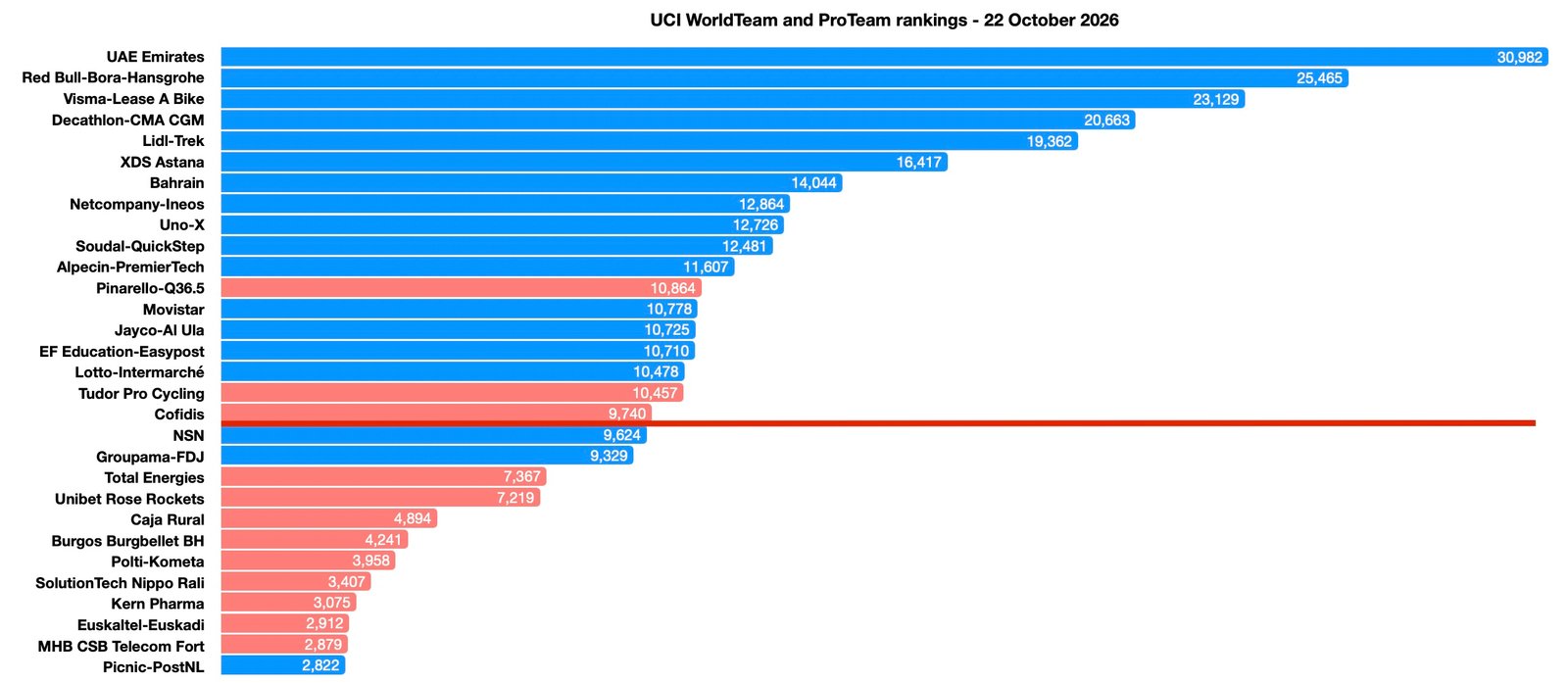
The chart shows the top-30 teams, blue are the 18 WorldTeams, red are the second-tier ProTeams.
UAE lead the rankings for the fourth straight year while Red Bull are second, a big gain from sixth last year and with help from Remco Evenepoel and his score of over 7,000 points. Visma-Lease a Bike slip to third, the first time outside the top two since 2021 and are set to go into 2027 as Team Yellow B, the name of the legal entity behind them as there’s no news on a search for a replacement title sponsor yet but they’re undewritten by Dutch billionaire Robert van der Wallen.
Decathlon-CMA CGM are up from seventh to fourth, in part thanks to their nouveau riche status but signing Olav Kooij on a mega contract has only brought 1,600 points after he resumed racing mid-season; Felix Gall delivered double that and Tobias Lund delivered more points than Kooij too, all while Paul Seixas is their obvious big scorer but not yet their big earner as contract talks continue.
Elsewhere Lidl-Trek are a flop in fifth, this is visible in the rankings but see the internation ructions with management this year and the shopping spree they’ve been on lately. XDS-Astana played the system well last year to stay in the top flight and have kept this up.
Netcompany-Ineos finish the season in eighth, their worst position since… well last year when they were eighth too which was their lowest since the UCI team rankings started a decade go.

Uno-X have done well. 11th last year was impressive and gave them just enough points to pip Cofidis for the World Tour but this late promotion could have overwhelmed them. Instead they’ve finished 9th and got some high profile wins, built a foundation to secure them in the coming seasons and all retaining an underdog image.
Alpecin-PremierTech finish 11th. Their top scorer is… Jasper Philipsen who scored 3,665 points compared to 3,404 for Mathieu van der Poel. The pair earned two thirds of the team’s points.
Next come a bunch of teams with little more than a thousand points between Pinarello and NSN. Movistar owe plenty to Enric Mas who got a quarter of their haul thanks to his Vuelta a España win but also second in Lombardia and more. Kudos if you can know their second-best scorer, it’s Natnael Tesfatsion. EF were lingering in 21st place at times during the year but have moved up only they lose Richard Carapaz and clearly the search for a replacement title sponsor has yet to find one, perilous but Jayco only have one year’s funding from sugardaddy Gerry Ryan to bank on so they’re arguably in even more need of something and a reminder that while these rankings look back at 2026 we need to see the teams as much for what is coming next.

Promotion-relegation
The red line sits between 18th and 19th place and marks the promotion and relegation zone but we’ve just finished the first year of the 2026-2028 cycle. Pinarello-Q36.6 and Tudor look set to join the World Tour for 2029 especially as they’ve made strong signings for next year so ought to score more. NSN will hope that signing Richard Carapaz gives them a boost.
Groupama-FDJ are in trouble but only 500 points adrift, so trouble rather than doom. Saying it’s only one year and there’s time to turn things around may prove comforting but there’s little to suggest they can reverse the trend. Romain Grégoire is a big scorer for them and so they’re at risk if he is injured in the spring; they’ve lost big names like Stefan Küng and Valentin Madouas but the budget has not been deployed on big scorers, much of it gobbled up by contract inflation.
Auto Invites
Assuming 18 teams in the World Tour then under rule 2.1.007 bis the best three teams outside the World Tour get automatic invitations to World Tour stage races and one day events: this is Pinarello-Q36.5, Tudor and Cofidis. These are elective, for example this year Cofidis could have ridden the Giro but declined. But team management has said it intends to do the Giro in 2027, both title sponsor Cofidis and their equipment suppliers all have business interests there.
Wildcards
Under the same UCI rule there are two wildcard invites for a grand tour next year, as long as it makes the top-30 in this year’s final rankings. Alas Bardiani-CSF slipped to 31st at the last minute so a Giro d’Italia without the green-clad squad looks likely for the first time since 2012. Organisers RCS will likely pick among Unibet Rose Rockets, Polti-Kometa, SolutionTech-Nippo-Rali and MHB CSB Telecom Fort. However we shall have to see for the viability of these candidates, Polti may have stopped as a sponsor; Telecom Fort too and so on. RCS doesn’t have to decide yet.
Vuelta a España organisers Unipublic have tended to rotate among the Spanish teams and thanks to some eleventh hour wins in Panama last weekend, Euskaltel-Euskadi move up to 28th place and look likely to get an invite, given Mikel Landa as a their new signing. Caja Rural sat out this year’s Vuelta so could start especially as 27th placed Kern Pharma is stopping. But Burgos-Burpellet-BH have been bolstering their squad.
Which teams go to the Tour de France? Total Energies may not survive, more on this below. Unibet Rose Rockets could be a pick especially if they can say “no thanks” to the Giro to better save themselves for July but they don’t have a must-have roster and their selling point of being strong on social media is no asset given the Tour hardly needs a boost here but in the past Christian Prudhomme has used the UCI rankings as a yardstick, it was cited as one reason why Caja Rural got invited this year instead of the Rockets and if so then the Franco-Dutch team qualifies. Burgos-Burpellet-BH have signed French riders from the Total Energies exodus but the Tour is a big ask.

UCI Licence Review
Made sense of it all so far? It’s not certain that the teams cited above are all licenced for 2027. Yesterday evening the UCI published the list of teams applying for next season and there was a gap between the number of teams applying and the amount listed in the press release. Jayco and Picnic-PostNL were missing from the World Tour teams; TotalEnergies absent among the ProTeams. It happens, teams may not be able to send every document ahead of the 15 October deadline and have until December to fix this. We know Jayco’s finances are tight and Picnic-PostNL are struggling on several fronts; the Dutch team got a warning last year from the governing body about its viability already.
Total Energies is the one that looks in real trouble. We know the French oil major is stopping sponsorship having pivoted to fund Netcompany-Ineos. Team founder Jean-René Bernaudeau has talked a good game lately saying he’s lodged a wage guarantee and other paperwork with the UCI but what’s missing is a title sponsor contract. Only this is fundamental to the team’s future. It’s here there’s a Catch-22 scenario because the team is eligible to for a Tour de France wildcard if they can find a main sponsor to keep the show on the road. But this may not be sufficient, if the roster is weak then ASO may just prefer another team. But there’s a prize awaiting: a viable title sponsor, a couple of signings and it’s bonjour to the Tour for 2027 and beyond. This is appealing but these deals typically take years or months to land and there are only weeks left.

Conclusion
These rankings can tell us which teams had a good season or not but they’re also used for next year and beyond. Pinarello-Q36.5 and Tudor are looking like World Tour teams already, their signings for next year consolidate this and they can and will race all the major events in 2027.
Outside of the World Tour there’s a tricky game of musical chairs where only a few surviving teams compete for the places left. If Euskaltel-Euskadi get to ride the Vuelta next year then Gotzon Martín’s win last weekend in the 2.2 Clásica Provincia de Chiriquí helped deliver this, arguably more than signing Mikel Landa even if more of the team’s late-season haul came from scoring in Binche-Chimay-Binche and the Tour de Vendée rather than Panama or the Hong Kong Cyclothon. If teams are trying to game the system and going to far-flung places, well it’s not a bad outcome to populate smaller races as a way of attending the bigger ones.
All teams face two races, the one to win events, land results, earn publicity and with this to get the points they need whether to top the table or qualify for races or the World Tour. The second race is existential, to be a viable team and to stay on the road. Here the promotion and relegation race ahead is fraught because some teams racing this year will no longer be around by 2029 or perhaps earlier.
I know a bit has been released in the news already on Jayco although i am not sure how much. My inside info on Jayco was that a month or so back an agreement was made to sell 80% of the team to a new backer from the wannabe dictatorship of the USA. No idea who or how much money they have. It does seem to have come a bit late in the season to hold onto some of their best riders. They have only announced some young riders and Simon Wellsford although i gather some of the new riders are well regarded.
I guess there’s still time to announce some big signings a guess but if not M matthews will need a season not derailed by a major incident or their points will go backwards.
“ Vuelta a España organisers Unibet” – just fyi
The Vuelta will (almost surely) invite two teams who are doing the Spanish circuit, which the Unibet Rockets don’t do. All the grand tours understand they have a responsibility to support their domestic cycling teams, and that the Pro-Teams riding their domestic circuit need to get the invite to attract sponsors.
Fixed earlier, thanks.
The Greenedge project you suggest sounds alarmingly like the Manuela Fundacion debacle. I hope not and Ryan deserves better for his input over the years.
Despite the current allegations Picnic merits success too.
Normally I would agree re: Picnic, but they have been so awful on a number of fronts that I’m finding it hard to root for them. It’s a lot harder to root for the underdog when the underdog seems to be a bit of a pr*ck.
on them today it was reported that a bankruptcy is severely threathening their bicycle sponsor right now. that team has now sailed through the dire straits deep into shit creek.
Apparently it’s just a bank transfer for Jayco so hopefully it’s sorted but they do face a race to find a replacement sponsor by this time next year; given EF and Visma have been trying and it hasn’t worked (EF has lost Oatly for its women’s team) it’s a tough time.
Same as every year – attempting to transfer any more than $10,000 from Australia to a Swiss bank triggers an automatic hold for anti money laundering and counter terrorism investigators to give it the all clear.
I know it’s not always a popular opinion, but I love the points ranking. It’s great to see what Astana have been able to accomplish, and Tudor and Q36.5 are showing that they belong in the big races as well. The legacy teams that don’t seem to care about staying competitive (I’m looking at you, Groupama) deserve to be sweating. All that said, I’m happy and relieved that Euskaltel was able to game their way into eligibility for the Vuelta. Can’t wait to see Landa back in the orange.
It’s a niche thing, something this blog can dissect but you don’t see much widespread coverage of it all, partly because it doesn’t matter to most teams and riders; but it has a big impact on those that do.
The Cycling Podcast guys have been chatting it up a bit. They note that points-per-race-day is a nifty metric, on which Remco is off the charts.
Evenepoel did well but has 54 days and 7k points but Pogačar is 9k and 45 days.
I don’t think it is fair to say that “XDS-Astana played the system well last year […] and have kept this up”. To me, they have redeemed themselves as a genuine World Tour team this season. Yes, they have continued to send strong squads to races where the competition is weak, but they have also been towards the front in many big races, and they did very well at Paris-Nice and the Giro.
If you look at their results from 2025 and 2026 they’re quite similar; 32 wins in each year plenty of wins in Asia and only a handful of World Tour wins but five this year compared to two last year some more quality as you say… but how much is luck, eg Kanter’s win in Paris-Nice? Guillermo Silva has been a breakthrough signing for them, their second top points scorer behind Scaroni.
One thing you can say about Astana is they are at least visible. There may be some slight recency bias given that Scaroni in particular and also Ulissi were strong in the end of season races. But they also had a good Giro. Working within the constraints of not having Pogacar, Van der Poel, Van Aert, Evenepoel, Vingegaard, Del Toro or Seixas ride for them they do reasonably well. Whereas you can go whole chunks of the season and forget that quite a few of the teams exist, such as Picnic, Groupama and NSN.
Tour Wildcards:
Personally I would be surprised if Total (under a new name) did not get the Tour invite, as long as they are still around as a Pro-Tour team. But I think there is an interesting question about whether the Unibet Rockets will get the other invitation.
While, in terms of UCI points, the Rockets are by far the strongest of the eligible Pro-Teams, it is unclear what exactly they would contribute to the race. They are really a “sprint and Belgian classics” team, and the Tour has little interest in having another sprint team. The Unibet Rockets barely ride week-long stage races, and at the Giro did not really participate in the breakaways (normally a key responsibility of invited teams). And Unibet Rockets don’t seem to be very amenable to changing their focus (e.g. helping the Tour by going into the breakaway on flat stages) in return for getting the invite.
Good take, indeed!
Maybe the route might also factor in, as it seems from the usual attempts of forecast that there’s going to be a lot of not-GC stages, although – as only arrival and departure towns are being disclosed – it’s to be seen if they’ll be more favourable to bunch sprints or rather Classics-like.
Out of curiosity rather than out of pedantry, but are these really the final rankings? At UCI.org the only published rankings are still dated 13/10/2026. Normally they are updated every tuesday but it seems they haven’t this week? A lot of races still finished last weekend so hundreds of points still to be added to the tallies of some teams in case these aren’t the final scores.
Several sites have taken the last published UCI rankings and have added the points scored in the races since. However, these sites do not always fully account for penalties issued against riders and teams (for things like littering). So until the UCI makes it official, there could be small and minor revisions to the final scores.
The rankings briefly appeared then went I think. I used a synthetic version for the season-end above with “20 October” in the chart title but have updated with the official UCI version that is online right now with the title “22 October”. There are some differences, eg NSN lose 90 points was the biggest change, but no movement on the table.
Movistar’s Vuelta victory is the only GT win which didn’t go to an oligarchy of 4-5 überrich superteams since the UCI team point ranking is at work, i.e. in the last seven seasons (and close to a duopoly in terms of win distribution – Visma 9/21, UAE 6/21, Red Bull 2/21, Ineos 2/21, Quickstep 1/21).
(We could debate about Quickstep actually being a superteam in 2022 but their results in the couple of years before and after that are a strong evidence to argue that, yes, they still were then).
Interestingly enough, Movistar had one of the best ratios between budget and GT success also in the previous era, the Sky near-monopoly (mainly such in terms of differential economic and political power). In the nine 2011-2019 seasons, if I recall it right, some 9-10 teams apart from Sky (which won 9-10 GTs) could win a GT. Some were then big teams with a decent financial firepower like Astana or Saxo-Tinkoff, both able to win 3 or 4 GTs, other were small ones like Orica or Lotto or Garmin and just won once each, but Movistar was the only team with some moderate pockets able to win multiple GTs (3).
Some specific team culture must be active within the team, despite overwhelming monetary pressure by bigger teams and their “old style” approach.
Movistar’s win still seems accidental. Before Mas was matching Pogačar in the first week they were keen to help Uijtdebroeks to the point of having a team car by his side but not one in the group covering Mas. So if Mas had punctured or had some other problem he could have lost minutes etc. But once he took the lead they rallied around him and improved.
Of course, but good and bad luck do balance each other in the long term. Gall’s attitude and Decathlon’s quite poor team strategies despite great athletical conditions was what prevented them to be the ones “taking advantage of good luck”.
On the contrary, Movistar repeatedy played great tactics to keep a complicated race under control with a weak team, and helped a relatively fragile leader to stay steady, unlike what Sunweb could do in the 2020 Giro or UAE with Del Toro recently, yet being offensive when needed, what Jumbo didn’t with Rogla at the 2020 TDF, or Ineos with Thomas at the Giro etc.
“Accidental” win in GTs can indeed happen but quite rarely so and it’s more often about a biased perspective by the spectators.
That’s an interesting point and one I hadn’t thought of. Once Pogi was out Mas looked like the strongest rider in the race, but so did Del Toro when Visma picked his pocket in the Giro. Movistar didn’t put a foot wrong once they had the lead. Some good old-school racing, not just trying to bludgeon the rest of the teams with athletic superiority.
I wonder if this was the last year where the top 30 ranking still made some sense, given that there will barely be any teams that try to reach the top 30.
Regarding Picnic-PostNL, would their extremely poor performance play any role in deciding on their WT license for 2027 and 2028? Like “yeah, you tick all the boxes but with your squad [likely even worst than 2026] you have no business in the WT”?
The requirements for Picnic to have their WT license for two more years is purely financial.
The top-30 requirement for being invited to the Grand Tours was put in place at the behest of the organisers of these races to help them select which teams to invite. They wanted a way to sift through all the applications, and to be able to say no to some weak teams. [Aside, the world tour and world ranking was created in the first place as a means for the Tour de France to select teams for their race.]
Re: the last sentence. You don’t mean that first attempt that really brought to the UCI vs.ASO-RCS 2008-2010 war, do you?
I’d rather say that current WT is the result of a mediation between different interests, but the TDF as such really has no need to get help to select whom they want in their race.
No, I did not mean that. During the 1980s there was a conscious attempt by the Tour to expand the number of teams included in the race, and in particular to take teams from a wider range of countries. This went with getting the TV-highlights shown in more markets (such as Britain and the US). By the late 1980s this resulted in huge pressure by teams to be invited to the Tour, and getting into the Tour (the only internationally broadcast race) became crucial for these teams’ financial viability. As a result, from 1989 the Tour used the world rankings to determine which teams to invite. These world rankings, produced by the UCI, were initially based on the World Cup which started that year.
The World Cup was gradually (in steps) transformed into the World Tour. An important consequence of the change in 1989 was that teams hired classics specialists to race in the World Cup races and score ranking points. Before then, teams had been squads of about 10-12 riders with a single team leader, and which raced only those races which interested the team leader or their sponsor. After 1989, teams had different leaders in different races and had large enough squads to race several races simultaneously: riders became more specialized.
In 1996 the best 18 teams had automatic entry to the World Cup events; entry for the best teams became compulsory in 1999. By 2005 there was an organised “Pro-Tour” (later renamed the world tour) with a limited number of Pro-Tour teams which were supposed to race in the Pro-Tour races. A key driver of this last change is that riders and teams were dropping the big one-week stage races since they were not part of the World Cup series and this threatened the viability of these races.
Hope this explanation is not too long and boring.
Great recap but it’s a long shot to use it as an explainer for the current situation which went through some radical negotiations and conflicts.
As remembered on these pages, we’ve gone through times (the 80s themselves) when teams directly paid a good deal of money to be in the TDF, more recently smaller teams paid (indirectly) to be at the Giro, as I recalled above. It’s not a linear process, not at least the part regarding relations within the triangle UCI-ASO-teams.
But OTOH I can see the historical perspective you depict as positively providing background on the more linear process of involving a growing commercial impact and bigger companies.
It’s also worth noting that especially before 2018 RCS had no problem, either, in “sifting through applications”… in order to invite whomever was *willing to promote their own candidature* by, for instance, sponsoring other RCS races. All that, leaving home Italian teams, if needed, and sometimes stronger than those whom RCS eventually invited.
Of course, the current situation is very different from several POVs.
I liked RCS’ previous practice of reserving a space for the winner of the Italian Cup.
“the world tour and world ranking was created in the first place as a means for the Tour de France to select teams for their race”
Was it brought in to make it easier for RCS or ASO to select teams; or as a way to /remove/ ASO and RCS’ ability to make their own arbitrary selections about who to invite, and give more stability to teams – the confidence that having results above certain level would guarantee a spot at the biggest race on the planet – and hence more stability for the sport?
I had thought it was the later. My vague memory is inrng has written to that effect on articles on the WT system yonks ago?
It was introduced to enable ASO to make the selection for the Tour de France. They voluntary used the rankings, and it only became important once they started using these rankings. RCS did not try to internationalise the Giro and did not face the same pressure on team selection, so they only used the ranking system much later.
As an aside, the Giro used to be similar in status to the Tour, but the failure to internationalise the Giro and get it on TV outside Italy resulted in its relative decline. It also developed a reputation for sharp-practise in ensuring an Italian rather than a foreigner won. It is now probably too late to change this and restore the Giro to its former status.
While my memory of the reporting from 10 to 20 years ago is hazy now, I’m fairly sure it was a lot more complicated than that, and fairly sure that it involved a power struggle between the UCI and ASO as to who got to decide which teams would ride the Tour de France and other ASO races, amongst other issues. E.g., at one point in 2015 ASO was threatening to pull /all/ its races from the UCI WorldTour calendar, re-registering them as HC-status, so that ASO could _set aside_ the “Must invite all WT teams” rule and so have more power to choose teams itself. I’m fairly sure prior to the “All WTs automatically are invited to WT calendar races” rule that ASO sometimes failed to invite some top teams – but I can’t find the examples back right now (I remember it reported on inrng).
See, e.g.: https://inrng.com/2015/12/aso-vs-uci/
The ASO v UCI “war” had been going on for a good while, in part cause of UCI having tried to setup its own race management company / series (GCP) – which obviously put it in direct conflict of interest with the existing major promoters of races (ASO especially). E.g.: https://inrng.com/2012/01/aso-non-uci/
Your characterisation of why we have WorldTour rankings doesn’t really tally up with my memory of the reporting over years back then, nor with my (admittedly brief) attempt to re-read the old news of the time.
Hard for me to disagree with the past blog posts but just to say the World Tour idea was to stabilise things for teams and given them some guarantees, ie if they met the UCI criteria (which have tightened up over the years with more and more rules and protections) then they’d get a Tour start in return. This way team owners could plan and show paths for prospective sponsors.
Paul J:
There was a dispute lasting 2008 to 2010 between ASO and the UCI over which teams entered the Tour. ASO withdrew from the world tour (then called the Pro-Tour) since they wanted to exclude a team which was implicated in doping.
I described what happened in 1989, many years prior to the dispute you are describing. They are different points in time. Up to 1989, individual races could pick whichever teams they liked for their races. This changed when ASO decided to base their invitations to the Tour on the world rankings (with a few added wildcard entries). They did this because they needed a way to sort through the applications. I have merely stated that the Pro-Tour (later renamed World Tour) eventually resulted from this key decision.
InnerRing:
Yes, I completely agree with your comment about WT status providing stability to the teams in terms of guaranteed entry, although the real interest for most of the teams was entry to the Tour. The decision in 1989 by ASO to use the world rankings was the first step in the process. Just to add, the races (especially the one week stage races) also wanted compulsory entry by the WT teams to provide them with similar stability too.
Some team managers want longer term licences but we can see the problem here, you could qualify with a team based on last year’s results, sell off your best riders over winter, and line-up with a weak squad but still be eligible for years to come for participation at the top level.
Picnic aren’t in such a cynical position but some protection against this is needed. We’ll see if Poole moves to another team like Decathlon too or if they can retain him.
I thought the move by Carapaz to NSN was interesting. Vaughters has said that the budget at EF Education is down 15 percent this coming year. He can continue to operate as a world tour team, but will be among the weaker teams. He really could do with getting an additional sponsor on board.
I can see he made a rather hard-headed decision to let Carapaz go. By all accounts they could have kept him one more year (as per the contract) but decided to let him go since he is 33, and they believed they could spend the money elsewhere. Obviously, he is happy since he now has a generous multi-year contract. It is a shame since I think he was quite a good fit for EF Education, and they are one of the few teams who could manage him effectively (although professional, he struggles in a more rigid structure, by all accounts).
Carapaz, Valgren, Steinhauser, Beloki, Mihkels, Honoré, Asgreen, and Shaw are out at EF, representing ~50% of their points this year. Healy, Baudin, and Powless are really going to have to step up this year.
Exactly, and it just might work out for them since those 4 are proven talents by now but there’s no guarantee and no backstop.
Carapaz’s results tend to map when it helps to be in the shop window (human nature, for the wider picture see how teams scramble for points in Year 3 not Year 1 etc etc), it’s on NSN management now to find a way to get the best out of him in his first year, presumably a deal with big incentives for high profile success.
Can you imagine Carapaz at Picnic?
The irony if Vaughters sold out to a Hincapie and Armstrong entity and bring this thing full circle. That’s extreme speculation but Hincapie is building something with a view to having a much more US orientated squad
EF owns the team. Not Vaughters (Slipstream).
Vaughtners already sold
A follow-up comment with Polti confirming the sponsorship is ending which leaves “-Visit Malta” scrambling for a title sponsorship with weeks to go. Marca reports they’re in merger talks with Team UKYO.
You have to feel for Bardiani which might have finished 31st and so miss out on the 30th-place-or-better Giro invite but now it’s possible three teams above them vanish (Kern certainly, Total and now Polti with no sponsor news).
If all three teams vanish (and with Team Flanders Baloise disappearing), we will be down to 12 Pro-teams. I think this is a bit worrisome, and bad for the sport.
Four as you say, Flanders Baloise finish 47th. There’s meant to be a pyramid with a few teams at the top but this isn’t the case. It hasn’t seen so for a while but the base is now shrinking and so if a current World Tour team stops, there’s not many to take their place. In come Tudor and Pinarello, Cofidis seem like a fixture but then it’s tough.
Totally so, and this further example also fits with what I comment below.
What’s worth noting is that those three teams belong to countries where sponsoring a second-tier cycling team is still a great deal in mere monetary terms, if you have some specific marketing objectives (more related to brand awareness than to reinforcing a winning identity). Not many cheaper ways to get eyeballs for money.
The issue with brand awareness is that it’s intrinsically shorter term, you’re soon done, mission accomplished thanks and goodbye all; unless of course you get to step two where cycling is especially well connected to your values (think Cofidis).
I can say that it worked very well, I’d even say it worked *great*, in Italy for Eolo and in Spain for Kern Pharma, but there’s a moment when you hit a roof because the brand’s got known by all that potential public. Investing more would make sense only in order to change objectives, but the change in scale for power playing is today shocking, unlike 15-20 years ago (Polti were probably disppointed by the comparison with their previous experience).
Besides, as I often noted, there’s a socioeconomic issue in that those team managers often don’t know how to move around in the sphere of the biggest transnational companies. Which is why Ag2R had a good deal of success externalising the process… until the original management was bought out of course. Same with LIDL. The side effect often being that the new managers from the parent company have no idea about cycling and end up underperforming big time.
Total is an interesting case because they stumbled into cycling by chance (buying an already active sponsorship) but were eventually satisfied with the marketing options to the point of wanting to scale up their expectations into the “winning and powerful image” zone, not just the cheaper greenwashing and French national spirit basic package. Also, those sort of companies often want results fast, rather than building a project across 5-6 seasons. Which is far from being effective but, hey, it’s their 360° mindset (which makes them so harmful for the world but that’s a different story).
I don’t understand the advertising needs of a company like Burpellet or Safety Jogger, but it seems like those kinds of sponsorships are becoming difficult to base a team on (maybe they always were?). There appears to be a growing gap between those types of sponsors and the corporate giants like Glasenberg or CMA CGM. As John has pointed out before, the real struggles are in the Pro Team ranks, and it doesn’t seem to be getting any better. Q36.5 and Tudor are looking very strong, but they are are supported in a totally different way than most Pro teams. It will be interesting to see how this impacts the more local racing scene in European countries. In my country Modern Adventure seems to be doing well, but I don’t know how they are funded or how long it will last. Anyway, those top 30 spots are going to be vital going forward.
Safety Jogger is a Belgian company, the HQ is in Oudenaarde so very Flemish etc. It’s part of the same company that makes Patrick shoes, in cycling they used to supply Anquetil, Poulidor etc and have sponsored football players over the years. Now the Safety Jogger brand is growing and so the company half wants to have the Belgium VIP sponsoring, half the international sales kind of sponsoring deal. It works worked for Quick-Step and Soudal so both local and international so it can work but not at super team budget level.
Burpellet is a brand created in 2011 by a century-hold small, local-scale family company of lumberjacks and carpenters. They decided to use the subproduct of the woodwork to produce high quality pellet and they went on to become the number one company in Spain for this product. It’s obviously a case of brand awareness. The brand is nearly… brand new, they jumped to national scale and need to inspire trust (how d’you really know what’s within a pellet?). They now work on a national market which is ideal for a Pro Team: they’ve been racing across the country bringing the brand in different regions, and most of those race were televised, normally with a modest impact of 50-250K viewers (which isn’t bad anyway) but overcoming the million mark with the Vuelta.
OTOH, the team also had to travel across the world from Baku to Langkawi to score the points they can’t earn in those home races where the objectives is just being there and showing the jersey rather than winning or even placing high.
The team has a total budget of some 4M €. Public institutions are happy to pay some 15-20% of that to promote themselves and the territory, they always did so with this team. It had to grow from 3 to 4 M of total budget and they struggled to do so (the total number of sponsors is around 20).
The parent company of the Burpellet brand has a turnover of some 50M, smaller than some WT teams, and I guess (wild guess) might be injecting into the cycling team a couple of M. In this phase of expansion I wouldn’t be surprised by the company spending some 10 or 15% of their turnover in marketing (8% being a reasonable average in a steady situation), meaning that they’ve got some 5-7M overall to spend promoting the brand. What they spend for cycling and what they receive is a good business, I’d say.
Issues: costs of cycling go up and I doubt the sponsor could raise their game; plus, once the brand is established across the country (quite soon, as they’re already market leader) the interest in spending for “mere” brand awareness might go down (see Kern Pharma, which went through a spree of brutal growth and acquisitions doubling their turnover up to 450M in a few years… until they really don’t need the impact of a small 4M budget team, even if now it’s nearly small change for them).
Fun facts about scale…
Team Total (Ineos) = Team Burpellet BH * 15
But…
Total (company) = Burpellet * 4.000
^___^