
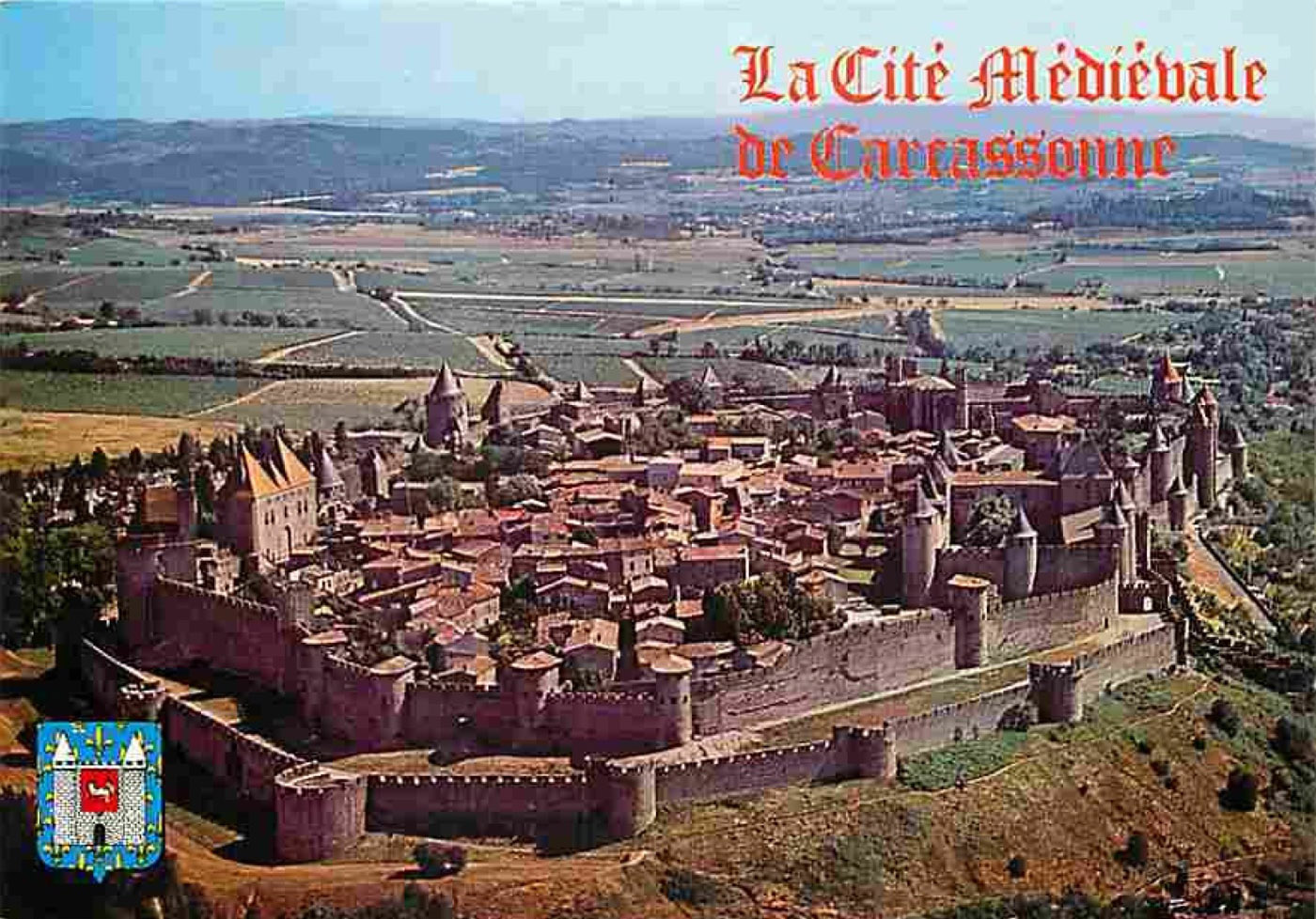
The stage starts in Carcassonne, the eighth start or finish in ten years. Tim Wellens won Stage 15 here last year. But something has changed since then.
France held local elections in March and Christophe Barthès was voted in as the new mayor. Labelled the “Trump of Occitanie” for his provocative tendencies, he is part of the far-right Rassemblement national (“National rally”, RN) party. The RN made gains in other town halls and leads in national opinion polls. It is possible their candidate becomes president of France next year.
The cycling angle is that today’s visit seems to be the first time a stage of the Tour de France is hosted by a far-right mayor. The RN, ex Front National, was founded in 1972 and it’s hard to find a precedent going back to then. If readers can crowdsource an exception it’d still be rare.
Several reasons explain this. The RN just hasn’t had many mayors until recently. Another is the towns they hold are in places infrequently visited, right in the South-East corner along the coast. But that doesn’t explain it all. Places like Toulon, Béziers and Orange ought to have hosted the race but have only seen the race traverse these bastions of the far-right.
A more complicated reason is the layers of local government above municipalities like départments and régions usually take part in the bidding and none are RN-controlled. So when Lille hosted the Tour de France start last year, Stage 2 started in Lauwin-Planque whose mayor has been centre-right Christian Poiret. He is also chief of the Douai agglomeration, a councillor and president of the Nord départment and so got to pick his Lauwin-Planque. And not the bordering town of Hénin-Beaumont which has been the electoral fiefdrom of RN president Marine Le Pen.
But what if there were other factors, a deliberate avoidance? That’s harder to prove and unlikely. Tour director Christian Prudhomme was a signatory to a letter when people France’s sports sphere cautioned against voting for the far-right in the 2017 presidential election but that’s probably as far as it goes.
Barthès inherited this stage as the hosting agreement was signed before the elections. If today is a first, it’s not going to be the last and this is where the twist comes.
The Tour might belong to the crowds by the road and broadcasters are influential customers. Local politicians are big clients too. Lately organisers ASO have moved on several things at the behest of green politicians elected in a wave at the end of the previous decade. Many had been vocal in their opposition to the race. The green party, in office in cities like Bordeaux, Rennes and Grenoble refused to host stages several times decrying the race as polluting and promoting big business.
To win over town halls the Tour’s shrunk its carbon footprint, promotes cycling as transport and celebrates biodiversity. The Tour de France Femmes happened in part because politicians denounced the men’s race as macho; yes it was the right time to launch the event but ASO had an implicit list of ready hosts for les femmes.
So what happens if the political wind is blowing in the other direction? Will the Tour change? If ecologists had been vocal against the Tour de France at times, the RN isn’t. There are swipes about too many foreign starts (“it’s not the Tour de France any more“) but the Tour could call their bluff and ask its French mayors to step in as hosts instead. Criticising the Tour is France is akin to taking a pop at kittens, cheese or summer holidays; it’s a cherished institution for many including the RN’s voter base.
The rise of the far-right isn’t exclusive to France. On the other side of the Alps we’ve seen Italians ministers deployng the Giro d’Italia to promote gentle nationalism; the new maglia rosa sponsor this year is a region run by La Lega.
Similarly it’s not far-fetched to imagine RN mayors wanting to use the Tour for their soft propaganda. Why encourage cycling over car use or show films at the start of the daily Tour coverage talking about biodiversity when you could celebrate French farm produce? What about removing TV coverage from FranceTV to reward a more RN-friendly channel?
These are all marginal changes. The Tour organisers will want to preserve their event from politics in part because this is what keeps it special. But they do bend to the priorities of mayors and their electorate.
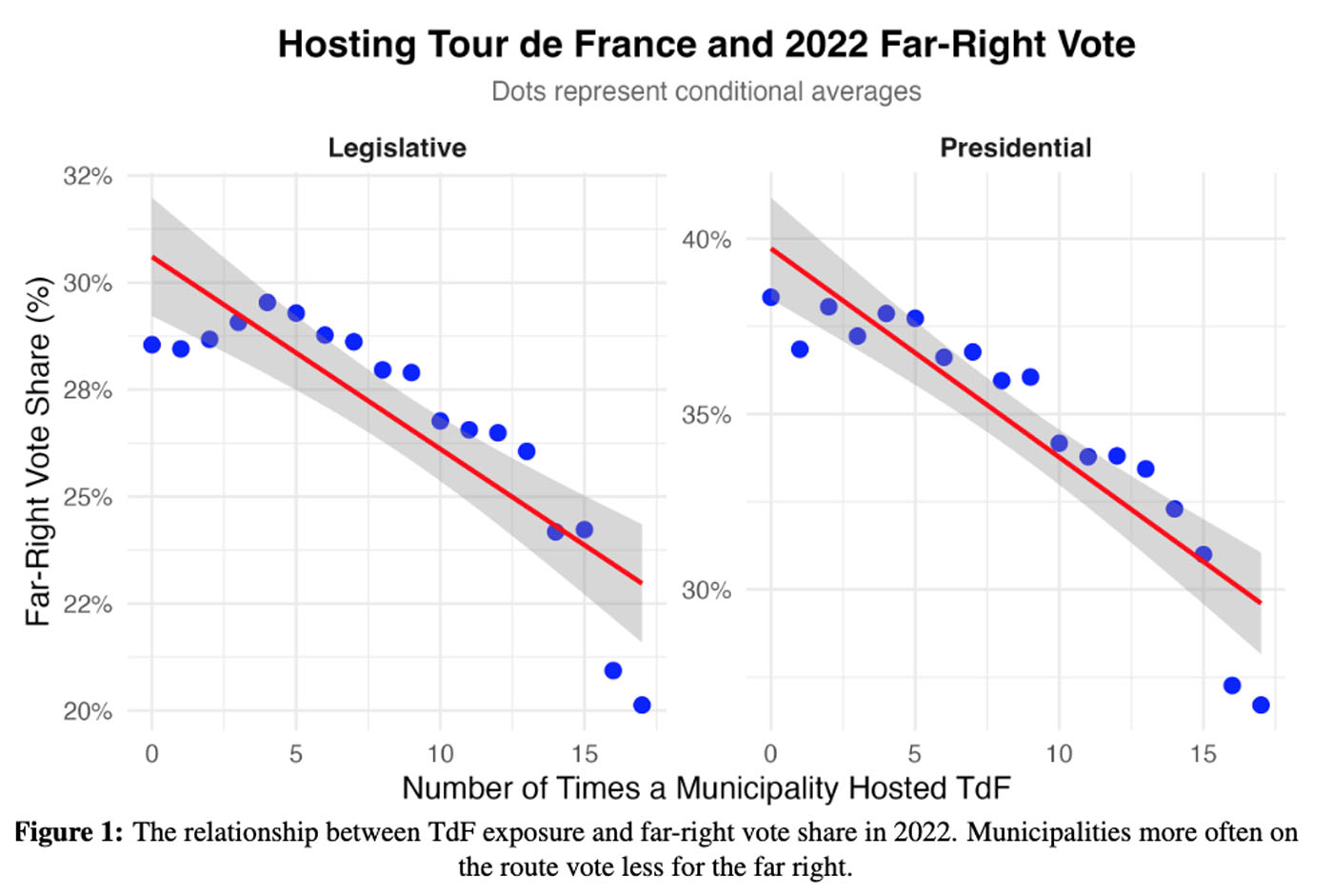
Some academic work – a preprint – even suggests that hosting the Tour could be electorally disadvantageous for the RN. In “Cycling through Elections: The Political Consequences of the Tour de France” from last September academics from Milan’s Bocconi university and the University of Zürich suggest that if the Tour comes to town then the vote for the RN dips by a small but measurable amount because the race boosts the local economy and above all it gives those living in often “left-behind” places a feeling of recognition which dampens the tendency to turn towards populism. Mayor Barthès may not be in a hurry to have the Tour back.
Very interesting postcard! Thanks a lot.
+1
Is that figure at the end essentially a graph of RN vote share vs population? The bigger the municipality (a) the lower the far-right share and (b) the more likely it is to host a Tour stage?
I believe they pass Mont Segur today? The last citadel of the Occitan Cathars to hold out against the global and imperialistic forces of Church and State.
It’s built on a spur of rock known locally as a ‘Pog’.
Pog is the same as a puig in Catalunya or a puech or pech to the west.
The charts graphic above? There’s no population count on the axes.
I think the argument proposed by Nick here is that there may not be any causal relationship between tour attendance and far right vote, just two independant relationships with the underlying variable of city population. The Tour visits bigger cities more, and bigger cities vote less RN, hence the correlation displayed. I tend to agree with this view. At the very least it should be explicitly debunked in the article if they have tested for population causality.
Anyway, I catch this opportunity to add my thanks to the general chorus. Such an amazing blog you maintain Mr Inrrng !
In Italy and Spain there’s a very firm trend of “we hate bicycles” in the far-right. The Lega has a problem with that because years ago they were the political party closest to cycling as a sport, but since the new wing represented by Salvini got the leadership, they changed that attitude radically, I suppose following the advices of the same spin doctors dictacting the agenda of these guys all over the world. Yet, you can’t just dump the majority of the real persons in your party, so it’s hard to change in the short term. It’s not by pure chance that MP now trying to turn the sport of cycling into votes is from Berlusconi’s party (similar to centre-right in France).
Spain is also interesting because the traditional right had developed several examples of cycling-friendly cities (mainly promoting gentrification and tourism), but as now they need to ally to the extreme right which has an explicit and violent anti-cycling discourse, at any level, they sacrificed their former policies. Now, crazy as it sounds, they’re eliminating existing cycle lanes, not only spending notable amounts of public money just to do that, but also spending further money because Europe is sanctioning the municipalities as most of the funds used to build the cycle lanes were European!
The same in the UK. The right and their lackeys in the media (or is it the other way round?) have always hated cycling and lumped it in with anything else they despise as ‘woke’. As for encouraging cycling as an environmentally friendly alternative to cars, that’s pure communism.
I don’t know whether to feel relieved or sad that insane anti-cycling views are not exclusively an American thing…
Once ‘populists’ get power they tend to end up being mugged by reality. They need to improve the conditions for their voters while simultaneously keeping their anger ramped up, but as the article suggests these are mutually exclusive. Also it’s amusing though that both the left and right populists seem to have found some common ground in disparaging the Tour, but equally know they can’t afford to ramp the performative hate up to 11.
FWIW if W Europe could just get GDP per head rising properly again all this populist stuff (right and left) would just dissipate IMO.
I love how ecologists are dismissed as “left populists”.
I guess that if we could just get GDP rising properly (?) again, most human life on the planet would dissipate in a couple of century at most, a great relief indeed for most of the rest of living being barring perhaps head lice and little more.
And western societies of course haven’t any issue of wealth distribution, have they?
Back to the Tour-adjacent comments please. It’s fine to hold different views but nobody is going to solve politics or the economy in the comments section here 😉
Just briefly: In the UK, Greens are definitely populists (now at least), though maybe wrong to assume France is similar. And Norway considers Britain’s attitude to North Sea resources to be a form of self-harming extremism (which is fueling right-wing populism in the UK).
Everyone can have a definition of populism but the notion of claiming to speak on behalf of the people against an elite comes to mind. Many parties across the spectrum claim this mantle now.
So what do you do with that when it’s not just a “claim”?
On some subject it’s hard to pick the difference (well, not that much, but let’s leave it at that) – yet, when the question is climate change or other environmental subjects, it’s quite obviously the actual interest of the collectivity against a few lobbies (especially if an equality agenda is included to avoid major fall-out of the measures on low income persons – which most serious Green parties comply with).
The struggle for safe water in England is a good example. Populism? Come on!
I don’t know a lot about the political landscape in France, but in the US only larger towns would likely be able to host races, and larger towns are generally not right-leaning. That was certainly the case when we had the Tour of California. If something similar holds in France, then the low number of starts in right leaning towns might just be due to the size of the town. Correlation is not causation.
Hopefully things don’t end up getting as far as a far right French President receiving the ASO Peace Prize from Christian Prudhomme.
Whatever we might think of pro cycling and the UCI, so glad it’s not FIFA. Makes the McQuaid era look noble.
I know you don’t want politics to intrude, but I should point out that Boris Johnson, former prime minister of Britain and hate figure of the left, and considered “far-right” by lefties for leaving their beloved EU. was extremely PRO-CYCLING and was regularly seen cycling into work whilst an MP. Also as London Mayor he introduced the Boris Bikes for people to hire to get around London, I remember seeing them when I went into London, so some people above might want to rethink their opinions/prejudices.
I’ll leave my thoughts on today’s stage in the next post.
Nothing do to with the Tour de France.
Will close the comments if people can’t resist from offering their worldviews rather than talking about the Tour de France or pro cycling.
Ops! Hadn’t read this yet, although it was already here. Well, sorry for the above 😉
Ban gabriele! 😉
“Boris bikes” were a policy from Johnson’s predecessor as Mayor, Ken Livingston, who was a keen advocate for cycling and instrumental in bringing Le Grand Depart to London in 2007. He also laid the ground work for the increase in cycling infrastructure that Johnson, to his credit, committed to.
Did a mini deep dive on PCS and saw that the Tour finished in Beziers in 2002. The surrounding region was pretty busy with cycling up to that time but has fallen off dramatically since. Not sure how the politics come into it, but the 2002 stage must have been beautiful, rolling through the vineyards and over the Canal du Midi. Would love to see the Tour return, but I have to admit severe bias because it’s the only place I have any connection to and might be able to stay along the route!
Béziers has a far-right mayor but he’s not in the RN; and when the Tour visited before in 2002 none were in power.
Away from party politics that day was an usual one with Laurent Jalabert teaming up with David Millar to help Millar with Cofidis win. Lenny Martinez’s father Miguel made the top-10 that day.
From postcards to political analysis. Very interesting! Somehow the name Ottavio Bottechia came to mind.
Come for the legendary castle postcards, get a succinct treatise on French micro politics!
Love Carcassone – would be neat to see the tour go right through the old Cite, Pont du Gard style.
There’s some good riding around too, especially to the south. The Stage 4 route has some good climbs and scenery around Quillan and Foix.
A follow-up via a journalist at the race https://www.letemps.ch/sport/cyclisme/le-tour-de-france-est-parti-pour-la-premiere-fois-de-son-histoire-d-une-ville-rassemblement-national (paywall).
The article says it was indeed the first time the race was hosted by an RN town. The mayor was at the start but not doing much and posted one photo to Facebook.