
This stage ought to go to the breakaway, and if not then end in a reduced bunch sprint. The flat finish doesn’t suit the Slovenian and with many riders well down on GC already plenty can go clear and not trouble the overall classification.

Angles fermés: it took 90 minutes for the breakaway to form. Visma-LAB tried a few times to place Matteo Jorgenson but Isaac del Toro closed him down.
A solid move of 19 went clear including Alex Baudin who was the best placed on GC and while Egan Bernal had worked hard to get in the move, punctured and could not chase back. For a moment it looked like Baudin’s mechanics could have started opening the boxes of yellow accessories in anticipation of him being the new race leader as the bunch sat up and many leaders stopping to urinate. Only Visma-LAB got back to work, presumably hopeful to keep the yellow jersey and the lead was capped at three minutes. The Dutch team still haven’t announced a replacement sponsor for next year, perhaps it’s a bad look to lose yellow.
With the breakaway within range, UAE took up the chase, reportedly a decision taken by the riders and not the team car. The escapees could feel it and looked resigned, all the effort to go clear but they could not sustain it.
Once on the short climb to the finish Isaac del Toro took over from his colleagues to lead out Tadej Pogačar who floated away for the win, opening up daylight on Jonas Vingegaard who was so bent over the bars in the sprint he seemed to be cowering with Richard Carapaz and Paul Seixas with him two seconds down, and the other GC names at four seconds. Tom Pidcock was a mild surprise at 18s.
It was surprising to see UAE chasing for hours. But Tadej Pogačar wanted the win and the chance to defrock Jonas Vingegaard. It seemed a lot of effort for another win but what price getting one over your rival? It’s the first time Vingegaard has ever lost the yellow jersey.

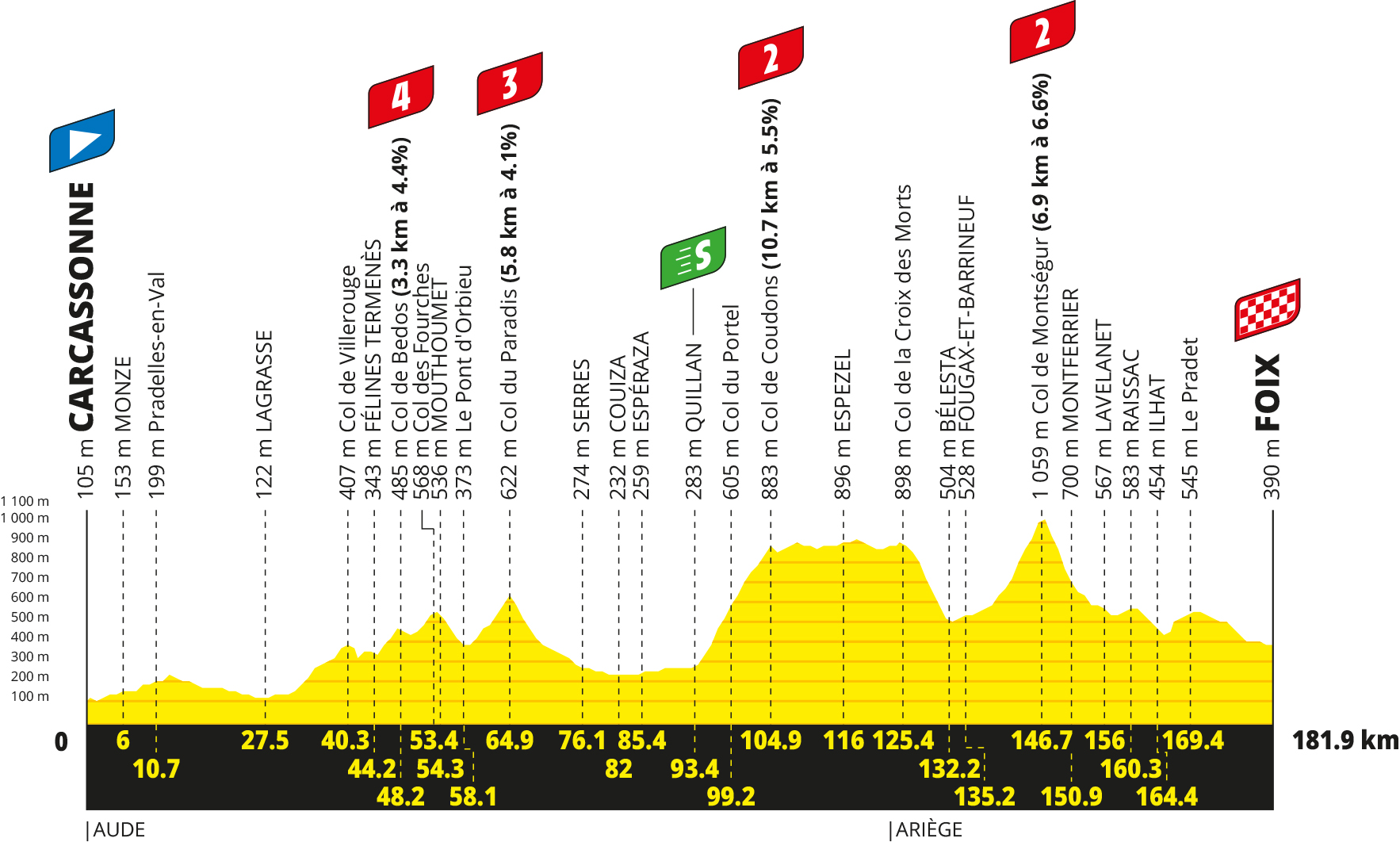
The Route: 181km and 2,700m of vertical gain. After several days for the GC contenders and baroudeurs this syage was meant to be for the sprinters but the layout of roads in Foix and some municipal refusals to uproot street furniture meant the plan was changed with an extra day in the hills to shrink the bunch by the time they reach the finish.
It’s south out of Carcassonne amid the Limoux vineyards. The first 20km aren’t big roads but they roll well. After 30km things get wilder with twisting sections, climbs and a road that’s one minute in a canyon and then another on an exposed plateau.
The Col du Paradis is pleasant and, away from the Tour very peaceful, but no paradise for climbers. A gentle descent with some corners gives way to roads shaded by plane trees and soon the intermediate sprint in Quillan. The Col de Coudons twists around a lot but is very steady.
The Col de Montségur is the hardest climb and after a gentle start there’s 4km at 7-8% to the top below the rocky cliffs upon which is perched the Montségur fort.
There’s an unmarked climb with 12km to go but it’s difficult ambush terrain, a wide road with good visibility.

The Finish: the course drops into the Ariège valley. Once by the river there it’s into the town of Foix and a right turn over the bridge with 300m to go for a flat finish.

The Contenders: a good chance for the breakaway and now that Pogačar has got one over Vingegaard perhaps UAE don’t need to chase. They could loan the yellow jersey but almost 150 riders are over ten minutes down so they can keep it without much work.
This stage is open to plenty of riders, it’s less mountainous than Stage 3. It could end in a reduced bunch sprint too.
Quinn Simmons (Lidl-Trek) is suited and will try again. He won a stage in the Aura Tour with his sprint and can take confort from not having to go solo but he has the engine for this in the finish. Team mate Mads Pedersen is in the green jersey already and can score double at the intermediate point and then the finish, or hope to sweep up at the finish on a day when others will be dropped.
Romain Grégoire (Groupama-FDJ) is a finisseur and said he’s got two goals this season: the French championships and a Tour stage. Now he’s shown the form to win the first the latter is possible.

Dorian Godon (Netcompany) has a string of World Tour wins this year and can crown that with a stage win thanks to his sprint.
Luke Plapp (Jayco) tried on Stage 3 and can win here but would he have to go solo to do this? Matej Mohorič (Bahrain) ought to be a contender but he hasn’t won a road race since February 2024. Similarly Ben Healy (EF) is a fit for the stage but is the form sufficient?
 |
– |
 |
Simmons, Godon, Pedersen |
 |
Grégoire, Plapp, Healy, Aranburu, Cort, Van der Poel |
Weather: hot with 39°C during the stage. A gentle breeze from the south of 10-15km/h should be a cooling breeze.
TV: KM0 is at 1.25pm and the finish is forecast for 5.35pm CEST. Tune in early to catch the battle for the breakaway.
How many times do UAE have to chase down a breakaway before other teams begin to collaborate against them in earnest? And would/could such collaboration ever be effective? What precedent is there for this, if any?
To reply by looking through your lense/telescope in the other direction, Visma’s work today helped set up UAE for the stage win. The question here is also when will teams and rivals leave all the work to UAE?
Not many I can remember in GTs but several ones in shorter stage races, in the last 15 years I can recall Tirreno, Itzulia, Dauphiné, Catalunya… although it’s sometimes hard to differentiate “other teams collaborating against a leading team” from… a normal aggressive breakaway to turn GC upside down, plus it often ends up being 2-3 top athletes collaborating among them each for their own objectives.
Problem with collaboration against UAE (or any other team in general) is, that even if succeed, only one will win. And how many stages are to be shared among teams? 21 stages at the Tour, remove from it 7 which are flat, so UAE should not be interested, 2 time trials and let say half of the mountain stages (4). So we have 8 stages and 22 teams. I don’t see any fair split.
Also consider how complicated is collaboration when winning is on the table. How many breakaways lost the stage on last kilometer, because they almost prefer to loose to peleton, than to breakaway companion, with whom you’ve shared the work for a whole day. And now add to this mix several teams with different targets and within them riders with their own goals.
Indeed. That’s probably why it happens more often (and, even so, quite seldom!) where the level of commitment is reduced.
Problem with collaboration against UAE (or any other team in general) is, that even if succeed, only one will win. And how many stages are to be shared among teams? 21 stages at the Tour, remove from it 7 which are flat, so UAE should not be interested, 2 time trials and let say half of the mountain stages (4). So we have 8 stages and 22 teams. I don’t see any fair split.
Also consider how complicated is collaboration when winning is on the table. How many breakaways lost the stage on last kilometer, because they almost prefer to loose to peleton, than to breakaway companion, with whom you’ve shared the work for a whole day. And now add to this mix several teams with different targets and within them riders with their own goals.
I think in this case cooperation will be hard, because teams like Lidl-Trek and Ineos probably want to make it a hard sprint stage for Pedersen and Godon and so will probably control a breakaway, while teams without a versatile sprinter want a breakaway to win.
Michael Boogerd said on Dutch tv yesterday in regards to Molenaar not being able to defend the KoM jersey, that the heat makes the physical cost of getting in the right and being in the breakaway higher, so riders will also have to be pickier about the chances they take.
Another Pogi win. Teams need to leave it to UAE to manage but don’t.
How much will UAE make it known that a breakaway can win but has to be at least 10 minutes back on GC?
Would love Grégoire to win this; it sure seems like this stage is wide open.
I think that since Pogi and Vingegaard are equal in the standings, it will be their placement on tomorrows stage, that determine who gets the yellow.
If so, will we see pogi and Vingegaard at the back of the peloton at the finishline to avoid it or at the front 😉
We might get a display of bike-balancing skills to rival Danny MacAskill
LOL, comment of the day!
As there has already been a time trial, the two are separated by the hundredths of a second registered via their respective performances on stage 1. No matter how much Pogi worsens his average stage placing, he would need to lose actual time to lose the jersey.
I haven’t delved into this year’s rulebook so our host can correct me if I’m wrong but this is how it has worked for as long as I’ve been following road cycling.
The team time trial was recorded to the hundredths of seconds but only logged in seconds so no difference here (Article 25a of the Tour rulebook).
I stand corrected, thanks for the clarification – exactly why this is the best cycling blog!
I do seem to remember the leader’s jersey being determined by partial seconds from time trials rather than stage placings in the past although this may have just been following a prologue. Either my memory needs checking or the rules have changed from year-to-year and race-to-race.
If they are still tied then the fractions of a second from the solo time trial stage will count (same rule, should have explained it in full).
Instead of Plapp being the main man for Jayco i will look at Schmit. It seems like a big clomb for him but his form has been good and the finish is far enough away from the climb it can come back together. Jayco needs to get several riders into the break or go home as its all they are here for. Plapp or O’Conner for a solo and Schmid to win a reduced sprint from the break.
The start of the stage is pretty flat so it will be harder to get super small climbers in unless it takes super long to form.
Like Mr Ring, I don’t think they’ll be in the mix – with O’Connor perhaps the only one in with a bit of a shout.
There is a flat part at the start but the hills come quickly and the roads twist. We should see teams using lead-out or launch tactics, watch as one rider sprints with two team mates on the wheel, one a climber and another there as an engine to help tow the break clear once it is established. Or see how Uno-X send a rider up the road first but his role can be to drop back and pick up their designated breakaway specialist for the day who is launched out of the bunch by team mates. All this and no guarantee it works.
UAE is strong. Pog can drop Vingo it seems at will. Barring a sans jour or crash, teams need to find new tactics or alliances to have a fighting chance. Or just compete for minor placings. Nobody remembers who came in second but we still remember Oscar Pereira.
That climb was effectively a sprint. It might be different on the longer climbs.
It is difficult to imagine Jonas dropping Pogi on the longer climbs unless Pogi has a particularly bad day, which is unlikely since he rarely makes the same mistake twice.
I have been speculating that Tadej could win this Tour simply by following Jonas and winning all the sprint finishes. I don’t think that’s what will happen but over the short distance Pog out-muscles the Dane every time.
100% this. Pogi would naturally like to put a couple of minutes on Jonas to relieve the pressure. But is their really a need to. No matter the terrain, Pogi will always out sprint Jonas in the last kilometre. Therefore he could build a smaller lead by compiling ten seconds here, ten seconds there and grabbing a few bonus seconds. It wouldn’t result in such a decisive win but it would save a lot of energy. Of course the possibility of a crash or a significant mechanical issue makes that strategy unlikely.
That is basically how Geraint Thomas won. Still, V-LaB know that. They know their only small chance of winning is making the race as hard as possible on stages with multiple high mountains and then hope that Vingegaard’s assumed better fatigue resistance still is there. I think in theory a more explosive athlete should always be a lesser endurance athlete, because of how physiology work. But Pogi doesn’t seem to care about laws of nature.
Imagine Merckx who was an even better sprinter (and TTer) but surely didn’t lack shocking endurance. In fact, some of his attacks are still to be matched by Pogi in terms of sheer length.
(Of course, Pogi is a better climber, the difference between the two is well mirrored by the Sanremo vs. Lombardia records)
del Toro should glue to Vingegaard’s wheel while Pogacar attacks, although UAE might find it more educational to let del Toro kick things off instead.
This is nothing new. Jonas has outsprinted Pogacar only once in his career. Jonas hasn’t got a single fast-twitch muscle fiber in his body. 🙂
The only way he can win is by out-fatiguing Pogacar over the long haul. That’s how he pulled it off in ’22 and ’23.
Back in those days, the Slovenian had a few rough days over the season, but those are long gone now with Pog 2.0 from ’24. So I’m pretty sure ’26 will be a copy of ’24-’25.
I agree in general but the argument “Pogi had bad days in 22 or 23, then not anymore” is urban legend at best.
In 22 the only theoretical “bad day” *before the TDF* was the Flèche. Unless one only watches superficially PCS results and deems “a bad day” his RVV where he showed to be the strongest but lost due to tactical weakness. In 23 he had no bad days at all, he “lost” Sanremo or E3 just as he’d “lose” Roubaix in 25 and 26, or Sanremo in 25 etc.
His actual bad days rather happened at the end of the season – in 2023 and 2025 more than in 2022 or 2024 -, and at the beginning of the 2024 Giro or at the 2025 Amstel.
It’s quite hard to make any pattern out of that. People tend to judge ex post with TDF final results firmly in their mind, and generate a mental scheme of sort based on that. But in a broader perspective the step happening between 2021 and 2022 was as significant, or more, than 2023 to 2024. All that within what actually was a constant growth 24 > 23 > 22 > 21 > 20 > 19. Yet, as he lost the TDF in 2022 and again in 2023 people try to build a whole narrative on that…
Pogacar has been able to outsprint Vingo (and everyone else besides true sprinters and top Classics guys MVDL Pederson et al) that isn’t exactly news. Very possibly he can drop him on the serious climbs too but let’s at least wait for some real mountains before we declare it done and dusted.
Well said. In 2024 everybody was surprised by Vingo matching Pogi in shorter efforts, only to then “discover” that the latter had worked hard on longer ones and the other way around. 2025’s third week will always be an unclear situation, but what’s certain is that Pogi looked to have a margin again in violent bursts, which he used on Hautacam, but that was the only long climb where he looked as superior as in 2024… Vingo blowing up big time trying to follow the explosive attack being one of the main reasons, by the way.
This TDF start really reminds me a lot 2022, a super strong Jumbo team (people who say that UAE has shocking superiority don’t remember well those years… a team who could run away from the peloton on smaller bumos than Pogi), an excessively confident Pogačar with heaps of explosive power…
Of course, history does not repeat itself, even less so in this case when the Slovenian grew so much as an athlete.
But what’s sure is that this TDF start didn’t provide any element to infer anything new or especially amazing.
We have Carlton Kirby’s dulcet tones on commentary, the “Homage meter” , Jono’s recipes, the landscapes of La France profonde, Inrng’s previews – the sights and sounds of high summer.
Given the heat I would guess we will get a break that gets a huge lead at some point, maybe not today but on one stage the break will get away and the bunch will soft pedal letting the lead grow out to maybe 10 minutes. Someone completely unexpected will end up in Yellow for a day or two.
Mats Pedersen seems to be aiming for the Green Jersey, would assume he will at least aim to take some intermediate sprint points even if the climbs are a bit too tough to be in contention at the end
I assume the Tour has a hot weather protocol but admit to ignorance of what it is. Should guys be racing bikes in 39C (102.2F)? Its not just a matter for the riders, of course. Spectators are getting a full blast of the heat too.
Our host has indicated that it is based on a wet bulb temperature (28 deg?).
It’s good to separate the public from the peloton. For the public there are weather alerts in France from green (nothing) to yellow, orange and red. There’s no red warning in place now but if there is then there is potential to go as far as cancelling a stage so that spectators don’t wilt by the road, staff on the race are not in danger and because the local emergency services might be too busy dealing with higher hospital admissons etc.
For the peloton they are better at dealing with the heat than the average member of the public – they’re moving at 45km/h for starters – and there’s the Extreme Heat Protocol, based on wet bulb temperatures but with calculations to consider factors specific to the race like road surface albedo. Once triggered various measures can be taken from having extra water on the course… to cancelling a race. Before all this teams also have their plans, handing ice, water and more.
Will try to look at this in a blog post soon.
It seems to me that the air that you breathe is a big problem … you cookfrm the inside out.
You can cool a lot through the lungs. On a cold day when your breath condenses in the air… this happens on a hot day too but not cold enough to condense but a lot of evaporation in the lungs and so a cooling effect which requires more water of course.
I recently rode on a 35 degree day with very low humidity. Little or no sweat on my body but still difficult to drink enough to rehydrate completely. Lost about a kilo of water weight in about 50 km. I can’t imagine how much these guys need to drink, it would have to be almost constant.
One difference is the riders today are almost wet from start to finish, pouring water on themselves all the time.
One thing that could be improved is some race suits fit to the body well for aero gains but the wicking/drying effect isn’t as good as some other fabrics. A “summer suit” could be a real gain.
This is a great point. The weekend rider doesn’t have a team of helpers dousing them, and it’s pretty tough to carry 10 liters of water around!
45 km/h until they have to climb 7 km at 7%… but I take the point that they are elite athletes and are very well supported in terms of water supply, team doctors etc. Looks like it’s relatively dry heat as well at the moment so the wet bulb isn’t too bad, but I still marvel at their ability to race in such temperatures.
Out of interest, are some riders known to particularly thrive (or suffer) in hot conditions? There seem to be some that are associated with wet/cold races although that perhaps mainly aligns with a rider’s preferred terrain – Pedersen in the classics etc.
Most riders train for this and adapt to it. But as a rule having a larger surface area is beneficial compared to be shorter and stockier, so in theory there’s a slight disadvantage for an Evenepoel over a Seixas or a Del Toro.
I have done a fair but of hot weather riding. If It’s a bit hot but if its dry humidity its manageable. Going up a steep climb slow is however much harder.
Top of the mountain is way easier than the bottom as the temperature can be near 40 at the bottom but only a bit over 20 at the top.
When it’s hot on a climb you can really tell which way the wind is blowing. If it’s a light tailwind it feels like you’re being cooked!
Added Van der Poel to the list of contenders.
What are the thoughts on Remco’s performance at the Tour to date?
He’s giving me great value on my Fantasy team – but in the real world?
Or will Thursday make or break his dreams.
The Tourmalet’s been his nemesis in the Tour and Vuelta before but he’s looking good at the moment and sounding much more relaxed. Red Bull have fared below expectations in the Tour several times but their coaching and riders seems to be going better this year. Still hard to see Evenepoel winning though but Lipowitz is keeping him on his toes already.
@Paul. Hard to say. He’s shed weight to be competitive in the high mountains so we’ll have to wait until the race hits a few of them. But I’m not sure that it’s always a physical issue for him.
Also he’s said to be 4kg lighter but nobody can verify this. And if he was going for the Tour of Flanders before he stopped racing then he might have put on 2-4kg etc. He does look lean but did so at previous Tour starts too. Either way we’ll soon see.
The Tourmalet will tell all.
The way Jonas can beat Tadej is the way Visma beat him in 2023. Isolate Tadej on the long Cat 1 and HC climbs along with Jonas and at least two other Visma riders, and attack him over and over until he cracks. Jonas needs numbers to beat him. The difference this year is that UAE looks stronger than Visma, although that hasn’t really been tested in the high mountains. If UAE uses the same strategy, I don’t think Visma comes out on top.
It sounds promising on paper, but the reality is quite different. In ’22 (not ’23) Pogacar had to keep both Jonas and Roglic on a short leash. Now it’s Jonas (and VLAB) who must juggle Pogacar and Del Toro.
As much as I, being Danish, would love to see your scenario, I’m fairly certain it will be a repeat of ’24 and ’25, and I wouldn’t be surprised if Del Toro gives Jonas a real challenge for second place.
Once again, I agree with you, but I think that it still exists some option (not the one devised above, which would need some other GC menace at Visma), in this case thanks to the weakness of UAE team, barring Del Toro. Despite what many were saying, I didn’t find them as impressive as in other occasions. Besides, their strategy generally tends to be poor. So, of course it’s not going to work precisely as in 2022, but there’s space for trying something risky and creative. The other added factor could be the presence of other relatively strong GC riders in different teams. Sadly, unlike past editions it’s not we’ve got many high mountain marathons to try that, essentially the penultimate stage, maybe the Tourmalet, but frankly most climbs aren’t long enough.
“weakness of UAE team, barring Del Toro”
UAE’s McNulty isn’t as punchy as Del Toro, but McNulty has a big “engine” that is at least as good as Visma’s Jorgenson. Visma’s Sep Kuss hasn’t seemed to sparkle as much in 2025 and 2026.
Ahem, indeed, *relative* weakness, indeed.
McNulty has a huge engine and he’s a rider I always admired, I still remember his amazing dress reharsal in a desert race when at Rally, a monstre solo eventually slamming into that Dam wall; or later on his Mallorca victory. although to me all in all it doesn’t get close to Jorgenson’s talent.
But I referred mainly to their general seasonal form, his among the rest. He didn’t look brilliant, and in Barcelona he was impressively steady but until the last lap the selection had been modest.
Maybe it just depends on the job they’ve trained for this year. As a Pogi fan, I hope to be proven wrong when perceiving a UAE team less athletically effective than in the last 2 seasons. Or otherwise I can hope to be right and Pogi overcoming the occasional shortcomings of his team 😛