
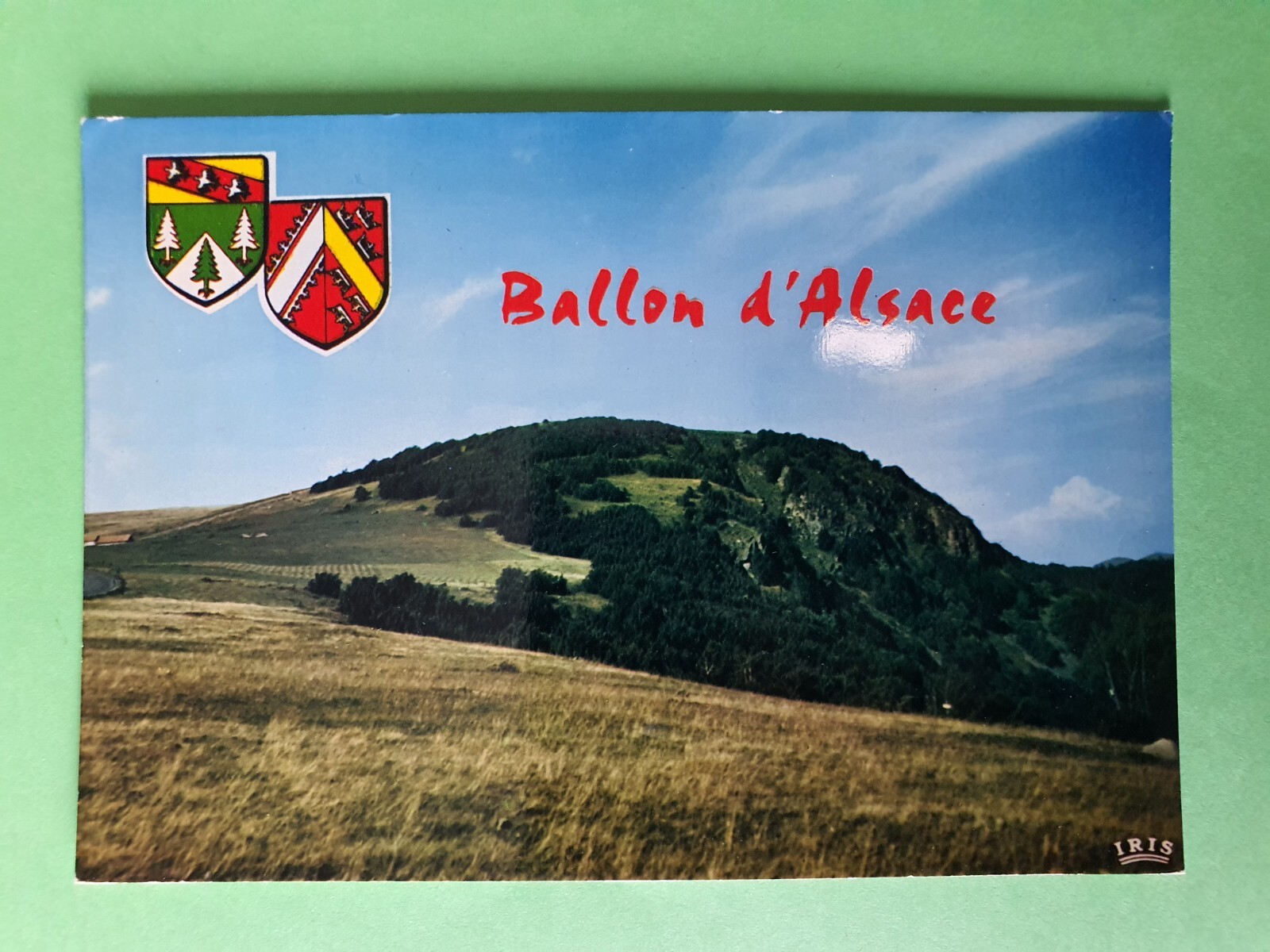
The Tour de France tackles the Ballon d’Alsace today, and will do again tomorrow too. It’s the first big mountain climbed by the Tour de France and the first celebration of climbing in the race and possibly the origin of the mythology of the climber as a lone rider ahead of the rest. And recently it’s been the subject of a mini-polemic.
The first two editions of the Tour de France tackled some climbs Massif central but they were not features of the race to the point where there’s debate over what the first mountain pass used by the race was, the settled view now is the humdrum Col du Pin Bouchain. In 1905 the Ballon d’Alsace was the first major mountain used in the race.
René Pottier was first to the top and when the race returned the following year he was first again and so the sport’s first identifiable climber. There is a monument at the top to Pottier which celebrates how he overtook everyone to arrive solo at the top of the climb, perhaps the origin story of mythical climbers. For all the history the Ballon d’Alsace has been used sparingly, today is the 22nd time the Tour visits.

Literally “the balloon of Alsace” in French, the spherical association can also be applied to a glass of wine, you can ask for un ballon de rouge as in a “glass of red” in a bar. Tour chronicler, pun artist and drunkard Antoine Blondin played on this double meaning in his despatch for L’Equipe printed on 5 July 1969.
It’s poetic to imagine the mountain with gentle, globular shape of a wine glass. But not linguistic, the origins of the ballon label here are debated, it could be from the celtic tribes, you can derive it from the Latin pabulum.
Le Ballon d’Alsace can confuse. It’s a ballon, it’s in the Alsace but the definite article is a trap as there are more ballons nearby. There’s the Ballon de Servance, and within riding distance are the Grand Ballon and the Petit Ballon. The Grand Ballon helpfully lives up to its name as the highest point of the Vosges mountains at 1,424m.

There’s been a mini-polemic in the French media earlier this year regarding the Tour’s visit with stories of 900 trees being felled just so that the race can ride past, eg Le Parisien. Shameful! A scandal! Well it might be if it were true.
Forestry workers did cut down many trees near the road in April and May this year, all in time for the race. But it’s got little to do with the Tour. While the top of the Ballon is exposed grassland, the flanks are covered by forest. Some trees have storm damage, others are prone to being toppled in a future storm, some are weakened from heat stress which in turn is helping a beetle which damages the pine trees. It’s common practice, and the law, to cut vegetation within two metres of all roads in France for safety, both so branches don’t fall on the road and to keep the roads drier.
The decision to start the works in April somehow got linked to the Tour coming, seemingly on a Facebook page. This kicked off a polémique about the race cutting down trees, the gigantisme of Tour devouring nature in its way. Only the local commune approved this regular work back in 2023, long before anyone knew the Tour was coming. But delays and bureaucracy meant it took years for the works to start.

There’s a lesson in causation and correlation, about someone being mistaken about something, others wanting to believe it and then it all going viral with wider media running provocative headlines only to deny the story in small print several paragraphs below. If it’s largely harmless when it comes to trees and the Tour, you wonder about more sensitive issues.
These days as well rating a climb for its distance and gradient, organisers now take notes on the leaf canopy. Not so they can rev up their chainsaws but instead because it affords shade to the riders, something increasingly valuable on hot days. Tomorrow’s final climb of the Col du Haag is a case in point and because it’s a cycle path and not a highway… the trees can grow right by the road.
I’m sure you know ( but other readers might be interested) that a ‘ballon’ is also a term used for a joint of meat, boned and stuffed, and then tied in a circle with strings across to resemble a Montgolfier (hot air balloon) . In this part of the world it is often lamb (perhaps from the lower slopes) stuffed with berries such as blueberries or blackberries ( or so the TDF site tells me). Sounds delicious, I’m going to give it a go once the heatwave has passed and we can bear the oven being on.
Thank you for the postcards, so evocative of the years in France.
I know blueberries are a local thing, you see signs with menus offering various dishes – cake is easy for visiting cyclists – but not the term for the meat roast, glad to learn something back.
“If it’s largely harmless when it comes to trees and the Tour, you wonder about more sensitive issues.”
Sadly, this is standard here in the UK. I work in the public sector and we see this all the time. Provocative front page headline, designed to stir unrest and some more accurate detail buried on page 5. Facts don’t sell newspapers.
Glad for the clarification on the differentiation of the various ballons. I think I had confused this ballon with the Grand Ballon. Both featured in stage 6 of the 2019 Tour won by Dylan Teuns on La Planches des Belles Filles. An interesting area for climbs.
I’m certainly finding the various Ballons rather confusing. There also seem to be multiple Cols de le Croix or variations thereof.
There are lots of croix (crosses) for reasons of religion and marking the landscapes. Some have a tragic sense as at times in the past cases of suicide or disease could or would not be buried in the village graveyard so the corpse would be taken to the edge of the village, sometimes denoted by a mountain pass or ridge etc, and buried there and a cross placed there for religious reasons. But many crosses just mark an obvious point of passage, a place to pray and a shrine to thank for safe passage too.
To make the whole “Ballon” matter even more confusing: there are at least two other “Ballon” outside the Vosges One is located in Switzerland and is called “Belchenflue” or “Ballon suisse.” Another is a mountain in the german Black Forest simply named “Belchen,” which translates to “Ballon.” The area between the Ballon d’Alsace, the Belchen, and the Belchenflue is sometimes referred to as the “Triangle des Ballons.”
Knowledge for quiz shows 😉
According to the Wiki, those Belchens (or Ballons) form a calendar of sorts, with the Sun rising above other mountains seen from the Alsatian Ballon marks eqiunox and both solstices.
When road transport depended mainly on animal energy, trees lined along were a key bonus feature, implemented when possible or already present from the very project. Trees made a course measurably faster, with all implications for fresh food, cheaper transport, economic growth for the population along the way (and some woes not comparable of course to a highway in your neighbourhood today).
Today, many countries are forced by law or by policies to cut them all down…
Cars crash on trees and they don’t care about shade!
Generally speaking administrations don’t fully assume as naturally that taking care of trees (which implies significant cost if made properly) is or should be paramount within their budget, something which was way more obvious when trees provided most building material for pretty much everything, and an energy source, too. Communal management being often the most effective approach.
Now a lot has been for years about sort of a decorative function, rather than a substantial one. But the world heating up brought to the collective attention again how effective trees are. Risks, costs and benefits probably need a deep review. And fast, because what we now may soon notice is how long do trees take to develop their full potential.
Clearly you are not thinking about gum trees that provide no shade and make a big mess all year round.
Must admit that I’m being Eurocentric big time with the above.
Some of the wood is reused. I got some info on the tree-cutting laws from a website from the Ardennes department and the wood they get is turned into pellets to heat local buildings, hospitals etc.
In case anyone wonders about the roads in France lined by plane trees supposedly so an army could march in the shade, the law says exceptions can be made and so these are often preserved. But they’ve been often the cause of grizzly accidents when motorists have left the road and collided.
On a recent visit to France one of our regular roads was one of the very narrow (at least by American standards) roads lined with beautifully manicured plane trees. It made a regular drive a pleasure, and made slowing down a little bit not a problem. Not sure how the locals feel about them, but I consider these lanes a treasure and can’t imagine sacrificing them even if it might improve safety.
Not a real life accident but the car from the opening scene of Kieslowski’s Bleu supposedly hits a tree by the road side when it weers off the road
Anecdotally it seems to have been worse in the past, people drink driving and getting in cars with little crash protection, perhaps no seat belt so if they veered off the road and hit a tree they were crushed. The number of the plane, maple and poplar trees on these Napoleonic roads has declined from millions to hundreds of thousands and some have barriers in front of them. But it’s still a live issue today, hundreds of deaths a year apparently.
“Tour chronicler, pun artist and drunkard:” now there’s an epitaph to aspire to!
If he was on the Tour today his podcast could be great
@ The Inner Ring, I love how you write about interesting cultural things that are peripheral to cycling. You have a lot of cultural knowledge. Thank you for educating me!