
Another round of the breakaway world championships.

Spectacle Sâone et lumière: the month-long heatwave in France is ending. Among the complaints, one has been difficulty sleeping at night given the persistent high temperatures. Stage 12 did not help anyone hoping for a languid siesta in front of the torpor of a Tour sprint stage.
A flurry of attacks showed intent from plenty to get away while the sprinters’ teams played whack-a-mole to knock back each attempt to escape. It worked and Baptiste Veistroffer went clear, almost too strong as he went solo and nobody joined him, no threat to the sprinters.
If the curtain fell down on the peloton anyone hoping for 40 winks was disturbed by the intermediate sprint where Mads Pedersen sprinted across to the right and after a enquiry that saw his team convoked to the jury car and them him too, he was lucky not to get relegated.

Soon after Ewen Costiou, Damiano Caruso and Matteo Vercher got across to Veistroffer while the peloton was in a long line for hours. If anything the bunch chased too hard as when the breakaway was caught this opened the way for more attacks. Lidl-Trek were firing riders forward.

Mads Pedersen took a flyer and tiny Valentin Paret-Peintre, head tilting to the side as if wracked by severe torticollis, fought to thwart him. The moves kept flying and if they were desperate, that was half the entertainment.
In the finish on the quays beside the Sâone Fernando Gaviria overlapped his front wheel with Vlad Van Mechelen as he tried to squeeze into a gap and fell, causing many more to fall like skittles in a bowling alley. Van Mechelen got a yellow card and after leniency towards Pedersen further evidence that consequences weigh on the jury even if this not said aloud. Olav Kooij was luck to swerve around this but this put him out in the wind and with work to get back while Tim Merlier was able to kick for the line again to win. The average speed was 49.095km/h, no record but still in the top-10 fastest stages.

Merlier gets his third stage, his Soudal-Quickstep team handling the post-Evenepoel era well and knowing Paul Magnier is waiting too.
Merlier sits fourth in the points competition despite the scale being tilted towards the flat finishes, in part because he’s been sitting out of the intermediate sprints. He told L’Equipe the other day that in the sprint for the finish line he seems able to find more resources, mental and physical, than he can for a point along the way. In a post-stage interview he lamented how he came to road cycling late – he was slopping around municipal parks of Belgium on the cyclo-cross scene with its euphemistic “Super Prestige” circuit – and how this means he may have missed out on the Champs-Elysées sprint. It’ll be interesting to see how many sprinters stay in the race now.

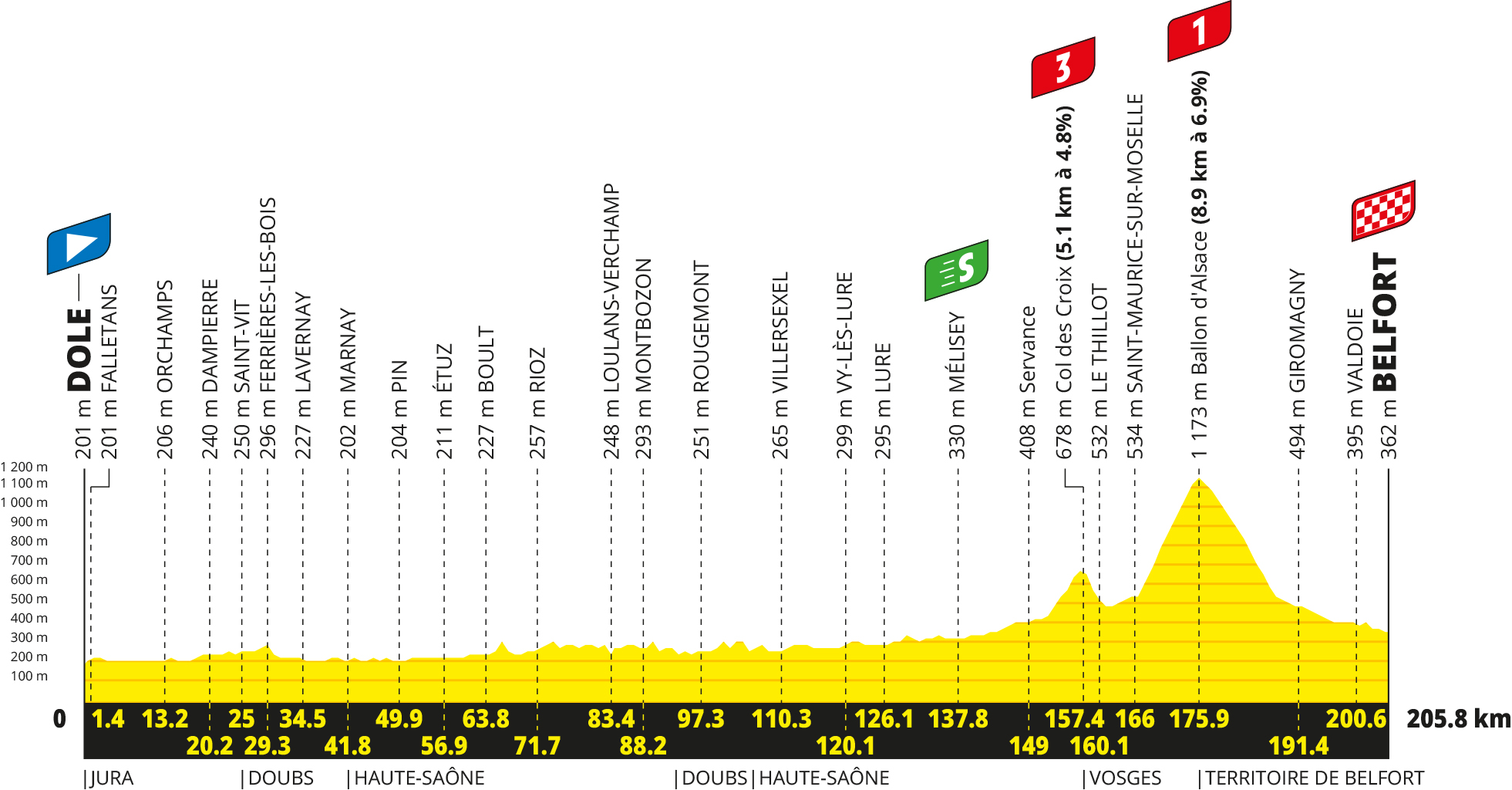
The Route: 206km and 2,400m of vertical gain. This is the longest stage of the race.
The intermediate sprint is in Mélisey, home of Thibaut Pinot of course. It’s late in the route but which sprinters’ teams have an interest in contesting it to the point of trying to neutralise the race all day? Instead we might see some sprinters trying to infiltrate the breakaway and treat this as their virtual finish line.
The Col des Croix is a regular road, a gentle introduction to the Vosges mountains.

The Ballon d’Alsace is 8.9km at 6.9% and very even with it, it feels as if the slope varies between 6.7% and 7.1% and all on a wide road. The matters as there are almost no tactical points along the way, even the hairpin bends are steady. It’s a sub-25 minute effort today and so accessible to some.
There’s a brief flat section over the top and 30km to go. The descent is even in slope but has many more hairpins and bends the first 5km on the way down before opening up. With 16km to go the descent eases and it’s onto wide, straight roads towards Belfort.
The Finish: flat with a gentle downhill run past the fort that dominates the town. A right turn with 450m to go leads onto the finishing straight which bends gently and so the arch isn’t visible until 280m to go.

The Contenders: a good day for the breakaway, no sprinters can cope with the final climb, the teams with GC ambitions will hope to save energy here and there’s no tale of revenge involving Tadej Pogačar and Belfort. So everyone else will want to crowd into the move and ideally a team identifies a winner to go in the move and sends a rouleur with them in support to help pull the break and close gaps later on.
One theme in this Tour and recent editions is the quality of the winners, it’s hard for a newcomer or outsider to get a breakthrough win. So the average number of career wins among the stage winners in this year’s Tour is 73.
If Richard Carapaz (EF Education-Easypost) can get in the move he’ll be hard to contain on the Ballon d’Alsace, and if not he can try tomorrow and leave team mates like Ben Healy, Alex Baudin and Georg Steinhauser to go for it.
Movistar have numbers for the breakaway too, Raul Garcia Pierna, Pablo Castrillo and Javier Romo fit the bill on paper but even combined don’t have the palmarès seemingly required to land a stage win in this Tour.
Quinn Simmons (Lidl-Trek) isn’t a climber but go to Lombardia and he can handle 20 minute climbs well but go back to Stage 12 and see the efforts he was making.
The climb today should be too long for Romain Grégoire (Groupama-FDJ) but if it’s not raced hard and means he’s facing a 10 minute effort then he’s got a chance.
Luke Plapp (Jayco) has a great 20 minute power on tap, especially when there’s no climb before but today will involve a lot of work and racecraft to make the break.
Lennert Van Eetvelt (Lotto-Intermarché) is going well. Netcompany-Ineos’s most suitable rider is probably Kévin Vauquelin but one factor that makes them harder to pick is the amount of punctures they’re having, from memory race radio announced three alone yesterday.
 |
– |
 |
Carapaz, Plapp |
 |
Healy, Grégoire, Baudin, Simmons, Romo, Tejada, Van Eetvelt, Vauquelin |
Weather: sunshine and showers and a cooler 23°C. The wind will blow from the west at 15km/h and could gust to 40km/h meaning a three-quarters tailwind for much of the stage. This wind direction is often the liveliest to split up the field as it whips the riders along and spreads them across the road.
TV: KM0 is at 1.20pm and the finish is forecast for 5.25pm CEST.
Why so many punctures for Ineos? Are they riding TT tyres without sealant? If this scuppered their stage 1 malliot jaune ambitions then you’d think they’d change to something more robust (unless such a wholesale equipment change isn’t feasible mid-tour?)
As for Stage 13, I hope it goes to EF or another team who haven’t yet nabbed a stage
Can’t someone send them a jiffy bag with some gp5000 and inner tubes?
😂
I must have ridden over 10,000 km now on GP5000s (with tubes) and haven’t had one puncture (and this is on shit Scottish roads). No doubt tyres are even faster in the world tour, but you’d think Ineos could find a more puncture-resistant solution
Marginal losses
Is Pidcock not a contender here you think? All out 20mins effort and then fast descent.
A contender yes but against him is he’s 10th on GC now and won’t get so much room.
We’re in a somewhat frustrating situation where there are too many teams who will fight for their lesser places already, so if Pidcock or Bernal try to get in the break I don’t think the fight would stop for many kms. I’m also nervous about the location of the sprint point and hoping we don’t end up with a bunch of teams dragging the peloton along trying to get something out of it. I sincerely hope that you’re right and the gc teams leave this one alone, for the win at least. It would be fun to see some gc action on the Ballon well behind the break, but it’s so far from the finish and the next day will be 100% gc, so probably not going to happen.
I think I’ve said this in a comment elsewhere, so apols if repetition, but with the GC win firmly out of the question for all, I wonder if the other top-10 GC places may have extra prestige this year. Intensifying that fight. I’ve likened it to the ‘race for Europe’ in the top football leagues, where sneaking into fourth or fifth somehow seems to mean more than finishing second.
And of course top-10 GC finishes will always bump up next years contracts for the contenders.
I think this is an astute observation. Whoever makes the top five this Tour will have had a fantastic race, so I don’t think that there will be “accidental” top 10s. Although stages 19 and 20 are so hard, there might be massive swings right at the end of the race.
After UAE riding hard on stage 9 and 10 it seems you can’t say any stage is a dead set breakaway win.
On stage 9 they road hard to keep the break at 1 minute without even a realistic way to win the stage.
I,m depressed about the tdf at the moment. The last few years are the so poor. Even in the days of a strong SKY or US Postal team they never had the team to chase all day on so many stages.
Pogacar seems to suggest that UAE won’t chase, though maybe it’s gamesmanship. He’s described stage 13 as “weird” and thinks of the next two stages as good ones. So maybe they won’t chase….?
He should just relax and then destroy everyone on Le Markstein and and the Plateau de Solaison….and leave us to watch to see if Vingegaard can hold off the “resurgent” Remco.
I think the difference is that although Sky/US Postal did have the team to chase all day in hilly stages, they did not have Pogi to actually win the stage.
PS. The breaks have actually been more successful in the 2020-2026 era when Pogi has been riding, than in the Sky era: 2012-2019.
i continue to be amused by the regulations’ description of this stage as “slightly rolling”, complete with 50 points at the end
A race of two halves? A breakaway for the stage and the GC guys coming in later looking for seconds on their top 10 rivals.
Would not be surprised to see Pogacar attack, due to excess energy and two days of boredom.
Just remember that MVdP and WvA were slipping about on those same Super Prestige courses at the same time as Merlier. Hermans and Vermeesh(sp) too. In fact, Merlier was a teammate of WvA back in the Corenden Cretan days, if I recall.
It did take Merlier a long time to move out of the CX circuit though.
I do enjoy seeing him back on the mud, slogging away mid-pack as part of his early training for the road season ahead. Clearly loves the sport which is nice to see.
Mention of Tour speeds is interesting. The feeling, if not the actuality, is that they are getting faster and faster year on year – which has the consequence of making the races shorter and shorter if they are roughly the same distance every time. As an exercise I checked how many hours it had taken to complete the last several Tours and it was only something over 80 hours and in two recent cases only in the high 70s. Now keep in mind that the longest ever Tour (OK it was almost 100 years ago) took well over 200 hours to complete.
I wonder what “the average fan” thinks about this? The TV fan probably doesn’t care because they just see a race regardless. But how about the cycling fan such as presumably readers of this excellent blog are? Are we being cheated out of more racing as the speeds go up and the stages take less and less time? Does race quality correlate to the distance of the stage or the time it took to complete it? I recall a few years back (and no doubt Gabriele might weigh in on this) there was some kerfuffle about the Giro having a procession of long and boring stages over 200kms long. There were a few rider grumbles as I recall. Our host informs us that today’s stage of 206kms is the longest of this year’s race – which doesn’t seem that long. Granted in recent times the Tour has tilted toward short and punchy but does that take away from the overall length of the race as a challenge in itself? One for the purists, I imagine.
One solution would be to insist on use of older bike tech to slow things down and ensure comparability with performances from previous eras (as done for wooden bats in Major League Baseball, or as previously done for the cycling hour record). I think there was some discussion about this in tennis a few years ago (ie use wooden rackets to slow down the game, decrease injuries etc).
This would never happen in cycling as it’s a shop window for technical development, but it’s interesting to consider how slower speeds (and longer race times) might impact race dynamics (especially in grand tours).
There has been talk about a shared tire to slow things down, eg everyone is a 28mm or 30mm that doesn’t have the best rolling resistance, all from a single World Tour-approved supplier. But as you say it’d be hard to implement with different tire sponsors.
Your solution is kind of music to my ears but I am not your average cycling fan. I am someone who doesn’t understand why a bike needs a battery in order to change gear or why riders are allowed to have “bike computers” – or even radios. I understand that a safety argument is made for the latter these days but I do roll my eyes at the idea cycling is some kind of Forumula 1-esque sport where the tech is the point. To me, the tech is NOT the point and who can sell bikes and bike accessories is irrelevant to the race in my view. Its a bike race not a shop window. Or it should be. (Yes, capitalism does ruin everything.)
I’m also biased, but on the other side. I’m aerospace engineer and for me technical evolution in gear and training equipment is as much interesting as the races itself. I also believe that we, amateur cyclists, benefits from the technical progress that is being made on the pro level.
And regarding speed. I’m using power meters for 15 years, co I can compare my efforts from that time. For a long time I was riding on a world tour level bike, top spec (electronic groupset, aero wheels, even new aero cockpit, ceramic bearings, ~6.6kg), but now 12 years old. Last year I have bought modern gravel bike and.. I’m faster than ever on almost any terrain. I didn;t beat my best ~5min climb time, but I’m now ar 1.4W/kg less for this kind of effort (4,8W/kg vs 6.2W/kg), but on flat and rolling terrain I have ~5-6% better avg speed (on road tire), I have similar climbing times despite additional weight of the bike (and myself 🙁 ).
So cycling gear is a massive difference. Now add to this bigger budgets, more funds for research, aero tests, training and methods of control every aspect of it, atittude camps, recovery devices, training control devices (core temp, breath, lactate…), optimized fueling etc.
Also race strategy changed, but it is rather the effect of all above that allows riders to race full gas from KM0.
I think that if we want to compare progress in cycling and athletics, than current increase it speed and record breaking efforts is more like high jump when technique changed from straddle to fosbury flop, than 100m sprint or marathon nowadays. It is more a small revolution (marginal gains, but on so many fields that the effect is massive) than evolution.
Professional cycling really is not a very good advertisement for bicycles with all the mechanical/electronic issues that they have. Aerodynamics seems to be the sol design criterium.
I don’t think “older” technology is a good idea but safer could have the desired effect. Wider tyres are a good place to start as this could help reduce crashes as well.
I don’t wince anymore every time I see a crash but they are uncomfortable to watch.
It’s not just the bike. It’s the aero skinsuits with the specially textured fabric (especially around the shoulders andarms), the aero socks and shoe covers. You’d have to regulate the clothing too.
Tour riders back on vintage-like steel bikes, with 80s style jerseys. I’d love to see it tbh. 😉
Yep – everyone focuses on aero bikes but I think skin suits vs baggy jerseys are an enormous aero gain and probably outweighs every other element on road bikes.
Join my campaign for a running of the Tour 1920’s style. A big lap of the Hexagon. No transfers. Enormously long stages. Never mind visiting the middle of the country. And sure, steel frames and no radios.
Fair about the wooden bats, but the overall trend of rules changes in baseball — larger bases, ghost runners in extra innings, and, above all, the pitch clock — have been to insure a faster game engineered for today’s smaller, higher-revving attention spans. In a way, this has been nice, in that a game can now slot more neatly and predictably into one’s day, but it has also eroded the sport’s special sense of time, and arguably made it less of a refuge from the tyranny of the hour.
That’s interesting about baseball. Similar to the rise of shorter formats in cricket. But we still have four and five day games (in theory at least) to enjoy.
As well as higher speeds, in Grand Tours we are seeing more and more shorter stages. But I’m in the market for at least one GT with two or more consecutive 200km days. They need not be sprint stages either – longs days on hard roads would be great.
And the five-day game is the best of the lot (although England obviously unofficially are doing their best to make Tests last two or three days) – but maybe the ‘Bazball’ days are now numbered?
Faster makes shorter but shorter also makes faster. It’s not the main factor, because Classics are as long as always in terms of kms and so are now shorter thanks to the “faster effect” only. Yet, in GTs the combination is a thing. They’re way easier than in the even relatively recent past when you look at the route, but they’ve got more of a constant intensity day after day. My sensation is that what we’re being “robbed” of is mainly diversity of athletical types fitting this model. The three GTs converging to a similar common style doesn’t help, either. Not that anything would change for Pogi or Vingo (they look like they can prevail on whatever course) but some athletes would clearly be more at ease within a different framework (probably Remco).
Interestingly enough, the current racing style would be kryptonite for the previous generation of GT champions, which makes any comparison close to meaningless. Froome could deal with higher intensity but not as much with sudden, unpredictable efforts or continuity, same for Contador although better with fireworks but less reliable day after day. Quintana could deal with longer range, continued strain but not the power peaks, Nibali being a mix of the above but not as brilliant on any. Feeding strategies has been the turning point, in that age the idea was recurring naturally or artificially (ketones et al) to fats energy to keep glycogen storage safe for some key moments, now the idea is that glycogen is constantly refilled. Of course there’s much more… we’ll readily learn about in 10 years or so. But to start with one has to wonder how sustainable these feeding strategies really are, even if you train your guts, because watching the first victims of the experiments (Aru and Dumoulin among top ayhletes) doesn’t bode well – the reduction of racing days also raises some question marks. Could you really feed like that all the days on longer days? Would other factors come into play? Who knows…
Another thing about shorter stages is that it reduces the time differences between riders when they do get gaps (well, Pogi seems to be good enough that this is not always true). In the 1970s and 1980s riders could recover a gap of several minutes on their GC-rivals to win the Tour.
The late, evolutionary biologist Stephen J Gould, in one of his essays in the book “Full House”, nicely describes this phenomenon. Gould used baseball as one of his metaphors, but his point was that as performance and methods improve, the distribution and variability of athletes’ performances becomes tighter, and everyone butts up against “right hand wall” of ultimate physical limits. Eg, no human will ever climb Tourmalet in 20 minutes, or run a 2-minute 1500m race.
@TomH He didn’t know about Universal Soldier or Rocky then!!!
“but some athletes would clearly be more at ease within a different framework (probably Remco).”
I’ve joked that if ASO gets tired of Pogi’s dominance, they should reintroduce two or three 50+km panflat time trials and have all mountain finishes on tourist-y ski towns with access roads made for buses.
I recall being annoyed with the 2022 Vuelta because it wasn’t “hard enough,” but I think your idea looks increasingly interesting. Relatively short stages with massive climbs have essentially ruled out almost the entire peloton from the gc competition. Giving the less-than-alien climbers (e.g., Remco, maybe Del Toro) another way to stay in the race might make for a more nuanced race. Of course, as Pogi has shown over and over again, there’s nothing that can be done about his level of dominance. But maybe everyone else could be on a relatively level playing field if the race was “easier.”
Not necessarily easier, but more focussed on lengthy high though not peak power output vs. very top segments (which nowadays aren’t anymore as short as 10-15 minutes, but still mark the whole racing of the day). Pogi or Vingo wouldn’t be bothered, but maybe we’d see a range of different outcomes, unlike, say, last Giro, or many a Vuelta (especially in the 10s). The mountain stage I enjoyed the most, at last Giro, was the “more different” from the now too common a pattern of 1-2 uphill set pieces. I like tomorrow (short efforts, short stage, but, hey…), I like st. 20… and I more or less liked Tourmalet plus the long false flat. Then, of course, “the riders make the race” etc.
@gabriele – some really good and interesting points here. I won’t ask where you place Wiggins!!
If Mohorič was in his MSR form, this could be the stage for him.
It’s strange how the self-fulfilling prophesy of a breakaway day surfaces and is accepted. I suppose in this year’s TdF that can mean any stage unsuited to sprinters or Pogacar. Yestreday was obvious for sprinters despite Lidl’s efforts and tomorrow looks obvious for the new cannibal.
I’m a Pederson fan, I’m loving his intermediate campaign for the green, but how did he escape relegation for that move to the barriers? What did the team and him say to the commissaires I wonder, and should you be able to argue your way out of it like that? Philipsen and Alpecin managed too the other day. I can’t see a good argument to overturn it though, it was a straight road, he obviously deviated from centre of road to the barriers and it blocked two riders. Consequences shouldn’t matter, it could have been bad if they’d been squeezed in to barriers.
This is a whole can of worms. Commissaires have now decided that they can change their decisions? It will open the floodgates to arguments. Can other teams argue the change of decision? Where does it end? Etc. (Pederson clearly deviated and should have been relegated.)
Note changing decisions is normal, there is an informal appeals process.
It can and has ended at the Court of Arbitration for Sport, eg Sagan’s exclusion from the Tour.
When you watch the overhead you can see that Pedersen starts going sideways slightly before Phillipsen makes his move. It was touch and go but the head on shot makes it look worse
Agree. But if it was at the finish line he’d have been relegated without a doubt. So they’re basically saying a crash at the intermediate doesn’t matter.
I think it’s the opposite, if Pedersen had caused a crash then he’d probably have been relegated with a yellow card too. But because there was no incident he was let off with a warning. The implementation of the rule is swayed by outcome.
But if Pedersen had lost the 20 points he’d still be in green and with all the main sprint stages done Girmay, Philipsen and Merlier will struggle to overhaul him anyway.
Aye, I guess so. I don’t agree with their rationale there though, it’s like saying: ok you can speed as much as you like on the motorways and you’ll only get charged with anything if somebody gets hurt. That doesn’t stop people causing accidents, it only encourages them to push their luck.
That’s where it’s wrong. The actual consequence shouldn’t be factored in, only the potential for a move to have a bad outcome. Pedersen should have been relegated.
SBS commentators were surprised that it was even a warning – because Pedersen picked his line and stuck to it, before Philipsen attempted coming around him to the right. It clearly was not a reaction to a move from behind.
They suspected the warning was for not straightening up and leaving one rider’s worth of space on the right.
These rules are unclear and it different interpretation each time make it even harder to understand the point. First, what is deviation from a chosen line? Is this line has to be parallel to the edge of the road, to imaginary middle of the road etc? If we consider motorsport rules, than one change of direction that does not impose any danger, is considered as allowed “defence” move. I think it is very sensible approach, because it makes maneouvers predictible. And from my perspective Pedersen move was ok. He was slowly closing the gap to the barriers, but it was constant, expected move. He didn’t deviate, he didn’t abruptly changed direction. He just slowly moved acros the road to the barriers, to defend one side that he might be attacked from, but also opened big gap on the other side that could be exploited.
Straight line parallel to the sides, you can’t change “lane” – rule 2.3.036
“Riders shall be strictly forbidden to deviate from the lane they selected when launching into the sprint and, in so doing, endangering others.”
The rule does not specify what lane is. It is especially tricky when there are bends or narrowing road. Not the case here, but rule is not specific. Also if you want to apply this rule literally, it does not allow to follow another sprinter and jump from behind (you are on his lane, and then change it to overtake him). Also moment of “lunching” the sprint is not defined. Is it also final lead out or just final sprint of dedicated sprinter?
Lot of unknown, lot of left for interpretation.
I think Quinn Simmons got Trump to phone the commisaires and ask them to reinstate Mads 😉
🤣🤣🤣
“ I understand cycling really well. And that wasn’t a deviation, just two guys cycling at speed who happened to nearly crash into each other.”
I am glad I am not the only person to feel Pedersen was lucky not to get sanctioned. The only thing in his favour is that there was no real danger of the riders following hitting the barriers (just, I suppose), but he could not really complain if he had got relegated. A safe sport requires pinishing people before the accident happens.
Several media outlets reported that Pogi was booed on the way to Le Lioran – nothing unusual, but apparently more intense than usual. I wonder if this could influence UAE’s strategy today, perhaps prompting them to stand down for a while instead of controlling any breakaway. It might be a politically smart move.
I think the big teams want to save energy for a big weekend coming up. If UAE did want to control the race today hopefully their rivals sit back and lick their lips.
The booing was at the 15.4km to go point, just after TP attacked.
It wasn’t much and it wasn’t taken up by too many more spectators, but there were some.
@Anton A number of media outlets also reported Vinny saying that was totally wrong and questioning why anyone would turn up to a race just to boo (inference – they’re rather sad).
I completely agree. It’s downright disgusting.
‘Saône et lumière’ merits a Légion d’honneur. By far the best cycling writer out there..!!
Van Eetvelt highlighted the next three stages, but a small rib fracture seems to have thrown a spanner in his ambitions. we’ll see, maybe he can deal with the discomfort.
I wasn’t aware of this. It can be ok to ride depending on the rib and the fracture… with difficult for sleep and recovery. And no team mates are allowed to tell jokes as laughing hurts.
Will cycling fans (I hesitate to call them that) now start booing Merlier because he wins all the sprints?
Do they also boo Messi because he’s exceptionally good?
Pretty sure in football that Messi gets booed given the tribal aspect of clubs and nations? In cycling some people can do this but it’s a minority. 1% of people booing make for a spicier story than the 99% who cheer.
What did you do at the weekend?
“I stood by the side of the road for 4 hours in 35° heat and then I booed at a rider that I don’t like”
What the hell is wrong with these people?
It’s nothing new. I haven’t really noticed it roadside for a few years, but back in Froome’s days, it happened quite a lot. My first roadside tour experience was in 2015, and I think it was the stage to La Pierre-Saint-Martin—it was almost shocking.
Let’s not remember the cases of riders – including Froome – who had urine thrown over them.
And MvdP, in whose case it never was clear if it was urine or beer, or if it was even possible to tell the two substances apart at that apex of CX spectator experience.
Can’t say I booed Messi the other night – I was just upset with my team self-destructing.
I definitely heard some boos during the podium ceremony. I personally see no problem with it. We have so many debates about Pogi here, and I can understand different attitudes about him, but there has definitely been a bit of a shift from “wow he’s amazing” to “this kind of sucks.” It would be somewhat surprising if that didn’t happen.
Even as a pogi-fan I can – sort of – undestand some of the frustration, and it’s not the Tour I had hoped for.
But a guy who gets up early in the morning, maybe drives for hours, queues at various spots to get a good location, all just to boo the leading rider?
I don’t get it.
Booing and jeering any sportsperson is not something I’d do or endorse, but I think those that do didn’t drive for hours, queue, wait etc. etc. just to boo someone. They did all that in the hopes of witnessing and cheering a competition and their favourite racer/s prevailing, and only when neither of things eventuates does disappointment get the better of them.
At least I prefer to look at it that way than believe it’s all premeditated.
@anton Yep, that’s what I don’t get. Why invest so much into something so negative?
What’s with the diss against cyclocross?
It’s great for skills but what’s better, laps of a muddy course with artificial obstacles lined by plastic tape for an hour, or lapping the Champs-Elysées on a summer’s evening? You can do both of course but also see why Merlier was thinking aloud about whether he should have moved to the road earlier.
Thanks for the reply. Sam Abt also disparaged cyclocross. Why this blind spot with my favorite cycling writers? To answer your question, cyclocross is more thrilling to watch and to participate in, given the crazy skills and grit involved. Another bonus: crashes don’t usually hurt much. Money on the road is better for some; maybe Merlier now, too. But if I were seeking out sport to watch based on salaries, I’d have had to skip cycling completely.