
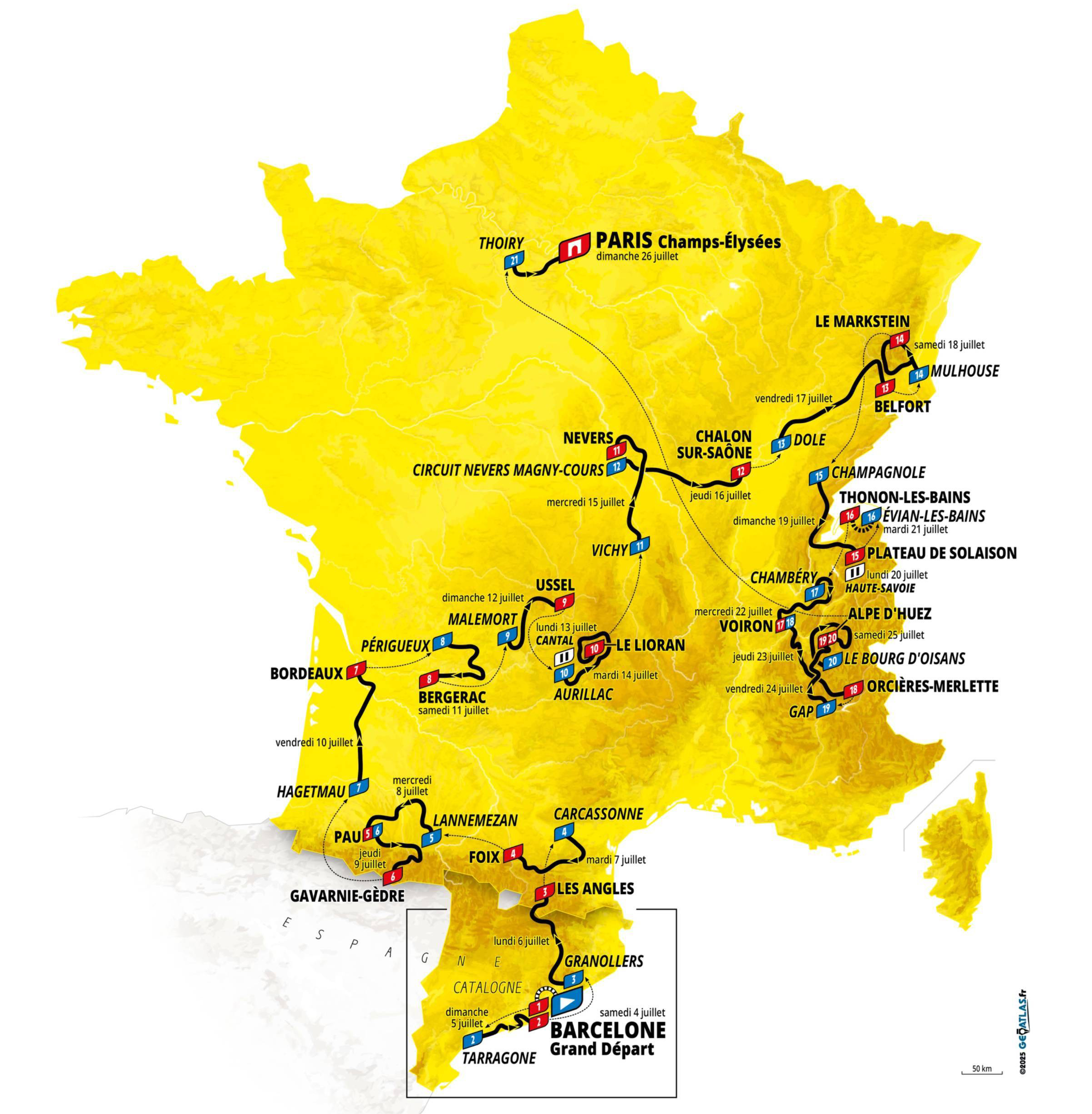
The Tour de France routes for 2026 are out and here is a stage-by-stage look at the course for the men. It runs between Saturday 4 July and Sunday 26 July.
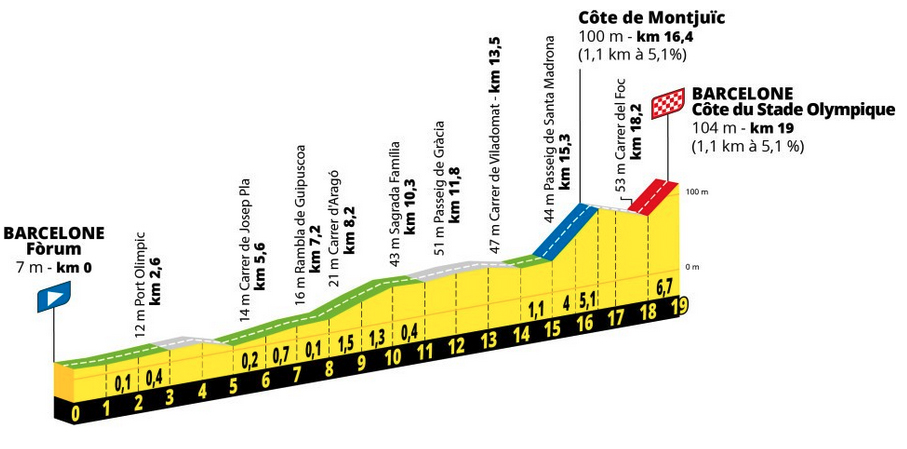
Stage 1 is a 19km team time trial in Barcelona. “Paris-Nice” rules apply where the winning time is taken on the first rider from each team and every rider is credited with the time they took to ride the course. Got it? It makes the race more tactical and, crucially, more visible as helpers fall away and team leaders storm up the Montjuic hills.
There’s an early contest between the cohesion of Visma-LAB and the punch of Tadej Pogačar and all sorts of tactical questions as teams with more than one GC leader will have see if their top riders work together or the strongest is set free.
Stage 2 doesn’t have a profile yet, it’s just marked “hilly” which is true as after a parade along the coast, it’s inland and then over the Coll de Can Pasquall to Barcelona for three laps of the Montjuic circuit and so this should be one for punchy riders, think Pogačar but also Wout van Aert and others depending on how open the race is.
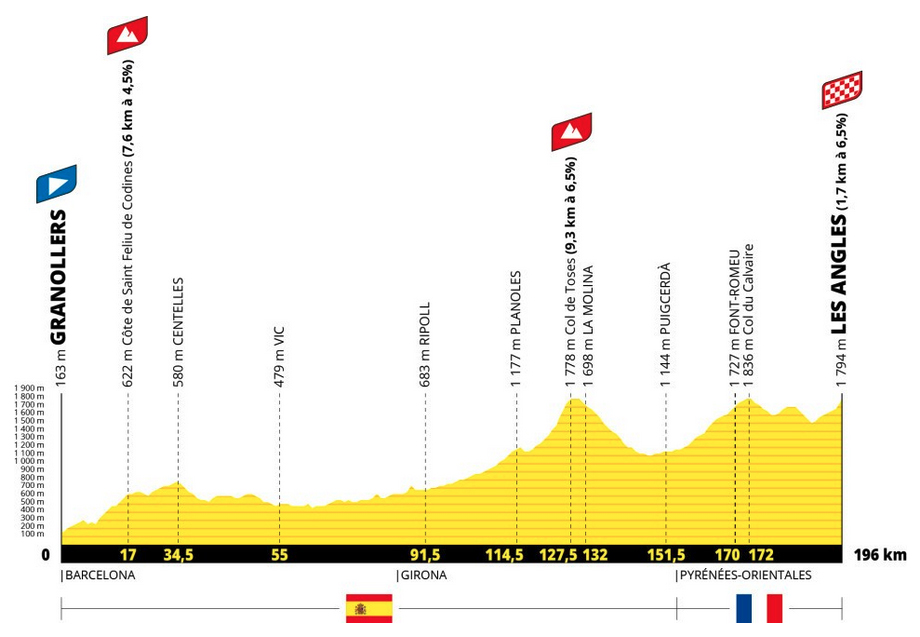
Stage 3 has 3,950m of climbing. The Collada de Toses is long but only steep over the top with the last 5km regularly over 10%. The Col du Calvaire is no calvary as it’s 4% most of the way. Les Angles is a “new” summit finish but it’s been used in the Route d’Occitanie and only a short climb out of the village to the ski lifts.
The elevation gain makes this sound like a decent mountain stage but the final two hours are rugged but not fierce so it could be a tactical one and a chance even for someone to go and take the yellow jersey on loan.
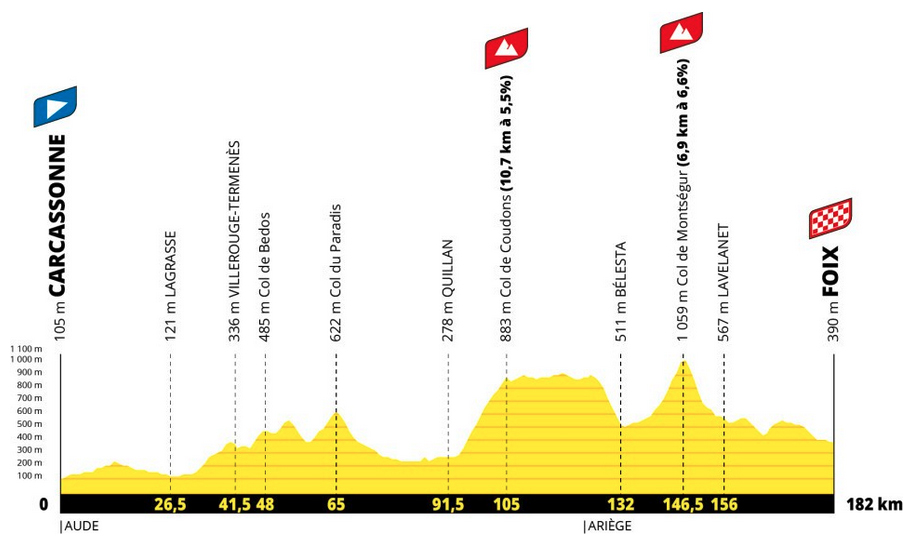
Stage 4 has 2,750m of vertical gain and looks like an ideal mid-mountain stage for a breakaway, and a chance for someone to grab the yellow jersey for a few days, all on scenic roads of the Aude and Ariège.
Stage 5 goes to Pau for the 77th time for the first sprint stage of the 2026 race.
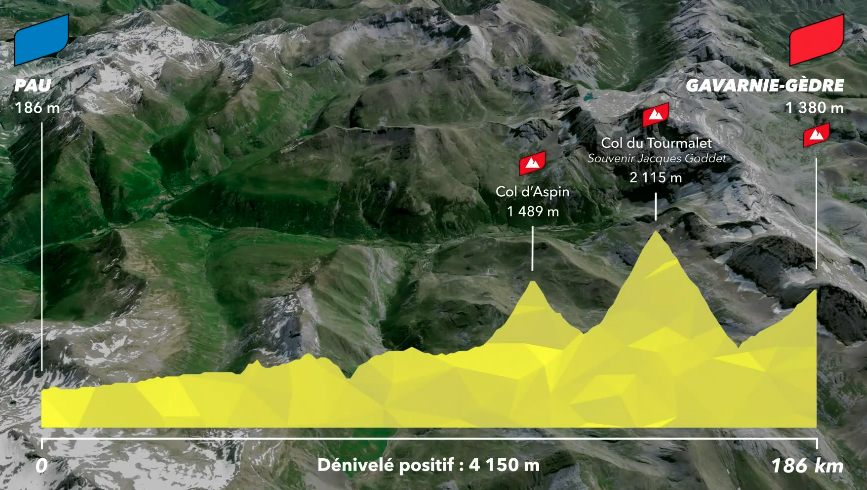
Stage 6 heads into the Pyrenees and tackles the Col d’Aspin and the Col du Tourmalet, big climbs but they come far from the finish. The news is the appearance in the Cirque de Gavarnie, a protected nature zone that the Tour has long wanted to visit. It’s a valley road that climbs gently for most of the way to Gavarnie at 1,380m. A fiendish finish to the Col de Tentes at 2,208m can wait for another year.
Stage 7 starts in the tiny town of Hagetmau, the “pearl of the Chalosse” to go Bordeaux for a sprint finish.
Stage 8 is another likely sprint and déjà vu as a near copy of the 2017 stage won by Marcel Kittel from Périgeux to Bergerac on scenic roads in a land of long lunches.
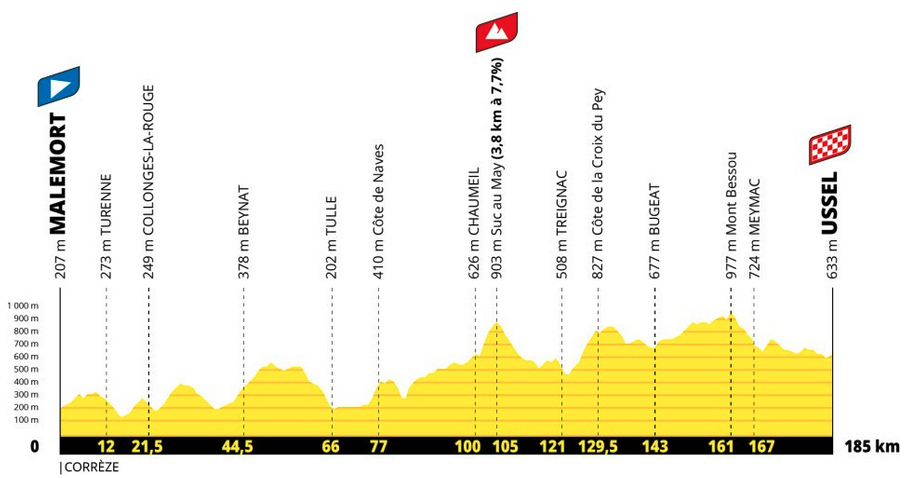
Stage 9 could be the decisive day in the Tour du Limousin as it nudges 1,000 above sea level on lumpy roads but is is a hilly day for the breakaway with 3,300m of vertical gain via Suc au May. The easiest part is probably once the race has climbed out of Meymac past the station and picks up a main road to the finish in Ussel.
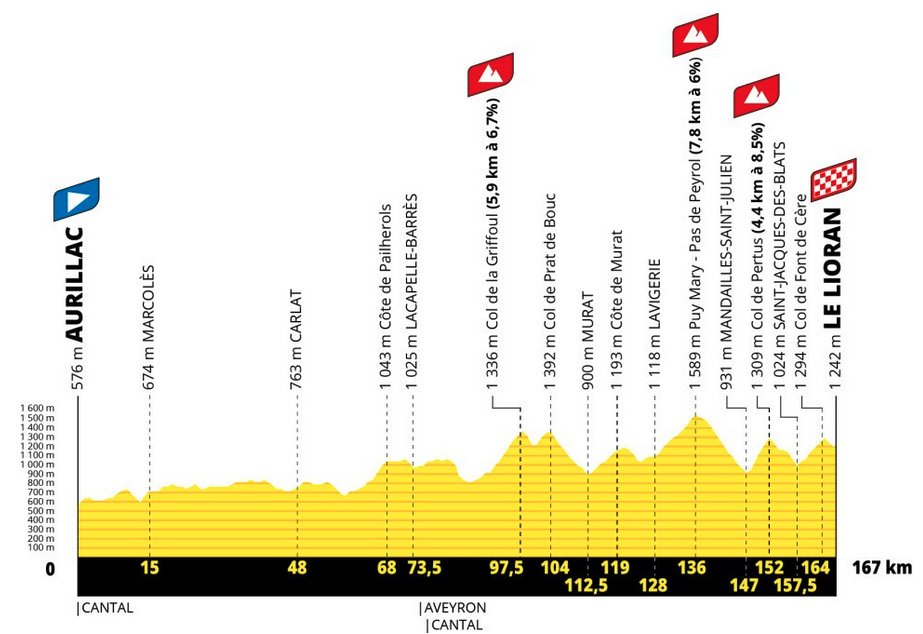
It’s back to Le Lioran for Stage 10 for the third time this decade after 2020 and 2024. Visitors to the ski station could be forgiven there’s only one way there as the same roads are used again, the steep Pas de Peyrol and the Col de Pertus leading to the Font de Cère. It’s the 14 July and another good day for the breakaway but we could equally see UAE and Visma-LAB drag race the peloton to the Puy Mary.
After a rest day in the Cantal Stage 11 and Stage 12 are sprint stages and visit locations like Nevers and Magny-Cours seen in this year’s Paris-Nice on the way to Chalon-sur-Sâone.
Stage 13 is the longest in the race at just 205km. It starts in the Jura mountains before going to the Vosges with the Ballon d’Alsace before the finish in Belfort. The Ballon has its history as the first major mountain scaled by the race and it remains a hard climb.
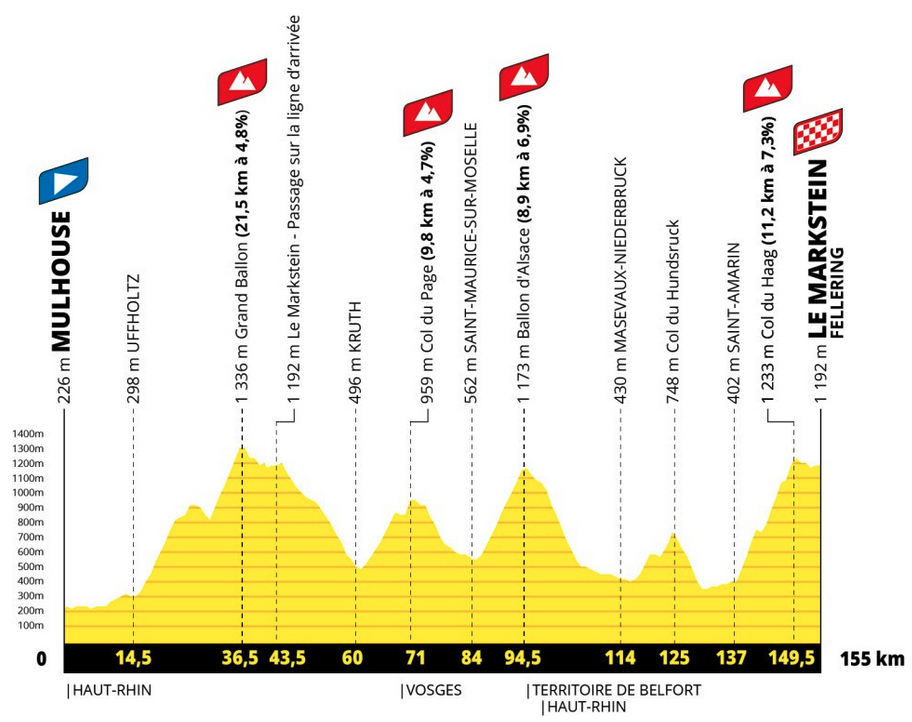
Stage 14 is an Alsatian mountain stage. It goes via the Grand Ballon (not to be confused with the Ballon d’Alsace) to the finish line at Le Markstein before tackling the Ballon. The Col du Haag has been crossed many times before via the main road the top but the novelty this time is the ascent. It’s the Col de la Loze of the Vosges, a dedicated cycle path closed to traffic and steep in places. At the top a left turn along the ridge to Le Markstein.
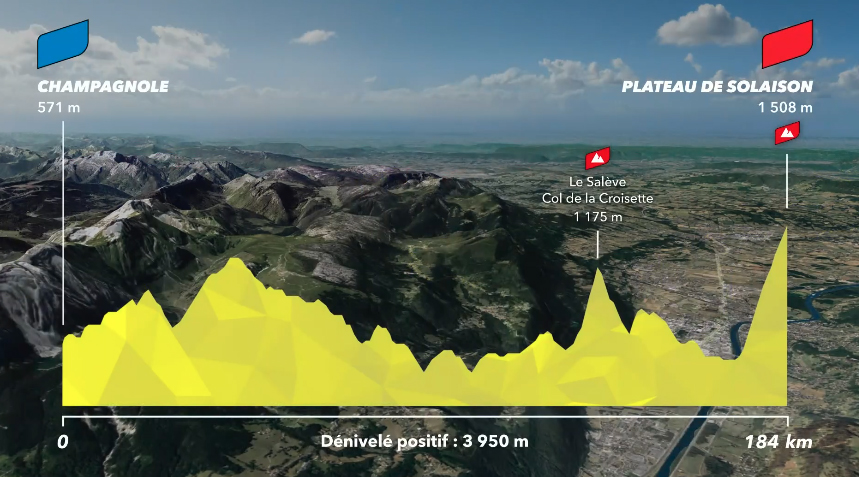
Stage 15 goes into the Alps but it’s out of the Jura mountains first and via the Col de la Savine and other lumpy roads. The new climb is Mont Salève, climbed via the direct route on the north-west flank, 9km at 9% is hard to start with but the upper half has sustained sections at 14-15%. There’s still about a third of the stage left before the final climb to the Plateau de Solaison, 11km at 9%. Last seen in the 2022 Dauphiné, Primož Roglič won the GC arm in arm with Jonas Vingegaard who was half a wheel ahead to win the stage.
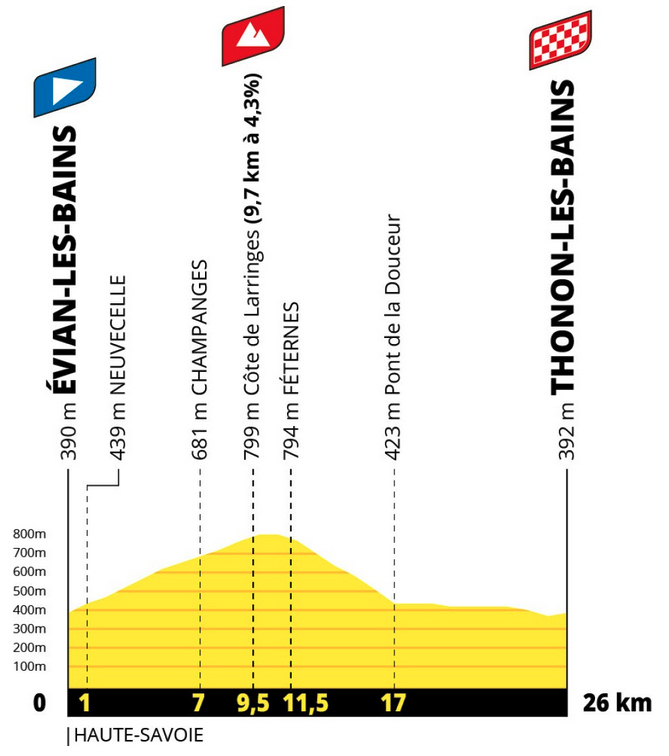
Following the rest day in the Haute-Savoie Stage 16 is the only time trial of the race and 26km between Evian where the water comes from and Thonon, it leaves the shores of Lac Léman with some climbing along the way to tilt the stage towards the GC contenders away from the specialists.
Stage 17 has plenty of jagged peaks and cliffs on the horizon but tries hard to avoid the mountain roads. It still crosses the Massif des Bauges and climbs to the Col du Frêne before dropping back to skirt the start town of Chambéry and then take the Col de Couz before the route reaches the plains for Voiron which hosted the Vuelta’s French arrival earlier this year. Sold as a sprint stage many will be tired now and this is a great day for a breakaway battle.
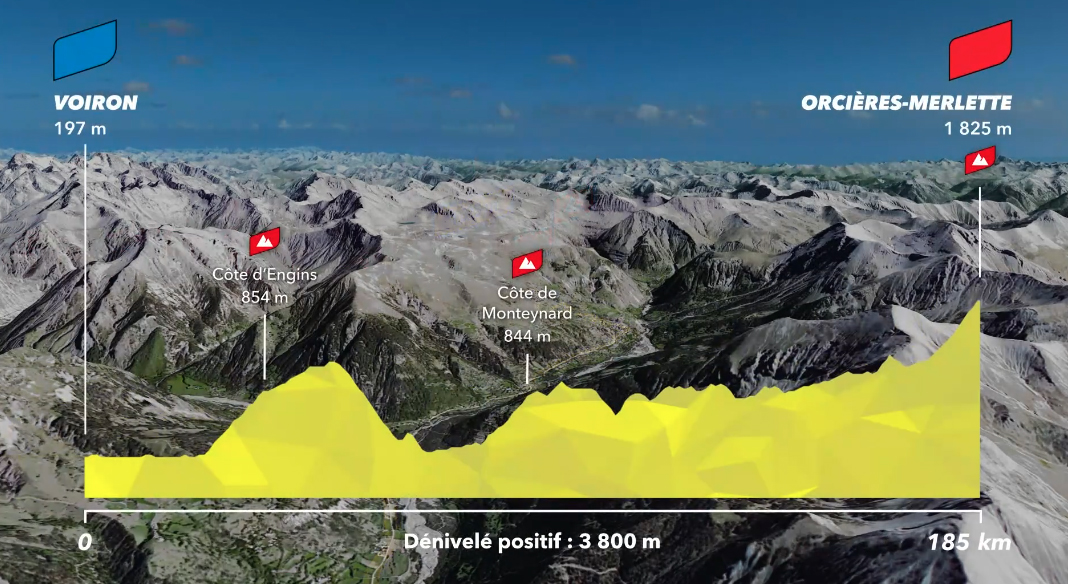
Stage 18 is a ski station summit finish but avoids the high passes, the Col de la Festinière comes after Monteynard and no surprises before the finish in Orcière-Merlette, 7km at 6.5%. It featured in the 2020 Tour and this was instructive but not thrilling as the lower gradient meant teams rode in train formation and anyone who struck out was mown down.
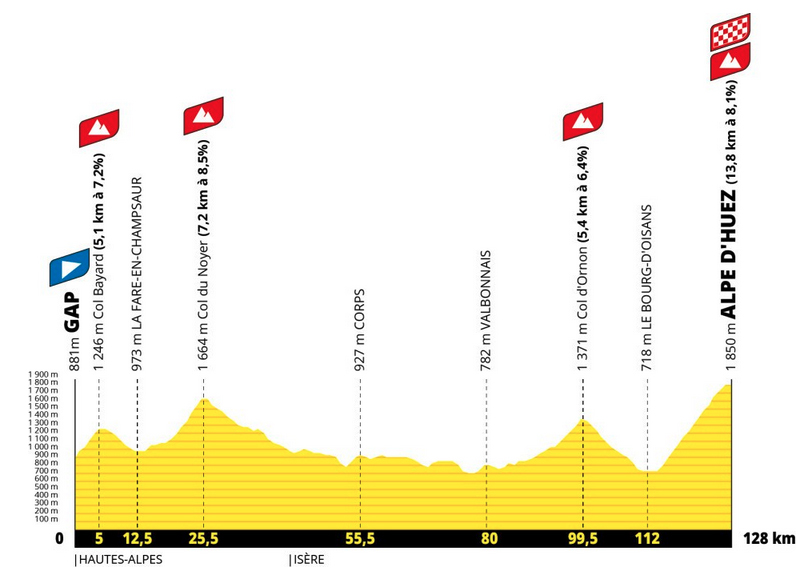
Stage 19 and the Bayard and then Noyer climbs will sting early on as a move tries to go clear for the day. The Col d’Ornon is a gentle climb before a scenic descent to Le Bourg d’Oisans. Then come the 21 hairpins – 23 if you actually count them – to the finish line in Alpe d’Huez, back after a four year hiatus. It’s almost famous for being famous but with 13km at over 8% it’s just a hard, decisive climb.
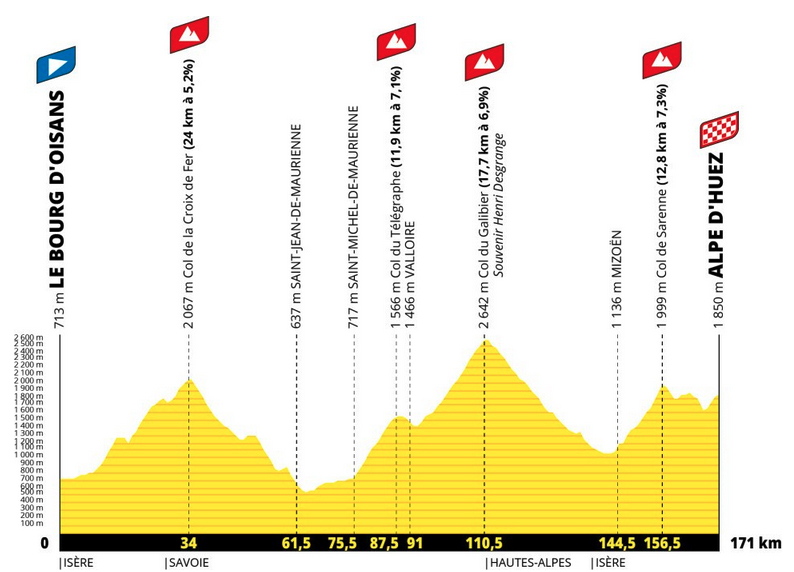
Stage 20 After the peloton’s had a rough night’s sleep at 1900m here comes the Queen Stage with 5,600m of vertical gain. The Croix de Fer is a big start and then comes the mighty Galibier, the high point of the Tour. The plot twist is rather than a descent to Bourg d’Oisans at the foot of Alpe d’Huez, a right turn to tackle the Col de Sarenne which leads onto Alpe d’Huez via a backroad. The Sarenne has been used before but as a descent and the climb is tougher than the stats suggest.
Stage 21 and it’s back to Paris with the Rue Le Pic and Montmartre making an encore only this time with a longer passage along the Champs-Elysées in between to lengthen the laps and give some riders more chance to chase.
Summary
54,450m of vertical gain in total which makes it the third most mountainous in the last 20 years (the average is 50,400m) but a lot of this climbing is away from the set-piece mountain stages and reserved for the battle stages in the mid-mountains. There are seven summit finishes but some of these are mild like Les Angles and Gavarnie. One solo time trial with 26km makes it the third lightest for TT distance in the last 20 years (average 50km). The sprinters get five clear chances, the same as last year but those with range have a shot at more.
The start in Barcelona obliges an early visit to the Pyrenees and so these are more hors-d’œuvre than main course. Indeed the route seems designed to leave the reveal of the winner for as late as possible and spice up the race with mid-mountain stages that look promising for frantic breakaway days although even better if the big names want to try too.
The line from Christian Prudhomme seems to be that anything could happen so late into the third week and before that there’s a good chance the yellow jersey is on loan rather than settled. There’s no realistic course that would trouble Pogačar – a blend of 21 sprints and time trials could generate a different winner but the ratings would crater – and so even if we think we know the winner already, plenty of stages along the way offer amusement and the sprint siesta stages are mainly mid-week.
This post looks into the men’s route, they’ll be follow-ups doing the same for the women’s route and also looking at other details, comments and trends soon.
Stage 8 is Perigeux Bergerac. Think you have transposed stage 9 profile/route in its place..
Great write up, thanks
The profiles sit above the description, hope it makes sense?
I feel like Pog has got to the point where people now want to see him win to equal/break records and this can override disappointment that the race isn’t close. I think this sentiment alone should make the next two TDF’s an interesting public spectacle. Interestingly, I don’t recall people feeling the same way about Froome when he was dominant.
Not sure who those “people” are. I follow cycling almost religiously and haven’t met anyone in real life who shares that view. On the contrary, I think the more dominant Pog becomes, the fewer viewers his races will attract.
I am one of those people. Wouldn’t call myself a fan, but I enjoy watching someone repeatidly pushing the boundaries of human abilities with such enthousiasm.
I find uncertainty in the outcome is only one aspect of enjoying racing, witnessing greatness in action is another. Admitidly I feel a bit let done by Jonas, as every good story needs a good struggle and last tour was underwhelming in that regard.
Most casual followers I discuss with don’t really mind Pog’s dominance, as the narrative always falls in either A) he’s a cyclist, therefore he’s doped, so if he wins he mus have access to bettter doctors/products or B), all cyclists are doped, so if he wins he must be slightly better than the other doped cyclists. Dominance has always been a defining feature of bicycle racing (Froome, Lance, Indurain, Hinault, Mercks, Anquetil, Coppi, etc.), so nothing much is new here for a casual observer. And as for doping, as Mr INRNG has repeatidly pointed out with much wisdom, in the absence of facts these opinions rarely lead to interesting or constructive discussions.
The point isn’t necessarily that someone is dominant. As you have pointed out, in grand tours at least, generally someone always has been. The years where we have no real definite idea who will win the Tour are outliers.
The difference is the extent of Pogacars dominance, which is at or very close to Merckx levels, but even more than that is the style of it. Someone pointed out in one of the Lombardia threads that Merckx occasionally had the good grace to win in a sprint, or even get beaten in them. Pogacar wins a sprint somewhere between 110 and 40km from the finish and wins by minutes. If he was going to the line with someone else there would be an element of suspense that would make it exciting. Then on top of this it isn’t just him. Van der Poel wins ‘his’ races in exactly the same way. A cyclocross race or any cobbled classic that Pogacar isn’t in is completely unwatchable if Van der Poel is in it. As if that wasn’t enough, Evenepoel does it too.
I think saying Pogacar is dominant just like all the others before is ingenuous really. The style of dominance by more than just him and the way the races play out, the actual sport aspect of it, has changed fundamentally. It’s either a permanent thing because of modern sports science, and the next generation of great riders will do the same thing, or we are just in a period of incredibly dominant riders. Either way just pretending everything is the same as it was 10 years ago and ignoring it is pointless. Bike race organisers always looking to add hills to races to make it more interesting and having the complete opposite effect, fuelling the dominance need to have a serious rethink too.
Also, just to make things even less interesting, Del Toro has got in on the act. Hilly races in Italy 160-200km in length aren’t won by anyone else. Italian one day races are reduced to audioless travel documentaries. The only reason to watch them is to have a look at the scenery.
My take on this is that Pogacar does it the hard way because he has to. If he comes to the final with a handful of others he is in trouble.
It seems like only yesterday when no one would attack and I can remember Merckx being quoted as saying that you have to back yourself. Pogacar does and others are now taking a leaf out of his book.
I find this a lot more convincing than the rider who simply proves to be the cagiest.
The point is though that he, and others, always can. Every time. As you say, it’s supposed to be the hard way. Its not the hard way if it happens all the time. It’s just the way. My point about the sport fundamentally changing is that long range attacks aren’t a gamble anymore. Merckx and Coppi are famous and all time legends because they could do it, sometimes. Now it happens in every bike race you watch. The only ways I can think to tip the balance back the other way is to make all races pan flat or 400km long.
Before the roads were paved with asphalt, long-range attacks were the normal way to win races. Coppi was at the very end of this era, and he is supposed to have gone years without getting caught after an attack.
Riders like Anquetil, Hinault and Indurain dominated the Tour by winning time in the time-trials and then riding defensively in the mountains. Everyone found attacks by climbers romantic in this era. Apart from Merckx, GC riders largely did not launch attacks only in order to win stages.
I think it is too early to say that we are returning to “long-distance attacks” being the winning strategy. It will depend on what happens after Pogacar: will the next dominant GC rider also regaularly launch long distance attacks that succeed, or will Pogacar be thought of as an extraordinary talent like Merckx and Coppi.
I entirely agree with Richard S, and I’d also place some blame on the other riders. In almost all of the races where someone (usually Pog) attacks from far out, the group of chasing riders singularly fail to organise themselves into a chase. If they did so, they would at least sometimes catch him (if the terrain is not too mountainous). That’s not going to happen in a monument, but in some of these races there are 40km of flat terrain at the finish and 10 riders not going through and off properly. (Sean Kelly used to say that the attacking riding was like watching junior racing – I imagine this failure to organise a chase is also what happens in the juniors.) And you never see the riders talking to each other anymore – are they incapable of working together? Can’t their DS explain it to them?
The commentators then trot out the usual line of nobody wants to use their energy because then they’ll lose at the end, but when are these riders going to realise that they always lose? (Or are they happy to lose, like Michael Storer coming third in Lombardia and wildly celebrating?)
The commentators also seem to be stuck in the past, and whenever Pog goes they still question how he will possibly make it – they seem to mean it (Hutch even said it in the WC), but if they’re being disingenuous, that’s even more irritating.
I only hope that Richard S’s frankly terrifying prediction that this is how racing could always be from now on is wrong. All of the tactical interest in these races is gone – and that’s the interesting part of the sport.
Also, riders like Froome, Armstrong, Indurain, etc. dominated the TdF. Pog dominates almost every race he’s in, over a wide variety of parcours.
And he clearly could have won more stages at the TdF this year and the points jersey with ease, but chose – for whatever reason (fear of unpopularity? fear of suspicion?) – not to exert himself. For me, that made it even more dull, him just letting others win.
To make my point above more clear, GT leaders have always let others take stages, but they would let a break go by many minutes and then we would have non-GC riders battling out for a stage. In this year’s TdF, on a few stages, Pog had his team chase down a break so that he was very close behind the leading rider, and thus we all knew he could win the stage if he wanted to. And then he sometimes decided not to. Stages 14, 16, 18 (I think), 19.
The stage Arensmen won this year was a farce, and there was the stage in his Giro where Pogacar clearly didn’t want to overtake Pellizzari but pretty much couldn’t slow down enough and he ended up apologetically beating him.
My thought that this is the future of cycling is based mainly on the amount of riders that ride this way now. You can see Pedersen effectively being a quasi-Van der Poel now too, to Del Toro’s plastic Pogacar. They say you can’t put the genie back in the bottle and I suppose now they have discovered a cyclist can consume an unlimited amount of carbohydrates they aren’t going to stop doing it just to save our boredom. Bike race organisers can stop putting extra hills in the finale of bike races though. One hill where your big shot takes off is fine, La Redoute say or Oude Kaweremont, Ghissalo. But more repeat hills thereafter just extends their gap and underlines the tedium. Do they have to go up Kwaremont 3 times in Flanders for example? Do they have to go up the Patterberg after it? Or would it be better to have a cat and mouse chase? Is there a need for some fiddly steep hill through a cobbled village in every time trial? The sport has changed and route thinking needs to too.
Arensman was the most obvious ones, but in the others I mention, Pog just didn’t get as close.
I watched this year’s Tour as a collection of (very entertaining) one-day races for the first half and then mostly stuff to fast-forward through in the second half of the race.
I completely agree with you on course design (and that the race organisers won’t change it) and suspect you’re right about the feeding, depressingly.
I do also think, though, that other riders need to (re-)learn how to work together in order to chase someone down. At the moment, even if you have a flat-ish finish, still nobody chases Pog properly.
I’m beginning to wonder if the reason riders no longer talk to each other and organise a chase is because not only are they radio-controlled but that nowadays most DSs were also radio-controlled during their careers. This could be radio-paranoia, though – but I simply cannot comprehend their continued failure to grasp this most basic of tactical points.
J Evan states: “other riders need to (re-)learn how to work together in order to chase someone down”, and comments about Kelly’s criticism of the non-cooperation.
Up until Kelly’s era, the leading riders used to ride the same races together regularly throughout the season. And they used to return “favours” (Kelly kept of book of whom he owed a favour). This meant that riders in group 2 could agree to chase since if one benefited, then he returned the favour in a race later in the season. They also didn’t much care about minor places (since UCI points were not “a thing”).
Co-operation is much harder now since riders ride such different calendars they have no opportunity to return a favour. And UCI ranking points increase the incentive to free-ride (e.g. not co-operate in the chase). The UCI points system has also incentivised domestics to get some UCI points.
I see your points, John, but it’s also true that in an individual race if you have six riders chasing Pog, they have two choices:
a) Work together, perhaps catch him, have a chance of winning if they catch him.
b) Definitely lose.
They always chose b). They always fail to form a decent chase; they never work as a unit. And often they will try to attack away from that group on their own. Only then will the rest make an effort – in order to catch that rider. And that rider, if they did get away alone, would have zero chance of catching the superior Pog.
But it only happens every single time.
(And rarely do these chasing riders work for teams who need UCI points. Few teams need the points, and riders from those teams aren’t usually good enough to be up there in the races that Pog is riding.)
Two comments in reply to J.Evan. This is how I read it, although I understand people might disagree.
“Few teams need the points…”
“…have a chance of winning if they catch him…
Unfortunately, winning has become relatively less valuable even if that is what we fans care about.
Up until c.1990, a rider’s value depended on their ability to win races (or for domestics, help their team leader win races). Coming 3rd or 7th had no value. After the ranking system was created, coming 3rd/7th created ranking points (eventually UCI points) on which the rider can be valued. Teams know how many UCI points a rider scores, and pay them accordingly. This makes coming 2nd/3rd/7th etc valuable to the rider in a way that wasn’t valuable in the past, and increases the incentives to free-ride. [TLDR: UCI points are valuable to the rider even if they aren’t for the team.]
PS. Incentives for minor places.
One of the changes in races is that many more riders now finish the big classics than finished in the past. In the early 1980s riders climbed off their bike once they were dropped, and normally only 30-40 riders finished. (In Lombardia, only once in 1961-1988 did more than 50 finish).
UCI points now go down to 60th place. Nowadays riders will finish the race after they are dropped in order to get some UCI points. Normally over 100 riders will finish.
Good points, John, but usually the riders who are immediately behind Pog in a small chasing group are top-level riders who don’t need points in order to build up their reputations.
Look at the WC – Evenepoel, Healy, Skjelmose, Skujiņš, Ciccone, Del Toro, Ayuso.
Of them, maybe – and only maybe – Skujiņš might feel like he needs to build up a points tally.
I’m pretty sure you could look at most of Pog’s wins and see a similarly impressive list of names in the group behind him who are not working together.
However, I do think this is a reason – and one that many of us said before the points system was brought in – not to have a points system.
PS And Skjelmose, Skujiņš, Ciccone and Ayuso (next year) are trade team mates – and they still couldn’t work together properly.
BTW, Lidl-Trek signing Ayuso on a five-year deal. Why would you sign a rider who has shown himself to be so flaky on such a long deal? I’ll predict right now that that will be a terrible deal for them.
@J Evan:
“BTW, Lidl-Trek signing Ayuso on a five-year deal. Why would you sign a rider who has shown himself to be so flaky on such a long deal? I’ll predict right now that that will be a terrible deal for them.”
I bet that Trek too care to load that contract with more options than the Project One website.
“Ayuso on a five-year deal”
It may seem crazy, but the buyout was rumoured to be 10 million. It can be amortized over 5 years (hence 2 million per year). If the deal was only two years, then that is 5-million per year, and wouldn’t be viable. The only way to make the transfer work financially is to sign a long contract.
J.Evan states: “Evenepoel, Healy, Skjelmose, Skujiņš, Ciccone, Del Toro, Ayuso…don’t need points”.
Actually, even at the Healy, Skjelmose level, the UCI points make a difference at contract negotiation (you would be surprised). Probably only Evenepoel can afford to ignore getting 2nd or 7th. My opinion of course.
The pressure to introduce the UCI points system came from the Tour de France and the teams. Before it was introduced, races had complete freedom to invite whomever they wanted. But by the late 1980s, too many teams were trying to race the Tour de France, and ASO had no way to choose between them. The choice could bankrupt a team not selected. Hence the Tour pushed for a ranking system to aid their selection, and it was introduced ready for the 1989 season.
A second consequence of this was that teams hired additional riders to ride the classics that their Tour leader was unsuitable for, and got much bigger squads. They became multi-leader squads with different leaders in different races. And it made the races on which the ranking was based much more important (Flanders particularly benefitted from this).
I mostly agree—I haven’t seen any evidence that Pog is involved in anything illegal, so despite my distrust of UAE, I’ll give him the benefit of the doubt.
My only disagreement is that, in my experience, very few people follow cycling just to watch a dominant rider. They follow it for the struggle. If this results in a dominant rider, that’s fine! But if the struggle is absent and all we see is a rider repeatedly winning by huge margins, then interest, in my opinion, drops like a stone.
BTW: I know this discussion feels academic and repetitive, and we can’t do anything at all to change it.
There’s a mix, some people want to see a contest (I’m here) but plenty will watch because they’re seeing a once in a generation athlete, the same way that people who didn’t care for basketball would sit down to watch Michael Jorgan, golf got big audiences from Tiger Woods etc.
But these are hard wishes to make true. A contest isn’t just Vingegaard being a bit closer, and Evenepoel securing third place, it’s seeing a breakaway take time early to propel an outsider up the GC, it’s a day when Pogačar or Vingegaard cracks or punctures and loses time and has to fight back, when fortunes are reversed several times and it goes down to the wire. You can’t really create a course for this either.
Valid points all around, though I think there’s a noticeable difference across sports. I’m not a big sports follower, but I really enjoy watching exceptional athletes in action. Like others have mentioned in these threads, I always tuned in for Usain Bolt (and other star sprinters before him) in the 100 and 200-meter dash. If I remember, I’ll also try to catch highlights of Armand Duplantis pole vaulting, along with a few others at that level. That said, I don’t sit through the entire three-hour pole vaulting finals—I usually just watch the last 5 or 10 minutes live or on YouTube. I wouldn’t be surprised if that’s how many people follow Pog.
I’m too busy (or lazy) to look it up, but someone shared a link about declining Tour viewership, and I’m pretty sure it shows that fewer people sit through the full end-to-end stage broadcasts.
I don’t blame ASO or Pog—they’re doing their jobs. But I don’t trust UAE, and Pog’s dominance on the back of that is definitely a turn-off for me.
Horse racing sometimes has weight penalties for successful horses. They are called handicaps. Just an idea.
Motorsport has BoP (Balance of Performance) which is more or less the same thing……
Another name for both is ‘fixing’
My family is these people. We travel 1000’s of miles to catch a glimpse of the world’s greatest athlete. The more he wins, the more we watch. We head to the Pyrenees and appreciate the spectators (local French & Spanish but also Columbians & Ecuadorians) and love seeing the whole peloton, but without Pogi, we’re doing something else for summer vacation.
I like your sarcasm. 🙂
My family is these people. We travel 1000’s of miles to catch a glimpse of the world’s greatest athlete. The more he wins, the more we watch. We head to the Pyrenees and appreciate the spectators (local French & Spanish but also Columbians & Ecuadorians) and love seeing the whole peloton, but without Pogi, we’re doing something else for summer vacation.
Maybe I’ll catch the TTT live since it’s nearby, but if Pog is leading or close afterward, I’ll probably skip the rest of the Tour. For me, cycling is all about the race and tactics. When it becomes a one-man show, I lose interest. Honestly, I find Pog even more unbearable than Froome. But to each their own.
Not to challenge too hard – although disagree, other than Slovenians and dedicated Pog fans most people I know find his dominance entirely yawnsome and actively bad for the sport* – but Froome had plenty of haters. He literally had urine chucked over him during races.
*in that it ceases to become a sport at all
@David Q I don’t think you’re right there. Froome was viewed more in keeping with Pog – maybe a bit less favourably due to the Sky train tactics – until the salbutamol case in 2018 when he’d already won four Tours. That’s when the negative feeling really ramped up.
Froome only faced the wrath of the crowd once he failed a doping test (for which all others were banned) but then he was found to have miraculously not doped, the reasons for which were never given, other than to claim he was physiologically different from others.
The reason was given. It was a fundamental one. The test was shown to be not fit for purpose.
Yes, now tuning in to see a master at work, interested in just how far he can go. And also… to see the moment this run comes to end. Because it must. This course looks set to deliver some grandstand moments whatever pans out. Very interested to see how Visma and Red Bull manage the TTT.
(I’m not sure Froome ever had armies of fans, he certainly had many detractors. But he was a GT specialist and we could always tune in to see others dominating in the Ardennes or World Champs. Froome’s GT palmares is almost unmatchable, but doesn’t have the breadth of Nibali, for example).
He dominates the conversations at times too. I think here organisers ASO don’t mind if he wins but they want suspense. This route is a bit like a Giro where the big stages come very late so we don’t know the winner until late into the third week. But as we saw with Pogačar’s Giro win, he’s not likely to sit still and mark rivals.
On stages 19/20
Lolz that Sarenne was ever used as a descent. It’s no surprise it’s not happened again since – no-one should ever race down that road. As a climb though (obviously dominance of one rider aside) it should be ace. I hope it’s competitive enough to do it justice so they come back again.
And the fancy goat hut built into the side of a massive boulder is about to become famous.
On the flip side, the descent off Ornon is great fun, and sweeping and windy enough that it could encourage an attack – the bottom is very close to the start of d’Huez.
Agreed ! Hopefully they will resurface the road of Sarenne or at the very least fill in the potholes, as it’s an absolute minefield. Even on the way up at the speed these guys go this could be nasty.
True, I was there in September and the road is in terrible state on both sides. It only improves once you reach the first villages while descending towards Mizoen.
There’s a good chance the Sarenne gets resurfaced next spring, the Tour is a regular prompt to get roads repaired. Just as people used to joke that British Queen probably thought the world smelt of paint because everywhere she visited was probably freshly painted for her arrival, Tour riders might think France smells of bitumen.
Ornon is very scenic and should be on people’s list if they’re drawn to ride for a few days in the area to try Alpe d’Huez.
June is the time when you ALWAYS encounter roads with gravillons in France as they do their work ahead of the tour. Nothing worse than that,
Granted, there´s nothing as bitter-sweet as encountering a section of newly laid base of gravel or crushed stone. You blame yourself for not checking the info on current roadworks when you planned your route and you feel sorry for missing the wonderful feeling of riding on the new, smooth asphalt.
But I thought that in France resurfacing would usually consist of just milling the old asphalt and then laying the new one?
I think it depends on the region but in the Alpine departments in France, where the weather conditions are rough, you mostly encounter porous asphalt, which is placed on a gravel base. Hence whenever I was there in June there were roads with gravillons where the repair works took place (this year I had the “pleasure” to ride on it on Cormet de Roselend, Col de Grand Cucheron or Col de Tamie).
I feel it would be a shame to resurface Sarenne since they will be riding up, not down.
Sorry, I didn’t mean to post anonymously
I think they used the Sarenne in the Dauphine in the mid-2010s? The stage was won by Pete Kennaugh if memory serves, he was in a break with Ben Swift and others.
correct. 2017 edition
https://www.procyclingstats.com/race/dauphine/2017/stage-7/info/profiles
Of the climbs I’ve done in the Alps, the Sarenne is my favourite. Unfortunately I had to turn around at the top because of rain – we ended up sheltering in a restaurant, shivering with cold, and being transported back to Bourg in a van – and the first part of the descent was very unpleasant indeed. As well as the terrible surface, there are no barriers and in places it’s a very long way down.
I intend to ride it again next June and hope they’ll have resurfaced it by then.
To me, this looks like a Tour where Pogacar can really use a lot of energy in the first two weeks without getting much time difference out of it. Then the differences can be made in week three.
I like the thought of trying to do something about his dominance, I just think that he is getting too clever for falling into this trap.
And what a let down with two Alpe d’huez ascents.
They aren’t really climbing the Alpe twice. The second day they will arrive along a balcony road from the Sarenne.
Not into the new TTT format, especially not now. It could have been a leveller, at a time when we badly need one, if they had taken the time of the team and used a flat course. Bit of course there absolutely has to be a hill, so Pogacar will rollock off on his own and win yellow. I suppose it will look good on instagram though, with all those little reels of the commentators getting excited about Pogacar attacking.
I think it works well on ordinary TV too as a visual thing but like your point that if it was totally flat then there’s a chance UAE and Pogačar would be behind Visma-LAB and possibly Red Bull, maybe Lidl-Trek and Ineos ahead too. But see the Paris-Nice race this year where they had a strong team but without Pogačar and messed it up, 8th and even behind Decathlon and EF.
It’s an ITT with a bit of pacing.
A bit as in 90% of pacing together, plus the team is declared the winner 😉
Yes, it’ll be UAE propelling Pog to the climb and Pog beating everyone else on the climb. How thrillingly original.
So people will be camped out for two days on the Alpe? I bet the local shopkeepers are rubbing their hands together!
I suppose ASO point to the TTT format as being an “ITT hybrid” if people complain about the lack of TT km’s.
The only thing I can think of that would dent Pogacar’s chances is, if it’s really hot and he suffers. Otherwise barring accidents, a repeat of 2025 looks on the cards.
Actually, I think a repeat of 2024 looks on the cards.
You wrote:
“There’s no realistic course that would trouble Pogačar” – might as well had written:
“There’s no course that would realistically trouble Pogačar” 😊
Was thinking someone could call for a blend of 21 flat time trials and sprint stages so wanted to pre-empt that.
The TTT will benefit the big teams a lot – and they don’t need it. Pog could wear yellow from start to finish.
He could but he surely won’t want to, the daily media rounds and other duties got to him. Instead the likes of Ben Healy, Simon Yates, Romain Grégoire, Mads Pedersen, Tom Pidcock and others have a good chance to take yellow soon after the race leaves Barcelona.
How many riders have worn yellow from start-to-finish? Maybe if Pogacar finds himself in yellow after day 1, he might just attempt it (but who knows, maybe he won’t).
For those of you wondering, it has been done 4 times (I think).
Surely, the only impressive feat left for Pog is to win all three GTs in one season.
I still think he should have tried it in 2024. He’d probably have won the Vuelta – Rog didn’t look that good.
Apparently, Pog’s team mates didn’t want him to do it – but when do they ever win GTs? He should have said to them, ‘I’ll do it this year to try to win the trifecta, and then I won’t after that’.
Two things : first, the road of stage 10 is not exactly the same as the last times the Tour came : the ascension of Puy Mary is not by Neronne and the infamous last km, but from an easier side by Lavigerie. The last km is also hard, but less than from Neronne.
On stage 12, I would be very disappointed if they don’t pass by the hills of Morvan, but it seems they won’t… There would have been room to make an exciting stage like the Creusot one in 2021.
The way the TT kms are in the 2026 Tour, it seems like ASO either a) don’t believe in Remco as a legitimate contender; or b) welcome the spectacle of Pog dominating for his fifth win, or maybe it’s both. A more decisive TTT or a pan-flat 40 km ITT would have been more likely to shake up the normal order of things a bit. These TTs seem to be designed to minimize the chance that Pog/UAE will be seriously disadvantaged by them.
I don’t think its anything necessarily intended to suit a Pogacar win. I just think they are completely gormless. I still think that in their minds they believe they have to put more punchy hills in and have shorter hillier TTs to Stop Froome and Sky dominating and give Bardet a shot. Either that or they have thrown all their eggs into making the Tour more like Vuelta and don’t want to change now.
Its just how bike race organizers think, more hills = better, when in the current situation the total opposite is true.
Longer and flatter TTs could help Evenepoel get a lead on Pogačar but surely at the same time Pogačar is likely to finish second to him and with this put time into almost every GC contender too? See the Giro where the TTs saw Pogačar pull out a lead on all his rivals each time.
I’m a big Jonas fan but I don’t like the idea of relying on a Jonas-Pog battle for entertainment purposes. I felt like the last week of the 2025 Tour was a bit of an ugly slog. I’d be willing to risk a dull race with Pog taking lots of time in TTs for the chance that he wouldn’t, because it takes some of the UAE dominance out of the equation. One of the things I haven’t enjoyed is the way UAE has been able to control breaks so effectively (but only when Pog is there!), so the wild unpredictability that we hope for seems so unlikely on stages that in the past might have been difficult to control. Also, when Visma is on the front foot but Pog is able to follow, it’s another version of the same thing. If somehow Remco was able to get a lead of a minute plus, I would like to see how everything would change, at least temporarily. Alas, it seems like absent a major drop in form, Pog will be in control from stage 1 of the 2026 Tour.
Exactly.
The recent announcement re the E3 Classic route next year is another example of bike race organizers being capable of only one line of thought.
‘Van der Poel smashes everyone to pieces on the hills and coasts to victory, what should we do?’, ‘dunno, put more hills in the route?’, ‘yeah, good plan’.
Looking at the website for E3 Harelbeke (or the Saxo Classic, if you prefer to call it that), there were 17 climbs this year, and 16 next year. The route is just over 200km with a flat 20km run at the end. Which is more-or-less what it was last year. I am not sure it has really changed much. Unless I have missed something.
More ITT may improve Remco’s chances, but they would likely worsen Jonas’ chances. The organisers may feel giving Jonas a shot is more important for the spectacle. They also know that TTs do not get much of a TV audience compared to other kinds of stages. We should also be aware that the course is mostly designed more than a year in advance, and it has to satisfy local stakeholders.
Another point:
In long time-trials it is difficult for teams to support each rider with a car+spare-bike. They normally only have 2-3 vehicles. A 40 km TT means 50 mins racing + 30 mins to return to the start for the next rider. This is too long to support every rider in the team. A shorter course means each rider can have a support car. I assume this is a key reason for the end of the really long ITT.
Less for the support I think as a lot of the riders are not racing for the win, teams can have two cars for their top riders, then other vehicles with a mechanic and spare if they have others racing hard for the day. These days only a few riders set off with a following vehicle not from the team and a pair of wheels in the back. This could be an issue though if there was a TTT with normal rules and then a TT within a few days and not much in between as riders could go off in groups.
ITTs in waves are good enough for National and World Championships.
Each team has two cars in the normal race convoy and at least a couple more to cover the feed zones, so they will have enough vehicles to do at least four riders in each wave. Running order could be tweaked to have the team’s top three on GC and a rider they nominate as a stage win contender in the second wave, the rest in the first wave.
A more radical way to achieve it could be to cave in to demands over taking the GC times at some distance short of the finish line (3km/5km/10km/final lap etc) on sprint stages, and reciprocate it by allowing riders who race the whole of the sprint stages to ride ITT stages as a group in the morning and get group time at the start of the final climb for any C1/HC summit finishes.
I wonder what they did in 1947 when they had a ITT of 139km.
Even in 1984 they had 67km ITT, lasting 90 mins. Similarly they had 75km ITT in 1985; 87km ITT in 1987 (that was two hours long); 78km ITT in 1989; 73km ITT in 1991. These long time-trials had huge time differences.
These stages were all before the mountains were reached and times are still close. I have no idea how they managed to support the riders, since the cars would not be able to support a rider and get back to the start for the next rider.
In 1991, the itt on stage 8 had 73km and in 7th place with 1:37 behind Indurain was Abduzhaparov in green.
As a Dane I try to look where Jonas can find the advantage, not easy.
Two questions, do you get the route early before it is published? Which stage would be best to watch and why?
It’s probably why Vingegaard is going to the Giro next year, I think we could see this coming on the evening of the Hautacam stage this year (did write it here somewhere too) even if it’s yet to be officially confirmed.
Still with hindsight Pogačar did complain of knee pain and so Visma-LAB could have tried more ambush racing in the Alps, particularly on the Col de la Loze stage when the team tried but then shut things down; but it’s hard to know how sore Pogačar was, perhaps not that much. We’ll see if a more relaxed Vingegaard with a Giro win in his back pocket can do better too.
He was saying in the moment his power numbers were great, later he was saying his watts were as good as usual but rival teams were measuring his efforts and thought he was below his best. So if he comes back at his best then we’ll see.
As for the questions
– no, but you can see some of the route details online early, but rarely what comes between. Almost nobody gets the route before the official launch
– picking a stage depends what you want and whether you can see more than a day but Alpe d’Huez is obvious for two stages, there’s plenty of riding if you have a bike but if you don’t it’s less scenic. If you have more time then catching the start somewhere is good and rest days can be fun as you might be able to tag along a recovery ride and for any stage the advice is to treat it as a long picnic, chose somewhere scenic to enjoy because when the race goes by it happens fast but a long mountain pass does give you more for longer
I am glad to see the Pogacar era. He has set the bar for the long rage attack that was once the domain of TV coverage riders or desperate to win riders. Now it seems everyone has a long range attack in them. Of course on VdPs turf the playing field levels or even tilts against Tadej but to see him get 5 would be a moment to remember esp in the WC jersey. Not that long ago Thomas was the first MJ to win on AdH so at least that honour has been taken.
Stage 6 finish is an absolute disgrace and totally unnecessary. I am not allowed to walk my dog in the cirque and they let the tour in.
Dogs badly disturb the wildlife, even when their owners keep them under control (and they often don’t). A group of cyclists will do much less harm.
Will it be a ‘group of cyclists’ or thousands of fans?
Races sometimes ban fans from the roadside for part of the route due to sensitivities about the wildlife. But I agree with your point.
That’s what I’m hoping happens, but I don’t know – hence the question.
As you say, they do that sometimes, so hopefully they will.
The Tour de France did it for a stage finish as recently as 2023 on the Puy de Dôme climb, and has done it a few times since on less notable spots.
Start to finish stage watcher here. I read plenty of comments here about the good/bad of Pog running away with the overall, which I’m split on myself.
I’ve always felt that the great fun of the TDF is the variety of other contests and stories. It’s such a multi-variant event that I’m always surprised, entertained or heartbroken by something nearly everyday.
On first glance I thought this seems like 21 days of Tadje in yellow. But on second thought, TTTs often throw up surprises, and with a yellow jersey on the line there will be a lot of hungry racers. It should be around a half-hour effort. Pog is really good at much longer efforts when everyone else is tired. Surely there must be some punchy riders who could beat Pog in this kind of effort. MvdP and Wout van Aert definitely have a chance, maybe Ganna and some others.
@JS
If Vingo is in the race, Pog will push close to his limit and likely win. He won’t concede seconds to Vingo until the hierarchy is established.
Without Vingo, he’ll puff his cheeks, act like he’s exerted himself, and willingly give up the lead.
When Pogacar did the Giro he definitely tried for holding Pink jersey for all 21 stages. He didn’t actually get it until stage 2, and then he kept it to the finish. It is certaintly possible (although some would say improbable) he could try holding yellow for all the stages in the Tour next summer where no-one has achieved it since the 1930s.
I’m sure you know but for completeness – the 1961 edition saw Anquetil announce well in advance of the race that he intended to hold yellow from day 1 through the entirety of the race. He did so easily. And boringly.
To complicate matters, Stage 1 was one of those split stages thankfully long consigned to the race’s history. A morning sprint won by Darrigade and an afternoon TT where Maitre Jacques smashed everybody else for at least two and a half minutes over less than 30kms. [But of course it’s TTTs that disadvantage the GC riders on lesser teams.]
If Darrigade wasn’t given a yellow jersey after stage 1a, and the wikipedia entry for the 1961 Tour says he wasn’t, then Anquetil was the only rider to wear yellow that year.
In either case he held it from stage 1 to the end where he was booed at the finish, L’Equipe’s circulation cratered, Jacques Goddet fulminated at the fiasco, there was talk of the future of the race being in jeopardy, and the decision was made to abandon national teams for 1962 and accommodate the pressure to make the race one for trade teams again.
Beat that Pogi!
OK, I guess it depends on how one views Darrigade’s victory in stage 1a. I did not include this as “yellow-all-the-way” but I can see how others may feel differently (and thanks for mentioning this case, it is a nice point). If this case is excluded, then the lat time this happened is the 1930s.
Imagine what the French would give now for not only a reasonably competitive GC man, but one that could ride a half decent time trial?!
I’m not so sure. Giving stages away to teammates might work well internally at UAE, but for the rest of the World it will look completely ridiculous if he has to slow down on the final ramp to let – say – Almeida or “plastic-pog”-IDT take the yellow jersey.
I’m liking the relative absence of long transfers
No mountain stage beyond 200km is not a Tour de France.
I know fueling has changed and everything, but I wonder if it would change anything to have a couple of longer stages before a potential “raid stage.” The most likely scenario would be Pog and Jonas taking even more time from the next tier of riders, but it might throw a little more uncertainty into the mountain stages, which have become almost entirely predictable.
I agree, Ferdi. People don’t seem to realise that variety is a good thing, and – more importantly – that a grand tour should test all aspects of riding, including endurance.
The nonsense dogma that long stages are boring has long since been disproven. The big teams don’t want this because they want control – they want everything to be about legs.
+1