

Tadej Pogačar attacked on the Tourmalet with 5km to go before summit and 43km left in Stage 6. In the picture above Jonas Vingegaard is out of the picture but only just, some 30 seconds behind at the top of the pass. But on the descent and then the valley road up to Gavarnie he multiplies this advantage by five to take back the yellow jersey and leave his rivals in no doubt they can’t dent him or his team.

The race started in Barcelona with a 19km team time trial, which with foresight was a selection trap for several teams who picked riders for the opening day but with less thought for what was to come. The “Paris-Nice rules” format probably needs a new label but saw Visma-LAB win with Jonas Vingegaard coming home first to take yellow, as good as their and his Tour would get.
Sunday’s stage told us plenty with Tadej Pogačar helping set up Isaac del Toro for the win and seeming more delighted with this than if he’d just won himself. He’d win the next day, for all the talk of riders not wanting the weight of the yellow jersey, Pogačar seemed privately determined to defrock Jonas Vingegaard, there’s a hint of spice to their rivalry that goes unsaid.
After a stage to Foix that saw Mads Pedersen score beaucoup points and put Torstein Træen in yellow we got a classic day in the Pyrenees. UAE set the pace all day and did another team time trial up the Tourmalet with a tailwind to launch Pogačar who set a record time on the climb, with chasers like Vinegaard at 30 seconds over the top and then Paul Seixas leading the others at 1m22s, still beating the old record too. Half a minute’s gain in 15 minutes of climbing was strong but it was the remaining 44 minutes of the stage that saw Pogačar extend his lead by over two minutes to finish 2m38 clear of Vingegaard and nearly three minutes on the next eight with the rest of the field scattered to the winds. If Pogačar won here, the selection made among the others was as crucial for the following three weeks.

The Tour had to use the Pyrenees given the start in Barcelona but what if the stage had been softened? Then Pogačar would have used the stage to Le Lioran instead, maybe the suspense lasted longer and gap would have been smaller but the psychological blow to rivals would have been as big. If Le Lioran was the next GC appointment when Pogačar attacked nobody even bothered to get out of the saddle and respond. When Pogačar attacked on the Col du Haag the others just chased and like the Tourmalet it was after the climb that Pogačar gained most time.
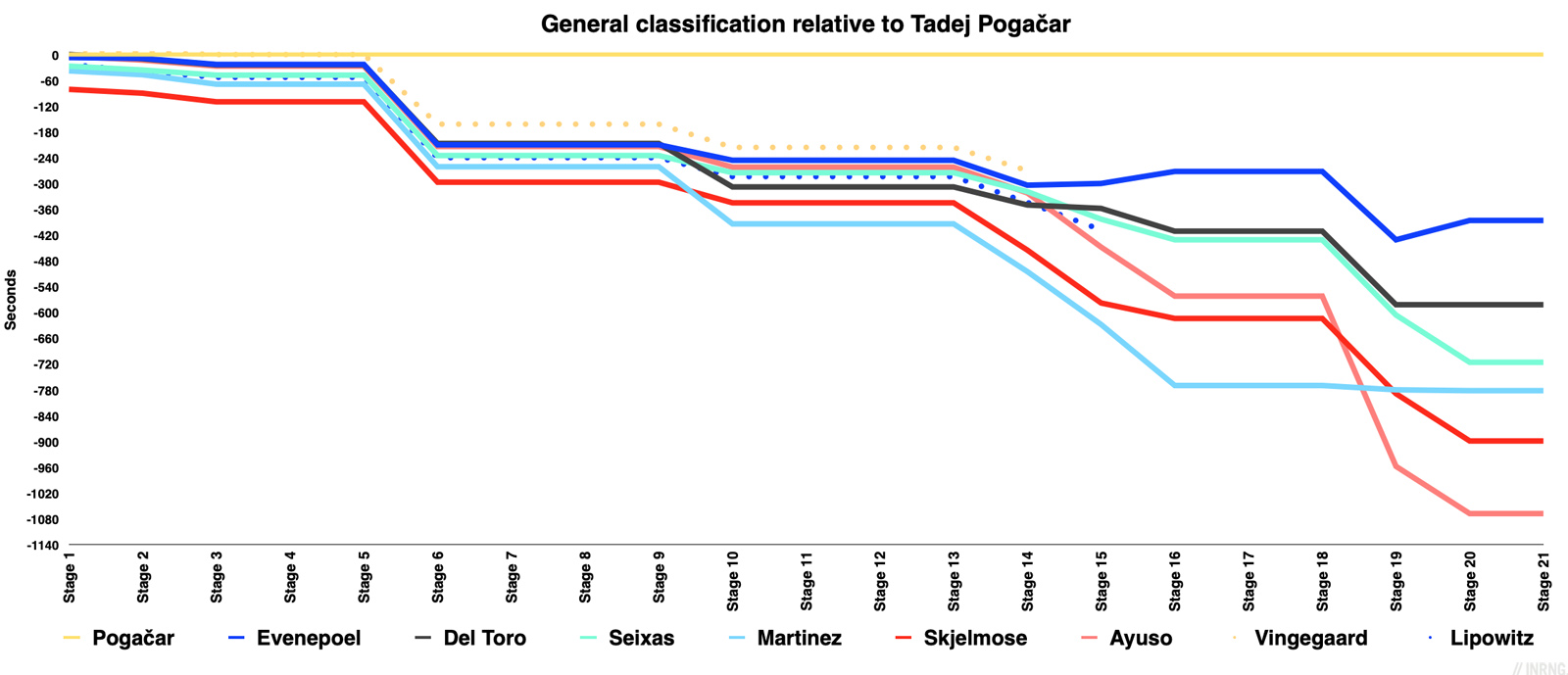
Fast forward the GC race to Paris and here are the GC standings of the top-7 overall plus the broken lines of Vingegaard and Lipowitz, loyal readers should know how the chart works by now and it’s pleasing to see many other outlets using the same format. Stage 6 sees everyone fall away from Pogačar after his Tourmalet coup. Stage 10 sees the black line of Del Toro dip after he was distanced on the road to Le Lioran, likewise Lenny Martinez lost time and was 9th overall but if not seen as a GC contender, still among the few who’d reached Gavarnie just behind Vingegaard.
A good Tour ought to see lines rising and falling but here the story is how they all fall away in unison, the order of the weekend in Barcelona is sustained for a long time. Evenepoel’s storming time trial performance barely registers on the y-axis. Those calling for more time trial kilometres should be satisfied next year – you read it here first – but you could double the distance on the day, and have three of these TT stages and it might take Evenepoel closer to Pogačar. But only so much and then the Slovenian could respond in the mountains rather than play chaperone to Del Toro.
Vingegaard’s Tour can be seen ending on Stage 15 after his crash on a roundabout. The team’s tactics were one contributing factor to their downfall, racing hard on the roads to the foot of the final climb which just suited Pogačar and let his UAE colleagues sit back. Mineralogists use Moh’s scale, an index to compare and sort rocks found in the field. Quartz will always scratch gypsum and never the reverse, a diamond will scratch quartz, and so on. In the Tour Pogačar seemed unbeatable and the tactic of trying to wear him down seemed to be like using up a lot of softer rocks hoping to eventually wear down a diamond. Perhaps pushing in the hope of finding a fault was the only tactic left, Visma don’t have a co-leader; but Red Bull did and couldn’t deploy this tactic either. The chart shows Florian Lipowitz’s exit, the stage after he’d lost time at the Plateau de Solaison and where two leaders had proved a difficult strategy to execute.

Vingegaard’s exit probably changed the race. We saw this on the stage to Le Lioran where he did not try to match Pogačar’s winning move but did shape what happened behind, leading the chase. He’d have likely done more in the Alps including the day he left where his pacing probably wouldn’t have allowed Pogačar do go at Del Toro’s rate and this could have affected the GC, some stage results, and possibly the mountains competition if Visma kept trying to wear down UAE.

The biggest GC move on the chart is Lenny Martinez who got in the breakaway on Stage 19 and if he cratered his chances of winning the stage by playing (too much) poker he got up on GC and held on the following day to finish 5th overall. This year he was supposed to go for GC in one week races and hone these skills, all while having free reign for stage-hunting and the mountains competition but because he never sat up to lose time and so stayed in the GC race, and benefitted from Ayuso and Skjelmose falling away. One thing he didn’t benefit from much was his team, often invisible.

Other competitions were more lively. The points competition came alive later in the race. Tim Merlier avoided intermediate sprints to save himself for the stage finishes and with three wins this paid off. Jasper Philipsen’s quest for a stage win looked difficult on the outside and apparently unbearable on the inside with talk of long silences at the dinner table but he delivered a win in Voiron and was within a handful of points of taking the green jersey with plenty on offer in Paris. Only for Mads Pedersen to go on the rampage and win the competition in the Alps.

The mountains competition was competitive throughout the race. It gave Caja Rural something on home soil on the opening weekend (and more than several other teams would get out of July) and while Tadej Pogačar took the polka-dots thanks to crossing the Tourmalet, Richard Carapaz and Valentin Paret-Peintre set about scoring points and duelling for the jersey and Carapaz came out on top thanks to a relentless three days in the Alps.

The white jersey and podium went down to the last mountain pass too with Decathlon-CMA CGM trying an all or nothing gamble to dislodge Isaac del Toro. The fact that Paul Seixas was fourth overall and within touching distance of the podium at the foot of the Col de Sarenne felt ordinary in the moment but go back to, say, March and this was the fever dream of a French fan. Two years ago he spent July doing the junior Ain Bugey Valromey Tour where four out of five days were under 100km. It slipped out this week he’d crashed before the TTT – which explains the bandages, they weren’t just there from June – and he was mildly ill in the first week and the whispers around his team say that his watts were higher in April than this July. That aside, note the progress he’s made in the last 12 months and if you think he can find a fraction more still, you can see why Netcompany-Ineos are flirting with him and his agent, and his current team are in the market for Ben O’Connor, Laurens De Plus, Pavel Sivakov and more to build a project around him.

Speed was a theme for an edition that set the record average speed of 43.227km/h. Søren Wærenskjold’s sprint win in Nevers set a new stage record of 50.910km/h, breaking the record from 1999 which had enjoyed a tailwind, and more, while this time the wind barely below. The next day was almost as fast at 49km/h and the day after was ridden at 50km/h despite the Ballon d’Alsace in the way; stage-winner Mauro Schmid fitted a 58T chainring, a set of wisdom teeth for the pace. Many times if the peloton was on flat road it was doing over 50km/h. But unlike previous editions there were few crashes and speed as a safety topic was not a big deal.
One factor in the speed is having most of the top names in the action. Breakaway days don’t see some wildcard riders go clear but you have Mathieu van der Poel, Mads Pedersen, Tom Pidcock and others making the moves. Some of the most entertaining stages were the mid-mountain days, like the stages to Ussel, Belfort and Voiron.
The flipside to this exclusivity is the exclusion, the lack of opportunity. Wærenskjold’s win was almost the revelation as, excepting Olav Kooij who has hardly raced this season, he was the lowest-ranked rider on the UCI rankings to win a stage; the average number of pro wins for a stage winner in the race was 69; boosted by Pogačar but without him the number is 50. This is a trend and so makes it hard for riders, and whole teams, to hope of a breakthrough win. The romance of sport needs to allow for this.

Talking of droughts, this was a dry Tour, taking place across parched landscapes and not just the habitual southern transition stages. Luke Durbridge mentioned that many riders were complaining their shoes smelled from of pouring water over themselves all day but that was a small problem compared the public safety issue of crowds waiting hours in the heat and the outbreak of wildfires which required emergency services to be diverted from Tour duties. Environmental issues came closer to the Tour and the race will have to respond. Despite some polemical headlines, the organisers are conscious of this, current broadcast contracts stipulate timings so any move to a morning slot is off the question now but up for review later on.
Another polemic saw anti-doping became a story but this time it was the testers who faced questions instead of the riders, in part because those tested shrugged balefully and got on with the racing even if sections of the media did not. Normally tests that return negative are never reported on but we have had press releases in the past on how the anti-doping procedures including a line that all tests came back negative.

The final stage in Paris was a thriller, the Rue Lepic performing alchemy as the peloton went in together and out at the top came a golden selection each time with the last distillation giving us just Pogačar and Van der Poel. The longer approach to the finish heightened the drama with Pogačar grimacing, seemingly prepared to lose to Van der Poel as long as they could stay away. Freezing the times overall before the finish line feels wrong on sporting terms and if it did rain at lunchtime, most of the circuit had dried in time. For all its thrills even in the dry the circuit does have a frantic aspect coming off Montmartre.

The Verdict
Standing on the top step of the podium put Pogačar alongside Jacques Anquetil, Eddy Merckx, Bernard Hinault and Miguel Indurain more than the two men flanking him on Sunday evening. He was unrivalled this year and if he took five stages he could easily have had more, possibly eight if his team had avoided illness.
Evenepoel rode a measured race, his only temperamental expression was reserved for team mate Lipowitz. But how to win, or is a podium sufficient? Still 26 years old the answer might be “wait” but he saw a 22 year old Del Toro on the other step.
Any suspense from the overall classification melted like an ice cream in July’s enduring heatwave, what looked likely before the race became inevitable within the first week and this vintage isn’t going to be held up as a classic. There was plenty left to enjoy, if Pogačar gobbled up riders like Pacman at times, the stage in the Vosges lively, the same for the Alpe d’Huez finish. There was also a lot going on among the other GC contenders, the race-without-Pogačar was lively.
In 1930 the Giro organisers paid Alfredo Binda not to take part. As tempting as it may be for fans to crowdfund the start fee for Pogačar to add next July’s Tour of Austria to his palmarès, it would quickly leave many frustrated that the best rider was not there. Pogačar included, who seems to crave the contest more than cash.
On many other days the quality of the racing high and often action that began and the start and lasted to the finish line and there was satisfaction in seeing the subsidiary jersey contests all battling until the last weekend. And then there was Paris.
Quand finit le Tour de France, j’ai une espèce de dépression qui ne nécessite pas que j’aille dans une zone de repos, mais je sens qu’il manque quelque chose : une grande partie de l’enchantement paradisiaque de mon été vient de se terminer
– Salvador Dali
That’s Dali lamenting on the post-Tour blues. But he didn’t have the Tour Femmes starting this weekend.
Thank you for all the great posts during the last month (and before). The daily reading of these posts was one of the highlights of July
Agree
It was an odd Tour, personally. The first for over 20 years where I had to follow it via the Cycling News live feed and this blog, with not a minute of live coverage. Did try the C5 highlights, heard Sean Kelly’s dreary monotone and didn’t bother again. Hey ho.
“Pogačar helping set up Isaac del Toro for the win and seeming more delighted with this than if he’d just won himself.”
This sums up the Pogacar era for me. Despite his wins and cannibal reputation he seems to have a generosity of spirit, plus a sense of real joy in what he does. I like that.
“…a generosity of spirit, plus a real sense of joy in what he does.” Just so. It strikes me that the same could be said of our host. Thank you, INRNG.
@Chuffy I presume you’ve heard of the mute button?
Two top riders lost to the fickle front wheel took some of the oxygen out of this one … most unlike Vingegaard and a bad lapse by Lipowitz.
It is a treacherous activity.
Thanks Inrng. Much to enjoy in this Tour and, as ever, wonderfully summarised here.
Stage 21 had me off the chair and just inches away from the TV. Not sure I’ve shouted at the screen so much since the Nibali MSR. A funny sport, where the riders that have dominated the season (and this race), suddenly become the underdogs.
I thought it was a decent Tour all told. Barring the risk of Pogacar ‘doing a Vingegaard’ we obviously knew who was going to win. In fact, until Jonas went down I’m guessing most of us would have had the 1-2-3 pretty easily predicted. Evenepoel perhaps surprising some of us by his lack of a bad day, or his improved ability to hide bad days. Whichever it was. But considering that a genuinely exciting nip and tuck GC battle at the Tour is pretty rare, the rest of the race provided enough keep it interesting. The green jersey and polka dot battles were pleasingly intense right to the end, and in both cases the right man won, and pretty much every day felt like a fairly tightly fought one day race. The quality of the racing at all levels and all moments is extremely high with stages and ‘minor’ jerseys fought over by GC and monument winners.
Yeah, I’d say it was just about vintage enough to keep us happy beyond yellow.
A nice summary of the GC battle. Thanks for all you work, and for making the chat mostly so pleasant.
For Vingegaard, I feel the only strategy he really has is to hold on until the later, longer mountain stages; and then make the race as hard as possible and hope Pogacar has a bad day. Its a long shot (as I am sure he and his team know) but at least they are giving it a go; for this he should not be criticised and I certainly appreciate what a great bike-racer he is. Next year, I suspect, will be his final serious shot at trying to beat Pogacar in the Tour (and he will surely want to win Romandie and Suisse).
Of the top 10 on GC, I am guessing that Ayuso and perhaps Pidcock are the only riders disappointed with their performance. Will Evenepoel and Del Toro aim to win the Giro next year (without Pogacar or Vingegaard in the race)? Should Seixas do the same, rather than another Tour? Are Ayuso’s hopes of eventually winning a Grand Tour starting to drift away from him? Will Pidcock give up on GC completely and become a stage-hunter?
Funny one for Pidcock. I understand that he was hampered by saddle sores early on, but then seemed to show fine form with that epic breakaway day. He certainly paid for the efforts, but we saw good resilience. And he did an excellent time trial. Hard to draw conclusions.
Seixas will head back to the Tour aiming for top spot. Remco can also aim for another podium run with confidence (especially with more TT miles). Del Toro and Vingegaard may be the ones off the Giro next year.
Seixas shouldn’t go to the Tour next year if the aim is victory – he is a long, long way off that.
I think Remco wants more than a GT podium now – another win is needed. Again, with Pog around he is a long, long way off even with more ITT miles.
Vinny has scratched the Giro itch. It’s Tour for him.
Del Toro – who knows?!
Did Pidcock ever begin being a GC rider? One gets the impression thats more a team/sponsorship requirement than what drives the man himself.
Reportedly, he’s got some curiosity himself about his actual limits in that sense.
It surely isn’t what first and foremost interests him in cycling.
Nice point about Pidcock having saddle sores JV, something I wasn’t aware of.
My impression (I could be wrong) is that Pidcock has always been “want to go for GC but also to be allowed in the breakaways”. And sort-of gets caught between the two and not quite doing either fully. In the Tour this year he complained that other teams did not want him in the break in week 3, and seemed disappointed (?-surprised) by this. The thing is, he doesn’t really hold on to the GC-group in the mountains (notwithstanding the Vuelta last year).
Bubble Wrap: You make a good point about Ineos wanting him to go for GC, but I think there is less pressure at Q36-5. But I also think he also sort-of believes he can podium the Tour if he really went for GC, and the Vuelta confirmed this in his mind. Lots of people on the internet named him as a serious candidate for “best after Pog/Vinnie in the Tour” prior to the start. That is why I don’t think he has yet totally given up on the idea of being a GC-rider.
@John. Vinny may only have one shot left before the young pretenders catch him up. Evenepoel, del Toro and Seixas will surely be keeping an eye on what each is saying about the possibility of going for the Giro – I doubt they would want to commit only to find all 3 are on the start line. As for Ayuso, looks like the Vuelta in a weak GC edition is his only hope for a GT win now.
I agree with everything you say here. I only wonder if Evenepoel, del Toro (and perhaps Seixas) would be prepared to race for the Giro with the other(s) there; I think they would (but who really knows).
“This is a trend and so makes it hard for riders, and whole teams, to hope of a breakthrough win. The romance of sport needs to allow for this.”
This quote is what I’ll remember most about this tour. The scraps for the lesser teams and riders were less than I can ever recall. As Richard said above, the stages and jerseys almost exclusively went to the biggest stars in the sport. This is generally a good thing, but it does remove a certain element of a normal grand tour. I know I’m very much in the minority, but I didn’t love that on stage 21 UAE didn’t have to worry about Del Toro and Pogi was free to help another superstar win the race. It felt like a post-race criterium, a great win by MVDP but under artificial circumstances. If Pogi starts again next year he’ll be an even bigger favorite; I worry that the organizers will have trouble finding ways for it to feel like a real race throughout.
It felt as though it was the same at the Giro this season, with only 9 of the teams winning stages & all the overall prizes going to some of those teams also. It’ll be interesting to see what happens at the Vuelta, whether that’ll have the same trend.
I completely disagree. Taking the times before the finish has been criticised by some in purist racing terms but its that, and the removal of the consequent jeopardy, that enabled the race that followed – as well as Pog and MVDP, of course. I usually found the old sprint Champs stage boring because it could only be a sprint but on this occasion the “will they make it/won’t they make it” scenario energised the finale. When they intitially crossed the line I thought van der Poel had been caught and it was only on replay I saw he hadn’t. What a fantastic effort and one of the best finishes for years! It is exactly the sort of finish that only certain riders could have provided and it certainly felt like a real race to me, not least because it titally had to be earned (unlike those post-Tour crits you mention).
Generally agreed, but worth noticing that with a way lesser degree of neutralisation and worse road conditions Pogačar try to go on the attack last year as well…
It’s far from obvious that the neutralisation implies more spectacle.
GC athletes who wouldn’t be interested in the stage could defend with their team (reducing thr offensive margins) but they could also be forced or consider it safer to take part in attacks, which would increase spectacle.
On the current course, I think it’s better if times are neutralised (too favourable to defense), while last year could be more interesting with real times.
I think that it’s a decision which can be taken each year by organisers and jury, maybe a little in advance so that people can take decisions knowing what they can expect.
The review was long already but another thing we saw, first at the Giro with Visma, then at the Tour with an informal pact, were the GC teams sitting out of the sprint when the race reached the final 5km/sprint zone. Will probably do a blog post about this soon as it’s a technical thing but possible an interesting change on the cards.
Of course, Pogacar would be racing for the win on Montmartre. But given his lead in yellow, the other GC-riders could agree to not-compete in Paris. I think the question will come if, in a few years time, Pogacar is behind on GC by 30 seconds, and might want to go for yellow in the final stage. Would they neutralize then, and how would people feel about it?
Just want to clarify that I agree that the stage was an absolute banger. My issue with it is that going forward it’s unlikely that we’ll have the same circumstances and I don’t want the stage to be turned into an exhibition (thus the criterium comparison). Call me crazy, but I also would like to see the old finish from time to time. Someone else mentioned that they miss the big sprint trains lining up for the mega-sprint to win the toughest sprint of the year, and I do too. We haven’t discussed it much (and it appears that most people don’t care), but this was a terrible year for sprints, which used to be an important element of the Tour, especially in the first half.
I certainly haven’t talked about it much because I find sprints entirely artificial and the most boring part of cycling. Why should anyone have to organise a stage to artificially create a sprint finish? This is in fact a very modern thing and not a good development in my view. You think in 1903 they were organising sprint stages? For me the less sprints the better.
Thanks for another expert series of previews and comments. Thoroughly enjoyed reading them over breakfast!
It’s a big part of what makes the Tour into a real “the Tour” for me!
Thank you INRNG!
(As soon as the temps go down a little bit, I’ll wear the INRNG jersey in honour …!)
When MVDP went to greet Pogi after the end of stage 21, Pogi said to him: “You did it!” before they embraced.
This is the spirit: for Pogi it was he and MVDP battling against the sprint teams, and when Mathieu won, *they* won. I liked that moment.
Yes, absolutly, me too !
I also thought Philipsen was such a class act and a masterful bike handler. The way he just stopped pedalling before the line after having controlled Pedersen to let MVDP have a 1 wheel advantage on the line was something extrordinary, and the way he congratulated him after very heartwarming. Great moto sideview thanks to the width of the Champ Elysées. MVDP recognizing Pirelli tyres in a uphill sprint at 60 km/h with the heart pumping at 200+ was a bit surreal to be fair. These guys are from another planet…
I won’t pretend to be even 10% the athlete or racer these guys are, but I find it’s quite common for time to slow down when in the flow of a bike ride or race. The few crashes I’ve had (or avoided) I could recount in almost millisecond detail, with reaction times also seeming to speed up at the time (e.g. instinctively swerving to avoid a crash, or putting a hand in front of may face to avoid it being totally smashed by a rock off road… I was glad for that!). It’s so bizarre: the situation might last for only a few seconds, but it’s like there’s a high-resolution frame-by-frame account indelibly etched on my brain. I guess it is something to do with cortisol and catecholamines increasing alertness?
Agree that Philipsen’s attitude, foresight and execution were so, so classy.
Mark Cavendish describes being in a sprint as happening “slowed down”
Big thanks to @inrng and
Community – the no1
Cycling blog without compare
Nice. There seems to be genuine affection and respect between Pog and other top riders, which is really nice to see.
Thanks for the daily write ups INRNG. Much appreciated.
I followed on You-Tube, moving from North Africa to South America and finally of all places Wales as TNT constantly shut down You-Tube coverage. Discovery are doing the sport a great disservice – shame on them! I am fasinated by Pog and his attacking riding. Shame, but said something about the man, that he spent the last few day helping a teamate to the white jersey.
I wish and hope that Discovery will desist from their current policy. Essentially shutting down a sport followed by millions by charging exorbinant costs, is no way to run a business, nor encourage the sport.
Yes, Discovery/TNT/HBO are awful — massively expensive, and adverts all the f**ing time. I can’t see this doing cycling any favours in the long run: I expect viewing figures drop significantly even if their income goes up this year — it’s not sustainable if new viewers never get the chance to watch
Last year in Spain they had a comparatively cheap ad-free option. They still have, but now “live events will get ad in any case”… ridiculous greed.
This my gripe with Peacock. I pay for the subscription, but then they absolutely pack the broadcast with ads.
The policy of ASO is to get the Tour on free-to-air, if they can. Unfotunately, nobody in the UK wanted to show the Tour on free-to-air, even paying a purely nominal fee for the rights.
Is there a deal for next year for this because of the start? At least for the opening days in the UK.
Yes, you are absolutely correct. Channel 5 have agreed to broadcast some stages next year, and show daily highlights this year.
Oh, and some stages this year were shown with Welsh commentary within Wales.
Well actually it appears it is as I think I read somewhere that the revenue from cycling was very healthy indeed. I gave in to the high pricing on a pay as you go monthly deal. Come October I will cancel until March 27. Can’t do without it.
“breaking the record from 1999 which had enjoyed a tailwind, and more, ” – whatever could that mean? /s
Very clever, as always, Inrng.
‘You read it here first”🤗🍵
Thanks as always for the excellent daily coverage. Like Dali I am also a bit bereft since the Tour finished but as you note we do have the women to look forward to. I laughed at the line about Pogačar adding the Tour of Austria to his palmares, can he resist the temptation! I seem to remember Cadel Evans winning it, are there any other dual winners of this race and the TDF I wonder?
I liked the Tour. I had spare time so watched more than usual. The other jerseys added lots of interest and it was good to see how the teams tried, and failed, to deal with UAE.
I like the hilly circuits too but I do miss the big sprint trains on the traditional finish as well. Perhaps alternating every other year would work.
Thank you for the insightful coverage.
Thanks for all the excellent coverage once again.
I see that Armstrong has been completely airbrushed out the history of the sport — no-one dare mention his name on the TV and even here on a blog for grownups 🙂 Not to open up the whole thing again, I find it a bit daft especially considering how people went on about Pantani’s record and things. Sure they were all juiced up but I think it’s time to just accept that was the era and move on. It seems that whatever they are doing now legally is way better than back then anyway.
Armstrong’s little problem wasn’t just “doping” as such which means close to nothing, rather the scheme, the means to influence the top spheres of the sport both thanks to his economic weight within the sport and his political contacts, the abuse on whomever dared to speak not only about him but also about his doctor (without necessarily linking it to Lance). Plus, it was him personally, he wasn’t just the athlete within a plot of corruption or influence managed by a team, a nation State etc.
The unprecedented doping difference was being able to doping systematically and without any quantitative or qualitative restriction, neither for him or his whole team, whereas his rivals knew that they could be put under pressure by authorities.
For example, having now had public access to data on doping programme of Armstrong and Pantani for the 2000 season, we know that Lance was doping even during the TDF, which is especially effective in case of blood doping, testosterone, corticosteroids etc., while Pantani could only dope outside that race. Of course doping in training is very important, but it’s pretty much evident as well that the two riders were in very different situations.
Another significant example is that Armstrong returned a series of positives and was found owning forbidden substances, never paid for that within the sport.
Pantani’s only adverse test is now (after more than 20 years and thanks to investigations external to the sport and police forces, i.e., the parliamentary board investigating mafia operations) officially and historically acknowledeged as having been made up to frame the rider.
Not that he was not doping, obviously! But the difference between the two situation is quite substantial.
Most people consider Pantani a genuine cycling talent who doped. He would likely be good if the sport was clean. Armstrong, on the other hand, is very unlikely to have won the Tour if everyone was clean. (Note: he would probably have been an excellent classics rider, and could win breakaway stages: Amstel was his natural terrain rather than the mountains).
The problem with LA is that he was a very nasty piece of work. A powerful bully with support from unpleasant people at the very top of the sport. That, as much as the doping, is why he’s persona non grata.
As for Pantani – I have no time for the dewy eyed sentimentality that surrounds him. He was an unrepentant and enthusiastic cheat. The classic Pantani photo is of him sitting cross-legged on the ground – I think people wilfully forget that he was dying so to protest about anti-doping controls. There’s a saying that squirrels are just rats with better PR and the same goes for Pantani. He was no better than Virenque and the rest of the rats.
If readers don’t mind, enough of the trial about him. It’s not to airbrush him away – his podcast each day seems to get a write-up in newspapers/websites from Spain to the Netherlands, “Lance said this” – but more it’s a never-ending argument that gets away from this year’s race.
You must really love rat racing if you follow cycling!
(Or pro sport in general)
As the following years showed clearly enough, athletes were right sitting in and protesting for oh so many reasons – whereas people happy ’cause «cheaters were being caught» simply proved to be sitting somewhere between gullible and delusional, with no idea of what was really going on, just buying the narrative they were sold and reacting accordingly.
Maybe time to think about how to somehow make the Tour more “open” again. Discussions about the course design etc have taken place, but I think the two main issues would be to make the teams smaller (6 riders instead of eight, allowing two more teams in) and get rid of the radios. This would mean more uncertainty, less control and more opportunities for smaller teams. At the end, its a mathematical equation: Increase the variables, and the outcome is more difficult to predict/ calculate.
Great analysis INRNG, as always!
I think your choice of user name says it all. Needless to say, the wind is not blowing the way you wait to go and I think there’s no chance these things will happen. Radios, for one thing, are regarded as a safety issue these days.
The safety argument for radios is obviously easily dismissed. Hundreds of races happening every day on much less secure roads compared to the TDF (think juniors, U23 etc). If radios are really necessary for this reason, just connect them to one sender with safety messages only.
I sat in enough team cars to know what is usually said over radios. Its not only time gaps, its composition of breaks, who is driving them etc. Restricting information will make a difference, especially combined with smaller team sizes. You remove/ restrict control, thereby incentivize initiative..
I agree it will likely not fly, due to DS and team owners loving control, but it will have an increasing impact on the sport, as can be seen on flat GC stages these days already..
Sorry, but the racing is much better with radios than without. Knowing the gaps and the composition of the breakaway means that there are actual tactics involved in the race. It would be absurd to have a situation where the only people with no idea of the race situation were the riders in the race.
Many here might remember races in the 1980s where, for instance, someone won the GC in the Vuelta because the current leader had no idea he was up the road. This isn’t racing, or entertaining, it is plain silly. And it happened regularly in the past.
One person relaying safety information to all riders does not work if riders are at different places on the course (e.g. the peloton has broken up into small groups on a mountain stage). Riders need to be told the information relevant to where they are in the race.
” This isn’t racing, or entertaining, it is plain silly.”
How is this not racing? Racing is several people start and race to know who finishes first. Is Marathon not racing cause they have no earpieces
Anon:
In the Vuelta that year, the leader of the race stopped racing because he was in the peloton and thought all his rivals were there too. He didn’t know that there was a rider up the road and nobody told him. So he just rolled along in the peloton chatting to his mates while the rider up the road took enough time to win the race.
Maybe you would have enjoyed watching that; I personally think it is silly for something like that to determine the winner of the race. This is different from the situation where the leader is actively chasing the rider up the road. That would be an exciting contest. If one of the riders isn’t “racing” then there isn’t a race in the conventional sense.
I’m with John on this one.
OldTimer isn’t wrong that increasing variables may create some madness but there are a lot of ways to do this which are a little fairer and match up to where modern cycling is going. It’s fun to suggest things and I fully support looking for changes that might improve racing, so enjoyed reading @OldTimer’s message, but the radio debate has just been and gone already and the aforementioned reasons why it’s not a silver bullet are good ones.
My only note with dreaming up changes is that we should all remember cycling is often a boring sport and that will never change. Every generation has had a multi-time TDF winner crushing the opposition before a few years of excitement between these great champions, and again this is unlikely to change. If we’re starting from the ambition of ‘creating a more competitive GC at the Tour’ our changes are likely to fail but that doesn’t mean there are not wider ambitions like sustainability, better action year round, safety, potential for growth by accessing new fans, expanding the talent pool etc etc we could aim for.
These may eventually have knock-on effects that improve the GC in years to come, for example if we give a route to racing for more riders from Asia, Africa, America etc we might find more Pogacar’s and they might arrive at the same time, you never know!
Sadly though none of this will happen in the near future as cycling is such a bity, poor and disorganised sport.
I still love it though! So will watch whatever.
Your argument amounts to “it was better in the old days”.
Was it?
If Pog was winning by 20 minutes, as some did in the old days, no one would be happier. (They would get bored very quickly of ANYONE winning by 20 minutes too. During this past Tour several commenters told me what they actually want is a real competition.)
But basically: things have moved on. Going back is not an option anyone is going to take for better or worse.
@oldtimer Doing away with radios in a GT will probably make the racing much more defensive and therefore much more boring. You also seem to misunderstand why the Tour is “closed” – one rider is so far ahead of the next best of the elite physically that changing all sorts of variables won’t change the outcome.
You seem to be putting forward a nostalgic idea akin to Uncle Albert’s “during the war…” (those of a certain vintage will understand!).
Would more randomness in the results make for a better race? When Clerici won the Giro in 1954, or Walkowiak the Tour in 1956 (both through massive breakaways early in the race), the crowd and fans were furious. Pingeon winning the Tour in 1967 was not much better (even if he was a rider who could top-10 in a normal year).
In a modern context, do we really want to see Jegat winning the Tour? Would this make the race better? Or do we want to see the best rider winning the race (perhaps after a few trials and tribulations)?
“In a modern context, do we really want to see Jegat winning the Tour?”
Why the f not? if the finishes the course faster than anyone else, he wins. Simple as that.
I respect that this is how you feel, and nobody’s feelings are wrong, but I suspect it is a minority view. Certainly pretty much almost no-one was happy when Walkowiak won the Tour in 1956. The public felt they had been cheated of a proper contest between the best participants, and let the riders (including poor Walkowiak) know how they felt.
Would it be better with smaller teams? Wouldn’t that mean just more of a man-to-man racing where we already know the winner?
I would argue for 9 cyclists teams and fewer teams. First is financially more sustainable, and second it is easier for teams to split interests into GC, breakaways and sprints.
It’s difficult to know. Smaller teams can still see suit the big budget teams because they can bring “Swiss army knife” riders who can climb, pull on the flat and never get tired and the few who can do this are very well-paid and rare. UAE’s sixth rider is going to kick sand in the face of many other team leaders.
How much of the structure of the sport should be changed because of Pogačar?
I think Pogacar, for sure, would attack if it is mano-a-mano racing. When he races he uses his team to get down to this situation so his attacks succeed. But if the principals were more equal, it might just result in a standoff where no-one attacks. And much more cautious racing in general. Most of us have seen Grand Tours where the principals indulge in a “staring contest” for most of the race.
I agree with the point Inner Ring makes. Should we really change the whole sport because we have Pogacar in the peloton? He won’t be here forever.
One point about having 8-man teams is that it means they have to choose whether to concentrate on GC or sprints and can’t really do both (at least not with proper support).
Yeah, there was that famous Rogla/Nibali staring competition that allowed Carapaz to win the Giro”
I enjoyed the Carapaz/Del Toro staring contest in the 2025 Giro immensely
Every one of these hypotheticals comes with ups and downs.
I think the question is what are you trying to do?
If people want to stop Pog, smaller teams likely will not change anything.
He’s the best rider and will win from almost any position with any kind of handicap aside from illnesses and crashes.
If you want to make the racing better that’s not guaranteed but is a conversation worth having alongside other factors/changes that might help and would need to happen alongside.
If you are trying to make teams more sustainable by having more teams but making their rosters smaller, this will also come with upsides and downsides (some unforseen till it’s tried) and really it would be a case of further changes to the overall sport working in tandem with this to help managers/team owners find more stability in the long term. It’s a big change if you went down to 5riders and maybe 15man squads though so would need a load of discussion and thought alongside other issues (the calendar/clashing races) before it was worth enacting.
In saying that – I would still be dramatically in favour of smaller teams alongside hundreds of other things they might try to evolve the sport and help team owners and others – these kinds of changes will throw up negatives and (as mentioned) unforeseen challenges which will have their own teething pains but I firmly believe owners, race organisers and riders need to be given every bit of help possible to keep giving us the sport we love under less stress than they currently operate with. So the powers that be should at least talking about/trying all options to hopefully help.
What this won’t do though is stop Pog winning.
The tension is that we want (most of us) a competitive fight to win the race with the result uncertain, but also for the best rider to eventually win. And we want race tactics to play a part in the race. Some think that making the race harder to control would deliver this. However, if you made the squads small enough then Pogacar would not win.
Currently, domestiques are used to control who goes up the road and to chase down attacks. Without these domestiques, Pogacar and Vingegaard would be left to control attacks themselves. Obviously they can not chase every break themselves throughout the race, since that would result in exhaustion and eventually someone would escape when Pogacar/Vingegaard tire. In practise, what you would actually get is “group 2 syndrome on steroids” where nobody would chase down attacks and leave it to someone else. This would greatly increase randomness in the outcomes and the best rider would not win.
But does much more randomness in the outcome really make the race more interesting? Would we be happy if Jegat won the Tour because no-one chased him down? Where we stand on this issue likely differs for each of us. But speaking personally, I would rapidly lose interest in the racing if each race was won by a complete outsider because group-2 didn’t chase him. For me, racing is interesting as a contest because, most-of-the-time, the best rider wins the race. I would not find it interesting or exciting if it became a lottery.
Actually, it sounds like what you’re saying, to some extent at least, is”best team wins the race”, which is to say richest team. (Not sure that’s correct, seems sometimes that Pogacar doesn’t need a team).
If it was a case of each one for himself, would that neccessarily mean that the strongest didn’t win, over the length of a Grand Tour?
On a different subject, anyone else sick of the over-use (and mis-use) of the word ‘super’ (instead of ‘very’) in each race interview. I can forgive it in non-english speakers, but not in those whose native language is english.
George:
UAE have become the richest team because they have Pogacar; it is not that Pogacar wins because he rides for the richest team. In 2020 and 2021, the team was actually quite mediocre: in 2018/2019 they were viewed as a bit of a joke and only had a middling budget (akin to Bahrain Victorious). The money increased when Pogacar started winning.
@george
tbh no changes in language bug me.
language is fluid, it’s always changing; super, very… as long as people understand you it’s all gravy – personally I love things like texting and online chatter morphing how words are spelt, and even better when things like acronyms take on a new life as a fully fledged word like ‘lol’, ‘rofl’ etc etc. I generally feel if the changing landscape of language annoys you it’s more than you don’t like change than the words themselves, which is fair sometimes!
the only time when misuse of words annoys me is when it’s in service of trying to sound clever! I think ontological is probably the biggest bug bear I have off the top of my head, my understanding is that it means ‘about existence’, or relating to existence, nature of being etc as a philosophical concept but is usually used to just double in for existence or worse to exaggerate a some random fact… I’m losing that battle though as the word is slowly being beaten to a pulp. (I’m not very clever though so may well be wrong and happy to be corrected by others if I’m getting heated about something I don’t truly understand!)
one thing I have noticed though – french speakers are the best players of english language scrabble as latinate languages (French) bring all our high level words, whereas our nordic/germanic side brings in the lower words so anyone with strong grasp of French usually destroys when it comes to scrabble!
Many thanks Mr Ring for another world class blogging performance…despite the late night testing:)
I found the statistic of the average pro wins for this years stage winners very insightful. Out of interest, do you know what the average number of pro wins was for the 184 riders who started the tour? I am guessing that statistically most did not stand a chance…
No idea for the win count for 184 riders – it was easier to count via 21 stages – but as you say bound to be way lower.
The best riders winning at the Tour isn’t new, a decade ago it was Cavendish, Kittel, Froome, Dumoulin etc. But it seemed even more concentrated this year. Exclude the TTT and half the stages went to former/current world champions (Pogačar, Pedersen, Van der Poel, Evenepoel).
the biggest change for me is how good you now have to be to win from a breakaway – not that riders of old weren’t good in the breakaways, but previously a few specialists would infiltrate the break and work it to their advantage to win, and occasionally a lesser known name would find a way to win…
now you see not only multiple riders from a team in breaks to set up a winner, but the best riders from that team doing the work – Quinn Simons setting up Mads are two of the top riders in the peloton, same with Healey and Carapaz – the level of these riders are far beyond for example a breakaway specialist like Cummings nabbing a win in the recent past.
you do see lone breakaway winners from time to time still, but even then it’s someone like Simon Yates last year, who similar to Carapaz is a grand tour winner.
just to win a stage these days at the tour has become such a high bar that you’re either one of the top few classics riders, sprinters or climbers – ie Mads, Carapaz, Healey, MVDP etc. Even Arensman last year who was one of the lesser known riders to win a stage, recently finished 4th at this year’s Giro and is no slouch.
Almost gone are the days where you’d have a Biel Kadri (stage8,2014), Lilian Calmajean (stage8, 2017), Christoph Riblon (stage14, 2010), Robert Hunter (stage11, 2007) etc etc.
Antony Turgis, Kaden Groves and Victor Campenaerts are probably the least famous riders to nab stages at recent Tours, and even between them, Turgis has been runner up at MSR, Groves has seven vuelta and tour giro stages, and we all know Campenaerts cause he’s a looney.
I found this year it made breakaway stages less interesting because once a break was formed you could look at the names & pretty much know in advance who was going to win, or at least who were likely to be the couple of main contenders, thereby making it similar to knowing the main contenders for the sprints & mountains stages. I think Mauro Schmid was the only exception to this. I’d’ve found it more interesting if there had been more breaks composed only of of non-star riders so it would feel as if any one of a dozen or more riders had a reasonable chance of winning.
Dawnstar, you and I see things similarly. I don’t always want to know exactly what is about to happen, and this Tour had very few surprises. I was surprised that Jonas crashed and that Remco was so strong, but that’s not the same as wondering if Cort or Healy can pull it off against a similar kind of rider in the moment. That kind of thing was really absent from this Tour.
I should say that I don’t mind knowing in advance that Pogacar is probably going to win a mountain stage, that’s par for the course, I just don’t want something similar for those stages that should be more unpredictable.
@The Other Craig Yes, crashes were about the only thing that really were unpredictable. Though even with that it felt as though this Tour had fewer people crashing out than others. Maybe that’s just that one tends to remember the big crashes the most though.
Verdict from a french Pogi fan:
Inrng coverage: 10/10. Best on the internet. Quite the consensus on this. THANKS !
GC: 5/10. No surprise. A worthy winner, some mild entertainment for lower steps.
Green & Dots: 8/10. Very entertaining. Also extremly worthy winners.
Domestic Pogi: 4/10. a novelty and a bit of surprise at first, but in the end I decided I didn’t like it. Mainly because it casts a shadow on Del Toro’s outstanding achievement, also, more chauvinisticaly because it played against Seixas. Bring back cannibal Pogi please.
Seixas: 9/10. Endurance and daring beyond expectations for a 19 years old. Very smart race, and bonus points for trying and blowing up in Sarenne. That said, I don’t see a path to victory before 2030. Pogi is just too strong. Maybe joining Vingo and replaying the Granon drama with an aging vingo in the role of Roglic ? But how to attack when you’re already going at 7 w/kg ? Only Pogi’s hubris and patience could lead to Victory.
Parcours: 8/10. A bit of everything, A beautiful start in Catalogna, some vintage stages in the diagonale du vide. Pyrenées too Pogi friendly with hindsight, but there was a logical rationale and as Inrng perfectly explains, if not there it would have been elsewhere anyway.
Paris Stage: 10/10. Does racing get any better than this ? A San Remo without the 250 km slog, A Roubaix with more field-leveling hills. Fantastic. On freezing times: there is a component that should not be forgotten in city circuits in general and Paris in particular: the dreadfull quality of pavement and millions of glass pieces littering it. I cycle 40 km every day in Paris, and even Schwalbe Marathon+ have failed me. OK, they sweep it before, but still, with all the spectators crazyness, it would be a bit unfair to loose the Tour on a delayed repaired puncture. Admitlidly, it would have put Seixas in white and on the podium, so…
Overall: 7/10: A good edition, not a great one. Like Dali, like all years, I’ve got post Tour blues. Hopefully the ladies can cure it next week. Allez Pauline !
I generally agree with this, apart from a couple of points on the Paris stage: first, I just don’t like the time neutralisation before the finish, unless it’s really necessary which wasn’t the case this year. I’m not sure that the added risk of a puncture changes this. And secondly, I do wonder whether the distance from the final ascent of Montmartre to the finish might be a bit long? This year we had two of the best cyclists ever doing their utmost to hold the sprinters off, but I still suspect that Philipsen could have won.
He could have, without a doubt. Watch the sideview replay, he slowed down to give MVDP the win. Class act. The freeze/no freeze debate is an entretaining one, I don’t have a definitive opinion. Either way could be fun. I’m pretty sure sure the riders prefer the freeze option, so after all they have suffered to get there I’m happy that they are happy 🙂
At the end of the day it is a race, and should be a race until the end. The other option is just to take the times at the end of the 20th stage and not bother with any times at all for the final stage, just a winner takes all shoot out with a parade behind it.
How about go the other way?
For the top 20 on GC, make Stage 21 an ITT. 2 laps of the Champs/Montmartre circuit plus another 8km of run in would make for a 40km course.
For the rest of the riders, have a road stage similar to this year with a distance of ~90km, with an extra intermediate sprint to keep the points jersey open to the final day.
Neutralising of circuits, 5km and 3km rules, even the bunch time rule has already put some significant cracks in the “purity” of the general classification being formed by each rider’s actual total time to complete the total distance, but stage races have still survived. One more change will not kill them.
@DaveRides What would happen if someone on the top 20 in GC was also competing for the points jersey though, like when Froome did at the Vuelta?
Normal ITT points scale for the ITT finish results, plus allow a top 20 rider to also enter the road stage without risk to their GC position.
Certainly a bit to be worked out to make it realistic, but there does have to be a way to make the final day competitive for more of the riders without completely losing the final day celebration in Paris that is a good tradition of the Tour.
@DaveRides I guess telling a rider they’d have to do both a TT and a road stage in the final day of the Tour to compete for the points jersey would show which ones really wanted to contest it & which didn’t!
I’ll dissent on this. Philipsen missed out on 1 pedal stroke, 2 at most, before the line, after he’d gotten past Pedersen – to which point he was /all/ out to beat Mads. Close as it was, I don’t think 1 extra pedal stroke of power would have gotten Jasper to overtake Matthieu, and I doubt even 2 would have done it.
Jasper just didn’t have the distance left for even 2 pedal strokes to make the difference. Had he kept going, I think maybe he’d have ended up 1 to ¾ of a bike length ahead of Mads, instead of just a front wheel, which would have still left him somewhere between a half wheel and full front wheel behind Matthie.
And some back of the envelope calculations… With a 2.15 metre circumference wheel and a 58T×10 gear 1 pedal stroke is 12.47 metres. At 65 km/h, that’s 0.7 s for 1 pedal stroke, 1.4 s for 2 pedal strokes. At 55 km/h 0.82 to 1.64 s. I don’t think Philipsen had even passed Mads before the final second.
There just wasn’t the time and distance left for Jasper to pass Matthieu.
Nice summary.
I especially agree with your assessment of Seixas’s performance. I said before the tour started that I thought 5-10th would be the ideal finishing position for him. (I’m counting it as 5th cos Jonas crashed out).
My reasoning is that it proves to everyone that he is the real deal but also that he has a bit to go not only to Pogacar’s level but the other main protagonists as well.
The hype train is still well and truly on track but the overbearing pressure from the French public has been dampened just a little bit.
@Lars a bit behind Pog – that made me laugh. He’s a country mile behind and then some.
Pretty much spot on there with your summary (although living on the edge of south west London I don’t ride in Paris obviously).
Thanks once again for this fantastic blog.
The Sanremo in Paris stage 21 was of course a banger, and stage 20 too (is there a more beautiful road to ride than over Telegraphe-Galibier?) with Pedersen’s raid and that incredible finale both for stage and GC, but being Norwegian dropping in front of the TV late on a sprint stage HAHAHA! WÆRENSKJOLD!!!! was my moment. It was a condensed will he/wont he as opposed to stage 21’s longer will they/won’t they.
I am glad I, as opposed to Salvardor Dalí, have the TdFF to look forward to.
“The Sanremo in Paris” – interesting way of looking at it. Montmartre = The Paris Poggio.
Personally, I hope its here to stay. There won’t always be guys who stay away and, most of all, to win that stage you have to earn the right.
I wonder what would have happened had Pogačar / UAE won the TTT in Barcelona? Would he have tried to hold yellow for the whole race? How would that have affected things? Imagine it’s on his list of things he’d like to do…
I was going to do a piece on alternative results on the opening day. It was a real selection trap for some teams notably Ineos who brought Ganna and Tarling for this and in alternative universe Vauquelin would have sprinted of Ganna’s wheel to take yellow. Without Vingegaard in yellow Pogačar may not have got his team to race so hard on the stage to Les Angles but perhaps Ineos would have.
If UAE had won, I think they’d probably have been fine for someone like Torstein Træen to take it for a day or two but the Tourmalet and time was there for the taking. So different tactics until Stage 6 but the Tourmalet feels like where whatever we change on the first day the departing versions come back to the same place.
Here’s an impossible question that I have been toying with this week
Bearing in mind budgets, riders expectations etc, who goes away from the tour happiest Lidl-Trek or Alpecin?
L-T 1 stage win,Green jersey, 6&7 on GC
Alp 3 stage wins.
Impossible to answer as I say but any views?
I think Alpecin are happier because their main cards (VdP and JP) essentially achieved what the team would have wanted (obviously would have liked JP to have beaten Merlier in some sprints, but at least he got one win and the 1-2 on the final stage will stay long in everyone’s memories).
L-T were great in supporting MP (Quinn Simmons, Vacek and Gee were so good at times). But I think they might have a sour note about Ayuso: is he worth all the money they’ve spent on him? Admittedly he’s still young, and all teams are grappling with how hard it is to even get on the podium. But I wonder if they’re worrying about the investment.
@WillC. Yes. They now know for sure that investment will never yield a Tour win and is unlikely to earn a Giro or Vuelta (which probably represents the best chance of GT return with a weak GC field) victory.
I expect that Trek view Ayuso as a multi-year project, and that they will be happy enough with the progress he made since his implosion at last year’s Giro.
I reckon they should look at a Giro/Vuelta program for him next year with the goal being to progress further and achieve a top three on GC, then take that momentum into the 2028 Tour.
@DaveRides – that is a long way short of what they expected from their big investment. Instant returns are what they were after.
The talk is of a project. Just finishing a grand tour for Ayuso is an improvement given his record of misfortune.
I was wondering whether both Ayuso and his team were a little worried that he faded in the last week. [But his preparation was rather poor, with him being ill]. I would have put his performance in the “slightly disappointing” category.
Both DaveRides and Inner-Ring are likely to be correct that they view him as a project. But my feeling (a personal view) is that hopes he will eventually win a grand tour might be beginning to fade. I do understand that others might have more confidence in his future; and it was only just over a year ago when he was viewed as joint-favourite (with Roglic) to win the Giro.
Got to be Trek, although they would have hoped for better on gc. But they obviously were all-in for green (leading to some weird/stupid tactics), so they must be happy that they got it done. Alpecin had a fantastic last week, but were dire in the early stages.
And they won the team competition! I actually forgot…
I’ve been waiting for this post to appear – as it acts as a way to bring the curtain down on the Tour – and gives us all a chance to thank our host for simply the best racing coverage across 21 days.
Thank you for another stellar July of previews, reviews, and postcards!
A bit of a wait. Went to Paris to see it up close, travel back and then wanted to check a few things, eg the info that next year’s Tour will have a longer TT didn’t come from info from Monday.
Thank you, once again for the daily posts and this summary. Amazing blog and we all appreciate the effort.
Thank you inrng for all you do throughout the season. To the dominance of Pogacar: I view him as another Greg Lemond – physically gifted to the point where, to paraphrase Lemond, he’s that 1 in 2 million that arrive once in a blue moon who’s 3% to 4% better than the rest. Vaughters also had some insight stating that Pogacar started out his career a little “chubby”, his training in his early years was “rudimentary”, and that what we’re seeing since 2024 is an “optimized” Pogacar.
Chapeau INRNG, awesome commentary once again 👏
I think the performance of Seixas and his team was the highlight of the tour for me. What an outstanding 3 week effort for a very young man. He seems to have a mature head on his shoulders too. That the Pog and the geniuses at UAE thought it necessary for the yellow jersey wearer to forgo stage wins and act as a domestique to counter Seixas’ podium bid says it all.
I’ll echo all the thanks, gratitude and appreciation for your work here.
Impressive how hard each stage seemed to be raced, shame that there were some largely invisible teams that didn’t (couldn’t?) at least throw rider up the road each day?
Hoped to see Alaphilippe get in on more of the action, had him on my fantasy team for nostalgia. Oh well, tough to see him go out like that.
Del Toro was there to learn/support Tadej and I’d say he received heaps of lessons along the way. Apparently he was ill over the last few stages? Imagine having Pogi telling you high up the Alp at the pointy end of the race that “you can do this, I’ll get you there…” And now Isaac really knows how deep he can go, and what it’ll take to shoulder that mantle down the road…quite the apprenticeship.
Last stage, awesome. Time neutralization made sense to me…how often did the traditional final sprint on the Champs make a difference in the GC anyways? The last staged has most always been ceremonial neutralized, hasn’t it? (Especially since Fignon lost on that fateful day? 😉 ) If time is taken before the final laps then race to that line if the gaps are actually that tight and then let the stage hunters take over for the spectacle. That racing we witnessed was the finest of last man standing, bragging rights amongst peers type of thing, imho. [20yrs from now…”yo, remember that time in Paris when we held off the sprinters…”]. Of course Pogi worked with MVDP, that was the only chance for either of them to win…hammer down and hope you don’t get chased down, MVDP sure wanted that one. And if it hadn’t been those two then it would’ve been a reduced bunch sprint with someone (Quinn?) taking a flyer at 2k and getting caught by MVDP at 700 as he launches Jasper….who else could’ve held off that galloping bunch? That was good stuff.
Had my fingers crossed for Sepp & Quinn, maybe next year….
If something is “off the question,” is it also “out of the table”?
Adding more TT kms next year makes perfect sense. When you have 1 rider utterly dominant in 1 area of cycling – the mountains – then obviously you should rebalance the Tour route to add more of the types of terrain/stages that play to other rider’s strengths against said dominant rider.
Even more so given how badly biased the Tour has become towards mountain stages for deciding GC, in modern times compared to before.
A tour that’s balanced finely between Remco taking ~4 minutes on TTs versus Pog taking that kind of time in the mountains would be an amazing tour.
I honestly don’t think the balance will ever work.
Remco took 30secs in this TT over 26km with Pog saying after he held back slightly.
So even at a 50km pan flat TT if you were being generous you might be looking at 2mins with a fully committed/TT ready Pog, let’s say 3mins to be kind… then lets add a second TT of 50km next year (the route is very unlikely to swing that hard to Remco’s favour but hypothetically…) and maybe again we’re generous and give him 3mins so he has a 6min total advantage in this fantasy.
Pog took 2mins30 alone on Alpe D’Huez, then he took 2mins57 on Tourmalet stage – those were the only times he really put the hammer down and we’re already at 5mins30 in the most generous scenario to Remco’s 6min advantage. There were multiple other stages Pog could’ve taken the additional 30secs necessary and would’ve likely built a healthy gap in doing so in this hypothetical. Even if you throw in a mechanical and give Remco another 3mins, so a 9min advantage, it’s so hard to see Pog not closing this should he need to.
Basically there is almost no vaguely plausible route imaginable from this era of planners where a fit Pog doesn’t beat Remco sadly – I could see Remco having a 10min headstart and still losing to this version of Pog. The difference between them is so great that Remco’s TT prowess will never be sufficient to overturn Pog’s advantage if he remains at this level.
This is so very true but not sure such detail was needed to prove the point! The way Remco talks at the Tour is never about winning.
+1 you’re right!
Remco put 2’37” into Pog at the 2025 UCI WC TT, and that was a pretty hilly TT (to attract Pog) over 40.6 km. He gained 12” over 25.3 km on the flatter TT stage 7 of the ’24 Tour, and 16” over 33 km on stage 5 of the ’25 Tour – with a broken rib. So a gain of 0.5” / km over Pog seems like the /worst/ Remco would do, even if nursing a injury. And probably he can do better than that, maybe up to 4” / km.
So have a tour with 2×50 km TTs and Remco perhaps can gain 1’40”, 3’20” or even 6’40” if he can do 1′, 2′ or even 4′ per km. Put one of those TTs ahead of the first set of mountain stages, the second before the next, and keep those mountain stages on less steep roads and you potentially have a very very interesting battle between Remco and Pog.
And sure, maybe Pog still tears away in the mountains and wins. But at least there’d be a bit more pressure on him, and a little bit more hope and entertainment for the rest of us.
They absolutely have to rebalance the Tour route to favour the (few) relative strengths others have against Pog, or else this is going to become even more boring for probably the next 2 years.
And the Tour is definitely /too low/ on TT kms at the moment. And it’s more interesting with higher TT kms. E.g. 2012 was pretty good, watching Wiggins trying not to explode keeping up with the climbers and retain his yellow.
Yes, I remember this TT last year.
You’ve put a 6min40sec advantage to Pog in your hypothetical.
In my silly hypothetical I went far higher and tried to imagine a version where Remco has a 9min advantage with a mechanical etc. Even then it’s so hard to imagine Pog not taking this back relatively easily, unless they do away with mountain top finishes, but even then he’ll just go from further out.
I’m not against rebalancing and trying to aid Pog’s adversaries but if this Pog remains fit it just will not work. I honestly think you could’ve given every rider a 10min head start on Pog this year and he would’ve still won.
> You’ve put a 6min40sec advantage to Pog in your hypothetical.
That’s not a hypothetical, that’s what Remco *did* in the Kagali TT – a hilly TT. He put in 3.92s per km. So over a /series/ of TT stages Remco *could* indeed get something like a 6’30” advantage.
Remco is potentially *capable of that* based on *what he has already done*.
Also, if the Tour /avoids/ the steeper mountains, and chooses longer, not-too-steep mountains, where Pog can’t blast off as much, and where Remco is able to put in a long consistent TT effort on them, then Remco has a chance of limiting his losses.
I mean, it’s pretty much *the only* chance we have of seeing a competitive Tour GC battle for the next 2 years.
Aside from whether it would hurt Pog (my guess is not really), I would like to see at least one long, flat time trial in the race, maybe even a second one very late in the race to potentially shake things up without the possibility of teams working to defend eighth place. Also, and more importantly for me, I want to see the Gannas of the world have a serious shot at winning the stage. Not every stage has to have a hill in it; recent grand tours have been extremely tilted towards the best climbers, which doesn’t have to be the case. Of course there will be mountains and the winner should be a great climber, but the race doesn’t need to be a pure climbing contest. And no big mountains before the first rest day!
Except for the ITT in this year’s Giro, which was about as flat as can be (and Ganna duly smashed it).
Agree in general, though (and for TdF particularly).
Thank you for the wit, erudition and expertise across the last three weeks. I hope you enjoy producing this as much as many, many people enjoy reading it.
Just a post to echo the thanks for providing this blog with all the insights and ‘postcard(s) from’. Very much appreciated.
As a tight fisted Yorkshireman, I have taken the ‘I won’t pay’ stance with TNT (unfortunately) being the only broadcaster in the UK. So your daily previews/reviews, supplemented with LR YouTube and social media have been my main points of reference with the Tour this year and I can thankfully say I have still enjoyed it.
Very much hope we can get back to a free, if not better priced option to watch (in the UK) ahead of next year and the future, because I’m very much excited to see where the sport goes. There are a lot of storylines developing that will make the next few years fascinating to watch and hopefully continue to read about on here. Thank you.
Thank you as always @INRNG for another stellar three weeks of Tour coverage. This blog is a brilliant companion to anyone’s cycling fandom in what are disappointingly dark days for UK coverage of the sport, where I’m sure many other commenters here are losing the friends who they once watched the Tour with as it is now so hard to access. I fill the gap with the board here but hope one day soon we’ll regain the audience of the last decade with better highlights and a lower barrier to entry than the current subscription services.
I’m posting my Tour memories here a few days later as I’m sure no-one will actually be interested so it’s probably better not to clog up this comments sections will banal musings. I’ll list points quickly to take up less space (yeah… that failed, long and dull is my stock in trade!):
1 So happy to see Remco’s performance, overall I can be pretty down on his prospects for the future given the talent pool he faces, but very happy to see him hopefully start to prove me (and others more prominent voices!) wrong – would be fantastic to seem him go up a notch as a GC leader in the third act of his career.
2 Should be noted Remco was 35secs behind Jonas when he crashed out, and even though I suspect Jonas would’ve taken time on that day’s climb, he finished 28secs in front of Pog in the following day’s TT, so there’s a small chance he could’ve legitimately been in 2nd place that day, something I would never have expected going into the third week of this years Tour. He’s also the first GC leader to take more than a handful of seconds away from Pog late into a Stage race for a while? Not that it will change the current landscape, but similar to Skeljmose being able to dine out for a lifetime on his Amstel victory last year, this is massive achievement against this era of Pog.
3 Stage1 this year was a highlight, and it stayed with me how much better a well organised TTT can be than a TT, simply because of watching time. The 2hr Barcelona excursion was a proper event and felt like there was always something going on while watching, which made me wonder if there were ever a way to get the TT down to a similar timespan rather than the six hour marathon? I like TT’s, but they are the discipline most tune out of and I have no idea how they could be shortened in time rather than distance (as every rider needs their time isolated on course) but if there’s any boffins out there with a suggestion it would be interesting to hear – as this would be such a better way to enjoy the discipline. I was trying to imagine courses that followed a figure of eight or doubled back to allow riders to set off in both directions (mad I know) or kept riders apart by using both sides of the road so they could set off closer together with some kind of service bike behind rather than a team car… anything to make the process shorter… none work unfortunately. Maybe just scenic city settings is the answer.
4 as noted on the following post but repeating here – award for silliest comment of the Tour goes to the infamous Lance stating the next step after 2am tests is to ‘lock the riders up in a local rehab facility or jail and surveil them 24/7’… what was even more shocking was this statement came with zero mention of his involvement in doping as the reason for why riders endure these tests today! (I don’t think he has to apologise for it everyday of his life, but when you’re directly talking about doping control and criticising those doing it, it seems fairly weird not to!)
6 Random note, but find it so crazy how much effort MVDP has to put in for everyone one of his TDF wins? He’s obviously prone to a post line collapse to really show off how tired he is, but for a rider of his talent I still think it’s notable that he can’t pick off more stages with a little less effort than it seems to require him. I understand why but it always surprises me still.
7 have also said this before, but it’s shame the first measurement of a successful Tour is the GC battle as this will be remembered as a poor race, despite having one of the best few hours of racing I’ve ever seen in its final stage.
8 the conversation of who should win the most attacking rider between Carapaz and Mads confused me, as both were attacking to achieve their goals of the polka dot and green jersey’s respectively, and then as they both won (plus won stages) I felt like they had already achieved their reward? To me these two being the only riders in the conversation for this award possibly showed how it’s starting to lose relevance in an era when winning from a breakaway is the preserve of the best riders only who already get their rewards in stage wins, jersey wins etc. Gone are the days where a lesser known rider would tear off in everyday’s breakaway, failing most of the time to win and be given this award as a recognition of endeavour rather than achievement!
9 worst crash – has to go to Einer Rubio – the only good thing about this is the video from a fan is pretty epic, so Einer might be able to watch it in years to come and laugh… although someone is going to get a broken neck from a crash like that one day. I do have a little sympathy with the organisers mentioning the sizes of modern cars… everyone is blaming the crowd and that is a part of it, but cars have got bigger in recent years also, surely there’s a way to use smaller vehicles alongside whatever crowd control might develop in the years to come.
10 montmartre is the best addition to the tour I can remember. I’d love to hear more stories from those who were present this year. Watching it feels like being in a Toulouse Latrec painting.
11 I’m interested to see how the summer heat/global warming debate goes in the years to come, I saw some asking whether the dates of the race will ever move because of the heat which feels a long way off for now but given the predictions of rising temperatures I’m wondering how the race might look in ten or twenty years? Maybe the same as always or maybe at a different time of year.
12 Carapaz’s accelerations are iconic, I hope he has a great fan club back in Ecuador because he’s such an impressive rider, and his dogged nature probably deserves more love as like all this generation aside from the gods at the top, he’s unlucky to exist in the era he finds himself in.
13 I really hope Edinburgh next year delivers! Could really do with an injection of energy into the cycling community in the UK as it’s noticeably faltering with the demise of the great coverage we enjoyed a few years ago.
That’s all.
Back to my lonely life of cycling and not much else!
For your point 8, I suppose Veistroffer was the main type of that rider in this Tour. I think I read that he was on the shortlist for the combativity award. Regardless of arguments about merit, it’s rather a pity he didn’t get it purely from the point of view of spreading the awards around a bit. As it was I believe only 4 teams actually featured in the final overall awards: UAE, Red Bull, Lidl & EF.
I discovered this blog during last year’s Tour, and it has since become an indispensable companion for all things Tour and cycling. Both from home and when roadside. Chapeau!
This years Tour was a mixed affair. A well-earned and anticipated victory for Pogi, though not quite the battle for yellow I had envisioned.
The roadside atmosphere was mixed. For the first time since Froome, I noticed audible boos and hissing, aimed at (mostly) Pogi and Del Toro. It’s probably something that happens every year, but it was more noticable this time. Still, it’s a rare occurrence, and the other riders’ support for Pogi was heartwarming.
But it did have an omnious ring to it, and it highlights the pressure that Seixas will face coming forward. The expectations that can derail even the best rider.
He performed brilliantly this year, displaying a maturity that promises great things. Hopefully, he can continue to excel despite carrying the weight of France on his shoulders.