
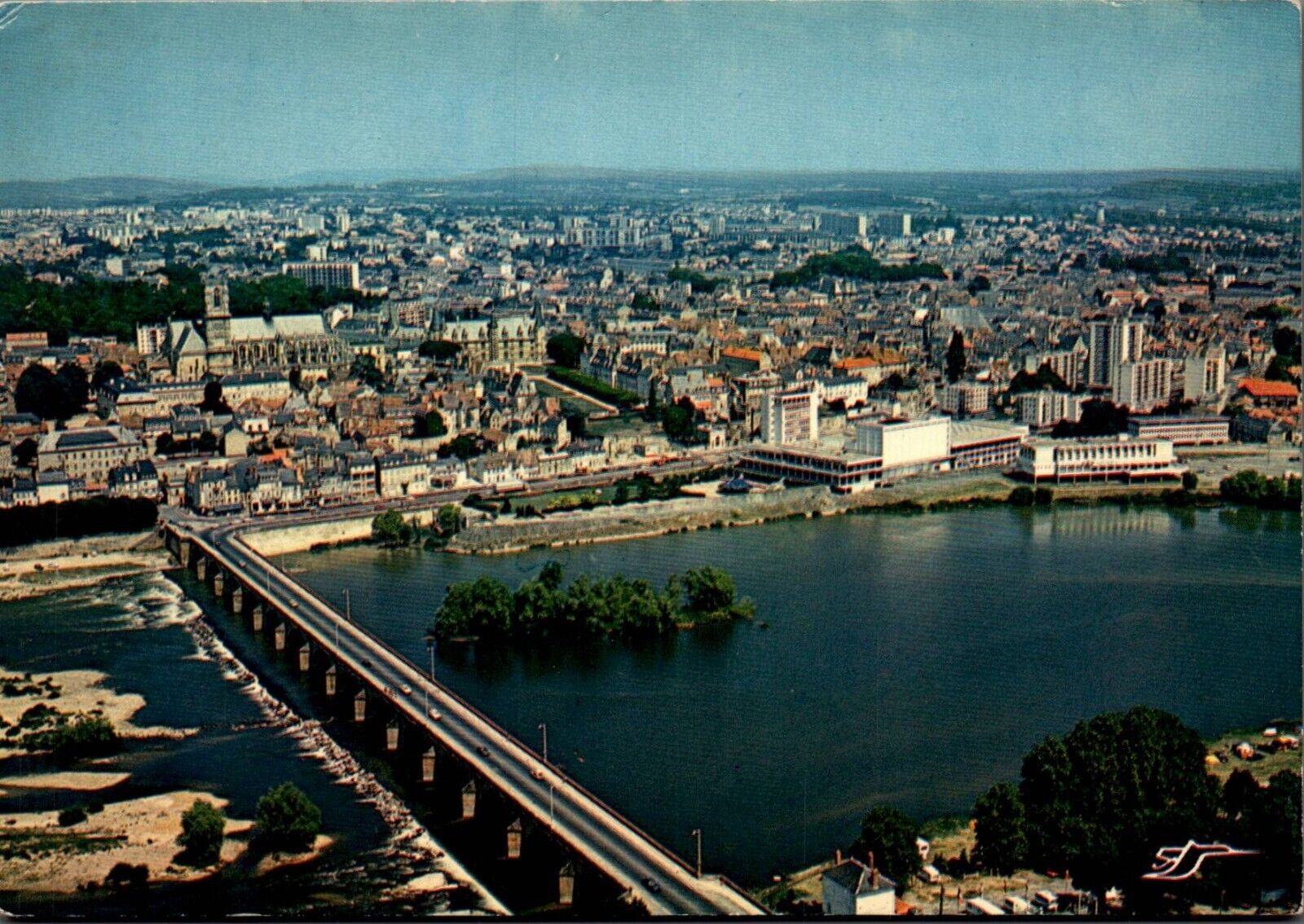
Ever been to Nevers? If not, chances are that it’s come to you because Nevers is the capital city of clipless pedals.
The city sits in central France on the bank of the Loire river, bank as in singular as the city is on the northern side and there’s little to the south. It sounds like the town that likes to say “no” but the name comes from “new fort” in Roman times.
Fast forward nearly 2,000 years and an industrialist from Nevers called Jean Beyl had a company making rubber bladders. One winter in the late 1940s he went skiing and broke his foot. Convinced the ski bindings were to blame for the injury he had his eureka moment to make a metal plate on the ski that would rotate in the event of a fall and use elastic bindings to help movement in an accident too.
Beyl wasn’t the first inventor of quick release ski bindings, Norway’s Hjalmar Hvam broke his leg skiing and came up with a similar idea, and earlier too. But he was a competition skiier and Beyl an industrialist with ready capital and labour. So Beyl perfected a quick release ski binding and soon the Look Nevada became the market leader. The English name of Look traded on post-war enthusiasm for all things American. The business flourished during a time when skiing became a mass activity and a growing market.
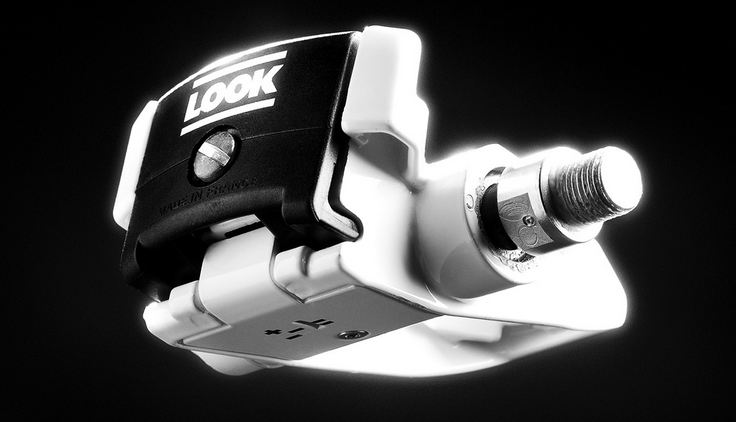
Only Look went bankrupt in the early 1980s during a period of upheaval in the French economy. Entrepreneur Bernard Tapie bought the firm out of bankruptcy for one franc and part of the turn-around was to enter the cycling market. Ski boots and bindings had plenty in common with cycling shoes and pedals. But most cyclists used small cleats with a grove to hold the shoe on the pedals and secured this with a leather strap. Look wanted to copy the automatique ski bindings to replace this. And just like the ski bindings before, Look didn’t invent clipless pedals, it refined them.
Tapie’s marketing abilities with the La Vie Claire team – then the wonder team seen at the cutting edge of sports science – helped sales soar, Look pedals “won” the 1985 Tour. To this day Look retains the Mondrian-inspired white, red, yellow and blue quadrilaterals branding that were first used for the team and then adopted by Look and also other companies in Tapie’s conglomerate. You can see it on packaging and also the factory walls in Nevers too.
Ousted from Look as a result of the bankruptcy proceedings, Beyl went on to create Time with his son-in-law Rolland Cattin in 1987. The company was also based in Nevers and hit the ground running, Pedro Delgado won the Tour de France in 1988 with Time pedals and shoes, so did Greg Lemond in 1989 Tour, and with white shoes too, ubiquitous today but until 1989 shoes were almost always black, with a few grey or blue options.
Time thrived for a while and Tom Boonen was on a Time frame with Time pedals when he won the Worlds in 2005. But the company lost ground was in financial difficulty with different owners trying to relaunch it. Confusingly Look Cycle was bought out by some of its managers while Time was taken over by ski brand Rossignol which also has the Look ski bindings business. In 2021 Time was bought by SRAM where the Time Sport brand lives on for pedals.
Today there are separate Look factories in Nevers for ski bindings and cycling and while they share a name, they are not the same business. The Look Cycle pedals business has recovered too. In 2021 Look Cycle brought back all some of its activities in Asia to concentrate in production in Nevers and now about 80% of its pedals are made here. It also makes road, gravel, MTB and track frames.
We’ll see who wins in Nevers. Cofidis with their Look bikes and pedals would be ideal for this postcard but today’s preview suggests that’s a tall order. If Biniam Girmay wins it’ll be on Time pedals and so a connection to Nevers. Jasper Philipsen and Tim Merlier use Shimano pedals but there’s actually a Nevers connection as while Shimano has its proprietary SPD cleats, it also has a line of road pedals that are licenced from Look Cycle which use larger, triangular plastic cleats similar to the design used by Look for decades. And while Decathlon-CMA CGM’s Olav Kooij rides a bike with SRAM components, he and his team mates are on Look pedals. Made in Nevers.
Fascinating post, as always. There’s such a beautiful history to cycle racing and a wonderful romance with the slowly evolving tech of the racing bicycle.
When I saw the title my first thought was that “Nevers” referred to all the TdF GC contenders not named Pogačar: they’re the “Nevers”, as in “they’ll never win the Tour as long as Tadej is in the race.”
This postcard is a bit of a retread from a Paris-Nice preview but there are always more Tour readers so reprising this for the local story rather than doing a piece about Vichy and revisionism.
Not necessarily about this article but just wanted to say, I’ve got back into watching cycling the last year or so after around 12 years away from it.
Used to read Inrng religiously back then and its been great to dive back into the site and still see going as strong as it was in 2014.
Keep it up
Really enjoyed this postcard and the history of Look and Time pedals. I got into cycling just before the whole La Vie Claire team so interesting to read about this history. Definite echoes of the Adidas / Puma story. Thanks again to @Inrng for all of the work on this blog that adds so much to my enjoyment of the sport.
Theunisse, Lemond, Fignon, Delgado… that was a competitive Tour!
Years ago my wife met Eddy Merckx at a corporate event for KBC Bank. She is an amateur racer and was of course interested in meeting him. During their conversation she asked him what he thought the biggest advance was in cycling technology. His response was “clipless pedals.”
It is an invention that’s hard to go back on.
Feels a bit lèse-majesté but maybe I’d differ from Merckx and suggest clothing as the biggest advance, but also depends what point in the past we we compare today with. But compared to the mid-1980s, clothing has come on a lot. You can ride in freezing conditions with a base layer and jacket, 40°C heat is manageable with synthetic fabrics, and the aero gains count. But no choices need to be made, plenty of improvements all around in frame design, wheels, gears etc.
My vote in recent years goes to shifters on the hoods, but clipless pedals are close.
Campagnolo brings home the all-time prize with, well, the Cambio Corsa (quick release isn’t bad, either).
As for clothes, I’m currently testing brand new equipment against 20 years old pieces, and the former essentially wins only in terms of aero. Mid-00s heat and cold management was the same or better with (to me) better feeling of the texture and higher quality synth fibres. More durability, too. Aero was obviously awful. Chamois haven’t changed much its “performance”, either, but was more durable, too.
What I wonder about is what equipment we’d now have with more modern production tech for the fabrics if we had listened to Bobet and sticked to wool and silk. I’ve got non-cycling clothes made out of those two materials only whose performance also in terms of elasticity is shockingly good.
For my riding practice, aero isn’t often relevant, but for the pros its impact is huge. Which explains why I don’t notice much difference if any between my 2005 and my 2018 bikes, but no positive change either when I’ve rented 2024 ones. Of course other friends with a different practice of the sport reportedly enjoy big benefits now with their post-2020 bicycles, although I don’t notice it on the road when together 😛
The big gap for me was between going up from mid-range alu to top titanium or carbon frames, and the wheels.
Ah, socks got better!
I started racing in 1994: integrated shifting, form-fitting lycra, and clipless pedals were common by then, even in the novice categories. The biggest advance in road cycling since then? Waxed chains. I realize they were around before my time, but having grown up through the teflon, White Lightning, and all manners of (nearly literal) snake oils, the cleanliness—and ubiquity—of waxed drivetrains means no more stains on my hands, no more stains from teammates bikes on my car upholstery. While my team and I started waxing in 2015 for the watt gains that’s a mere bonus benefit compared to the money, cleanliness, and time saved saved not having to clean drivetrains.
I like waxing too but apparently people have been dipping their chains in paraffin for a long time, it seems to have comeback as some additives and the ability to measure drivetrain efficiency has proved it works well. As you say, there are savings in wear and time as often you can just wipe your bike when in the past it needed a full wash.
I was wondering why Shimano road pedals look so much like Looks. I passed on the first gen Looks (the white ones) but failed to resist the 2nd gen (the “lightweight” — only 480 g/pr! — black ones. These days I’m on Time, and the pair weigh as much as a single 2nd gen Look pedal). IMO the gamechanger tech of the 80’s, even more than indexing.
Re: the change that matters most in road cycling that nobody mentioned yet – wide tires.
For me it goes together with disc brakes, as in I had to buy a new bike (the old one was otherwise perfect) with much more tire clearance. I went from 20mm to 35mm and next pair will be 38mm. I’m 100kg, 190cm.
It’s a big change too, comfort, grip and not necessarily slower, but is it new?
What is old is new again :), also chain waxing