
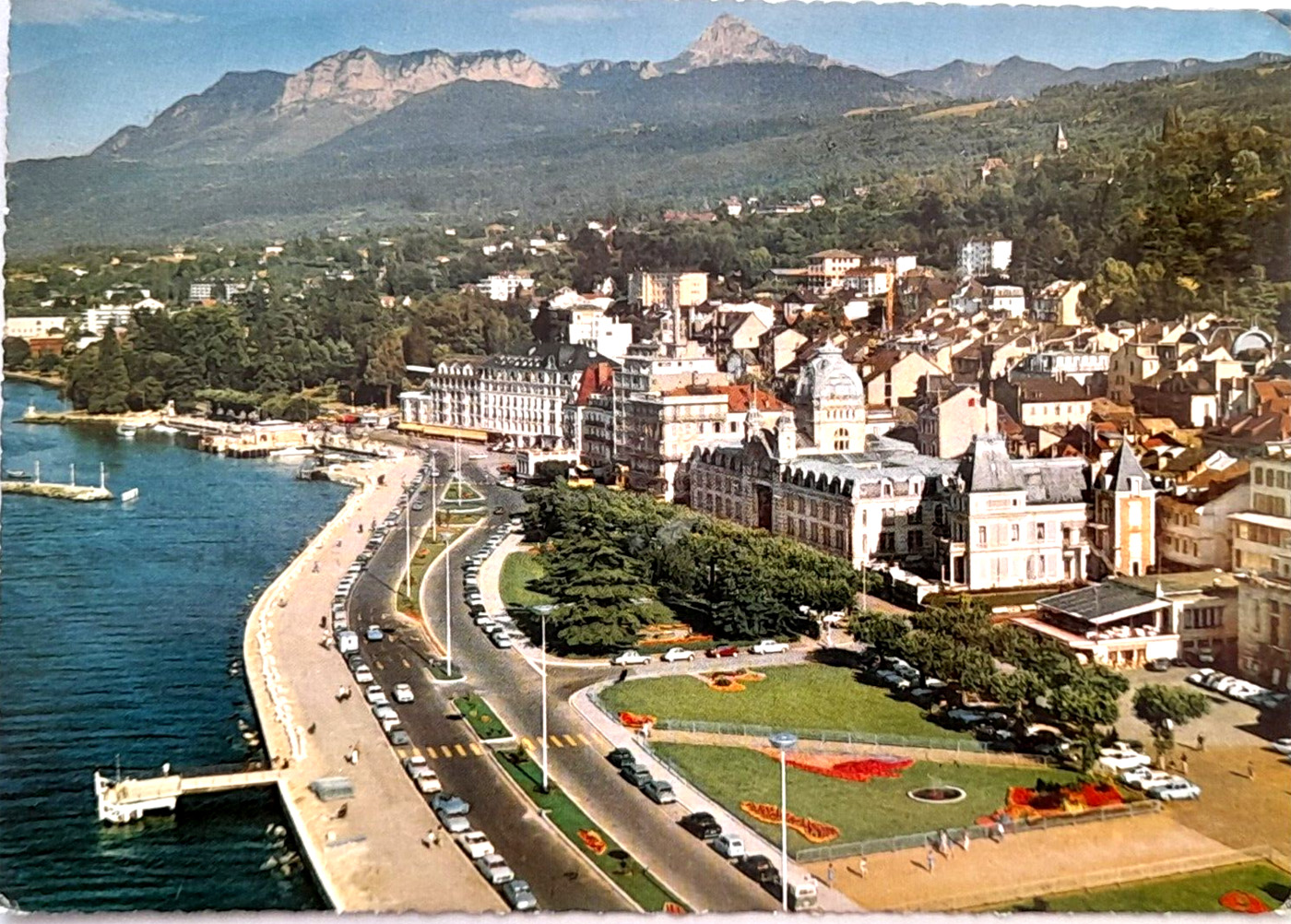
Thirsty? Today’s stage starts in Evian-les-Bains to give it the full name, but as Evian it’s one of those places more famous as a consumer brand of than a town.
Spring water is abundant in the Alps, there are many fountains supplied by abundant rain and snow melt. The handy website eau-cyclisme (“water-cycling”) lists over 7,000 places to get a free drink during your rides across France, it’d be helpful to have a map or app that does this in more countries or unifies other attempts. It’s been essential for the recon rides that inform the daily previews here. Some are dilapidated public toilets, others taps inside a cemetery. A few are more swanky. One such spot is in Evian where you can fill up your bidons with Evian for free.
In the late 18th century Gabriel Cachat had a spring in his garden and this is the origin of the water which became celebrated for its light taste. People took a liking to it, he ended up fencing his garden and one thing led to another. It was in 1826 that the spring water got official approval to become a saleable product and the industrialisation begun. This year obviously marks the 200th anniversary and the Tour is here to play a part, last month the G7 summit in Evian did too.
Visit Evian and the scale of the industry is not obvious. It’s a tourist town and not a corporate one. The fountain is a steady trickle rather than a gushing torrent. However three big pipes which take water from the Cachat spring, or the geology that supplies it, a vast layer of glacial sand wedged between to layers of clay. The conduits go to bottling plant in Publier, another town to the west.
Production estimates vary, take your pick of online sources, but at the low end of 1.5 billion bottles a year are said to leave the factory gates or two billion litres. Whatever their size, that works out as over four million bottles a day, most of which is taken away by train direct from the factory to different freight platforms where it is loaded onto more trains, trucks and also sent to shipping ports for export.
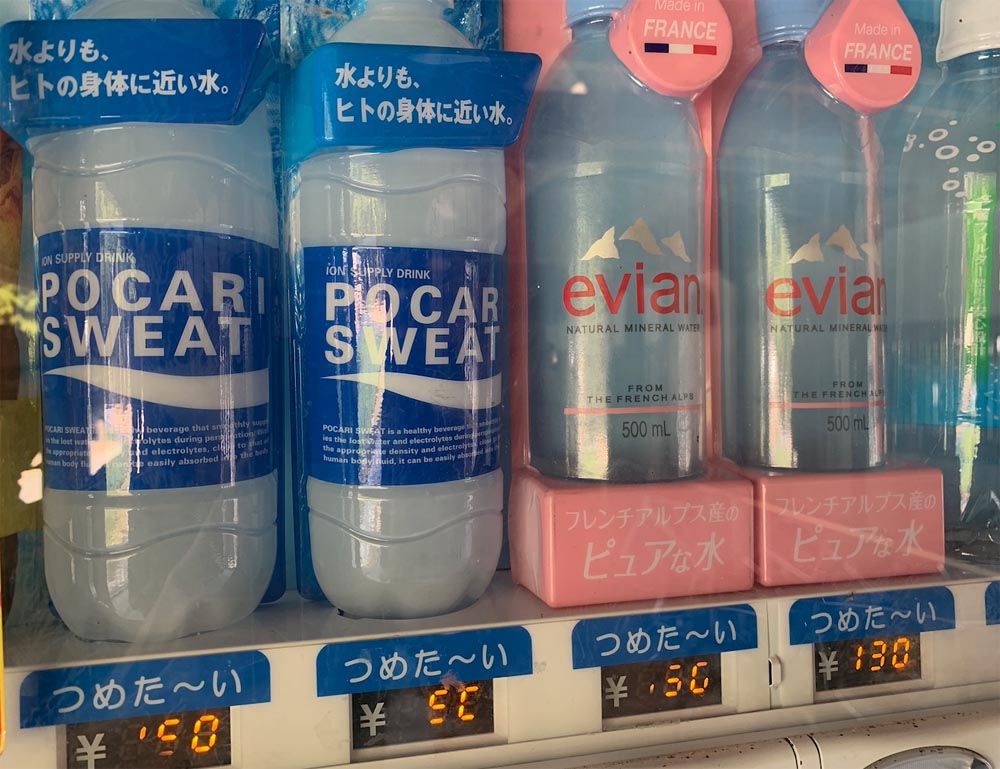
Plenty ends up in countries with abundant water and what’s really being sold is convenience and standardisation. It’s big business for parent company Danone, Evian has been a tenth of its sales.
This makes it a delicate day for the Tour de France’s sponsorship staff. Since 2008 the race has been sponsored by Vittel, another brand of water that belongs to Nestlé Waters, arch rival of Danone.

Vittel is an important customer for the the Tour as an “official partner”, the label used for the second tier of sponsors below those that sponsor the jerseys like LCL or Skoda. So how much can the race visit Evian and not trigger talk of Danone’s produce? Perhaps starting in Evian helps as the finish tends to get more attention.
The Tour has a good reason to visit now. As well as the 200th anniversary of the water as a commercial venture, a century ago in 1926 the race started in Evian. This was the first time it did not begin in Paris, a literal departure from its established format.
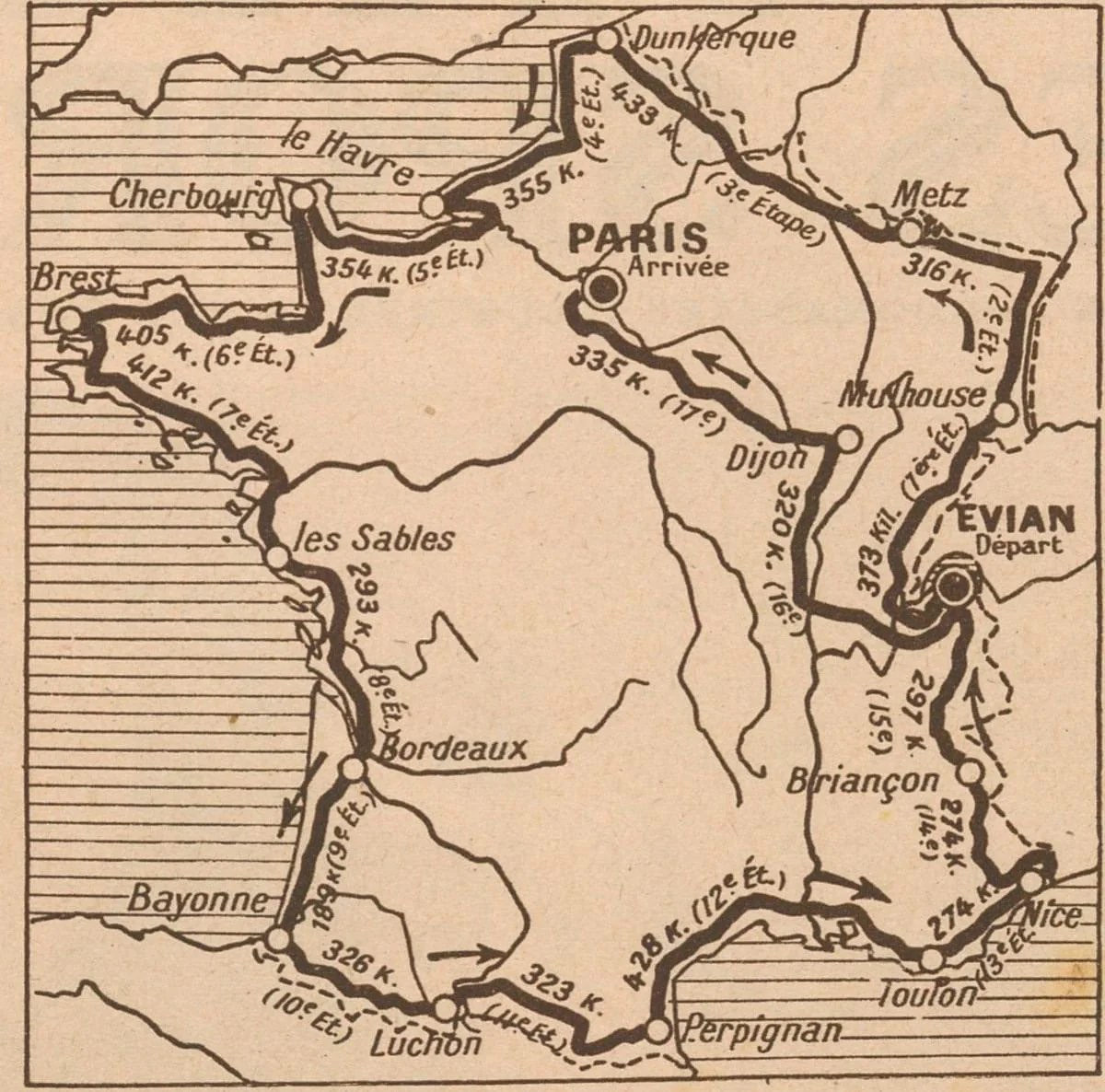
Nevertheless the race was determined to stick to its tour-of-France. 1926 was truly the year of the grande boucle, “the big loop” as the race fastidiously returned to Evian to complete a full lap around France before making the journey to Paris for the remaining two stages. This made it the longest ever Tour de France with 5,745km compared to 3,200km today. But back then things were obviously slower. The 1926 Tour took 238 hours to complete for the winner Lucien Buysse, and the lanterne rouge was a full 24 hours down on GC, compared to last year’s race taking 76 hours for the winner with the last rider only six hours slower. Thirsty work either way.
I would simply love to see a route like that again. Just the once.
Who would win it? Pog I suppose. But other riders, different types of riders, would surely be in the mix. Though it might need to smaller team sizes to avoided big trains on the front all through those long days.
All those stages across flat land without mountains, a big bunch together, be careful what you wish for.
It’s a subject for another day but pro cycling’s selling point used to be endurance but that’s altered with speed and action increasingly part of the appeal.
I’m very interested in reading a piece on the endurance vs speed issue.
In my imaginary 1920s route teams would be smaller and stages would include lots of roads that match, as closely as possible, the conditions of that era. Maybe not possible all the way, but that big pull towards the Channel coast would include “Roubaix” sections, Brittany sees ribbinoux and so on. A fun thought experiment if nothing else.
I’d love it too – just for once. But remember too that other real long distance races (Bordeaux-Paris, Paris-Brest-Paris…) fell by the wayside too due to lack of sporting and rider interest. Paris-Brest is only known by most in France today as a patisserie in the appromimate form of a bicycle wheel.
People still pay for bottled Vittel water despite repeated scandals of contamination and non-compliant filtering, and also for illegal dumping of waste plastic in woodland. Why?
I guess the furore over a 2am wake up call from the anti-doping control would pale into insignificance if you were already up at that hour for the stage start anyway!
Why do you suppose Pog would win? It would be a very different race.
Pogačar would be bored. There’s a new biography of him (in French) by Yohann Hautbois and one theme for his childhood is getting bored with things and his parents needing to turn things into games with rewards. So if he struggles with something in school, no point asking him to try harder but instead to turn it into a game, to make it fun for him. There’s something like this in cycling today, he gets stimulation from beating Vingegaard or taking on Van der Poel, or being pushed by Seixas on La Redoute etc rather than riding away unchallenged. So can’t see him doing 12-18 hour days on the bike.
They already do have a similar race…the Transcontinental Race! As noted elsewhere, ultra distance races suit a different physiology and mindset.
Imagine the excitement. A break dangling 2 minutes in front for 433k of fields from Metz to Dunkirk. Nils Politt, Victor C et al tractoring along for eight hours. I’d have thought Pogacar would perish from boredom.
😂
it’s how you’d pog proof a tour
Also 1926 Tour was the first time no French cyclists won a stage. Seems like the Tour is paying centenary homage this year.
@Pete ha ha!!
Re. maps of water taps, it’s not exactly user-friendly but various online (free) services allow you to create maps based on OpenStreetMap data – the “amenity=drinking_water” tag will find most of these taps. I use uMap for this, other similar services exist.
This method is obviously dependent on how good the OpenStreetMap data is for whatever country you’re interested in.
It’s helpful but as you say as good as the data. What’s useful with the eau-cyclisme site is it’s got enough cyclists to log places you might pass on a ride when more general map data is near populations, eg in town etc.
In places like France the OpenStreetMap data is so good that I (almost) completely trust it, and there are way more taps than are shown on eau-cyclisme. I just checked a route I did in the Jura recently and a decommissioned tap is correctly not shown on OSM, various other taps are shown, and none of them are on eau-cyclisme.
Overpass Turbo is a slightly more user-friendly service for this than uMap. The default query is actually for water taps!
Recommend Organic Maps. Free downloads of OSM mapping data by region for offline use. Search ‘drinking water’ for taps and fountains.
Seems accurate to me, barring to odd dried up tap or eau non potable sign
Or the tried and tested method in France – find the cemetery on the route out of town and have your fill
Cemeteries often work but not 100%.
Also if a tap is threaded at the end then apparently it’s drinking water. If not, at your own risk.
In my part of the World, there are many roadside fountains that are too remote to merit regular testing, and on a sweltering day it is useful to be able to read the lay of the land. One may assume the water is safe if the fountain is in a forested valley away from habitation or high up in the mountains. Downstream of cultivated areas or pastureland, it is best not to trust it, unless one can see plumbing going to a source higher up.
If you’re into lake swimming, today’s a fantastic stage. Great amenities at both the start and the finish and Lac Leman is just lovely in the sunshine.
Not cycling I know but I’ve certainly jumped into the odd French lake after finishing a bike ride and would recommend it.
Seeing the water itself can make you thirsty, it looks as if the lake is filled up with Evian.
Ned Boulting said on his podcast that the 1926 start caused such an outcry that they ended up having a ceremonial neutral start in Paris, then everybody got on a train and went to Evian for the Grand Depart proper.
The question is begged – how do Evian and Perrier scale up to such ridiculous volumes from tiny springs? Methinks Monsieur Cachat was one for the dark arts…
The water from about 35km squared is funnelled towards Evian, think of the original Source Cachat as a small leak.
If Del Boy’s Peckham Spring Water venture had truly taken off we’d be getting a postcard from Peckham instead!!!
San Pellegrino (not the mountain pass), the thermal town from where the water brand springs (now owned by Nestlé, but on sale as they’re trying to slim down their water business), also had a strong connection to cycling – and a “grand hotel Budapest” like the building in the photo above.
They also had a train… which was removed decades ago to favour some private truck & bus business. Now the old route has been turned into a great cycling path, and luckily so because the valley road are thick with San Pellegrino trucks (Koiné branded), a gigantic hub needed just to manage them close to the bottling facilities.
The cycle path will bring you to the foot of Passo San Marco, sometimes though not so often tackled by the Giro, close to much smaller and locally owned Stella Alpina spring. Another local option is Gaverina Terme water, the spring can be found climbing up Colle Gallo, long a Lombardia feature and a humbler Ghisallo, too, with the sanctuary of St. Mary of Cyclists on top. I consider both bottled waters being better than the more famous brands – but as long as they can work on the smaller scale, I just prefer them not to be as successful.
P.S. Cyclists can savour for free the very same San Pellegrino water from several roadside fountains 😉