
Welcome the start of a week’s worth of race previews and daily analysis from Paris-Nice.
Today’s stage will work the derailleurs of many a rider thanks to a hilly finishing circuit and the postcard celebrates the lost art of gearing.
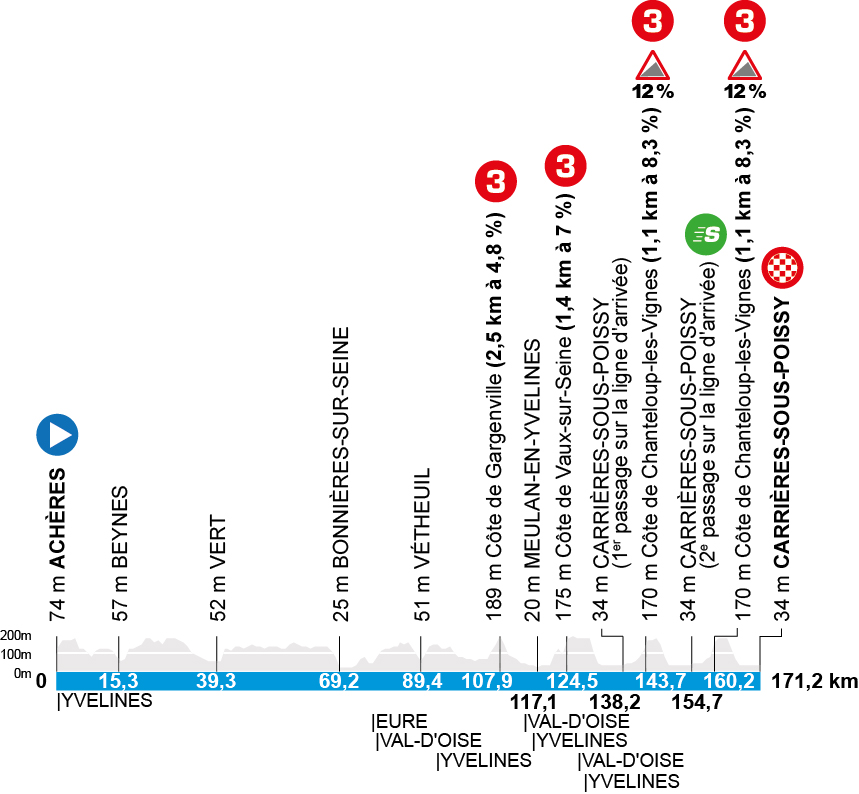
The Route: 171km and 1,950m of vertical gain, which is plenty of some sprinters. The climbing comes from riding around the Seine valley and tackling the flanks. The first climb out of Gargenville is a ramp out of town that levels off amid exposed farmland on a wide road before kicking up once inside woodland but it all feels like less of a climb and more a drag uphill. The next climb out of Vaux stings a bit more but it’s still wide.
The course then arrives on the finishing circuit with two times across the finish line and three times up the climb of Chanteloup, over a kilometre at 8% and it gets narrower in town and keeps climbing beyond the KOM point. It’s all on a long straight road. The descent features one wide hairpin bend which ordinarily isn’t a problem but on the last lap riders won’t want to lose position.
The second time across the finish line is an intermediate sprint with 6-4-2 seconds in time bonuses as well as points for the green jersey.
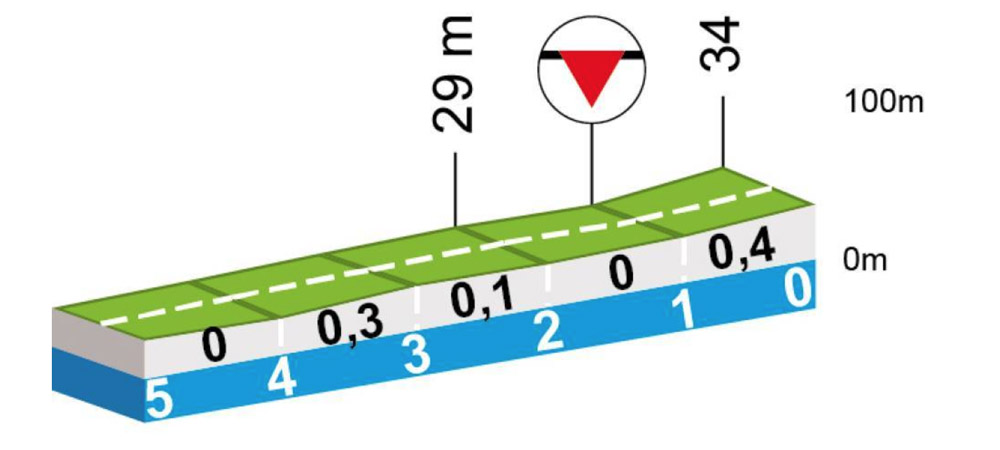
The Finish: a long straight road into Carrières and then a left turn with a rise to the line. It’ll be familiar thanks to crossing the line before for a boulevard finish.
The Contenders: the climbing makes it harder for heavyset sprinters but there aren’t many on the start line. A reduced bunch sprint seems the most likely scenario, especially as the top of the climb is 11km from the finish and after the descent the route to line is on a big wide road that won’t help a lone attacker.
Biniam Girmay (NSN) seems the best all-round pick, a fast finisher who is agile for these climbs and he’s already won this season, ending his drought.
Milan Fretin (Cofidis) is more than a sprinter and a Van Aert body-double, he’s after his first World Tour win. Team mate Bryan Coquard has said he’s done with sprinting but has two bunch sprint wins this season.
Marijn van den Berg (EF) is a contender but will he go for it or team mate Luke Lamperti?
Alberto Dainese (Soudal-Quickstep) might be the fastest in the field and gets the Quickstep lead out train but the climbs in the way and his low win rate make him hard to back. Similarly Phil Bauhaus (Bahrain) more often places than wins.
Rick Pluimers (Tudor) is fast when others have been dropped. After wiping out last week on the Molenberg and losing several teeth if he could smile here then it’d be a fairy tale result. Matteo Trentin brings experience and form too.
Axel Zingle (Visma-LAB) is sort of the team’s house sprinter but he’s much better suited to uphill finishes that last rather than today’s kick to the line.
Cees Bol (Decathlon-CMA CGM) has a Paris-Nice stage win to his name. He was going well in the UAE Tour as the rider who almost got Isaac Del Toro back in the opening stage’s uphill finish but the hilly circuit with repeat climbs makes things harder.
The likes of Ineos could try to force the pace on the climb in order to make life harder for the sprinters cited above and set up Dorian Godon. Similarly Orluis Aular (Movistar) is due a breakthrough win but he’s among the sprinters who would like a hillier circuit but if Movistar were to join in it would help.
Finally a couple of breakaway jokers in Ivan Romeo (Movistar) and Ewen Costiou (Groupama-FDJ).
 |
Girmay |
 |
Fretin, Godon |
 |
Bol, Dainese, Trentin, Van den Berg |
Weather: sunny, 17°C and calm.
TV: KM0 is at 1.10pm CET and the finish is due for 5.00pm. TV coverage begins at 3.30pm on France3 for locals and VPN users. Otherwise it should be on the same channel you watch the Tour de France.
Postcard from Chanteloup-les-Vignes
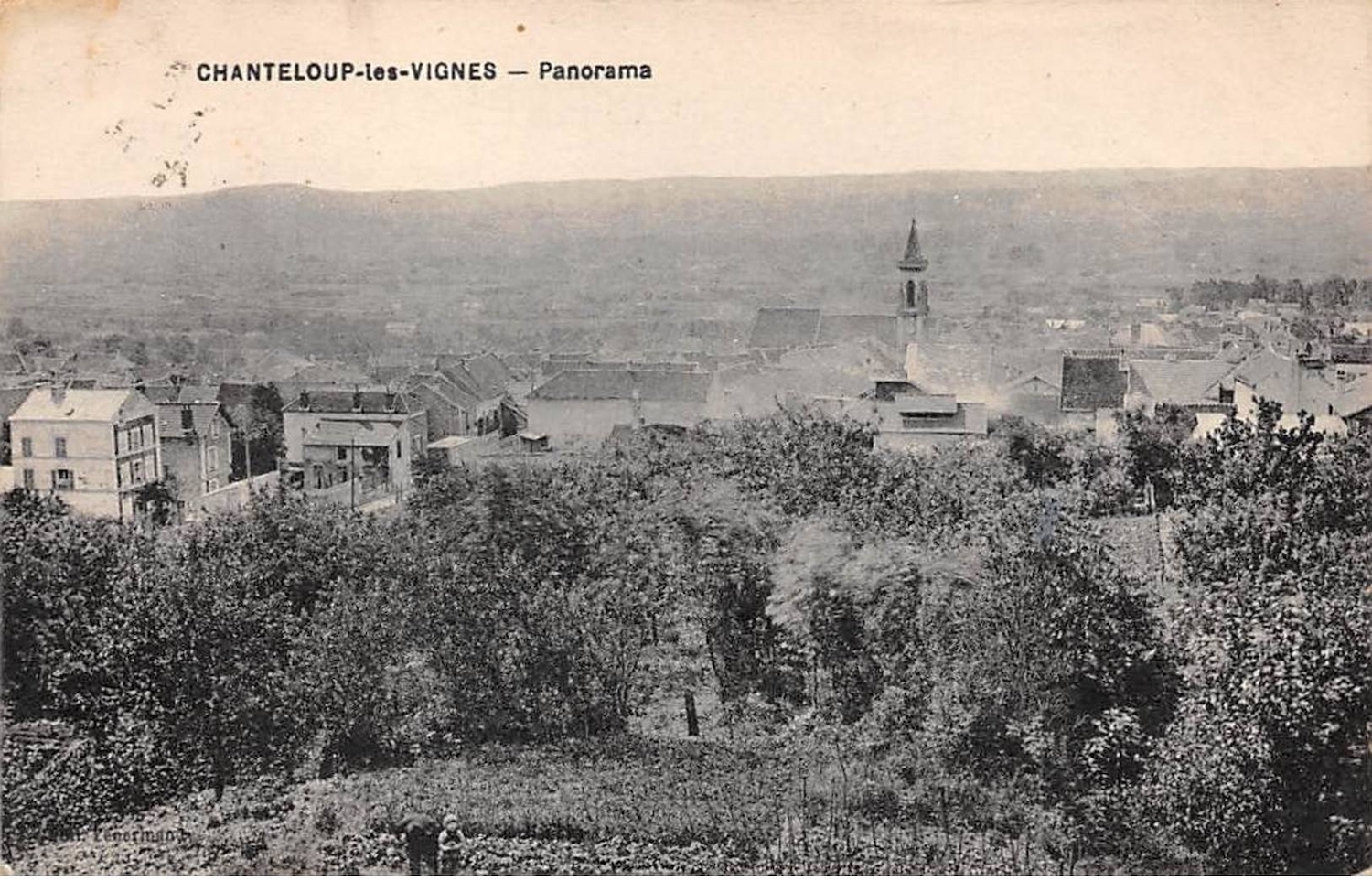
Chanteloup used to host a race called La Polymultipliée which was later branded the Trophée des Grimpeurs, literally the “Climber’s Trophy”. It seems audacious to hold a race with this name outside Paris rather than the Alps or Pyrenees but multiple ascents of the road to Chanteloup made it hard and climbers from Julio Jiminez, Luis Ocaña to Richard Virenque have won here before. Thomas Voeckler took the final edition in 2009.
The Polymultipliée was created in 1913 celebrate the derailleur. “Polymultiplication” meant gearing. To explain, a chainring and a sprocket bring multiplication, as in a 48T chainring will turn a rear wheel with a 12T sprocket four times. Poly meant several gears, a choice of ratios to select while riding as opposed to a single gear and obviously a hilly course was needed to make the most of gears.
Changing gears while riding was radical to the point where it was even portrayed as unsporting and lazy. Turning the pedals over was meant to be a manly act of brute force. It wasn’t until 1937 when derailleurs were allowed in the Tour de France as the sadistic organiser Henri Desgrange had long been opposed. So it was cycle tourists rather than professional cyclists that embraced and helped to perfect gearing. It’s no coincidence that the race wasn’t launched by a newspaper but by Le Cyclotouriste, a magazine.
While pro cycling belatedly adopted the derailleur it’s striking to see the likes of Fausto Coppi and Eddy Merckx riding up a mountain pass with their shoulders rocking – “pedalling with their ears” – as they toil to turn the pedals, partly because they did not know otherwise and above all they were limited with five or six sprockets.
This laboured style continued right up until the end of the 20th century, even Miguel Indurain and Marco Pantani wrestled with their bikes. Gear selection mattered. Raymond Poulidor in part put losing the 1964 Tour de France down to the wrong gearing, he didn’t have a low enough ratio for the Puy de Dôme. More recently riders have struggled with the Zoncolan or Angliru and these climbs arguably owe their legend in part to being introduced to the Giro and Vuelta just before “easy” gearing arrived in the pro peloton and so establishing a feared reputation just in time.
At times gearing crossed from mechanics to art and lore. Fitting a 24 or a 25 tooth sprocket at the back was a concession, a weakness. 1990 Tour de France mountains winner and 1993 Trophée des Grimpeurs winner Thierry Claveyrolat insisted on 44×23 as his lowest gear as a make-or-break for him. Some riders opted for or against even or odd-toothed chainrings out of superstition.
Today gearing in pro cycling is barely mentioned. Even the steepest roads can be tamed thanks to low gears and now at the press of a button too. The adoption of 2×12 speed means riders have gears to suit every occasion as standard. Some riders are using single chainrings as they don’t even need all that choice. In Paris-Nice many will opt the same chainrings and cassette today as they will for next Saturday’s stage to the Auron ski station. Watch today as riders climb the hill to Chanteloup and barely change cadence.
The climbing thing is interesting because whilst Pogacar does it seated Contador used to intimidate standing up and dancing on the pedals. The image that I have in my mind of Indurain is his hands clasped to the handlebars adhacent to the centre post.
Del Toro tried to shake Tiberi in the UAE Tour with a long attack standing on the pedals all the time, it was notable because it was almost unseen these days when a typical mountain attack is 10-14 pedal strokes standing before sitting down.
I didn’t see it but it seems Del Toro set a record for the climb though … if it is the same stage as you reference.
Del Toro is a cyclo-crosser, and cyclo-cross in the muddy, rainy laage landen of winter teaches your legs to produce ‘smooth’ stabs of power from a seated position (standing up takes weight off the rear tyre and makes you much more likely to spin).
I’m looking forward to the race. P-N is always a highlight of the season for me, and the daily previews make it even better. Thanks a lot also for the enlightening postcard. I had no idea that derailleurs were so old, and the point about Zoncolan and Angliru is very interesting. I’d say that gearing is still a major topic in today’s time trialling, though. By the way, has anybody ever looked into what sort of preferred cadence climbers and GC riders have had over the years when riding uphill? Among today’s contenders, Roglic seems to stand out…
Felix Gall for high cadence too. Almeida might be among the slower end, sometimes Storer stands to push a big gear but there’s not much in it.
Love the postcards and history. The gearing brings back years of struggling over Cumbrian passes with nothing lower than 42 (Campag’s smallest) x 24 (Regina’s largest) and at times 42 x 21.
This week should bring some real racing after yesterday’s promenade. It might have been better without Del Toro and Christen weighing down the chase
I get that picking a 24 meant not having, say, a 17 but only a 16 and a 19 but all the same it would seem better to have the right gear for the decisive part of the race? It’s like Poulidor climbing the Mont du Chat in 44×23 and he got to the top first and dropped Merckx but almost because he had to in order to avoid stalling and Merckx was fresher and got back to take the stage. Gearing like this along with food was presumably why so many riders would implode late into a stage.
Especially before the 80s, but sometimes during the 80s and 90s even, with cassette with less than 9s, you risked not to get to the decisive part of a race if you had poor gearing for the flat to rolling rough terrain before or between, often raced aggresively to break the peloton into smaller pieces. A jump from 16 to 19 will easily leave you dead or dropped if things get hot on false flats, little côtes etc.
Charlie Gaul was famous for using a small gear to climb (he was the best climber of the late 1950s). The problem was that the range of possible gears was quite narrow so a small gear for the climbs also meant a small gear for the descents (and the flats). He invariably got caught on the descent and dropped on the flats.
Modern derailleurs not only allow more gears; they also allow a much wider range of gears. The wide range is what has changed the way riders cycle. In Merckx’ time, the typical was 52-42 on the front and 13-14-15-17-19-21 on the rear. And if you wanted a 53 on the front, you had to combine it with a 44. This meant they all slogged up the hills at a small cadence, and soon spun out on the descents.
It felt like a relief to watch a normal race today will no lone rider serenely cruising 80kms to victory. Instead a spirited breakaway caught in the final kms before a decent sprint.