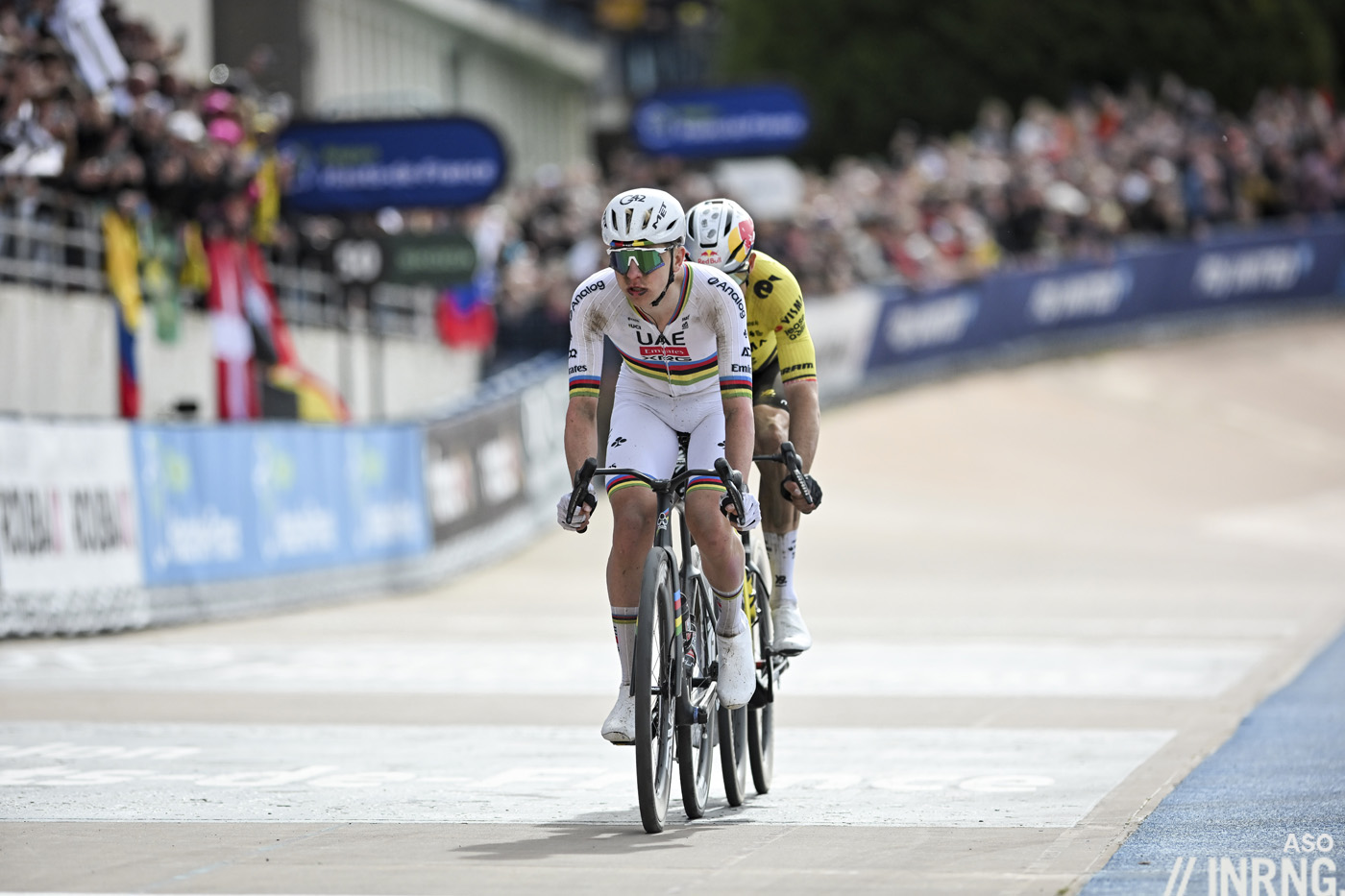
Tadej Pogačar leads Wout van Aert into the Roubaix velodrome. With over 250km done in record time it felt possible that it could go either way but the more you review it, the more decisive the win for Wout van Aert becomes.

Normally these race reviews list the early breakaway’s riders. But there were none, a clue of the exceptional race to come. The bunch was often doing 60km/h and if UAE, Ineos, Alpecin, Lidl-Trek or Red Bull weren’t driving the pace then most of the other teams were busy trying to prove they exist by launching moves only to cancel each other out. Their attempts often lasted seconds. It was costly to open a gap and impossible to build a lead. The field split at one point.
Instead the big teams went into lead-out formation for the first cobbled sector but once delivered onto the pavé the intensity eased. Mike Teunissen even escaped for a moment, the first rider to breakaway and for the anecdote he’d later finish 10th, despite a crash and a puncture.
The mechanicals and mishaps began on the first sector. First to puncture… was apparently race organiser Thierry Gouvenou’s lead car, an incident curiously not relayed on race radio. Among the riders Mads Pedersen needed a bike change and began a long solo chase, alone at first to get into the vehicle convoy and then back to the bunch. If this looked disastrous, it was straightforward compared to what was to befall others.
The wheel of misfortune span for Wout van Aert next, puncturing with 150km to go. He got a quick bike change and without leaving the column of vehicles found, and he found team mate Owain Doull was there to help him back, the pair slaloming amid team cars trying making emergency pitstops for their riders.
UAE led the pace, their black and white kit contrasting with their rainbow-clad leader. Their pace split the peloton in half after the fifth cobbled sector, towing a group with all the main contenders clear. They stayed on the front and each further sector shrank the group further, Davide Ballerini fell, taking out Ineos pair Ben Turner and Josh Tarling. Visma-LAB lost Edoardo Affini and Per Strand Hagenes to mechanicals. It was like watching a pot of sauce reduce: the heat was on, but gently.
Then it Tadej Pogačar’s turn. He stood up on the pedals and started to freewheel on the pavé of Quérénaing, guiding his bike to a stop. Remember the peloton had split earlier, this meant his team car was not waiting, it was behind the group that was adrift.
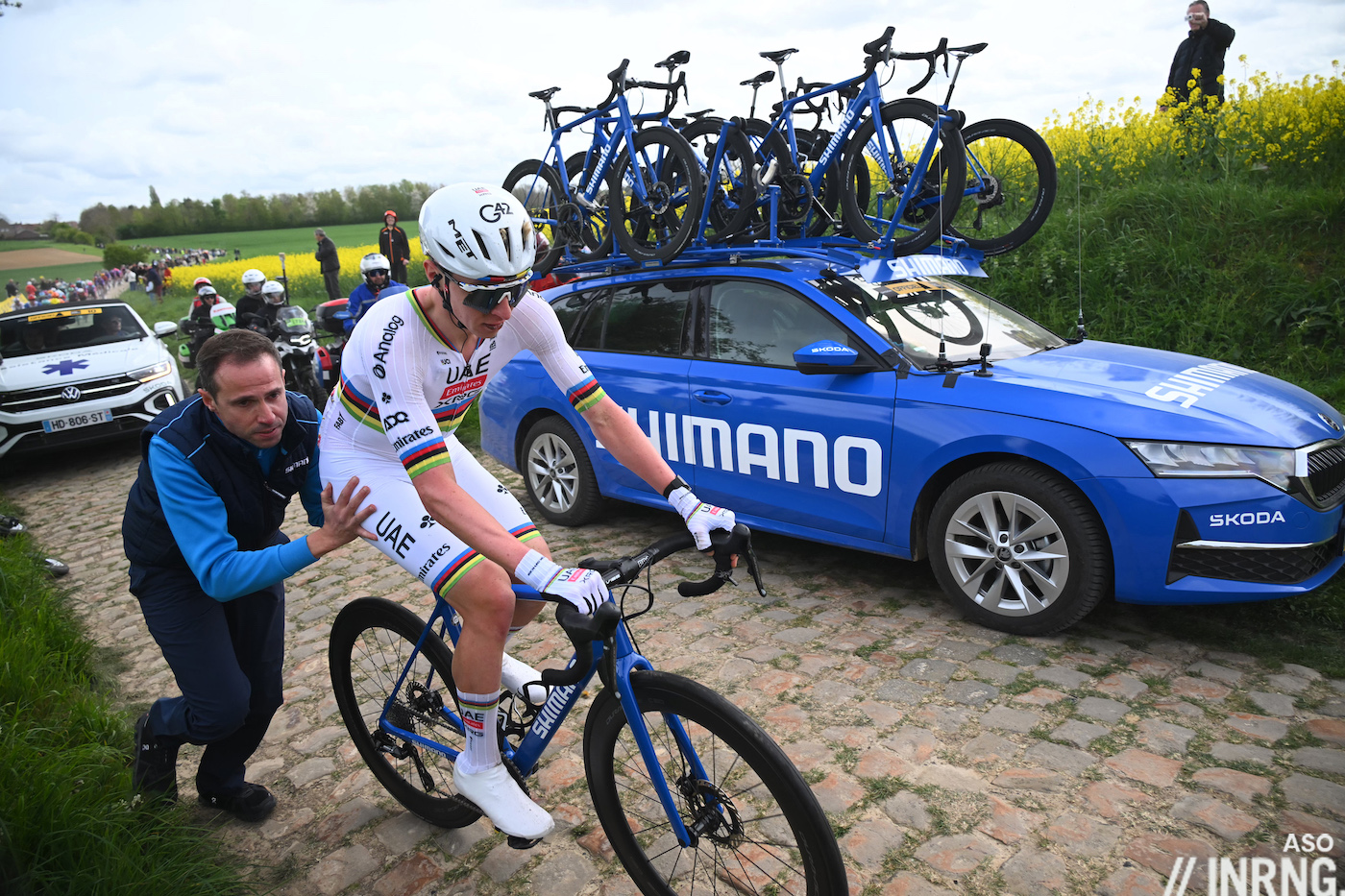
In the moment Pogačar opted not to take a spare wheel but to ride a neutral service bike, presumably just to keep going without losing any more time and to make a bike change as soon as possible. Panic? Probably and a febrile moment for the Shimano crew too which made the cardinal mistake of stopping on the left of the road and seconds later caused a traffic jam. Look at the image below and you can see a medical car about to get snarled up and plenty of riders appearing.
Pogačar caught up with Hagenes and Tarling and others chasing but for a long time was without any team help, no spare bike nor team mates. He’d used up some helpers, Florian Vermeersch was being preserved and this left few riders and in the heat of the moment it seemed they could not be contacted via radio to help.
Up ahead Pogačar’s absence was visible. Alpecin didn’t accelerate immediately, Silvan Dillier seemed to be asking on the radio what to do. Come the next cobbled sector they, Red Bull and Visma picked up the pace, after all this was a race. The world champ spent almost five kilometres on the neutral service bike before the UAE team car could barge past others and once he got a spare this left him with another 18 kilometres of chasing to get back on, with the help of some diminished team mates but a lot of work done himself. He made it back just in time for the Arenberg forest.
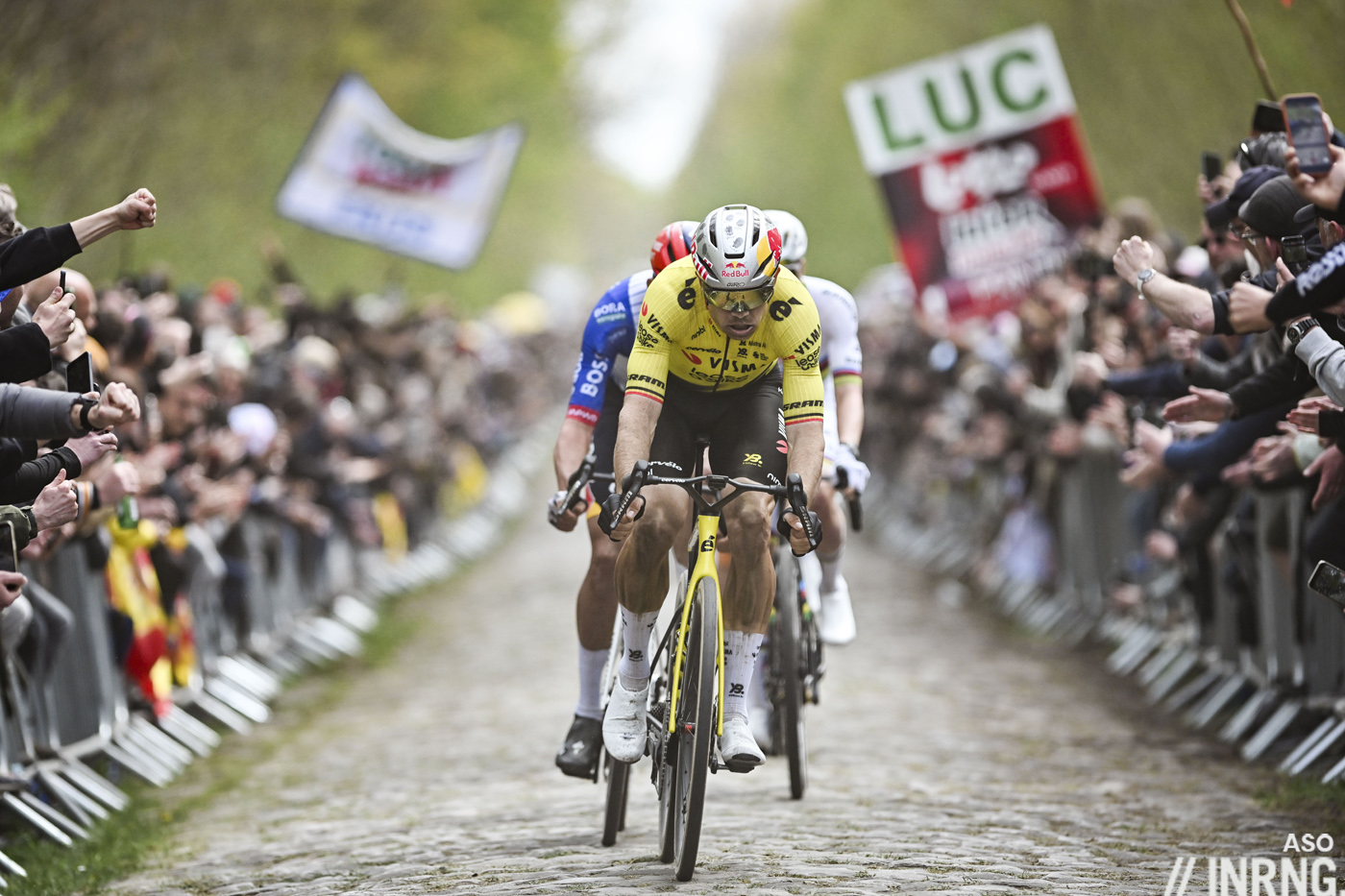
Van Aert led into the five-star sector thanks to a lead-out from Matthew Brennan. Van der Poel was second, next an impressive Laurence Pithie (Red Bull) then Jasper Philipsen and Pogačar fifth wheel. Van Aert’s pace and the angular stones were causing havoc for many and suddenly Van der Poel peeled out of the line, one foot unclipped and then running, for a few steps this was his Froome-Ventoux moment until Philipsen handed over his bike and gave his leader a push to get going. Only Van der Poel was unable to clip his feet into the pedals. Philipsen came running back to recover his bike and race on.
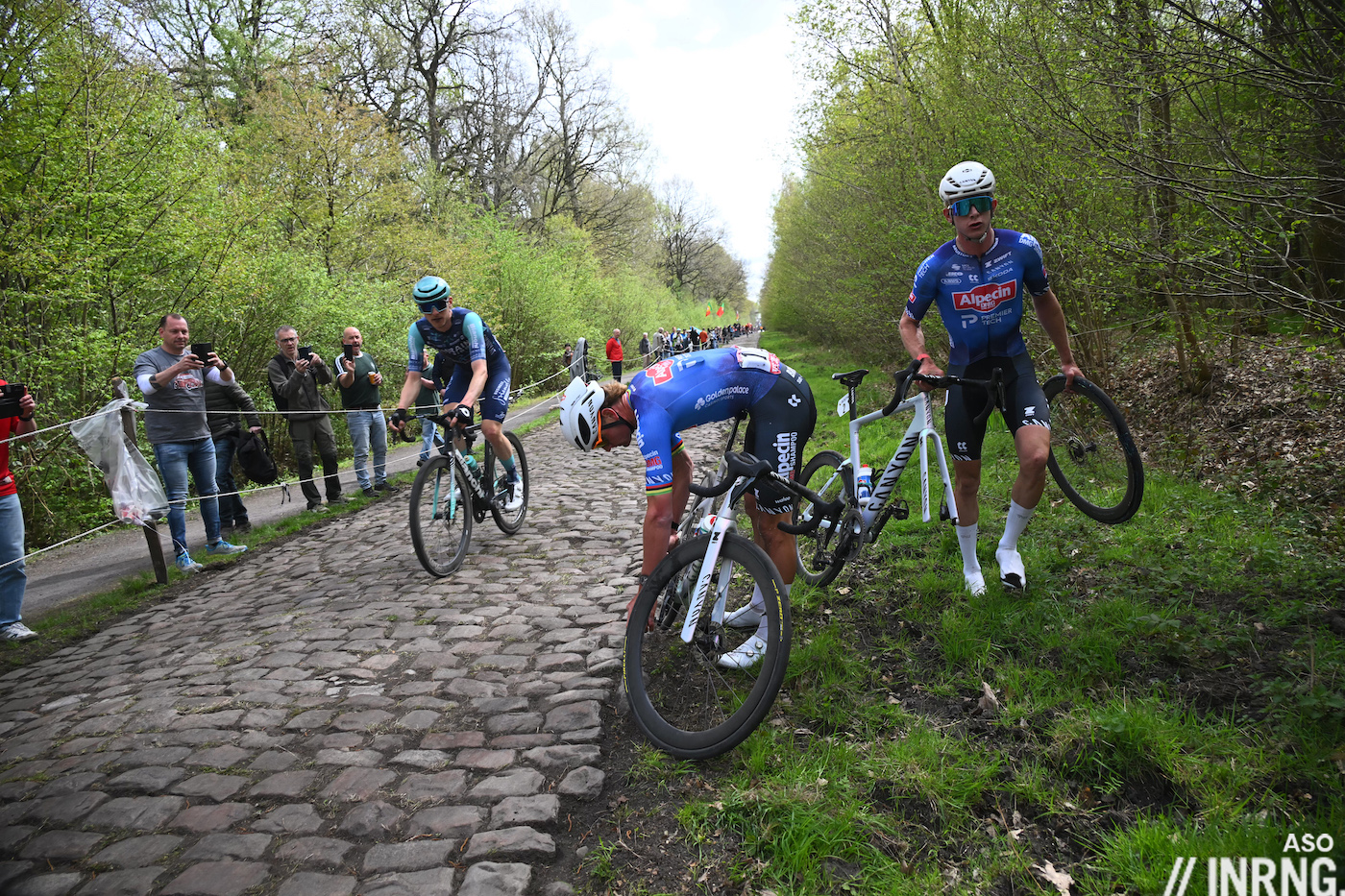
This left Van der Poel walking back down the course to recover his original bike to find Tibor Del Grosso had popped his front wheel into Van der Poel’s forks. Only Del Grosso’s rim was cracked and as Van der Poel approached the end of the sector he was struggling to ride on. Already 90 seconds behind the front, now he got a bike from his team car but he was two minutes down. For a rider who seems to float on the cobbles this time he was on the receiving end.
Once upon a time, or just a few years ago, Arenberg was a point in the race where a contender or two could come undone and the exit was a moment for many to assess themselves ready for the race ahead and observe their rivals. Now most of the field had been eliminated.

There were seven riders in the lead: Pogačar, Van Aert and his team mate Christophe Laporte, plus Mads Pedersen, Jasper Stuyven, Laurence Pithie and Stefan Bissegger. All the big names minus Filippo Ganna and Van der Poel. Only Ganna was thirty seconds behind and closing, towing Jordi Meeus across.
Van der Poel started chasing and the gap went from two minutes to 1m30s. By this time it felt like the race was being narrated by a team of capricious scriptwriters locked in a room. Ganna punctured. Then Meus was dropped and moments later Pithie punctured to leave six in the lead.
At this point Van Aert’s route to victory started to become clear. He had a team mate in Laporte for support, Pogačar was sapped from his chase on a bike that didn’t fit him. Mads Pedersen was a menace but possibly still short of form while Stuyven and Bissegger outsiders. Pogačar punctured again and if he got a quick bike change, he had another long chase.
Behind Ganna was chasing at one minute, Van der Poel a further thirty seconds back. In reality this meant the Dutchman could see Ganna’s group and crucially was able to get into traffic of team cars behind and closed the gap. Ganna and Van der Poel could be seen talking, presumably an alliance to close the gap.
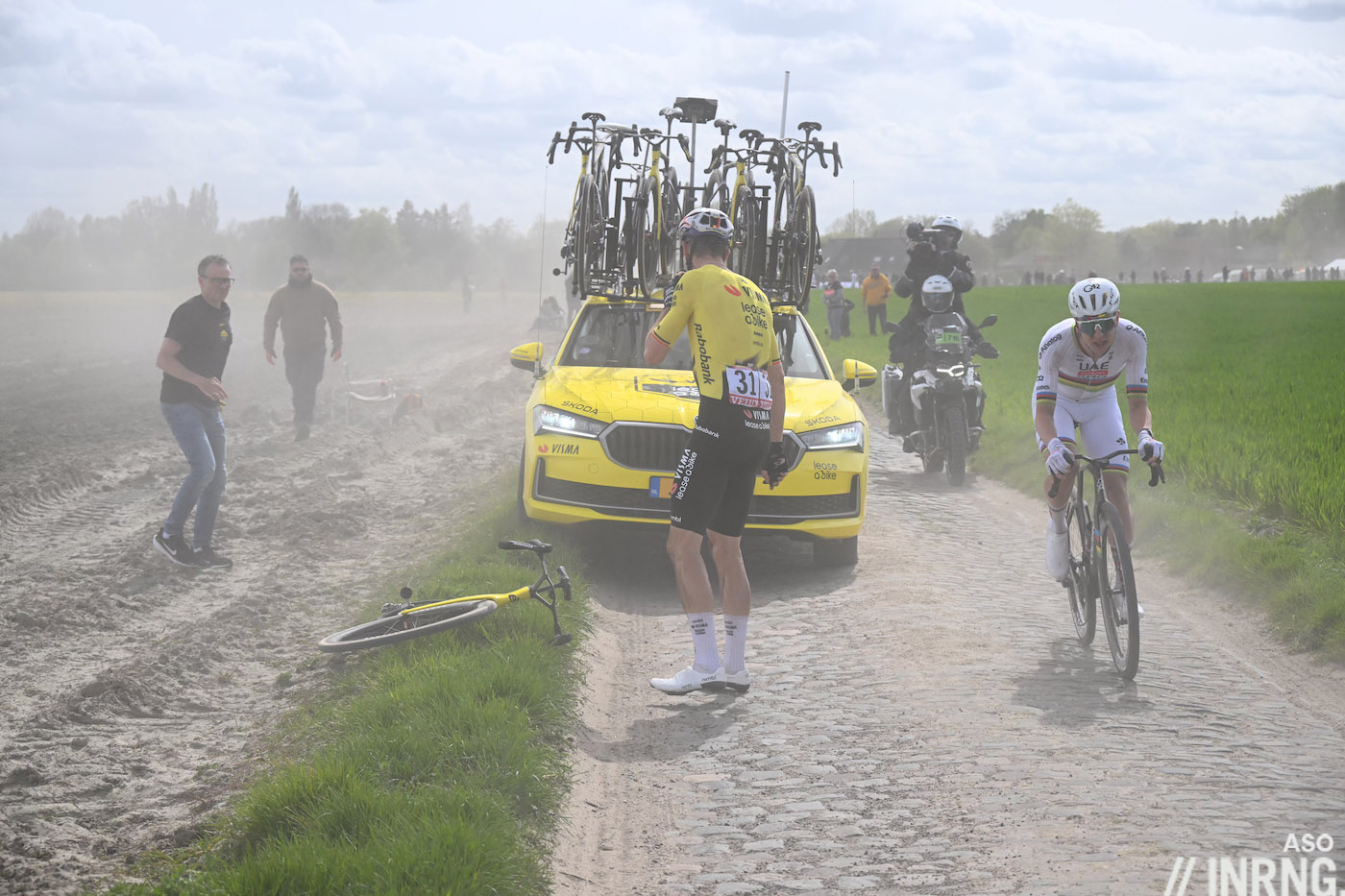
Now Van Aert punctured, with Pogačar passing him as he got a new bike. The Belgian was left chasing. Advantage Pogačar? He too chasing to get back to the front. This was a key phase in the race as Laporte eased up for Van Aert which let Pogačar get back and then Van Aert too. This also produced the concertina-effect where Van der Poel and Ganna were able to close the gap too. With still 54km to go Van der Poel was at 20 seconds.
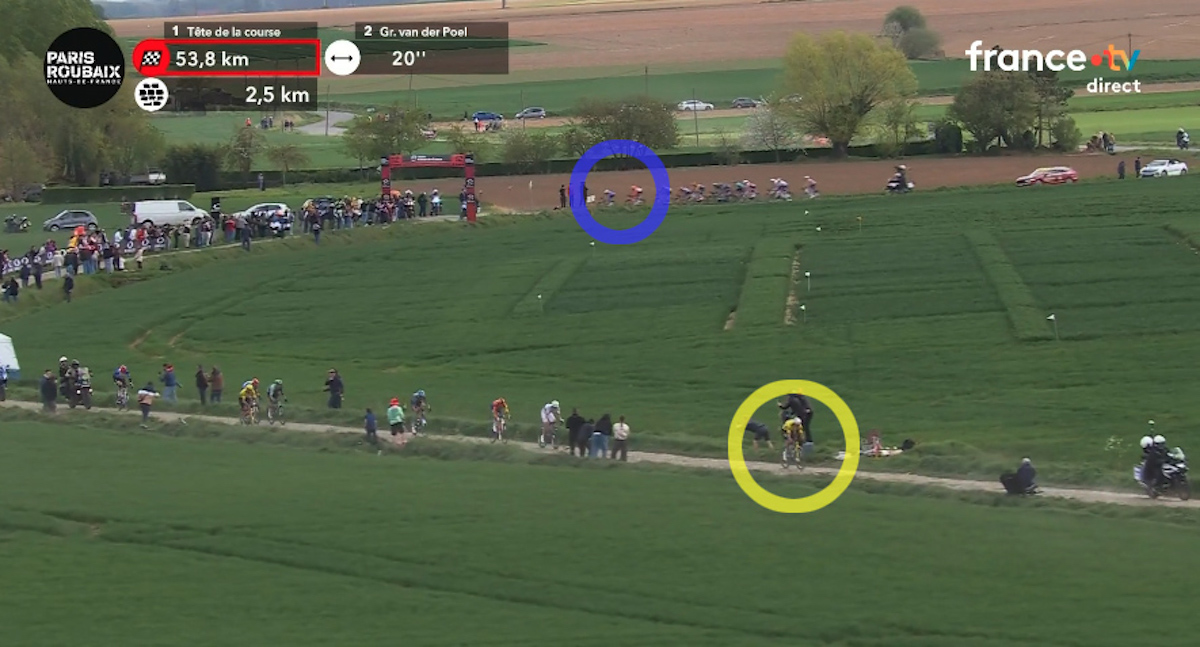
This saw Wout van Aert attack just before entrance to the Auchy pavé. This was another crucial moment. In the annotated screengrab above you can see highlighted in yellow Van Aert on the attack while in the background highlighted in blue Van der Poel and Ganna are close. With Pogačar and then Pedersen chasing we got a sense of hierarchy, with the Dane who looked in trouble with his head dipping and back arched. Pogačar got across to Van Aert, passed him and the increase in pace was too much for Pedersen. With 53km to go Van Aert and Pogačar were away together and would not be caught.
Van der Poel was chasing with Mick van Dijke while Ganna was goner, a puncture saw the Italian distanced and then he wiped with the the flat tire sliding on a corner.
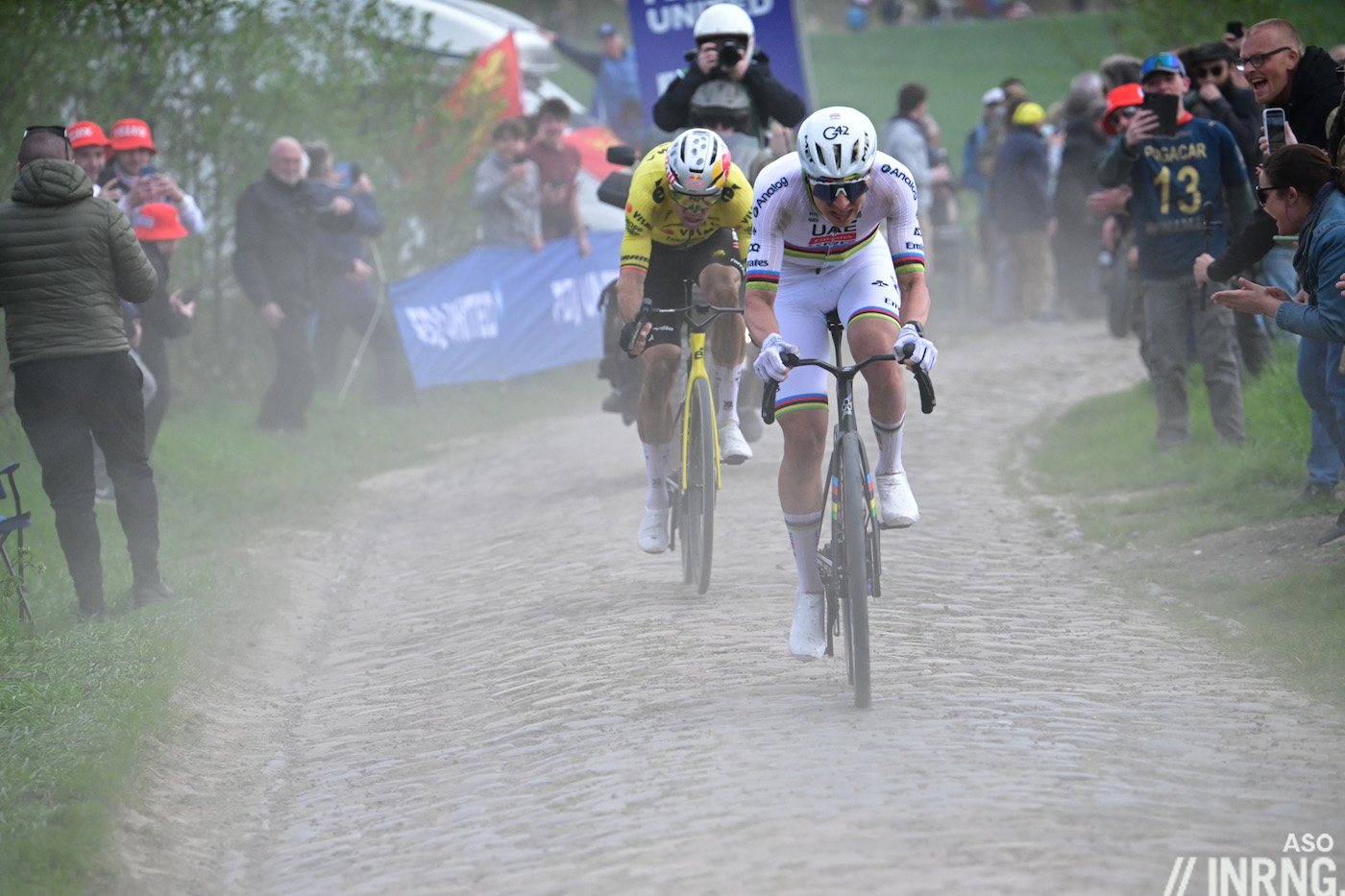
Pogačar led onto the 5-star Mons-en-Pévèle sector. Halfway through the sector he tried an attack – pictured above – but Van Aert got back, head bobbing. Both were tired but seemed to want to collaborate, each knew their chances together were better without with Van der Poel, their shared tormentor. This led to a stasis with the lead two clear of the group led by Van der Poel with Laporte, Pedersen, Stuyven, Bissegger and van Dijcke.
The final cobbled sectors saw Pogačar running out of road. Rather than accelerate he was starting to struggle to stay with Van Aert. The Belgian wasn’t attacking, instead he was smoother on the cobbles, taking better lines and conserving speed while Pogačar was less lucid. Even a late attack on the false flat in Hem before Roubaix was out of the question.
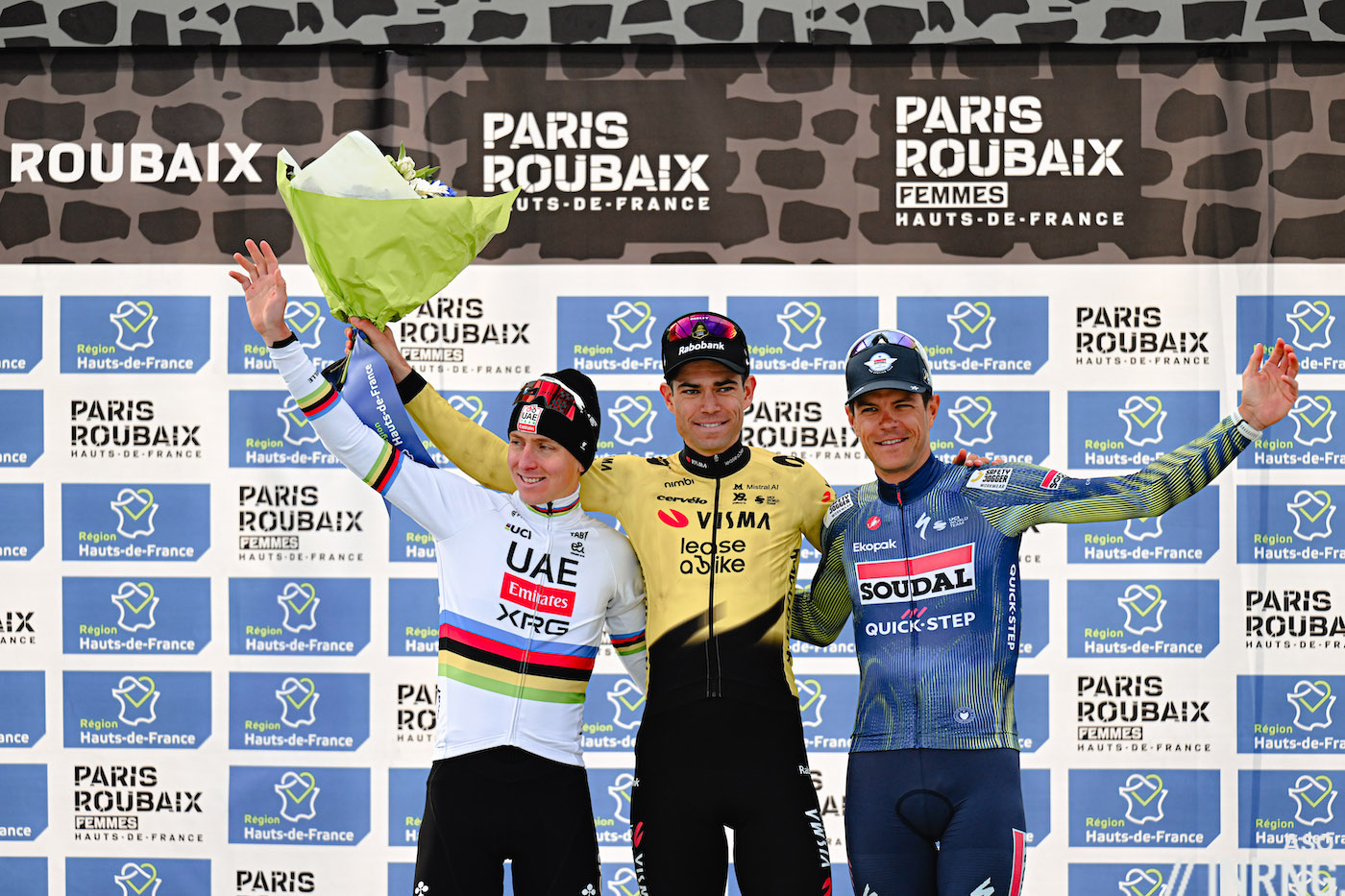
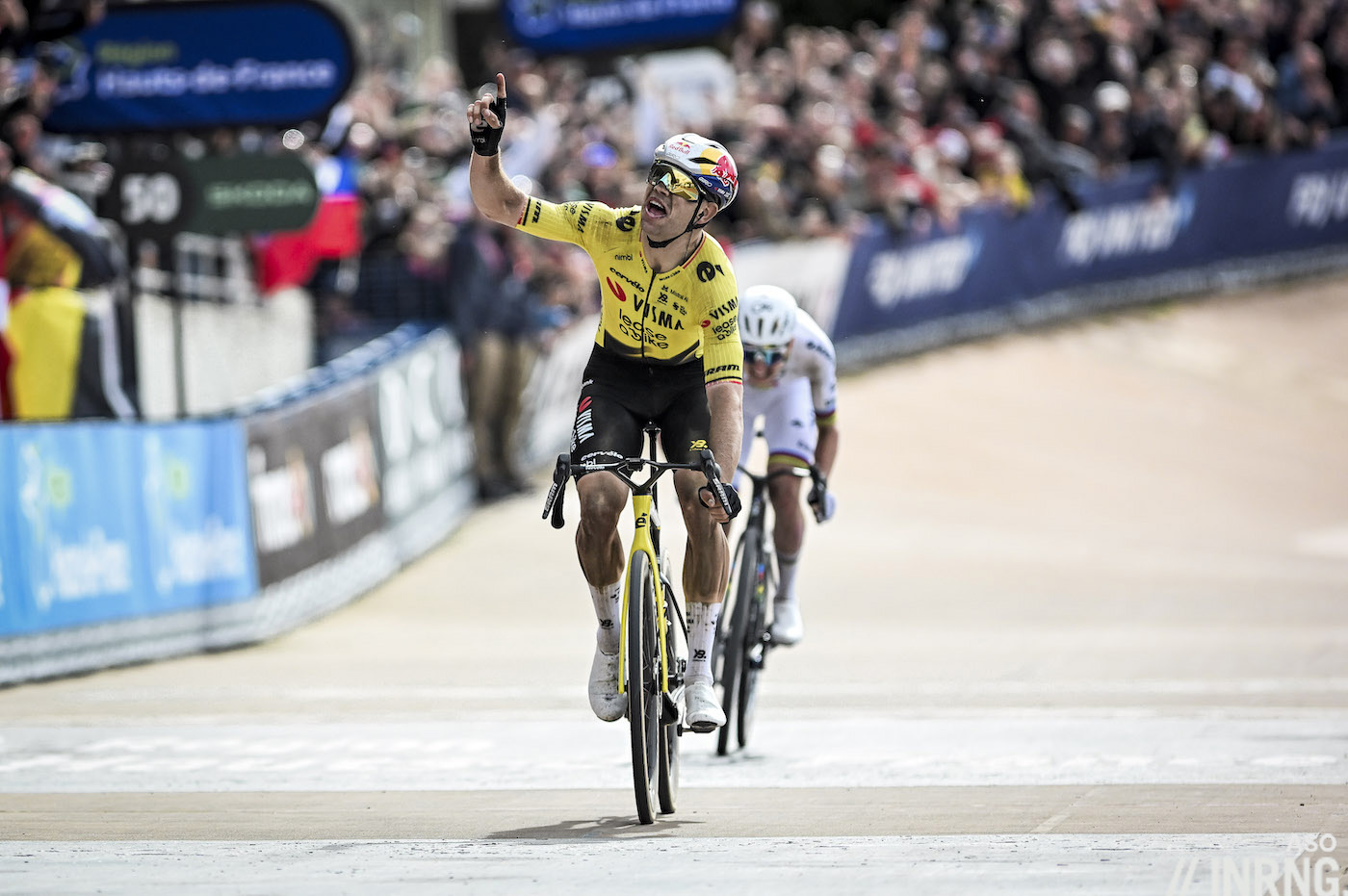
After 258km it came down to a two-up sprint. Pogačar led into the velodrome and across the finish line for the first time. There were no games. This wasn’t going to be a test of speed or tactics, just what was left. With half a lap remaining Van Aert launched, came around Pogačar and kept sprinting to the line while Pogačar had to sit down for a moment. Van Aert had won.
The Verdict
A vintage edition for the ages. Race director Thierry Gouvenou said it was probably among the best two two races he’d seen, for him as good as 2016 when Matt Hayman won. If he has a different vantage point to most it’s still hard to argue.
It was packed with drama but rarely, at least for the prime contenders, negative. Van der Poel will have hated losing two minutes but his chase only heightened the action and ennobled the breakaway as they tried to keep away. It would be a different kind of sport if mechanicals occurred with this frequency every weekend but this is why the race is most exceptional race on the calendar.
If Lady Luck kept shuffling cards, there was redistributive logic with all the big names having a set-back and being forced to overcome fate, none of the obvious names that would have gone in a preview were cancelled en route. Similarly she wasn’t over-promoting random riders, there was satisfaction that despite the chaos this was still a race among the best. Pogačar’s long chase may have cost him the win; Van der Poel’s even longer pursuit suggested he was the strongest. Neither got the openings they wanted.
For Pogačar a loss and the compulsion to return the next year. With the possibility of winning all five Monuments in a season gone, perhaps forever if he eschews Sanremo now, he still finished runner-up in a race where little more than a year ago taking to the start with ambition was seen as audacious. As much as he’ll want to return, he’ll haunted by the near-miss and lost chances. If he hadn’t punctured, if the team car had been closer and so on then he might have had the extra punch to shake Van Aert on a day when his greatest rival in Van der Poel was out of the picture.
This was Van Aert’s day. It was hardly a Germinal remake of the downtrodden Van Aert revolting. But it is a reward for patience and persistence, and in a year that began with a broken ankle and for a rider whose losses have helped enhanced his legend and created sympathy but were beginning to weigh on him. This time luck went his way. He made it his own race, leading in to Arenberg to chose his path. Attacking when Van der Poel was closing in to go clear with Pogačar. Surfing the stones when Pogačar was tiring. Getting on Pogačar’s wheel for the velodrome. Then a decisive sprint to leave Pogačar sitting.
31 years old, Van Aert has long been dreaming of taking one of the cobbled Monuments and always said if given the choice he’d want to win Roubaix. He got the chances and took them all. As a final act he dedicated the win to his former team mate Michael Goolaerts who had died in this race in 2018.
What a race. And what a way to close off this classic classics season. Just magical to see WvA finally make it on his biggest stage. His post race interview had me in tears. This was sports at its absolute finest.
I am one of those who gets a little tired of seing Pogacar dominate hillier races, but as he makes hillier races less exciting, he surely makes flater races more entertaining.
There were many reasons that Van Aert could have celebrated for himself on winning but he pointed to the sky on the line, he quickly dedicated the win to Goolaerts too. Apparently he gave the winner’s bouquet to his parents today too. There’s a generosity here that’s visible but team mates report on this at the rest of the time and so on, it’s why he’s so popular in Belgium and the week before seemed to get more cheers than Evenepoel, as in both were roared on but Van Aert seems to have more sympathy as well.
As I get older I may be getting a bit more sentimental. But, there are few sportsmen who generate this kind of love and admiration from fans and competitors alike. Wout is one of one
His competitors seem to like him very much too.
Great to have you back for such a wonderfully comprehensive “moment”. Perhaps the most complicated yet?! Fantastic race, fantastic review 🙏