
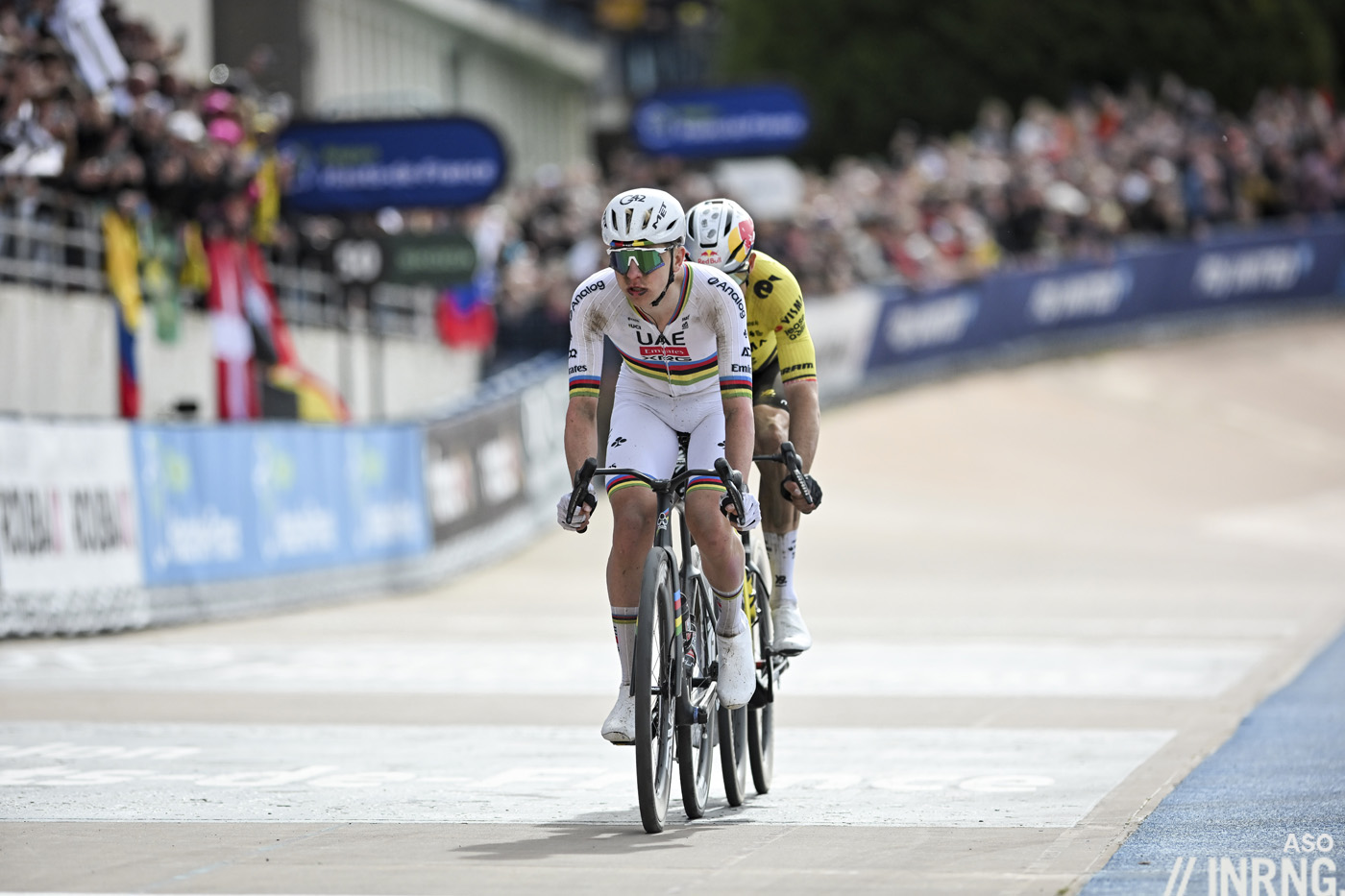
Tadej Pogačar leads Wout van Aert into the Roubaix velodrome. With over 250km done in record time it felt possible that it could go either way but the more you review it, the more decisive the win for Wout van Aert becomes.

Normally these race reviews list the early breakaway’s riders. But there were none, a clue of the exceptional race to come. The bunch was often doing 60km/h and if UAE, Ineos, Alpecin, Lidl-Trek or Red Bull weren’t driving the pace then most of the other teams were busy trying to prove they exist by launching moves only to cancel each other out. Their attempts often lasted seconds. It was costly to open a gap and impossible to build a lead. The field split at one point.
Instead the big teams went into lead-out formation for the first cobbled sector but once delivered onto the pavé the intensity eased. Mike Teunissen even escaped for a moment, the first rider to breakaway and for the anecdote he’d later finish 10th, despite a crash and a puncture.
The mechanicals and mishaps began on the first sector. First to puncture… was apparently race organiser Thierry Gouvenou’s lead car, an incident curiously not relayed on race radio. Among the riders Mads Pedersen needed a bike change and began a long solo chase, alone at first to get into the vehicle convoy and then back to the bunch. If this looked disastrous, it was straightforward compared to what was to befall others.
The wheel of misfortune span for Wout van Aert next, puncturing with 150km to go. He got a quick bike change and without leaving the column of vehicles found, and he found team mate Owain Doull was there to help him back, the pair slaloming amid team cars trying making emergency pitstops for their riders.
UAE led the pace, their black and white kit contrasting with their rainbow-clad leader. Their pace split the peloton in half after the fifth cobbled sector, towing a group with all the main contenders clear. They stayed on the front and each further sector shrank the group further, Davide Ballerini fell, taking out Ineos pair Ben Turner and Josh Tarling. Visma-LAB lost Edoardo Affini and Per Strand Hagenes to mechanicals. It was like watching a pot of sauce reduce: the heat was on, but gently.
Then it Tadej Pogačar’s turn. He stood up on the pedals and started to freewheel on the pavé of Quérénaing, guiding his bike to a stop. Remember the peloton had split earlier, this meant his team car was not waiting, it was behind the group that was adrift.
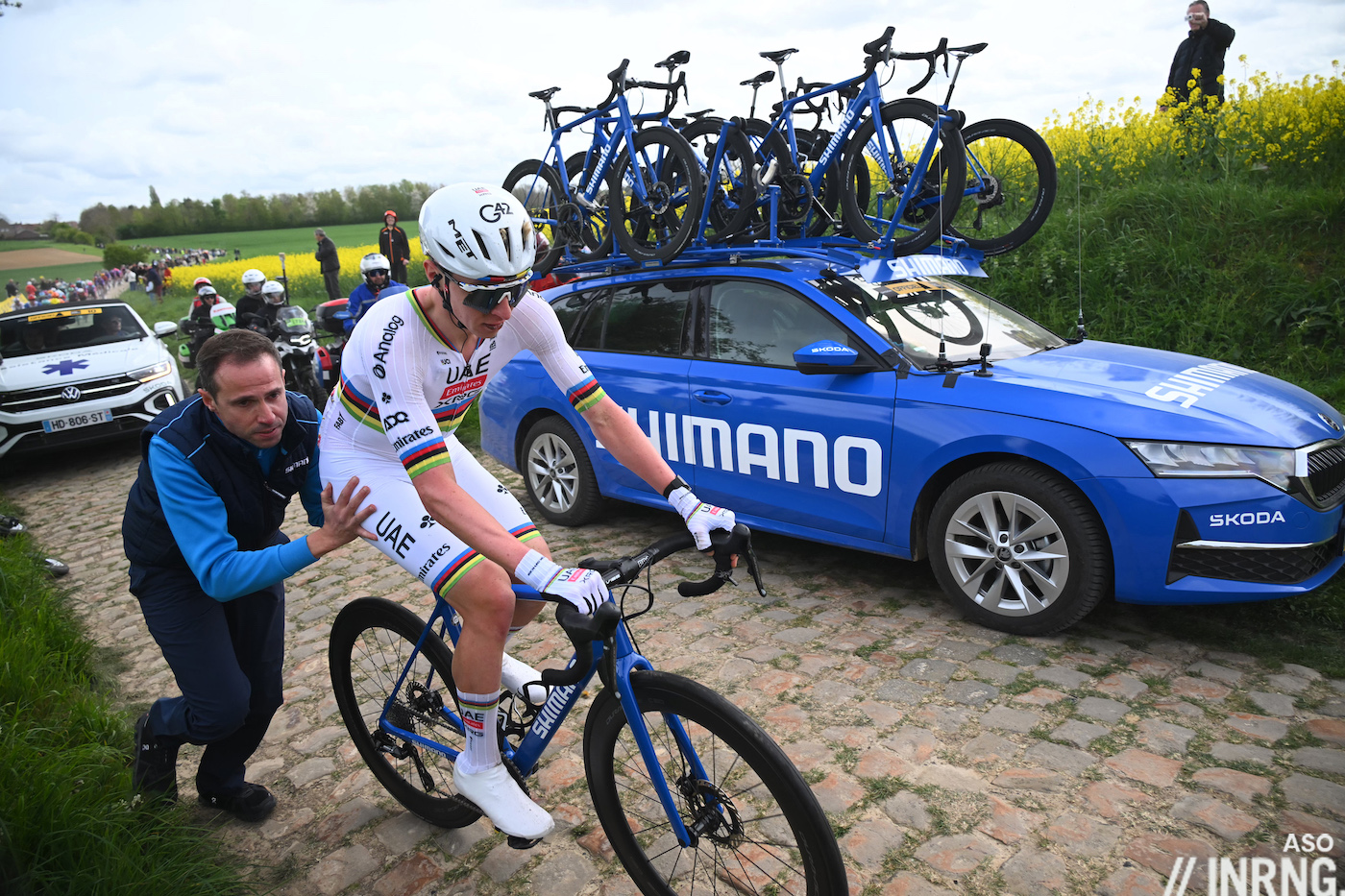
In the moment Pogačar opted not to take a spare wheel but to ride a neutral service bike, presumably just to keep going without losing any more time and to make a bike change as soon as possible. Panic? Probably and a febrile moment for the Shimano crew too which made the cardinal mistake of stopping on the left of the road and seconds later caused a traffic jam. Look at the image below and you can see a medical car about to get snarled up and plenty of riders appearing.
Pogačar caught up with Hagenes and Tarling and others chasing but for a long time was without any team help, no spare bike nor team mates. He’d used up some helpers, Florian Vermeersch was being preserved and this left few riders and in the heat of the moment it seemed they could not be contacted via radio to help.
Up ahead Pogačar’s absence was visible. Alpecin didn’t accelerate immediately, Silvan Dillier seemed to be asking on the radio what to do. Come the next cobbled sector they, Red Bull and Visma picked up the pace, after all this was a race. The world champ spent almost five kilometres on the neutral service bike before the UAE team car could barge past others and once he got a spare this left him with another 18 kilometres of chasing to get back on, with the help of some diminished team mates but a lot of work done himself. He made it back just in time for the Arenberg forest.
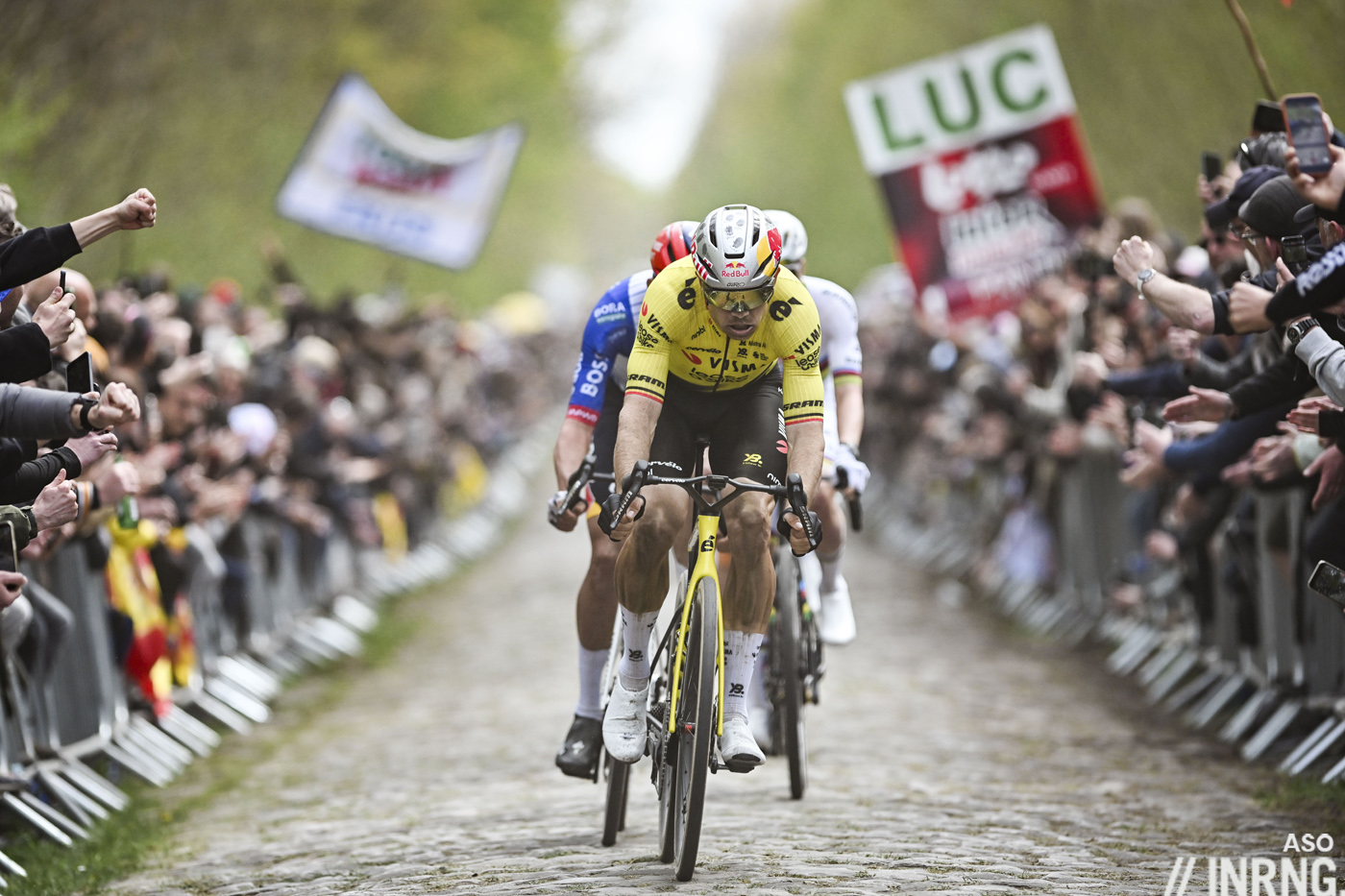
Van Aert led into the five-star sector thanks to a lead-out from Matthew Brennan. Van der Poel was second, next an impressive Laurence Pithie (Red Bull) then Jasper Philipsen and Pogačar fifth wheel. Van Aert’s pace and the angular stones were causing havoc for many and suddenly Van der Poel peeled out of the line, one foot unclipped and then running, for a few steps this was his Froome-Ventoux moment until Philipsen handed over his bike and gave his leader a push to get going. Only Van der Poel was unable to clip his feet into the pedals. Philipsen came running back to recover his bike and race on.
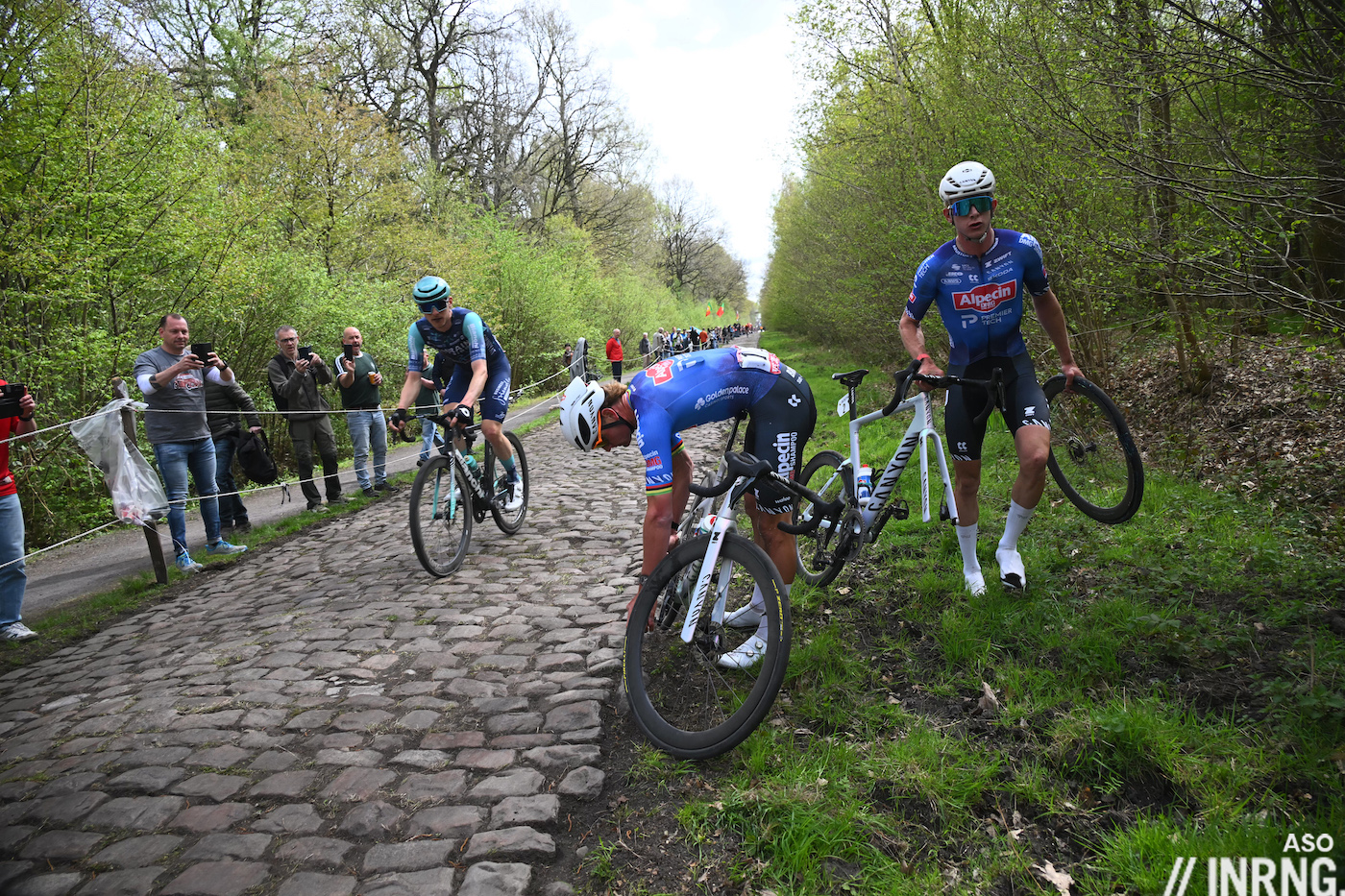
This left Van der Poel walking back down the course to recover his original bike to find Tibor Del Grosso had popped his front wheel into Van der Poel’s forks. Only Del Grosso’s rim was cracked and as Van der Poel approached the end of the sector he was struggling to ride on. Already 90 seconds behind the front, now he got a bike from his team car but he was two minutes down. For a rider who seems to float on the cobbles this time he was on the receiving end.
Once upon a time, or just a few years ago, Arenberg was a point in the race where a contender or two could come undone and the exit was a moment for many to assess themselves ready for the race ahead and observe their rivals. Now most of the field had been eliminated.

There were seven riders in the lead: Pogačar, Van Aert and his team mate Christophe Laporte, plus Mads Pedersen, Jasper Stuyven, Laurence Pithie and Stefan Bissegger. All the big names minus Filippo Ganna and Van der Poel. Only Ganna was thirty seconds behind and closing, towing Jordi Meeus across.
Van der Poel started chasing and the gap went from two minutes to 1m30s. By this time it felt like the race was being narrated by a team of capricious scriptwriters locked in a room. Ganna punctured. Then Meus was dropped and moments later Pithie punctured to leave six in the lead.
At this point Van Aert’s route to victory started to become clear. He had a team mate in Laporte for support, Pogačar was sapped from his chase on a bike that didn’t fit him. Mads Pedersen was a menace but possibly still short of form while Stuyven and Bissegger outsiders. Pogačar punctured again and if he got a quick bike change, he had another long chase.
Behind Ganna was chasing at one minute, Van der Poel a further thirty seconds back. In reality this meant the Dutchman could see Ganna’s group and crucially was able to get into traffic of team cars behind and closed the gap. Ganna and Van der Poel could be seen talking, presumably an alliance to close the gap.
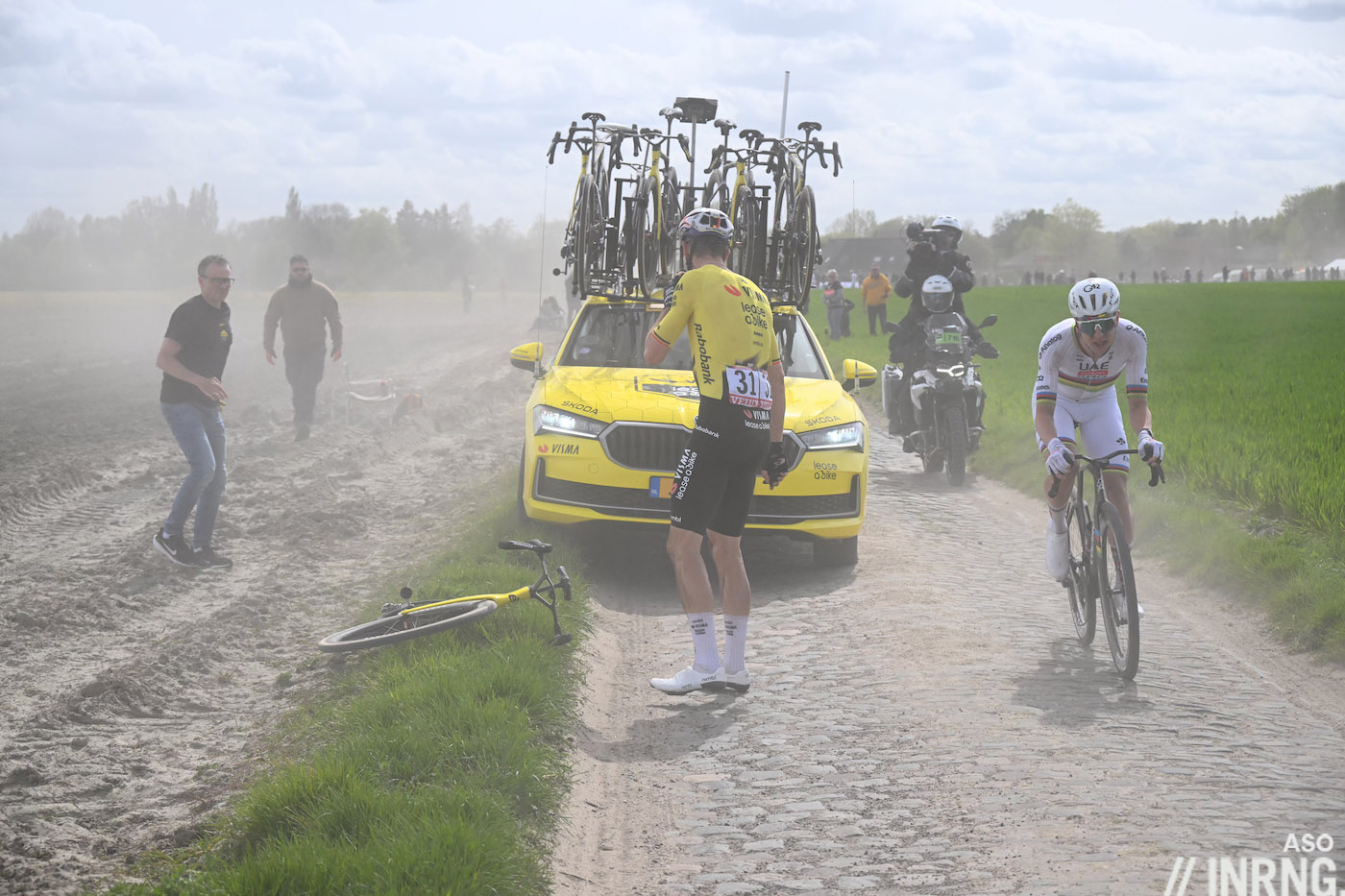
Now Van Aert punctured, with Pogačar passing him as he got a new bike. The Belgian was left chasing. Advantage Pogačar? He too chasing to get back to the front. This was a key phase in the race as Laporte eased up for Van Aert which let Pogačar get back and then Van Aert too. This also produced the concertina-effect where Van der Poel and Ganna were able to close the gap too. With still 54km to go Van der Poel was at 20 seconds.
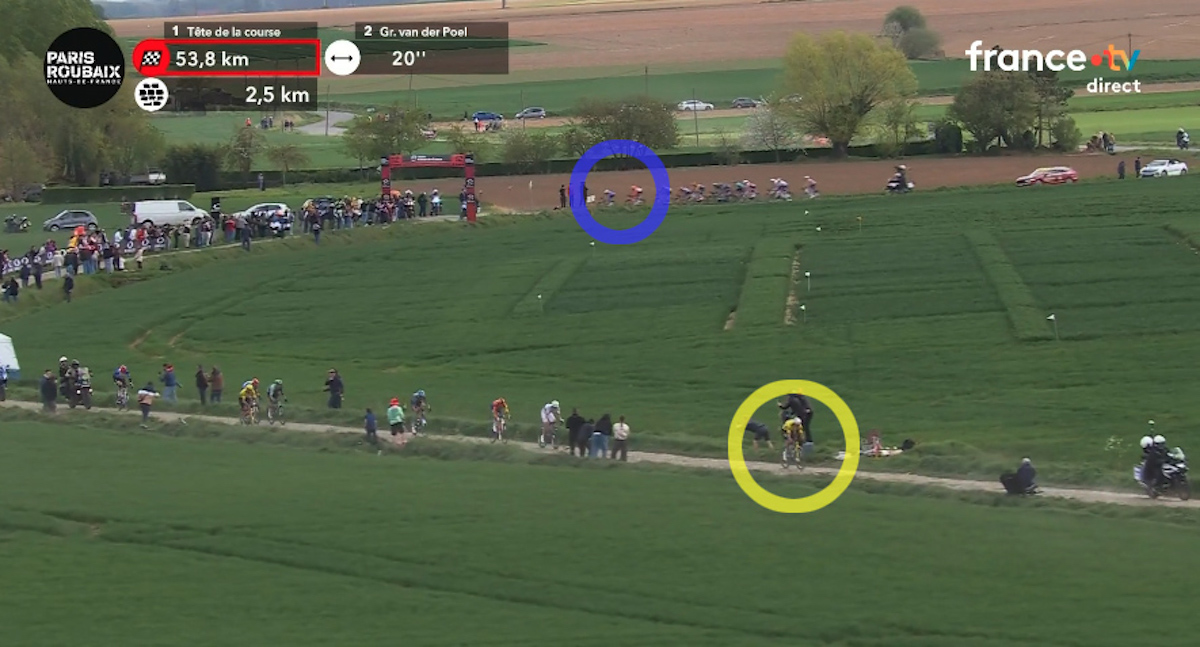
This saw Wout van Aert attack just before entrance to the Auchy pavé. This was another crucial moment. In the annotated screengrab above you can see highlighted in yellow Van Aert on the attack while in the background highlighted in blue Van der Poel and Ganna are close. With Pogačar and then Pedersen chasing we got a sense of hierarchy, with the Dane who looked in trouble with his head dipping and back arched. Pogačar got across to Van Aert, passed him and the increase in pace was too much for Pedersen. With 53km to go Van Aert and Pogačar were away together and would not be caught.
Van der Poel was chasing with Mick van Dijke while Ganna was goner, a puncture saw the Italian distanced and then he wiped with the the flat tire sliding on a corner.
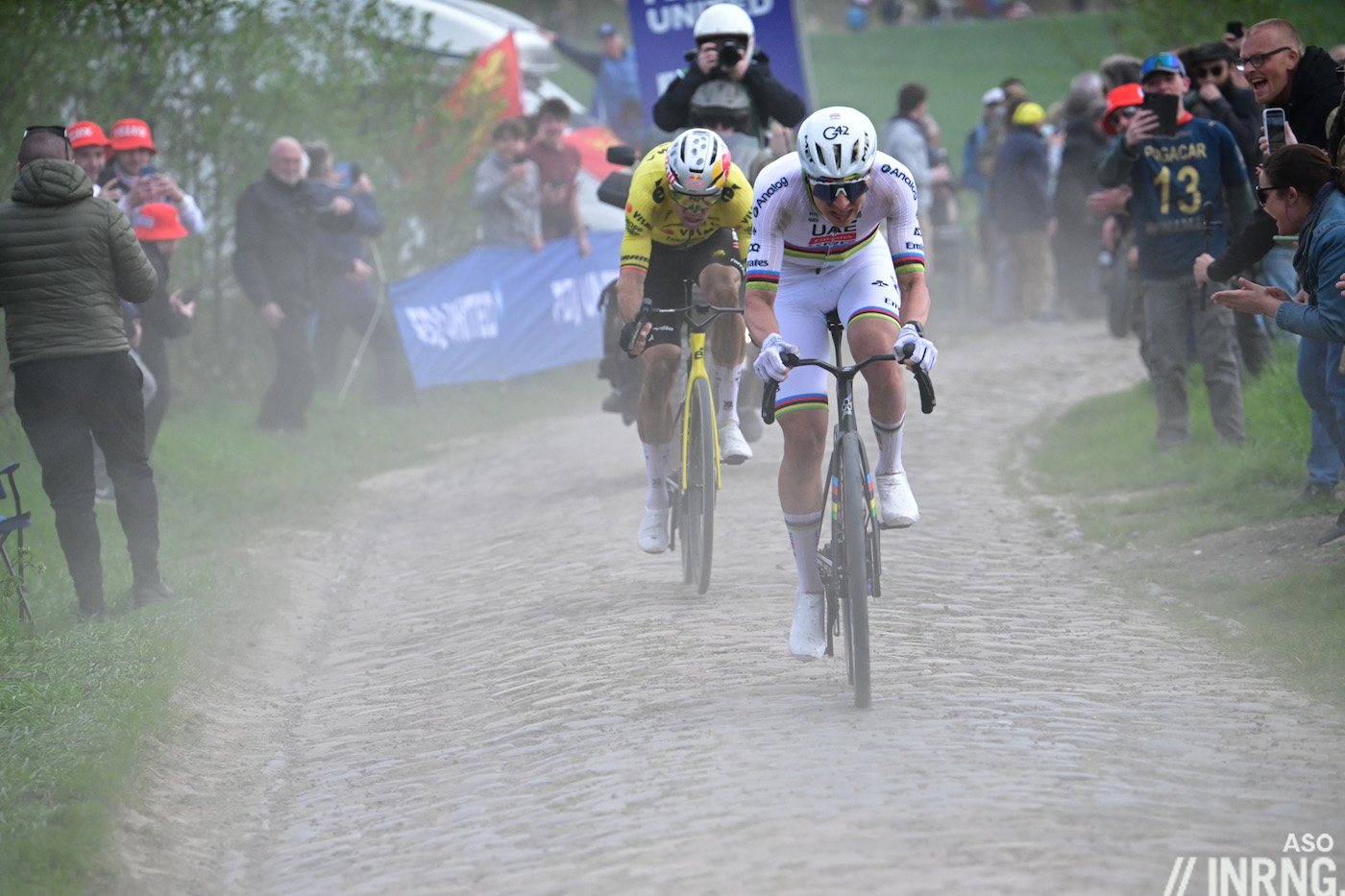
Pogačar led onto the 5-star Mons-en-Pévèle sector. Halfway through the sector he tried an attack – pictured above – but Van Aert got back, head bobbing. Both were tired but seemed to want to collaborate, each knew their chances together were better without with Van der Poel, their shared tormentor. This led to a stasis with the lead two clear of the group led by Van der Poel with Laporte, Pedersen, Stuyven, Bissegger and van Dijcke.
The final cobbled sectors saw Pogačar running out of road. Rather than accelerate he was starting to struggle to stay with Van Aert. The Belgian wasn’t attacking, instead he was smoother on the cobbles, taking better lines and conserving speed while Pogačar was less lucid. Even a late attack on the false flat in Hem before Roubaix was out of the question.
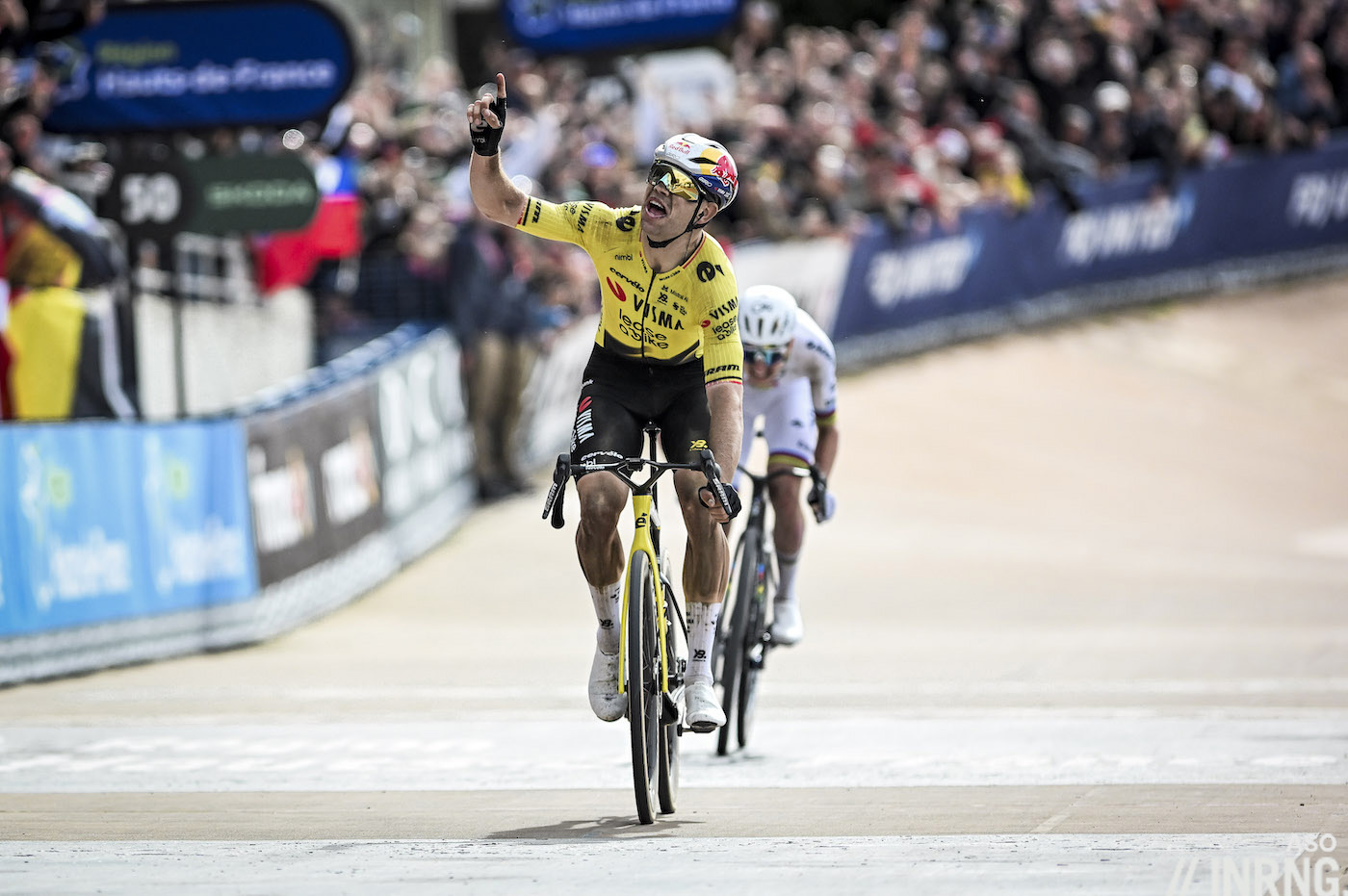
After 258km it came down to a two-up sprint. Pogačar led into the velodrome and across the finish line for the first time. There were no games. This wasn’t going to be a test of speed or tactics, just what was left. With half a lap remaining Van Aert launched, came around Pogačar and kept sprinting to the line while Pogačar had to sit down for a moment. Van Aert had won.
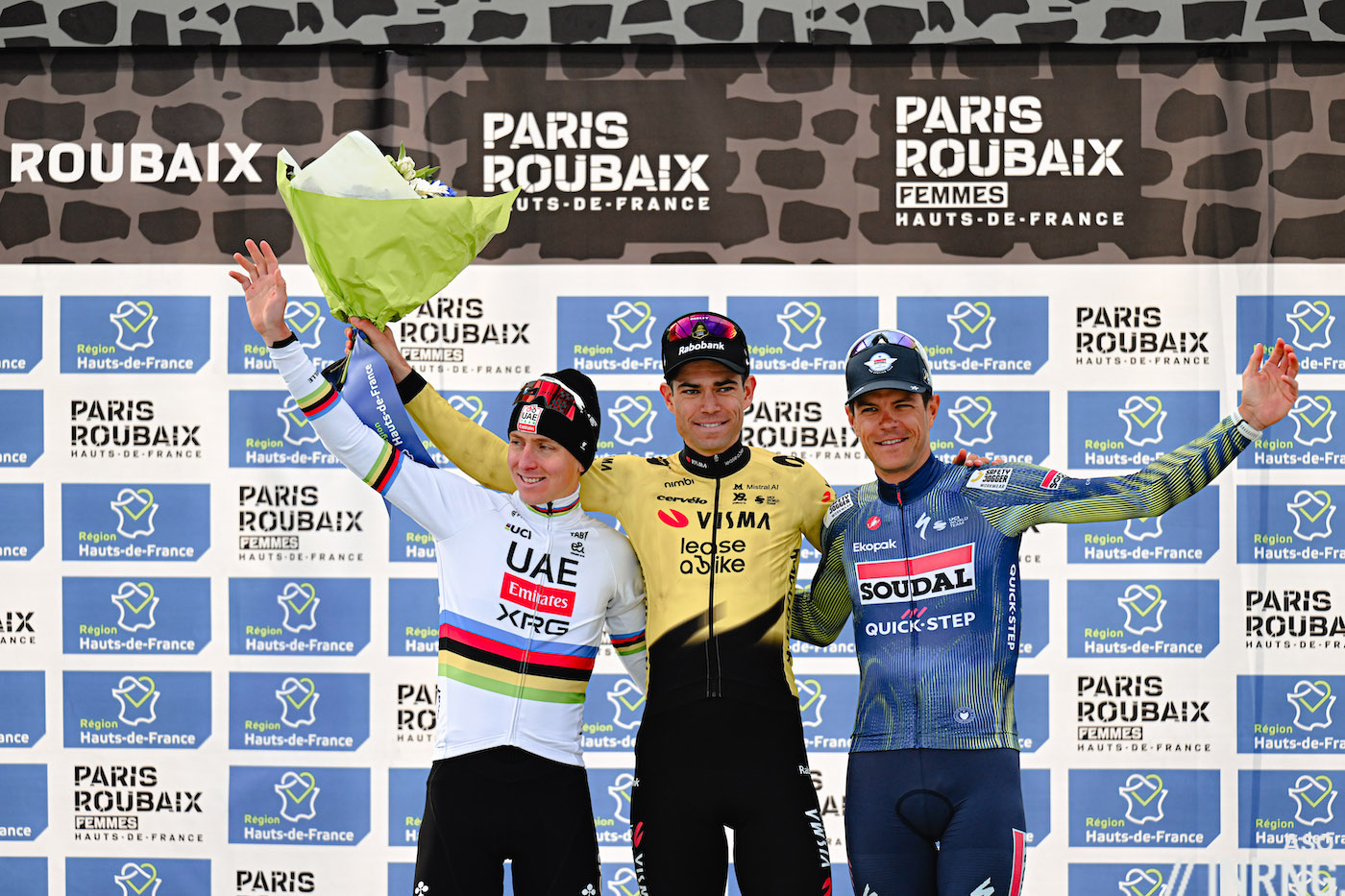
The Verdict
A vintage edition for the ages. Race director Thierry Gouvenou said it was probably among the best two two races he’d seen, for him as good as 2016 when Matt Hayman won. If he has a different vantage point to most it’s still hard to argue.
It was packed with drama but rarely, at least for the prime contenders, negative. Van der Poel will have hated losing two minutes but his chase only heightened the action and ennobled the breakaway as they tried to keep away. It would be a different kind of sport if mechanicals occurred with this frequency every weekend but this is why the race is most exceptional race on the calendar.
If Lady Luck kept shuffling cards, there was redistributive logic with all the big names having a set-back and being forced to overcome fate, none of the obvious names that would have gone in a preview were cancelled en route. Similarly she wasn’t over-promoting random riders, there was satisfaction that despite the chaos this was still a race among the best. Pogačar’s long chase may have cost him the win; Van der Poel’s even longer pursuit suggested he was the strongest. Neither got the openings they wanted.
For Pogačar a loss and the compulsion to return the next year. With the possibility of winning all five Monuments in a season gone, perhaps forever if he eschews Sanremo now, he still finished runner-up in a race where little more than a year ago taking to the start with ambition was seen as audacious. As much as he’ll want to return, he’ll haunted by the near-miss and lost chances. If he hadn’t punctured, if the team car had been closer and so on then he might have had the extra punch to shake Van Aert on a day when his greatest rival in Van der Poel was out of the picture.
This was Van Aert’s day. It was hardly a Germinal remake of the downtrodden Van Aert revolting. But it is a reward for patience and persistence, and in a year that began with a broken ankle and for a rider whose losses have helped enhanced his legend and created sympathy but were beginning to weigh on him. This time luck went his way. He made it his own race, leading in to Arenberg to chose his path. Attacking when Van der Poel was closing in to go clear with Pogačar. Surfing the stones when Pogačar was tiring. Getting on Pogačar’s wheel for the velodrome. Then a decisive sprint to leave Pogačar sitting.
31 years old, Van Aert has long been dreaming of taking one of the cobbled Monuments and always said if given the choice he’d want to win Roubaix. He got the chances and took them all. As a final act he dedicated the win to his former team mate Michael Goolaerts who had died in this race in 2018.
What a race. And what a way to close off this classic classics season. Just magical to see WvA finally make it on his biggest stage. His post race interview had me in tears. This was sports at its absolute finest.
I am one of those who gets a little tired of seing Pogacar dominate hillier races, but as he makes hillier races less exciting, he surely makes flater races more entertaining.
There were many reasons that Van Aert could have celebrated for himself on winning but he pointed to the sky on the line, he quickly dedicated the win to Goolaerts too. Apparently he gave the winner’s bouquet to his parents today too. There’s a generosity here that’s visible but team mates report on this at the rest of the time and so on, it’s why he’s so popular in Belgium and the week before seemed to get more cheers than Evenepoel, as in both were roared on but Van Aert seems to have more sympathy as well.
As I get older I may be getting a bit more sentimental. But, there are few sportsmen who generate this kind of love and admiration from fans and competitors alike. Wout is one of one
His competitors seem to like him very much too.
I’ve occasionally wondered what his palmares would look like if he was less inclined to work for the team and colleagues.
Classics seasons not finished we have Ardennes week coming up: brabantse pijl, Amstel, fleche and liege. Pogacar v Evenepoel v seixas.
The “classics” also include Lombardia and Paris-Tours (at least historically), as well as Fleche Wallonne and Liege-Bastogne-Liege.
Some time ago I read you naming the idea of 8 or 9 big Classics held as such in the past versus the current idea of 5 Monuments which is quite modern, indeed, to start with as they became such precisely “surviving” the rest.
And that’s precisely so, but I couldn’t be sure about the total number you listed. Let’s begin with the 5 now known as Monuments, ok, although Ronde and LBL didn’t matter much for longer than the rest. Add Flèche, which no doubt belongs to the list as it went big immediately after WWII, as GW a decade later and Paris-Tours, a worthy Monument hadn’t it declined in recent years.
Amstel and San Sebastián are much later additions, the former soon gaining traction and being relevant already in the 70s whereas the latter needed a decade or so and went bigger in the 90s with World Cup etc. So in their case it depends on what age we’re talking about. Today they’re solid and with their own tradition, but not quite, say, 50 yrs ago.
Then we have the once-Classics, some of them extint some just much smaller today, Paris-Bruxelles comes to mind but also Zürich, both well above in status (when at their best) when compared to Amstel or S. Sebastián.
Then again we have a lot of ancient Classics which never were “top of the top” but still have or have had great prestige, Omloop, Emilia, Tre Valli (or the whole Trittico Lombardo), Brabantse Pijl, Hamburg etc. (semi-Classics?).
You might be interested:
The concept of the “8 Classics” dates from 1945-c.1988. The races were: Milan-San Remo, Tour of Flanders, Paris-Roubaix, Fleche Wallone, Liege-Bastogne-Liege, Paris-Brussels, Paris-Tours and Lombardia. These were the eight most prestigious one-day races on the race calendar. Their prestige dates from c.1918 (or before) but they were not “the eight classics” before 1945. Only Rik Van Looy won all eight (Merckx missed Paris-Tours).
A further two important races were Bordeaux-Paris and GP des Nations, but were not part of the eight (they were not conventional one-day races). In the 1950s some more races became quite important, including Ghent-Wevelgem (the Queen of the semi-classics) and Milano-Torino. These newly important races were called “semi-classics”. In the 1970s, Amstel Gold and Zurich Championship became “semi-classics”.
By the 1960s/1970s, improvements in bikes and road surfaces meant the classics started to become hillier to keep them interesting. Paris-Brussels stopped being particularly important (now a very minor race), and Paris-Tours declined due to being too flat, and not having any nearby hills which could be included. An additional problem is that other races sometimes called themselves classics since the UCI did not protect the phrase.
People started informally using the phrase “monuments” in the 1980s for the most important one-day classics. When the World Cup started in 1989, it did not include mid-week races, hence it excluded Fleche. As a result the UCI legislated that the “monuments” included San Remo, Flanders, Roubaix, Liege, and Lombardia. This is when the concept of “the monuments” replaced “the classics”.
A wonderful bit of cycling history, thank you John 🙏
@John, thanks, all very interesting indeed, and it mainly corresponds to what I had heard on the subject. Yet, some minor points don’t, so I’d be curious to know if you have a source or if it’s you combining different readings together.
I won’t go through every detail but I’d say that the decline of Paris-Tours happened later, much later.
Another aspect is linguistic: in Italian semi-classics looks to be reserved to the quite secundary races as Waregem, Omloop, Brabantse Pijl etc. while nobody would call GW “a semi-classic”.
MI-TO always had great up-and-downs but it was very important already at the beginning of the 20th century, then declined during fascism, to the come back as you say in the 50s.
Zürich as many other Swiss races (GP Lugano above all, not named before because it long had a TT format) was soon very important, the K&K Swiss champions of the 40s and 50s gave it relevance and all the best went there to win it. It declined a bit at the end of the 50s, as any race may do, but it never lost international appeal and during the 60s many important GT men already started racing it again along with the Classics hunters so it was no surprise that many big names lined up as soon as 1968-69-70.
Anyway, history always have different perspectives on it, and that’s why I was curious to know where they’re from.
Gabriele,
I tried to be brief, so made it simple. Paris-Tours was struggling a bit by the 1970s. They reversed the route in 1974, and even renamed the race for a while. It was during this period when it lost some of its prestige. When the World Cup started in 1989, the direction returned to Paris-Tours and the race got its name back. However, it was clearly not going to be named a monument. It was a world tour race until 2009. The addition of gravel sections from 2018 has made it a bit more interesting.
Ghent-Wevelgem was called “the Queen of the semi-classics” and was considered the most important semi-classic: sometimes people still say this. Until recently, Milano-Torino was probably the most important one-day race in Italy outside the two “classics” (e.g. San Remo and Lombardia). It has been messed around a bit recently, moving between Spring and Autumn, and can’t decide on the Superga finish (or not). The GP Frankfurt (now Eschbonn-Frankfurt) was the most important one-day race in Germany until recently.
Races change their status over time. By the early 1980s, the prestige of some of the most important semi-classics had matched Paris-Tours and especially Paris-Brussels. This makes comparing palmares of riders across time quite difficult (and causes problems for the PCS all-time ratings).
Great to have you back for such a wonderfully comprehensive “moment”. Perhaps the most complicated yet?! Fantastic race, fantastic review 🙏
Wout van Aert a very worthy winner. In a way, the pressure on Van der Poel and Pogačar, focussed on one another, helped Van Aert win…
Tadej panicking a little, riding a Shimano support bike, expending a lot of energy to make it to the front of the race as soon as Arenberg, thanks to some slowing down ahead of him.
Mathieu panicking a little, somehow not realising Philipsen’s bike with its prototype pedals was unrideable, and then having the misfortune to borrow a damaged wheel, to leave himself well adrift.
Over two minutes down proved an insurmountable deficit even for Van der Poel, what with Pogačar riding more than anyone else to stop his return, turning his legs to spaghetti by the time of the velodrome sprint against Wout.
What a race.
Several outlets say they spotted these new pedals for the race but they’ve been seen in other races, eg Paris-Nice. Seems they’re really the soon-to-be released Dura-Ace 9300. Apparently they are compatible with the current 9200 version so maybe it was Van der Poel’s steps on the grass that got his cleats jammed with dirt. Let’s hope so as pedals/cleats that are not backwards compatible like this would be a lesson for all in bad practice.
Interesting, and yes, I saw a couple of lines about them using the new pedals in other races already, though Van der Poel seems almost wary of new tech… not riding Canyon’s brand new Endurace (despite him winning on it at E3), sticking to his less aero wide bars, and no 1x chainring for his team at all, and so on.
It sure seems odd that the team and its riders wouldn’t know if they really are incompatible systems (once adjusted to each rider’s preference?), and I hadn’t thought of mud being the issue… made me think of pootling around the Peak District in winter, then after a quick stop somewhere, stomping my shoes on the road to get rid of icy snow.
No, the pedals aren’t compatible, and Van der Poel knew this (see the interview with Roothoofd on wielerflits.nl if you understand Dutch) . He had hoped to just pedal out of the forest on Philipsen’s bike but even that didn’t work.
It’s not obvious as the team have also said they’ve swapped riders before and it was ok, eg in Kuurne-Brussels-Kuurne.
But there’s a strong culture where technical sponsors are never blamed. So it’s hard to get to the bottom of it.
Roodhoofd also said that they are expected to test stuff for Shimano, as all the Shimano teams are. The subtext being that sponsor obligations required them to run at least a few riders with the newer pedals.
Van der Poel also stated that Philipsen was never meant to stop for Matthieu, Philipsen was himself meant to be a protected rider, subtext being that there was no expectation or need for Jasper’s bike to be compatible with Matthieu’s gear. However, on the day, Jasper wasn’t feeling great so he himself decided to stop for Matthieu.
I guess Shimano would have preferred it if Jasper hadn’t stopped. 😉
Especially in an attritional race like this, it seems reckless for MvdP & Philipsen to have been on incompatible pedals.
see below, apparently not incompatible… either way, the whole thing is madness, I assumed they’d practise and talk these things over so even if it was confusion in the moment that caused the misunderstanding, that would be overcome by preparation.
admittedly though… they’ve won three in a row so criticism seems a bit churlish!
As inrng said, hard to judge without full information. Maybe it was a call by Shimano and a smaller team has less leverage – MvdP has, and used it, but the team in general perhaps just can’t or won’t.
As inrng pointed out, lots of “wrong” tech choices are taken because producers force them.
That matters because the choice, I’d say, should have been “everybody on old pedals” – you don’t change favoured materials to your number one rider on such a race.
Personally, always sticking with the same producer for 30 years or so, Look, I’ve had small issues with pedals since the last iteration of the Look Delta, which was called A.2 or so I think. None of what followed was as apt for me, no matter the price tag. Of course nothing hugely relevant, but if I was tackling Paris-Roubaix I’d care…
As reported, maybe it’s not something like “totally incompatible” as they swapped bikes in other races and worked, it might be something like “less margins”.
Sponsorship apart, there’s also a HR question. It should have been up to team management to take a decision independent from the athletes, not easy in a team as “personalised” as this, i.e., even if a DS had come to Jasper with the news, it would have felt as Mathieu’s request anyway. And, no, if it doesn’t come from Jasper himself in the first place, if you’re a fellow athlete it ain’t sound good to say “mate, shift pedals to the ones I like best just in case…”. You can tell that to a gregario, not to a two times runner-up, not *even if* you’re MvdP and we all know Jasper wasn’t going to win this.
No way, and even a DS should be careful doing that.
I’m struggling to think of a more popular winner of a sporting contest! Perhaps only surpassed if a Frenchman ever wins the Tour?!
I wonder if this race will be Pogacar’s kryptonite. If Pogacar perhaps faces relatively thin competition in the hilly races, Roubaix is the stomping ground for a golden generation of power house one day riders in Van der Poel, Van Aert and Pedersen and several very able second tier leaders. Plus his and his teams style of making the race incredibly tough and a mano a mano gun fight for the final 100km is fine until he’s stood by the side of the road without any team mates and nobody to help him back to the front. Its the one race where he isn’t automatically able to do effectively whatever he likes.
I’m not sure what was going on with all the punctures. Are teams having to use kit that isn’t optimal to so their suppliers can take advantage of the marketing opportunities?
Some teams have more room than others to mix and match things like tires and wheels. One new thing is puncturing… via the rim. We’re used to a tire perforating but with tubeless you can now slam into a cobble and with low pressure the tire deflects causing the rim can crack, letting air escape that way. So it feels like the same amount of mechanicals, but all faster, 5h15m instead of 6 hours for Cancellara 20 years ago.
I did not realise it was 45mins quicker than Cancellara back in the day.
Despite knowing it’s nearly 5km quicker.
Thank you for doing the maths, my mind is blown.
He was on carbon rims etc but it was raced another way, the early phase was different with a breakaway going clear, now it’s 50-55km/h for the first hour and then the second and into the third. Wet editions are obviously slower.
Also, I’ll add (with out any hard evidence), the constant bussle on the cobbles probably does no good either for the distribution of the sealant in these tubeless tires.
I actually feel that Pogacar has developed the right strategy for the race: make it hard from the beginning, and make it a race of endurance. If he had not had several punctures I think it could well have ended in success. Van der Poel, Van Aert and Pedersen are all over 30, so I think Pogacar will likely win Roubaix in the next 2-3 years using this strategy: he just needs a year where he has the luck with mechanicals.
Interesting that Visma’s Gravaa tyre inflation system, used by Pauline Ferrand-Prévot forher win last year, was banned at very short notice last week. Seemingly because it’s too good?
Meanwhile, after much pre-race publicity for Lidl-Trek’s twin valve system, Pedersen was perhaps the first of the protagonists to stop with a puncture.
Seemingly because it’s not available to the public.
For all the tech – and Paris-Roubaix has become a big shop window – you can’t help wonder if the solution wouldn’t be some wide carbon rims with 32/30mm tubulars complete with sealant inside. But this would not suit the industry based on tubeless.
I don’t really understand that ‘not available’ part. They are ready to order on their website. https://gravaa.com/products/gravaa-x-reserve-42-49 .
Go on then, order some. Then see how long the delivery is and if you ride for another team whether you can get a set. That seems to be the problem going by reports.
Ah, yes, that might be the thing. It says 90 days delivery, which is a long time to see if it actually works or not, especially given the price. I could start a gofundme to test this out in the name of investigative journalism :-). This wasn’t an argument in the past with the track bikes used at the Olympics, but it’s not a bad thing they are actually upholding their own rules now.
I really want to see this technology gain some more ground (esp for mountain bikes). Penalizing limited availability by denying it the main advertising slot may have the undesired effect of the whole thing disappearing. But who knows they might be pushed into making it more available, one can always hope.
As for tubulars, I think they make a lot of sense for pros on courses like this. I know cyclocross weekend warriors who use them too still. But for the general road rider who does their own maintenance it’s a bad idea. If you are half way on a long ride and get a flat the sealant won’t fix you’re in trouble without a team car behind you .There are still a lot of people who think that what is good for the pros is good for them too, that’s why the shop window works the way it does and why many people ride up hills on overgeared bikes.
@AK That’s also why people ride undergeared bikes! But I totally agree with you. I think we’re in an historical high (perhaps not the absolute peak, but close to) as for the difference of what works for the pros vs. what works for common cyclists who must bring with them all they might need, from feeding to fixing a flat.
Same for most aero improvements.
Anyway, some things also went towards Sunday riders and were forced on the pros, say 12-13 speeds (for cost/benefit reasons, i.e., extra sprocket is really good for everybody but for the pros not at the price of more common mechanicals, albeit simple ones, whereas a cyclotourist doesn’t care about losing 30 seconds on a jammed chain or resetting the electronics), then surely disc brakes and probably some aspects of frame geometry (excessive stack reinforcing the already existing concept of micro-frames for the pros, but those have worse handling).
So, that might have been a reason to ban ketones while they still weren’t on the market…?
However, I think that a reasonable part of Visma’s upset may have been the timing of the ban.
Interesting question about a more popular winner?
Others from the top of my head in the same arena – Rory in last year’s Masters; Murray’s first Wimbledon. There must be many non Anglophone examples?
Certainly could see if for a French TDF winner but they’d have to go through some travails first. Pinot would have been perfect.
My new favourite hobby is watching videos of crowds, living rooms & commentary boxes watching Van Aert sprint for the win – I certainly can’t think of another sporting event where the winner was so universally loved and respected
Monica Seles winning the Australian Open in her comeback after the stabbing.
Nico Hulkenberg’s first F1 podium last year.
Similar vein; one of my favourite recent(ish) sorting moments was a cricket match: an ultra slo-mo of Ben Stokes hitting the winning boundary against Australia at Headingley in 2019 after a 100+last wicket stand (appreciate this will be gobbledegook to international readers – just assume that it was epic if so).
It was a side-on TV shot, and Stokes clearly celebrated the win as soon as he had hit the ball, half a beat before the crowd react and go up in unison.
How good to know that you have won an amazing victory just before everyone else watching does – if even just for a fleeting moment. I bet Van Aert had that sensation on Sunday.
It would also be interesting to differentiate between “popular in their own country” or “globally so”.
And “within their sport” or “beyond”.
I was surprised by the quantity of articles written on the generalist press by sport journalists, or even other journos, who you’d have thought had no interest in cycling and commented on having been zapping from tennis to football to Roubaix then at a certain point finding themselves unable to shift away from the latter and going all the way to the line. Everybody super happy for Wout of course.
“Too often second” triumphing on “too often first” is a powerful line, and also all the amazing human factor Wout brought in.
Messi finally winning the World Cup would be up there, if not for the fact that Argentina are happy to revel in a ‘no-one likes us, we don’t care’ approach
Simone Biles in Paris after dropping out of Tokyo? Or perhaps not, because Tokyo didn’t really capture the imagination the way Olympics normally do. Maybe Ali in the Rumble in the Jungle? Too early for me, but he was clearly popular beyond his own country and beyond his own sport.
Or Federer’s final, record-breaking, Wimbledon win?
Bare naked Bikila (now there’s even a chain of shops using his name as a brand)?
Of course those moments which survived through decades confirm their impact as such, whereas I couldn’t say if Brignone’s Olympics will matter much a decade from now.
Speaking of the Winter Olympics, apparently Pantani’s TDF win was appreciate by somebody in France, then that child became a skier… (but now a cyclist! What a crossover!!!)
Denmark winning the EC in 1992?
With all due respect, I must say that your comment is not only incorrect, but also highly discriminatory. Who gave you the authority to judge Argentinians?
Ahem bare-footed above ROTFL
I really think a shout out needs to go to the whole millennial generation not just WVA?
Like every generation they have their arseholes and will come to be loathed much like my own but – I personally feel it’s unavoidable that across sport, many of the leading lights from the last decade seem like really nice people and I don’t think it can be a coincidence?
Sport has always had nice people but I look at those currently retiring and those hitting their thirties now in real admiration (only listing men for sake of time, but there are equal number of women obviously) – LeBron James, Steph Curry, Ben Stokes, Harry Kane, Rory Mclroy, Wout Van Aert, Lewis Hamilton, Tom Daley, Andy Murray… there’s a very long list of elite athletes who’ve all suffered a lot of abuse in their careers and seemingly have been able to come through it not only remaining kind hearted but also many still with an interesting personality in tact!?
Previously we had Michael Jordan, Roy Keane, Michael Schumacher, Lance Armstrong and many others who gave the impression you just had to be a bastard to reach the top or conversely an exceptionally dull roll-call of British footballers and others who seemed terrified to say a word beyond ‘it’s a game of two halves’/’at the end of the day’…
Millennials seem destined to be overlooked as the Boomers have dominated Western life for so long, and Gen Z will be the AI generation, but I think they and many younger (it’s remarkable how Pog, Jonas and people from other sports like Saka seem to be carrying this through) should be praised for bringing a kinder side to sport in the past decade or so?
I should highlight that growing up in relative wealth (as many western sportsmen/women do) and then living in extreme wealth, as many of the above do, does make it easier to be kinder, plus many probably learnt from the mistakes of previous generations who lived in the public eye, but still, I think the trend has been positive overall even if there’s always a few bad eggs out there!
I’d be interested to see if Millennials posting here think the sportsmen/women they have supported/idolised have seemed like nicer people than those they grew up with.
I think you’re quite right, although there’s always been a decent number of kind, polite, respectful and/or thoughtful sportspersons, even at the very top level, in cycling just think Lemond, Pantani, Indurain, Bugno, Gilbert, Garzelli, Bettini (except his “terrorist” celebration against the UCI… or not?), Scarponi, Sastre, Urán, Quintana, Purito, Gimondi, Ballan, Chaves, Perico, Petacchi, Baronchelli, Coppi & Bartali etc., far from exhaustive list skewed towards nationalities I’ve read long interviews to in the media or I’ve met etc., so one gets more of an idea about their personality. Plus, athletes with a strong personality and maybe a wild side of sort who all the same weren’t as arrogant as you could expect, never abusing of their position, say Contador, Boonen, Sagan…
In other sports, too, I can think about famous cases as Lineker, Sollier, Tommasi and many more in football, then a very iconic moment with the black panthers salute at the 1968 Olympics (the three of them), many figures in mountain sports from Messner to Killian Jornet, but nonsense to name random names from a list which could infinite.
Yet, as I said, you’re probably right in that proportions between “norm” and “exception” have changed, the sport luckily has changed much starting from the very way it’s taught and then thought. Totally for good. It’s been a brutal cultural shift, and what’s interesting is that it’s (also) been driven by the “astonishing” discovery that the “new way” is generally more effective.
What a race, the femmes wasn’t bad either with shades of the Powless win last year
Could venture into a “how the race was lost” piece as with hindsight Vos was in the right place but PFP kept working too much. As you say shades of Visma wanting the right rider to win only to take the strongest rider to the line. Who had the worse day in this race, Visma or SD Worx’s managers?
It struck me with 2025 Dwars and 2026 Roubaix Femmes that the team with the numerical advantage has to be ready to let the “wrong” person win. If everyone knows that the secondary rider is going to bail out of the finale, the Koch/Powless rider can just call their bluff. I thought that PFP was going to make a dash for it and make Koch lead Voss out. Instead, she just got out of the way and let the two other riders fight it out mano a mano.
Numerical advantage only works if the numerically superior team repeatedly attacks and forces the lone rider(s) to constantly chase until eventually the elastic snaps and eventually one, any one, of the riders from the advantaged team gets away and wins. The way Visma did it will always risk being outsprinted. The best example I have ever seen is the 2008 Worlds where the Italians had Ballan, Cunego and Rebellin in the lead group with 5 or 6 lone riders. They repeatedly attacked, as soon as one was caught another went, until eventually Ballan got away and won. They never gave the impression of being bothered which one of them won.
I don’t know whether others felt the same but Femmes being the same day and after Hommes really didn’t work for me as a viewer, I didn’t watch as I was far too hyped from the mens race.
I understand that they wanted bigger crowds for the women and maybe that’s the trade off, so losing people like me isn’t a big deal, but as someone who wanted to watch, I far preferred having Saturday to enjoy the womens then Sunday for the mens – interested to see how others felt and how it impacted the viewership.
I always assume I’m a pretty bog standard UK based viewer with an above average interest in cycling, so if I wasn’t watching then many others may have been similar?
I’m also extremely pro growing the sport alongside the growth in interest in womens racing, so would like for the sport to find the best approach overall to maximise roadside enjoyment and armchair viewing – the current system of some races the day before, some races the same day but before mens, some after and some on a completely different calendar is so random it’s quite frustrating as a fan who wants to engage more.
This is one of my big reasons for also being pro an overall calendar reorganisation. Personally mens/womens calendars overlapping with women generally racing the day before in classics and earlier in stage races (so you get an exciting womens finale while the men are generally rolling along) would be my preferred solution despite a few obvious issues with it (I fully understand some women riders preferring to distance themselves from the men) but interested to hear others views.
I have no clear view and I think that the women movement should work that out trying to find a collective perspective about what works better (well, or keeping a variety of options).
What I can remark is that in Italy in TV terms it works to have the women race just after the men’s. It even worked better to have a recorded Giro stage broadcast right after the men’s TDF versus a separate live broadcast. But obviously audience figures aren’t the only factor here.
In this case, for example, although 40% of the viewers were lost probably jumping over to tennis, a strong 60% watched the women, bringing an audience way superior to, say, men’s Tirreno-Adriatico.
I know that in the Netherlands some women races got better results’ than men’s, only I can’t remember what was the chosen format in that case.
The women’s race got a good audience in France. The men’s race was down but still very strong, but in part because of competition on France TV alone which had international rugby on France2 while Roubaix was on France3, plus the Paris Marathon and Monte Carlo tennis.
Paris-Roubaix Femmes was moved to Sunday because of costs and complaints about road closures affecting business on Saturday (shops are largely closed on Sunday in France) relayed by local/regional politicians. Plus Zwift pulled out as a sponsor and was replaced by the region, the “Hauts-de-France” label which gave the local politicians even more say.
Ideally if it is all on one day then we’d have full live for the women too. However FranceTV is under pressure to shrink its spending and the sports department is a big target for savings, it even had to give up valuable rights to international rugby matches to arch rival TF1. So it’s not an easy conversation to expand it, but they should.
Speaking entirely selfishly, the womens race was better on Saturday for me too. Come the end of the mens race I had been sat on my ar5e for 5 hours +, so couldn’t really justify any more. I recorded the womens race and intended to watch it but saw the finish on the gram and decided not to bother, rightly or wrongly.
Inner Ring highlights an extremely important point. The race goes past peoples homes and places of work. We are asking people to give up access to the road for our enjoyment of the race. And moreover, the race organisers to not pay for the police and disruption to people’s lives. Understandably, the race organisers want to minimize the costs and disruption they cause. We should be very grateful that the race is allowed to run at all. And it is completely understandable if people on the route want to close the road only on one day rather than two.
Appreciate these answers.
I hadn’t realised it was moved due to residents ire.
Makes the answer to my imaginary calendar shifts simpler.
I agree that there were shades of the Powless win in the women’s race, and there is a lot of truth in the point that teams sometimes need to allow the ‘wrong’ rider to win in such situations. However, it seems that Koch was simply the strongest of the three, and this means that it was difficult for Visma-LAB to play the game differently. Vos and PFP both confirmed after the race how much they were put under pressure by Koch. She doesn’t have very many wins (yet), but I found her recent performances in support of Vollering hugely impressive. She reminds me a lot of Longo Borghini, and if she is given the opportunities, this victory should not remain the only big one in her career.
It struck me that there was a calmness and confidence to the way Van Aert rode yesterday, that we’ve perhaps not seen from him before:
– he positioned himself at the front of the decisive sectors, rather than deferring to others
– he took his time to ride back to the group after his second puncture, taking the opportunity to feed and using the two Red Bull riders to help him. A contrast to the relative panicked decision making of Pogacar & MvdP
– he put pogacar under pressure on almost every single cobbled corner, using his superior handling skills to open up a small gap that Pogacar had to close
– he wasn’t as generous with his pulling as he has been in races past. He seemed to do just enough to keep pogacar collaborating, but no more
– and of course banking on his sprint, which hasn’t always prevailed, but I think yesterday he KNEW he wouldn’t be beaten on the velodrome
Praise should also go to his team – Brennan’s leadout into Arenberg was a key moment. And Laporte is the unsung hero. It might not seem like he did much, but in fact he did a massive ride to be present in that front group, and his mere presence allowed WvA to roll easier turns, and gave him the opportunity to ease his way back after his second puncture, and will surely have demotivated & slowed the chase from behind once WvA and Pogacar were clear.
Totally agree re: Laporte. Those types of rides don’t always get the credit they deserve, but we’ve already seen multiple occasions this year where a rider is able to play that card to a huge advantage. Pogi definitely didn’t want to risk bringing Laporte back into the picture, and Wout knew that he would still have a chance to win even if the chasers got back on.
The perfect race, indeed! Nicely summed up here.
Excellent race, excellent write up, thank you.
It does seem to me that our host is viewing the “cooperation” between Pagacar and Van Aert through rose coloured glasses. Wout knew he had Pogacar snookered and did no more than token pulls.
Sprinting is Pogacar’s weakness … but not Van Aert’s.
That’s just bike racing. When someone has just attacked you full gas, you don’t immediately take a pull. You sit in the wheel a bit.
To talk about cooperation is a bit misunderstood, as you only do what’s best for yourself in a race
The failure of Pog’s UAE teammates to help him back to the front after the Shimano neutral bike change was surely where the race was lost? It seems very strange to me that one or two teammates from the front group didn’t stop with him, regardless of whether their radios were working.
They didn’t know what was happening, something that is often hard to understand for viewers on television. As it was, Politt and Berg gambled that Pogi was behind them and needed help, but they didn’t know that for sure.
this is very true, on TV, especially these days it’s much easier to understand where a lead rider is. But on the road, with groups everywhere and punctures it is a different story. And if you have ever raced with a radio you will know that communication through that is as clear as Dendermonde mud. It is not like the nice Velon youtube videos or netflix dramas where the DS is sitting in car saying “ok guys, keep toegether, remember to eat”, it is more like “GRRREAKKKWWW_guyzzzz_RRRRRRRJJJJ_gether_WOWOWO”
It can be very noisy and hectic, if it is working. Roubaix is unusual for the way the course loops around, it’s possible to be 3km behind a rider on the route but 500m away from them as the course passes one village and doubles back on another track etc. But with groups spread out and cars held back it’s extra chaotic.
When they play clips of the radio during races I can never understand what they’re saying, and I’m not racing a bike 50kph!
It would have been incredible to have seen Pogacar win and complete a historic series of wins. However, it was even better to watch Wout stand up and accelerate around Pogacar, hold it to the line and win. The immediate tears and emotion were obvious, and shared by so many. Matthieu seemed as emotional and pumped up at Wout’s win as anyone – a beautiful moment in their rivalry. Wout crying with his sons with a huge smile on his face.
What a Paris-Roubaix.
Just one of the best races I’ve ever watched, it was a battle just too keep up. Congratulations to Wout, physically and tactically he won the race.
From my perspective the main factor was Tadej’s fight back from his technical issue, that burned many candles, Wout had his issues but never that much of a gap. Had Tadej not have burnt his candles early he might have had the jump on the cobbles or sprint to make the difference.
I think the whole of cycling will applaud Wout’s victory, I would hope the whole of cycling will applaud simply one of best races we’ve ever had the privilege to watch.
I can’t remember being happier for a race winner, I honestly can’t.
WvA has had a truly rubbish few years with luck and injury.
I forget which TdF it was a few years back, but he blew my mind by winning a TT, the Green Jersey competition and the stage to Ventoux, all while being domestique de luxe for Jonas guiding him to the win.
He also seems to be a genuinely nice bloke.
Perfect result yesterday 🙂
I think Cav won Green but Wout had the bunch sprint on Champs Elysees over Cav himself, Philipsen and Greipel (as Pogi recalled in the post Roubaix interview).
He got Green the following year when he was paramount for Vingo’s GC victory besides winning himself a stage while in yellow, with Jumbo dropping like everybody on a 4th category 1-km “climb” then going 10 kms solo, plus a couple of other random stages, although the last ITT looked like Vingo had gifted him with it. OTOH that year Wout also had the satisfaction of dropping Pogi on Hautacam, even if the Slovenian then got back and climbed to 2nd.
That couple of seasons, or that couple of Julys, WVA was probably just… the strongest cyclist on the planet.