
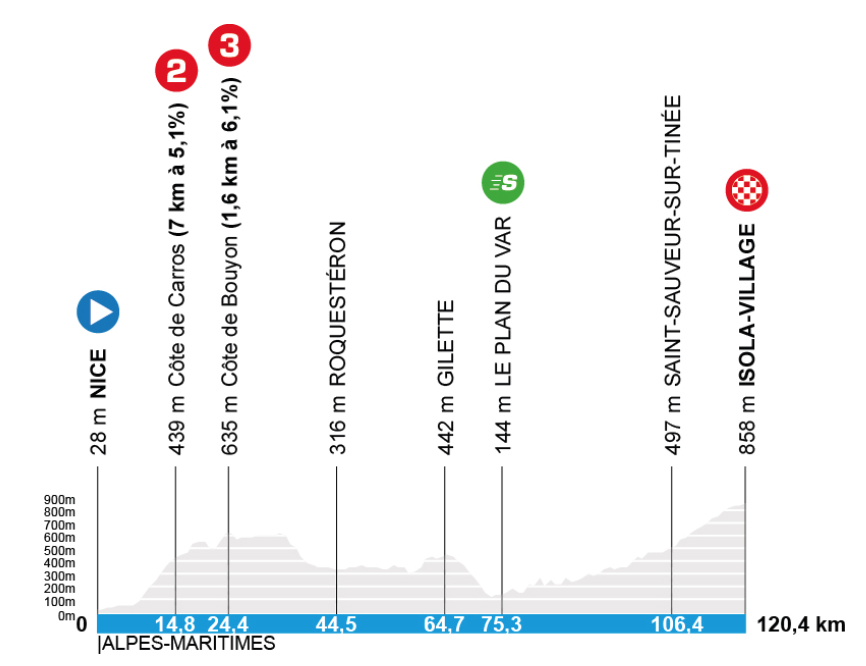
An Alpine summit finish and an early finish so if you plan to catch this on TV then note it’s two hours earlier than usual.

Apt à la compétition: the breakaway of four with Josh Tarling, Igor Arrieta, Stef Cras and Arthur Kluckers wasn’t allowed much room and with 30km to go they had under a minute going up the Col de l’Aire dei Masco. Only on the way down the escapees took back 30 seconds, dropping Cras and restarting the race.
It set up a tense finale with Lidl-Trek taking up the chase but they ran out of riders and at about this time Harald Tejada punctured. A textbook bike change and teamwork got him back to the shrunken peloton in time to save his now 10th place overall having started the day 11th only for Oscar Onley to leave the race.
Ahead in the break Kluckers was dropped on the last climb to leave Tarling and Arrieta but they were caught as Visma-LAB’s Victor Campenaerts rode hard seeming to ride just to keep Jonas Vingegaard out of trouble but his pace had team mate Axel Zingle seemingly shouting “stop” into his race radio as he went out the back of the group and an outsider for the sprint finish.
Lenny Martinez tried an attack of the top but needed steeper terrain. Just when Martinez was caught, Harold Tejada went clear and profited from the rest catching their breath. This hesitation was enough to give him a gap and this was sufficient to stay clear.
Tejada’s been a promising rider who has had plenty of top-10s but never seemed strong enough to ride away for the win on a summit finish. If this was more opportunistic, all the better as he gets his first World Tour win.
The Route: a change in plan with the race not going to the Auron ski resort. Instead a finish in the village of Isola on the valley floor. There’s an uphill start to help a breakaway get clear but then the bigger valley road for the second half of the stage to to the finish.
- Update 11.30am: the race will have a neutralised procession from the start to ride to Plan-du-Var, the intermediate sprint location. From here the race will start.

The Finish: no ski station summit finish. It’s the valley road that drags up alongside the white water Tinée river. It kicks up in a few places but nothing severe. The final two kilometres to the village of Isola are the flattest and allow a small sprint train to get into place.
The Contenders: without the summit finish it’s all change. Visma-LAB would have worked to contain the break and launch Jonas Vingegaard on the final climb to the stage win, now the Dane’s path to victory looks almost impossible. But other teams will fancy setting up a reduced bunch sprint.
Second yesterday Dorian Godon (Ineos) is an obvious pick and he is often good on foul weather days too and has the backing of a strong team where Josh Tarling can chase and Kévin Vauquelin do an improvised lead out but he’d like a real uphill sprint with a 2-3% slope. Luke Lamperti (EF) is moving well. Orluis Aular (Movistar) is good in sprints. Axel Zingle (Visma-LAB) seems a bit short of form but the ex-skier often seems to thrive in grim conditions, likewise Laurence Pithie (RedBull) so harder picks.
 |
Godon |
 |
Lamperti, Girmay |
 |
Pithie, Zingle, |
Weather: cold and wet at the start with 12°C but going inland the temperature will drop and it’ll be about 4°C at the finish.
TV: an early finish due at 3.00pm CET.
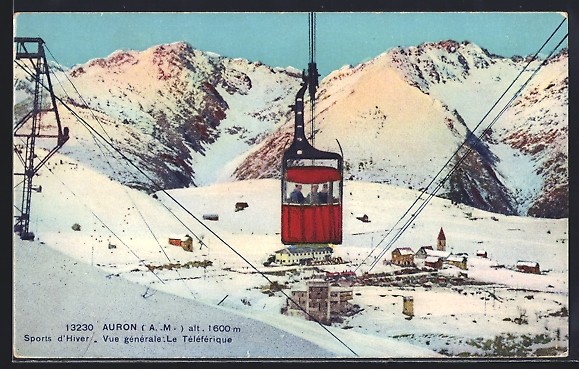
Postcard from Auron
The plan was to race to Auron today. Michael Storer won in this ski station last year. Paris-Nice can’t avoid the snow in March in case of bad weather but it never meant to be an Alpine race
Originally it was billed as “The Six Days of the Road”, it was a marketing stunt to appeal to the crowds that flocked to track races in the 1930s and riders alike who’d spent winter on the boards indoors. It linked Paris and Nice because organiser Albert Lejeune had a newspaper in each city.
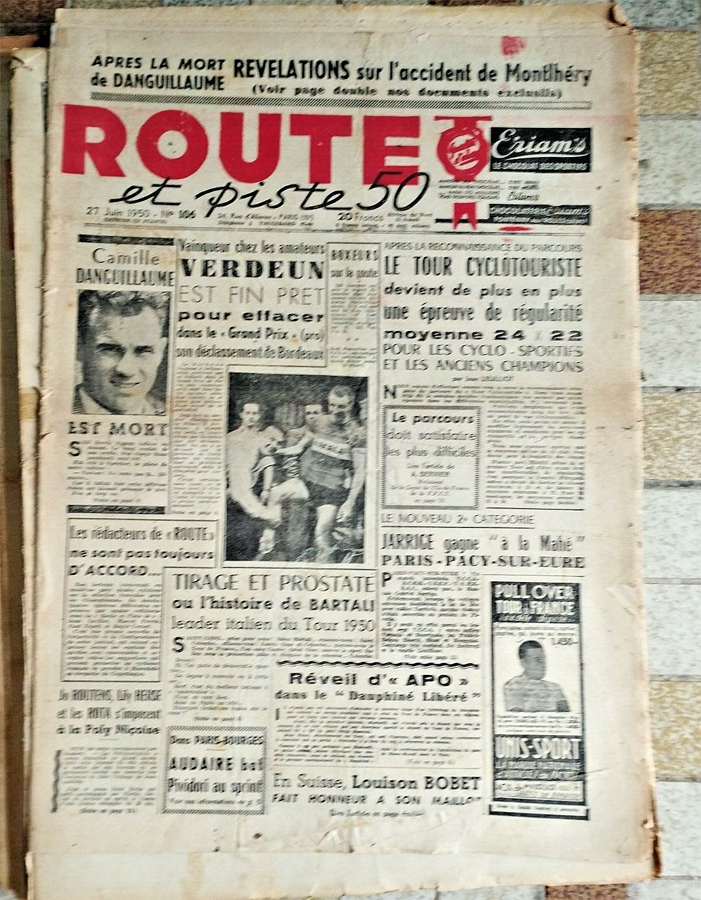
The race took a while to lean into this identity but in 1951 it was relaunched by journalist Jean Leulliot and Jean Médecin, the mayor of Nice. Leulliot could promote his weekly Route et Piste (“Road and Track”) newspaper while the city of Nice was out to appeal to cyclists as a place to ride and train and to boost hotel occupancy during low season. Much like Calpe and other places in Spain today.
It was never a flat race but it did avoid the Alps for a long time. It visited Mont Ventoux – not Alpine geologically – in 1975 with a finish halfway at Chalet Reynard and has been back a few times since. In 1992 it had a summit finish in the Col du Grand Duc on the edge of the Alps. In 1994 it went to the Vaujany ski station in the Alps. In 2009 it had a summit finish on Ventoux’s “sister” mountain of the Montagne de Lure and has been back. There have been other climbs and summit finishes but often more towards mid-mountains.
Snow has been a regular presence, especially when tackling climbs in central France where winter puts on a late show. Only 19 riders reached Nice in 1939 because most of the field had quit on Stage 2. Often stages have been modified and shortened because of icy weather.

2017 marked the change with the Col de la Couillole. It’s given the race a different feel, think the Tour de France but minus the heat and crowds. Every edition since has seen the Saturday stage going into the Alps behind Nice for a ski station visit. This is risky for the race with snowfall in March but no problem for the host locations if we all learn they’re covered in snow. Auron might not get the race its due but it’s the region that pays and to cut a longer story short the mayor of Nice manages the resort too so the added publicity of “too much snow” is no bad thing for everyone. Except Jonas Vingegaard who could have won a third stage today.
Thank you for this. I love your posts, and the ‘postcard from…’ sections most of all. This sort of thing is harder and harder to find these days. Thank you for all of this wonderful blog, it really brightens my day!
This is truly my favorite site anywhere in the internet. The insights of our host combined with the astute commentary the readers provide make every visit here both a pleasure and a learning experience.
I understand the logic behind truncated, neutralised and cancelled stages while somewhat regretting the lost images of snow-covered riders battling over frozen roads, riders struggling to remain upright in gales… It makes sense while depriving us of drama.
Today would have been a banker for Vingegaard and Visma.
Agree with Kit 100%. Thanks IR.
I get the feeling that Tirreno Adriatico gets this year’s braggimg rights.
As always thanks IR. Old cyclists like me really enjoy your website. Hoping to convince my son that he will be a fan in the future. I was wearing one of your t-shirts a few weeks ago. Not patient enough to explain to people why I was wearing it.
Or poor Kevin who is hoping to crawl back 19 seconds. He needs to do it with more brain than brawn.
Wonderful stuff. Thank you!
Shortened stages are upsetting, but,
Been hearing about lack of snow quite a bit, so, “too much snow” has to be OK.
Wouldn’t it be Nice to wake up and find a race has been extended to a higher point due to a nicer weather day than expected? I have rides and skis like that where, feeling good, everything comes together and increase the fun.
The mayor of Nice seems to have other kinds of problems now… The municipal election looks fun, from far.
Very intrigued by “Tirage et prostate, story of Bartali” in the old Route et piste.