
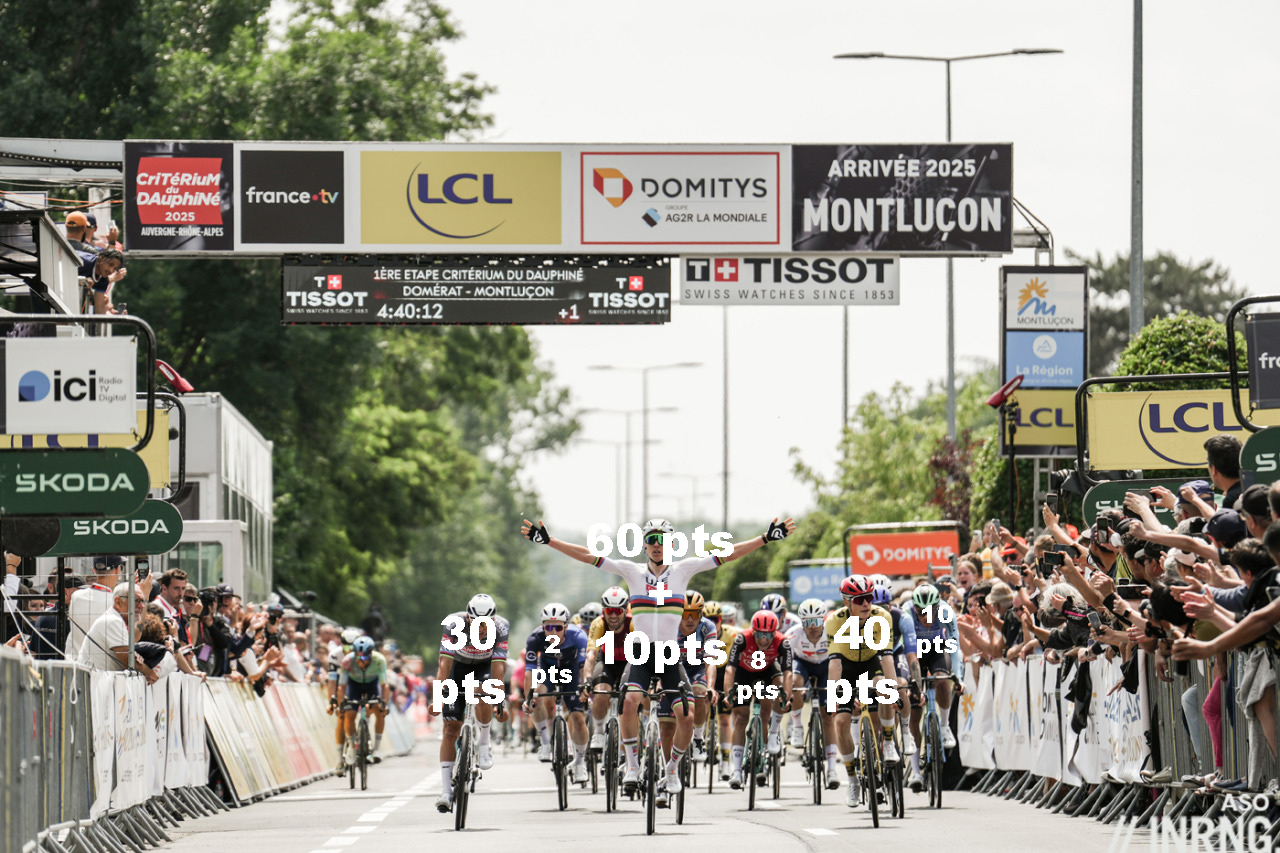
Do rankings and points matter in cycling? Demonstrably not as they’re hard to find. You need to get to the regulations page on the UCI website then scroll to road races and find the right PDF to download. Manage that and 87 pages into a 400 page document come the badly-formatted tables.
Anyway this blog post is just to put the UCI points scales all on one page for handy reference during the year. So if you want something to read today… try something else.
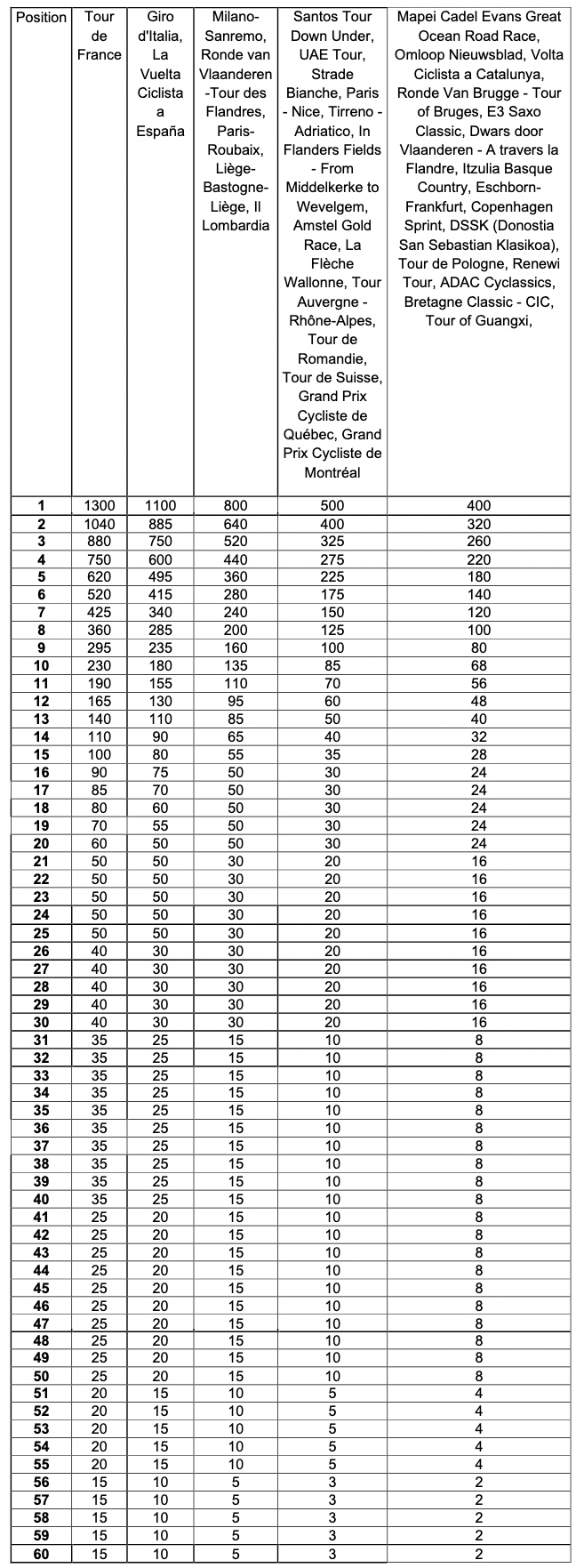
The table below is for the men’s World Tour races, if it’s a stage race then it’s for the final overall classification. Note the unusual numbers, 1,300 points for the Tour de France win for example rather than, say a round 1000 and then everything scaled proportionately to this.
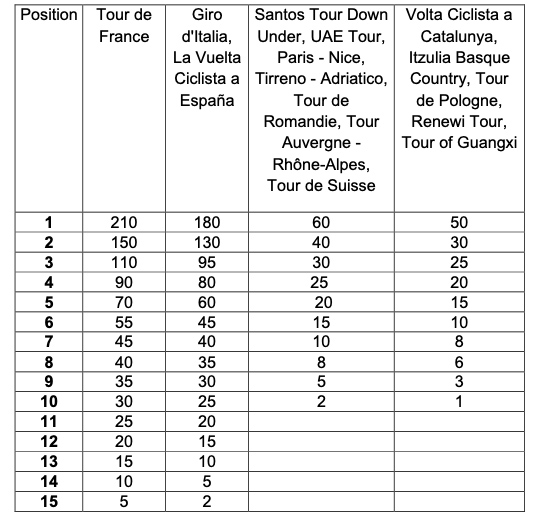
Next comes the points per stage in the World Tour stage races, as you can see a Tour de France stage is 210 points and points in the grand tours go down to 15th each day and 10th for the other stage races.
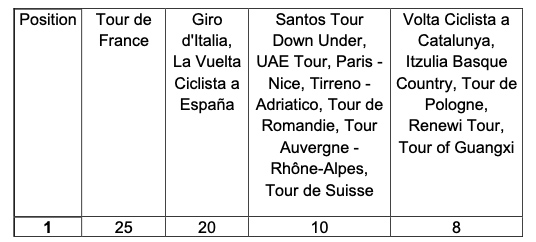
Next you can see points on offer for final place in the secondary competitions of a grand tour, namely the mountains and points competition, as you can see winning points or mountains jersey is worth as much as a stage win. And even if a sprinter or climber is arithmetically unable to win the competition late in the race you can see why they might carry on chasing points as there are points for being a runner-up.

Next comes a daily award for leading a World Tour stage race, the real prize is the publicity and opportunity but the points are here to signal it counts too. Someone who wins overall takes plenty for this, they’ll often win stages along the way and they also collect for every day in the lead too, a winner-takes-all scenario. New for 2026 is the small boost for UAE and Guangxi, no longer 6 points per day.

Now comes arguably the most important table here for the promotion/relegation contest because there are points galore outside of the World Tour. These results are often more accessible, and teams devote time and resources to finding races where they can score best, including jetting around the world in search of the easiest pickings even if the team’s sponsors have no commercial interests there and it’s not on TV back home either.
Managers of teams trying to avoid relegation know the table below by heart. Here winning a stage race overall or winning a one-day brings the same points haul, which makes one-day races very important. The season-opening Challenge Majorca races are a good case study, all Class 1 one-day events where the winner banks 125 points each day, but if it was a stage race only the final overall would bring this many points.
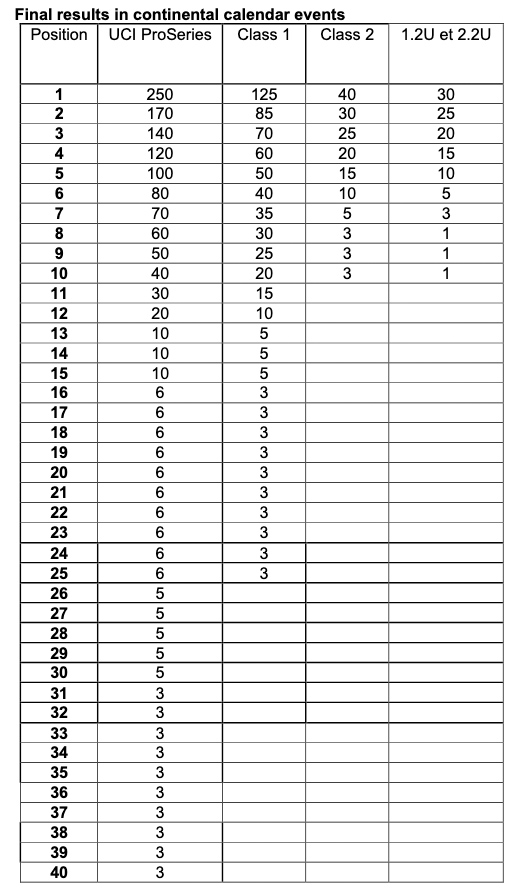
The next two tables below shows the points on offer for stages in non-World Tour races and the daily points for leading the race too. It’s just cosmetic but note the clumsy formatting, these tables just don’t seem to be designed with public consumption in mind.
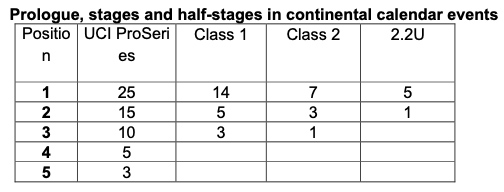

Below are the national championships, split into A and B groups, where A is defined as a nation that started at least one rider in the previous Men’s Elite world championship road race. These points matter because often when we look at the teams with few wins and placings in the year, several of their best results can be from national championships in smaller nations, the kind with only a few pros. Sometimes we’ve seen big name riders skip their national championships but smaller teams hunting points ought be paying business class returns for their riders to go and grab the jersey and points:
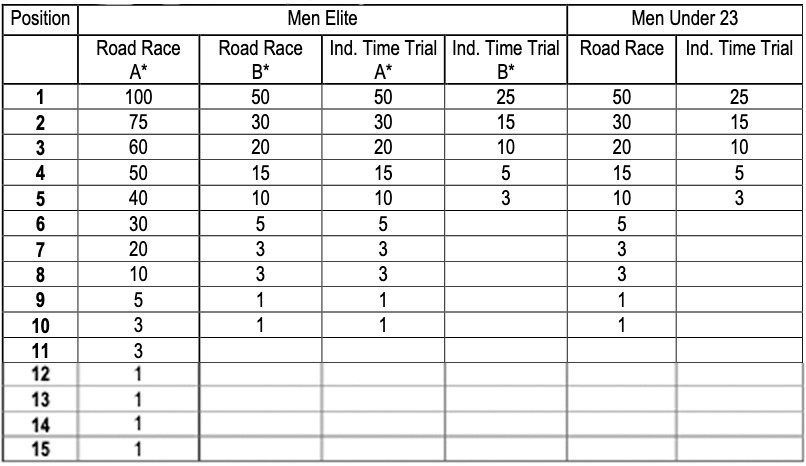
Now comes the Continental Championships, think the European championships for the best example. If these championships have a team time trial and/or a mixed relay time trial event, the small table further below also applies:


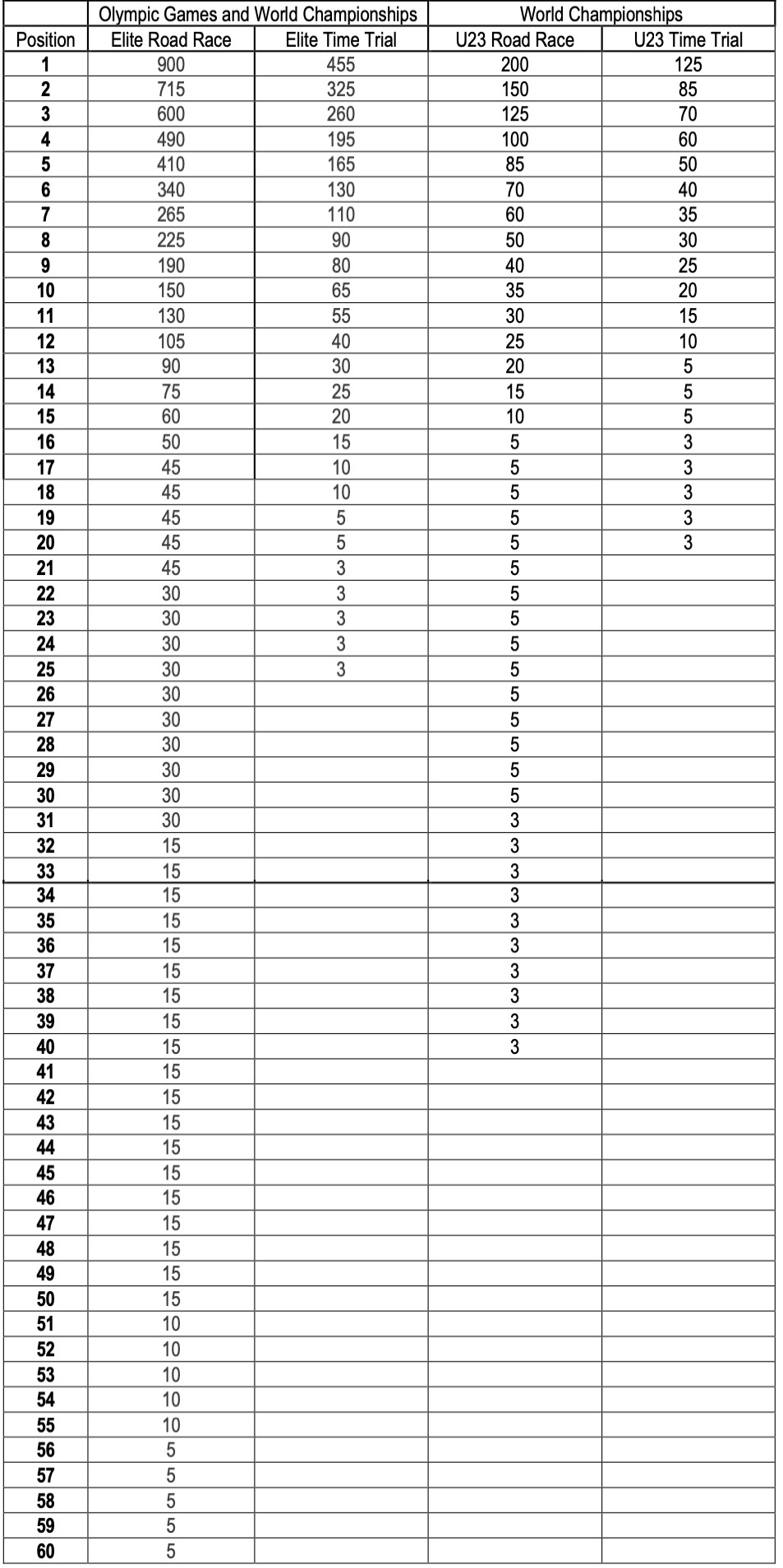
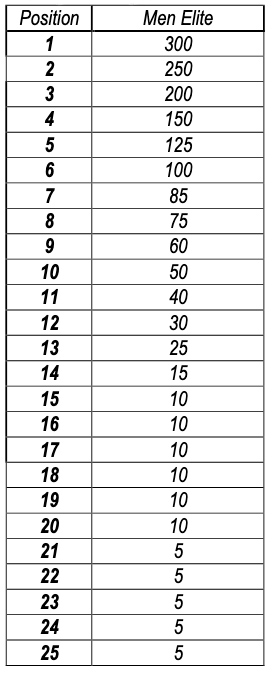
Now for the Worlds and Olympics, big events but the UCI is keen to big them up even more and they are the most lucrative one day races on the calendar in terms of points, 100 more than a Monument classic:
For the last of the tables, here’s the mixed relay time trial at the worlds which the UCI is keen on promoting, it’s 300 points but this is divided by the three men, so 100 points each (of course the women get 100 each too):

How to forfeit points
Riders can lose points too. The UCI rules include penalties for bad behaviour and some come with points deductions. They concern cheating like taking short-cuts, using sidewalks, ignoring level-crossing red lights, littering and other misdemeanours, right down to failing to sign on for the day’s racing or show up for the post-race press conference if invited. Any team manager sweating about winning points needs to also encourage riders not to lose them. Remco Evenepoel won’t worry about 25 points lost at the Tour but given the efforts others go to in order to earn 25 points these penalties matter too.
Where to find them
Go to uci.org > “Regulations” link at the top of the page > Scroll down to “Part II – Road Races” > open the big Part II – Road Races PDF > Scroll to Chapter X in the document.
Comment
The allocation of points is imperfect but reflects the UCI’s priorities. If the rankings correlated with media attention the Tour de France would have an extra zero on the points but the UCI system evens things out.
Is the Tour Down Under better than the Itzulia Basque Country? The rankings say yes but most would disagree. One of the charms of the sport is it retains a qualitative aspect that eludes rankings and the committees that establish them.
If incentives matter then UCI points do too. Many riders can earn bonuses from their points haul. For outsiders it’s a way to compare riders and teams during the season but also used for the three-year promotion and relegation contest. It’s this secondary battle that is arguably where the points matter most these days as teams target races and results in order to get points, both strategically in terms of race calendars and rider resources but also tactically on the day.
You can sit back and ignore a lot of this as “inside-cycling” but if you’ve scrolled this far then you’re up for these subtleties. So the next time you watch a rider sprint for a place well-outside the top-10 this explains why, or see how 25th place vs 26th in the Giro or Vuelta is worth 20 points and see which riders try to fight for this in the final week of a grand tour.
If you want the women’s points tables on one page, a separate blog post will follow soon and a link will be added here. In the meantime, new for 2026 is the women’s points score aligns with the men, eg 1,300 for the Tour de France, 125 points for winning a *.1 race and so on.
I’m a sucker for the rankings and tables. The promotion/relegation cycle has added to this, and we can already see how important racking up points in less prestigious races can be.
Less than a month into a three year cycle, sure, but Picnic-Post NL are around 1,000 points behind Jayco already. In the last cycle these teams were both looking over their shoulders and margins like this are maybe not so easy to close.
Count me as another fan of the points system, even (especially?) with all its ideosyncracies. The only downside for me is that richer teams can fly all over the world to get points in obscure races, while strugglers can’t. The flipside of that is that a rider like Alexander Salby can go around hoovering up points all over the world, a good consolation for toiling in relative obscurity.
Like most things in life, the points system has it’s pros and cons, but are the pro teams still fighting every year for points for selection to the Grand Tours?
For the automatic, mandatory invitation, yes. If you’re not among the three best ProTeams (including every three years any possible relagated WorldTeams), you must pin your hopes on receiving a wild card.
I really enjoyed this very thorough article. Thank you also for explaining how to find UCI regulations–I bookmarked it! : )
Comparing points could make for an interesting game of “would you rather”. Win Strade Bianche or finish 6th overall in the Tour? Win a Tour stage or finish 10th overall with no stage win? I suppose teams would theoretically be agnostic if the points were roughly the same, but surely there is a preference for the better quality win.
I suspect many would prefer the win but poll a lot of pros and that stealth sixth place is probably the answer, even if reluctantly. Finish sixth the Tour and you’re probably a millionaire already and if not, you will be after signing the next contract. Win the Strade Bianche and it depends, drop Tom Pidcock on a descent before punching clear of Pogačar on the ramp up into Siena and that’s promising and very lucrative all of a sudden; win from a breakaway that holds out and things will be different.
Money isn’t the be all and end all here but it weighs on the minds of riders more than fans. In many ways the points system helps redistribute things, it promotes winning Strade Bianche over settling for sixth.
Love that Strade scenario:) Every team would be falling all over themselves to sign that rider!
I’m not sure I understand that final sentence.
All other things being equal, riders will prioritise winning over finishing sixth in the same race. [You do mean ‘settling for sixth’ in Strade, right?] One would think that applies more so for a WT race; and more so again for such an iconic WT race.
But one of the effects of the current points system has been to see teams instructing riders to prioritise packing the Top10 in races with multiple riders over trying to win the race with one of them and sacrificing others to achieve this. Arkea, Wanty and Astana all come to mind immediately as examples.
In that sense the points system does help redistribute things but promotes coming, say, 4th, 5th and 8th over winning.
This is why I’ve been saying for years that the points scored by a team should be only those scored by their best result in each stage/race, not the sum of the best 20 individual ranking totals over the year.
This would mean that the hypothetical scenario of a team placing 4th, 5th and 8th would only be rewarded with the points for 4th place. They would be incentivised to instead work together for a top 3 position, with domestiques able to work for their leader without worrying about balancing that against saving something for their own sprint for a minor placing.
I quite like the idea but it would amplify the “winner takes all” scenario, ie a Pogačar or Van der Poel rider takes max points while a team that struggles to compete with them would be left further behind.
I think you might have misread it.
I’m not suggesting that only the winner’s points would count each day, but that each team would get to count the points scored by the *best placed rider of their team* each day.
Rather than hurting smaller teams, this would actually help them by restricting bigger teams from stacking up massive amounts of points.
Taking the GC result of the 2025 Tour de France as an example:
– Every team whose leader finished below 8th place would benefit because Red Bull wouldn’t get to bank 360 extra points for their second rider Roglic, having already counted 880 points for Lipowitz in 3rd.
– every team whose leader finished below 13th gets the same benefit, plus the benefit of UAE not counting 140 points for Narvaez, having already counted 1300 points for Pogacar.
– every team with a leader finishing below 15th would benefit from Visma not getting to count 100 points for Yates in addition to the 1040 scored by Vingegaard.
Even having counted only as far back as 15th place, which teams have “lost” points? UAE, Visma and Red Bull.
Methinks there is a (fairly large and sometimes quite loud) contingent of cycling fans who have, for one reason or another, let their initial (and possibly false or quite mistaken) impressions (based on some isolated or quite atypical instances early in the season) filter the evidence available to them in the course of the whole season and who therefore anchored their judgement far too early.
I would go as far as to say that if the tactical priorities chosen by Arkea, Wanty and (especially) Astana had been viewed more objectively, they certainly wouldn´t come to anyone’s mind as examples of trying to pack the Top10 with three riders instead of trying to win (or, at the very least, to finish with their best rider of the day as high as possible).
They did it and said so explicitly. It’s not the only tactic that was used but they were open about it being part of their strategy – https://cyclinguptodate.com/cycling/sometimes-we-no-longer-focus-on-winning-the-race-xds-astana-ds-on-the-ruthless-battle-for-uci-points
Another consideration is that Strade needs a rider in form at that time of year to give up 1 race day and a few days travel and is probably helping them for next weeks race. TDF 5th place probably needs dedicating half your race days for the year for training and preparation.
I do think they have the gotten the mix of points of Grand tour versus WT versus smaller races fairly good.
The previous points system with French and Belgium teams in particular (but others as well) getting a large amount of points by flooding small races was a bit unbalanced.
Possibly the biggest remaining problem if you are going to do the entire promotion relegation thing is that teams in the WT get to enter races with far greater points hauls. But several teams have overcame this disadvantage to get promoted. Or at least some WT teams have been so poor the advantage has been lost.
Astana’s miraculous resurrection last year was based squarely on flooding small races to gain large amounts of points.
They were incentivised to go to more races, they absolutely lit them up and were rewarded for it.
Looks like the points system was a strong positive for the sport in this case.
It has been pointed out that Astana would have just as miraculously well, if the point system had rewarded only the best placed rider of each team.
In other worlds, “flooding small races” is a hugely erroneous description if it is supposed to mean going for three riders in the Top 10. If sending an A or an A- team to races where other WT and PT teams sent B teams, then it could be somewhat accurate…
Michael Matthews is not a fan of the points system – “For me, it’s destroying cycling. I totally disagree with this 100%.” some interesting comments on team’s internal competition instead of teamwork too in a recent podcast.
… and yet his main claim to fame is winning the points jersey (many, many years ago).
We’ll look at the promotion/relegation system soon as these points tables help to set up that piece but the short version is a bit like Churchill’s quote on democracy, as the worst system but better than the rest. Relegating teams to make room for new ones can make sense and some system with rules and points you can see from three years out is open.
Churchill was demonstrably wrong.
By making our politics a popularity contest that happens every 4-5 years, democracy will always result in us being ruled by sociopaths, because their only goal is winning that contest and having power.
(There are many options other than democracy or totalitarianism.)
I completely agree. There has to be some system in place to decide which teams are invited to the biggest races, especially the Tour.
It is worth pointing out that the Ranking system for teams began in 1989 as a device to help ASO decide which teams should be invited to the Tour de France: this was the first year this system was implemented and in that year the Tour took the top 18 teams in the rankings plus four wildcards. At the time, there was more-and-more pressure on teams to get a place in the Tour and ASO was desparate for a system to help them choose which teams should do the race. This was especially important since not getting a Tour place could result in the team folding. (The first ranking system dates from 1984 but had no formal importance). The World Cup also started at this time; it was a circuit of the most important one-day races.
One of the effects if the ranking system is that teams hired classics riders to score points in the one-day classics (making these riders and these races much more important, especially Flanders). Hiring classics riders to score ranking points was especially important for teams whose leader was a climber. Up until 1989, teams typically had one-team leader and a set of domestiques, only riding the races their team leader could do well in (or their local sponsor cared about). Many teams only lasted as long as the career of their team-leader.
A direct result of the ranking system was teams became much bigger to cover all the races, and had different leaders in different races; it also drove specialization in rider types. And teams no longer mostly concentrated on their national circuit, becoming much more international. This lead to the creation of the World Tour in 2005 (called the Pro-Tour until 2011).
Personally, I believe that without the Tour de France (and the importance of ensuring a guaranteed invitation to the race), most teams would not have much incentive to become World Tour teams. And this would badly affect entry to races outside the core cycling countries (making them much less viable).
Another way to put this: would you rather watch Flanders-Baloise and Euskaltel, or UAE and Bora? I know that some people would prefer the former, just as some football fans prefer the lower divisions because it is more accessible and more “real,” but the growth of a sport (or at least holding on to the status quo) depends on keeping people interested. The popularity of PCS is at least somewhat attributable to the fact that people do care about the rankings for all of the reasons listed above. Cycling teams have a history of dying on the vine, but at the very least the ranking system gives sponsors a reason to take a second look, especially if the Tour is in the equation.
Matthews has never ridden for a team that could be excluded from their target races on an organiser’s whim, has he?
I like the mystery of UCI points system because it makes me wonder how Marc Hirschi keeps scoring so highly but does barely anything against quality opposition.
XDS Astana just claimed 575 points in the Asia contient championships with 4 of the top 5 guys. That’s like getting 5th at the tour.
Point farming par excellence.
A jackpot indeed. But they don’t need to do this any more, they’re in the World Tour now.
We’ll look soon at maintaining that place but it should be a means to an end… and winning the Asian title is probably pleasing for the Kazakh backers too.
They also just went 1-2 in the Tour of Oman, which was also a nice points haul. Two things can be true at the same time: Astana have done a great job of racking up points, but they have also had fantastic results since the beginning of 2025, completely aside from the points race. I think the whole organization deserves a ton of credit for that.