
Some software and hardware that proved helpful during the year.
VPN software
If you live somewhere where it’s become expensive to subscribe that’s frustrating but at least you have an option to pay. Here, a Virtual Private Network has been essential at times to watch the racing. But it’s not for everyone given watching races via the local channels means the language barriers. If you can clear that it’s enjoyable, and even educational if you like to learn a language by listening.
Yes there are questions of legality as every channel has terms and conditions but up to you to check the small-print for each channel and proceed or not.
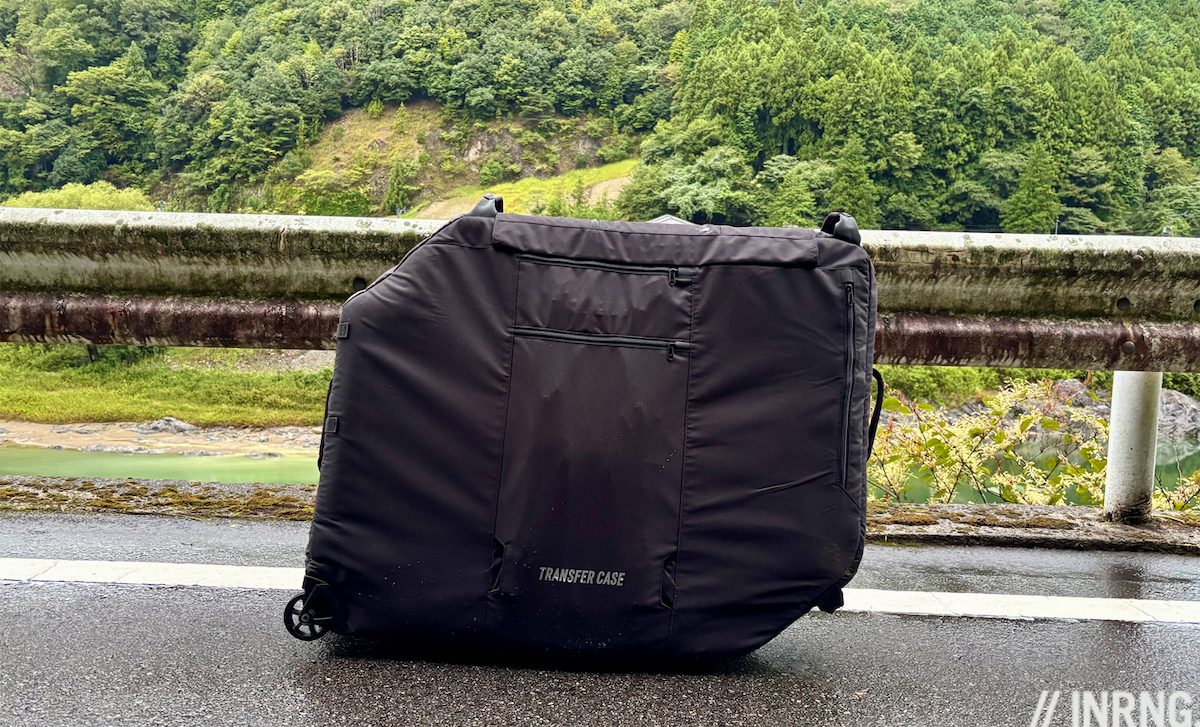
Postcarry Transfer case
Travel by bike is great, but travelling with your bike can be fraught. I’ve rate the Fairman Rinko bag in a past piece because it is light and it compresses to less than the size of a bidon so you can haul your bike onto trains and into hotel rooms with no fee or fuss, but it’s so thin it offers little protection. There are plenty of travel bike cases on the market but some are so big they make travel awkward and take up space at home.
This case protects your bike for air travel but it’s gone in the back of small cars. You can carry it onto crowded trains and buses without bother. It’s also easier to wheel through streets and haul up stairs because it’s not so big. Once back home it can be rolled up to roughly the size of two yoga mats laid lengthways.

So far so good, but the price is is having to dismantle and rebuild each time for packing. You don’t just remove wheels, the seatpost and pedals, you also lift the bars off the steerer tube, remove the forks and undo rear mech too (their photo above). So you need to be comfortable doing this away from home and stay several days at a time in one place. Invariably what feels like a ten minute job takes way longer when outdoors with just a multi-tool. But it worked well for travel and you can stash clothes, helmet and shoes inside too. Also it depends on the airline but the reduced height+width+length size may count as normal hold luggage item and so save you fees.
Muc-Off Inflator
What could be more simple than a bike pump? A piston with two valves, a well-built one should last a lifetime. The trouble is either you get a big one and it is not obvious to fit on your bike, or you get a small one that’s still too big to fit in a jersey pocket but needs several hundred strokes to inflate a tire.
This Muc-Off Air Mach Pro came from a bike shop. It looks so similar to the Cyclplus models that they probably come from the same company so the review here is more generic. The battery will inflate five road 28mm tires. Not that you’d need it five times in a day but you get this from the same weight as two 16g CO2 cartridges with an inflator chuck, or a regular mini-pump.
Where the inflator delivered was on travels as it did the job of a floor pump while doubling inside a jersey pocket as a mini-pump. Deflate tires at the request of airlines, fit a new tire when away, or just adjust the pressure when wet or dry and the job gets done quickly and the displayed pressure seems accurate.
There are some downsides. It’s vacuum-cleaner loud. It’s not waterproof and if it comes with a ziplock pouch that’s proved flimsy. Above all, any device you rely on with a battery and moving parts means it goes on an unwritten pre-ride checklist where you ought to test from time to time as you don’t want to discover it’s bricked when away from home.

ccWay
There’s a French cycling club called the “100 Cols” where members must climb a hundred mountain passes to become a member. But in order to work out if an applicant has climbed 100 passes it seems they needed to create a database of mountain passes. Of every single one in France, paved or not. And Italy. And Spain and seemingly everywhere, from Afghanistan to Zimbabwe. It’s certainly comprehensive for most of Europe and rigorous too, a high road is not necessarily a pass. The database is open to all via the ccWay web page and it’s a powerful tool. Select the area you want, whether you want road only or off-road and you can download the results to open in Google Earth.
So far so good, but non-members are limited to 100 cols at a time so don’t select a country or an entire mountain range. Plus you’ll only get the location and height, not the name…but the map routing app Openrunner is partnered with them and uses their database and you can cross-check for the names of locations (screengrab pictured). You can buy catalogues from the 100 Cols too which gives you the names and supports their work at the same time.
All this is useful here for previews as races in the mountains often rename places – the Tour de France has the Col de Toses for the Collada de Toses on Stage 3 – or put the KoM point at a different point to the pass. It’s useful if you want to know where you’ve climbed on a trip. Google seems to be ubiquitous for maps today but it’s often missing labels for mountain passes.
Peakfinder app

If you’ve done the pass, what about the peaks above? Having tipped the rival PeakVisor app before, it became hard to use without a pricey subscription. Peakfinder feels better because you buy it for a one-off fee and they promise updates will always be free, refreshing for an app. When in the mountains just point your camera at the horizon and it’ll identify the mountains for you and you can label photographs. In case you’re wondering, that’s the city of Genoa and to the right, below Monte Reixa, sits Passo Turchino famous in cycling as part of the Milan-Sanremo route.
Peakfinder is absolutely brilliant, been using it for 11 years all over the world and the developer has stuck to their guns and refused to cripple it by subscription. What your photo doesn’t show is how just how easy and intuitive it is to use in the normal AR mode. Just when you think ‘now what the heck’s that hill/mountain called’, whip out the phone, fire up Peakfinder and Voici! It’s blown everyone’s mind I’ve shown. Seeing the snappy, clean outlines of the peaks align, scroll and tell you what you’re looking at instantly is so satisfying. Seriously, can’t rate Peakfinder highly enough, fantastic functionality and value – that’s coming from a rather jaded ex-technophile.
For those who are into that sort of thing, gravelmap.com works well for route finding.
A couple of software things i use.
When going to a new place i will use strava segments to work out good places to ride. Chances are if a segment has lots of different riders its hopefully fun and safe to ride. For me the emphasis is safe. Choosing a narrow busy road with no shoulder is never fun.
Map programmes or web apps. Simple maps like bing or google can give you a good idea especially for gravel roads. Quite a few roads even near where i live are now often ridden simply because i looked at a map and realised there is a dirt road going from here. If you want to get technical if street view exists you may even get a look at the surface quality.
Strava’s Heatmap can be of use too but you need to work out what is popular, like a commuter road or just some quick route in and out of a city, and what is more rideable or enjoyable.
Streetview can be very useful, but worth checking the date, the road that looks ok to ride could be overgrown since… writing from experience here.
There’s a blog post to do one day about Google maps as it’s free and useful but increasingly a business directory over a geographical survey. The ratings are amusing sometimes, eg the Col du Tourmalet is 4.5 stars, largely on account of some weird or accidental 1 and 2 star ratings, eg “Too much uphill. Not enough shade. 2*”
It may have changed now, but I was planning a cross-France trip a few years ago, and Strava Heatmap often wasn’t helpful. Too dominated by those people that actually use Strava. So tourists = towpaths and voies vertes; racers = main roads. Which wasn’t what I was looking for.
I’ll second this about many areas I know well, across several countries. Strava heatmaps aren’t a good match with what I’d look for, both as a resident cyclist or a visiting one. Lots of locals train on roads whose security or scenic appeal is rather low, but they just priorise other aspects. Of course, if your only priority is instead meeting other riders, which is totally legit, they might work decently for that.
for findling passes and planning tours in mountains I usually use https://www.quaeldich.de. the user-generated database features 8857 passes with profiles, descriptions and tour recommendations. When logged in I can a to-do lists ir lists of favourite passes etc.
but i’ll see what ccway can.
Just keep on promoting VPNs and contract-breaking and don’t tackle the bad race organisers selling coverage rights to tiny money-grubbers who want to take cycling down the same elitist exponsive path as football? This then turns the cycling industry into advocates for VPN bans that politicians are happy to deliver under cloak of age verification or child protection.
You’d have to name the organisers first.
A lot of races are by law free to air country by country, the Tour in France, Giro in Italy and in Belgium many races so you can view races via the public service broadcasters. So it’s rare for an organiser to sell rights exclusively and extract value or rent from this.
Hopefully a VPN ban is far away, it seems to be something reserved for repressive places like the DPRK, Russia etc… even if I know Russian cycling fans and readers have their ways to enjoy cycling through this.
The question is, what are we expected to do? Just not watch cycling on TV? Or fork out for the rent-seeking subscriptions?
There’s the individual and the overall effect. I suspect a lot of British viewers will find something else to do. The sad thing is that not only will some give up but plenty just won’t find a way to enjoy the sport
See https://inrng.com/2024/10/itv-ends-tour-broadcast/
On bikes cases, having tried the B&W ABS clamshell case, and some other soft cases, I’ve gone to the other end of the spectrum from your very-soft-case and bought a Buxumbox. A solid aluminium case that provides excellent protection for your bike with minimal disassembly needed (just loosen the bar and twist it around, and take off the wheels); quality wheels that make it easy to move about; and space left over inside to pack a full track pump, plenty of tools and spares, helmet and shoes.
Thoroughly recommend the Buxumbox. Quality box – even when you look out the airplane window and see the baggage handlers abusing it, you don’t feel any stress, you know your bike will be fine.
I’d like to use this for the protection it offers… but how to get it on trains and subways and not get lynched or at least frowned on?
I’ve had this on trains and buses its not an issue. It’s possibly handier than a soft case, cause there’s it’s square and robust enough that you can leave it in the luggage area and stack your own stuff on top, or let others stack theirs on top, without fear.
As a robust square case, it is in a lot of ways more “compatible” with the rest of the world, in terms of integrating with other people’s luggage and spaces for storing said luggage.
One issue is it generally will not fit in the boot of compact or saloon cars. You need to fold down the rear seats to fit the case. So if you travel with more than 1 other person (e.g. partner and kids), and you need to drive at the other end you need to hire a sufficiently large vehicle (or buy an easy to pack inflatable universal roof rack, and make sure you strap it all down sufficiently – I havn’t been brave enough yet to try this on an actual holiday). If you have to hire a larger car to fit case + others, that will cost more.
Oh, subways.. just plan your trip so any subway legs of your journey are not at rush hour. 😉 There’s usually plenty of space on metros outside of peak times. And metros/underground lines serving airports typically have carriages with luggage areas.