
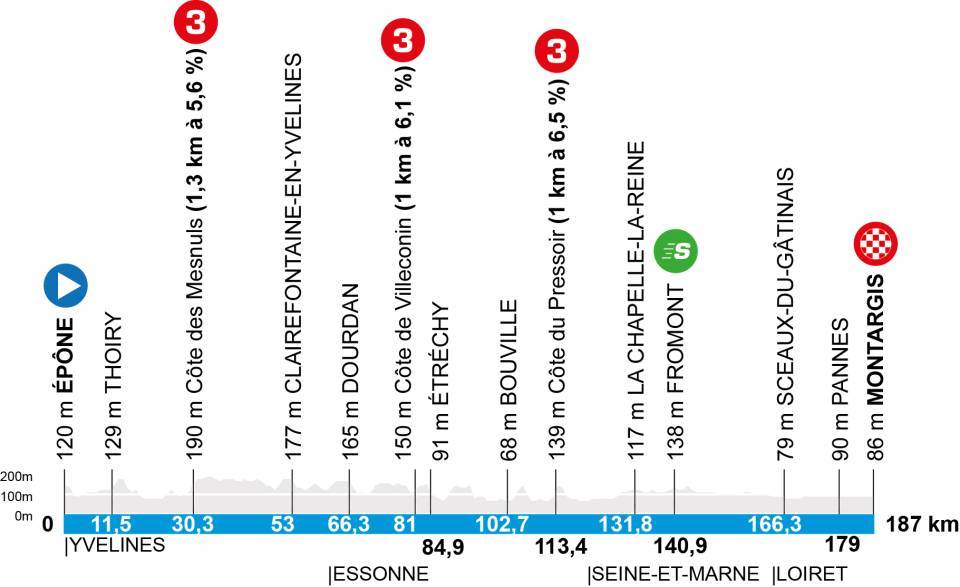
A sprint stage.
If this doesn’t set the heart racing, it’s the only certain one this week and today’s postcard looks at the way sprinting opportunities are drying up and changing.

Lucky Luke: a vexed start in the Vexin with the first 100km covered in little more than two hours, or 48.7km/h. The breakaway of six was reduced to five and they threatened to contest the stage win with the hilly finishing circuit burning up the chasers. The escapees were caught with 2km to go which sounds routine but there was some suspense here.
Casper Pedersen got something for Soudal-QS by taking the mountains jersey and will probably try to go away today as he only needs one point to keep the jersey for today and tomorrow.
Visma-LAB did a lot to chase down the break in the final kilometres and set up the sprint for Axel Zingle but seemingly just as he was about to launch he was blocked by others. Marijn van den Berg led out team mate Luke Lamperti and if they went early with 350m to go this got them out of the congestion. Lamperti did not quite sprint faster than his shadow, visibly pushing a bigger gear than the rest but he was ahead and stayed there.
Behind Biniam Girmay had seemed in the perfect place, following Cees Bol, but was unable to pass on the right because of the barriers and blocked by others on his left having missed the moment, and resembled a coiled spring that could not be released. Talking of releases, EF get their first win of the year to leave Picnic-PostNL as the only WorldTeam left without a win.

The Route: 187km and somehow 1,200m of vertical gain thanks to some rolling terrain early on. It’s back to Montargis, a town picked by newspaper Le Monde for a series of reports precisely because it’s in the middle of France in several ways, geographically but also neither rich nor poor, neither rural nor urban.
There’s déjà vu as 2024’s Stage 2 that started in Thoiry to go to Montargis which was similar to 2020’s Stage 2 that finished in Châlette-sur-Loing, a suburb of Montargis. Those two stages were almost identical but today’s has some different roads. But the feel is the same with the course zigging and zagging across the flat Gâtinais lands. The idea is to catch the (cross)wind but the forecast is for calm conditions.
The Finish: the same flat final kilometre as 2024 but a different run across town to get there, it’s a regular road but not a wide boulevard so advantages to teams with trains for putting riders in place and defending their position.
The Contenders: take your pick of the sprinters, as the only guaranteed sprint finish of the week there’s no chance to assess form, speed and establish a hierarchy, it’s today or bust for plenty of riders or at least complete the week to hone condition for the upcoming spring classics.
Luke Lamperti (EF) can repeat and yesterday’s result seems to have settled the question of who does a lead out. Van den Berg is a smaller rider so not the obvious windbreak but agile while Lamperti was leading out Paul Magnier last year but we should expect the American in yellow to go again.
Biniam Girmay (NSN) gets a second go today.

Casper van Uden (Picnic-PostNL) won a Giro stage last year. The team needs some good news and this won’t make him any faster and Giro apart he’s not troubled the top sprinters but the field is light on sprinters so there’s a good chance.
Phil Bauhaus (Bahrain) and Pascal Ackermann (Jayco) fit the bill as speedsters from Germany with non-Germanic first names, a continuation of Marcel and André only without their win rates.
Milan Fretin (Cofidis) was close yesterday. Jensen Plowright (Alpecin-PremierTech) is quick but yet to win a race in Europe after three seasons.
Vito Braet was second yesterday but he’s more suited to uphill leadouts for Arnaud De Lie and in a flat finish Lotto-Intermarché might back Milan Menten then Josh Giddings over Braet.
 |
Girmay |
 |
Plowright, Lamperti |
 |
Van Uden, Bauhaus, Ackermann, Fretin, Menten |
Weather: 17°C and a mix of sunshine and cloud. A 10km/h breeze from the south.
TV: KM0 is at 12.50 and the finish is 5.00pm CET. The last two hours will be live on TV but you might want to ration your viewing given the near certainty of a bunch sprint.
Postcard from Montargis
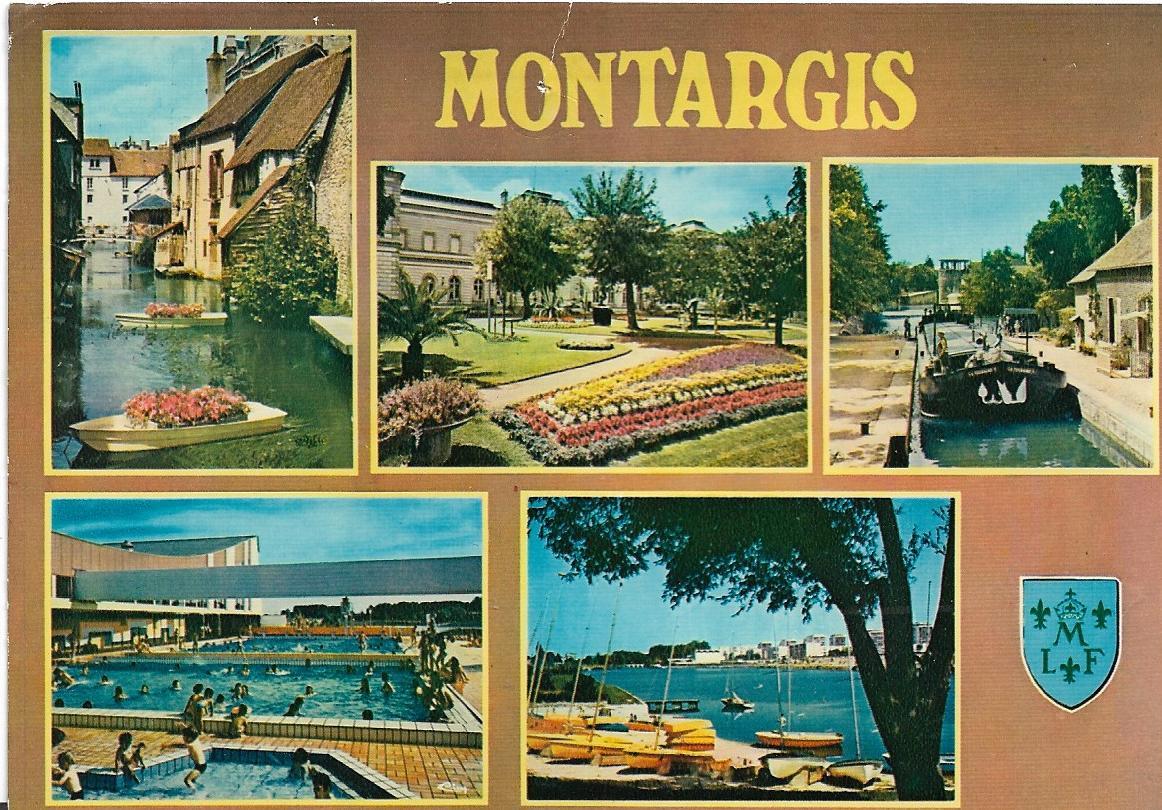
When Paris-Nice came here two years ago that day’s postcard went off on a tangent to explore the strange way Montargis hosted about 300 Chinese students over a century ago and their disproportional role in the Chinese revolution. Zhou Enlai, Chen Yi, Cai Hesen and others came to stay. Estimates say about 1 in 10 of the Chinese who studied in Montargis would become senior Communisty Party figures or generals in the Army. And if Proust has his madeleine, Deng Xiaoping was nostalgic for the croissants of Montargis from his time working in the Hutchison rubber factor here too.
The tangent we can riff on today isn’t quite a statistical curiosity of the same rarity but sticks to the theme of scarcity: today is the only nailed-on sprint stage this week. And there are fewer and fewer of these.

By now we know the Gestalt. Sprint finishes see the peloton proceed across the landscape for hours on end as several teams set the pace. In the past you’d get a “4×4” breakaway: four riders given no more than four minutes. Sometimes now nobody attacks. A year ago Jonas Abrahamsen got the short straw while his team were jostling for a wildcard invite to the Tour. It’s not edge of your seat sport and ratings dip. The scenery is often featureless too.
Among Christian Prudhomme’s stock phrases is “the dogma is that there is no dogma” when it comes to route design so we’d better call it a rule instead that there should be no more than two consecutive sprint stages no matter the terrain. Hence last year’s northern grand départ seeing out every climb possible; or having a time trial. Other events think the same, see how once “sprinters’ classics” like Gent-Wevelgem or Paris-Tours have been spiced up. How long until the Scheldeprijs features a hill?
It means sprinters today are having to be more all-round athletes, capable of handling a few climbs en route. Matthew Brennan comes to mind, the same max power as Olav Kooij but 5kg lighter; similarly Paul Magnier as the modern sprinter compared to his team mate Tim Merlier. It’s hardly a new category, think of Oscar Freire, Edvald Boasson Hagen or Peter Sagan in recent years. Sean Kelly before them and many more. It’s just that these riders were regularly beaten by pure specialists on the numerous days when featureless finishes rewarded pure speed. Now these dragstrip finishes are becoming more rare. It’s too soon to talk of a lost class of rider but the incentives are changing and pure sprint specialists are not the royalty they once were. Except for today.
I was laughed at the last time that I suggested this but I still think sprint stages should be shorter … just as sprint races are in any other form of sport.
Some of the riders have stated that the longer stage ensures that the riders are not as fresh for the finishing sprint. And that this makes the sprints much safer (and less congested).
@Cadence 66
Or how about 3-4 intermediate sprints for timebonuses that count only towards the stage classification deducted from your stage time?
That was one of my thoughts early on but I have veered towards shorter sprint stages … which are likely to be more intense.
The flip side is that the other stages should get back to 200 km or so.
I could get on board with this. I endorse your candidacy to succeed Prudhomme.
A short blast across flat country and a boulevard finish for the grand finale (you know, why not split the day with a 10k TT – it’s been done before). Then those days where the stages are made for the Brennan type rider – yeah, make ’em long. A mini-classic buried in the GT. 200km+ and some really grippy roads.
I would have loved to see crosswinds today. To me, there is something missing from P-N if there is no stage with echelons. As for the lack of ‘pure’ bunch sprints in today’s stage races, I don’t mind where we are now, but I wouldn’t want to see even fewer of them. Given how youth races are designed, there will always be a pipeline of talented sprinters, and if we keep enough opportunities for them to win at senior level (and at present there are), I can’t imagine that most teams wouldn’t want to invest in their sprint trains.
To keep the postcard short one thing missing was the cost of trains, few teams have them now as it uses up a lot of resources. Lidl-Trek and Decathlon have them. There’s also a literal “free rider problem” as teams that do establish a big train just see rivals sitting on for a ride and the hope to come past in the finish. Some teams have made an art of exploiting this, Quickstep for example sometimes sit well back but exploit the slipstreams to come through in 800m-300m and then launch.
Today a team could help but defensively as the roads are not wide but don’t have obvious overtaking points either and a strong train can defend a position
“Deng Xiaoping was nostalgic for the croissants of Montargis from his time working in the Hutchison rubber factor here too”
I mean, this paragraph is worthy of a long blog entry in itself, but I’m happy that I’ve read it all the same.
More in the postcard from 2024 if anyone wants it at https://inrng.com/2024/03/paris-nice-stage-2-preview-montargis/
John (not ‘Johann’) Degenkolb was considered a sprinter in his early days wasn’t he?
Maybe those stages in the TDF where no one goes in the breakaway are another nail in the coffin. I totally get why you wouldn’t want to spend a day in the break on a long flat stage but it makes watching the stage even more like paint drying. Wow I’ve mixed my metaphors!