

The 2026 Giro d’Italia route has been unveiled. Here’s the stage by stage look at the course.
Stage 1 – Friday 8 May
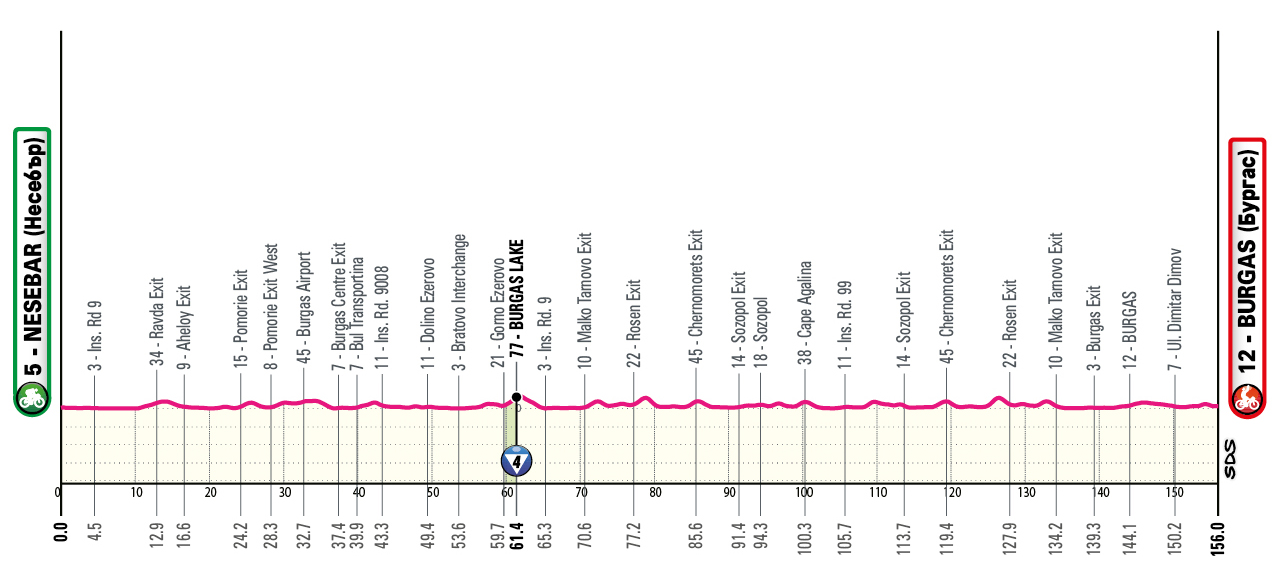
A Slavic start with the opening stage in Bulgaria on the Black sea coast. Why Bulgaria? Like Albania in 2025 this is a country courting the Italian audience to promote a nearby low cost holiday destination. Similarly it has had a few pro riders over the years and hosts a 2.2-rated national tour. Unlike Albania it’s an EU member but it’s got its own currency the Lev tied to the Euro and uses the cyrillic script. So plenty to discover.
There’s one climb but it’s almost imperceptible, a ruse to award the mountains jersey for the day. There’s one lap of a finishing circuit in Burgas which has its charms but the skill of TV production will be to showcase these ahead of the giant oil refinery.
Stage 2 – Saturday 9 May
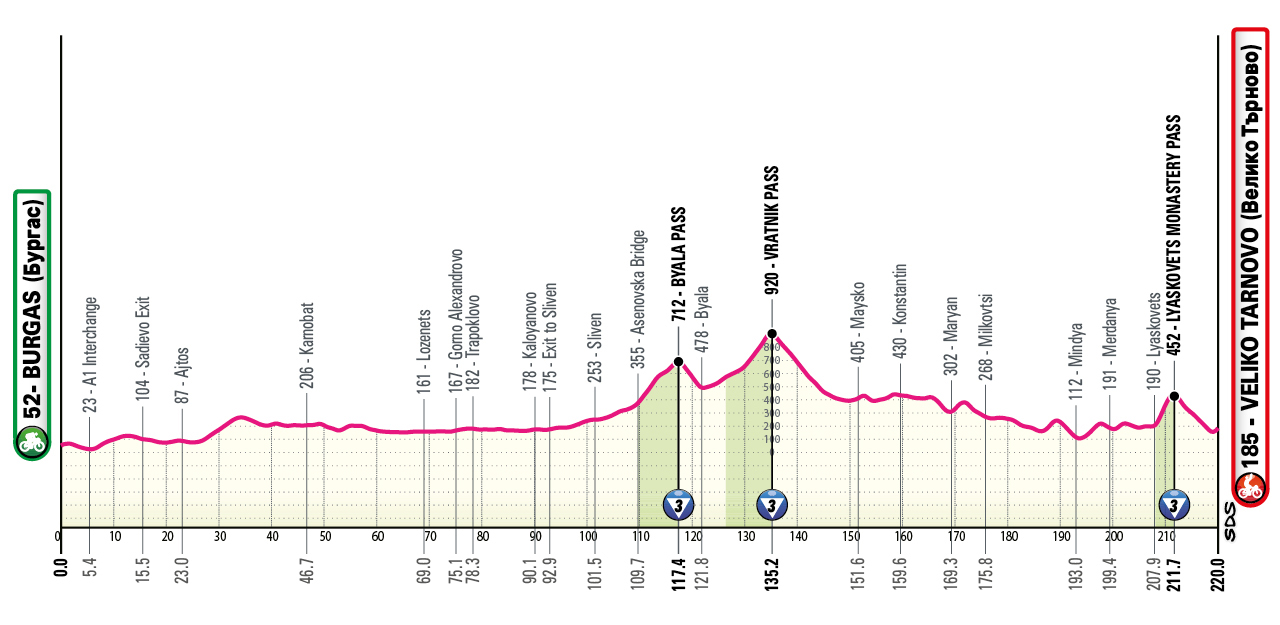
The second longest stage in the race at 220km. The final climb out of Lyaskovets is steep and will see most of the sprinters in trouble.
Stage 3 – Sunday 10 May
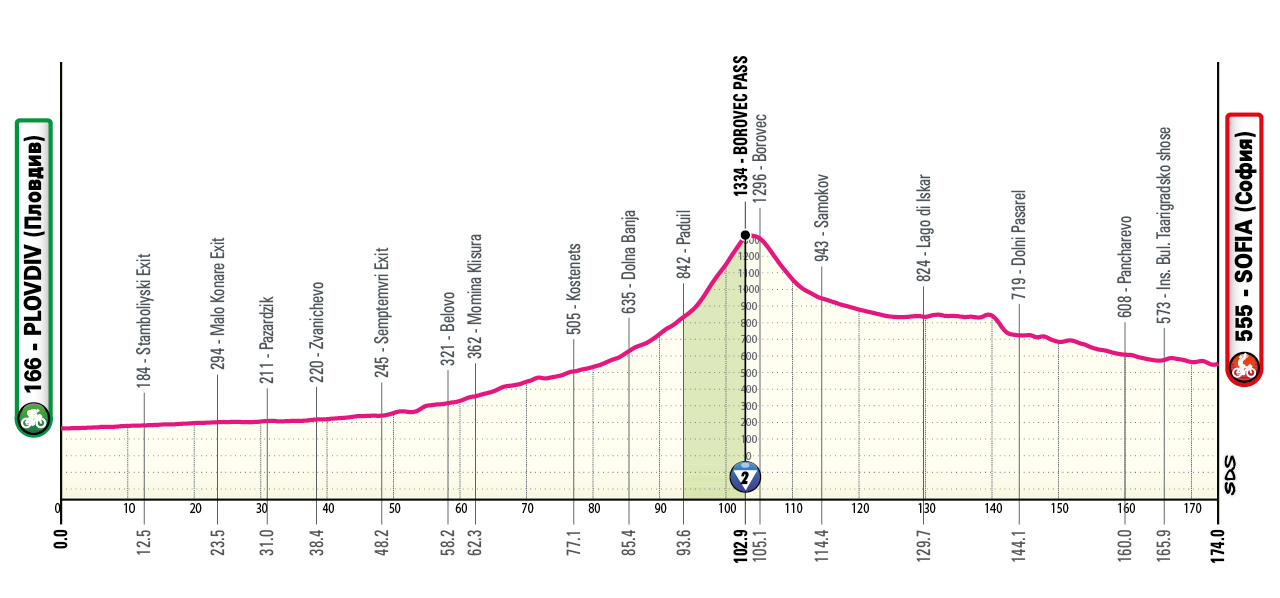
A race between the two major cities with the finish in the capital. If you want to learn some Bulgarian, why not start with ceдловина or sedlovina which means a saddle, as in a mountain pass because the race goes over Borovec sedlovina but with 75km to regroup. The race then has a Monday rest day as the convoy makes its way to the foot of Italy.
Stage 4 – Tuesday 12 May
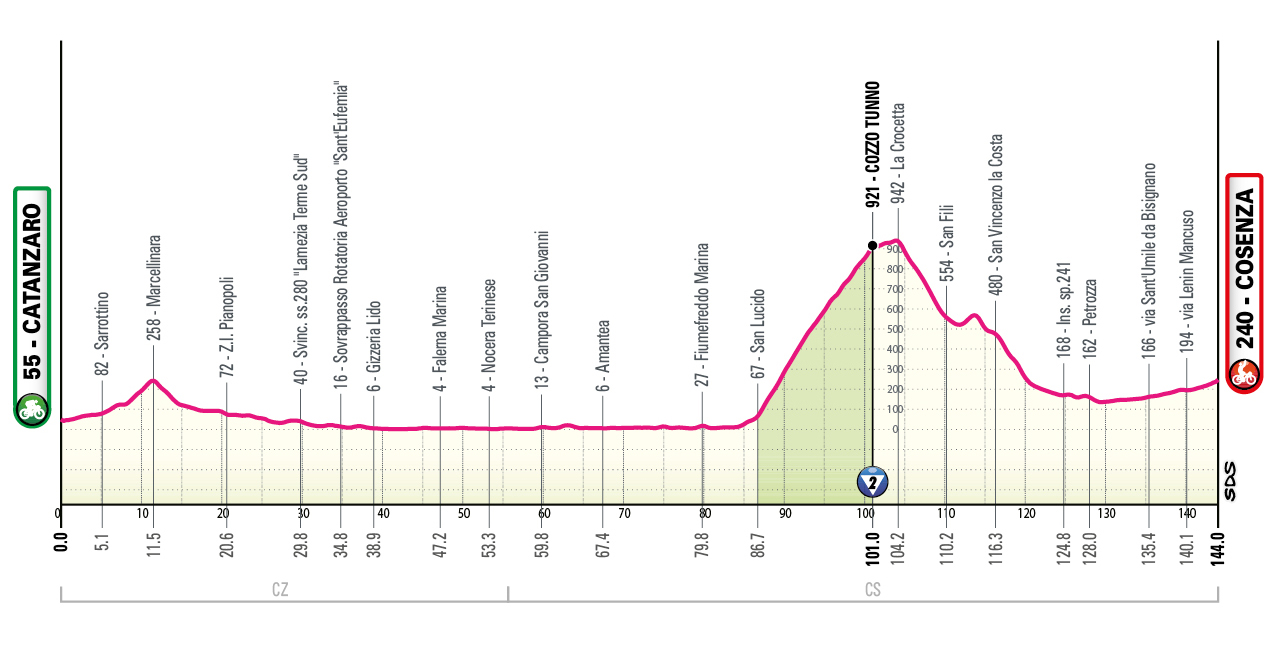
144km and a climb midway. The race manual says its “easy” but it’s still 17km at 5% and via a twisting side road too so bound to sap some sprinters.
Stage 5 – Wedesday 13 May
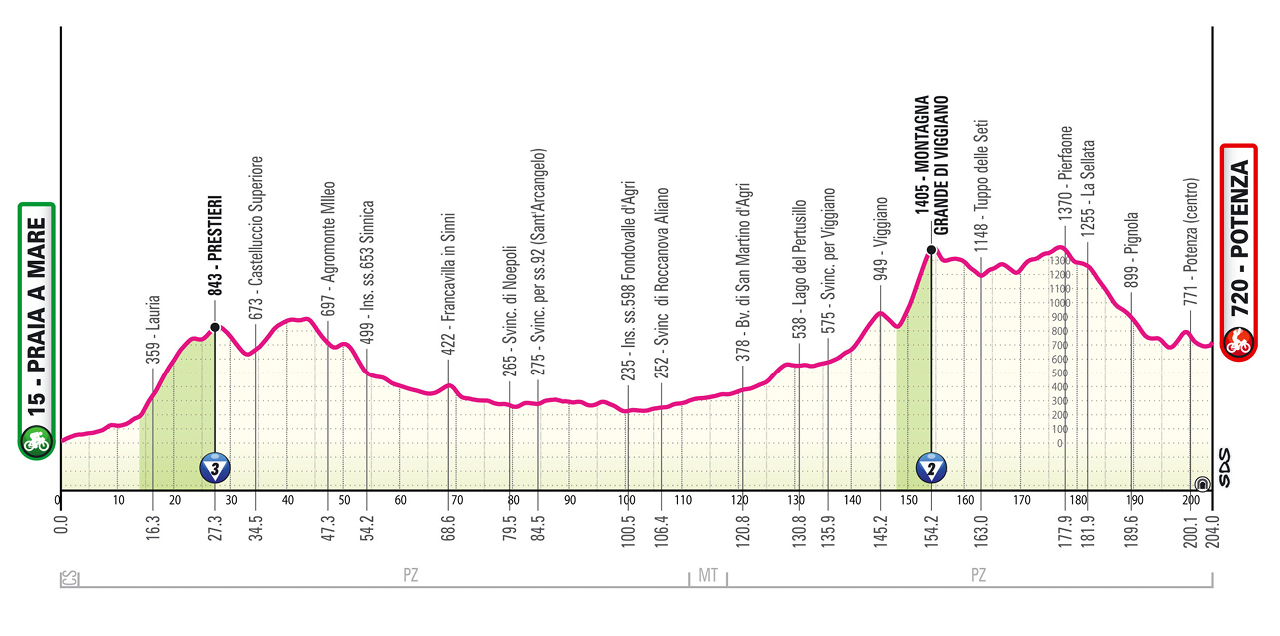
Similar to Stage 7 in 2022 where Koen Bouwman won in Potenza to salvage Jumbo-Visma’s Giro after their GC ambitions had already evaporated, although this has a slightly different finish in town. Like that day the climb of Montagna Grande di Viggiano is the hardest of the day, 6km at 9% towards a small ski station.
Stage 6 – Thursday 14 May
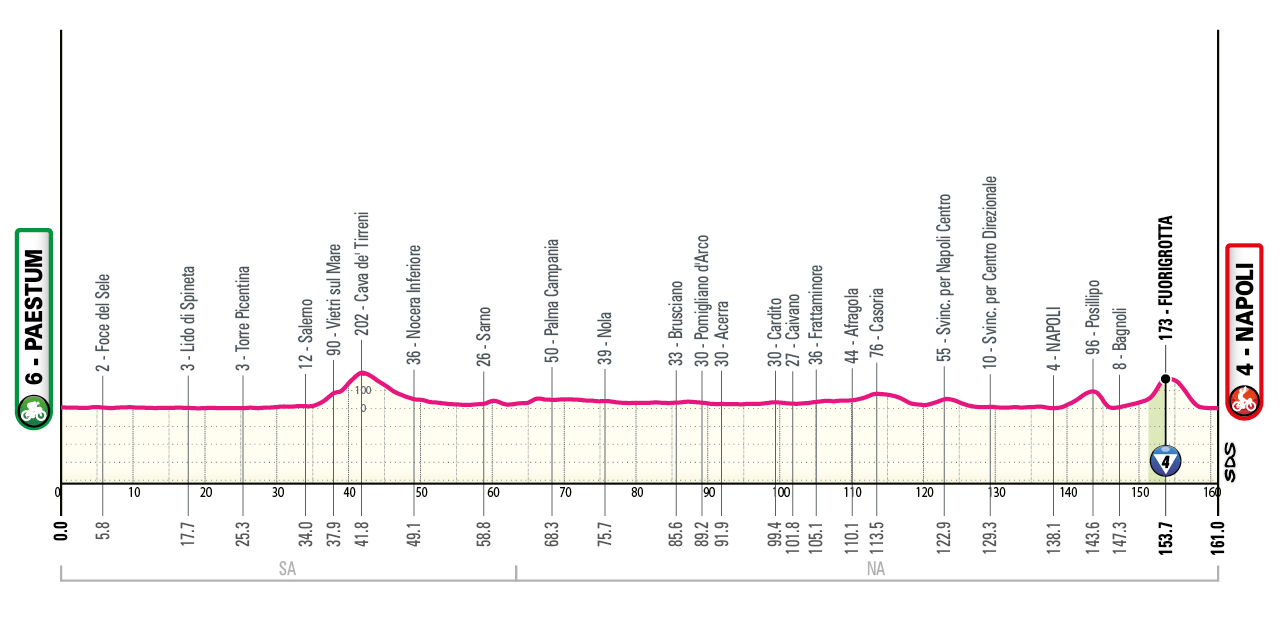
A spin along the Mediterranean coast. Napoli is the new Pau. A regular mid-race haunt, a ready supply of hotels and the ability to draw on a variety of local terrain. This time the climb in the Fuorigrotta part of town should be gentle before the habitual sea front finish.
Stage 7 – Friday 15 May
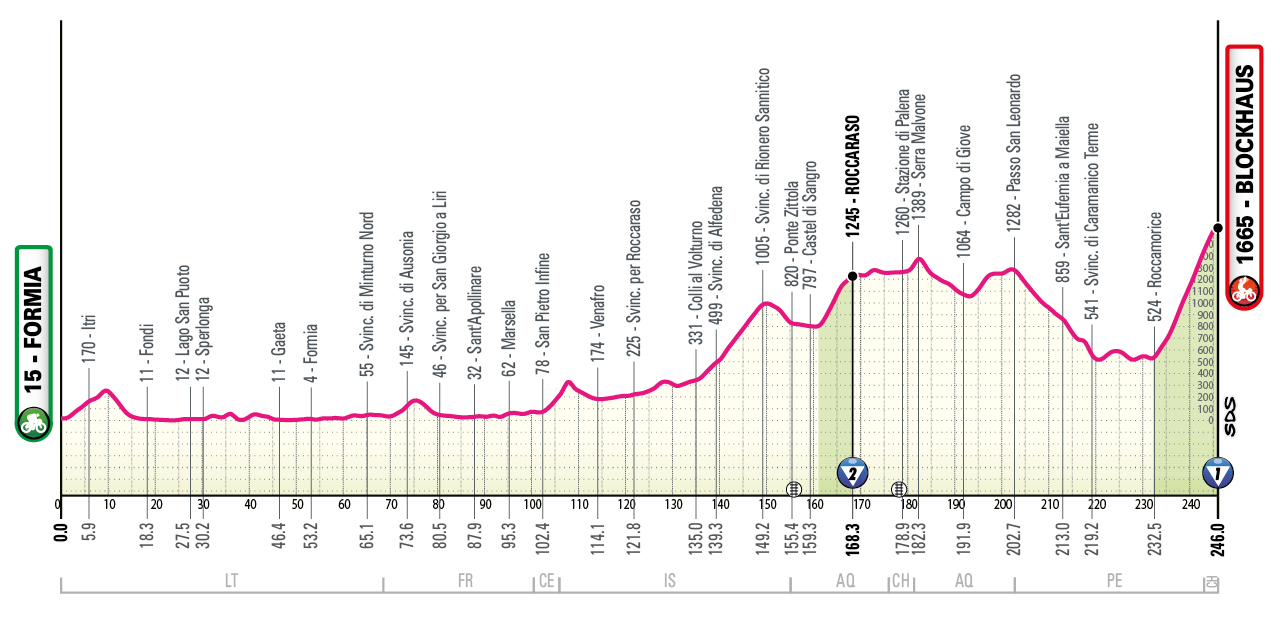
Blockhaus via Roccaraso. A long day at 246km – the longest grand tour stage since 2021 – so there’s plenty to tire the riders before they reach the final climb of the day with 4,600m of vertical gain, most of it before Roccamorice. The final climb is 18km at over 8% so comparable to Mont Ventoux in terms of stats; and anecdotally often windy too. The road goes on to over 2,000m but 1,665m is plenty for the first week.
Stage 8 – Saturday 16 May
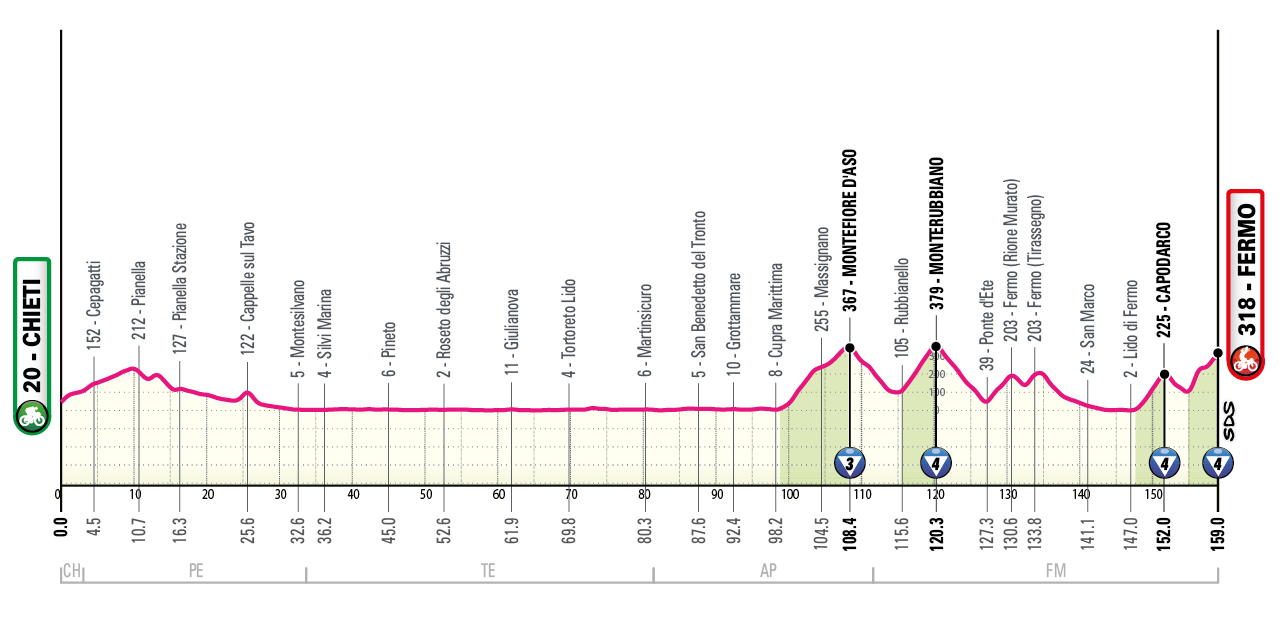
Almost a day out of Tirreno-Adriatico, this puts the emphasis on the Adriatic with a long ride along the coast before turning inland for the final 60km for the some wall-like climbs. Capodarco is known to the peloton for its selective U23 race and there’s a steep climb to the finish in Fermo.
Stage 9 – Sunday 17 May
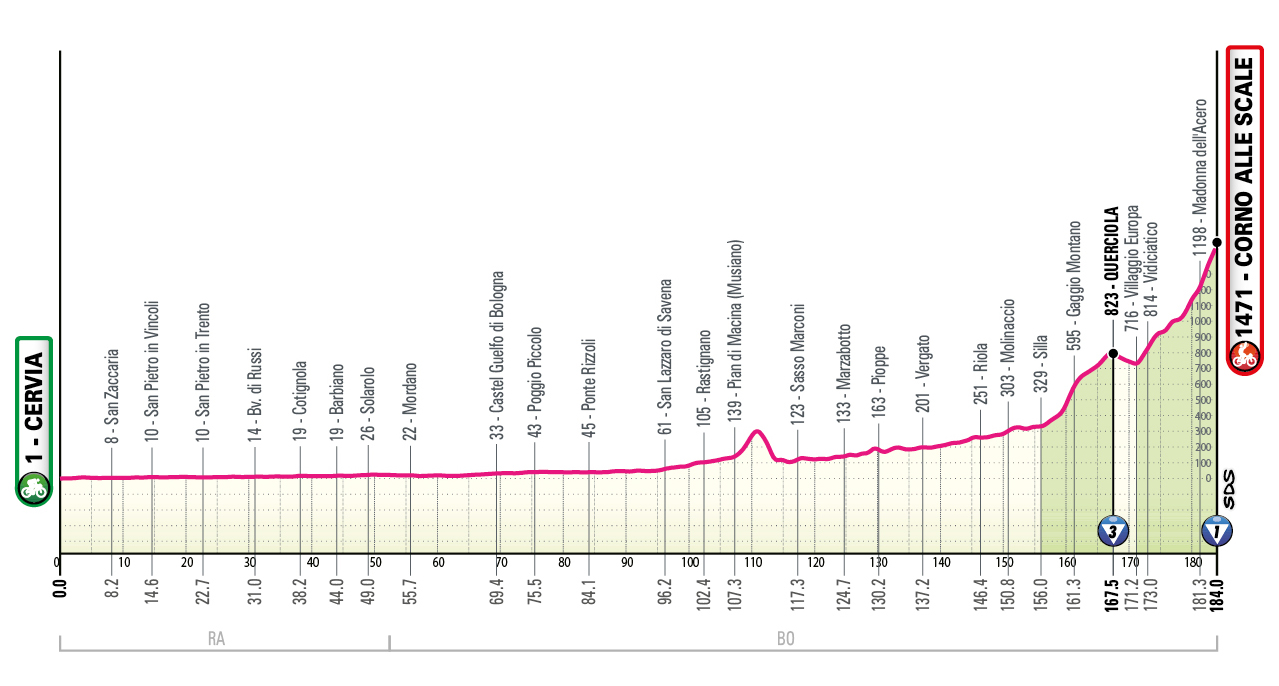
A summit finish? Yes, just a gradual one with a long but often gentle climb. The Corno alle Scale is the peak above, this is the road via Acero. It kicks up right at the end but this is the sort of finish where a sizeable group comes into the final kilometre together.
Stage 10 – Tuesday 19 May
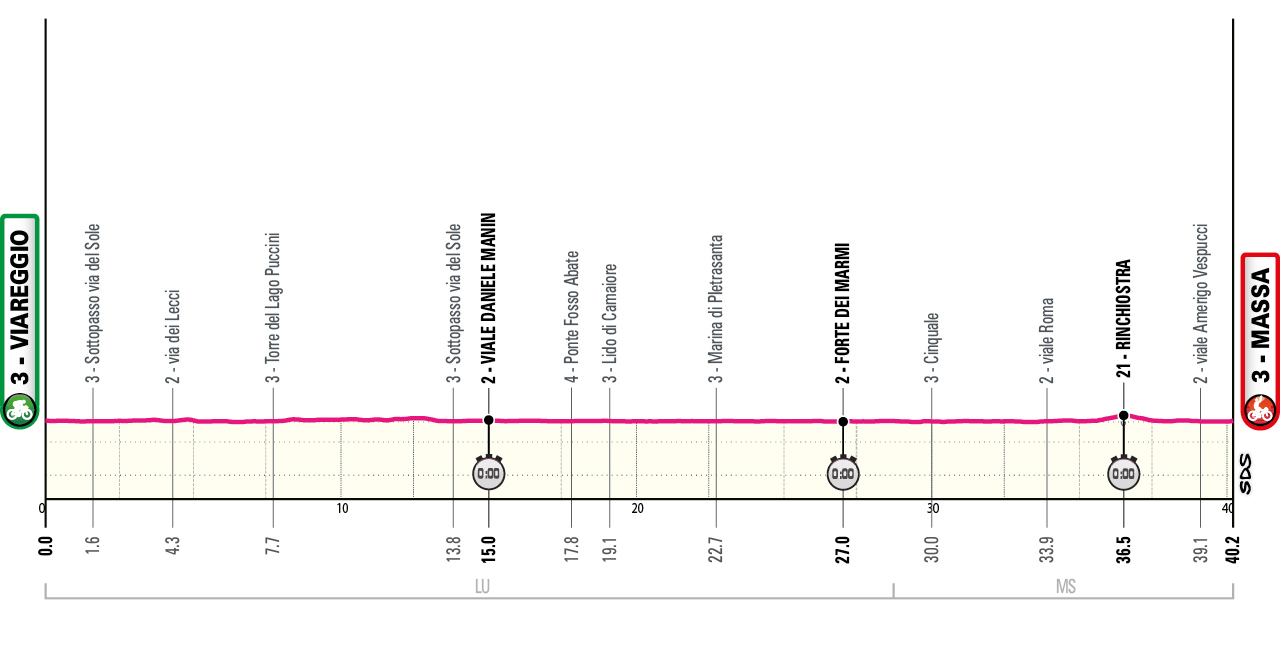
A flat time trial where the obstacles are the numerous corners to the first time check as the course stays in the streets of Viareggio. Then it’s along the coast to the finish. This is relatively long – the world champs are shorter at 39km – but as the only TT in the Giro, the thinking is that it might be insufficient to tempt Remco Evenepoel. Nevermind for organisers RCS who will be equally happy with a Ganna stage win.
Stage 11 – Wednesday 20 May
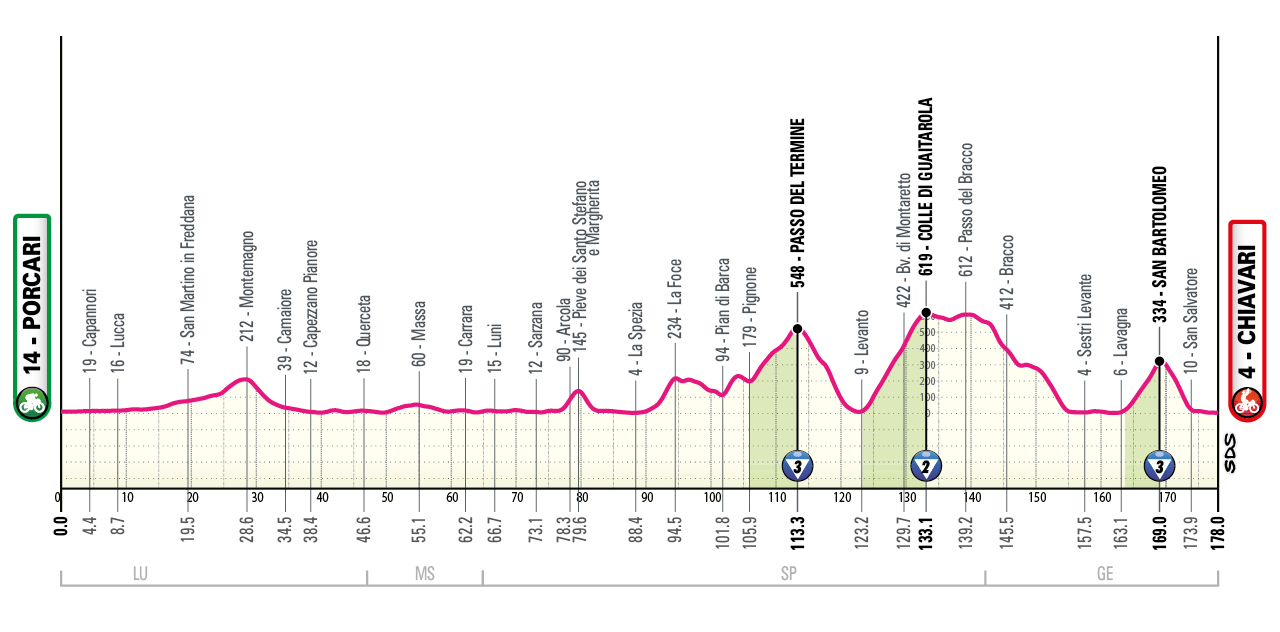
A ride out of Tuscany and into the hills of the Cinque Terre. The roads here vary, the Giro has often stuck to the main arteries but this time it’s got some smaller roads and they’re very tricky in places. The final climb is really to Cogorno and after winding up through the olive groves has some awkward 12% sections at the top. Plus a tricky descent straight back down.
Stage 12 – Thursday 21 May
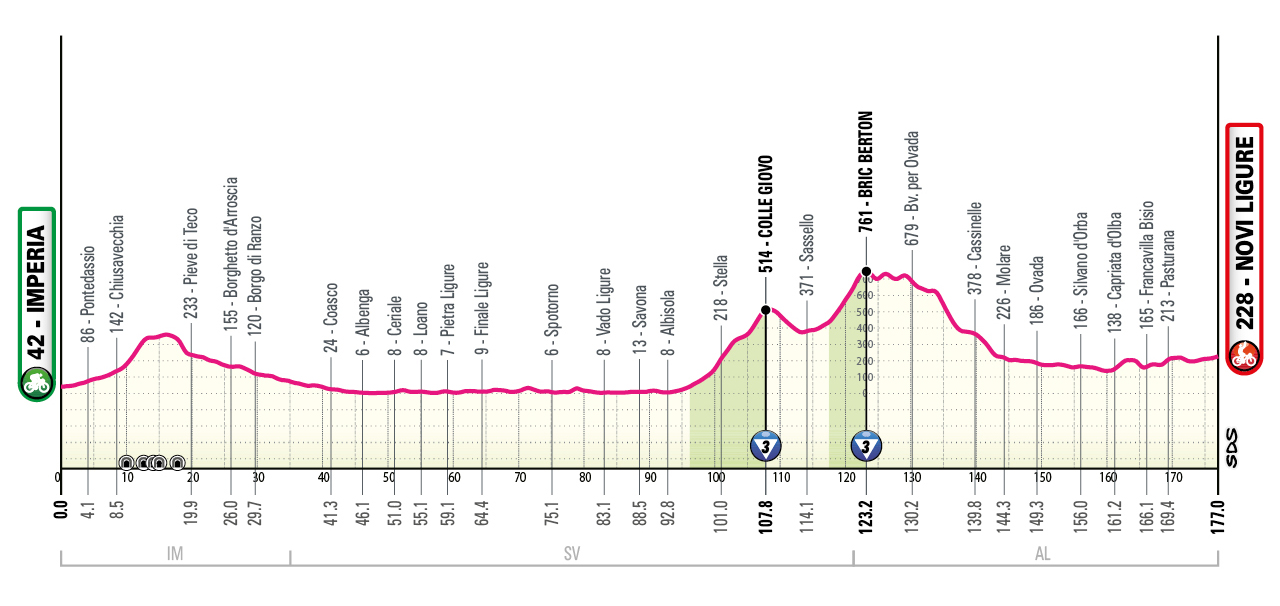
Not quite a reverse Milano-Sanremo but a start in Imperia and then taking part of the via Aurelia. The climbs make life harder for the sprinters, the Bric Berton has 4km nudging 7% but there’s 50km to regroup.
Stage 13 – Friday 22 May
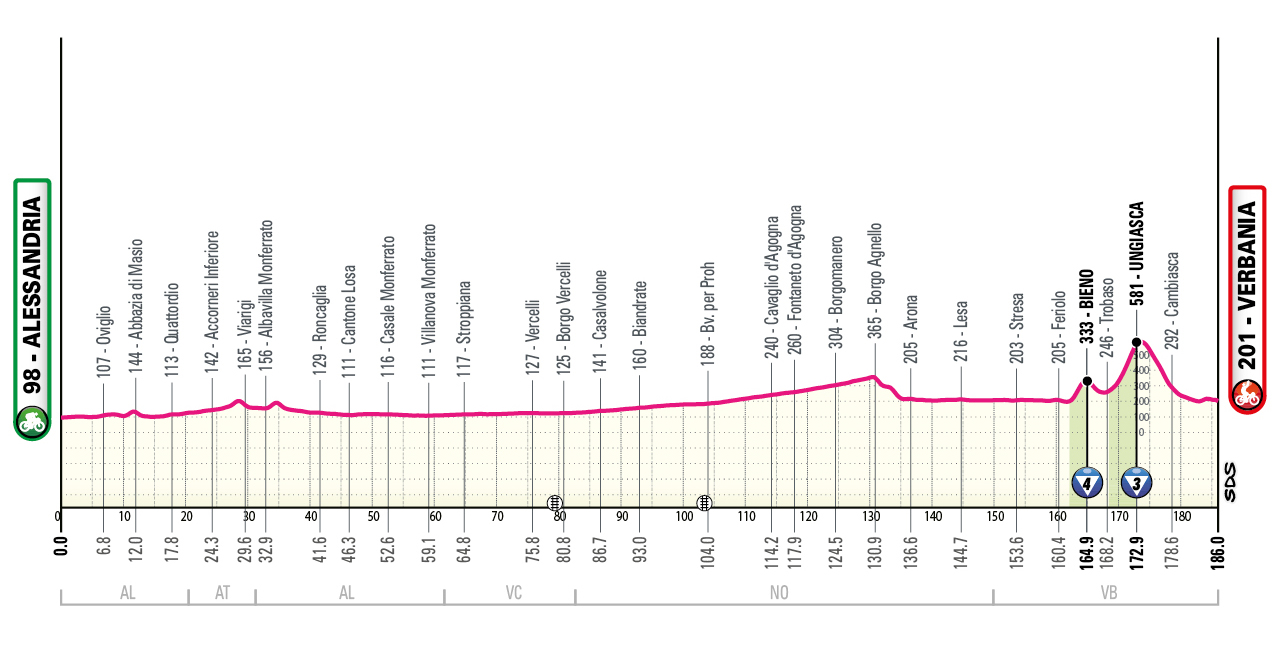
Two tricky climbs to thwart the sprinters in the finish. The local rider in Verbania is Filippo Ganna – or was as in he’s moved to Switzerland – so he might be interested but the course is hardly designed for him. The final climb to Ungiasca will sting as it tackles backroads.
Stage 14 – Saturday 23 May
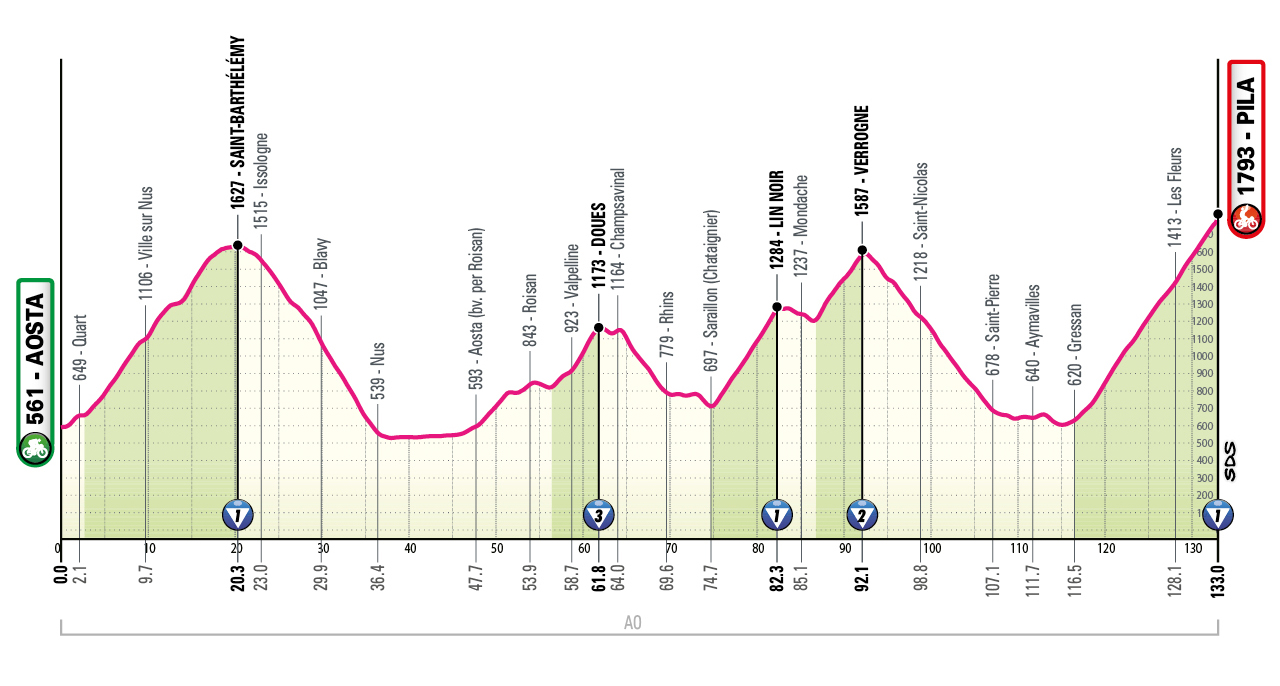
4,400m of vertical gain in just 133km. It’s on lots of familiar roads now around the vineyards of Aosta. One selling point of Aosta is you can get a ski lift out of the city to reach the slopes and it’s the Pila lift. The road to Pila featured in 2022 but it was a descent. It’s 17km at mostly 7% so think of a steady ski-station summit finish.
Stage 15 – Sunday 24 May
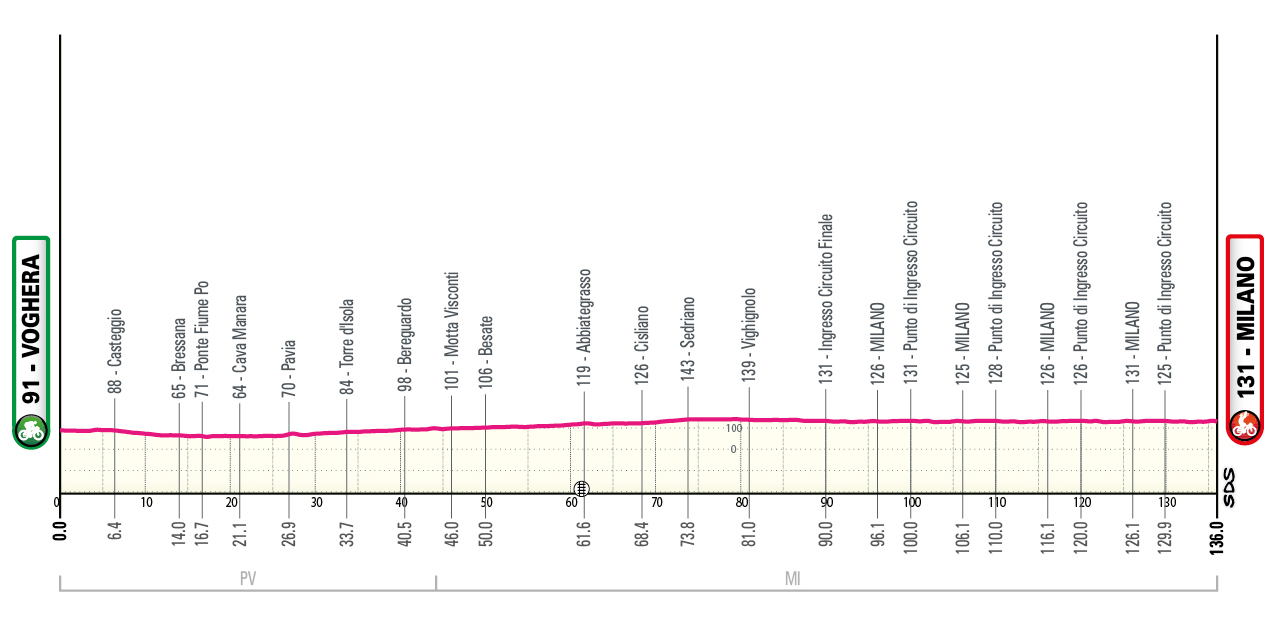
An urban interlude with the finishing hosting four laps around Milan but not the city centre, more towards the Vigorelli velodrome. As much as cycling is a rural sport it’s important to visit cities along the way too and good especially for the Giro and RCS to be back in Milan after issues with the townhall and the move of Milan-Sanremo to Pavia… which features here too.
Stage 16 – Tuesday 26 May
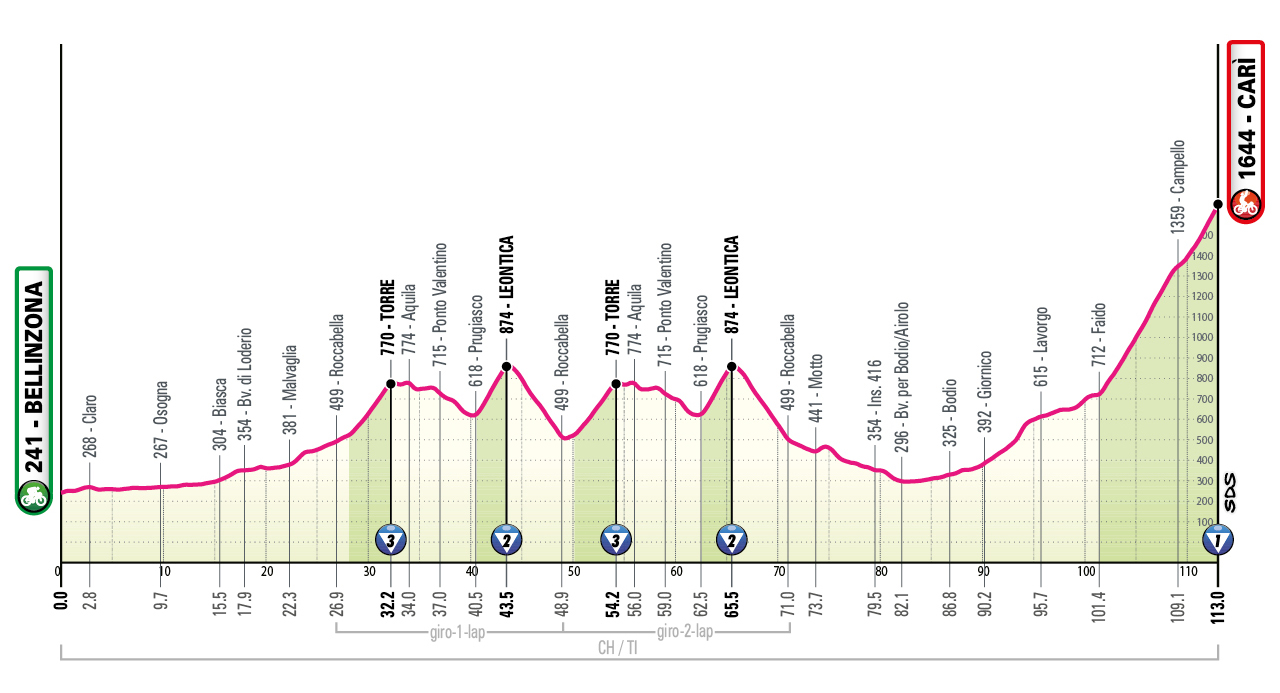
The race goes to Switzerland for a mini-stage, just 113km and crammed into a small zone too but still 3,000 of vertical gain and all on Swiss tarmac. The south-facing finish is steep with lots of 8-9%.
Stage 17 – Wednesday 27 May
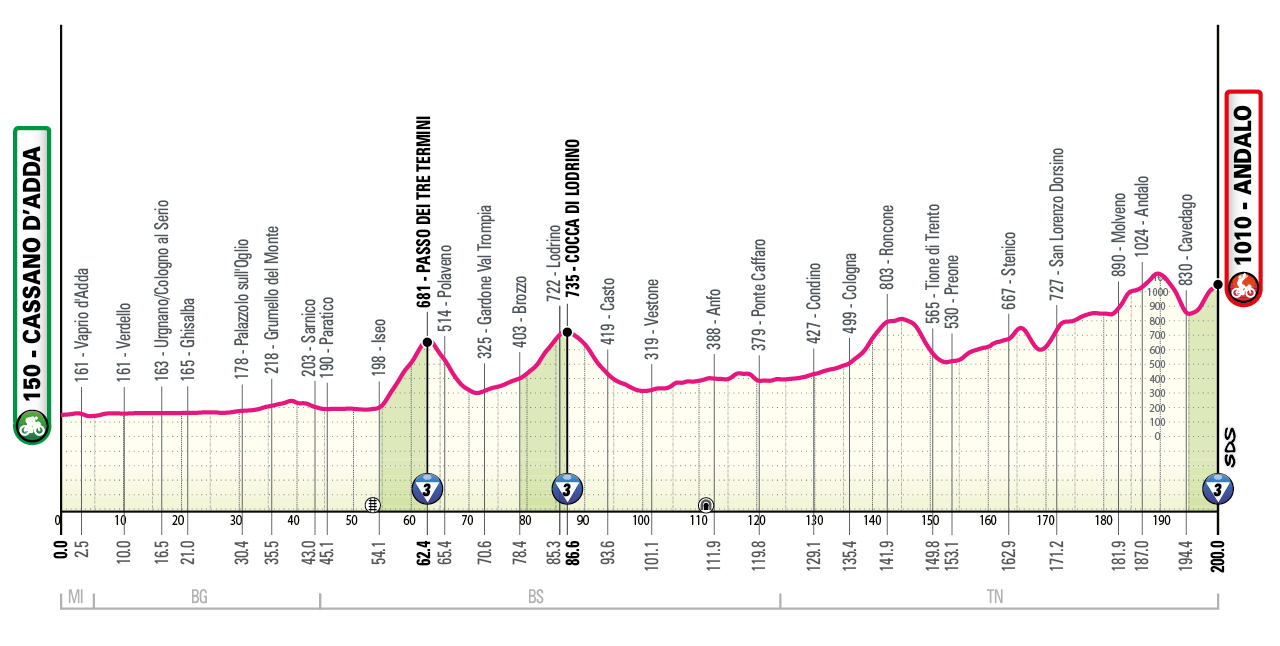
The breakaway stage, half the field should have this in their diaries as it’s open to plenty with a loop around Andalo below the peaks of Paganella which makes it a Dolomite stage or at least a finish but in geological terms more than the usual roads we associate this with.
Stage 18 – Thursday 28 May
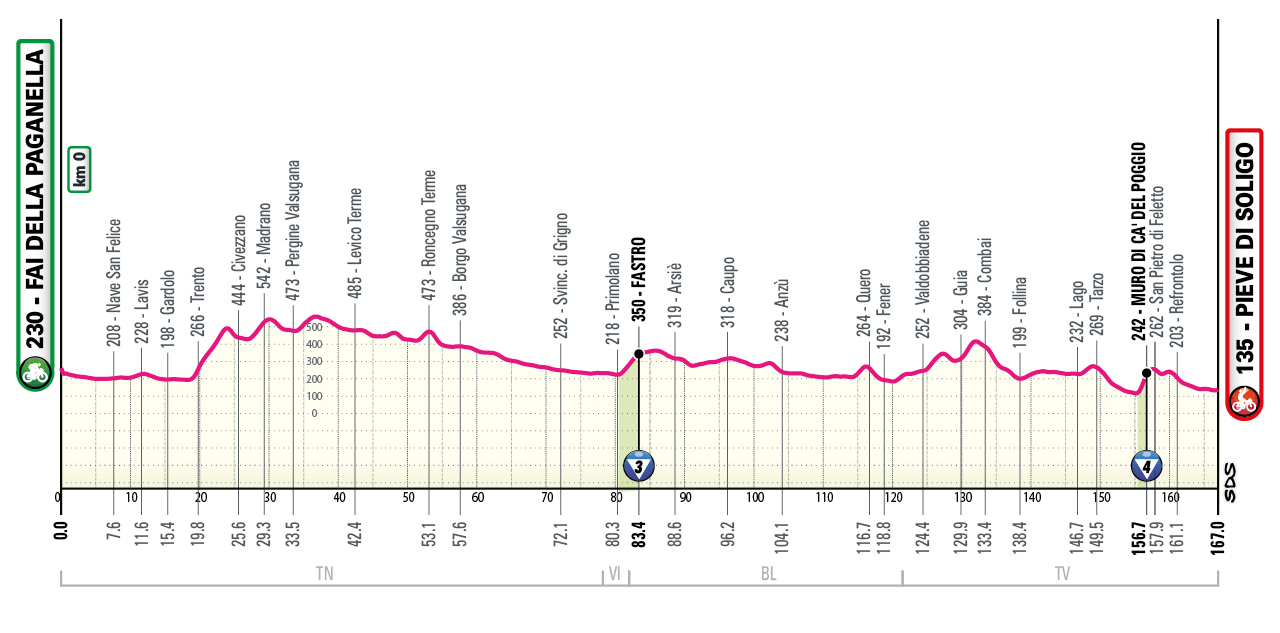
Didn’t win from the breakaway yesterday? A chance for teams to correct things if they missed the move and by now for riders strong in the third week to try again. The Ca’ del Poggio wall is a staple of cycling and always a good point for fans.
Stage 19 – Friday 29 May
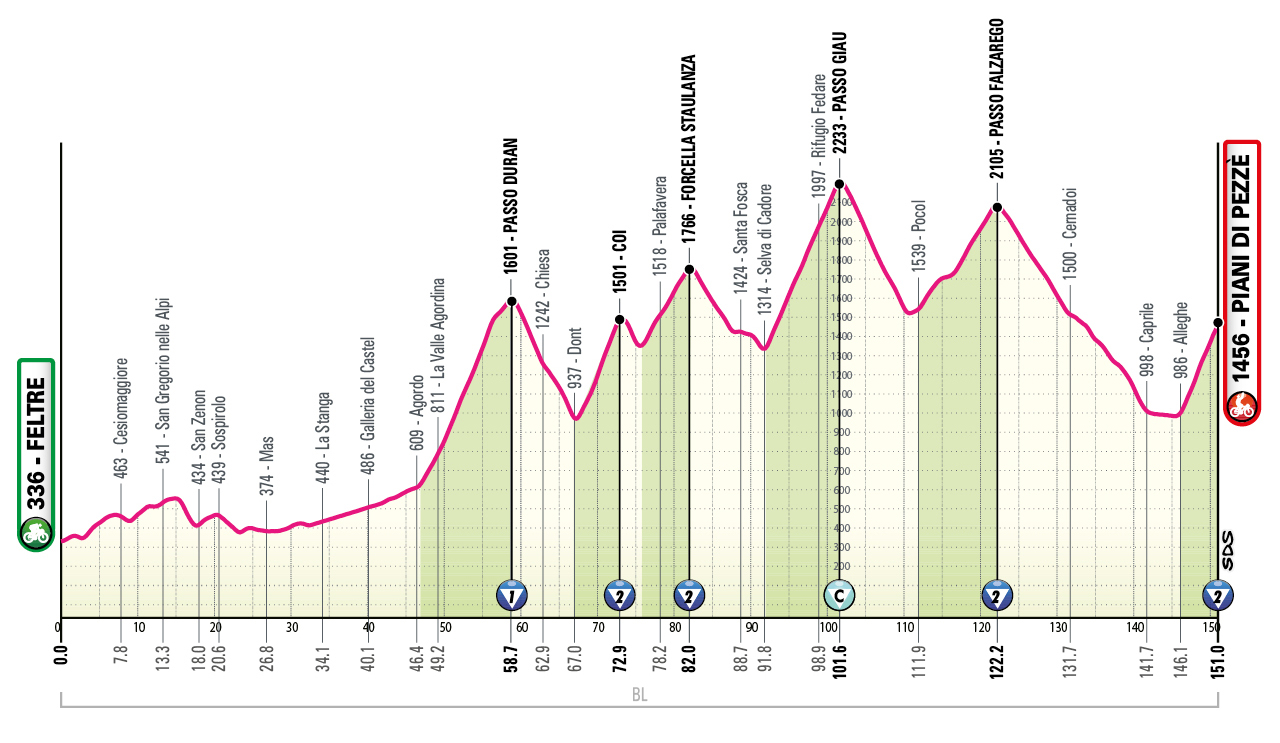
The tappone. No marathon in the Dolomites as this is 151km but there’s 5,000m of vertical gain via plenty of tough climbs in the Dolomites including the Giau via its harder side which, weather-permitting, is the Cima Coppi high point. The final climb is only 5km but 10% most of the way.
Stage 20 – Saturday 30 May
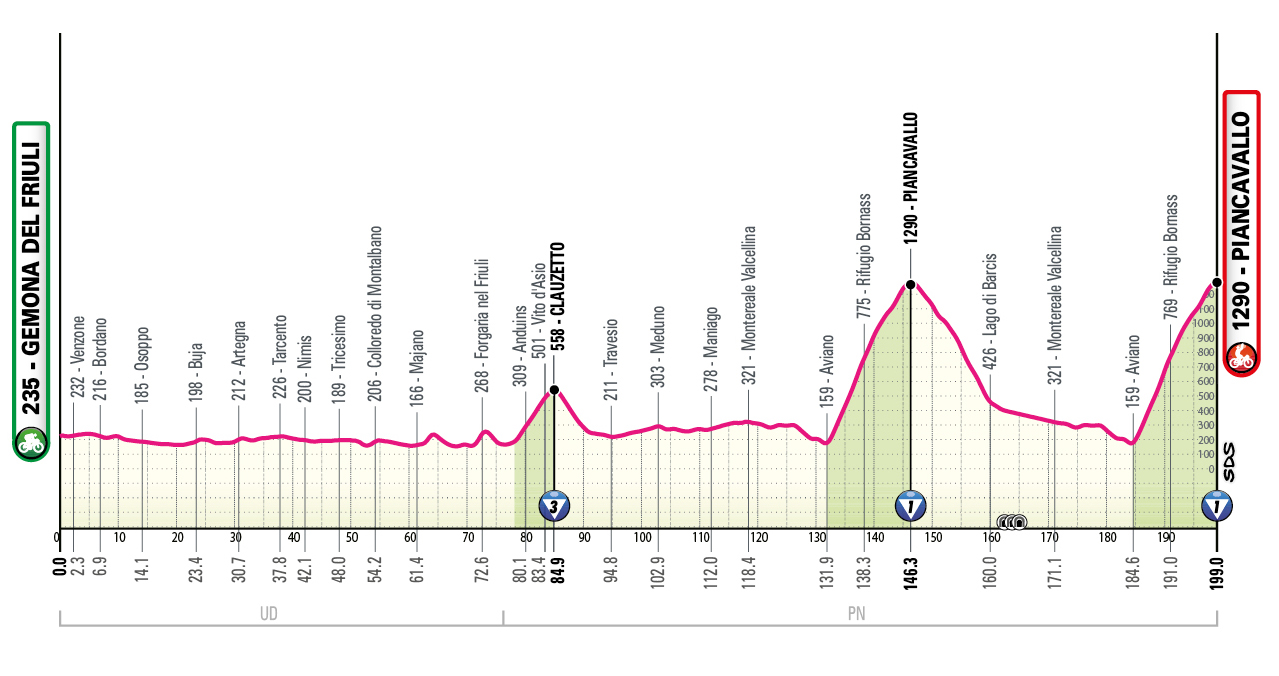
After a start to commemorate the 1976 Friuli earthquake in Gemona the stage is all about the double rations of Monte Cavallo. It’s a steep climb that’s often 10% and most selective at the start, but all on a wide road. It should make things marginally easier to control, especially for a stronger team.
Stage 21 – Sunday 31 May
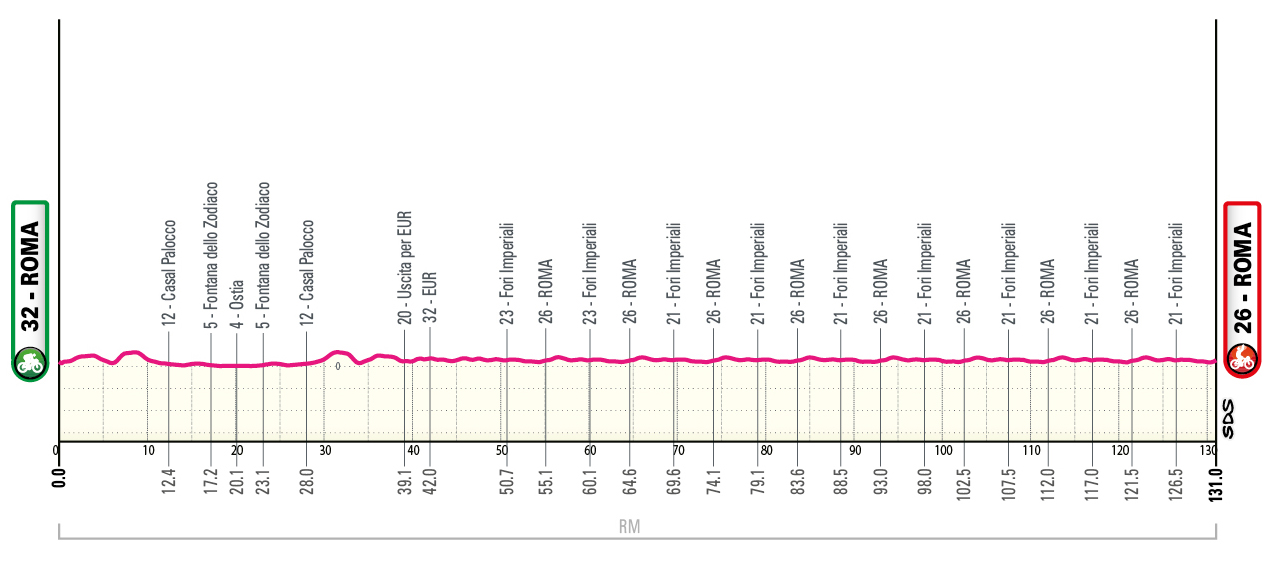
The final stage in Rome with the now traditional trip to the coast in Ostia, the return via Eur and before that, the 700km transfer to debate.

The Verdict
It took a marathon presentation long on speeches from middle-aged men and short on sporting details but the Giro route has been unveiled and with more time to spare than last time this year.
It’s very much a Giro route. If you did not see the map and could could view the the stage profiles stripped of their place names it would still be easy to identify but Mauro Vegni’s final route before retirement is neither swan song nor bucket list, it’s a more a handover that continues the trend of shorter stages which not long ago the Giro seemed immune to but now embraces.
Is it easier? When Tadej Pogačar got a route to suit in 2024 the course difficulty was pruned back, over 6,000m of vertical gain lopped off to make the Giro-Tour double easier. The appeal to Jonas Vingegaard this time is not as direct: 49,500m of vertical gain puts it within 1km of the average under Mauro Vegni. It’s certainly shorter as the x-axis shrinks more, the 246km Blockhaus stage is notable but the story is the brevity of the main summit finishes, 133km to Pila, 113km to Cari and 151km for the Dolomite day. It’s often more medio than gran fondo.
The average stage length is 165km, down from 179km in 2025 and 193km in 2023. It’s backloaded with mountain stages but less so than recent years, just three mountain stages in the final week compared to the usual four.
There are seven stages likely for the sprinters but some of these have significant climbs to get over and open up the day to a breakaway, all the better as this is a way to create sport and suspense. There are some likely breakaway days.
As ever the course seems to be one element when it comes to luring key riders, the other is wrangling over appearance fees as RCS offers a package to teams that varies according to who starts. As blogged on the evening of his defeat on Hautacam, it’s most likely Jonas Vingegaard will start. UAE will likely return with Del Toro and several others too but Vingegaard is already the obvious pick for pink.
oh well, yet another uninspiring and disapponting Giro course of the Vegni era. Not that I am surprised as I had no expectations whatsoever.
I can see your point, but at least this time it’s better than the TDF (…sigh…poor consolation).
The Vegni era anyway, in terms of course design, has had a lot of very good Giri: recently, 2019, 2020, 2021 and 2023 all had great routes, then the fact that things did not go as planned doesn’t depend on the original route (although I agree that it depends on Vegni for different reasons).
It’s absolutely true that the importance of chasing money “no matter what it takes” became more and more important in recent years: with a keen eye you could even detect what might have been the original ideas and how they were transformed. This didn’t make the Giro any better, as the desire to lure in Pogacar, even if that Giro was still better than 2022 or 2023 as a race, yet surely not a brilliant route.
Vegni’s first Giri (he was working on the courses even before becoming officially the race director, but let’s start from him being in charge) were frankly very well designed: 2014, 2015, 2016… I had my doubts about 2017 and 2018, when, once again, much was about getting a specific rider at the start (neither route was as terrible as 2024, anyway).
Out of 13 Giri, 7 had good to excellent routes, at least on paper; 4 were rather average (including 2018 or 2026 which would probably even deserve a slightly better qualification) and only 2022 and 2024 were that bad. Better than most could boast, especially as mostly what’s to blame is some historical process in cycling which happen well above what currently a race director can control (not Torriani’s age anymore, in case you hadn’t noticed – just ask Zomegnan or Acquarone if you have any doubt).
A small correction about the Bulgarian currency. By the time Giro visits them they would have moved to the Euro already (which happens next month on the 1st of January).
Noted, the peloton and media will appreciate the timing of the switch… assuming it goes ahead.
Albania saw a “lite” Giro exported for the grande partenza, less of the caravan and other parts of the show made the trip. Logistically sensible but it apparently felt like less of a party because of it. But like last year reading the Albanian newspapers the Giro got almost no coverage – “here are the road closures and parking restrictions” – and scanning the Bulgarian press online today there’s no news, even if the Prime Minister took part in the presentation in Rome yesterday (but haven’t trawled site, every page) but there are big protests in the country right now over the government finances.
Why wouldn’t go ahead? This things are in the work for years , it can’t be cancelled a month before, strange comment honestly.
A thousand times more likely the giro doesn’t start there , then the euro not being used.
Wow, respect if you made it through the whole presentation. It was terrible!
Old-style… but without the “style” part, word salad at its worst and a parody of a proper understanding of cycling’s potential (“territorio-eccellenze-turismo-territorio-economia-gastronomia-territorio”… have I said “territorio” already?). Longo Borghini was probably the most competent and fluent person there; next after her: Simon Yates, which says quantity.
A sense of general lack of connection with the sport, jokes and references were more often than not related to football and tennis.
That said, Vegni’s last Giro was in fact a swan song, only the sort of swan song you’d expect from him: great balance, understatement, fine tuning. It’s probably true that this time he pushed harder than other times in order to have things his way rather than as he was been asked by marketing geniuses or the property. The only stage which really couldn’t be as he wanted it is the Swiss one, he expressed regret in interviews because not only he wanted it to be shaped otherwise, but from his POV it should have been a totally different concept with a totally different weight in the race as a whole. The costraints imposed by Swiss institutions made it as we can see it now (not going out Ticino’s borders, not climbing high-passes). A mockery of sort by destiny that the stage now resembles a lot all of those way too modest “plan B” stages which Vegni used to bring up in case of snow or whatever. Especially in case of “whatever”. I call it the “2016 Tirreno EWP curse”. And this time the effect on the course is quite much akin to what happened in Switzerland in 2023, probably one of the lowest point ever in Giro’s history in terms of image. But at least we won’t see the riders filming from the bus how amateurs on supermarket bikes ride the route which they themselves couldn’t.
Personally, I think that’s a very good course. No need to say (as somebody always feels urged to point it out!) that this matters up to a certain point: the 2025 Giro had a course with many flaws but it turned out to be the best GT last season, unlike the TDF which on turn had a very interesting route, and yet…
OTOH, the 2024 TDF could be great also thanks to its course, just as the previous two which had in the route one of their strong points, whereas the course flaws, albeit not huge, were decisive in hindering the Giro in 2022 or 2023.
Speaking of 2022, it looks like that Vegni – perhaps inspired by the Eastern Europe partenza – went back there to give a second chance to a couple of very promising stages which hadn’t really worked that time, namely the Potenza and Blockhaus one. Both were made slightly easier, or apparently so, hoping perhaps that so we may get more fireworks. I think that the Blockhaus lost some strategic potential compared with the previous version, which really suffered mainly from the strong winds, not a factor you can control. Potenza, on the contrary, is clearly better, with the hard climb of Montagna Grande now not followed by any serious descent for some 25 kms, which might really become decisive if a team decides to exploit them. Trickier than having more climbs but way easier and with several descents in-between after Montagna Grande.
I guess Vegni also hopes that the Napoli stages might be as good (tough call!) but, even more important, he got back from that same playbook those “Démare stages” with only a climb mid-way through or even at the beginning… enough to have FDJ turning them into mayhem and a frantic team against team chase, even more entertaining as the pure sprinters who had been left back could actually hope to rejoin the peloton. Cosenza and later Novi Ligure might work like that (not sure about Sofia, it will depend more on kind of roads – which I don’t know – and the peloton’s attitude).
Generally speaking, this time around I appreciate a lot the good work made with potential sprint stages – which I had complained about in previous years due to lack of variety. Now 3-4 of them are dragster style (Sofia being the one in doubt), which is also fair. But then you have those 2-3 which I named above which might turn into a team arm-wrestling between resistant and pure sprinters (plus the break); and then again, as noted by inrng above, you get those with a bump in the finale which will have sprinters sweating hard and could also involve into the decisive fight some explosive clasicómanos type, think Veliko Tarnovo, Napoli, Verbania and Pieve di Soligo (each really with a different difficulty level, some might even require a degree of attention by GC men).
By the way, the four tricky stage aimed at stage hunters, be it from the break or with late attacking (no hope for sprinters), are also often promising in terms of a more or less slight GC potential for creative riders (barring maybe Andalo). Fermo is obvious and will be a marked one, Potenza less so but might be surprising, as explained above, the Tosco-ligure route to Chiavari would made the joy of a 2015 Astana vintage approach.
I also applaude the controversial decision of having 3 out of 4 Sundays in big capital cities, Sofia, Milan and Roma, although this means having poor stages and hence mediocre TV audiences. But this is a strategy actively deployed by RCS (steady average audiences as big stages happen on workdays – plus, the first and last Sundays normally don’t get a great audience anyway, unless you have an ITT on the very last stage) and what’s more important it gives value to roadside public and to the “big event” aspect of hosting a GT stage.
On the negative side, two Vueltish stage are too much for me, but I guess it’s because the Swiss stage coulnd’t be drawn as planned. Turning Corno alle Scale into a tricky mid-mountain option (very easy, indeed!) would have probably changed too much the balance desired by Vegni, making it a copy cat of the Muri Marchigiani stage the day before. Yet, it’s a pity, as Blockhaus will turn out to be a mono-climb of sort anyway (not that kind of climb, but ghosts of Gran Sasso looming around…!), and one more long tappone somewhere would be sorely needed. Once the Swiss stage had been scaled down, the most logical solution – I actually can’t understand it wasn’t done – would have been making the Andalo stage much harder, even more so as the following day there’s another relatively soft day. Probably this is the main flaw of the course, which lacks something in terms of very challenging mountain stages – not that they’re absent, but just a little more would have been better. Very Vegni, anyway. I suppose that it’s also about allowing Vingo or Remco to think about it without totally renouncing to any GC option at the TDF .
40 kms of ITT is really too little, but, ok, it’s useless to complain – on the contrary, the Giro looks like they’re doing whatever possible to minimally defend the specialty and its role in GTs. I find it sort of crazy that the industry cares so much about having ITTs with a separate type of bikes but then isn’t pushing, even injecting money if needed, in order to have those stage matter something! If I was king of cycling, I’d obviously go the opposite path, (a little) more ITTs… but on normal bikes.
Giro stages may not be as long as they should be but full credit to you gabriele for the length of this. 😉
Blockhaus stage would be better with a hill or two in the early parts.
I was thinking about making 3-4 separate posts, but… ^___^
I have to agree: 60-70km of ITT on normal bikes would be the way I would like to go. I don’t understand why lower level stage races do not insist on normal race bikes since it would sharply reduce the cost to the teams of participating in the race.
Stages three, four and twelve look intriguing on paper – but probably only on paper. Almost all the sprinters are likely to be dropped on the mid-distance climbs if ridden hard, but how many of the survivors with work together to prevent the sprint teams bringing their potential stage winners back into the fold? Such stages with potential often disappoint.
Even if the sprinters and their teams have to work for it then there’s still surprise and so the result is not the inevitable procession across the plains to the finish. Having a “pedal-able” climb midway to use the Italian phrase does open up the scenarios.
This year they worked great thanks to Lidl-Trek (or to Asgreen’s perseverance later on). A little less so in 2024.
In 2022 or 2023 they also worked very well in terms of entertainment, whatever the final result – probably among the few things which really worked great in those editions.
However, it’s of course about who’s at the start, team interests and so on.
You surely don’t always have the one-man-show kind of athletes who keeps the racing electric during the whole first half of a GT (or more) as Pedersen did this time, or van der Poel in 2022.
2019 and 2020, although both ended up being very good races, began with a rather dull first week precisely because of that lack of spark in the field.
I wonder if Mr Ring thinks this course is designed to entice Remco or Vinny.
My knee-jerk reaction is Remco with the long flat time trial and not too many multiple mountain stages.
But I guess there’s still enough climbing for Remco to have his usual bad day.
I think it’s adjusted to suit Vingegaard, the reduction in distances helps to accommodate the Giro-Tour double.
As much as Vingegaard needs some kind of mental reset and fresh focus, he’s still got to do the Tour de France in July. But if he wins the Giro he could find the pressure off a bit, being runner-up in July again would be seen as much less of a defeat if he could manage it, especially against others.
The talk is Evenepoel would like another time trial stage. If you were in his shoes you’d want this and probably even at the expense of a mountain stage to feel confident about the chances before starting.
Remco would always prefer more ITTs! But this is a long one that he can get the power down on and Vinny hasn’t been so hot against the clock recently. While Remco may want one less mountain stage to accommodate another ITT, I can’t help but think Vinny would prefer an extra multi high mountain climbing stage. We’ll see – but I’m sure Vinny will do this Giro as a palmares with all three GTs on puts him up with the greats of stage racing.
I think it’s for both of them. It’s not like Remco is generally that bad climbing. During the first half of that Vuelta he won, he regularly destroyed the field single-handedly on the last climb (three very different serious climbs) after 150-180 kms long stages with some 4K of altitude gain. Roglič 2022 vintage, Simon Yates, home-soil Mas, Almeida, Ayuso, O’Connor, Hindley, MAL, Arensman, Carapaz, Landa, Pinot… It’s more about what Kevin says about multiple mountains, which, as I noted above, have been reduced. Or whose forced reduction led to no proper substitution. Barring the Dolomiti tappone, it’s not a bad course for Remco, quite the contrary. Vingegaard’s got good things for him, too (short stages), but the totally flat and long ITT isn’t clearly for him, nor the relatively “light” final week compared to usual Giri (he grows stronger at the end of the three weeks, normally).
It’s a good mix for both with single ups and downs.
My knee-jerk rection is that Bora would be insane to do anything other than send their shiny new toy to the Tour with as close to perfect preparation as possible. I just can’t see Remco going to the Giro as such a long shot to win, as he would surely be if Vingegaard is there.
Yep, but the question was whom RCS possibly hoped to be enticing with such a route.
(I suppose that the route is just a further secundary detail, besides convincing the team, the sponsors, the athlete, his agent, his family… and paying the right amount, of course).
Red Bull have spent big and probably expect the team and Evenepoel to go all in for the Tour, plus internally the have other riders to give leadership to, think Pellizari and Hindley. It all puts a lot of pressure on Evenepoel but he’s signed up for this.
Evenopoel has no acceleration either in a sprint or on a climb. It is surprising how often he is out of the saddle given his size. Hard to see how any of this can change by switching teams.
His sprint used to be consistently useless with no acceleration, yes. But no longer and not for a couple of years.
Agreed. I think we’ll see Rog and Pelli at the Giro and the a full team(no dual leadership) behind Remco at TDF with Hindley as climbing domestique. But then what to do with Lipo? Vuelta ? That’s a tough ask if Pog goes. Either way a good problem to have.
I think Lipo is their best GT rider. Eve is flaky; Rog is too old.
We’ll see for Roglič, he’s said to be looking at a “farewell tour” season. He’s won everything except the Tour de France and the Tour de Suisse, so Suisse is probably the more attainable one although the much reduced format next year means it’s not what it was as a goal.
Much reduced format? Please elaborate!
The good news is the women’s Tour de Suisse goes up to five days, the bad news is the men’s race goes down to five days too. It’ll be a Wednesday to Sunday race next year, a pity for a race that has been one of the major stage races on the calendar after the three grand tours, and with some beautiful roads too, held in June which often looks spectacular.
I keep wanting to write a small lament about this as it’s significant in several ways… and so probably will, but it’s not an urgent topic.
Wow, that is bad news. I’ve always felt like the difference between five days and a week or more is pretty significant. I don’t have any data to back that up, but it seems like the longer the race, the less flukey the results are likely to be.
Despite all the reservations on the route, this year delivered and, given the air leaving a balloon last TDF week, was the best grand tour. Love to see this as a changing of the guard GC, but think the young guns will be at the Tour looking at the third step of the podium. 2027 maybe though, eh
Did this year’s route deliver? The final Saturday was great – this blog will pick some highlights soon, it will probably feature – but until then was the course good? Like previous years many seemed to be watching and waiting for something to happen.
I’d say the racing was frankly good, with the usual occasional disappointment on some stages, although not all action eventually comes down to big impacts once the dust settles.
Even if the former finally didn’t play a role in high GC, Bernal and Carapaz racing aggresively generated events and promising situations in stages where, on paper, I’d have said nothing was going to happen at all, think Bormio or Castelnovo ne’ Monti, in both case a lot of strategy and different actors came into play, plus in both cases also the finale as such was exciting, notwithstanding moves having begun well before.
The two main tapponi, Sestriere and San Valentino, delivered big time, just as the Strade Bianche.
Lidl-Trek and Mads on fire made for an entertaining first week, especially stage 1 or Matera, but also Vicenza later on. Nova Gorica was also much more exciting than one could expect.
Castelraimondo didn’t offer GC action, but the fight for the stage win was top quality for hours. Some 10 good quality stages with tension and action building up well before from the finish line is a high benchmark, to me. “Only” 5 of this top quality stage involved GC action, but, OTOH, you had GC interest on some “more normal” days, like ITTs or Marsia, a total of 8.
In fact, no need to chastise the simply *normal* stages; as said, the 2 ITTs being ITTs (some might appreciate Pisa more for the rain factor, some instead won’t like it as much or simply don’t care, but… whatever! I liked the Tirana one, short but with technical features); the first uphill test in Marsia being just that; plus, the 4 flattish sprint stages granting the corresponding bunch sprints (honest, not too many, not too few); Denz doing a Denz where due.
Finally, to me just 3 stages were a bit of a disappointment, albeit predictable, to a certain point: Vlöre, Asiago and Champoluc. We knew what might not work – and it didn’t. Not much of a fuss, I’d say that three stages not delivering is decent rather tragic.
I wouldn’t be so sure as you are… I had the impression, like Inrng, to wait most of the Giro for something to happen, and even on this last bloody Saturday, I still wait for Del Toro to do something to save his pink jersey (isn’t it important to FIGHT for Pink ?). In the TdF, I can understand those who says nothing happened, and the end was boring (even if I liked the battle for minor places, from 3 to 10), but it seems that stages like Boulogne, Rouen, even Viré Normandie before Healy’s attack, and above all Toulouse, (which for me is the best day of racing of the year) had no real competition in another GT (most of it because of startlists). As usual, I can understand your position, but I don’t agree with the way you say it (“I’m telling the facts, you can’t contradict me or I will write 50 lines to prove you’re wrong” 🙂 ).
I thought the first two weeks of the Tour de France were great. Unfortunately, the last week was less good, partly due to rider fatigue and partly due to Pogacar being slightly injured. The last week, I think, slightly affected our judgement of the race.
I guess it’s about expectations. I didn’t expect anything different from hard fighting within the break in a couple of Giro stages which surprisingly even had sparks of GC action from very far out. On the contrary, I expected more from Boulogne, Vire Normandie and Toulouse, even if they were far from bad. So they end up in the “normal to fine” category. Rouen was excellent, indeed, and I also liked Hautacam, Superbagneres even (not as good but very interesting despite the anticlimatic finale) and the very last Paris stage.
Generally speaking, to me the TDF – including the first weeks – lacked more authentic action among the GC top figures, especially compared with previous years. Surely the intensity of competition in the breakaways was always high, but that’s fine to keep up the interest in 3-4 stages, yet a 20-person-a-day cycling race can’t be the main course in a three-star GT meal.
All that in less than 50 lines!
Probably we had more total GC emotion in the Dauphiné – which says it all in a single line (or two, depending on screen edit)!
I’m proud of you Gabriele 🙂
As you say, we all have expectations bias. I didn’t expect any GC competition in the TdF anyway, and I had pretty high ones for the Giro. If only Carapaz could have dropped Del Toro in the Champoluc stage ! We would surely have a nice stage the day after (but would Prodhomme have had his gigantic season after ? 🙂 )
It’s been all about Vingo since he obviously couldn’t do anything to put a chink in Pog’s armor at last year’s Tour. Then when he won the Vuelta it became all about completing the set. I don’t think this route is especially good or bad for him, but if Pog’s not there it shouldn’t matter and Pog’s got his own agenda that definitely doesn’t include the Giro. For me the only question is whether any of the UAE guys can compete. I don’t think this route is bad for Del Toro, with the possible exception of stage 7.
Re: Del Toro, big question marks also on the ahem “long” ITT and the Dolomiti “not-marathon”, which, albeit short, looks like a different beast than say even the Champoluc stage this year.
As I wrote above, it’s really a balanced route, and as such it’s quite good for any strong, solid three-weeks guy. However, I quite much agree about that being irrelevant if Vingo’s there to win and Pogi isn’t, unless something has changed in relative strengths, which we have no hint to conjecture anyway.
If anything, it’s not great for the fondo very specialists, the Carapaz, O’Connor and… dunno who’s left in the category, which faces hard times in “modern” stage racing (Hindley? Almeida?). But it doesn’t matter much precisely as whatever specialism falls behind against overall athletical superiority. Obviously this sentence is the premise of one of ’em winning ^___^
I hope some of the stages turn out to be harder in actuality than they look in profile maps, as there’s really only one stage that looks like a properly difficult multi-mountain stage. (Though I shouldn’t even really care as I won’t be able to watch it, having ended my TNT Sports subscription due to their massive price increase in the UK.)
If I had £10 for every Giro stage over the last few years with a fairly innocuous climb in the middle followed by a sort of sprint finish, I’d be typing this from St Tropez.
A few added details:
– the so-called Monastery Pass on st. 2 is probably steep enough to force some interesting selection, Liège-style (with not as much total altitude gain of course). 3km x 8% max 14%. Less than 10 kms to the last uphill 5% km.
– Hard to imagine any hard selection on st.3, maybe some chasing but should be a big sprint.
– Rionero – Roccaraso are closer and harder than they look on the official profile; without a subsequent descent they can be made a significant tactical variable, although a strong and dedicated team is needed.
– Fermo should come down to the last 10 decisive kms, even if the first passage through Fermo should include a hard short wall 25 kms to the line.
– Crazy preposterous non-sequitur ideas… Remco (who won’t even start ^___^) attacking alone 30 to 70 kms from the finish in Andalo, all slightly uphill false flat terrain where he just rides everybody out of his wheel out of mere power to aero advantage 😛