

Sponsorship has flooded in, team budgets expanded, rider pay soared and real gains have been made in safety, ethics and institutions. Today riders enjoy longer contracts while teams have become multi-decade franchises, some are even outlasting their founders. And yet…
Pro teams are brittle, what looks strong today could snap tomorrow. First EF the other day and now Visma-Lease A Bike are reportedly looking for new sponsors. Others are having doing the same in private.
Once upon a time
Cycling was a cheap sport. It offered big returns on investment, a sponsor could enjoy publicity that would otherwise cost much more to buy elsewhere, whether in other sports or in planned marketing campaigns.
It was a bargain because it was risky. “Investing” in cycling was cheap in the same way buying the debt of a developing country caught in a currency crisis is cheap. Plenty of brand managers opted for tennis or billboard campaigns instead.
Today
Pro cycling isn’t the darling of brand managers, in fact they’ve often been outbid by nation states and billionaires. The sport is no longer cheap. When he founded the Française des Jeux team Marc Madiot said when he was an épicier, a shopkeeper, and now he’s stepping down from a multinationale. Lidl-Trek has a staff close to 200 from coaches to content creators and it’s not exceptional, when the Arkéa-B&B team folded last year owner-manager Emmanuel Hubert said he had the grim task of informing 150 staff.
If you prefer data, the UCI collates all the team budgets and this leaked to La Gazzetta (€). The total for the 18 men’s World Tour teams went from €473 million in 2023 (average: €26m per team) to €663 million for 2026 but note this latter number is for 18 World Tour plus applicants Cofidis and Pinarello-Q36.5, (average: €33.1m per team). That’s 27% per team in four years, or 6.5% a year. 2023-2026 is not exceptional as high single digit and sometimes double-digit increases have been ordinary for the past 15 years.
In many ways this is great, more money flowing into the sport looks strong: if you want a crisis, imagine the opposite. A 27% rise is great if you’re a rider or an agent as the bulk of this uplift goes on athlete pay. But otherwise it’s just an increase in costs. The sport has not got 27% more exciting, the calendar is not 27% bigger, audiences haven’t grown by 27%, TV rights are not worth 27% more. It’s largely the same sport, only suddenly more expensive.
- Note: there are more hours of women’s racing on prime time but this is a separate spending category rather than more for existing money and if there are inflationary concerns too, there’s is big growth in audiences, calendar and more.
This where the problems stack up. Marc Madiot’s successor Thierry Cornec has to go to FDJ and Groupama and ask them to renew sponsorship for a team with a budget of about €25 million when it was €15 million not that long ago. If they pay more what extra do the backers get in return? It’s not clear, and maybe they’re still happy with the deal. Similar conversations are happening across other teams.

Other talks have reached a different stage, EF is now seeking a co-sponsor and while this is being spun as an opportunity to join the team, if no prospective partner emerges to share the costs then you can imagine EF being unwilling to fund the team if loses ground to others.
Now Visma-Lease A Bike is reported to be looking for a new title sponsor. The language is similar to EF’s appeal, with talk of taking “the next step” but what it really means is just being able to keep up with rising costs. More money is needed just to stand still. Although if there is a corporate, sovereign or billionaire who wants to go large then… it raises the bar for other teams to match.
This blog is due an updated version of last year’s Race For Survival post and rather than catalogue concerns team-by-team, the topic here the collective challenge of teams having to ask sponsors for more money only to deliver the same.
It’s this inflation rate that is destabilising. Imagine being the marketing manager or on the board of a potential team sponsor. You’re thinking of backing a team and if the entry price is €20 million today then it means you’re potentially going to have to pay 10-20% more soon just to stay still. Your €20 million ticket buys you mid-table status with a shot some glory in July included but what chance this sum funds relegation fodder in 2028? It is a hard sell to sponsors already worried about injury risk and other perils of sports sponsorship; and it can’t be easy for some nation state backed teams either; nor billionaires as we’ve seen with Ineos.
Another viewpoint to see how expensive sponsorship has become is the pipeline of teams and sponsors wanting to take part.
As we’ve seen recently it’s already not obvious who to invite the Tour de France, there’s no surplus of competitive teams in the second tier. Indeed there are only 16 ProTeams in the second tier of the men’s sport compared to 18 at the top, just seven in the women’s Tour compared to 14. Normally a pyramid-shape would be healthier as teams compete to reach the top.
Today Tudor and Pinarello-Q36.5 are waiting to take the place of any World Tour teams that fold. But beyond this? It looks barren. See Alpecin’s search for replacement for Deceuninck and despite the allure of Van der Poel it “only” got PremierTech, and presumably in part because of internal ructions in another team; likewise Ineos’s search for a sponsor brought them TotalEnergies. Cannibalism is rarely the sign of a feast.
What to do?
The UCI is launching a consultation. Which doesn’t sound like much, but it is the start of a process and the scope could be radical. The screengrab below from the UCI’s letters to teams and organisers yesterday frames some of the issues:
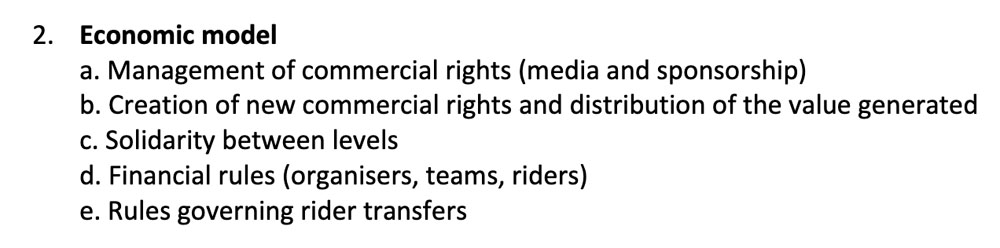
Each points is potentially substantial, and a minefield. Remember talks on team budget caps broke down last year and surprisingly it wasn’t just the big teams that cratered them.
Rather than waiting for the UCI, teams confronted with this need a coherent project more than ever, and they know this. As proof it’s not all doom and gloom, see how Decathlon has bought the team off Ag2r and the prospect has enticed CMA CGM to come aboard.

Conclusion
There have long been big differences among the teams, a decade ago BMC and Team Sky had more resources than IAM or Dimension Data; a decade before that CSC and Phonak outspent Crédit Agricole and Lampre. The gap between the top teams and the rest has been persistent issue but it is widening. And over time budgets and costs have risen. Much of this is to be welcomed, riders enjoy better pay and longer contracts in part because scandal and the memory of it has faded, while teams are responsible for coaching their own riders while logistics to public relations have been modernised.
But the rising costs have been inexorable. Budget inflation is putting pressure on teams and their sponsors in all directions. Rivals are dominating in a winner-takes-all domain, yet the losers in this scenario are expected to pay more to continue. It’s this that makes pro cycling a more expensive proposition and is starting to put the squeeze on.
Teams are now going public about seeking extra sponsors which implies discreet approaches so far haven’t worked; their peers are probably knocking on the same doors. We’re starting to see some cracks appear.
Last offseason there were several discussions of whether Pogi was “good for cycling” or not. At the beginning of 2026, I would ask the same question about UAE as a whole. If one team is in a hegemonic position, it doesn’t look like a great proposition for new sponsors to jump in the fray. I’ve enjoyed seeing the way Lidl, Decathlon and Red Bull have beefed up their respective teams, but it feels like everyone except the very few are fighting for scraps.
The list IR shared in this article is a good sign that the UCI understands the peril, but we’ve heard all the talk before. Ultimately, it’s still ASO’s game and it will be difficult to try to wrest economic power from their grasp. I hope some kind of change can happen, because we all want to see a competitive peloton and potentially having interesting teams like EF and Visma fold would be a huge loss.
The key thing to understand is that ASO organise the Tour on behalf of the French government. They spend most of their time liaising with local and national politicians ensuring these key stakeholders are happy with the arrangements. Most of the costs of the race are underwritten by the French government. The French government makes particular demands on ASO, one of which is free-to-air broadcasting. ASO are allowed to make a small profit from running the race. Aside: The lack of free-to-air broadcasting in Britain is because no broadcaster wants to show the race.
There is zero chance that the French government would ever be happy with Plugge and One-Cycling running their race. Or allowing them to make large amounts of money at the expense of the French taxpayer (by, for instance, selling the TV rights).
ASO make more than a small profit from the Tour, another blog post to do soon here is a look at their accounts.
But as you say it’s a sort of public good. Plus as wealthy as the Amaury family, it would be form of reverse redistribution to use ASO’s profits to pay out teams funded by states, billionaires and corporate multinationals.
The profits ASO make from the Tour are, I agree, rather difficult to decipher. And they cross-subsize their other cycle races (some of which they saved from going bust); several of these these other races likely make a loss. They also run non-cycling events, where their profit margins are thought to be higher.
‘ Aside: The lack of free-to-air broadcasting in Britain is because no broadcaster wants to show the race.’
That’s not the story according to ITV, who had been covering the race in full for decades. It seemed to be bound up with the transfer to international paying channels, and they couldn’t do a deal which they could justify ( day time TV doesn’t bring in much ad revenue in the UK.)
That’s the same point expressed differently, isn’t it?
No free-to-air broadcaster in the UK want to show the race *at a price which the rights owners want to sell them for*
(although apparently S4C are still in discussions about the Welsh-language rights)
I read that the pricing of the FTA broadcast rights for the UK is not the problem, given there is no competition. It is the lack of revenue making it a viable use of production resources and air time.
It needs a more courageous streamer to shake up the market and offer an alternative to the legacy TV networks.
“Cycling … offered big returns on investment, a sponsor could enjoy publicity that would otherwise cost much more to buy elsewhere.”
The cost of sponsoring the team should rise until the return is the same as the return invested elsewhere: publicity should not be sold ‘on the cheap’. We are now getting to the efficient market price of sponsorship, with teams (and riders) earning more money. This is a good thing. Part of the way this is achieved is that old teams which don’t pull in the money are replaced by new teams with more sponsorship money behind them. This is tough luck for Plugge and Vaughters, but their whinging should be ignored.
The key fact to understand about cycling is that the teams are replaceable, but the races are not.
Aside: The key problem, in my view (touched on by Inner Ring) is that the domination of the world tour means there are fewer 2nd tier teams concentrating on their regional races, and bringing a lot to the sport of cycling. For example, the last Belgian Division 2 team is likely to discontinue at the end of the year.
I’m not sure there’s a market pricing here. As the likes of UAE or a billionaire will outbid the actual market value of a commercial sponsorship proposition and why we have a lot more of these than, say, 20 years ago. Also if this is the market with these participants included, the problem being raised in the post is what’s coming down the tracks where sponsors are thinking of pulling out, ie it’s fine for a few to keep funding this but it’s becoming too expensive to participate for others so the price is starting to bite.
That’s really the point, right? If it really was left up to the market (that is, not considered a public good worthy of spending taxpayer money on), the sport as we currently know it would collapse. It already has in the US. So I think it’s important to tweak the business model to keep it functioning going forward. For me, losing the JV’s and Plugges of the world and keeping whoever is behind the UAEs of the world would be a terrible result.
The French/Italian/Spanish government believe that getting people to view the race is a valuable marketing tool for their country (and region/locality). This is why there are all the TV shots of the places the race paces, and lots of info about local food etc. And why these governments insist on the show being on free-to-air television since they want to maximise the number of people watching the race/advert.
If Plugge gets replaced by Cancellara, will it really be a problem? The best riders will still be riding the race, just for a differernt paying agent.
@The Other Craig. Why should it be so important that the business model of the sport separates itself from being considered a public good? It’s always been a substantial part of it. As for most sports all over the world, but in the case of cycling even more so as it can’t be properly practised without public infrastructure and support, unless you want to imagine some grotesque version of it.
So I’d say that what’s really important is not as much to tweak the business model as, rather, to keep as strong as possible the feeling that cycling is actually a worthy public good! The business model, as shown above, looks relatively steady, whereas the second aspect is much more at risk.
Sidenotes: not an expert, so maybe I’m way wrong, but how would the NBA or NFL grow talent without a broad system of universities, several of them public? Are the teams really paying institutions for all the value and costs implied in keeping such a broad formation and selection system working? Including the mere fact that human resources which don’t get to pro sport aren’t simply discarded as waste.
Aren’t baseball teams counting on significant resources due to urbanistic value of their venues, which is heavily dependant on city planning?
In Spain and Italy the latter is normally true for the teams based in big cities, which, by the way, are really the only ones producing economic value. The others survive only as they’re part of the system and receive a share proportionally bigger than what they’re worth of.
The whole Olympic thing wouldn’t collapse if States didn’t throw heaps of money in it with negative economic return?
Normally when a sport boasts a great business model, it’s just that they achieved that somebody else pays big externalities for non-strictly-economic reasons (general rule in capitalism, great business model normally equals having somebody else paying what you ought to, or placing costs on future generations, or simply robbing resources etc.)
Tennis ia maybe a partial exception? …which is perhaps why their business model includes small players selling matches for the betting market 😛
Spain and Italy = for the *football* teams
Gabriele, I think you misunderstood what I was trying to say. I actually think the public/private partnership in cycling is great, and it’s a lot less exploitative than the ball sports examples that you point out, which tend to take public money to make billionaires richer. I was making more of the point that I think you were making in another comment, which is that it’s becoming more difficult to compete on a level playing field. It’s kind of like having a semipro football league that’s supported by the community, then having a giant professional team join the same league. If the resources are so disparate and only a few organizations thrive within the system, I think the system should be tweaked. I wish I had an answer for how to change it to spread the pros and cons of the sport more equitably, but it’s above my pay grade. I just don’t want more countries to experience what we have in the US, where not enough people see a benefit to make the necessary sacrifices to make the sport work. I know this is unlikely to happen in some European countries, but we’re already seeing weird name changes for races because organizers are so desperate to find someone who will pay to make them happen.
I’m not so sure. The kind of situations is similar. Astana and Euskaltel represented national projects, and we should add FDJ which was back then public, not just State-owned. Today we have Astana, UAE and Bahrain. We may add *hybrid* situations like Illes Baleares which was public money on a regional name but we can also see the commercial side of it beside the political one (remember that in Spain «nations» and «nationalism» refer to what we’d consider regional identities); or T-Mobile still owned by Deutsche Telekom which albeit privatised was still partially controlled by the State both as an owner and through personal relations between management and political powers. A bit like Movistar today. Only, we now know also that public universities had been working on the a-hem «sport science» side of the team, which strengthens the national aspect well beyond Bahrain & C.
Lampre and Phonak may have had a commercial name but they were totally sugardaddie teams, like Jayco or NSN now. Coucke’s different pharma brands responded to the definition much more back then than in recent times. And dunno what to say about CSC, for example, it was a personal project with someone else money added, but I doubt that CSC, whatever that brand was, entered cycling for purely commercial reasons. Ineos is now a hybrid thing, too, of course.
What I see is very similar logic, different actors.
Not so sure that we now have a different share of non-commercial paying agents than in 2006.
We saw an example of the problem in Clasica Jaén yesterday. Wellens (UAE) rode away with 60km to go while the small chasing group was weighed down by a further bunch of UAE riders (Cosnefroy, Arrieta, Soler, Christen…) wanting the chase to fail. Inevitably it did.
Such team dominance doesn’t make for good racing, and that was UAE’s second string!
I just want to tell that time passes but this blog stills a trustworthy place. I’m a long time inrg reader, maybe never a commenter. I like your unique writing style, it’s like hearing the voice of a good, old friend. In this 2026 sea, this place feels cozy and safe.
Totally agree – always very interesting stories and takes. Been a great spot to rely on for our sport for the past couple decades.
How does a “Bad News Bears” -esque team flip the script on this sporting environment?
Alcohol, cigarette/nicotine adjacent sponsorship. Tons of cash and a generally bad brand perception
Treat TT’s like rest days (wind tunnel and equipment seems to be a large budget suck)
Scrap for top 20’s tooth-and-nail, farm points like Astana did not long ago
Table sugar drink mix (because really what are people paying for these days)
Employ questionable, shady, nefarious race tactics (recruit Rui Costa here as DS)
Ride unbranded open mold frames with 105 (the people’s groupset)
Recruit fans to pass bottles; minimize staff
Market to blue collar American fans with a NASCAR hankering and a great underdog story
Maltodextrin, not table sugar. 😉
(I buy maltodextrin in bulk and make my own energy drink powders and gels – the only difference is the amount of water. I use those refillable, reusable, gel pouches with the self-sealing spigots. Make sodium citrate powder by mixing sodium bicarbonate [baking soda] with citric acid monohydrate (i.e. crystalline citric acid powded) in a 2.1g : 2.5g ratio of citric acid : sodium bicarb, and add a few grammes to a bottle; buy some 50:50 sodium:potassium salt, often marketed as “Reduced sodium” salt or “LoSalt” and add a pinch of that to your bottle too, for the potassium, bearing in mind you’re also getting sodium in addition to the sodium bicarbonate; you can buy packs of concentrated flavourings to make them taste however you want – a drop will do).
For athletes consuming carbs at World Tour level rates, (120 gr/hr), a combination of the sugars glucose and fructose are used as the absorption rate of glucose is limited. Maltodextrin is long chain glucose. Table sugar is a disaccharide made up of one glucose and one fructose molecule, so can be absorbed at higher rates than just pure glucose. Also, in my neighborhood, bulk maltodextrin is 4x more expensive than table sugar.
Hmm… interesting. Perhaps I need to recheck things. Thanks.
Appreciate the insight on electrolyte addition. I do the same but with a table sugar base and add maltodextrin to get the balance to 1:0.8. Instead of just adding salt, I’ll do the Sodium Bicarb/potassium trick from now on!
I’m just wondering about the talent factor and how tight the correlation is to money. Of course money buys talent. But always? Did UAE know how good Tadej would be when they signed him? Did MVP choose a big budget team? And what does cycling look like, and cost, when Tadej retires? Will Paul Seixas and Jakob Omrzel take turns winning the Tour riding for Decathalon (roughly 5th largest budget) and Bahrain (mid-tier budget)?
UAE is interesting as almost the reverse case. It was like the Lampre team of old had discovered a gold mine by accident so they had a lot more money but not much to show for it for a while. Dan Martin’s autobiography makes this point well in his time with them (2018-2019). But one thing they did do well, or luck out on, was having Gianetti link up again with “Matxin” who stopped being the Quick-Step talent scout and instead worked for UAE and this brought Pogačar to them. With him the team has improved, in part because they’ve had to.
It’s a tangential story but thinking of this there’s probably a parallel universe where Patrick Lefevere hired Peter Sagan – he rejected the Slovak – and then Pogačar because he’d kept on Matxin.
So a dose of good fortune goes a long way with the money.
Thanks for sharing that, very interesting
For me the interesting part about the Visma announcement is that it implies Rabobank are not interested (for now at least) to move up to be title sponsor again.
This is also what the Belgian newspapers are reporting, eg HLN says Rabobank will stay but just that, as in it won’t step up.
“Cannibalism is rarely the sign of a feast.” Ouch.
The funny thing is that sponsors are currently spending more to get less. Male road cycling in general can be watched, and is actually watched, by less people. The rise in interest which may be perceived in France is negatively compensated by a significant relative drop in Italy or the UK while Germany or Spain look more or less steady, but if anything on a negative trend. The small boom in Poland also got to a rooftop some seasons ago. Russia or Ukraine, once relevant are obviously out, as many Latin American countries facing geopolitical and economic issues. And it doesn’t look like that Africa or Asia are that much more promising now than ten years ago.
All the above has little or no relation with Pogi and UAE. The last State to do something similar and in an even more radical way was UK, but although it spoilt some races for some time it didn’t prevent cycling from having margins for further growth (we had had Germany and Italy before). And companies smart enough to notice cycling’s existence had already taken advantage of the opportunities it offered. Sugardaddies were less rich but it’s not really like Mr. Lampre used to put the money in to sell pressed metal layers.
The main change is in scale, which of course becomes also qualitative as inrng points out very well.
But it’s just logical, something is cheap and smart until everyone becomes aware of that. Like when you got stuck in a traffic jam back to cities on Sunday morning, now not just in late afternoon.
The risk is cost soon overcoming value then leaving us with a powerful negative rebound to manage.
One big change is big sponsor money going to teams, so that it’s now races which are in a tighter spot.
A big factor has been killing doping talk by normalising doping as something you catch small fishes at, so it’s become no news without being taboo. The implicit risks of an external force (police) catching a big fish are huge, but while it works…
However, in Europe I’ve long seen teams in virtually any sport including football changing often their sponsors, going bankrupt, going through cycles of wealth and success or hard times. What’s strange in cycling? Just that you haven’t got a title name to sell as a brand and real estate power related to your stadium. But in Italy it’s exactly the same for basketball, volleyball, waterpolo, well, every team sport barring football I think (and, as I said, in football you keep the name, the colours and the venue, but owners, structures, human resources, sponsoring companies etc. come and go. Sugardaddies and Oil Countries are part of the equation, too).
Money will mean a small no. of dominant teams, a breakaway from the UCI (eventually) and paying much more to see races on TV.
The breakaway won’t happen because the teams breaking away won’t have any races. The roads on which the races happen are owned by the government, and these governments (and the voters who elect them) will not be providing their roads for Plugge and the like to make money.
These governments are capitalist governments, and – as they always do – they will side with the money.
The deciding factor will be ASO, and one day they will be offered enough money (probably from one despot or another) to sell up, and then the new owner will have a huge control in cycling. And if that is the same country that is behind the OneCycling slop, that will be that. The only thing that might stop that is if French nationalism does not allow the TdF to be owned by foreigners (but there will probably be ways around that).
The best thing that can happen to cycling is if the rich backers pull out. The problem is that the vile regimes involved have so much money that they don’t care about profit, so the fact that cycling will never be very profitable won’t save it. (Even some doping scandals for top riders probably wouldn’t.)
I genuinely can’t see any way that the sport does not descend in this manner.
It is always an inevitable consequence of lots of money coming into a sport (ironic that so many for so many years have bemoaned the lack of money in cycling).
I genuinely can’t see any way that the sport does not descend in this manner… unless the despots get bored (or, better still – but infinitely less likely – overthrown) and doping positives for top riders drive away the very big businesses. But I think it would need both of these to happen.
@The Other Craig. Thanks for making it clearer.
Anyway, I think we have two separate problems here.
1) Excessively dominant teams are bad for «intrinsic» sport quality and may have a negative effect in the medium term when the bubble blows up, but in the short term they tend to generate a peak of interest which draws commercial money into the sport, including other teams and races, unless they explicitly act to focus the definition of what’s relevant in cycling on a reduced number of races, normally as a part of a political alliance of sort. Mass public is poorly sensitive to the quality of the show, alas (or luckily so).
The playing field was made far from level by other projects before, typically enjoying national support by some State (USPS had public money in, which is what ultimately allowed long term federal investigations; I’ve named above Germany which had begun before and we all remember well Sky’s case; Italy had had a different model which didn’t lead to a long single-team domination). Usually, that goes hand in hand with exclusive ahem «technological» privilege, be it a contract with some specific doctor now working with a single team or exclusive availability of a new product for some years at least. Add to the mix the political support within the sport by institutions which can be considered as «family and friends» you can share a cup of coffee or tea with while they cover up your issues or you reccomend which rivals should be put antidoping pressure on.
On top of that, success brought often more money which allowed USPS and Sky to massively buy talents around to have them working as gregari or at least keeping them from joining other teams.
Barring this last aspect, it’s hard to point out which among these elements do apply in UAE’s case beyond any doubt, although we can have reasonable suspects. Exclusivity had looked less of a thing in former seasons, now one needs to wonder, but at the same time in this case it’s harder to separate of it from talent distribution.
However, it’s a process worth reverting someway, but being aware that it’s a pattern which has been present through the last 30 years of cycling history in very similar forms while also with a variety of results. The Armstrong age nearly killed the Giro, Sky’s didn’t, it even corresponded to a good phase. OTOH, Armstrong didn’t hinder as much Classics, while Sky had an effect in that sense, yet jointly with a welcome promotion of one-week races.
2)…which brings me to the 2nd and separate point. Races are struggling, ownership is in a process of concentration which isn’t totally healthy and economic pressure is generally on the rise. Not sure if this is much related to point one. Actually, we have examples of small races being benefitted by Pogacar’s stardom and cannibalism, by concentration of talent and by rivals *apparently* avoiding the Sloven (I don’t share completely this way to view thing).
Here the issue is rather the deep change in the broadcasting model where commercial international capitals outbid public TVs often in a merely speculative perspective, then fight each other fragmenting the market and trying to squeeze fan’s individual pockets.
Much more to say but my time is over for now!
How about this synopsis: the sport is getting more expensive for teams to compete in and more expensive for fans to watch, but the return on investment isn’t any better for sponsors (in fact maybe worse for smaller sponsors). On a race-to-race basis, the competition is actually pretty great with the advances in sport science and pressure to improve just to keep up. The big question is sustainability.
Agree on the general view, but with a very important (while partly, or apparently, paradoxical caveat): as a trend has begun of way bigger commercial sponsors stepping in, for this “new” kind of companies the ROI is still *relatively better* than it was for most sponsors in the past, obviously not on an euro for euro basis but as a percentage on the company’s turnover.
20 years ago what’s now the World Tour, besides the usual fraction of national State sponsors and sugardaddies (as listed above), barely included a couple of sponsoring companies with revenues then over 10bn. Surely T-Mobile, still acting as a proxy of sort for Germany’s soon-to-be-dismissed public investments in the sport. And Credit Agricole quite probably. Not sure about Caisse d’Epargne (I bet inrng knows better given their apparent France & Finance background). You had a good mix where these banks or other financial services, think insurance, consumer credit, market stock investments etc. mainly French (or Dutch or Dane), were prevalent, then Italian or Belgian manufacture, German water or milk etc., but the size of companies normally sat comfortably below the 10bn revenue mark (or even the 5bn one). It really didn’t feel like Lance had scaled up the sport in sponsoring terms, beyond he himself I mean.
10 years ago you only had Sky and Movistar over that 10bn mark, both then acting in structures very close to national politics (which isn’t as true anymore in Movistar’s case for a series of reason). Among sponsor States, you had Russia… and Tinkoff as the perfect example of a sugardaddie (among others, of course).
Now you have Lidl, Movistar, Ineos, Decathlon, and Red Bull well over the 10bn line, and when I say well over I mean between +10/+50% and… 2×, 5×…12x !
Team budgets have been roughly doubling up every ten years. I guess that ten years ago the spending shock had been even more violent than now, if you think that out of 18 teams 5 had the bike industry (which is pretty small compared to the rest) stepping in as a name sponsor to keep wheels spinning, and 5 had public money right up there on their shirt. Commercial sponsors outside cycling simply weren’t giving it much of a shot.
Now the change in scale led to a change in process, where teams pay external specialised companies to get a big sponsor (as reported by inrng) or where team management itself became more professional, sociologically and culturally closer to the international business world. Cycling itself partly changed its symbolic universe of reference, even if I wouldn’t say it’s already “the new golf”. Yet the shift is hugely manifest.
What’s a bit absurd is that *these* top level companies (barring Ineos *but* including Total) would supposedly be interested in sponsoring a sport with a broad popular appeal, yet in this moment many organisers and a decent part of the industry look more aligned with the dream (?) of becoming a cosmopolitan highbrow niche of sort.
Perhaps team should decide to create their own joint broadcaster and fund a streaming only project à la GCN… if they agreed on a progressive proportional contribution for equalised returns (if any) it would also work as an equitative tool.
In fact, a huge issue cycling might soon be facing (unless good news are landed by surprise) is “what happens when the buyers-owners of TV rights or even a given organiser doesn’t really care much about cycling?”.
Cycling has been used for years to receive “passionate” sponsorship both for teams and races, same for broadcasting. The jump to a purely commercial setting of ROIs and the likes might be akin, for the sport, to a shift from being raised as a pet to being bred as cattle.
@gabriele
“Perhaps team should decide to create their own joint broadcaster and fund a streaming only project à la GCN… if they agreed on a progressive proportional contribution for equalised returns (if any) it would also work as an equitative tool.”
This!
Great article thank you.
I was pretty shocked watching the highlights of Volta Algarve yesterday.
Fuzzy, grainy footage where we could barely make out Paul Seixas winning move.
A far cry from the GCN glory days, despite those years still being faced with similar issues of chaotic and backwards sport. In hindsight it should’ve come as no surprise that the beacon of hope from Bath would be snuffed out in such a poorly run and fragmented ecosystem but even now I struggle to believe what we’ve been left with.
So many cycling friends have dropped off following the sport recently, leaving me with only the INRNG comments section to go indepth with! So it’s not only the teams who are enduring the boom and bust of the sport as it stands – sustained/able growth is a fantasy in the current set up.
Same old, same old I guess…
Did anyone notice this Jonathan V article:
https://www.nytimes.com/athletic/7048110/2026/02/17/jonathan-vaughters-interview-ef-cycling-tour-de-france/
Interesting reading, I enjoyed thinking of pro cycling’s evolution as a fungus!
Although I continue to be dumbfounded by those who can’t see the need for reform across elite level road racing – even if the fragmentation of stake holders/governing bodies makes it impossible – but what I enjoyed about the above was INRNG’s term ‘brittle’. It made me think of how much of life outside of cycling currently feels brittle? Even the grand debate of our age, the famous 1% vs cost of living crisis can be seen through this lens; how brittle we are when the wild growth and breakthroughs of tech square up against the threat of younger generations being poorer than their forebears.
Brittle feels very 2026!
But cycling…
What an oddball?? How can we have so much advancement (strava, zwift, even the cycling focused youtube channels that gave birth to GCN+, Unibet Rockets or instagram’s Swatt Club) and yet the sport as a whole is in no position to surf this joyous wave of innovation to a more rewarding experience for fans, riders, teams, race organisers.
So I guess it’ll just be more years of strange highlights reels where the next generation of riders in Algarve look like they’re competing at my local clubs hill climb showdown rather than the top level of an international sport. It’s a weird world!
But how about that Algarve stage, eh? An absolute cracker. I was thinking that whenever Pog does come down from his lofty throne, there are some amazing athletes ready to step into the fray. I see years of great cycling ahead. It’s ironic how “brittle” it feels when the product itself is rock-solid.
How dramatic re: Algarve, a 3rd-tier race at best under the most optimistic metrics – but 5th-tier or so is probably a more realistic evaluation considering time of the year and level of competition, with 9 continental teams out of 24.
This level of competitions in other sports including football (!) aren’t normally even televised, think maybe a quarter-final match or below of a national cup.
It’s a testament to cycling’s good health (or our own mental health lacking a pinch of that) that we find this kind of races interesting.
I suppose that’s the same kind of interest out of mere «hunger» which sometimes brings on TV «friendly» summer matches between improbable competitors. But if you ever watched any of them you might have noticed that the sort of context rarely looks much «professional».
What I find great is that the likes of Seixas, Ayuso and Almeida are there knife in teeth and making a show of it.
Which brings me to a further point. The sport is clearly surfing a joyous wave of intensity brought along by innovations in training, more money for teams hence more professional follow up, plus a certain degree of laissez faire imposed by some teams being more rich and powerful than UCI or most organisers. I used to meet here in Tenerife mainly Jumbo or Ineos riders, Sky before that or Astana when they were top, before disappearing for a while. In the last couple of weeks I’ve seen Tudor, Jayco and Astana is back. Along with Visma of course.
Only, you maybe didn’t notice or expect that most joyous waves have a dark tube below (you can also surf through, of course). Extreme control in training (ask Visma athletes), long weeks (months, actually! Ask Seixas) away from families and beloved ones, a different human and sociological attitude by sponsor companies which work and think so differently (ask Ineos about the last seasons). It’s not a random side effect, it’s part of the same process, good and ill intertwined.
Some, despite what you say, are clearly enjoying this age because they’re on the same vibes or at least they can endure the dark side. Van Aert looks enthusiast (as so many more), others don’t. Same for races. Ask the organisers of Tre Valli or Jaén. And same for teams, of course, most of which will complain just out of mere custom (Vaughters comes to mind, been apocalyptic for over a decade and yet nor the world nor his team have ended). As a fan I’m also quite happy if I compare today with 6-7 years ago. To me, the two weakest part of the chain are currently a general access to watching and the broader social perception of the sport. Plus, health issues for athletes, but this would require a medium term analysis (less food deprivation seems an improvement, other aspects not as much).
“…general access to watching and the broader social perception of the sport.” I agree with your diagnosis. Fix these two things and the sport is less brittle.
An example: nor in Italy neither in Spain the majority of the public will enjoy access to the full set of 3 GTs and 5 Monuments. Paywalls will reduce a potential fanbase of one to two millions to a 10-15% of that. Only half of that will be available in Spain whereas Italy will miss one race for each kind.
We’re speaking beyond any doubt of 1st-tier events and of two of the most significant countries both in terms of grassroots and spectators.
«High» 2nd-tier events like the top seven one-week stage races and several among the main Classics (think Amstel or Gand) won’t equally be available to big figures that would otherwise be watching – but this aspect might be open to debate, whereas having all the above on national broadcasting in the key countries should be a big priority. You don’t need it to be public or free, of course, but you need to have 1M watching if they’re quite willing to do so. Crazy prices or fragmentation don’t help.
Does it cost a lot to broadcast races, with all the motorcycles and helicopters travelling so many km? Would drone coverage help and make it cheaper? Thank you.
In the case of GTs and Monuments, production costs are more than covered with no excessive worries by their organising structures.
The troubles begin when organisers decide to try and sell exclusive rights for vast markets in order to try to maximise the price tag (previous RCS-Eurosport agreement, which prevented rights to be sold separately in Spain or France, whose broadcasters would have paid for the Giro if only it was possible), or just push up prices in a «take or leave» move typical of Flanders Classics. They try to leverage on the Ronde to promote their other races, which is a good idea and worked great for a decade at least, yet now people are calling their bluff so they actually lost a huge number of eyeballs in a few seasons. Perhaps they just won’t count on foreign viewing figures for their future business model but they risk teams becoming less interested in shining through their whole classics calendar; OTOH maybe this way they’ll happily sell to a specialist hardcore public a bunch of «minor» open races where the big names aren’t on the start line.
Production costs are an issue for smaller races but drones aren’t a solution yet. Inrng posted content on the subject some time ago I think (or just comments?). Extension in time and space plus safety are the main issues. OTOH, motos only with fixed bases to send over the signal or using mobile network (especially if 5G comes into play) might be a cheap solution. Of course quality is often mediocre and it won’t work everywhere. Last Coppi & Bartali was horrible. Personally (far from an expert) I think that drones can add up ultraspectacular images (very important nowadays) in the context of a quality production rather than solving the question of low-cost situations.
Production costs are relatively high because of having to cover a 200km space. And often move overnight to do this again the next day and so on. It’s one reason why the TV rights don’t sell for all that much, win the rights comes with the obligation to produce the images. Many races don’t even sell their rights, they pay for their event to have TV coverage as this brings in sponsors and partners who want visibility, even a “lite” production for 2.5 hours with one helicopter still costs anecdotally €60-80k per day (not seen a contract or a receipt).
Drones are fun in the Olympics and we’ve seen them used in short scenes like Paris-Nice’s TTT but can’t replace a helicopter yet for range and the pilot’s ability to see the landscape and objects in the way like power lines, spot weather conditions and also viewing and stability of image from the camera operator. Maybe it’ll come in the future but we’re not there yet.
#Inrng
“Drones are fun in the Olympics and we’ve seen them used in short scenes like Paris-Nice’s TTT but can’t replace a helicopter yet for range and the pilot’s ability to see the landscape and objects in the way like power lines, spot weather conditions and also viewing and stability of image from the camera operator. Maybe it’ll come in the future but we’re not there yet.”
Having worked with the technology, I believe most of the challenges have already been addressed—partly due to the rapid evolution of drone capabilities driven by the tragic Russia‑Ukraine war. Optical and digital camera stabilization, mast and powerline detection and avoidance, and autonomous weather assessment and adaptation are now largely off‑the‑shelf features, and a dynamic mesh-based (or Starlink controlled) swarm will also be able to handle difficult communications and – by continous replacement of individual drones nearing the end of their battery capacity – also most of the range issues.
Harsh weather and a few remaining challenges will continue to make helicopters relevant, but the overall trend is unmistakable.
The real obstacles now are operational: how to deploy and manage drone swarms effectively and make full use of the technology. We’ve already seen extensive drone use during the current Winter Olympics across multiple disciplines, and while cycling has its own unique requirements, I wouldn’t be surprised if we see the first full start‑to‑finish drone coverage within the next one to two years in a handful of minor races.
I think it could be done technically but no broadcaster wants to experiment, they need reliability first so helicopters might be here for a bit longer. Especially as a lot of the broadcasts are by domestic producers, they’re conservative and for a mass market audience, ie “château-vision” rather than detailed sprint analysis.
It depends on the teams but a lot of them and their sponsors rely on this mass market audience appeal too rather than more detailed analysis and close-ups.
It’s not just helicopters – there’s also 1 or 2 airplanes flying much higher (10k feet, and 20+k feet) above to relay the feeds from the motos and helicopters to the production location. Least for bigger events.
Any big stage race (Tour, Giro, Tour of Britain), go to flightradar24.com and you’ll see an aircraft flying circles high above the race. Aerosotravia (e.g. the Super King Air F-HFTV) is one company, PixAir another (BN-2 F-HPIX).
@Thomas Krogh
Would the costs be that much cheaper with drones than with traditional moto + air relay production though?
The drones are presumably still battery limited, you’ll need a lot more drones just to get the coverage (you have to send 1 additional drone in as you take one out for battery swap). Plus, a drone is very weight limited (even if you use a large drone that requires additional aeronautical licensing) so it will STILL require aerial relays, won’t it? Even if the drone sent its feed to a local operator, that only shifts the problem – the TV signal has to get to the production location _reliably_ in real-time, you can not rely on 4G/5G cause even if signal is available (and it may not be in the places that bike races like to go to) it may be swamped by the phones of fans.
So.. I don’t see how drones get rid of the need for aerial relays. They could maybe replace the helis… But, probably not cheap/versatile/safe enough to replace motor, and can not do replace the need for some kind of aerial relay (heli or fixed-wing – fixed wing is almost certainly a lot cheaper for just relay).
Great write-up, oldDave!
I live in Munich, and it’s very clear that something has changed profoundly. Ten years ago — even as recently as two or three years ago — we would sit at lunch discussing the latest road racing news. On weekends, you could flick through the channels and there would always be at least one race on.
As the media landscape has evolved, so too have the focus and the audience. From where I stand, cycling has been one of the biggest losers — perhaps even more so than tennis or golf, which draw similarly non-football audiences.
I have a very close colleague from Ljubljana (Leibach 😉), and at least at work, the two of us seem to be the only ones left who still follow it closely.
I have no statistics to back it up, and you can argue that Monday morning DS’ing is not the right way to gauge commercial and public interest, but I do feel there is something amiss here. I also follow golf and it the dynamics are similar, but much less pronounced.
The Saudi Tour (aka LIV) seems to have kicked golf into action, at least just to keep it irrelevant, and i wonder if something similar would be beneficial for cycling. A cold shower and a visible threat.
@Anton
From Ireland, I’ve had the exact same experience. Our numbers are dwindling, and it’s becoming increasingly difficult to find decent cycling coverage in today’s streaming-driven media jungle.
Golf may be experiencing some of the same dynamics, but with one very significant difference. It’s huge in the United States, and the sheer size of that market gives it a self-sustaining momentum that generates its own media presence. Cycling simply can’t replicate the scale or staying power of the golf juggernaut.
I tend to disagree a lot with @gabriele, but I think he has a very valid point above:
“Perhaps team should decide to create their own joint broadcaster and fund a streaming only project à la GCN… if they agreed on a progressive proportional contribution for equalised returns (if any) it would also work as an equitative tool.”
I don’t think the UCI (or ASO or..) will be able to build a project like that, but the WT teams could and should.
Note, I don’t think GCN ever ever handled the race coverage – i.e., the actual filming of the race and the initial mixing of the different camera feeds, plus addition of timing overlays. That was always the local race organiser and whatever production company they had contracted with.
GCN added their commentary, their own roving reporter’s pieces and interviews, and their further distribution via the Internet (and later satellite and cable TV via Eurosport).
Of course I was referring to «broadcasting», not filming. Buying the appropriate rights and build a platform. Which is why I believe it would now be possible for a consortium of all WT teams, unlike, say, ten years ago. Their budget doubled up, tv rights not as much. Having a fixed reference budget/product standard might even help other negotiations.
Sorry, that comment was in reply to OldDave, who was bemoaning the fuzzy footage of Seixas winning move and then wrote “A far cry from the GCN glory days” – which sort of suggested that GCN were responsible for better filming of the racing itself.
Willing to be corrected, but I don’t think GCN ever handled the actual race coverage produiction. 😉
@gabriele Thank you!
When people lose this jobs because of AI they will have more time to watch sports. This is inevitable as no government has put up guardrails, and the tech and finance bros don’t care if they do things right as long as they win, regardless of the cost to others.
I like Gabriele’s idea.