

The second pick of the season is the Giro d’Italia’s penultimate stage on the Colle delle Finestre.
Several riders are close on the overall classification. The finish in Rome is days away but the contenders are cautious, all hoping someone else will crack while fans grow impatient, willing them to attack. This has been the story of the Giro for the last few years. It sounds better than the early settled outcome of the Tour de France recently but it’s been a frustration. The mark of a really good race would be to see the contenders gain and lose time and then recover, all while the pink jersey changing shoulders several times during the last week. This year’s Giro felt the same until the last mountain…

Isaac Del Toro took the maglia rosa after the stage to Siena where he was away with Wout van Aert. The Belgian got a redemptive win, the Mexican got questions about his abilities and leadership: how far could he go?
Almost all the way. Team mate Juan Ayuso had crashed in the Albanian start but still took the first summit finish in the Apennines but then the contenders started to drop away. Primož Roglič and Juan Ayuso started as joint favourites but would leave and several others fell by the wayside from Jai Hindley to Antonio Tiberi.

Richard Carapaz had the momentum in the final week in the Alps but his moves were only gaining seconds here and there and compensating for losses elsewhere. He started the final mountain stage second overall at 43 seconds down on Del Toro, with Simon Yates 1m21s down.
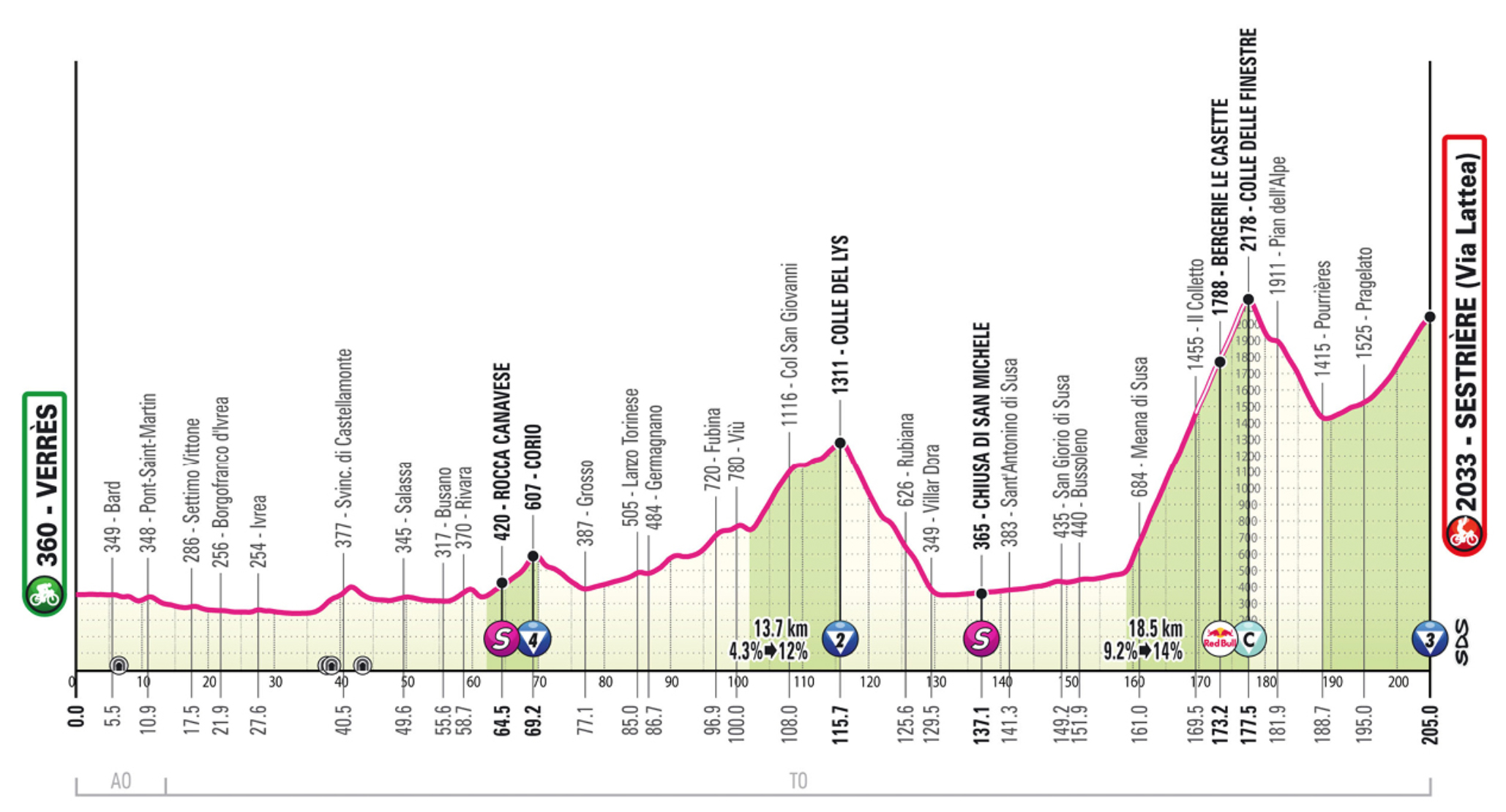
A big break went early and kept swelling as more riders jumped across and among the last to make it was Wout van Aert. It was ok to let him in the move, but UAE and EF made the mistake of letting the break take almost ten minutes which meant Van Aert might be able to get up and over the Finestre and to relay Simon Yates on the valley road to Sestriere. If Yates was there of course.
EF launched Richard Carapaz on the early slopes of the Finestre, they had to because the squad doesn’t have climbers able to last longer into the climbs and it was a good tactic too to put Del Toro under pressure from the start rather than let UAE hypnotise everyone into a slumber.
Del Toro followed, he had to. This set up a duel, Carapaz attacking over and over but he could not shake Del Toro. Then Simon Yates quickly bridged across. He attacked the Latin American duo almost immediately, then went again and again. The fourth time was lucky, an incisive move tracking the inside line of a bend as he went away.
Yates started to open up space. This might have given him psychological boost while Carapaz had the mental burden of Del Toro on his wheel. His every attack only saw the maglia rosa winch his way back to Carapaz’s rear wheel. Crucially this is where Del Toro stayed, he was marking Carapaz rather than chasing Yates who was now taking plenty of time, and climbing the Finestre in record time.
Yates was virtual maglia rosa over the top of the Finestre and soon found Wout van Aert ahead. This was precious help but by now the gap was made and Del Toro and Carapaz were stuck with each other. They conceded the race to Yates, at times sitting more upright on the descent than during the climb, arms straight rather than elbows bent.

It should also be mentioned that Chris Harper took the stage, one of those days when the stage winner gets forgotten because of all the action behind.
Why the highlight?
No point trying to explore too much subtlety, watching Carapaz attack Del Toro on the early slopes of the Finestre was great. We often use the word “attack” when we really mean acceleration but Carapaz’s moves were all aggression and his flurry of attacks was dramatic to watch.
Was it good tactics? This only made it better, you could admire the audacity of Carapaz and the poker play of Del Toro while able to see the story could go either way.
Seeing the pair away and the race reduced to a duel was dramatic, then the giant plot twist as Simon Yates bridged across and then took on the pair. Watching on Italian TV there were time checks and mentions of Van Aert but Eurosport apparently didn’t report likewise which probably heightened the drama for many when the Belgian appeared on screen having crested the Finestre in time to wait for Yates.
Also it was all good sport. Carapaz and Del Toro did raise the white flag on the road to Sestriere but nobody lost because of a crash or a puncture.
With hindsight
The best overall contest for GC in a grand tour this year? It wasn’t a vintage year but thanks to this stage which saw the overall classification overturned on the last go the Giro probably wins because the order was upturned but the Tour merits a second look for the sheer number of attacks and the revelation that Pogačar had a sore knee in the Alps might have Visma kicking themselves; but absent a diagnosis the assumption is that Pogačar was always on course to win.

Del Toro went into the Giro as a promising rider and came out as a grand tour contender. His rise partly explains Ayuso’s exit to Lidl-Trek; to renew Del Toro’s contract in the wake of the Giro came at a cost for UAE, releasing Ayuso meant a saving. The Mexican went onto to have a superb follow-up, the Tour of Austria in July, Burgos in August, top-10s in the Worlds road race and TT, a slew of Italian autumnal classics and then the Mexican championships for dessert. But is he a grand tour contender? This feels a bit picky but it’s something to look forward to in 2026 because his only real weakness in the season was in the high mountains after repeated, long climbs. Is this his frontier or just an area to improve on? All the incentives in the sport learn towards working on this so expect more.
Yates’ win at the age of 32 shows patience works too, poetry too as he won on the Finestre where he’d been sacked in 2018. Visma-LAB won and in part thanks to their collective strength and budget, having Van Aert up the road is a luxury other teams don’t get. But the Giro almost went to EF and shows that other teams can get a look-in.
Del Toro and Yates enjoyed results after the Giro but it was notable how others struggled. Roglič first among them. Antonio Tiberi and David Gaudu were both ill but pressed on with the Giro and this was probably a mistake.

A sum up is a sum up but leaving totally out of the picture San Valentino actually shapes a different narrative, because Del Toro lost 1’36” to Carapaz on that single day. Not exactly small change. S. Yates also lost 42″ and really only Pellizzari and Gee were within 30″ to Carapaz.
Plus, the fact that Bormio or Castelnovo ended up with one of the final two podium contenders winning each but, as said above, with a reduced time gap, doesn’t actually mean that they weren’t moving on the big climbs away from the line – it’s different if things come together, esp. as it happens thanks to intense team action by GC teams or, well, a supreme Pedersen, versus nothing happening at all barring bare breakaways.
Trading attacks among equals isn’t the same as a waiting game.
I wonder if the commenters who share the sensation of too much waiting really had been watching those stages for the last 3 hours or so, or if they had chosen the typical “last 60-90 minutes” format.
Or… if they had been watching the 2022 Giro, a true waiting game barring Blockhaus, Torino (and Marmolada).
Here’s the chart of the GC contenders.
I’d like to see more movement, lines that rise and fall and especially overlap. Carapaz looked to be closing in come the Alps but with hindsight would he have wanted to attack more, for example on the Aosta valley stage to move more on the Col de Joux? Although there was a headwind etc.
Well, if you look yellow and pink lines… 😉
And stage 16 was indeed dramatic, but the shape of the graphic doesn’t help to notice it at first sight, yet if you watch without hindsight it can mean much more.
At st. 9-10 you can notice they were also a good shake-up for those finally involved in top GC fight.
However, my general point is on a different level and it is precisely what you can’t see in the graph *by design*: you can have a stage with lots of moves which ends up with minor time gaps among the best – in the graph it’s exactly the same as if it was just flamme rouge skirmishes or even small natural gaps in a reduced bunch sprint… yet, for spectators the difference is huge!
And I also think that the above (slightly) underestimates the importance of WVA, esp. though not excl. in “indirect” tactical terms (as in chasers knowing they now had it lost, or not, i.e. Carapaz being aware of the situation unlike Del Toro, with resulting conflicting expectations), something which was debated here back then (I think).
I cut one part as it was getting long but saying it was almost a textbook example of a “relay move” where teams send a rider forward to help later, but only almost because Van Aert is not an ordinary rider so the case is different with him involved, able to keep within 10 minutes on the Finestre and then to pull after for a long time.
With hindsight UAE should not have left his move take 10 minutes, that was probably the root of the upset and an angle to explore as it’s probably the team’s weakness. So strong thanks to their budget and roster such that being a DS on the team looks easy 99% of the time but because of this prone to ambushes.
My recall is the gap went out to 10 minutes because there was crash in the peloton on the descent that leads to the climb up Finestre. The riders leading the chase in the peloton missed a corner. The peloton lost several minutes while they re-grouped and checked everyone was OK. If it had not been for this the gap would not have been 10 minutes.
They had over 5 minutes with 150km to go, 8 minutes with 135km to go. EF did miss a corner together but don’t think this changed things much, the gap was long at 8-10 minutes as the Finestre approached.
I guess we read it differently since my reading was that the chase had started and the time gap was coming down. And then the chase stopped after the crash. But that is fine; it is what makes life interesting.
Possibly typo in the paragraph talking about Del Toro’s season.
“to renew Del Toro’s contract in the wake of the Giro came at a cost for UAE, releasing Del Toro meant a saving.”
Should this be, “releasing Ayuso meant a saving”?
Don’t know if I can rationalise it but my reaction when watching it at the time was that this stage was a fizzer/anti-climax.
It exploded at the bottom of the climb and then just evaporated as Caraoaz and Del Toro carried on as if they were the only two riders in the race. Neither were prepared to lose the right way and both lost the wrong way.
Yes, for me it was like the 2019 TdF : a great build-up, and then nothing. The most frustrating race day of the year. The fact that a 22 years old rider doesn’t fight for victory doesn’t stop to puzzle me. In France, we say it ended “en queue de poisson”.
Wow, defining “nothing” a flurry of violent attacks by Carapaz, a serious prolonged middle-range move after his own attack by Yates, a strategic team move to seal it up, all while the 4th placed in final GC entered the mix on his part, too… well, to me it’s a nothing with a lot of things within. Maybe you can say that the things was actually over when the chasers were some 4 kms to the top of Finestre, but, hey, that was after some full 14 kms (~45′) of red hot racing followed and preceded by other events, even more so as Del Toro wasn’t fully aware of the situation which added more drama through misunderstanding.
Admittedly, the very last climb was more for those cinephiles who love hard, grey, cold, bitter movies with big losers (happy winners always look the same, sour losers are a spectacle as each loses it all their own way) rather than an action film full of further fireworks – yet, to me the whole was a great show, probably even more so in retrospect.
Ha ha. Nice Tolstoy paraphrase
The pink jersey wearer, after the top of the Finestre, poorly represented the pink jersey, especially considering how he got into the jersey.
There was a huge tactical blunder by UAE.
In the moment I was embarrassed for Del Toro, but he’s shown in other races that this was likely a one-off mistake.
A lot of people criticised Del Toro at the time, but he clearly thought he didn’t have the legs to win. I’d rather have seen him work with Carapaz to try to bring back Yates, but the worst tactics were displayed by Carapaz. He fixated on Del Toro and the fact that he was following him, whereas he should have stayed with Yates, no matter what. Carapaz once won the Giro probably due to Nibali focusing on arguing with Roglic, who was in pink, about who should chase; Carapaz then made the same mistake in this race. He looked better than Yates throughout the race and might well have beaten him had he focused on Yates once Yates was clearly in a race-winning position (Carapaz should have gone with Yates as soon as he went, but once Yates had even a small gap, this was obvious). Carapaz evidently also under-rated Yates (which seemed fair enough at the time) given his massive early attack (and who knows how much this cost him). Apparently, Carapaz has a reputation for falling out with people. His team must still be despondent that he (very possibly) threw this away.
This is not to excuse Del Toro, who should have tried to win – who cares whether you come 2nd or 3rd (and he’d already shown that he was a big prospect).
Completely disagree with this analysis.
Go and rewatch from the point that Yates first passes Carapaz and Del Toro. Many times Carapaz almost closes the gap to Yates and Del Toro is clearly strong enough to close the last few seconds, but consistently chooses not to because he thinks he’s playing 4D chess.
Lost all respect for Del Toro and his potential as a GC rider after this stage.
I quite tend to agree with you. And would ask @J Evan how Carapaz might have won just focussing on Yates and possibly bringing Del Toro closer or on the front while enjoying a free ride. Del Toro would have won pink in that case. Carapaz threw at the Mexican all he had and could not shake him anyway, at least – as we all saw – not while the latter did no extra effort himself to try and get to Yates.
How would Del Toro be getting a ‘free ride’ going up a steep hill behind Carapaz? At best, he’d get a slight aero advantage by following a wheel.
If Carapaz rides to stay with Yates, eventually Del Toro will probably be dropped. (If not, Del Toro wins.) If Carapaz can then stay with Yates, Carpaz wins the race. (If not, Yates wins.)
If Carapaz does not stay with Yates, Carapaz definitely loses the race.
Carapaz let his psychology get the better of him, because – like others – he believes that if someone is on his wheel, they are getting a ‘free ride’. (And if he does believe that, he should have sat on Yates’ wheel in the first place – and let Del Toro try to hang.)
I’m not backing Del Toro’s tactics in any way – they were terrible. I just also think that Carapaz’s were terrible. And I suspect that it was Carapaz who threw the race away because he’d shown previously in the race that he was the best uphill.
* hang on
Carapaz understood (probably correctly, but indeed we’ll never know, which is the “unknown-[un]known” option he threw away) that he wasn’t going to drop Del Toro unless the latter made some extra effort which couldn’t be forced while the Mexican just focussed on keeping Carapaz’wheel, so he decided to let more tactical scenarios open up, hoping that Del Toro would accept to raise his risk to lose to Carapaz in exchange for the security of losing to Yates. Which probably didn’t work mainly as DT was not aware it was game over to Yates with those gaps. If you can find the original thread on the day (after), I think I posted there (not 100% sure) an analysis with reasonable/acceptable time gaps, point of the race, and athletes’ reaction.
On a climb of that length, Del Toro might well have fallen behind Carapaz and Yates (if Carapaz was riding properly). He had on other days.
Once it was clear that Del Toro was not going to do anything – and it was clear very early – Carapaz should have accepted his reality.
https://inrng.com/2025/06/giro-review-2025/
(Well worth reviewing…)
Gabriele, you mean surety rather than security. Security comes with positive connotations. Surety is neutral.
“the surety of losing to Yates.”
Spicelab’s analysis agrees with my memory. There was a point where Yates had clearly put distance on Carapaz and Del Toro, where Carapaz decides to start chasing Yates. Carapaz put in a number of efforts to try claw Yates back, but each time Del Toro either just stayed on Richard’s wheel and didn’t come around to help, or if Del Toro did come around he didn’t put in an effort.
And then Carapaz changed tactics – still on the climb – and stopped putting in big efforts to try regain Yates, and sought to make Del Toro face the consequences to his pink jersey of letting Yates go. And Del Toro decided not to fight for his jersey.
On the descent, Del Toro and Carapaz completely capitulated.
We shall see in the future whether Del Toro’s capitulation has added a psychological block on his future efforts; or whether it fires him up to never repeat that mistake again.
Yep. Carapaz was risking blowing up to get back to Yates, so he decided that he had to force Del Toro to share the risk or lose the jersey.
Derek Gee showing up partway up Finestre, and then pulling, added to the complexity of the tactics. Did Yates attack when Gee was on the front? I do remember Gee riding on the front while the other two looked at each other.
What a day! Tactics, teamwork, determination, and avenging old battles. I have been watching cycling since the Yates brothers joined Orca and it was good to see Simon get his Giro as well.
A killer move, you might say, as he and Visma whaled on their opponents.
It was the best moment of the year for me. Part of it was the uncertainty about Van Aert’s location. At least in my country the commentators were not sure if he was still out front, or if he was dropped. There was no footage of him on the climb or after, and he was not waiting at the top.
I had such a spontaneous moment of laughter when I then saw him a couple of K’s down the descent. A moment that will live forever!
I agree fantastic! made all the sweeter by the memories of the collapse from leading all those years ago – that story memory really framed the day
Even Carlton Kirby knew WVA was up ahead (albeit probably only because Brian Smith told him).
He was ahead but where and would he get over the climb to be of use? There was a bit of suspense in the moment and even if RAI had a moto up ahead it was covering the break and Harper with the other on the GC battle and Van Aert was in between.
If UAE had kept the break at, say, 7 minutes then Van Aert would have only been a waiter able to pass up a drink to Simon Yates as he came by, instead he was a waiting chauffeur on the descent.
Or van Aert would have ridden harder in order to get over the climb in front? Who knows. He’s a good climber.
I don’t remember what I knew when, but there was no suspense for me – I knew he was far ahead.
Best day of the year for me and it’s not close. An absolute disaster for UAE from start to finish, completely forgot that tactics are important in a race! By the time they reached the Finestre, they had already lost the initiative to WvA, then they all melted down under EF’s pressure. Del Toro still had a chance to win, but hitched his hopes to Carapaz’s back wheel and never let go, which proved to be a fatal mistake.
I can’t blame Carapaz, he tried to shake Del Toro but couldn’t, so he had to call Del Toro’s bluff or tow him to the Maglia Rosa.
Finally, there will always be the question of whether Yates was simply the strongest and would have won without the craziness behind. He was always going to pick up time once he met up with Wout, so the race might have been won 100+ km from the finish when Wout got away!
@TheOtherCraig – i do agree with you there, it was a fantastic day for me. Tactics tactics tactics.
Diff’rent strokes and all that jazz -and I certainly enjoyed muchly the race on the climb of the Finestre for many, maybe all, of the variety of reasons mentioned in the OP and the comments – but, on a more general point, can a race be the best when one of the major players is adjudged to have had an absolute disaster? Schadenfreude of the Year, maybe, but the best at or as close as possible to their best and may the best win should be hard to best, I think.
I get the point, but there are many reasons that I loved that day. First, I don’t like UAE, so there’s that (although I do like Del Toro). Second, even though it was a disaster, the drama still lasted a long time before we really knew the outcome. It’s not like there was a crash or puncture or anything. Finally, watching Yates finish the job with WvA was a joy to watch, at least for me. Just a super satisfying day overall.
Watching Carapaz attack Del Toro before being joined by Yates, I had the impression the gap could maybe have been maintained if his attacks had been slightly less violent. As it was the effort was just too extreme to last.
He was trying to snap the elastic, but just couldn’t do it. I think you’re right that a long, sustained effort probably would have been more effective. Yates used his exhaustion to perfection.
My first impression on watching the race live, and I haven’t watched it since, was how bizarre it was that Del Toro didn’t try to win. The Finestre started off very exciting with the massive ramp in pace from EF and then a flurry of attacks from Carapaz. He maybe thought that would be enough to see off Del Toro and once it didn’t he was out of ideas. But you’d think following Yates would have seemed like a reasonable idea. I agree with the comment above, there were several times early in Yates move where it seemed all Del Toro had to do was press on a pedal and he would have gone across, he just chose not to. Maybe Del Toro is one of those riders who can be absolutely empty and not show it, and he was just clinging on. But that’s not how it seemed watching it. All in all, probably one of the strangest bike races I have ever watched.
Why – and how – do so many people believe that if Del Toro is on Carapaz’s wheel, he is being ‘towed to the line’?
Yates attacked 13km from the summit of the Finestre, which has an average of 9.2%.
The advantage of being on someone’s wheel at 9% is minimal.
Better answer later on if I can, but for now…
Not that minimal at over 18 km/h (their avg.), even less so when pushing hard, i.e., at even higher speeds.
But there are other psycho-fisiological factors at play (how much margin are you leaving to yourself not knowing how much does your closer rival has etc.)
Then Carapaz should have got himself to Yates’ wheel – ignoring the fact that Del Toro wouldn’t help – and then sat on it. Then see if Del Toro can hang on, and attack him later – having ‘rested’ – if he does hang on.
Ergo, Carapaz’s tactics were as bad as Del Toro’s.
Carapaz lost this race because of his psychology – fixating on Del Toro – not because Yates was physically better.
“not because Yates was physically better”
Could be that, on the day, he was! And in any case, unless Carapaz could drop Del Toro, and he’d tried repeatedly, (and he had to gain >43″ on him), he was only racing for 2nd place.
Yes, I was definitely missing a ‘probably/possibly’ there. Yates may have been better on the day.
If Carapaz had ridden with Yates at a decent pace, I think there’s every chance that they would have dropped Del Toro, and a good possibility that Yates would not have dropped Carapaz. We’ll never know because Carapaz was tactically poor and focused on one rider only.
Del Toro in a Mexican stand off with Carapaz … The Giro once again delivered the best GT of the year (and I’m not Italian)
Definitely.
This and MSR were the year’s highlights for me. Not knowing the result really helps.
The tdf had good individual stages.
I have been following S Yates since his first year with Orica and was, like several others here, delighted to see him win.
Beyond that Del Toro may well win the Giro in the future though, if he doesn’t, he will always rue 2025 when he could surely have done so with better guidance. He’s young and inexperienced and needed some wisdom from the old hands in the team car. Where was that wisdom?
Almeida was talking about something similar the other day, he regrets losing the 2020 Giro because while he was a novice he felt like he had the legs to win but made some mistakes he would not make today and he’s not sure about being able to win it again now. He was nuanced about it, the tone wasn’t “I would of course have won” etc.
I think Jai Hindley was the guy who could have won that race, had he not been held back from attacking TGH on stage 20 and building up the lead he would inevitably need for the final time trial. The team were seemingly trying to hedge their bets and hoping that Kelderman wouldn’t lose too much time to TGH, so they didn’t want Hindley to attack. By backing nobody – Kelderman was in the lead, so they could have held back Hindley to help him – they won nothing. (More terrible tactics that were obvious as you watched. Clearly, Hindley was the card to play, and it was equally clear that he would need time on TGH in the ITT.)
The worst thing – amongst a lot – about Del Toro’s tactics was that he was able to follow Carapaz’s every attack, but then refused to do any work.
However, whereas I think he might well be back to win it another time, I’m not convinced Carapaz will be.
I’d agree on this!
@J Evan
I think that the theory “Carapaz stays with Yates and they drop Del Toro with their steady pace”, although apparently possible, doesn’t hold as a probable “alternative reality”, not probable at all I’d even say. Yates wasn’t going to help Carapaz, why should he?, so in case he didn’t break free, he’d stop working. Then try again another attack. Would Del Toro close that? And, of course, while when you (Carapaz) are attacking, you’re choosing the moment to maximise your options of not being dropped thereafter, plus picking the best configuration for *your* objective, i.e. dropping Del Toro, while Yates would attack every time in the worst moment for their rivals, including Carapaz, and I’d even dare to say that not only Yates’ objective towards pink was dropping *both* rivals (apparent paradox yet actually quite obvious: easier if the two are together), but I’d also go as far as to say that probably Yates would prefer – had he to choose between two theoretical scenarios – staying with Del Toro instead of Carapaz (the first part of my reasoning is factual, this second part more conjectural and probabilistic).
All that dynamics would just make Carapaz run out of time and road.
All in all, even if the Carapaz’ fairy tale ending of riding together with Yates to 1st and 2nd place respectively, it was not going to happen this time, according to what we saw on the road. Visma don’t look as useless as UAE when tactics are concerned.
I’d also suggest to consider how Del Toro himself explained the situation (reported in the original thread).
Plus, we shouldn’t think that Carapaz could achieve whatever he’d like… I believe that once Yates was gone in the last part of the climb, Richard hadn’t it easy, if possible at all, to claw back the necessary time with no collaboration. The stop & go process is watts-wasting, once the gap is there it might be impossible to close it at will.
In that sense, I again suggest a look at the old thread which gathers much information.
As I said in my original comment, ‘he should have stayed with Yates, no matter what’. And that includes the moment when Yates attacked.
Maybe Yates was just stronger, maybe Carapaz had knackered himself with his early attacks (also a tactical error), or maybe Carapaz would have won if he’d stayed with Yates (or maybe not). All maybes, but Carapaz’s tactics were poor, and while everyone rightly criticises Del Toro’s tactics, Carapaz is given a pass by most.
If he stayed with Yates «no matter what», he’d have had less probabilities to win pink than with the path he chose. Obviously having more probabilities doesn’t mean winning. But I’ve explained already it above, most of it was precisely about covering Yates’ move(s) while only the last part of my text referred to closing the gap later. Defending tight on somebody which isn’t your main rival is normally suicide in cycling, for the reasons expressed above, among others. Anyway, what makes this stage so good is also the range of conjectures, perspectives, ideas etc.
I certainly agree with your last sentence.
I absolutely loved this stage, definitely one of the highlights of the year for me.